
BO-GLASS / MATERIALS & CUSTOM COMPONENTS
Borosilicate Glass: Properties and Molten-Formed Components
Compare borosilicate glass grades, thermal and optical properties, and forming routes for custom lenses, covers and other components made directly from molten glass.
Your drawings remain confidential.
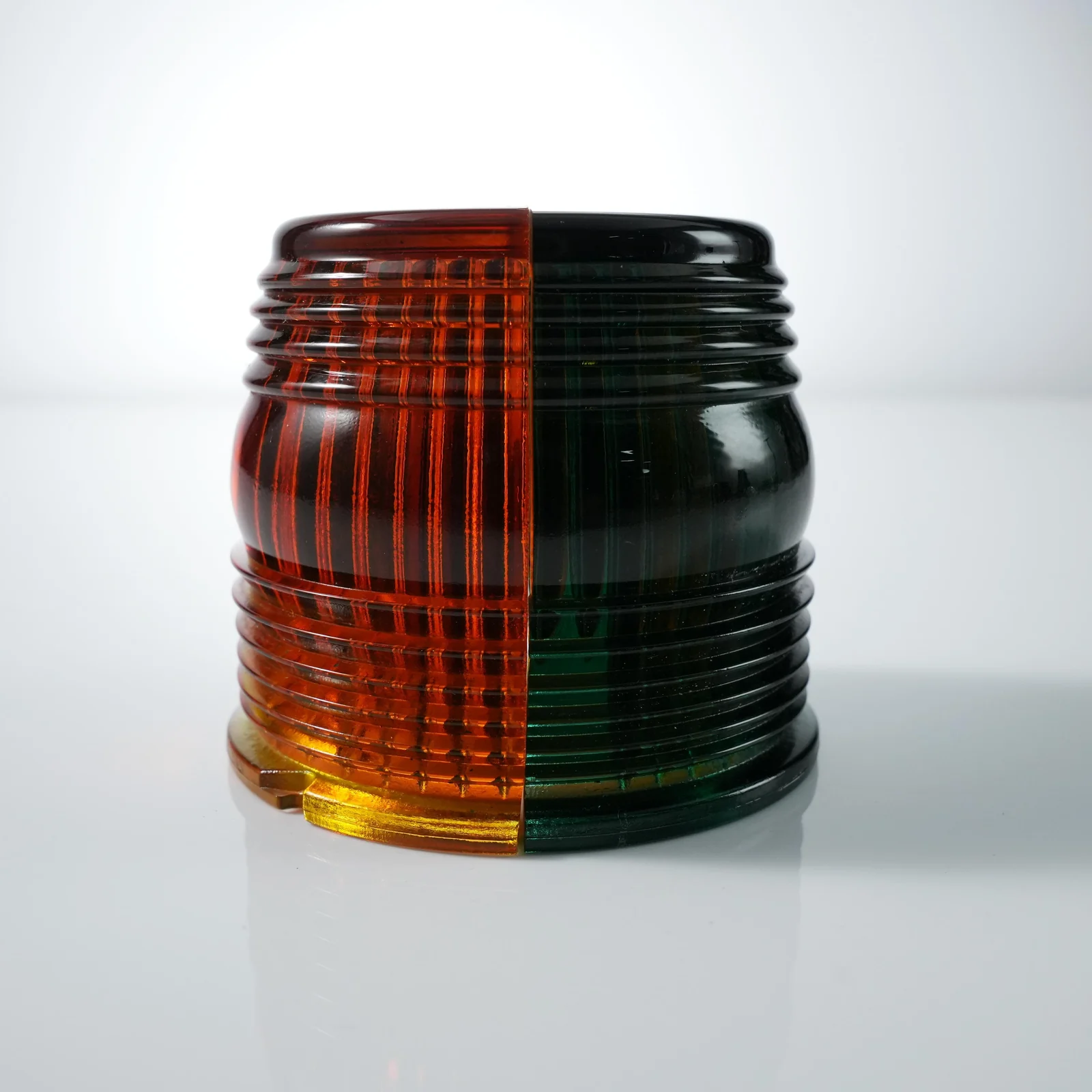
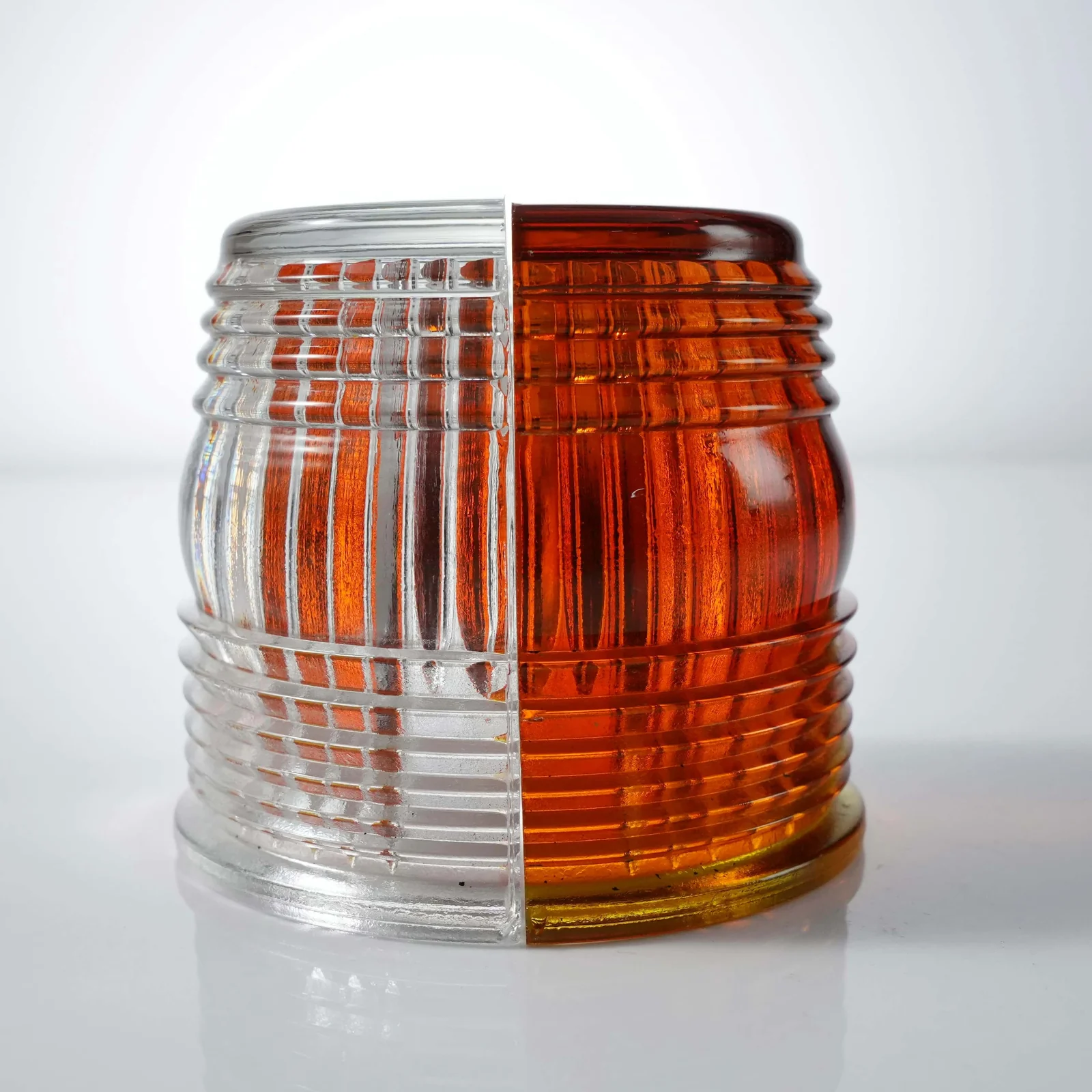
- Drawing or sample
- Mark dimensions, mating features and critical areas
- Operating conditions
- Share temperatures, loads and chemical exposure
- Finish and order details
- Specify inspection criteria and order quantity

Swipe to view brands ↔
01 / Material fundamentals
What Is Borosilicate Glass?
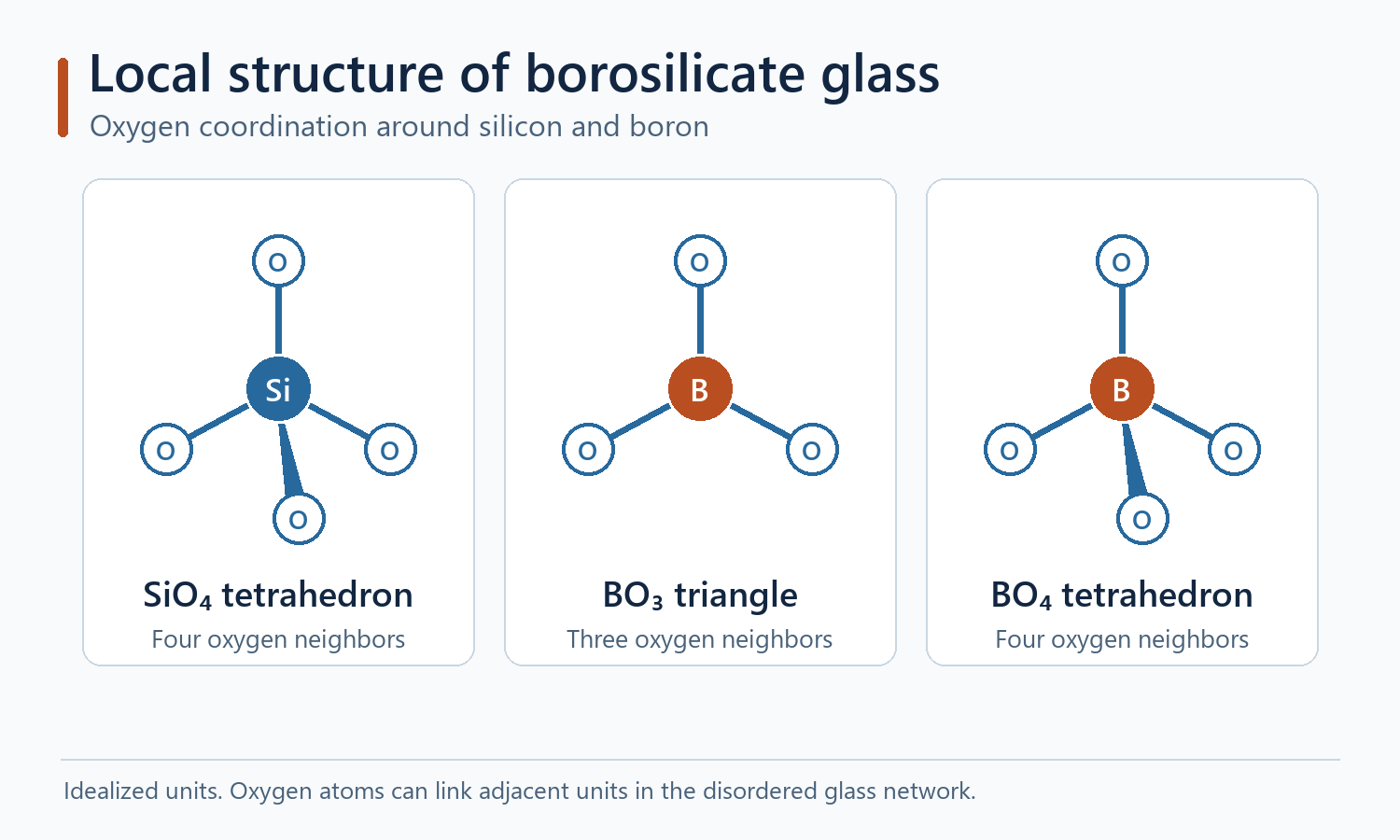
Borosilicate glass is a family of glasses whose network is built primarily from silica (SiO2) and boron oxide (B2O3). The solid glass has no repeating crystal lattice. Its local structure includes linked silica tetrahedra and boron bonded to three or four oxygen atoms.
- Silica and boron oxide form the main network. Their proportions and the way the units connect affect thermal expansion and the viscosity of the melt.
- Alumina (Al2O3) and modifiers such as sodium and potassium oxides help tune the balance of melt flow, expansion and chemical durability.
- Low-expansion grades such as borosilicate 3.3 combine a silica-rich network with relatively low modifier content. Formulations with different oxide proportions can have different expansion and working characteristics.
For one named 3.3 example, SCHOTT Pharma reports approximately 81% SiO2, 13% B2O3, 2% Al2O3 and 4% combined Na2O and K2O by mass for BORO-8330™. See the SCHOTT Pharma composition examples and the Composition and Material Grades guide.
| Glass Grade | Nominal CTE | Relative Boron Content |
|---|---|---|
| Borosilicate 3.3 | 3.3 × 10⁻⁶ K−1 | High |
| Borosilicate 5.0 | 5.0 × 10⁻⁶ K−1 | Medium |
| Borosilicate 7.0 | 7.0 × 10⁻⁶ K−1 | Low |
The nominal mean linear thermal expansion (CTE) and relative boron labels refer to the pharmaceutical-glass classes in SCHOTT Pharma’s Table 1. Its reported example CTE ranges are 4.9–5.5 and 6.3–7.5 × 10⁻⁶ K−1 for the 5.0 and 7.0 classes, respectively. Confirm the available grade and specification in the BO-GLASS quotation.
Material grade and forming route. On this page, molten-formed describes a component shaped directly from molten glass. Specify the required borosilicate grade or property range separately from how the component is made.
02 / Reference properties
Key Properties of Borosilicate Glass
Use thermal expansion to assess dimensional change, refractive index to model how light bends, and Young’s modulus to estimate elastic deformation. SCHOTT publishes the following approximate data for its DURAN® 3.3 tubing glass to ISO 3585.
| Property | Reference Value | Condition or Method |
|---|---|---|
| Mean linear thermal expansion | 3.3 × 10⁻⁶ K−1 | 20–300 °C, ISO 7991 |
| Density | 2.23 g/cm3 | 25 °C |
| Refractive index | 1.473 | 587.6 nm |
| Transformation temperature (Tg) | 525 °C | ISO 7884-8 |
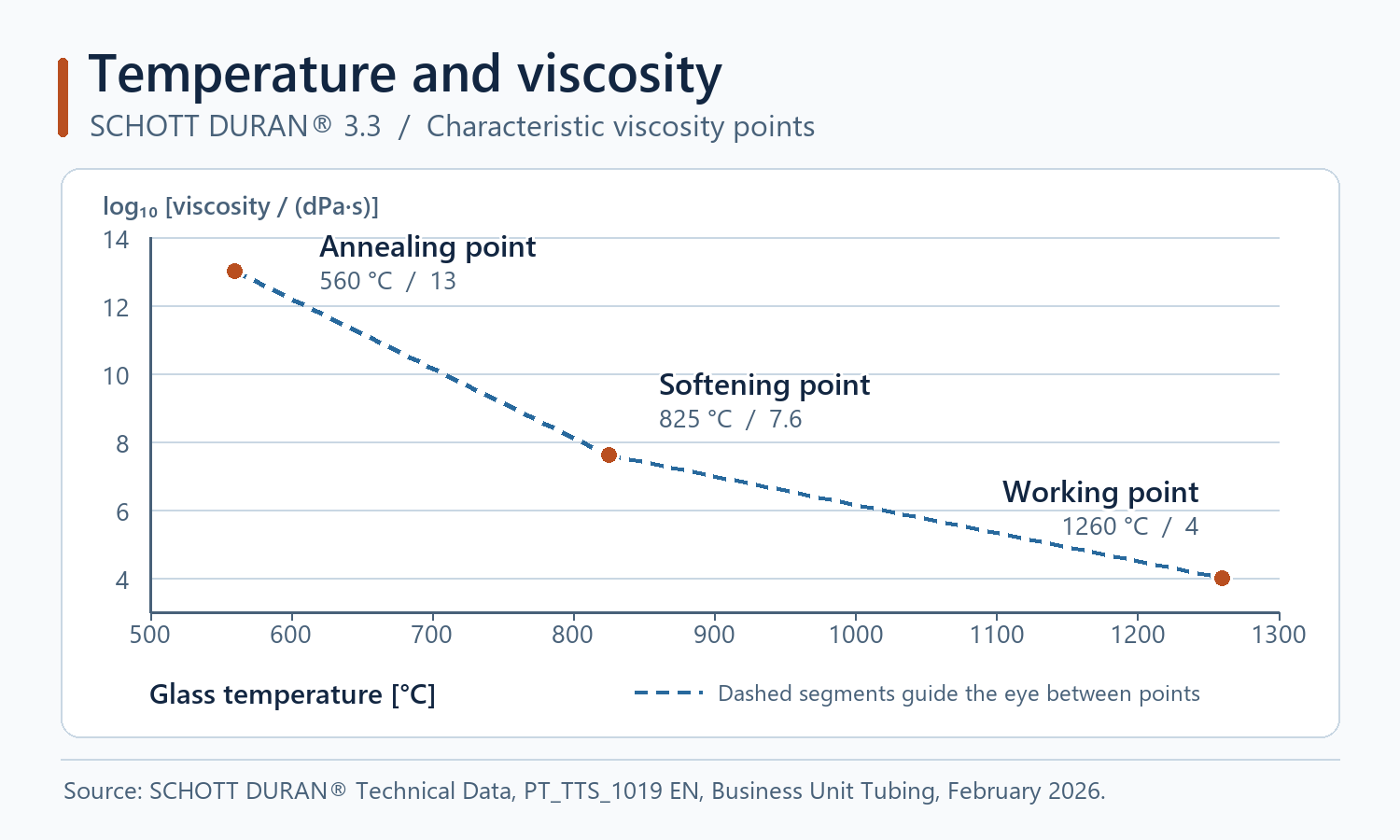
| Annealing point | 560 °C | 1013 dPa·s, ISO 7884-4 |
| Softening point | 825 °C | 107.6 dPa·s, ISO 7884-3 |
| Working point | 1260 °C | 104 dPa·s, ISO 7884-2 |
| Thermal conductivity | 1.2 W/(m·K) | 90 °C |
| Young’s modulus | 63 GPa | Approximate value |
| Hydrolytic resistance | Class HGB 1 | ISO 719 |
| Acid resistance | Class S1 | DIN 12116 |
| Alkali resistance | Class A2 | ISO 695 |
Scope of the reference data. The values apply to the named reference grade under the listed conditions. The hot-forming points describe viscosity benchmarks. Confirm the properties and traceability of the quoted glass, and qualify the finished component for its actual temperatures, loads and chemical exposure. SCHOTT DURAN® technical datasheet
03 / Melt behavior
Viscosity and Melt Forming Behavior
Viscosity is the glass melt’s resistance to flow. It falls as temperature rises and increases as the glass cools. Each composition has its own viscosity curve. In blowing, glass needs to stretch around the mold while maintaining the wall profile. In pressing, a charge of molten glass needs to fill fine ribs and thin sections before it stiffens.
Refining helps release gas bubbles, while homogenization reduces compositional variation that can appear as optical striae. Agree where bubbles, striae and inclusions matter most, especially in a lens’s active optical zone. After forming, an annealing cycle suited to the glass and section thickness helps relieve residual stress as the part cools.
Read the guides to viscosity and formability and melt defects and homogeneity.
04 / Thermal performance
Thermal Expansion and Thermal Shock Resistance
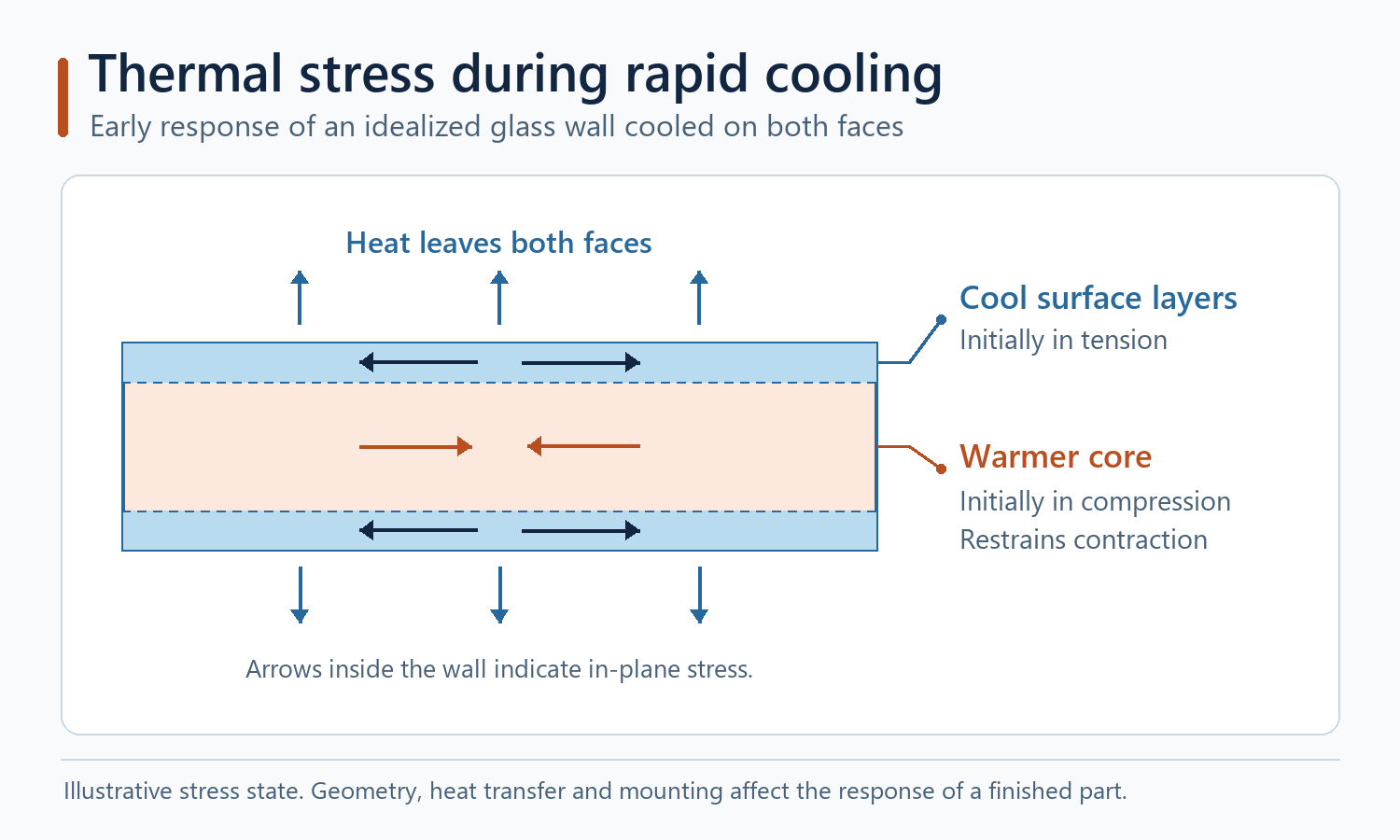
Borosilicate 3.3 expands less than typical soda-lime glass over the same temperature change. Thermal shock can occur when the surface, core or adjacent regions heat or cool at different rates. The uneven expansion or contraction creates stress. Lower thermal expansion helps reduce that stress under otherwise comparable conditions.
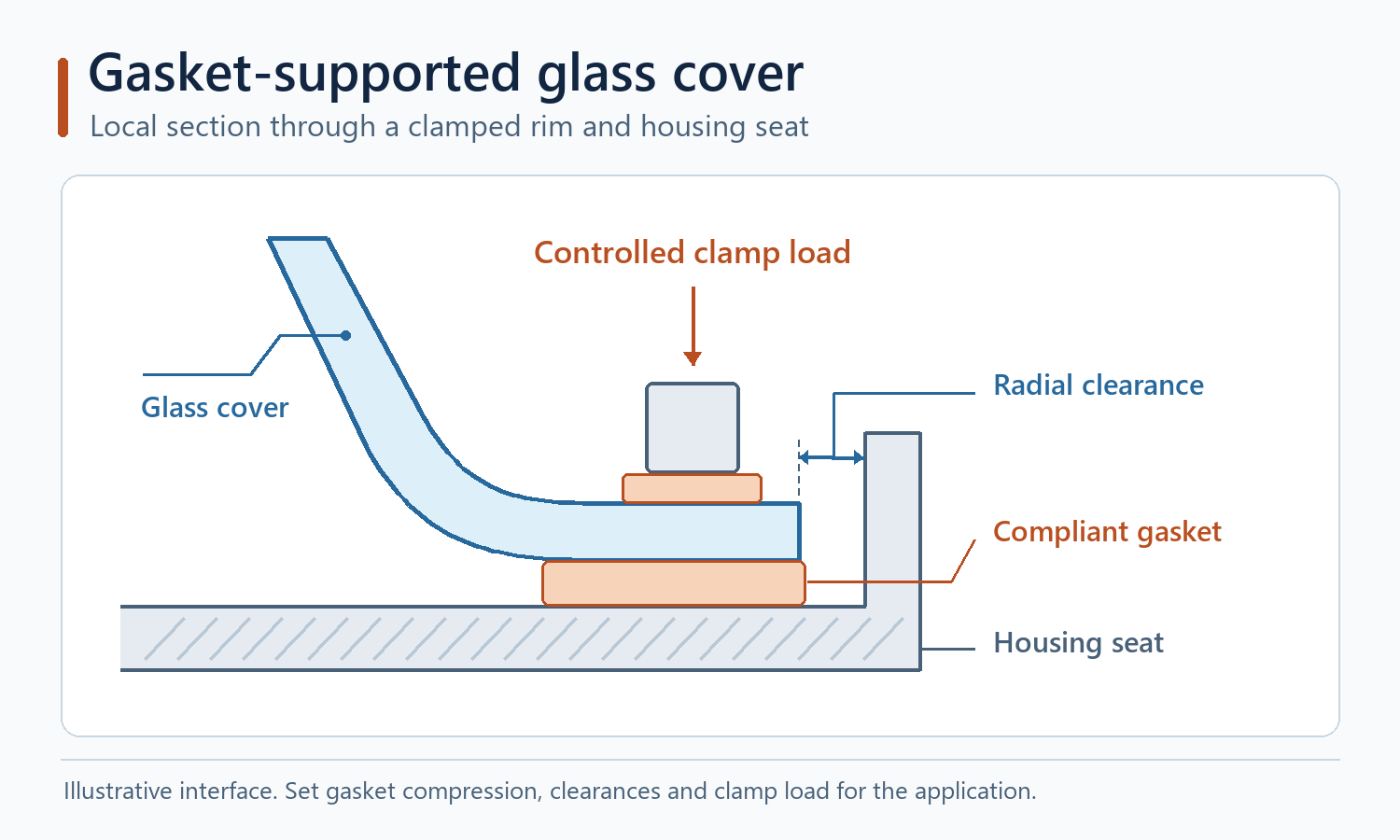
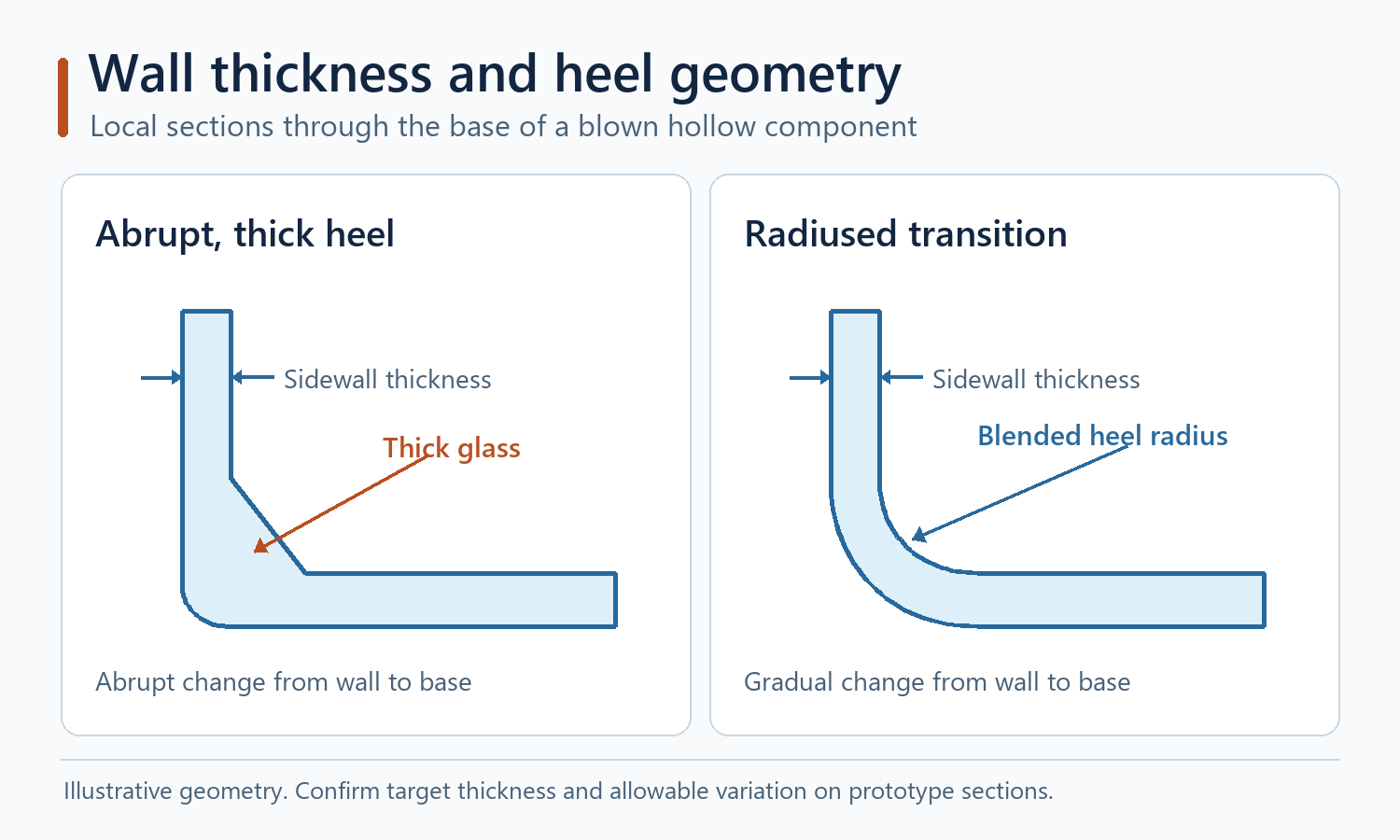
Wall thickness, abrupt transitions, mounting restraint and the location of the heat source all affect the temperature gradients and stresses in the part. For a heat-resistant glass cover, evaluate the installed assembly through the intended heating and cooling cycles, including any cold splash or rapid change in airflow.
Service temperature. The softening point is a viscosity reference. Establish the operating temperature and allowable thermal cycling on the actual material, geometry, finish and mounting arrangement.
05 / Optical performance
Optical Properties and Light Transmission
Visible-light transmission depends on the wavelength range, glass composition, optical path length and surface condition. Refractive index describes how light bends at a glass boundary and changes with wavelength. Additional thickness increases the path through the glass and can reduce transmission where the glass absorbs light. In colored borosilicate, the spectral transmission and apparent color can also vary with thickness.
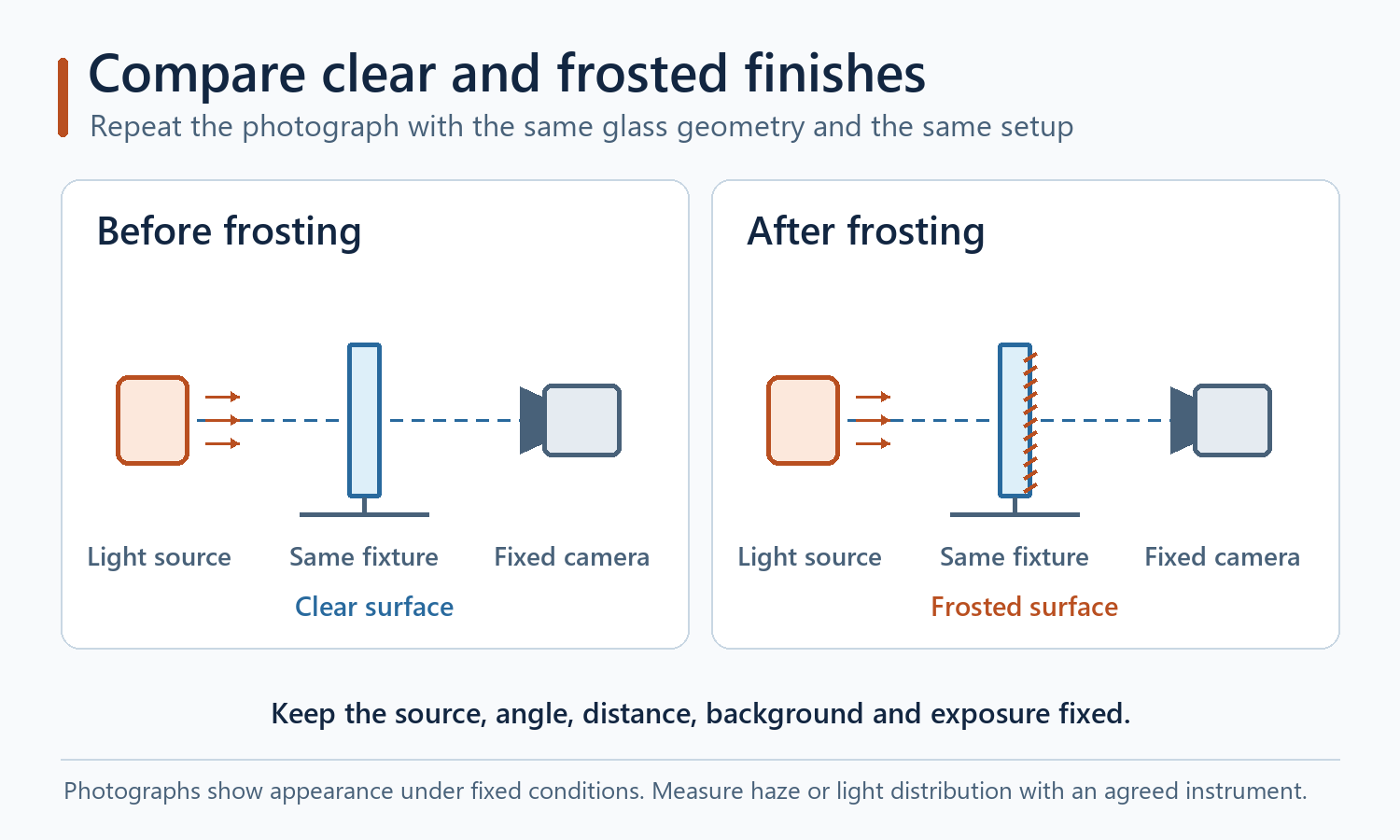
For a pressed borosilicate glass lens, molded ribs or facets steer the beam. Bubbles and striae can scatter or distort light in critical zones. A frosted surface spreads transmitted light, and a coating can change reflection, transmission or diffusion depending on its design. Specify the optical zone, wavelength range, thickness, finish and measurement geometry on the drawing or test plan.
Read the optical properties and spectral transmission guide.
06 / Strength and stress
Mechanical Strength and Residual Stress
Scratches, chips and machining damage can concentrate tensile stress at glass surfaces and edges. Wall thickness changes and mounting contact affect where loads concentrate. Uneven cooling can leave residual stresses that combine with loads in service. Control edge condition, wall transitions and the annealing cycle around the areas most likely to see tension.
Specify mechanical performance separately from thermal expansion. Young’s modulus describes stiffness, while drop, impact and load resistance depend on the part geometry, flaw population, supports and test conditions. Polariscopy helps assess residual stress under an agreed inspection method. Verify impact or static load performance on representative parts in their intended mounting configuration.
07 / Chemical and outdoor exposure
Chemical Durability and Weather Resistance
Water can exchange ions at a glass surface and gradually alter the near-surface network. Hydrolytic resistance describes how the material performs under a specified water test. Acid and alkali resistance use separate methods. Borosilicate 3.3 can resist many aqueous and acidic solutions, while hydrofluoric acid, hot phosphoric acid and alkaline media can attack the surface. The result depends on the grade, concentration, temperature and contact time.
For outdoor lighting, assess the complete glass and finish system against expected exposure. Cleaning agents, wet and dry cycles, deposits, UV exposure and temperature cycling can affect appearance or coating adhesion. Agree what to measure after exposure, such as haze, color shift or loss of adhesion.
Read the chemical durability and corrosion guide.
08 / Forming routes
Molten Glass Forming and Secondary Processing
Choose the production route from the starting form of the glass and the geometry the part needs. Specify the material grade separately to meet thermal, optical and chemical requirements.
| Production route | Starting material | Typical products |
|---|---|---|
| Molten glass pressing | Molten glass gob | Lenses, prisms and molded covers |
| Molten glass blowing | Molten glass gather | Lamp shades and hollow glass shells |
| Borosilicate lampworking | Preformed glass tubing or rod | Laboratory glassware and tubular assemblies |
| CNC glass machining | Preformed plates or flat blanks | Optical windows, sight-glass discs and other flat parts |
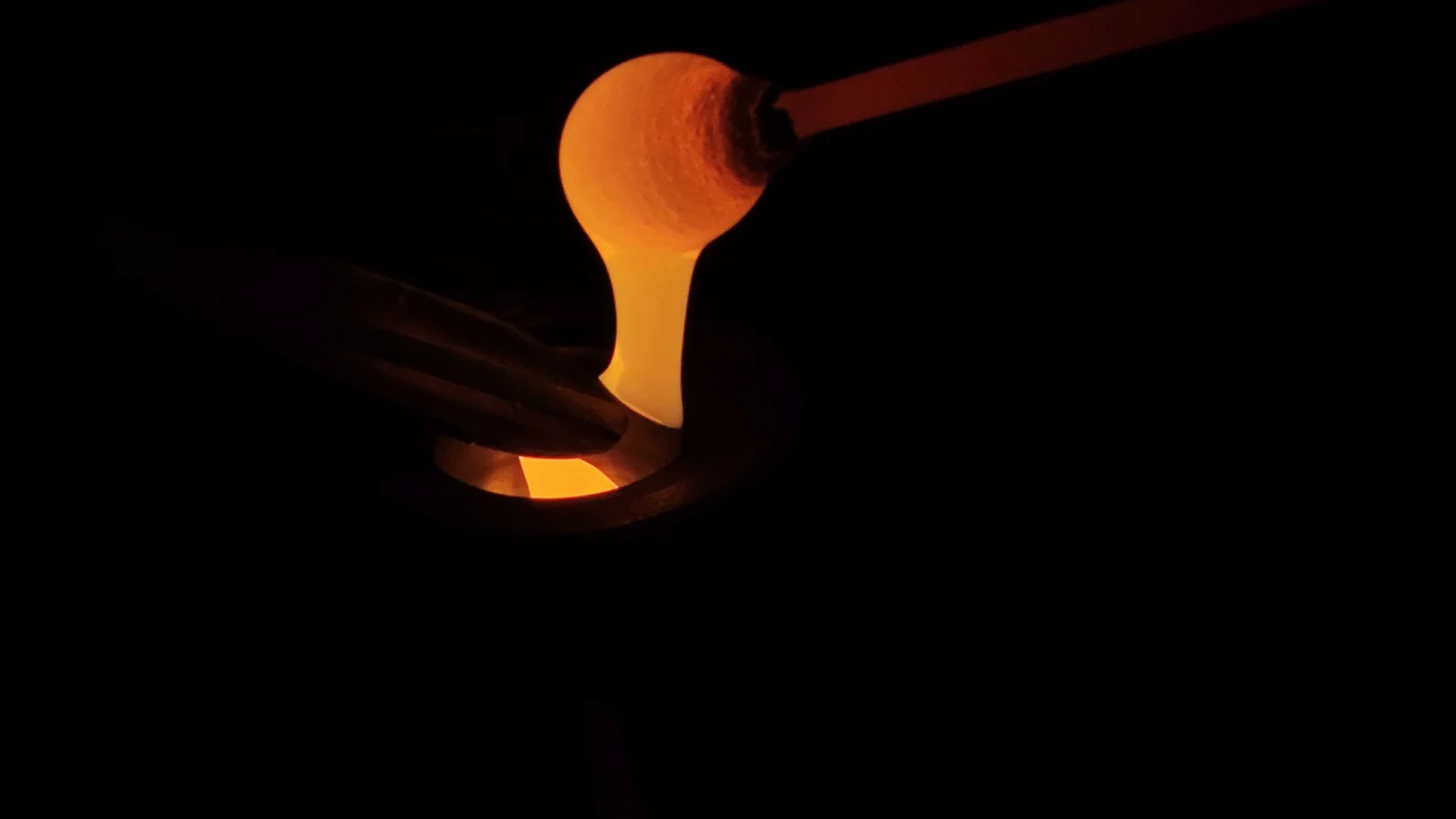
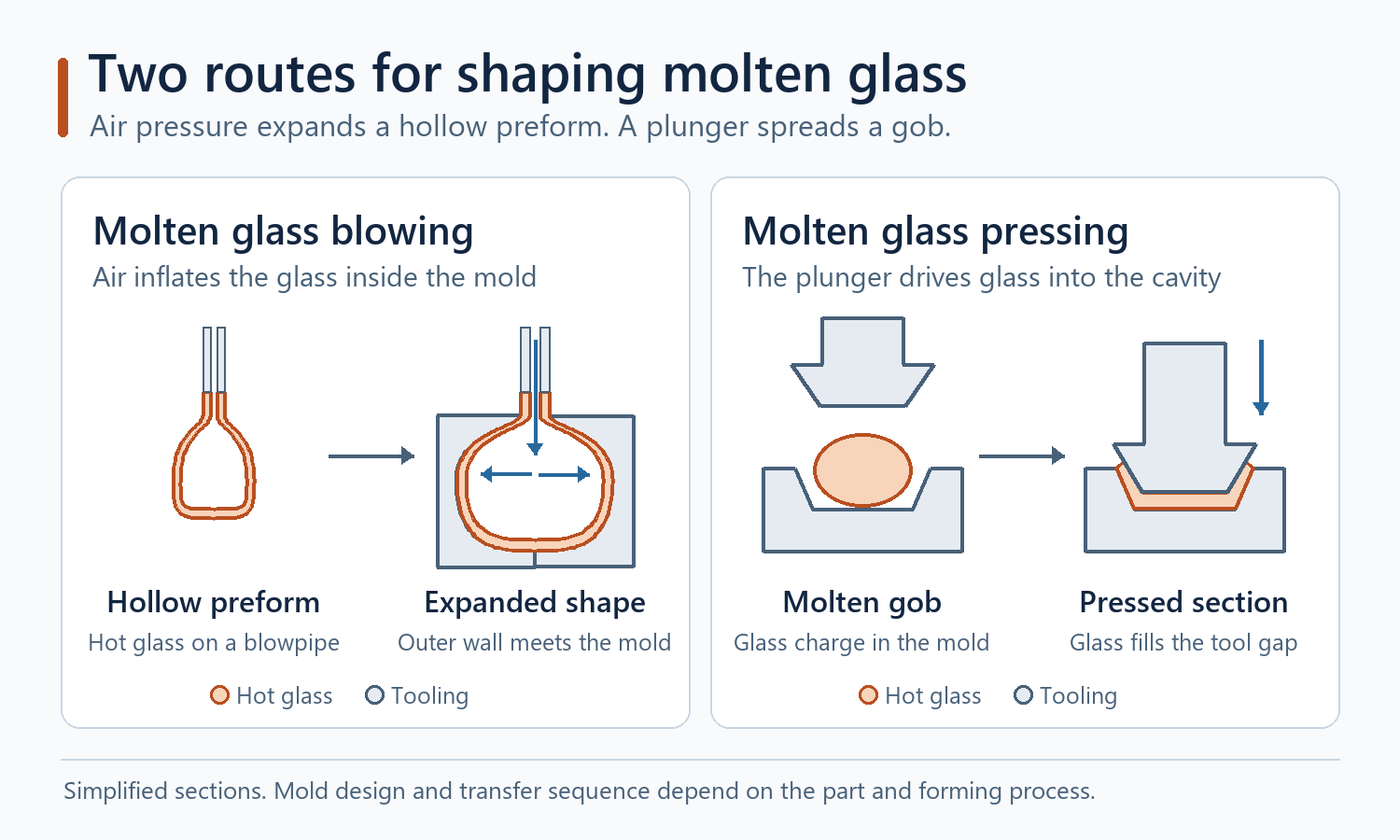
In pressing, a mold and plunger shape the gob. Review how glass fills ribs and thin sections, along with tool access, parting lines and release. In blowing, a gather expands into a hollow shape. Review the opening and how wall thickness changes around shoulders and transitions.
Secondary Processing
Annealing controls residual stress after hot forming. Plan trimming, drilling or edge grinding and polishing around datums, edge integrity and sealing surfaces. Specify frosting or coatings by finish area and the required optical or environmental performance. Confirm strength and finish requirements on the finished part after its full processing sequence.
09 / Component design
Design Guidelines for Molten-Formed Borosilicate Components
Identify the dimensions that control fit, sealing or optical performance before discussing tooling. Practical wall profiles, tolerances and edge finishes depend on the geometry, forming route and inspection method.
Wall Sections and Release
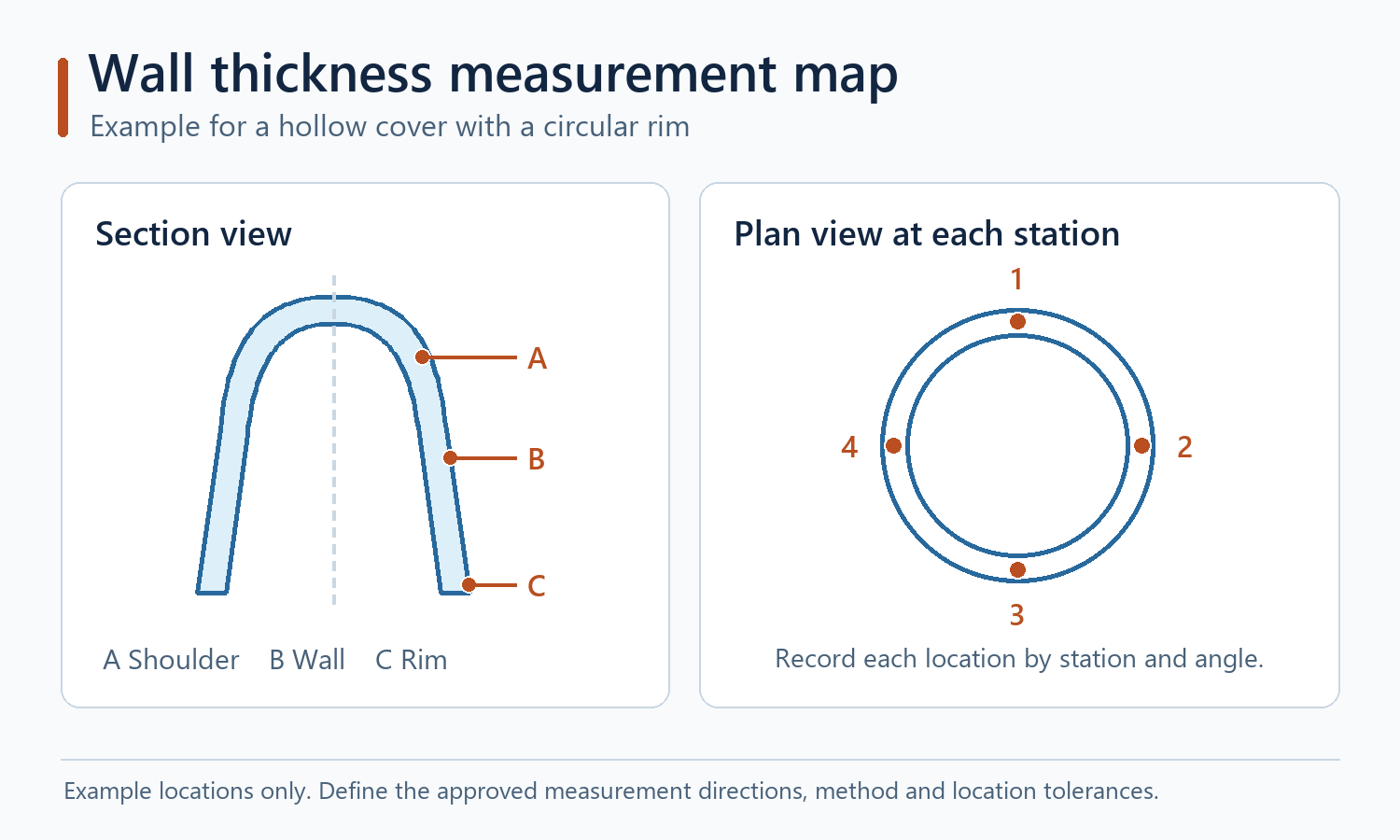
Mark minimum wall locations, substantial thickness changes, ribs, corners and openings. Review access for tooling and measurement before assigning tolerances to these features.
Mounting and Sealing
Identify datums, threads, sealing lands and mating parts. Include the actual supports, clearances and loads. Inspect local form on sealing surfaces and verify assembly with the agreed mating part or gauge.
Optical Zones and Finish
Mark the active optical surface, reference thickness, required wavelength range or viewing conditions, and areas that require polishing, frosting or coating. Use an approved sample to communicate appearance.
Service Conditions
List operating and peak temperatures, heating and cooling cycles, loads, chemicals and cleaning exposure. Include the actual mounting configuration when the test reproduces installation.
See the molten-formed component design guide for wall transitions, mold release and inspection access.
10 / Material selection
Borosilicate Glass vs. Other Glass Materials
Use these examples to narrow the material choice. Lower expansion reduces one contributor to thermal stress. Geometry, edge condition, mounting and heating or cooling rate still govern how the finished part responds to thermal shock.
| Selection factor | Soda-lime glass | Borosilicate glass 3.3 | Fused silica |
|---|---|---|---|
| Linear thermal expansion | Higher. 8.3 × 10⁻⁶/K for Pilkington float glass (75–575 °F) | Low. 3.3 × 10⁻⁶/K for DURAN® (20–300 °C) | Very low. 0.52 × 10⁻⁶/K for Corning HPFS® (5–35 °C) |
| Thermal shock considerations | Higher expansion increases sensitivity to temperature gradients | Lower expansion favors designs that see repeated temperature changes | Very low expansion favors demanding thermal cycling |
| Typical relative material cost | Generally lower for common commercial stock | Typically intermediate | Typically higher for high-purity optical stock |
| Typical applications | General lighting and decorative glass | Heat-resistant lighting covers, laboratory equipment and industrial components | Precision optics and specialist high-temperature applications |
The expansion values come from named materials measured over different temperature intervals. Confirm the quoted grade and validate the finished part under its intended conditions. Stock form, tooling, surface finish, tolerances and quantity determine actual part cost. See the datasheets and data scope.
11 / Evidence and acceptance
Quality Inspection and Testing
Agree which glass properties require documentation and which finished-part characteristics require measurement before approving samples.
| Check | What to Agree |
|---|---|
| Dimensions and assembly | Drawing revision, datums, measurement positions, gauges and assembly checks. |
| Glass appearance and finish | Viewing conditions, critical zones, permitted bubbles or inclusions, edge finish and surface reference samples. |
| Optical performance | Wavelength range, reference thickness, locations and measurement setup for transmission, color or diffusion. |
| Annealing and stress | Evaluation method, measurement zones, sampling and acceptance criteria where residual stress matters. |
| Service performance | Sample configuration, thermal cycles, optical setup or chemical exposure, with measurable pass criteria. |
Record which checks belong to sample approval, routine lot inspection and application-specific validation. Set sampling and traceability in the order. See the borosilicate glass inspection guide for inspection methods and reporting.
12 / Production examples
Applications and Case Studies
Direct molten pressing
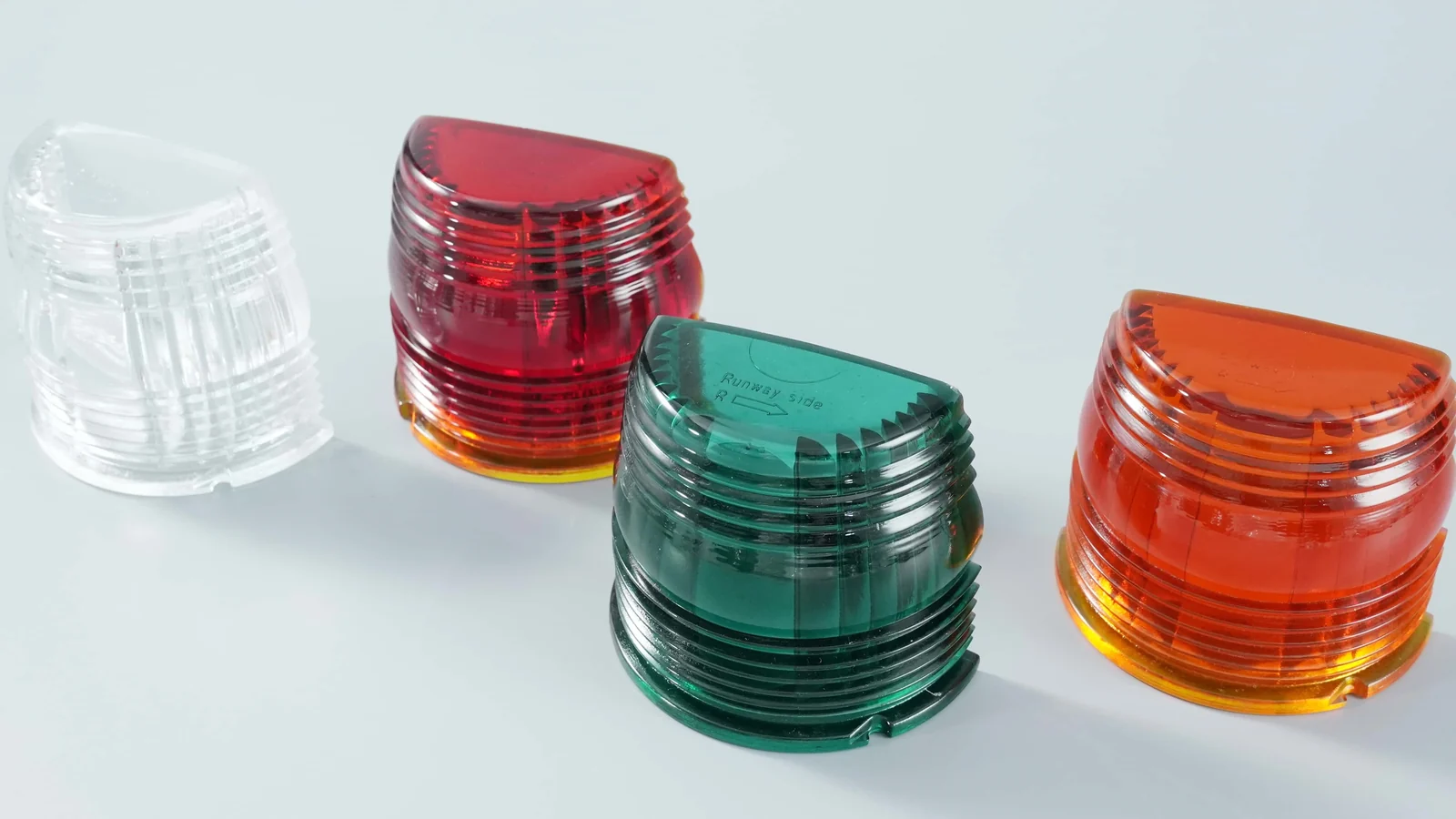
Pressed Airfield Lighting Lenses
The colored lenses started from a high-borosilicate melt with metal oxide colorants. Direct pressing formed the lens profile and optical ribs, followed by annealing.
View the Airfield Lens ProjectMore lighting projects formed directly from molten high-borosilicate glass. These examples show how forming and finishing address optical features, appearance and fit.
Outdoor LED lighting
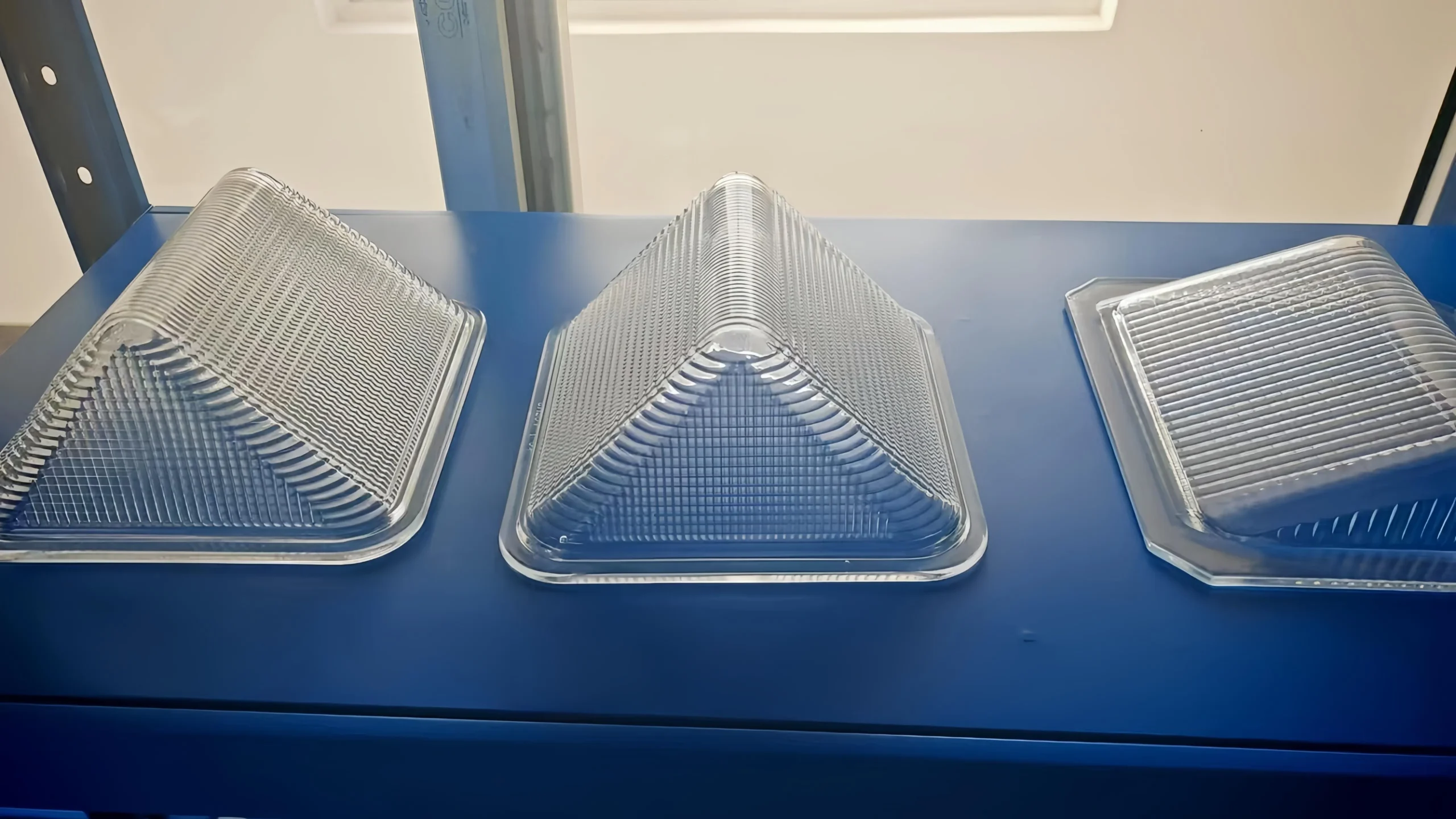
Ribbed Wall-Pack Lenses
Automated pressing shapes molten high-borosilicate glass into clear lenses with the required optical surface and mounting profile. Finished lenses are checked for dimensions, appearance and edge condition.
View the Wall-Pack Lens Project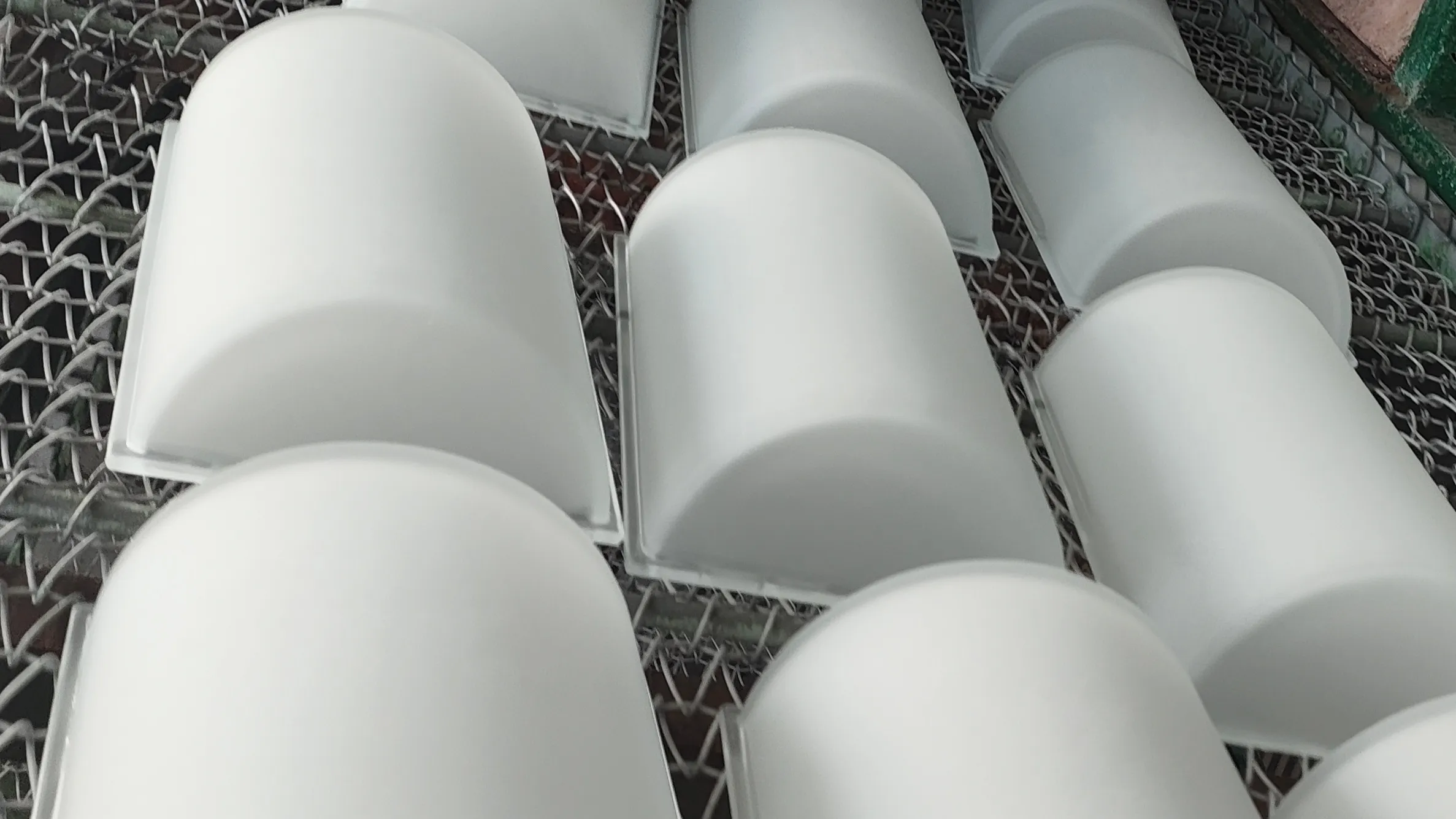
Landscape lighting
Milky-White Outdoor Lighting Covers
Precision molding shapes molten high-borosilicate glass into the rectangular shade. Abrasive frosting and a milky-white surface coating follow forming.
View the Outdoor Lighting Project
Decorative lighting
MULLAN Lighting Bulb Shells
The bulb shells are formed from molten high-borosilicate glass and feature molded threads and a sandblasted finish. The project documents local flame heating at the neck and checks for thread fit and appearance under illumination.
View the Bulb Shell ProjectExamples with preformed tubing. The studio diffuser cover project starts from borosilicate tubing. The GL45 bottle project uses tubing for mold-assisted hand blowing, followed by lathe-based thread forming.
13 / Source documents
References and Data Scope
- SCHOTT DURAN® 3.3 technical datasheet for the named grade’s physical properties and chemical resistance classes.
- SCHOTT Pharma, The Nature of Glass for oxide compositions and example expansion classes used in glass packaging.
- SCHOTT BOROFLOAT® 33 technical details for examples of optical and chemical data for a named flat-glass grade.
- Pilkington ATS-129, Properties of Soda-Lime Silica Float Glass for the soda-lime example.
- Corning HPFS® Fused Silica Industrial Grade for the fused silica example.
- ISO 3585 for borosilicate glass 3.3 and ISO 7991 for the mean linear thermal expansion measurement method.
Named product data and family comparisons help narrow material choices. Cost, technical acceptance and service limits are determined for the specific grade, finished geometry, mounting conditions, and agreed measurements and tests.
14 / Detailed guides
Borosilicate Glass Technical Guides
Use these guides to specify the glass, review the shape and agree how the finished part will be checked.
Composition and Material Grades
Connect the glass formulation with expansion and material identification.
Viscosity and Melt Behavior
Review flow, forming temperature and cooling around tooling.
Thermal Expansion and Thermal Shock
Evaluate temperature gradients, mounting and thermal cycling.
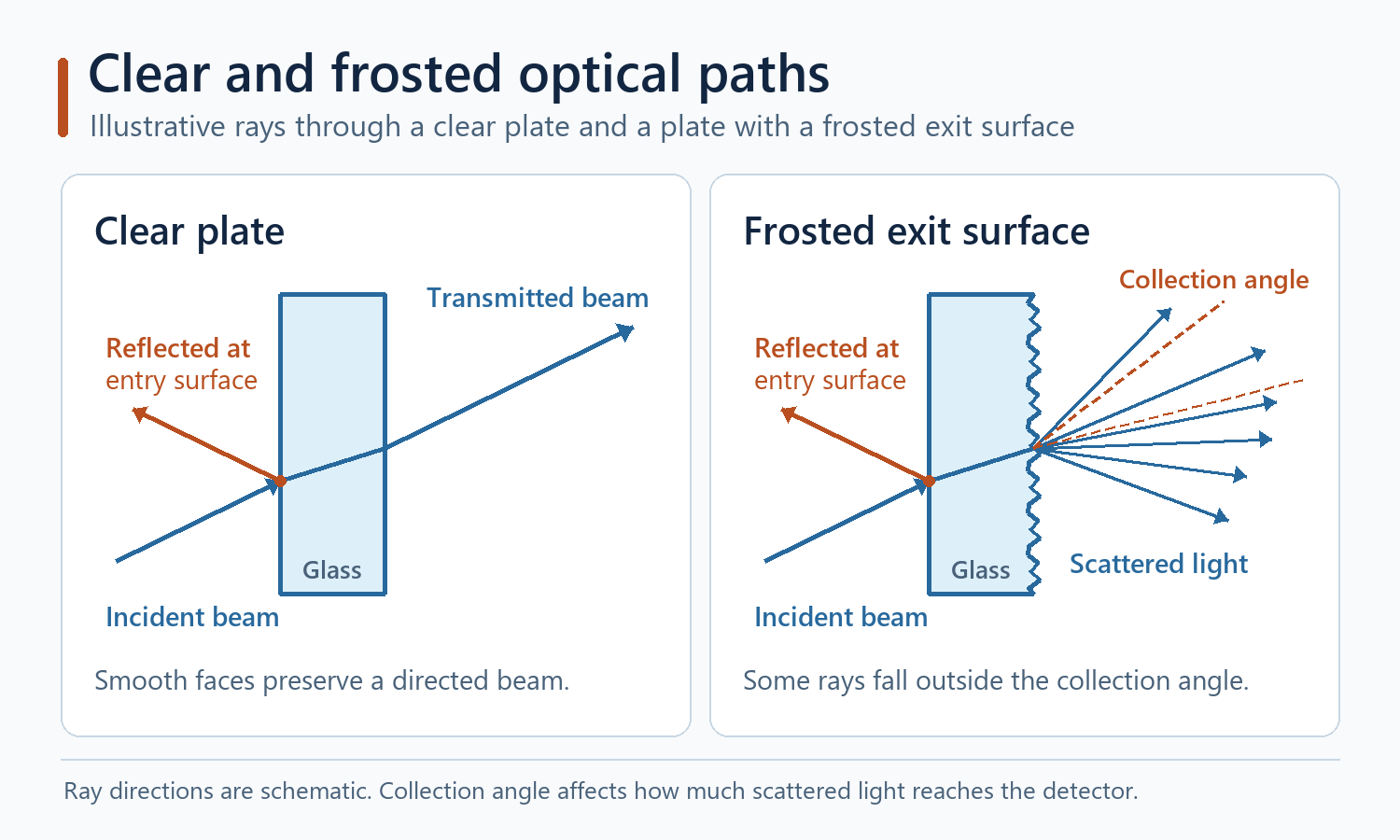
Optical Properties and Transmission
Define wavelength, thickness, optical zones and measurement conditions.
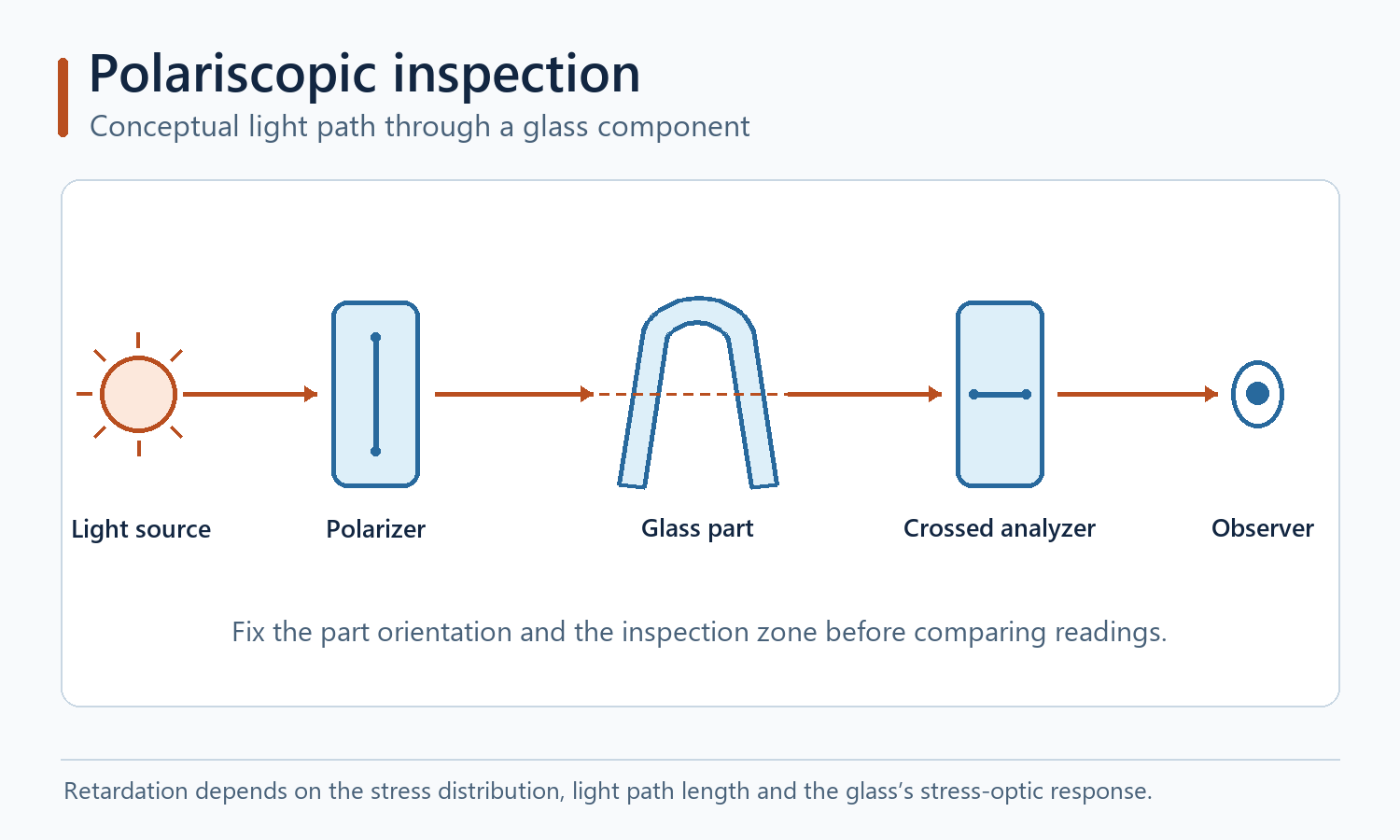
Mechanical Strength and Residual Stress
Review loads, edges, surface flaws and stress from forming and cooling.
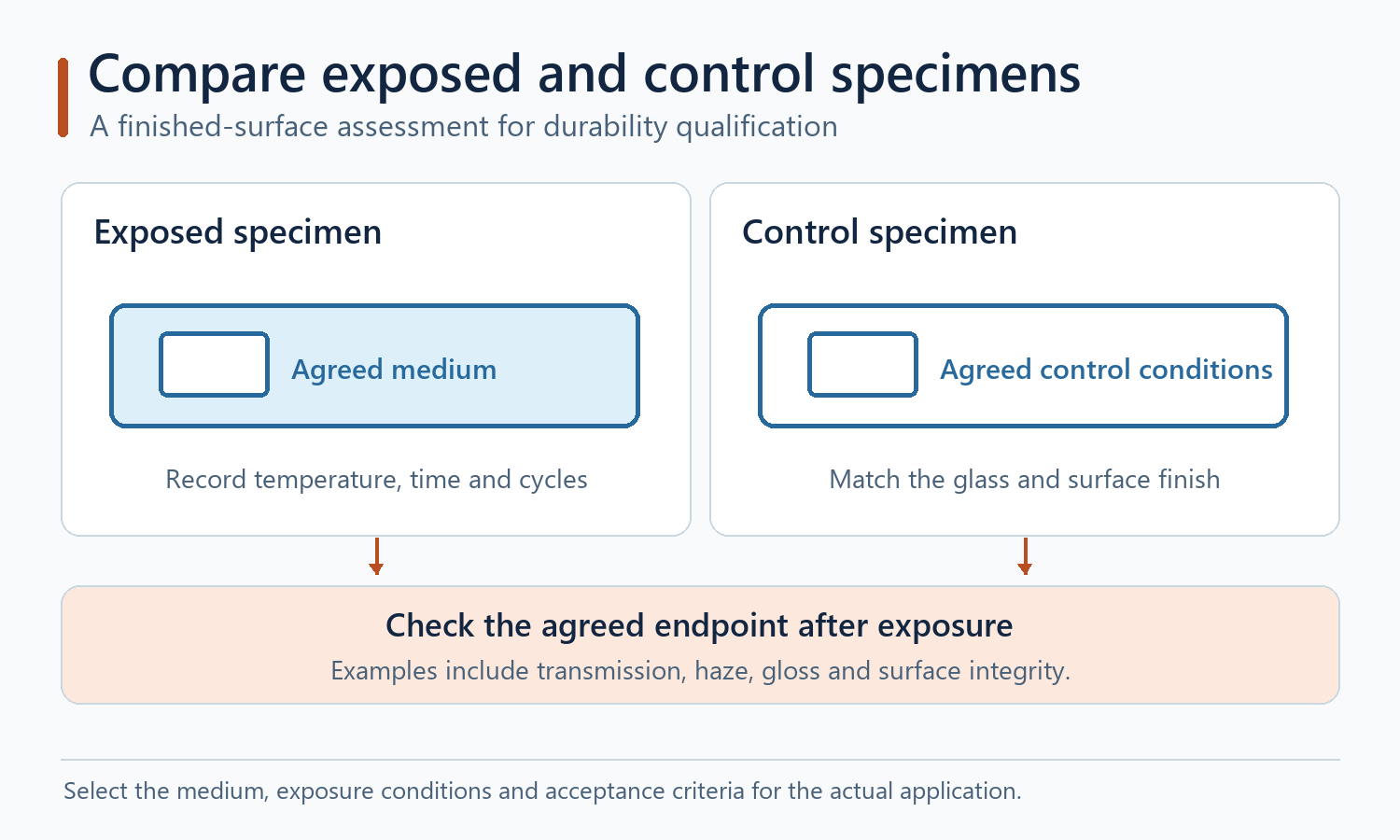
Chemical Durability and Corrosion
Specify the chemicals, concentration, temperature and duration of exposure.
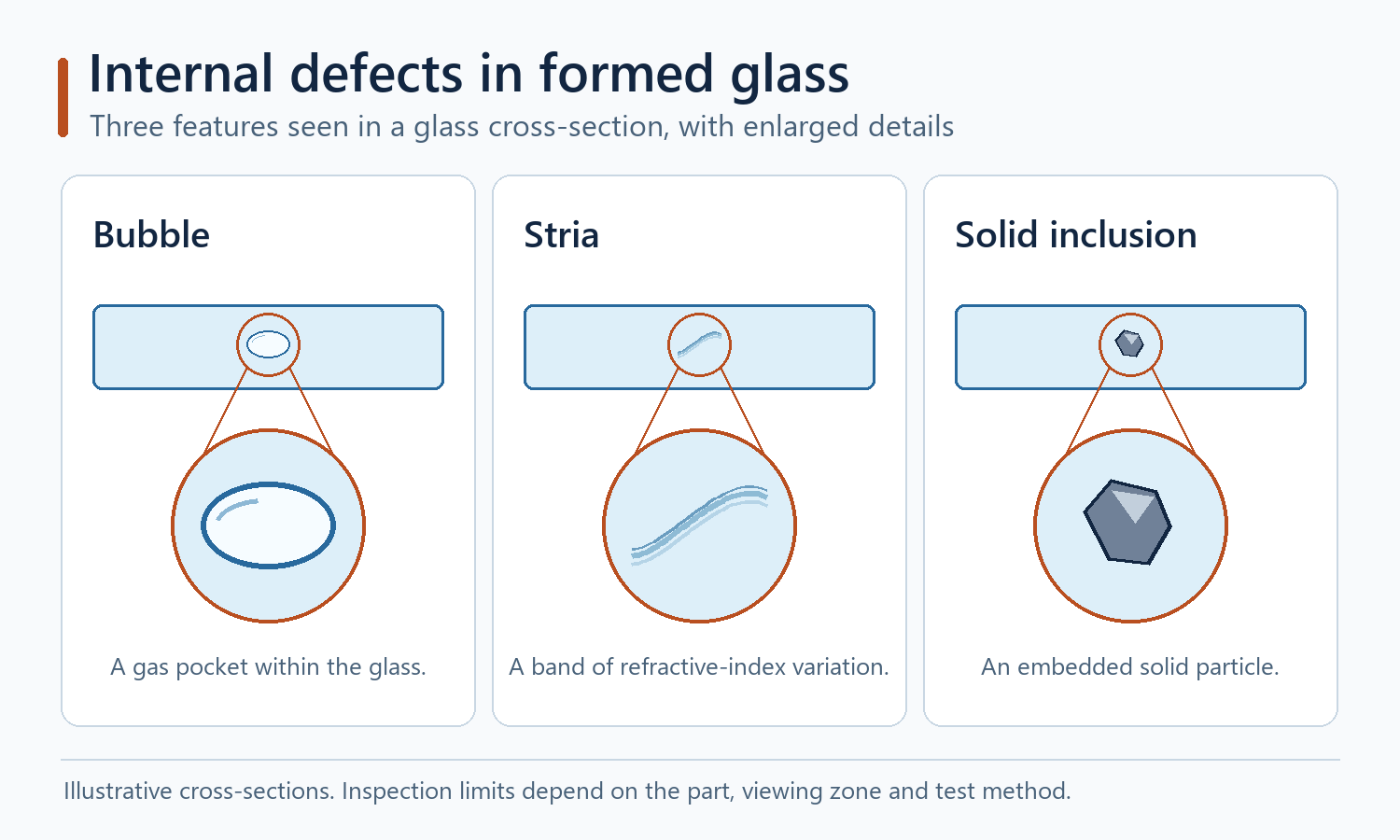
Internal Defects and Homogeneity
Identify bubbles, striae and inclusions under agreed viewing conditions.
Molten-Formed Component Design
Review wall profiles, openings, tooling release and mounting interfaces.
Specifications and Quality Control
Translate drawing and service requirements into measurable checks.
15 / Procurement
Ordering and FAQs
What is the difference between borosilicate glass and soda-lime glass?
Boron oxide helps form the network in borosilicate glass. Soda-lime glass is based mainly on silica with sodium and calcium oxides. Borosilicate 3.3 expands less than typical soda-lime glass for the same temperature change, which can reduce thermal stress in comparable parts. Compare the materials.
What is the maximum operating temperature of borosilicate glass?
The maximum operating temperature depends on the grade, part geometry, mounting, exposure duration and temperature gradients. Use the grade’s service data and validate the finished assembly under its intended operating conditions. See thermal expansion and thermal shock resistance.
What is the difference between molten-formed and lampworked borosilicate glass?
Molten forming starts with a charge of molten glass and shapes it by pressing or blowing. Lampworking uses a torch to locally soften preformed glass tubing or rod for shaping and joining. Specify the glass grade separately from the forming route. Compare forming routes.
Can I specify a manufacturer and glass grade?
Include the required grade or material property range in your request. Confirm availability, traceability and documentation in the quotation.
Can I approve samples before production?
Include the sample quantity and what you need to test. Agree the sample scope, tooling charges and acceptance criteria before the production order.
How are tooling, minimum order and lead time determined?
They depend on the grade, forming route, geometry and inspection requirements. Share first-order and repeat quantities and request separate timings for tooling, samples and production.
What should I provide for pressure, vacuum or thermal cycling?
Include the load or pressure range, peak and operating temperatures, cycle details, support conditions and required validation. Agree the finished-component test and acceptance criteria for the intended service.
Send Your Drawing or Requirements
A drawing or sample, operating conditions and target quantities help us review the forming route and prepare a quote.
Contact Us
Discuss Your Custom Glass Project
Share your drawing, photos or dimensions, together with the intended use and target quantity. We will review your requirements and discuss the next steps.
Sales Enquiries
Email sales@bo-glass.com with your part description, intended use and target quantity.
Send Your Design
Use the form to upload a drawing or describe an existing part. Mark critical dimensions and tell us which surfaces or features matter most.
Request a Custom Glass Quote
Upload a drawing or share dimensions, quantity, intended use and finish. Include any heat, pressure or chemical exposure.
Your drawings remain confidential.
We use the contact details you provide to respond to your enquiry. See our Privacy Policy for more information.