Borosilicate glass material overview
Borosilicate Glass Viscosity, Melt Behavior and Formability
In direct molten forming, glass must flow rapidly enough to take shape before cooling limits deformation. It must then stiffen enough to retain the geometry during release and handling. The usable range depends on the formulation, the temperature distribution in the melt and any tooling, and the time available for glass to flow across the part. PNNL study of commercial glass viscosities
Temperature and Viscosity
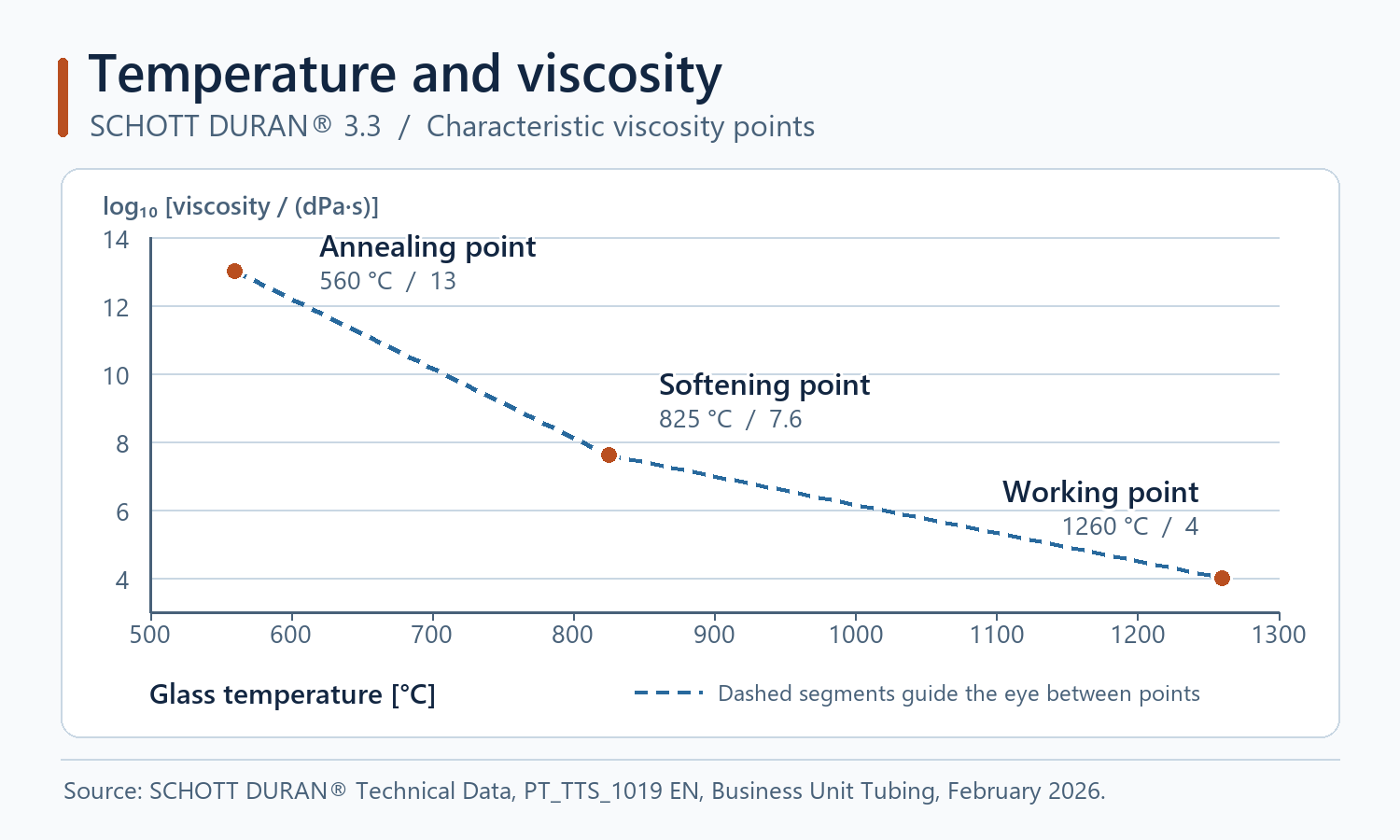
Viscosity describes resistance to flow. It drops steeply and nonlinearly as borosilicate glass heats through the forming range. A viscosity curve therefore needs measurements for the formulation and temperature interval being modeled. Characteristic points let engineers compare grades at equivalent viscosities. SCHOTT publishes the following values for DURAN® 3.3 tubing glass. SCHOTT DURAN technical data · Commercial glass viscosity modeling study
| Characteristic point | Viscosity (dPa·s) | DURAN® reference temperature |
|---|---|---|
| Working point | 104 | 1,260 °C |
| Softening point | 107.6 | 825 °C |
| Annealing point | 1013 | 560 °C |
One dPa·s equals one poise, or 0.1 Pa·s. The working point is a viscosity reference. Production trials establish the actual glass and tooling temperatures for a particular pressing or blowing operation. The annealing point likewise gives a material reference for stress relief. The schedule depends on how long it takes the thickest section to reach a sufficiently uniform temperature and how evenly the part cools thereafter.
Melt Homogeneity and Fining
Melting dissolves the batch and brings its constituents into solution. Homogenization reduces composition differences that can appear as refractive-index streaks, or striae. In experiments on a model borosilicate melt, stirring stretched and thinned striae, allowing diffusion to reduce the remaining differences during the hold. Fining addresses entrapped or evolved gases. Bubble size, temperature-dependent viscosity and gas exchange with the melt affect whether bubbles rise out, shrink or persist. An apparently clear melt can still contain striae that become visible when the light path crosses them at a suitable angle. Borosilicate stirring experiments · Bubble rise and thermal cycling study
Boron Volatilization and Composition Stability
Boron-bearing species can volatilize from a hot melt surface. The rate and species depend on melt composition, surface temperature, gas flow and atmosphere. Water vapor can favor the formation of some volatile boron species, and exposed surfaces may develop local composition differences. Laboratory results are specific to the tested chemistry, atmosphere and scale. A process investigation should relate melt-history records and part inspection to the same lot before attributing a streak or shift in forming behavior to volatilization. Industrial furnace evaporation study · Aluminoborosilicate evaporation experiments
Glass Flow and Finished-Part Quality
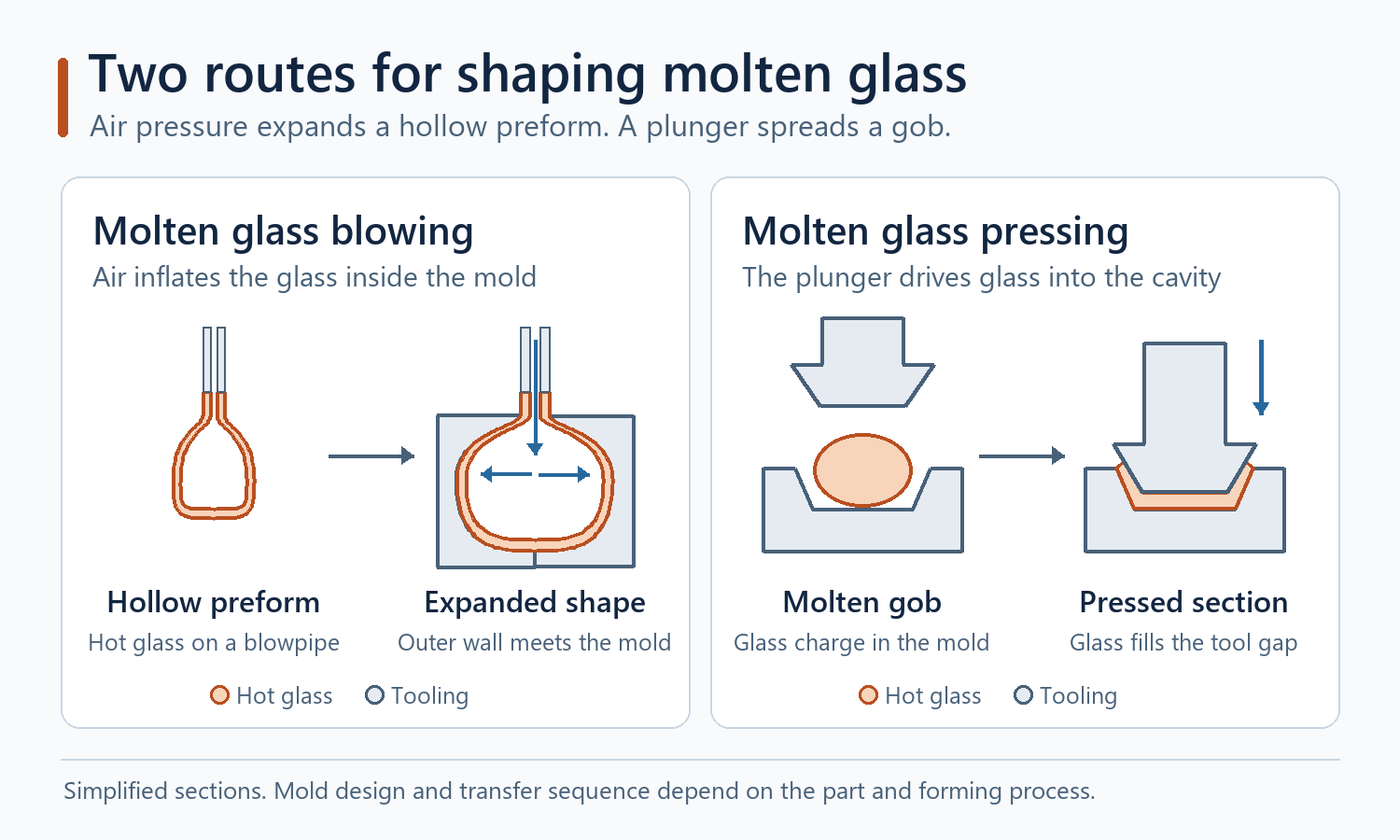
In molten pressing, the gob spreads under the plunger. The contact layer cools while the interior continues to flow, so narrow sections, sharp transitions and long flow paths are especially sensitive to early stiffening. In molten blowing, the hot hollow blank expands toward the mold. A warmer region can stretch faster than adjacent glass, causing local wall thinning. The shape of the blank, pressure history and cooling against the mold all affect where glass accumulates. Molten glass pressing · Molten glass blowing
When qualifying a part, correlate process records with measurements from the same samples. Map wall thickness at the heel, shoulder and other transitions, and check fully filled features against the drawing. View bubbles and solid inclusions under agreed lighting and use transmitted light to check striae in optical zones. These checks help distinguish filling or stretching problems from inhomogeneity already present in the melt. Use the internal-defect identification guide to record the feature before investigating its origin. BO-Glass molten pressing material and gob control guide
Connect an Observed Feature to a Check
| Observed feature | Compare during the investigation | Use the sample to check |
|---|---|---|
| Pressed feature fills incompletely | Gob condition, tool contact and the length of the flow path | Which edge or recess remains unfilled and whether it repeats in the same location |
| Blown wall thins locally | Preform shape, glass distribution and the order of mold contact | Thickness readings around the shoulder and wall from the same part |
| Streak appears under transmitted light | Its position across molds, runs and parts from the same melt lot | Whether its visibility changes with viewing direction and where it crosses the optical zone |
| Bubble cluster appears in several pieces | Lot records, process timing and any change in location between tools | Bubble count, size and distribution under consistent lighting |