
Precision Milk white Opal Glass Processing
We craft custom glass parts through expert hand-blowing and die-pressing. From prototype to mass production, our streamlined process ensures fast turnaround without compromising quality.
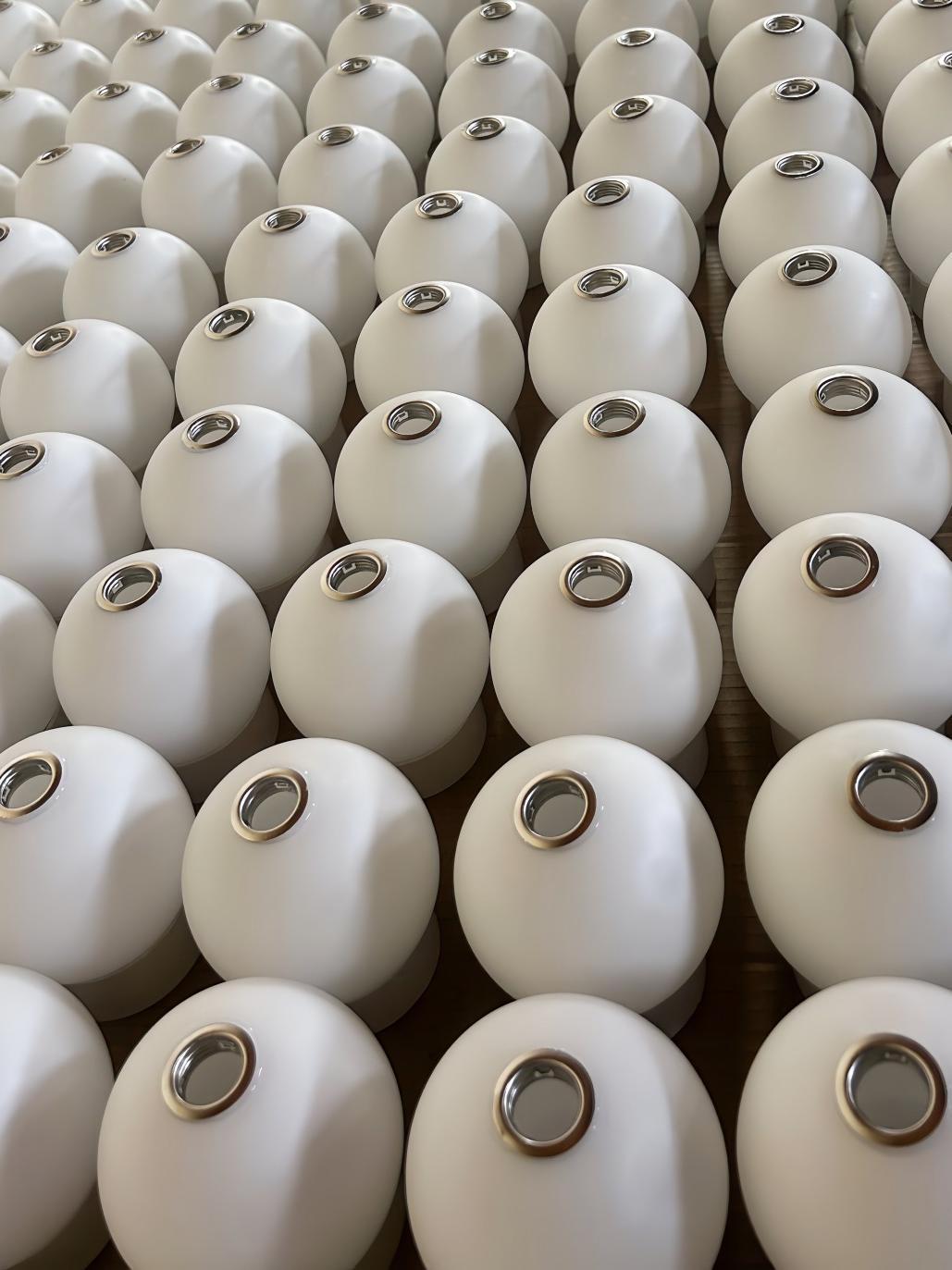
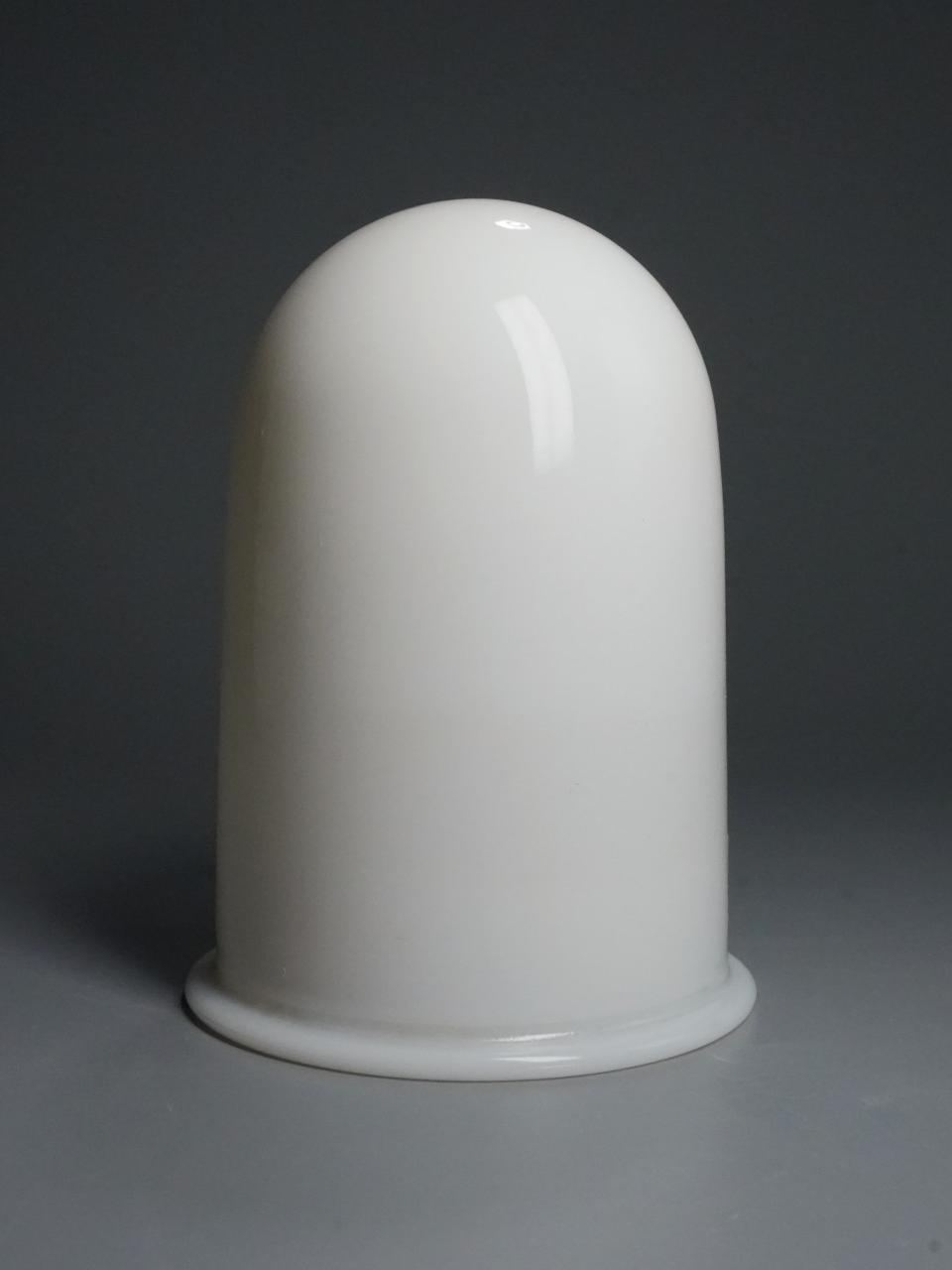

What is Milk White Opal Glass?
Max Part Size (X/Y/Z): | 500 x 500 x 500 mm |
Dimensional Tolerance: | ±0.1 mm |
Minimum Wall Thickness: | 2 mm |

Milk White Opal Glass for Blowing & Pressing
| Category | Specification / Description |
| Material Type | Opaque, light-diffusing glass (also known as Opal Glass or Milk Glass) |
| Key Raw Materials | Base Glass: Soda-lime or borosilicate glass. Opacifiers: Fluorides (e.g., Cryolite, Na₃AlF₆) or Phosphates (e.g., Calcium Phosphate). Stabilizers/Refiners. |
| Optical Propertie | • Appearance: Uniform, milky white, porcelain-like. • Light Transmission: Low (typically 10-40%, highly diffused). • Haze: ~100% (perfect light diffuser). • Gloss: Can range from matte to a soft satin finish. |
| Physical & Thermal | • Density: ~2.5 g/cm³ (soda-lime base). • Thermal Expansion: Varies with base (high for soda-lime, low for borosilicate). • Softening Point: ~700-750°C (soda-lime). • Chemical Durability: Excellent resistance to water and atmospheric agents. |
| Mechanical | • Hardness: Good surface hardness, resistant to scratching. • Strength: Similar to base glass; brittle material. |
| Key Advantages | • Superior Light Diffusion: Creates soft, uniform, glare-free illumination. • Elegant Aesthetic: Premium, uniform matte white finish. • Chemical Stability: Non-porous, stain-resistant, easy to clean. • Custom Shapes: Excellent for complex thermal forming (blowing, pressing). |
| Considerations | • Not Transparent: Cannot be used for clear viewing applications. • Impact Resistance: Like all glass, it is brittle unless tempered. • Weight: Similar to standard glass, heavier than plastics |
| Primary Applications | • High-End Lighting: Lamp shades, globes, panels for soft ambient light. • Decorative & Tableware: Vases, art objects, premium tableware. • Architectural: Decorative tiles, privacy screens, back-painted wall panels. • Technical: Light diffusers for LEDs, instrument panels, cosmetic packaging. |
Milk white Opal Glass
Milky white glass is a functional material that achieves soft, diffused light by adding opacifiers. Its warm texture brings a significant aesthetic premium to high-end lighting and decorative products. However, this characteristic is also accompanied by practical constraints such as high raw material costs, inherent limitations in light transmittance, and complex process control.
Benefits
Superior Optical Performance: Provides perfect, uniform light diffusion, eliminating hot spots and glare. This simplifies lighting design by often removing the need for secondary diffuser films or components.
Consistent & Uniform Aesthetic: Its inherent, bulk opacity and homogeneous milky white color ensure visual consistency from any viewing angle and across production batches, crucial for brand quality.
Excellent Formability: Highly suitable for a wide range of thermal processes (pressing, blowing, sagging) allowing for the creation of complex, seamless, and intricate shapes that are difficult with other materials.
Design Flexibility: The material itself provides a premium finish (from matte to satin), reducing or eliminating the need for post-processing surface treatments like painting or coating to achieve a desired look.
Inherent Durability & Stability: Offers high chemical resistance, is scratch-resistant, non-yellowing from UV exposure, and easy to clean. These properties are “baked-in,” ensuring long-term performance without degradation.
Material Integrity: Being a monolithic glass, it does not delaminate, warp, or outgas like some composite or plastic materials, ensuring reliable performance in demanding environments (e.g., high-temperature lighting fixtures).
Key Limitations to Consider
Inherent Material Brittleness: Like all glass, it is a brittle material with low impact resistance and cannot bend or deform without risk of fracture unless specifically tempered.
Significant Weight: Has a high density compared to polymers or composites, making finished products heavier, which can be a disadvantage for shipping, handling, and certain applications.
Thermal Shock Sensitivity: Although borosilicate opal glass exists, standard soda-lime opal glass has limited resistance to rapid temperature changes, which can lead to cracking.
Processing Difficulty & High Energy Cost: Requires high-temperature melting and precise thermal forming (blowing, pressing), making it energy-intensive and requiring specialized equipment and skilled operators.
Challenges in Consistency: Achieving perfectly uniform color and opacity (without streaks or clouding) throughout a batch and across different production runs requires extremely precise control of opacifier distribution and thermal cycles.
Limited Post-Forming Modification: Once cooled, the shape and surface are largely fixed. Drilling, cutting, or significant machining is difficult, expensive, and risks cracking.
Higher Material Cost: Raw material and production costs are significantly higher than those of common plastics (like polycarbonate or acrylic) used for similar diffuser applications.
Design Limitations: It is completely opaque and cannot be used for applications requiring any transparency or backlighting effects beyond soft, diffuse glow.
Supply Chain Dependency: Reliant on the availability of high-purity raw materials and specific opacifiers, which can be subject to price volatility or supply constraints.
Milk White Opal Glass: Applications
Lighting & Luminaires
• Light Shades & Globes: For pendant lights, ceiling fixtures, and table lamps.
• Diffuser Panels & Covers: For LED panel lights, linear fixtures, and downlights.
• Decorative Bulbs & Tubes
: Vintage-style Edison bulbs and decorative lighting elements.
• Outdoor Lighting: Lanterns and soffit lighting globes.
Architecture & Interior Design
• Decorative Wall & Partition Panels: For privacy and integrated ambient lighting.
• Back-Painted Glass: Used as a luxurious, easy-to-clean backsplash or feature wall.
• Tiles & Mosaics: For creating unique, light-diffusing surfaces in bathrooms or kitchens.
• Skylight & Privacy Screens: Providing soft, diffused natural light.
Consumer Goods & Home Decor
• Tableware & Drinkware: Plates, cups, and decorative bowls with a porcelain-like look.
• Vases, Bowls & Art Objects: Standalone decorative pieces.
• Cosmetic Packaging: Jars, bottles, and compacts for a high-end feel.
• Furniture Inlays & Hardware: Decorative elements on tables or cabinet handles.
FAQ: Milk White Opal Glass – Key Client Questions Answered
How do you ensure perfect color and opacity consistency in every batch?
We control it at the melt stage. High-purity opacifiers (fluorides/phosphates) are homogenized under precise temperature profiles to prevent streaks or cloudiness. Our standardized process ensures uniform light diffusion and an identical white hue across all production runs.
Can this glass withstand heat from integrated LEDs or in kitchen applications?
What are the MOQ and lead time for custom shapes?
Lead Time: Standard items: 4-6 weeks. New custom shapes requiring mold fabrication: 8-12 weeks for sampling and production setup.
Is it possible to achieve colors other than white in opal glass?
What are the main advantages of opal glass over white plastics (e.g., acrylic, PC) for diffusers?
Inherently Superior Stability: No yellowing from UV exposure, higher heat resistance, and no warping over time.
Premium Feel: Significantly better scratch resistance and a denser, more substantial “luxury” tactile quality.
Permanent Finish: The color and opacity are integral to the material, not a surface coating that can wear off.
How does the cost compare to plastic alternatives?
Can the glass be cut, drilled, or tempered after it is formed?
Tempering: It can be thermally tempered to increase impact resistance, but this may slightly affect the surface texture and requires careful process control.
Contact Us
Your feedback fuels our growth, and your questions drive our solutions.
We value your feedback, inquiries, and suggestions. Please feel free to get in touch with us
General inquiries
Please contact us via sales@bo-glass.com, and we will reply to you as soon as possible.
Interested to work with us
Drop your resume at info@bo-glass.com
and we will get back to you shortly.
We uses the contact information you provide to us to contact you about our relevent content, products, and services.