
Borosilicate glass material overview
Borosilicate Glass Composition, Structure and Material Grades
Borosilicate glass is a family of amorphous materials with silica and boron oxide as network-forming constituents. The proportions of these oxides, together with alumina, alkali oxides and other constituents, determine how the glass expands, flows at forming temperatures and responds to chemical exposure. For a component that is blown or pressed directly from molten glass, the formulation and manufacturing route should appear as separate entries in the material specification. ISO 3585 · Borosilicate network structure study
Chemical Composition and Oxide Functions
The table uses the approximate major-oxide composition of SCHOTT DURAN® 3.3 tubing to illustrate how the oxides work together. The four percentages describe this published reference formulation. Use the composition or grade identification supplied for the melt selected for your part. SCHOTT DURAN tubing brochure
| Constituent | DURAN® reference, wt.% | Role in the glass network |
|---|---|---|
| Silica (SiO₂) | ~81 | Forms SiO₄ tetrahedra that link through oxygen to create the backbone of the glass. |
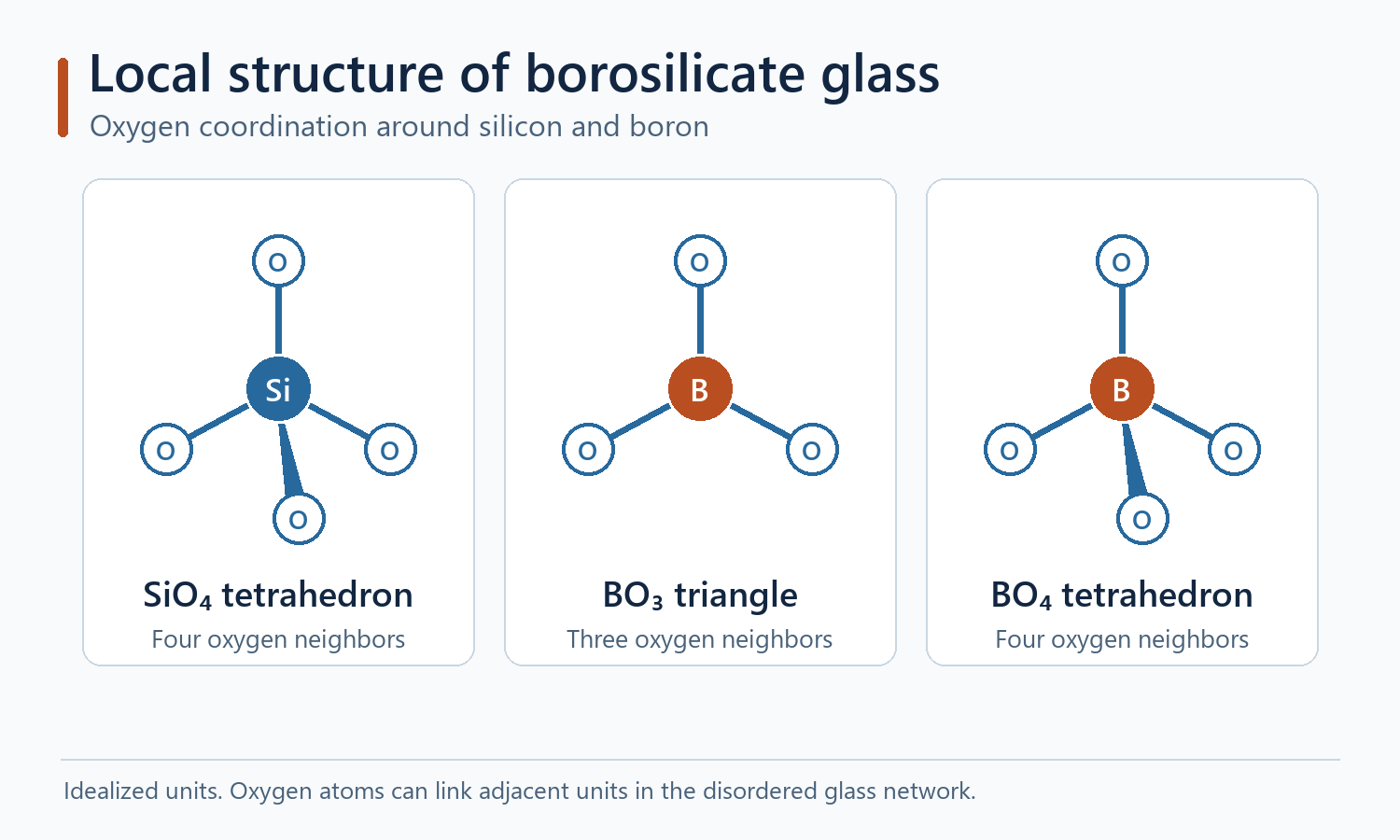
| Boron oxide (B₂O₃) | ~13 | Forms borate units with three or four oxygen neighbors. Their distribution influences thermal expansion and how the melt flows. |
| Sodium and potassium oxides (Na₂O + K₂O) | ~4 | Supply cations that can balance negatively charged tetrahedra or modify the network by creating non-bridging oxygen sites. |
| Alumina (Al₂O₃) | ~2 | Can enter the network as AlO₄ units, which share the supply of charge-balancing cations with borate units. |
Glass Network Structure
Bridging oxygens join neighboring silicate and borate units in a network with short-range order. Boron can occupy a triangular BO₃ unit or a tetrahedral BO₄ unit. Alkali ions help balance the charge of BO₄ and AlO₄ tetrahedra. They can also stabilize oxygen sites attached to a single network former. Changing the ratio of alkali, boron and alumina can therefore change network connectivity in several ways. Low thermal expansion comes from the overall network structure and composition. A boron oxide percentage alone cannot predict it. Diffraction measurements also show that boron coordination can shift between the solid and molten states in specific compositions, which helps explain changes in viscosity. Solid-state NMR study · Alumina and borate charge compensation study · Glass and melt structure measurements
Borosilicate Glass Grades
ISO 3585 defines properties for borosilicate glass 3.3. The designation refers to the nominal mean linear thermal expansion, expressed in units of 10−6 K−1. SCHOTT reports 3.3 over 20–300 °C for DURAN® tubing. Its FIOLAX® clear and amber pharmaceutical tubing formulations have published coefficients of 4.9 and 5.4 over the same interval, respectively. Both FIOLAX grades are listed as Type I under the cited pharmacopeias. A Type I designation and a 3.3 expansion grade describe different properties and should be recorded separately when relevant to the application. ISO 3585 · SCHOTT DURAN technical data · SCHOTT FIOLAX tubing brochure
What the Material Designation Tells You
| Designation | What it identifies | What to confirm for your drawing |
|---|---|---|
| Borosilicate glass | A family of compositions based on silica and boron oxide | Approved grade or formulation and the properties relevant to the application |
| Borosilicate glass 3.3 | A grade described by ISO 3585 with a nominal expansion coefficient of 3.3 × 10⁻⁶ K−1 | The applicable test interval and grade evidence for the selected material |
| Type I | A pharmacopeial classification used for the cited glass and test context | The governing pharmacopeia, glass or container test and supporting documentation |
| Molten blown or pressed | The route used to form the component from hot glass | Start material, finished condition and acceptance criteria for the resulting geometry |
Material Composition and Manufacturing Route
Direct molten forming starts with conditioned glass melt. Tube or rod forming starts with a preformed blank that is reheated and shaped. At a given composition, properties such as mean thermal expansion provide a material baseline. Geometry, cooling history and finishing determine component-level characteristics such as wall distribution, residual stress, optical distortion and edge quality.
For a drawing or request for quotation, identify the required grade or performance range, the critical optical or contact zones, and the test conditions. A glass-to-metal assembly may need an expansion range over a particular temperature interval. A lamp cover may need a defined wall-thickness range and transmission measured on the finished cover at the wavelengths of interest. Confirm any required composition declaration, lot traceability and finished-part acceptance tests before approving the material.
Related Borosilicate Glass Guides
- Borosilicate Glass Viscosity, Melt Behavior and Formability
- Borosilicate Glass Thermal Expansion, Thermal Shock and Temperature Limits
- Optical Properties and Spectral Transmission of Borosilicate Glass
- Mechanical Strength, Residual Stress and Fracture of Borosilicate Glass
- Chemical Durability and Corrosion Resistance of Borosilicate Glass
- Internal Defects and Material Homogeneity in Molten-Formed Borosilicate Glass
- Design Guidelines for Molten-Formed Borosilicate Glass Components
- Borosilicate Glass Specifications, Inspection and Quality Control