
Underwater, Pool and Fountain Lighting Glass Guide
Underwater lighting places the glass inside a pressure, sealing, electrical-safety, thermal, optical, and maintenance system. Glass thickness and material matter, but so do the sealing land, edge quality, gasket compression, cable entry, housing, water chemistry, and operating cycle. This guide distinguishes component controls from complete-luminaire IP testing and explains the optical and color issues specific to pools, fountains, and underwater RGB luminaires.
Glass Components for Underwater, Pool, and Fountain Lights
- Water pressure
- Hydrostatic pressure rises by approximately 9.81 kPa for every meter of water depth, before adding transient loads and the design safety factor.
- IPX8 condition
- The complete luminaire is tested under declared immersion conditions. “IP68 glass” is not a valid standalone material property.
- Thermal movement
- Published CTE examples are about 8.3 × 10⁻⁶/K for soda-lime float glass and 3.25 × 10⁻⁶/K for BOROFLOAT 33.
- Color underwater
- Measure the control LED and the assembled luminaire for spectrum, CCT, Duv and output using the same water depth, water condition and geometry.
Why should we focus on long-term sealing of the underwater luminaire protective cover glass?
Underwater luminaires have been in a water-immersed environment for a long time. The protective cover glass is not only a protective piece, but also one of the most critical pressure interfaces of the complete luminaire sealing system. Ordinary outdoor luminaires mainly face rain and short-term water accumulation, while underwater luminaires have to withstand the long-term effects of continuous water pressure, temperature changes, chemical water quality and cleaning and maintenance.
If the sealing surface between the protective cover glass and the housing is unstable, water will continue to find the weakest point to penetrate, eventually causing condensation, short circuits, corrosion and light degradation. The underwater luminaire protective cover glass must simultaneously control the glass flatness, thickness tolerance, edge quality, gasket compression level and compression structure. It cannot only depend on whether the glass itself is thick enough.
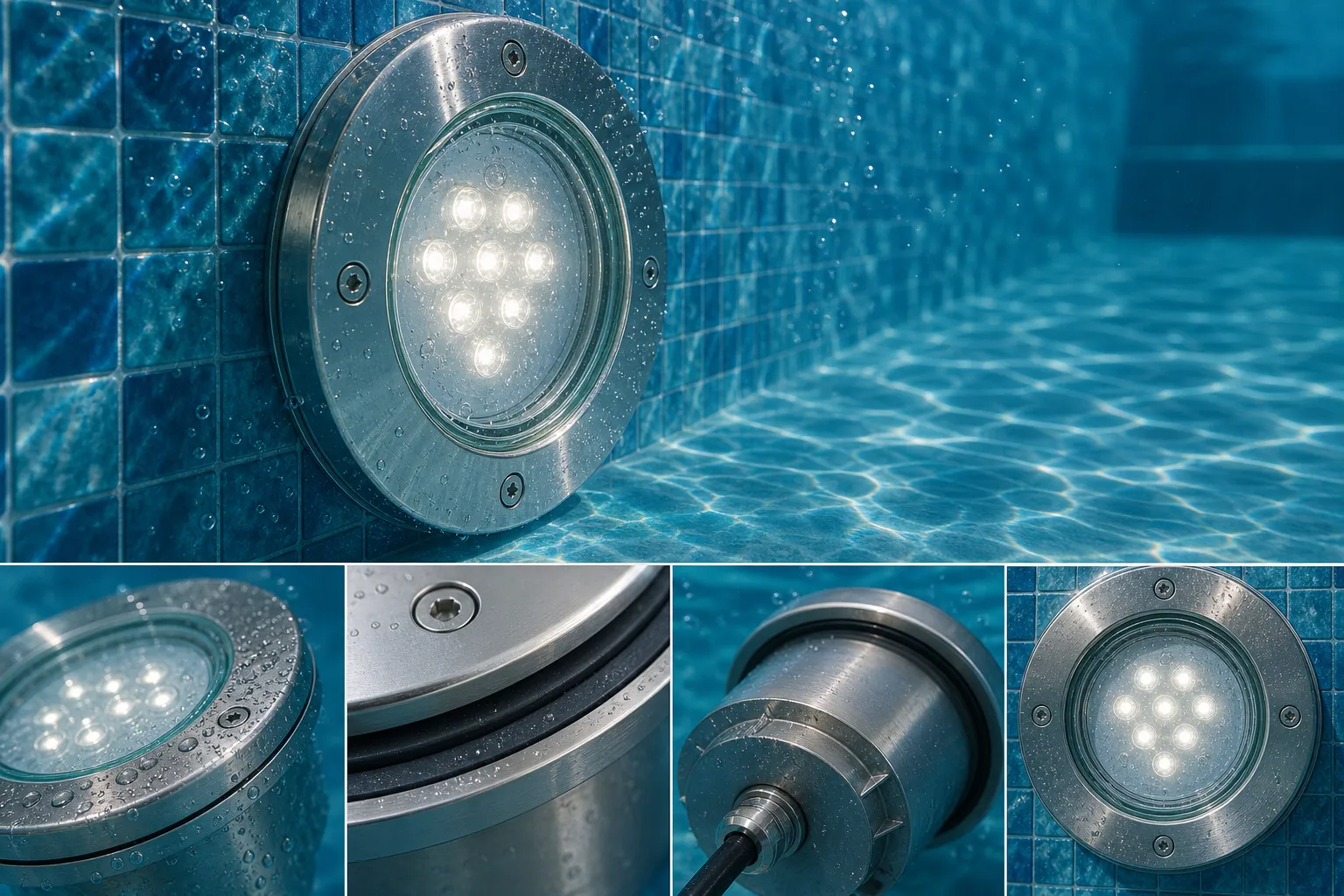
Is flat glass or hemispheric glass suitable for swimming pool light protective cover glass?
The choice of flat glass or hemispheric glass for swimming pool lights depends on the structure of the luminaire, light angle, installation location and appearance requirements. The flat protective cover glass has a simple structure and the sealing surface is easy to control, making it suitable for recessed swimming pool lights, wall-mounted underwater lights and products that require a flat appearance.
Hemispherical glass can produce a wider beam and a softer visual effect while giving the fixture a traditional underwater-luminaire appearance, but it places greater demands on sealing, stress control and manufacturing consistency. If reliable sealing and low maintenance are the priorities, flat glass is usually the more robust option. If wide-angle diffusion and decorative effects are required, hemispherical glass may be considered with enhanced structural verification.
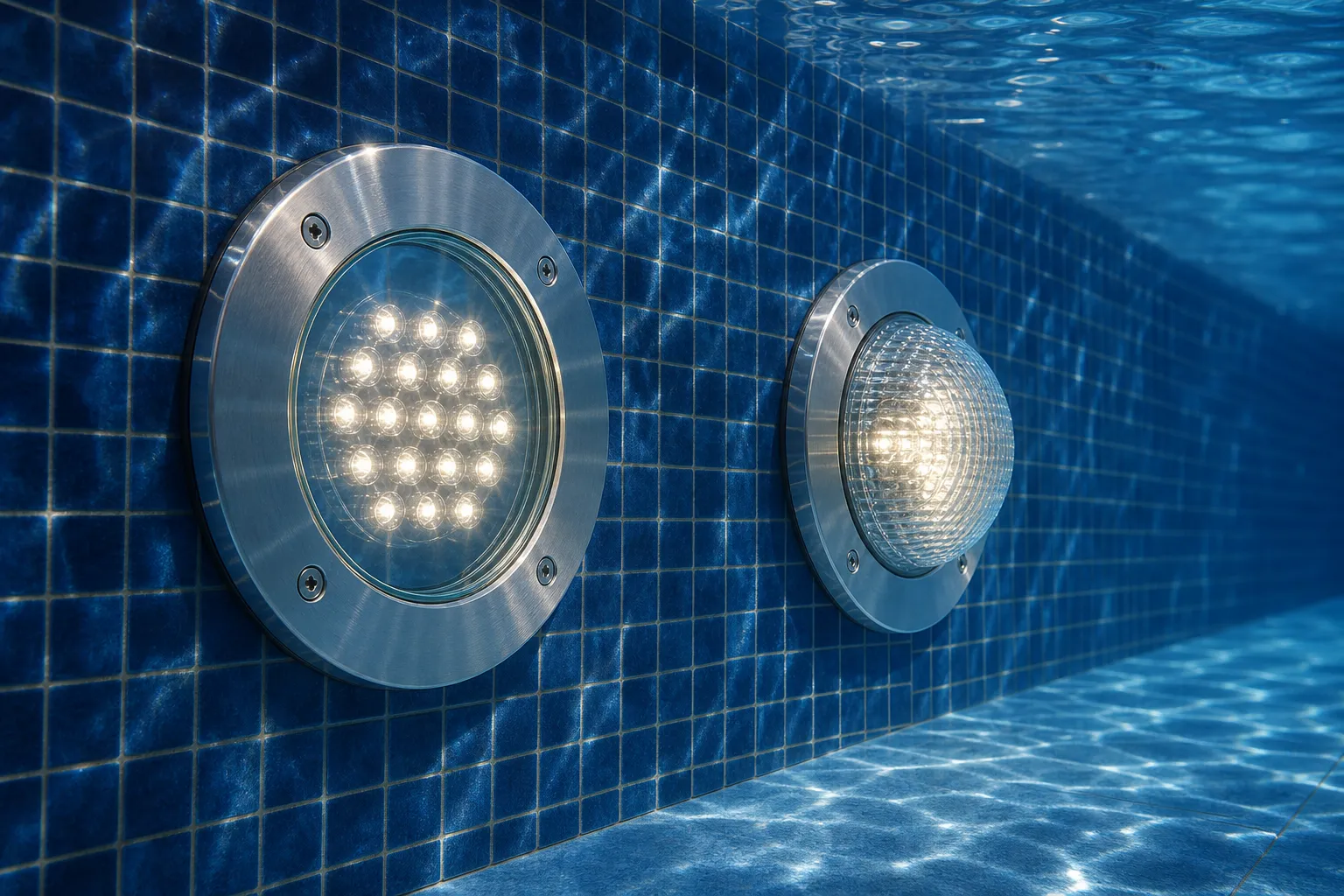
How is the thickness of underwater light glass determined based on water pressure and structure?
The thickness of the underwater luminaire glass should be determined based on the installation depth, water pressure, glass diameter or span, support method, whether it is tempered, and the safety factor. The deeper the water, the larger the glass area, and the narrower the supporting edges, the higher the requirements for glass thickness and structural strength.
But thickness is not the only indicator. Whether the edge of the glass is evenly supported, whether the compression ring is flat, and whether the gasket causes local stress will all affect the actual safety. A more reliable approach is to confirm the thickness by combining structural calculations, sample hydrostatic tests, thermal cycling tests and long-term water immersion tests, rather than simply applying fixed values.
Engineering decision: Use approximately 9.81 kPa pressure increase per meter of water depth, then add the specified safety factor and any transient or installation load. The structural model must include clear span, edge restraint, holes, surface condition and gasket reaction; validate the selected thickness by hydrostatic testing of the assembled luminaire.
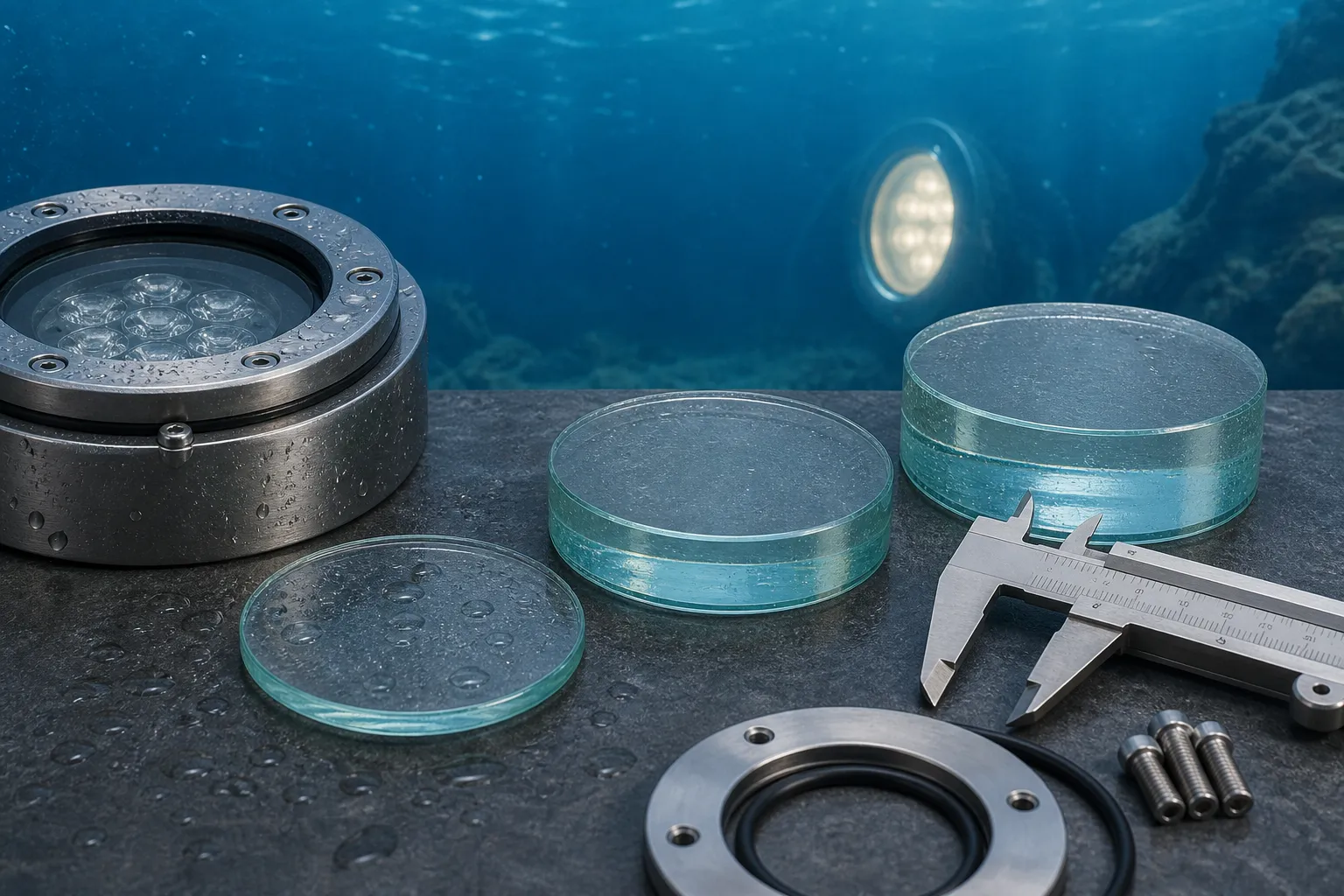
Why is the underwater luminaire glass prone to internal condensation and fogging?
Condensation and fogging inside the underwater luminaire usually come from internal residual moisture, loose sealing, negative-pressure water absorption caused by thermal cycling, or excessive ambient humidity during production and assembly. The interior of the luminaire heats up after it is turned on and cools down rapidly after it is turned off. Water vapor will condense on the cooler inner surface of the glass to form fog.
Such problems are not necessarily caused by the glass material itself; they are more closely related to the sealing design, drying treatment, cable-entry waterproofing and assembly process. Reducing fogging requires controlling humidity in the assembly environment, using reliable gaskets or potting structures, and adding desiccants, pressure-equalizing vents or more stringent air-tightness tests when necessary.
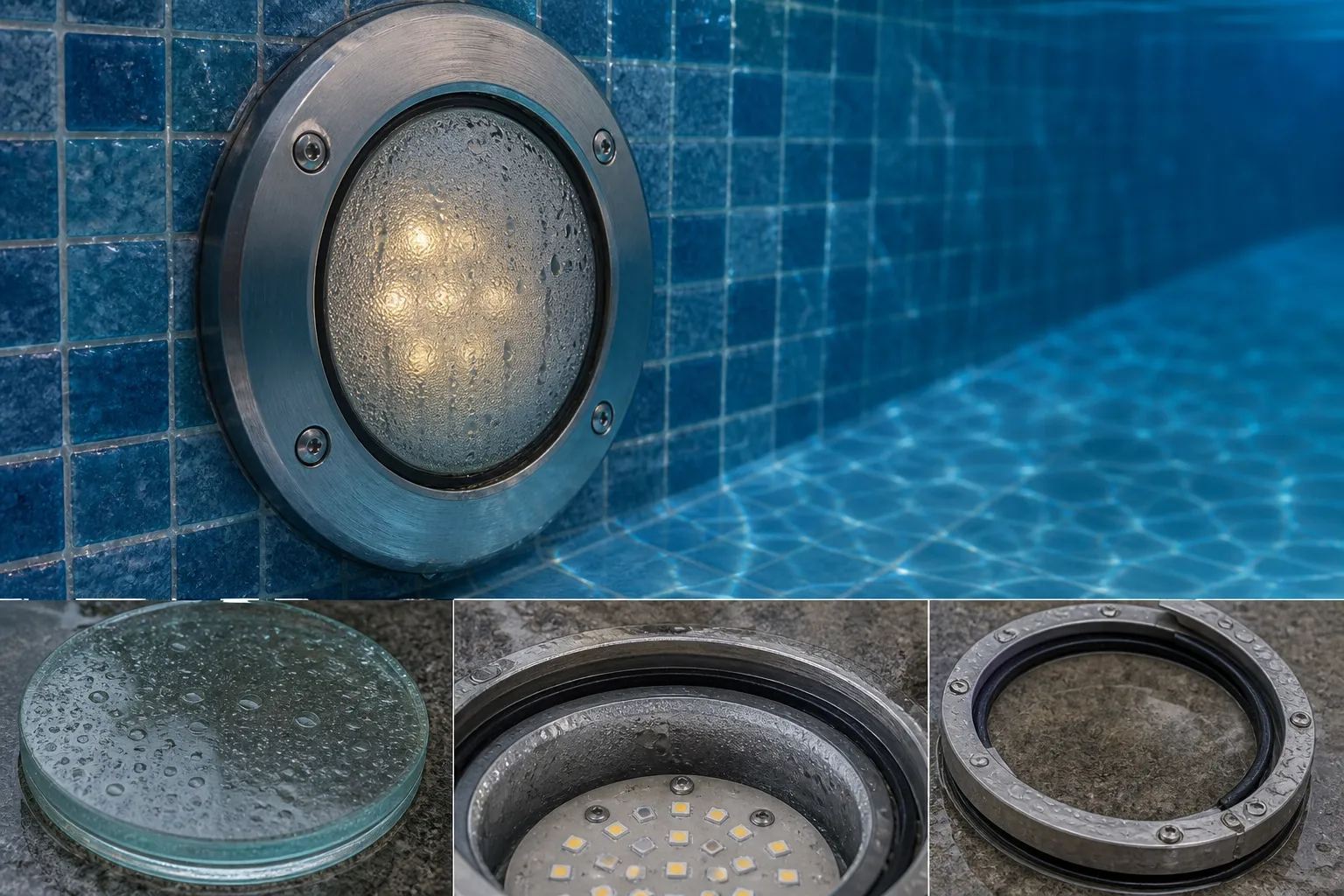
How should the sealing interface between underwater-light glass and the metal housing be designed?
The sealing surface between the underwater luminaire glass and the metal housing should be as continuous, flat and wide as possible, and the gasket should be evenly pressured. The edge of the glass cannot be pressed directly against the metal. It should be cushioned and sealed by a silicone ring, rubber ring or other water-resistant sealing material.
The sealing structure must avoid local deformation caused by single-point screw compression, and also prevent the gasket from losing its rebound after over-compression. The processing flatness of the metal housing, the rigidity of the press ring, the screw distribution and the glass thickness tolerance must be controlled together, so that the glass can maintain a stable seal under long-term water pressure and thermal cycling.
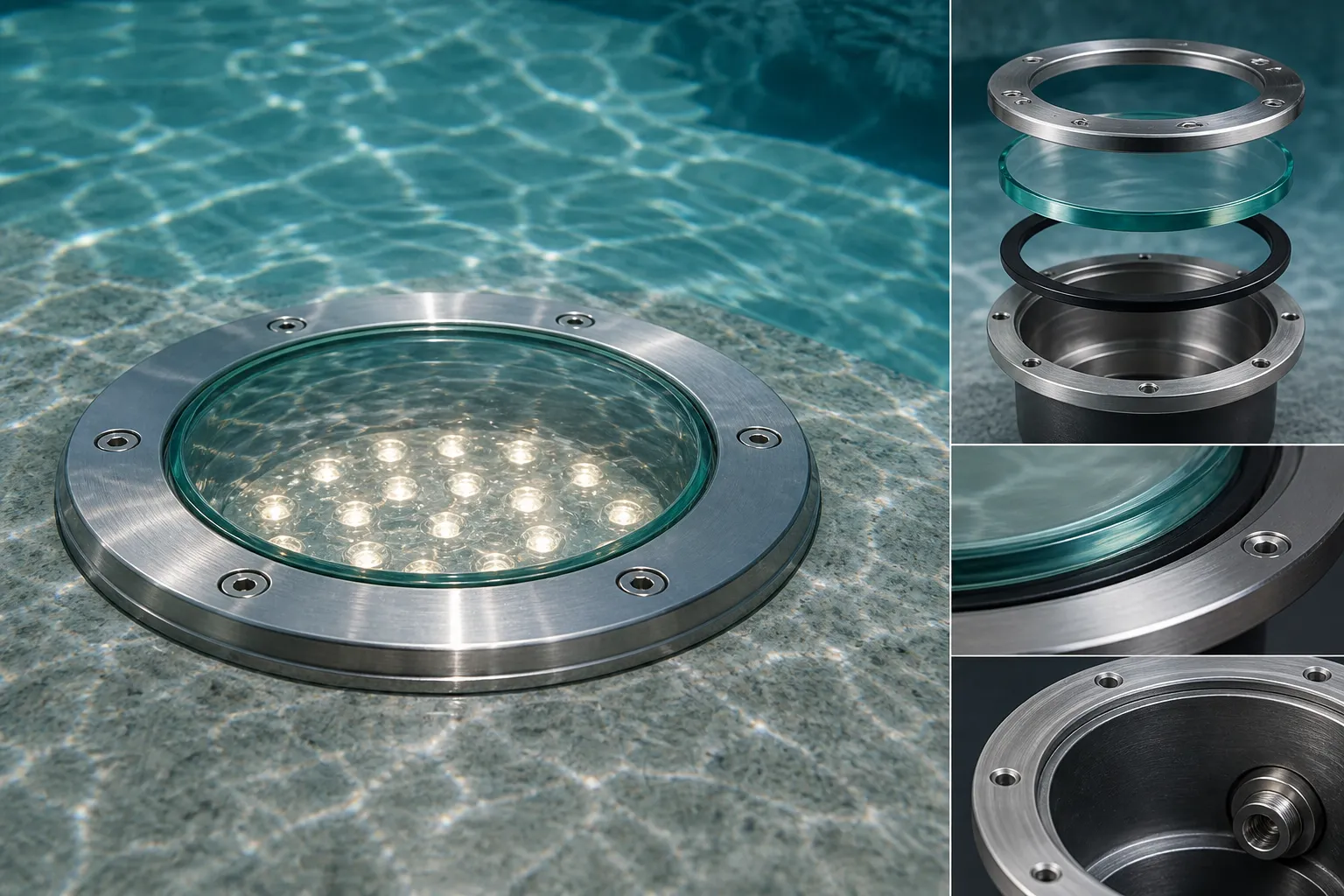
How do pool-light glass components withstand chlorine, scale and detergents?
Pool light glass has been exposed to chlorine, scale and detergents for a long time. The glass body is usually relatively stable, but surface dirt, coatings, sealing materials and metal accessories are easily affected. Chlorine will accelerate the aging of certain metal parts and seals, and scale will adhere to the glass surface, reducing light transmittance and affecting the appearance.
Glass components should be made of materials and processes that have a flat surface, are easy to clean, and have good chemical resistance and stability. If anti-scale or hydrophobic coatings are used, confirm their resistance to chlorine water and detergents. During maintenance, strong acids, alkalis and hard tools should be avoided to avoid damaging the glass surface or surrounding sealing structure.
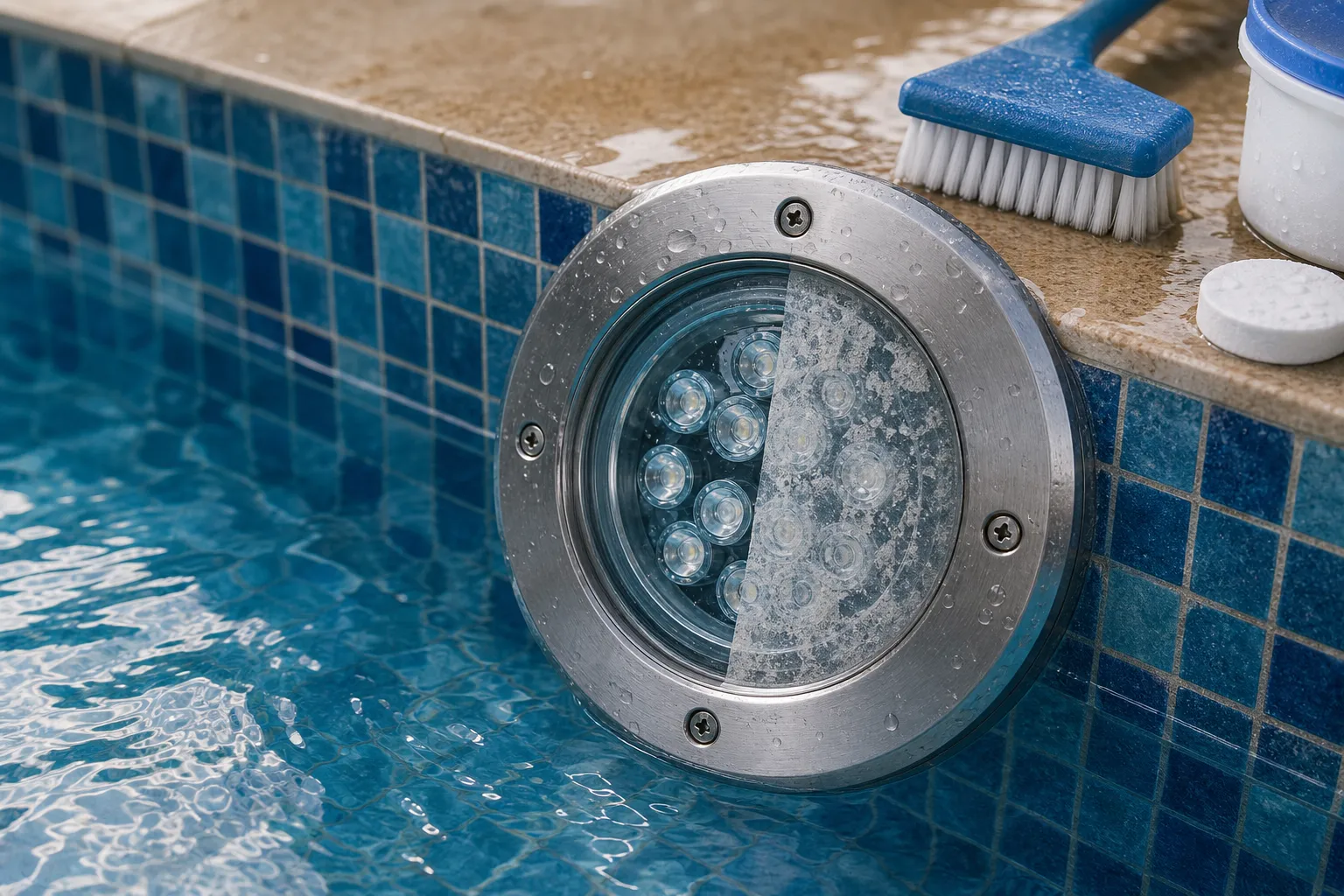
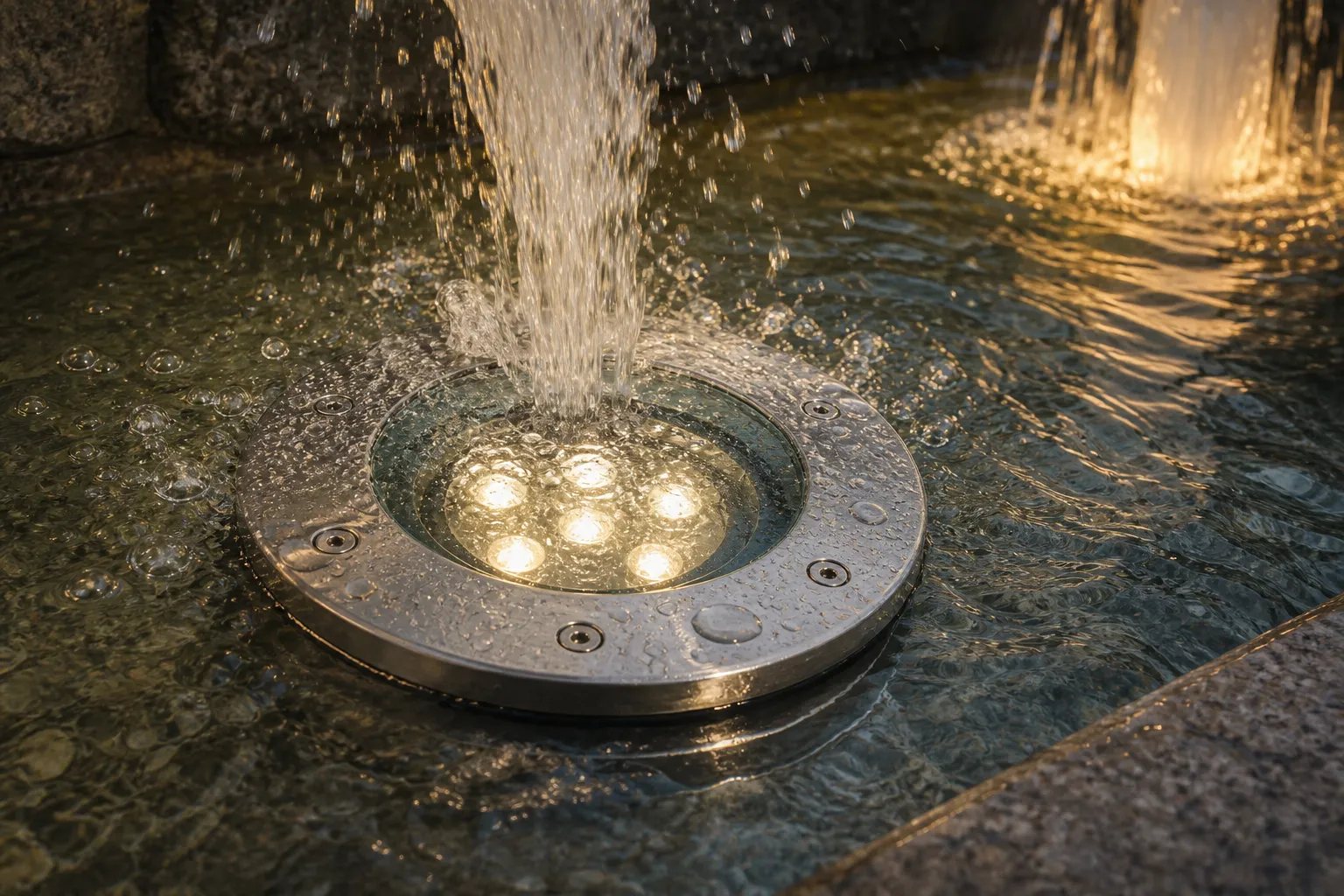
How does the fountain luminaire protective cover glass withstand the impact of water flow and temperature changes?
In addition to long-term contact with water, fountain lights are also subject to water flow impact, bubble vibration, nozzle drop water pressure, and rapid cooling after the luminaire is lit and heated. The protective cover glass needs to have sufficient mechanical strength and thermal stability, and the edges must avoid stress concentration.
The structure should allow the glass to bear even force to prevent water flow from directly impacting weak parts of the glass or edge joints. For applications close to nozzles, high-frequency switching, or where temperature changes are significant, consider borosilicate glass, tempered glass, or thicker glass structures, and verify reliability through thermal shock and water flow shock testing.
How does underwater landscape light glass maintain light transmittance and color performance?
Underwater landscape lights are often used in swimming pools, fountains, water features and underwater decoration. The glass needs to maintain high light transmittance and optical neutrality to avoid significantly changing the LED color temperature and RGB color. Transparent low-iron glass is suitable for projects with higher requirements on brightness and color reproduction, while standard clear glass is suitable for general landscape lighting.
If you use frosted, opalescent or colored glass, it will add soft light and decorative feeling, but it may also reduce the brightness or change the color expression. For RGB or variable color temperature fixtures, be especially careful with glass color and haze, and it is best to test in real water with a sample light, as water depth, water quality, and glass all work together to affect the final visual effect.
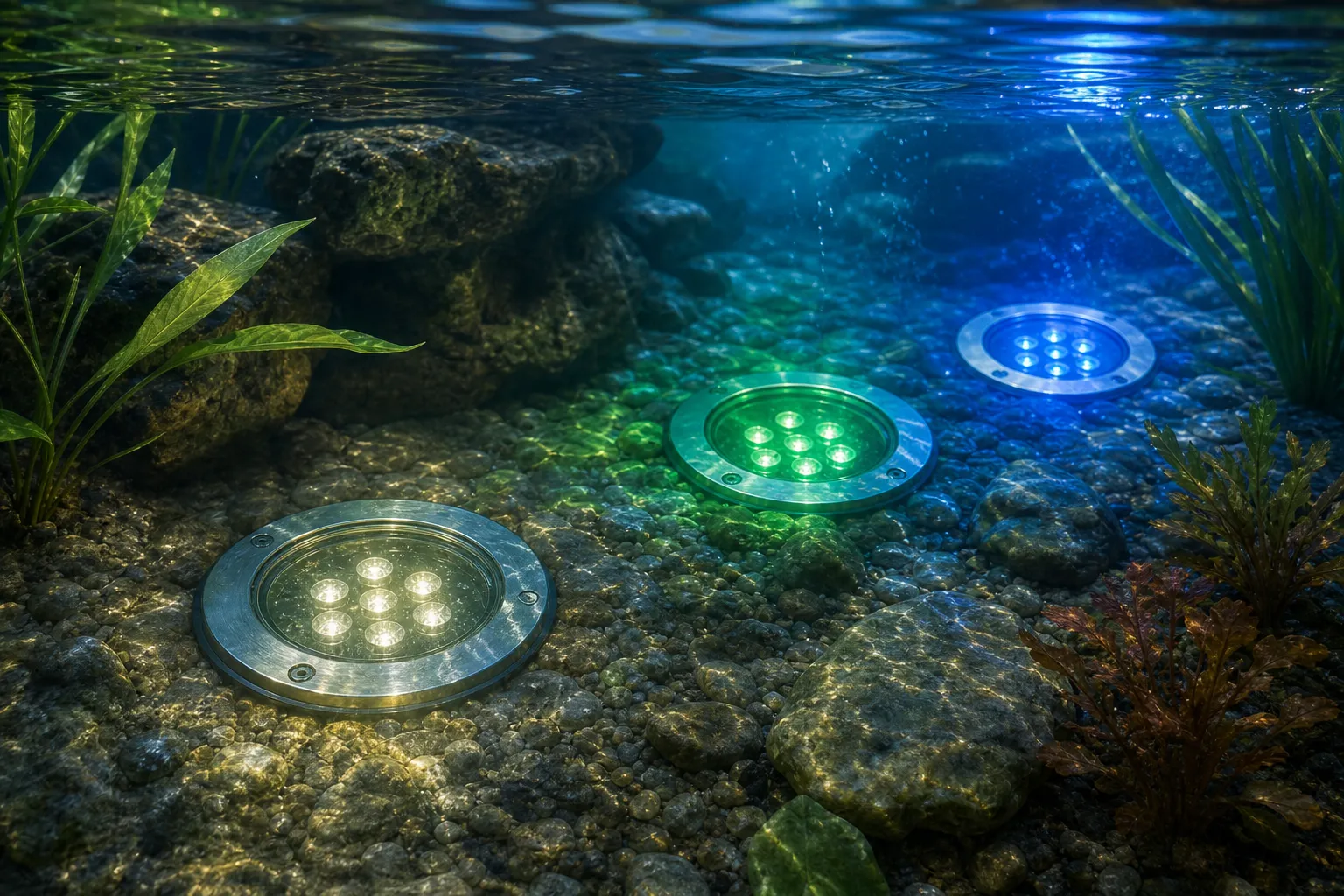
How can uneven color mixing be reduced in the protective cover glass of underwater RGB luminaires?
If the protective cover glass of the underwater RGB luminaire is too transparent, the LED color chips are too close, or the light mixing distance is insufficient, it is easy to see separated color spots of red, green, and blue, and uneven color mixing may also occur on the water surface and pool wall. Protective cover glass can help with light mixing through moderate haze, opalescent diffusion, or textured diffusion.
However, excessive glass haze will reduce brightness and projection distance, so it is also necessary to match the internal diffusion cover, reasonable LED arrangement, reflective cavity and the distance from the light source to the glass. For high-end swimming pool and fountain projects, different color scenes should be tested under real installation distance and water environment, rather than just looking at the white light effect.
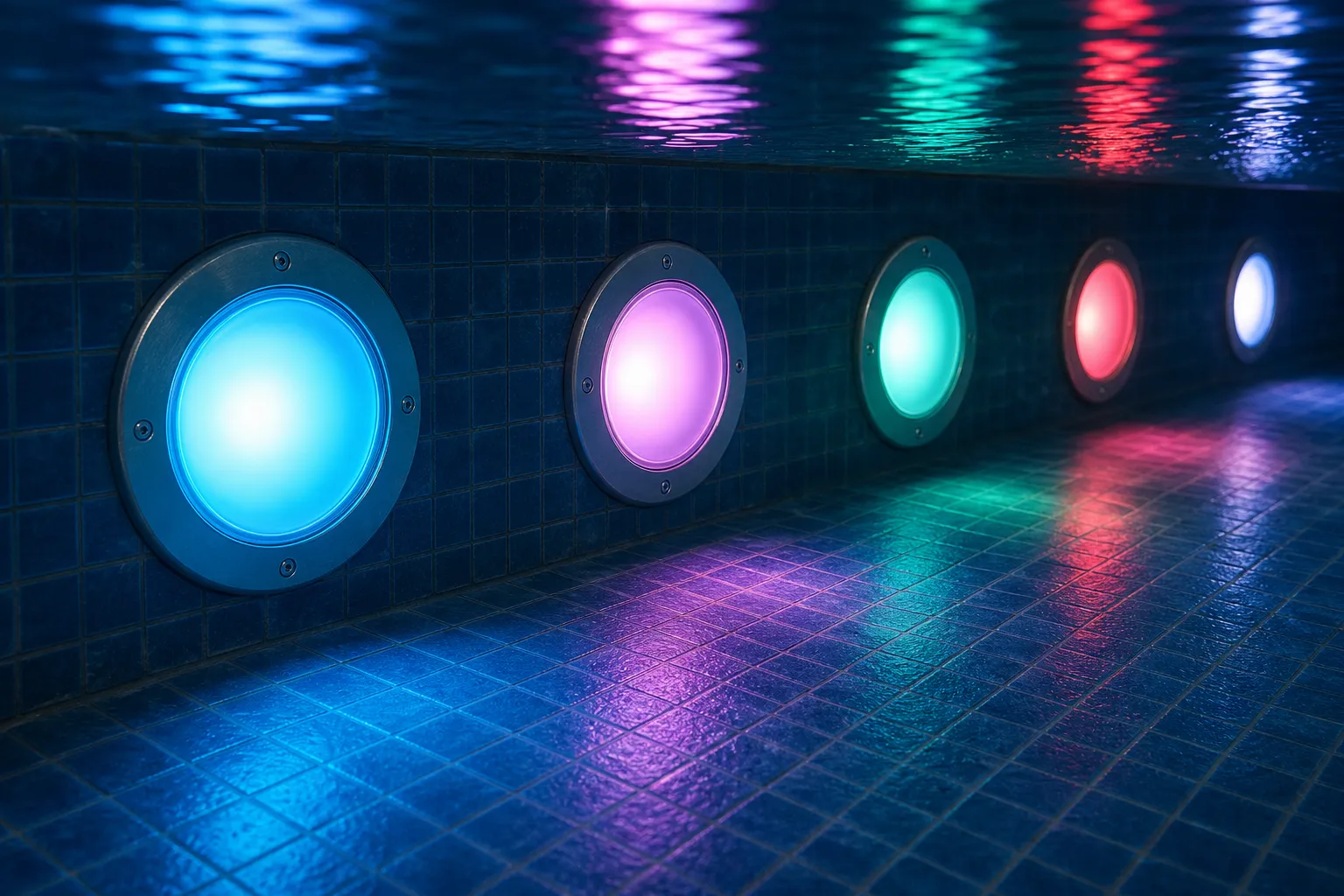
How can the protective cover glass of a smart underwater luminaire avoid uneven mixing of different colors of light?
For smart underwater RGB luminaires, uneven color mixing is usually related to LED spacing, optical lens design, distance to the protective cover glass, diffusion level and water projection distance. A suitable protective cover glass can help soften color transitions by using controlled haze, opal diffusion or a properly curved surface, but it should not blur the beam so much that output efficiency and projection definition are lost. The glass also needs to work with the complete optical structure. If red, green and blue LEDs are too close to the glass or arranged unevenly, the cover alone may not fully solve color separation. During development, the supplier should confirm glass thickness, transmittance, haze and curvature with real RGB modules, then test color uniformity underwater because water depth, viewing angle and installation distance can all change the final mixed-light effect.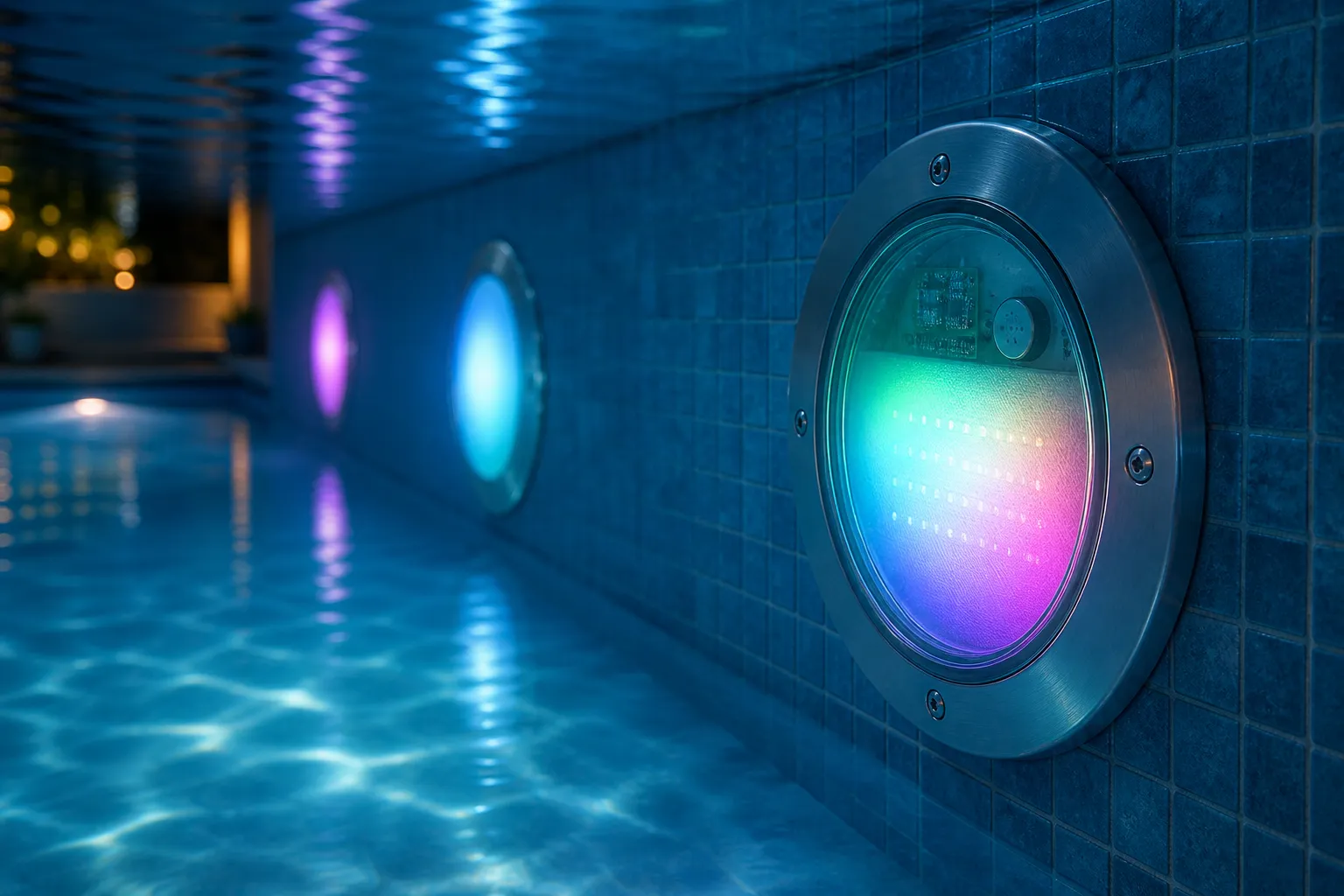
Why does the edge treatment of underwater luminaire glass affect the waterproofing stability?
The edge of the underwater luminaire glass is directly involved in sealing and stressing. Edge chipping, burrs, unevenness or size fluctuations will affect the gasket contact. Even if the front side of the glass is intact, micro-cracks on the edges may expand due to compression, thermal cycling or water pressure, creating the risk of water leakage and rupture.
Through edge grinding, chamfering and polishing, stress concentration can be reduced, gaskets can contact more evenly, and the risk of assembly cuts and edge chipping during transportation can also be reduced. Underwater lights generally have higher edge quality requirements than regular outdoor lights because repair costs and safety risks are higher if the seal fails.
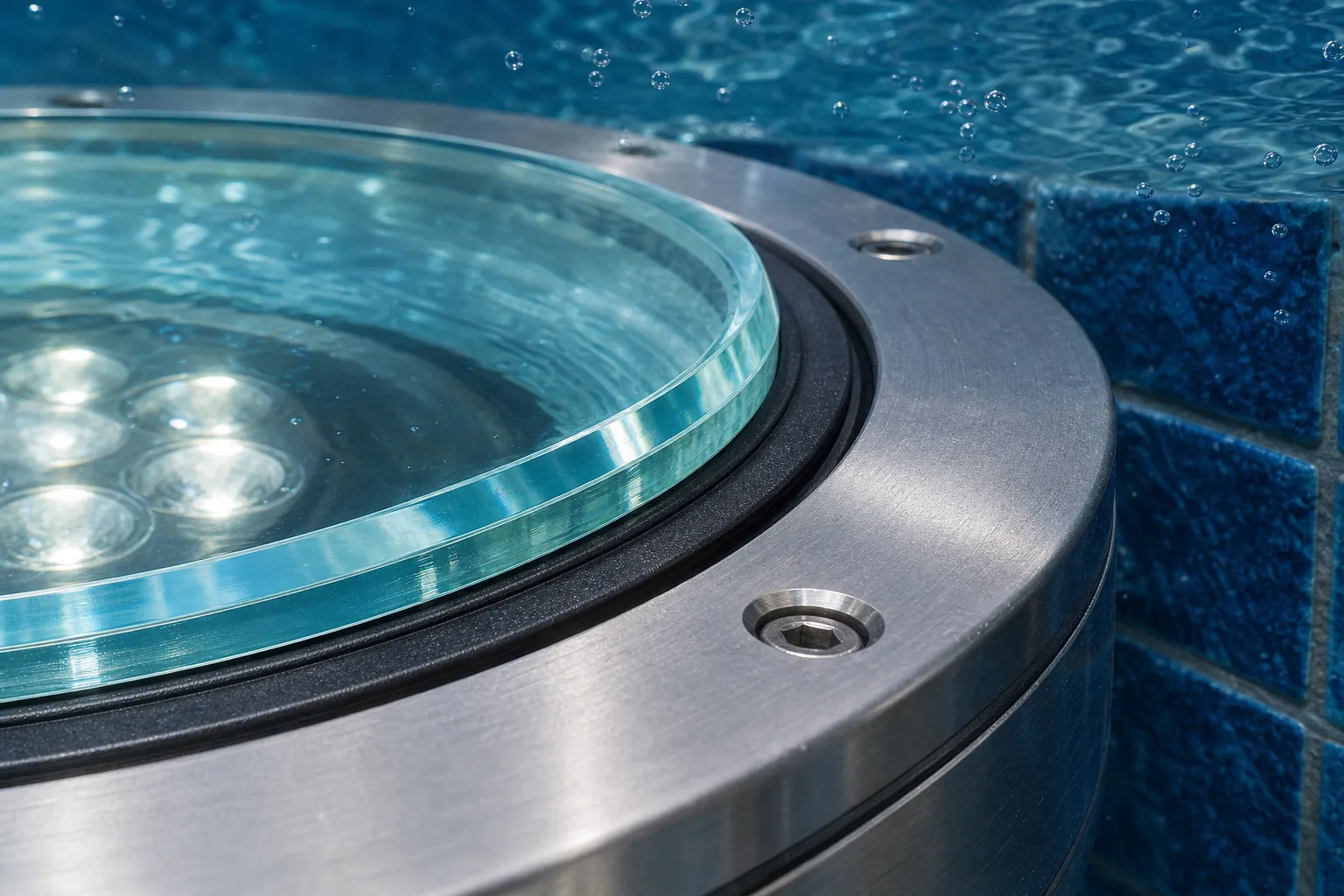
How do underwater luminaire glass components help the complete luminaire achieve IP68 long-term water immersion protection?
Underwater luminaire glass components can help the complete luminaire achieve IP68 long-term water immersion protection requirements through appropriate thickness, edge flatness, sealing surface quality, tolerance control and assembly structure. It should be noted that the IP rating is a classification of the dust-proof and waterproof capabilities of electrical equipment enclosures according to IEC 60529, and is not an independent certification of a single glass component itself.
In actual projects, the protective cover glass must also work with the metal housing, gasket, compression ring, outlet structure and potting process. Whether IP68 can ultimately be established should be based on the complete-luminaire water-pressure, water immersion, thermal cycling and third-party or project test results.
Engineering decision: For an IPX8 claim, state the immersion depth, duration and operating condition used for the complete product. Record glass flatness and thickness, gasket compression, housing flatness and cable-entry construction before the test, then inspect for water entry, fogging and seal movement after pressure and temperature cycling.
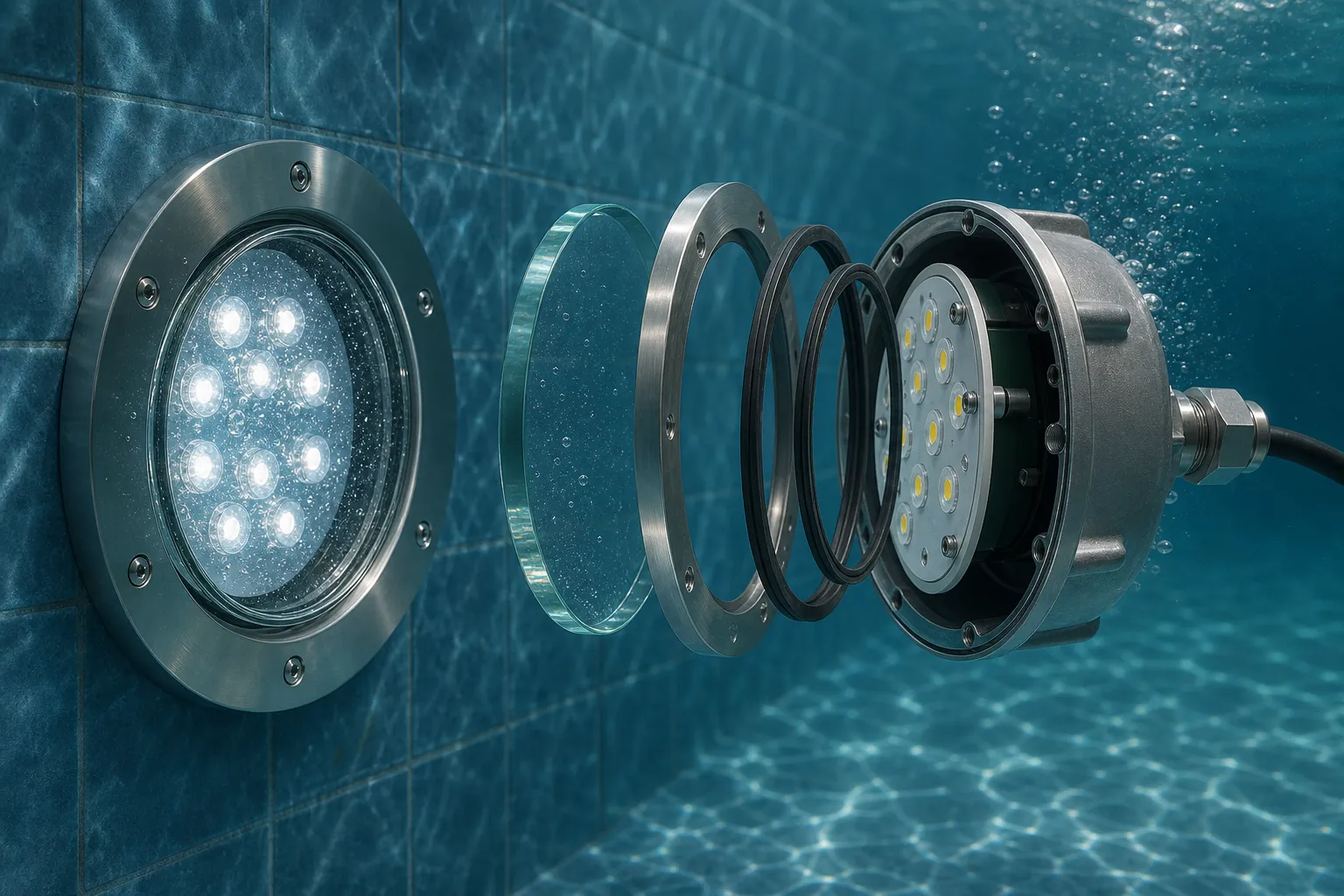
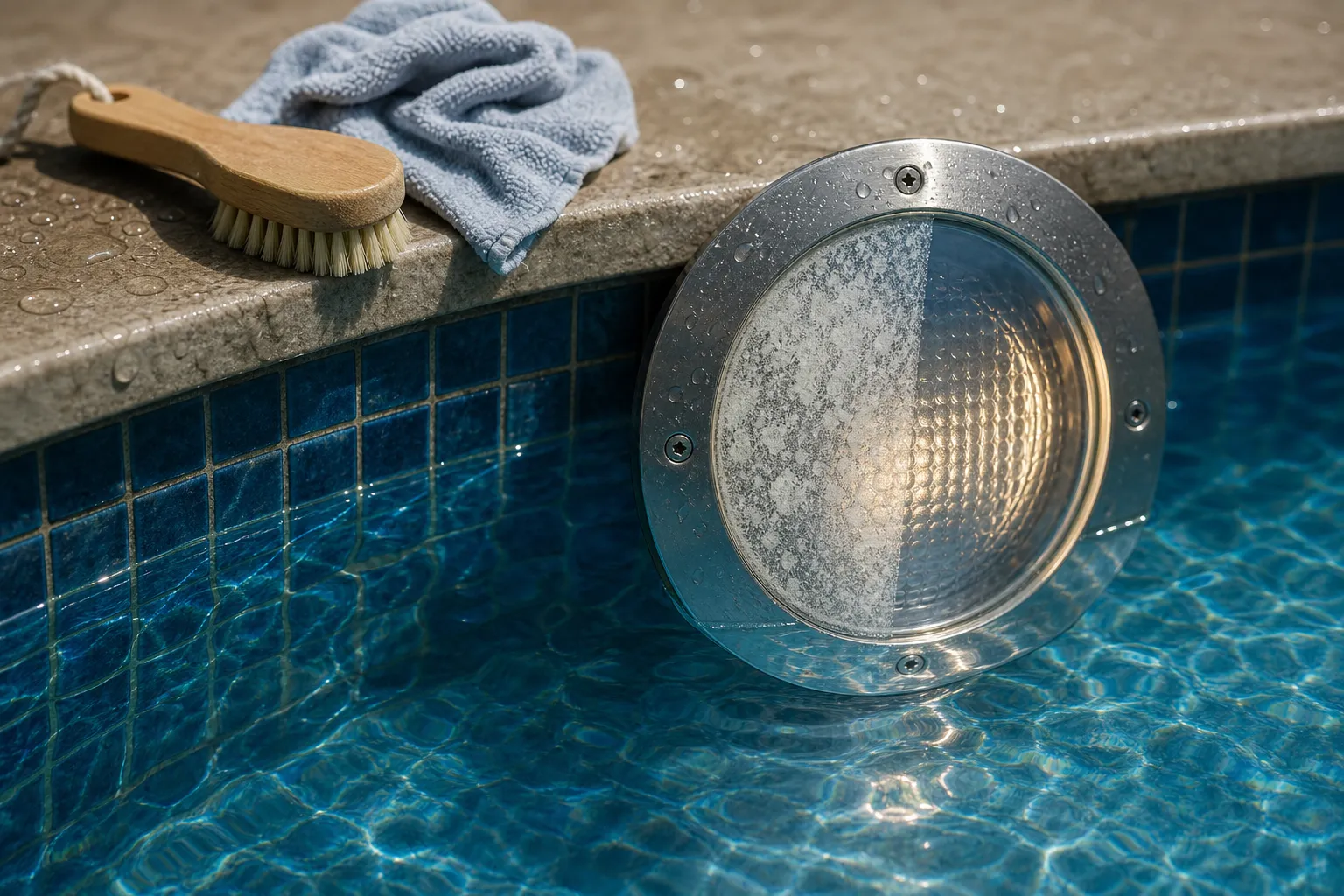
How can scale adhesion and maintenance frequency be reduced on underwater-light protective cover glass?
To reduce the adhesion of scale on the underwater luminaire protective cover glass, you must first make the surface as smooth as possible with as few grooves and rough textures as possible to avoid water flow stagnation and mineral deposition. Clear glass with a smooth exterior is generally easier to clean than rough, sandblasted surfaces and is better for long-term pool and fountain maintenance.
Consider scale-resistant, hydrophobic, or easy-to-clean coatings, but be sure to verify the coating's longevity with chlorine, detergents, and repeated scrubbing. Maintenance should be done regularly with a soft cloth to avoid scratching with hard objects after scale has solidified for a long time. Good water circulation and water quality control will also significantly reduce the frequency of cleaning the protective cover glass.
Contact Us
Your feedback fuels our growth, and your questions drive our solutions.
We value your feedback, inquiries, and suggestions. Please feel free to get in touch with us
General inquiries
Please contact us via sales@bo-glass.com, and we will reply to you as soon as possible.
Interested to work with us
Drop your resume at info@bo-glass.com
and we will get back to you shortly.
Request a Custom Glass Quote
Tell us about your project or upload a drawing.
Your drawings remain confidential.
We uses the contact information you provide to us to contact you about our relevent content, products, and services.