
Structural, Thermal and Safety Design
Glass must remain safe through manufacturing variation, assembly loads, source heat, cleaning, transport, installation, impact, and long-term service. Optical performance is useful only when the structure survives.
Jump to a question (16)
- What different requirements do closed and open glass lampshades have for efficacy, heat dissipation, and safety?
- Why do large glass chandelier shades require higher mechanical strength and thermal stability than other luminaires?
- Why are light weight/thinness and uniform diffusion equally important when selecting ceiling-light glass covers for low-ceiling spaces?
- Why should corridor wall-lamp glass shades consider impact resistance and shatter protection in addition to efficacy?
- For replaceable glass lampshades, how can optical matching and safety be ensured when users replace them themselves?
- How can ultra-thin glass diffusers for LED strips balance uniform diffusion and mechanical strength below 3 mm thickness?
- For toe-kick lights and cabinet linear lights, what load-bearing and waterproof sealing standards should tempered glass covers meet?
- In coastal or high-humidity environments, metal fittings on glass lampshades corrode easily; how should compatible sealing processes be selected?
- How can lampshades be sealed structurally against dust and insects without affecting heat dissipation?
- How can bathroom glass lampshades meet both moisture-proof sealing and high transmittance?
- What specific requirements do children's room glass lampshades have for impact resistance and blue-light protection?
- How should IP ratings for dust and water protection be understood, and what minimum ratings are needed in dry and wet zones?
- What ceiling load-bearing requirements apply when installing heavy chandeliers and large ceiling lights?
- How should cut-out size and heat-dissipation space be reserved for recessed luminaires so installation is safe and future replacement is easy?
- In older residential buildings with unstable voltage, what protective measures should be considered when selecting and installing lights?
- If a glass lampshade breaks accidentally at home, what emergency handling and safe replacement steps are needed?
Structure, temperature, mounting, and protection
Coordinate glass geometry with the fixture, gasket, fastener, heat path, IP strategy, installation method, and foreseeable misuse.
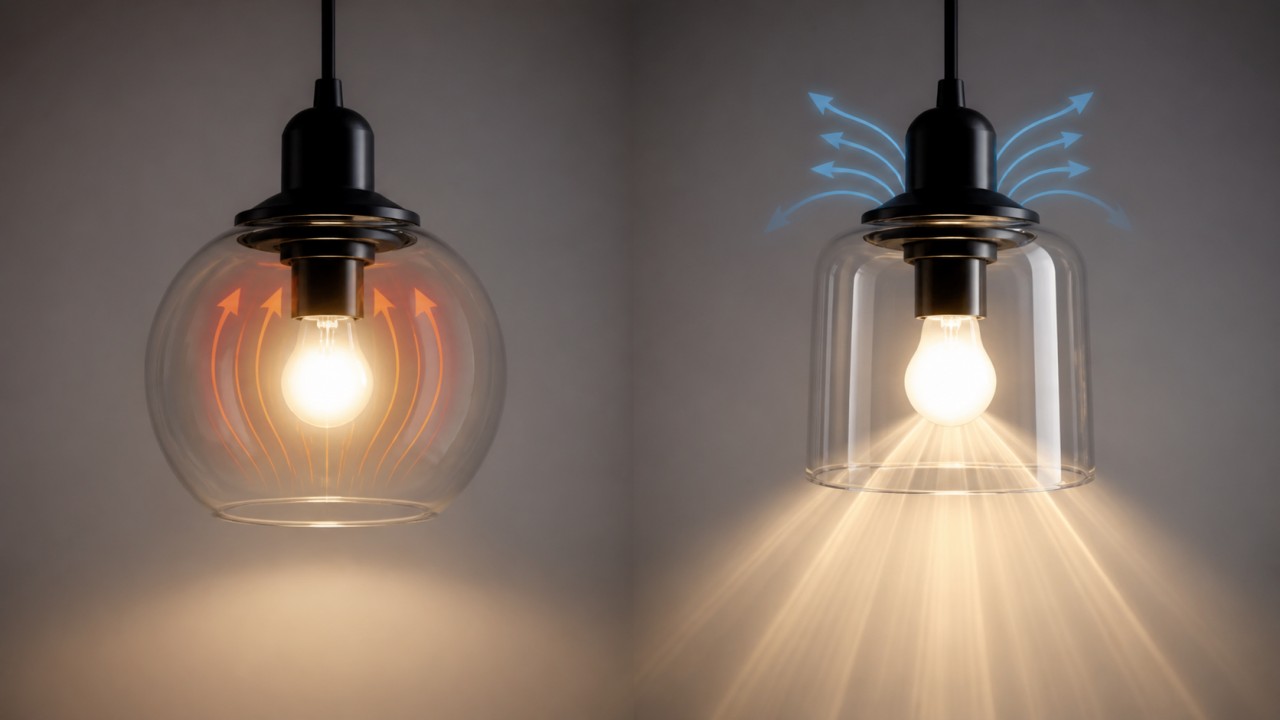
What different requirements do closed and open glass lampshades have for efficacy, heat dissipation, and safety?
Light efficacy requirements: transmittance and beam control A closed shade can place glass across more of the emitted light paths, but total optical loss depends on the shade geometry, thickness, tint, finish, coating, internal reflections, source distribution, and housing. No universal ≥91% material value or 15% loss limit applies. Define acceptance through complete-luminaire luminous flux, efficacy, intensity distribution, glare, and maintained cleanliness for the intended design.
An open shade may allow some light to exit without passing through glass, but it does not automatically provide higher efficacy or more precise distribution. Clear, ribbed, opal, frosted, and optical glass can all be used in open or closed constructions when supported by complete-luminaire photometry and glare evaluation.
Heat dissipation requirements: heat buildup and LED lifetime A closed shade can restrict convection and alter LED, driver, seal, and glass temperatures, but the effect cannot be predicted from enclosure type or wattage alone. Select the glass composition and thermal design from measured complete-luminaire temperatures, ambient rating, heat-source distance, thickness and curvature, edge condition, mounting restraint, and the applicable safety tests. Borosilicate glass may offer a useful low-expansion margin, but it is not automatically required for every closed shade.
An open shade may improve natural convection, but it does not automatically make any source power safe or guarantee longer life. The complete luminaire still needs temperature, electric-shock, fire, mechanical, and accessibility assessment in its intended mounting position. Material selection should follow measured conditions and risk, not a universal rule that ordinary soda-lime glass is always sufficient.
Why do large glass chandelier shades require higher mechanical strength and thermal stability than other luminaires?
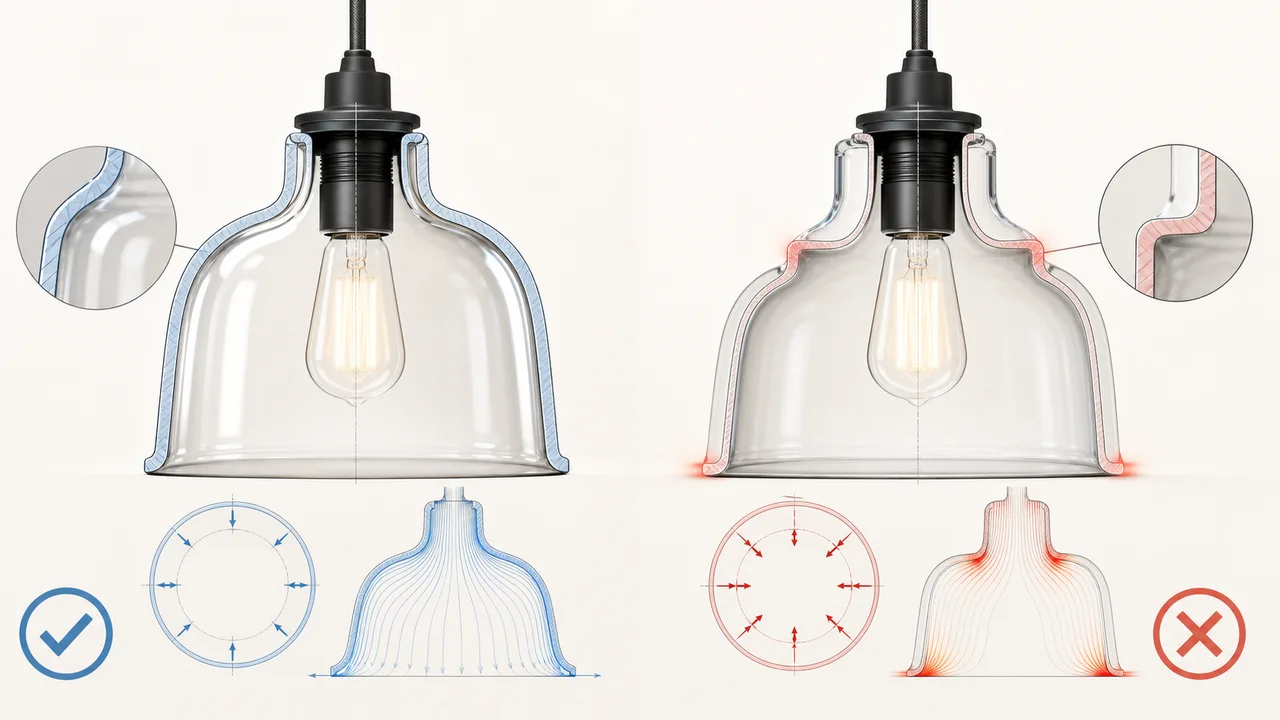
For a fixed general-purpose chandelier, assess the complete product to IEC 60598-1:2024 together with IEC 60598-2-1:2025. IEC 60598-2-1 covers fixed general-purpose luminaires and is used with the general safety requirements and tests in Part 1. If the product has a different classification, special function, installation method, or target-market adoption, confirm the corresponding Part 2 and national requirements with the test laboratory or certification body.
Glass selection and test severity are determined from the complete luminaire design, including accessibility, mounting height, shade mass and geometry, suspension and secondary retention, edge protection, source temperature, breakage consequences, maintenance, and the applicable clauses. The standards do not create one universal rule that every chandelier shade must use the same glass type, impact test, or thermal-shock condition.
Self‑weight and suspension stress Large‑sized glass chandelier shades typically have large diameters (e.g., >50 cm) and considerable thickness, with self‑weight reaching several kilograms or even more than ten kilograms. Unlike small luminaires, these loads are fully transferred through the suspension points (such as top metal rings or screw fittings) into the entire glass structure. Ordinary glass may creep or develop stress concentrations under long‑term static loading, whereas tempered or laminated glass can withstand higher bending and shear stresses. Furthermore, the suspension points must be designed to distribute stress uniformly and avoid local overload. Large shades also may experience accidental impact during transport and installation, requiring higher impact resistance.
Why are light weight/thinness and uniform diffusion equally important when selecting ceiling-light glass covers for low-ceiling spaces?
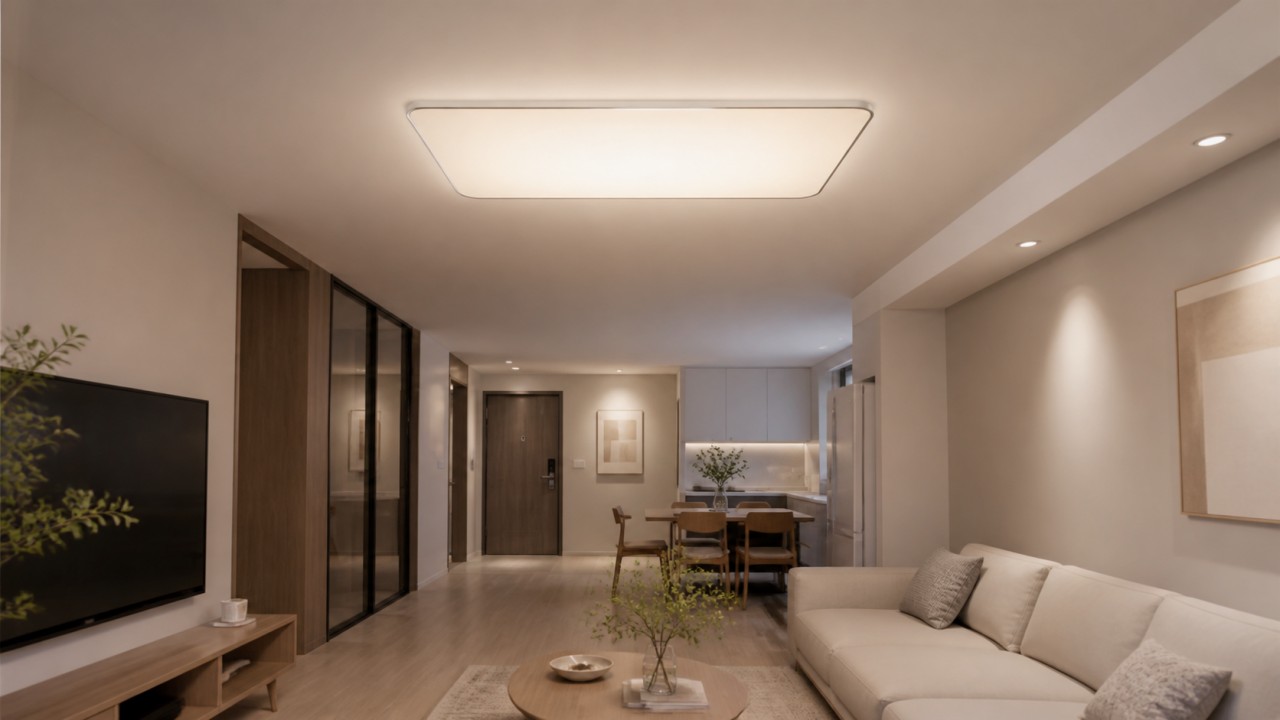
The special challenge of low ceiling height spaces Low ceiling height spaces typically refer to rooms with a ceiling height below 2.5 meters, or even as low as 2.2-2.4 meters. In such spaces, a ceiling luminaire is almost directly overhead, with the human eye very close to the fixture. Any shortcoming of the fixture is magnified: a thick or bulky glass shade will intensify the feeling of oppression; uneven light diffusion will allow the human eye to directly see bright LED spots or alternating bright‑dark patterns, causing severe glare and visual discomfort. Therefore, thinness and uniform diffusion become two equally indispensable requirements.
Why “thinness” matters In low ceiling spaces, the visual oppression largely comes from the perceived bulk of objects overhead. A thick, heavy glass shade feels like a heavy stone hanging over your head, making the space feel cramped. A thin glass shade (e.g., only 3-5 mm thick, flat or slightly curved) appears visually lighter and blends almost seamlessly with the ceiling, reducing the sense of intrusion. Moreover, thinness also means a lighter total fixture weight, safer installation, and less load on the ceiling structure. Optically, thin does not mean low transmittance — modern ultra‑clear glass can achieve over 90% transmittance even at small thicknesses.
Why should corridor wall-lamp glass shades consider impact resistance and shatter protection in addition to efficacy?
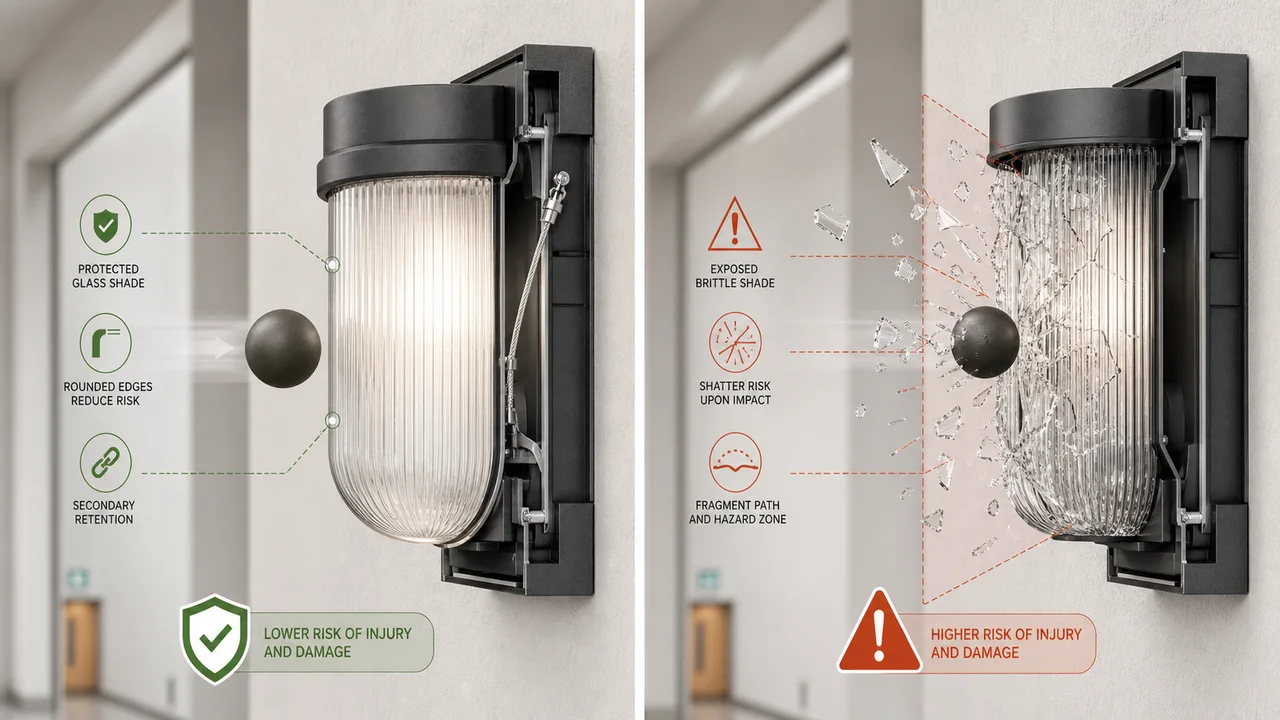
Corridor wall lights may be exposed to carts, furniture, bags, cleaning equipment, and accidental body contact. The risk assessment should consider installation height, projection from the wall, glass mass and geometry, expected impact location and energy, edge exposure, pedestrian route, and whether people can contact or stand below the shade.
Glass family alone does not establish impact resistance. Wall thickness, curvature, surface and edge condition, holes and cut-outs, tempering or heat strengthening, residual stress, support width, gasket stiffness, clip position, frame deformation, and the complete mounting assembly can control the result. Qualify the production luminaire using the applicable impact and retention method rather than relying on generic strength multipliers.
Tempering can change the fragmentation pattern and may reduce the risk of large knife-like shards, but tempered fragments can still cause injury and the fragmentation result depends on glass thickness, process, geometry, impact, and support. Laminated constructions can retain many fragments when the interlayer, edges, and frame remain effective, but retention and post-breakage stability must be tested in the actual assembly.
Where falling fragments are foreseeable, consider secondary retention, a protective frame, film or lamination validated for the temperature and cleaning environment, reduced projection, guarded placement, and a replacement method that does not expose users to damaged edges. The acceptance plan should cover impact, breakage behavior, fragment retention, mounting security, and inspection after transport and installation.
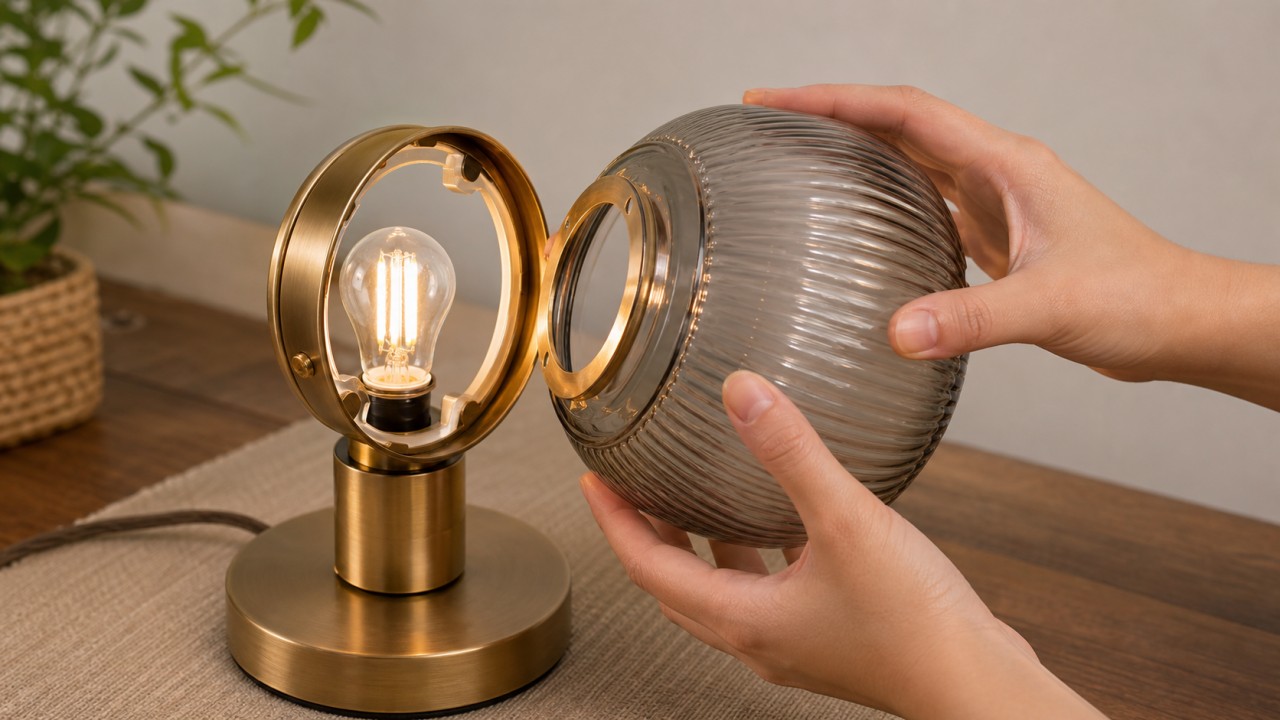
For replaceable glass lampshades, how can optical matching and safety be ensured when users replace them themselves?
Optical matching: precision of physical dimensions Replaceable glass lampshades must first precisely match the original luminaire in physical dimensions. The luminaire’s optical path is typically designed for a specific shade size, so the diameter, height, opening size, and mounting interface (e.g., clip-on, screw-fixed, twist-lock) must be identical to the original specifications. Mismatched dimensions not only alter light distribution and reduce efficacy but may also cause insecure attachment and risk of falling. Therefore, users should prioritize replacement products that explicitly state compatibility with the original model and verify that all geometric parameters and interface types are exactly the same.
Optical matching: consistency of material and finish The glass material and surface treatment directly affect transmittance, haze, and transmitted light color. Clear glass, opal glass, frosted glass, and patterned glass each have distinct optical characteristics. If the original shade uses high-haze opal glass to hide the light source and provide uniform diffusion, replacing it with clear glass will ruin glare control and create harsh bright spots. Likewise, the absence of original coatings or films (such as anti-reflection or oleophobic layers) will alter optical performance. Users should try to select replacement shades that match the original glass type and surface finish, or choose certified compatible components that have been optically tested.
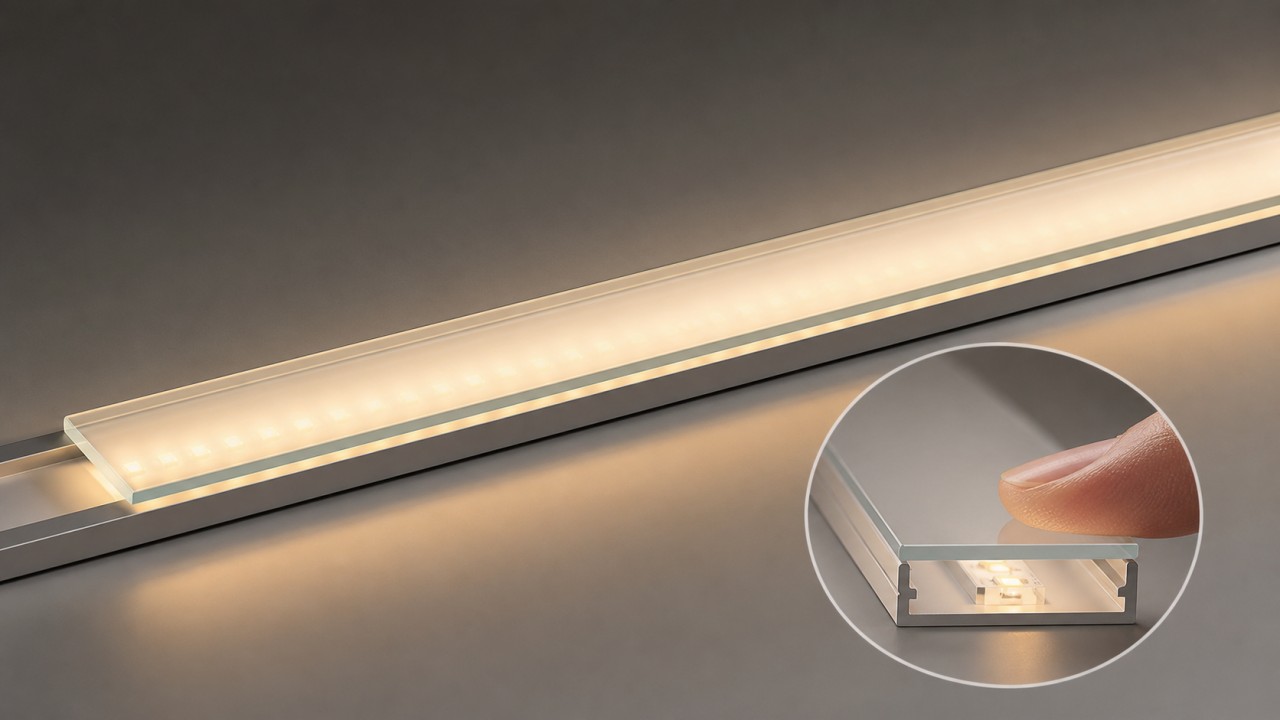
How can ultra-thin glass diffusers for LED strips balance uniform diffusion and mechanical strength below 3 mm thickness?
Achieving uniform diffusion: internal scattering particles During the manufacturing process, ultra-thin glass diffusers incorporate fine scattering particles (such as titanium dioxide or barium sulfate) with high melting points and high refractive indices into the glass matrix. When light passes through the glass, it undergoes multiple refractions, reflections, and scattering events among these particles, thereby mixing the originally discrete point or line light sources of LED strips into a uniform area light. This internal scattering (bulk diffusion) does not rely on surface roughness and can achieve haze over 90% even at very thin thicknesses while maintaining relatively high transmittance. Because scattering occurs inside the glass, the surface remains smooth, making it easy to clean and resistant to wear.
Achieving uniform diffusion: surface microstructures Another advanced approach is to fabricate micron-scale lens arrays, prisms, or random texture structures on the surface of ultra-thin glass. This can be achieved through photolithography, chemical etching, or precision imprinting (such as LIDE technology). These microstructures precisely control the exit angle of light, eliminating hot spots and dark areas, resulting in extremely uniform diffusion. Compared to internal scattering, surface microstructures offer greater design flexibility, allowing customization of the diffusion angle according to the arrangement of LED strips while reducing light loss. This technology is particularly suitable for high-end LED strips where optical performance must be excellent at thicknesses of only 1-2 millimeters.
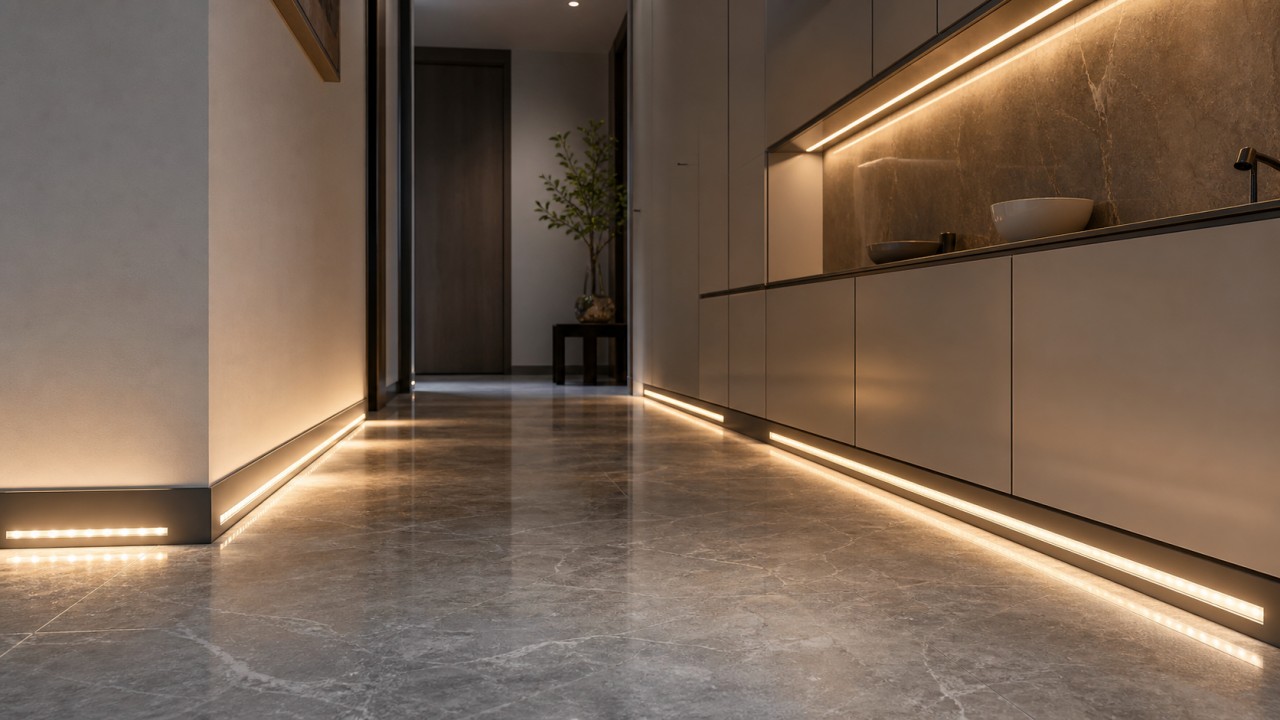
For toe-kick lights and cabinet linear lights, what load-bearing and waterproof sealing standards should tempered glass covers meet?
Ground-recessed luminaires can be exposed to pedestrians, wheels, furniture, maintenance tools, or other mechanical loads. Identify the applicable IEC 60598 Part 2 or national product standard and the project load class before setting force, duration, impact energy, support condition, or post-test criteria. Do not infer compliance from a generic 1,500–5,000 N range, an IK label, a 4 mm thickness, or tempering alone. Test the production-representative complete luminaire, including the transparent cover, frame, seals, fasteners, cable entry, and mounting arrangement.
Cabinet linear lights can experience cleaning pressure, shelf deflection, door vibration, local point loads, and installation stress. A furniture-glass value should not be transferred directly to a luminaire cover without confirming scope, support geometry, specimen dimensions, and acceptance criteria. Select glass type and thickness through the actual span, curvature, edge finish, supports, fasteners, contact loads, accessibility, and applicable luminaire requirements, then verify the assembled product.
Ground-recessed lights can face splash, cleaning water, condensation, temporary pooling, soil, dust, and corrosion. IEC 60529 defines enclosure protection classifications, but it does not impose one universal IP rating on every ground luminaire. Determine the required rating from the intended installation, drainage, likelihood and duration of water exposure, the applicable IEC 60598 Part 2 or national requirement, local rules, and the tested mounting configuration. Verify the complete enclosure—including glass, frame, gaskets, adhesive, fasteners, vents, and cable entry—after relevant conditioning and durability tests.
In coastal or high-humidity environments, metal fittings on glass lampshades corrode easily; how should compatible sealing processes be selected?
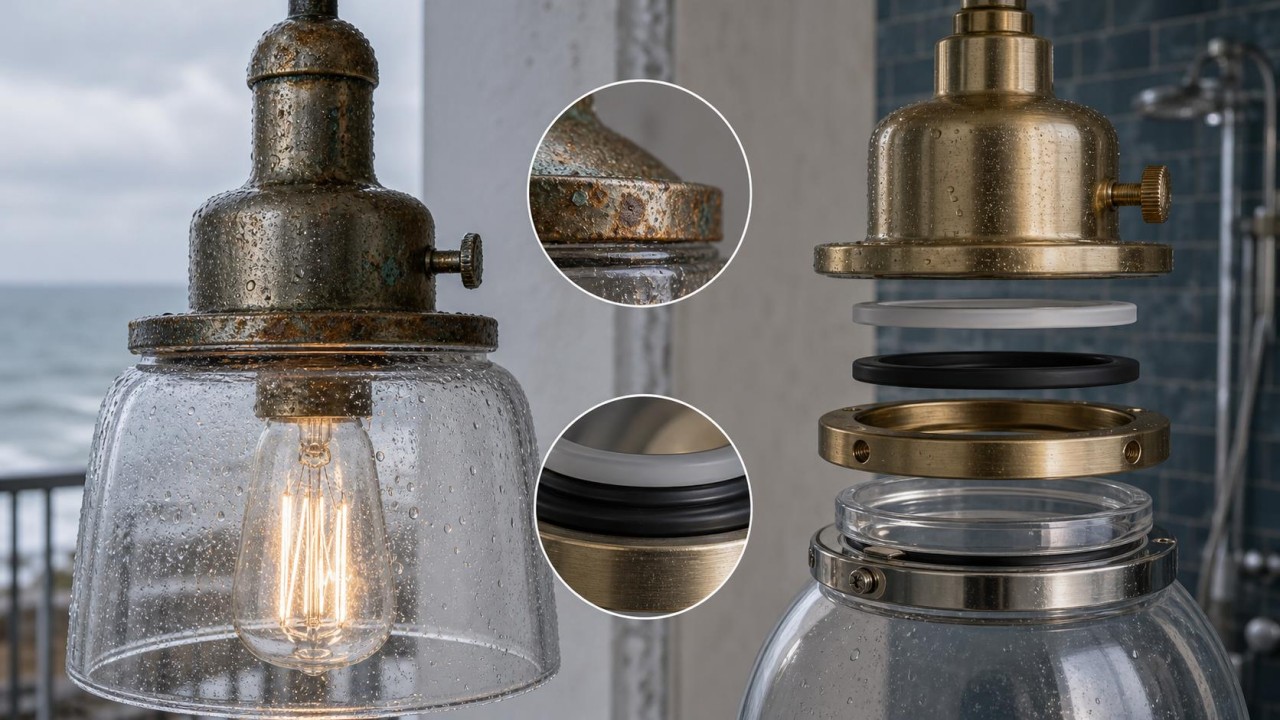
In coastal or high-humidity environments, the glass shade itself is usually not the first component to fail. The vulnerable parts are metal clips, screws, retaining rings, rods, rivets, springs, and sealed joints. Salt mist, moisture, and cleaning chemicals accelerate corrosion. Once metal parts corrode, the fixture may show staining, reduced holding force, seal failure, uneven stress on the glass, or even loosening of the shade.
Material selection is the first line of defense. For indoor damp areas, 304 stainless steel, anodized aluminum, powder-coated aluminum, or high-quality plated hardware may be acceptable. For coastal homes, semi-outdoor areas, bathrooms, balconies, and sea-view rooms, 316 stainless steel, marine-grade aluminum, fluorocarbon-coated aluminum, or coatings verified by salt-spray testing are safer. Ordinary iron, low-grade plated steel, unsealed aluminum, and thin decorative plating should not be used as critical fixing parts in long-term humid environments.
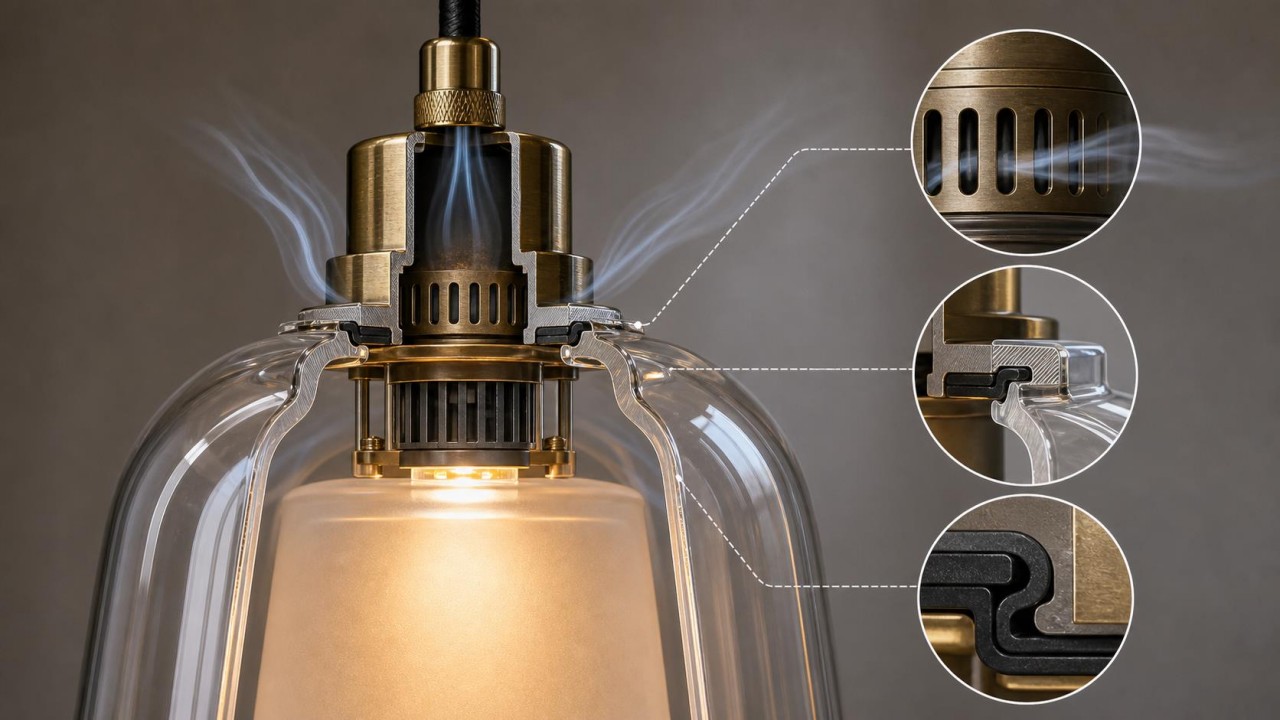
The sealing process should avoid rigid glass-to-metal locking. Glass and metal have different thermal expansion behavior. If they are clamped together too rigidly, temperature changes can create stress concentration, edge chipping, or seal cracking. A better approach is to use an elastic transition layer such as silicone gaskets, EPDM gaskets, fluorosilicone rings, PTFE pads, or structural adhesive. The gasket cushions stress and also helps isolate galvanic corrosion and capillary water ingress.
For moisture-resistant luminaires, use a full-perimeter seal that still allows stress relief. Transparent silicone, hydrolysis-resistant silicone, MS polymer adhesive, or suitable UV adhesive can bond glass to the frame, but compatibility with glass, metal coating, and cleaning chemicals must be confirmed. Bathroom and semi-outdoor fixtures should also use labyrinth joints, overlapping lips, waterproof breathable vents, and drainage paths, rather than depending on a single bead of sealant.
How can lampshades be sealed structurally against dust and insects without affecting heat dissipation?
Dust or insects inside a glass lampshade are usually not a glass problem. They come from gaps in the fixture structure, negative-pressure suction during cooling, unsealed cable holes, untreated mounting openings, or poorly designed ventilation slots. To block dust and insects without harming heat dissipation, the fixture should not simply be sealed blindly. It should block particles, allow controlled pressure or air exchange, and manage heat through a designed thermal path.
First, control the gap geometry. Dust and insects enter through the joint between the shade and body, cable entries, clip openings, ventilation holes, and removable interfaces. The shade-to-body joint should use a continuous gasket, labyrinth overlap, or stepped interface instead of a straight-through gap. Cable entries should use rubber grommets, silicone plugs, potting compound, or sealed cable glands. A removable shade can use a twist-lock and compression gasket, allowing cleaning while still sealing reliably when closed.
Second, heat dissipation should not depend on random leakage gaps. LED fixtures should conduct heat through the PCB, heat sink, metal backplate, or housing. If the thermal path is well designed, the shade cavity can be relatively closed. If ventilation is necessary, use a dustproof breathable membrane, insect screen, or folded air path in a non-visible location so that air can exchange but particles and insects cannot easily enter.
Breathable membranes such as ePTFE are useful for pressure balance. When the lamp is on, internal air expands. When the lamp turns off and cools, negative pressure can pull dust or insects through small gaps. A breathable membrane allows slow pressure equalization while blocking droplets and particles, reducing suction through uncontrolled gaps.
How can bathroom glass lampshades meet both moisture-proof sealing and high transmittance?
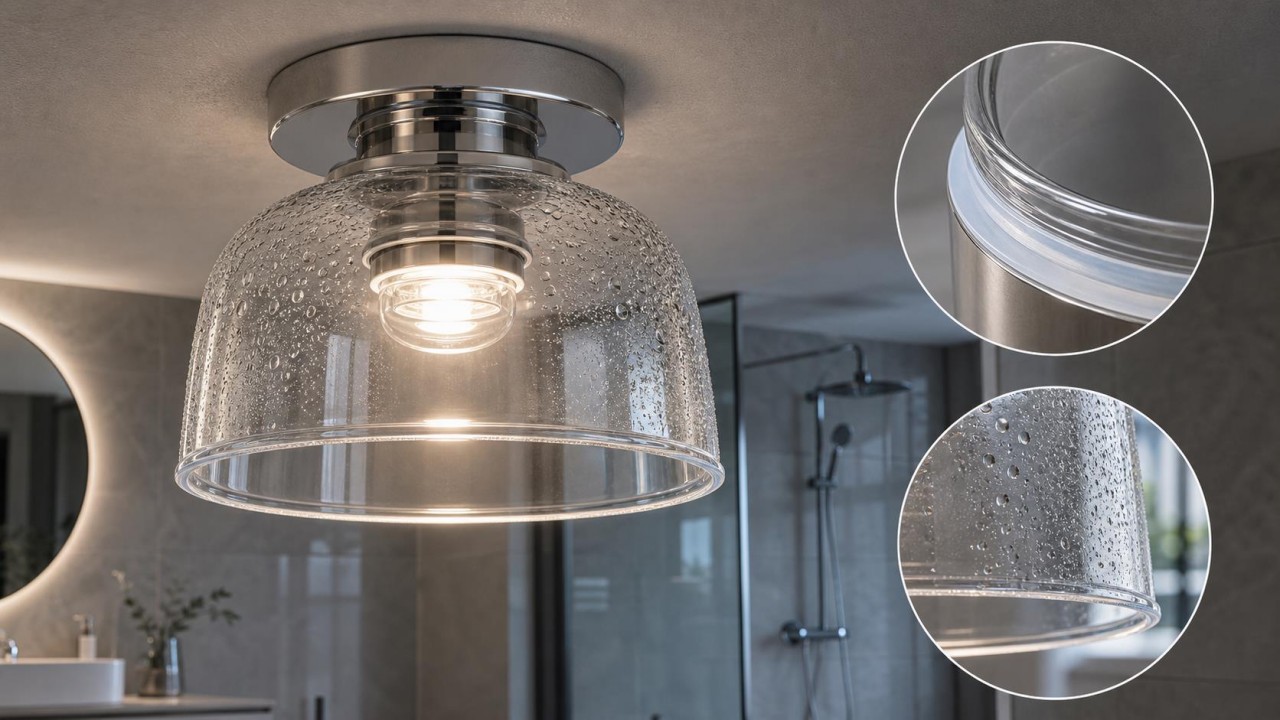
Bathroom lighting is difficult because the shade must resist moisture while still allowing enough light to pass through. A bathroom contains steam, condensation, water splashes, cleaning chemicals, and repeated temperature changes. If the shade is poorly sealed, moisture can enter the lamp body, causing fogging, corrosion, short circuits, yellowing, or failure of the LED driver. But if the sealing structure is too thick or placed in front of the luminous area, it blocks light and reduces the effective optical aperture. The design therefore has to solve both problems at the same time.
The sealing interface is usually best kept outside the main optical aperture. Gaskets, adhesive, frames, and compression features can be placed at the side wall, flange, or concealed edge when compatible with the product design. The required IP rating is not automatically IP65: select it for the complete luminaire from the exact bathroom zone, water exposure, mounting orientation, local electrical rules, and applicable product standard, then verify the production configuration through a traceable enclosure test.
The glass substrate should have high transmittance and good safety performance. Low-iron tempered glass is a strong choice because it can reach about 91-92% visible-light transmittance while providing better breakage behavior than ordinary annealed glass. Borosilicate glass is also useful where thermal shock is a concern, because bathroom fixtures can experience repeated heating and cooling. If softer light is desired, it is better to use micro-prismatic glass or a controlled diffusion texture rather than very heavy frosted or opal glass. Heavy diffusion can hide the light source, but it may reduce useful output too much.
What specific requirements do children's room glass lampshades have for impact resistance and blue-light protection?
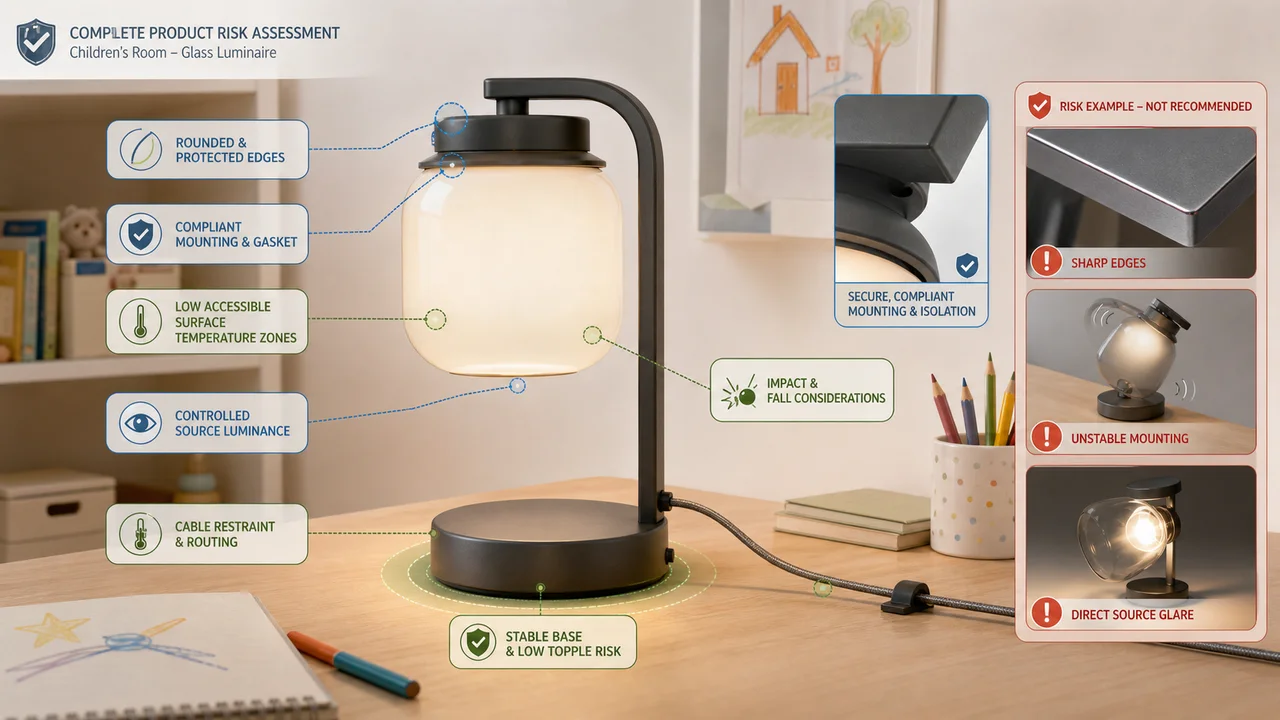
For a luminaire used in a children's room, begin with a complete-product risk assessment: installation height, reachability, likelihood and direction of impact, shade mass and projection, edge exposure, mounting security, source temperature, electrical access, foreseeable misuse, and the consequences of breakage. Glass family alone does not establish impact resistance or injury risk.
Wall thickness, curvature, holes, edge quality, surface damage, residual stress, tempering or strengthening, support width, gasket stiffness, fastener position, and frame deformation can dominate mechanical performance. Tempered, laminated, filmed, guarded, or secondary-retained constructions may reduce particular hazards, but none is automatically preferable for every shade. Verify impact, fragmentation, retention, post-breakage stability, temperature compatibility, and aging on the actual assembly.
Blue-light or photobiological-safety claims should be based on the complete luminaire under the applicable method, not inferred from the glass colour or a filter claim. Request the tested spectrum, distance, operating mode, optical configuration, radiance or irradiance, exposure assumptions, classification, standard edition, and model coverage. Any spectral filtering should also be checked for flux loss, chromaticity shift, colour rendering, glare, and durability.
Where a glass shade remains reachable, consider recessed placement, rounded or protected edges, a robust frame, restricted surface temperature, secondary retention, and a service procedure for damaged parts. Final acceptance should follow the current product and market requirements identified for the exact luminaire.
How should IP ratings for dust and water protection be understood, and what minimum ratings are needed in dry and wet zones?
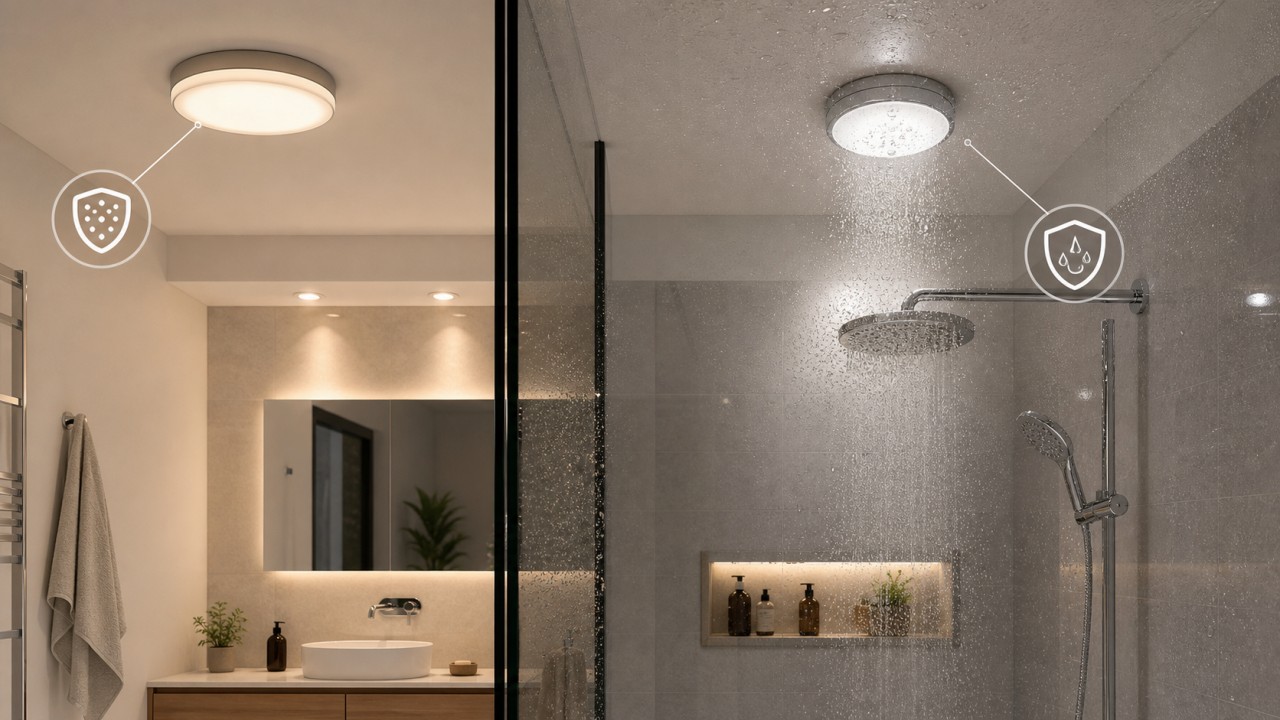
An IP code uses characteristic numerals to classify protection provided by an enclosure against access, solid foreign objects, and water under defined tests. Examples such as IP20, IP44, or IP65 describe different tested conditions, but the code should be read from IEC 60529 rather than treated as a simple “higher is always better” marketing scale. The claim belongs to the tested enclosure configuration and mounting orientation.
IP is assigned to the tested enclosure or complete luminaire, not to a glass sheet and not from glass thickness alone. A 3 mm and a 6 mm cover can achieve the same IP rating with different frames, gaskets, fasteners, cable entries, vents, tolerances, and mounting orientations. Publish an IP claim only with the tested model, configuration, mounting position, report number, laboratory, standard edition, preconditioning, and any permitted variants.
Values such as IP20, IP44, IP54, IP65, IP67, and IP68 describe different tested enclosure-protection levels; they are not universal room labels. Select the required level from the actual dust and water exposure, installation zone, orientation, drainage or immersion condition, maintenance method, manufacturer instructions, the applicable luminaire Part 2 standard, and local regulations. A rating suitable for one bathroom, kitchen, outdoor, or in-ground position may be unsuitable for another.
IP rating is not the only safety factor. Also consider mounting position, supply voltage, grounding, residual-current protection, corrosion resistance, condensation, drainage, thermal management, and local zone rules. Bathroom and outdoor lights should not rely only on marketing claims. Check a traceable complete-luminaire report and install according to the electrical code for the target market. IEC 60529 classifies enclosure protection; it does not by itself specify the correct bathroom zone or approve a luminaire for every installation.
What ceiling load-bearing requirements apply when installing heavy chandeliers and large ceiling lights?
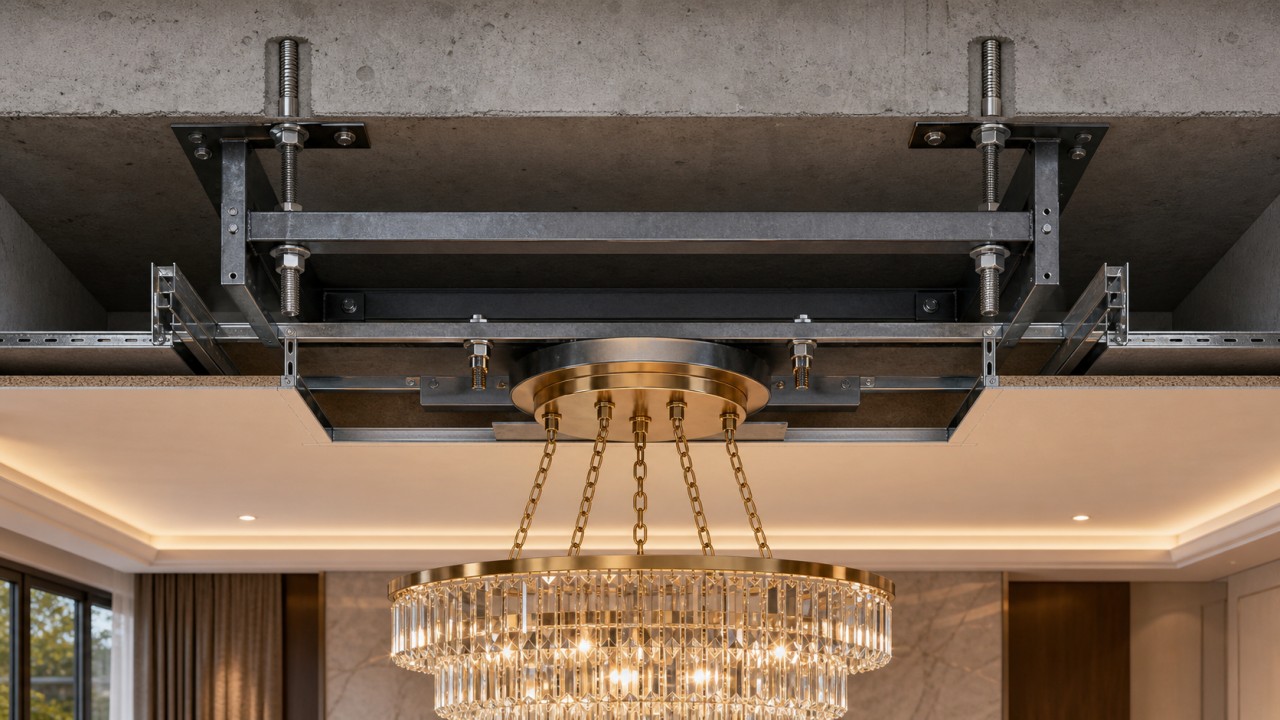
Heavy chandeliers and large ceiling lights must not be fixed only to gypsum board, wood veneer, or ordinary suspended-ceiling runners. They must connect to a reliable load-bearing structure, such as a concrete slab, embedded anchor, reinforced steel frame, reinforced main runner, or dedicated suspension point. The heavier the fixture, the more important it is to consider long-term static load, installation impact, swing, and vibration or seismic factors.
Before installation, confirm the total weight, including glass shades, metal parts, light sources, drivers, and decorative elements. Suspension points, expansion bolts, rods, steel cables, backplates, and connectors all need sufficient safety margin. Large ceiling lights should use multiple load points to avoid deformation from single-point loading. Glass parts should have secondary retention or anti-fall structures, especially large glass shades and crystal pendants.
In finished apartments or older buildings, the ceiling structure must be verified. If uncertain, open an inspection point or ask a professional installer. Heavy fixtures are best planned during renovation with embedded reinforcement; strengthening after finishing is harder. The rule is: decorative surfaces do not carry weight. Loads must return to the building structure or a calculated reinforcement system.
How should cut-out size and heat-dissipation space be reserved for recessed luminaires so installation is safe and future replacement is easy?
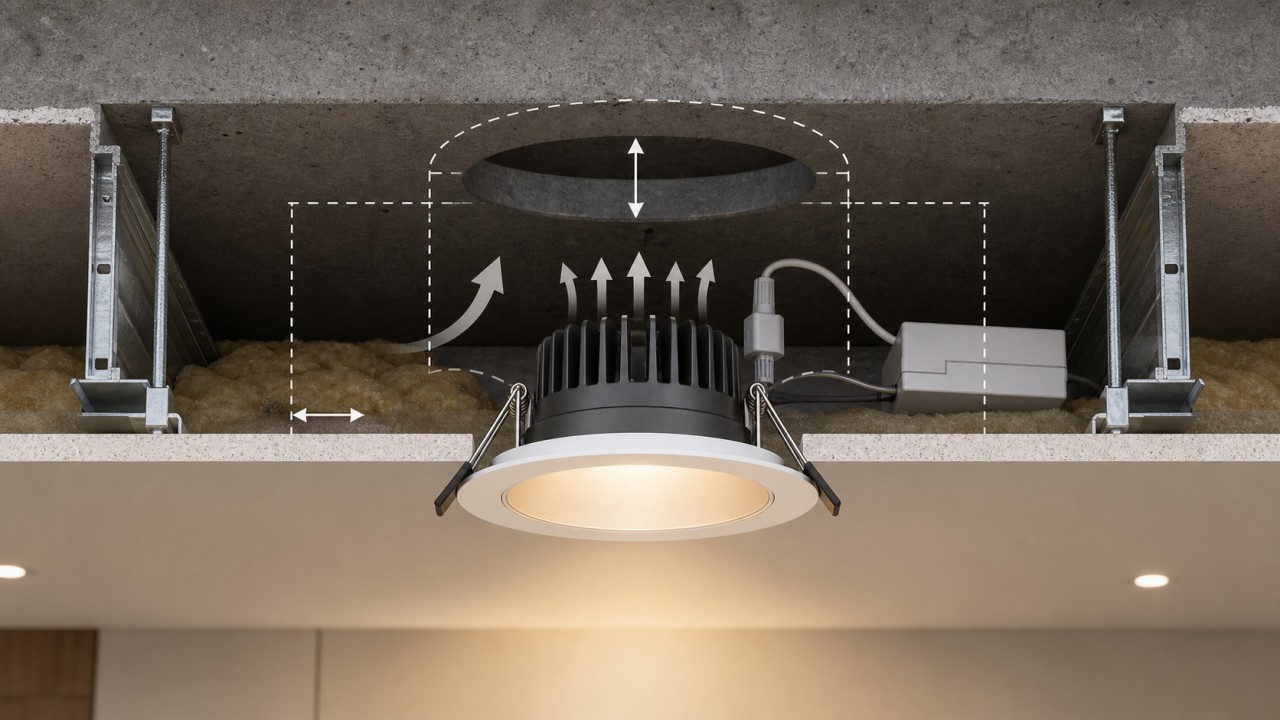
For recessed luminaires, do not reserve holes based only on visible trim size. Check the product manual for cut-out diameter, installation depth, spring clearance, heat-dissipation distance, and driver space. A hole that is too small prevents installation. A hole that is too large causes weak fixing, gaps, or poor appearance.
Heat space is critical. Recessed LED fixtures need to transfer heat to the housing and ceiling cavity. If insulation, wood boards, or debris press directly against the fixture, temperature rises, causing lumen depreciation, driver failure, or safety risk. Reserve top and side clearance according to the manufacturer. Do not bury the driver in a non-ventilated and non-serviceable location.
For future replacement, use common cut-out sizes, keep an access opening or pull-out driver lead, and avoid permanently sealing the driver. Record fixture model and cut-out dimensions for multiple lights. For no-main-light systems, confirm actual samples before ceiling work, so the cut-outs are not discovered to be wrong after finishing.
In older residential buildings with unstable voltage, what protective measures should be considered when selecting and installing lights?
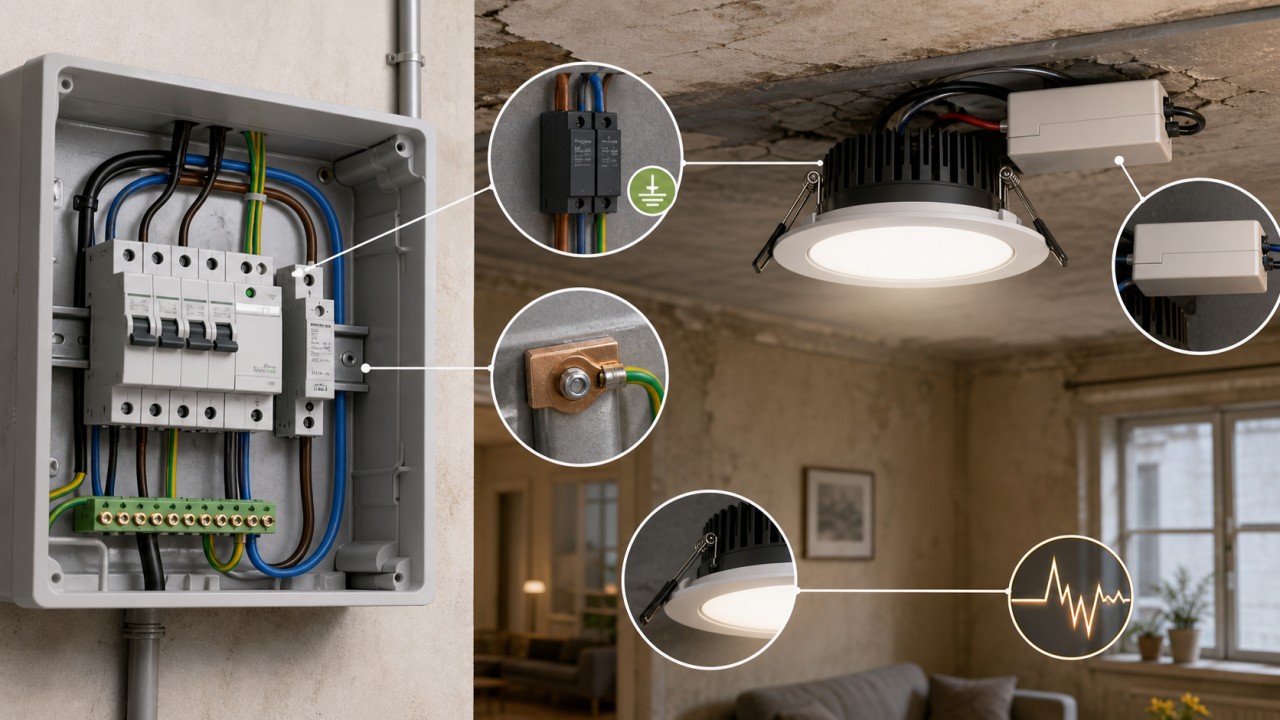
Older residential buildings may have voltage fluctuation, aged wiring, poor grounding, and transient surges, all of which can shorten LED-luminaire life. Choose fixtures with wide input voltage, good constant-current drivers, and protection against overvoltage, overcurrent, short circuit, and overheating. Avoid very cheap unbranded driver products.
During installation, check circuit capacity, wire size, grounding, residual-current protection, and switch wiring. For high-power, smart, or dimmable lights, confirm driver and dimmer compatibility. In areas with frequent storms or obvious grid fluctuation, surge protection can be added at the distribution board or important circuits. If lamps fail repeatedly, ask an electrician to measure voltage and neutral-line condition.
The glass shade itself does not solve voltage problems, but enclosed shades can raise driver and LED temperature. Voltage stress plus heat accelerates failure. In older buildings, heat dissipation and serviceability are especially important. Drivers should be replaceable and should not be permanently buried deep in the ceiling.
If a glass lampshade breaks accidentally at home, what emergency handling and safe replacement steps are needed?
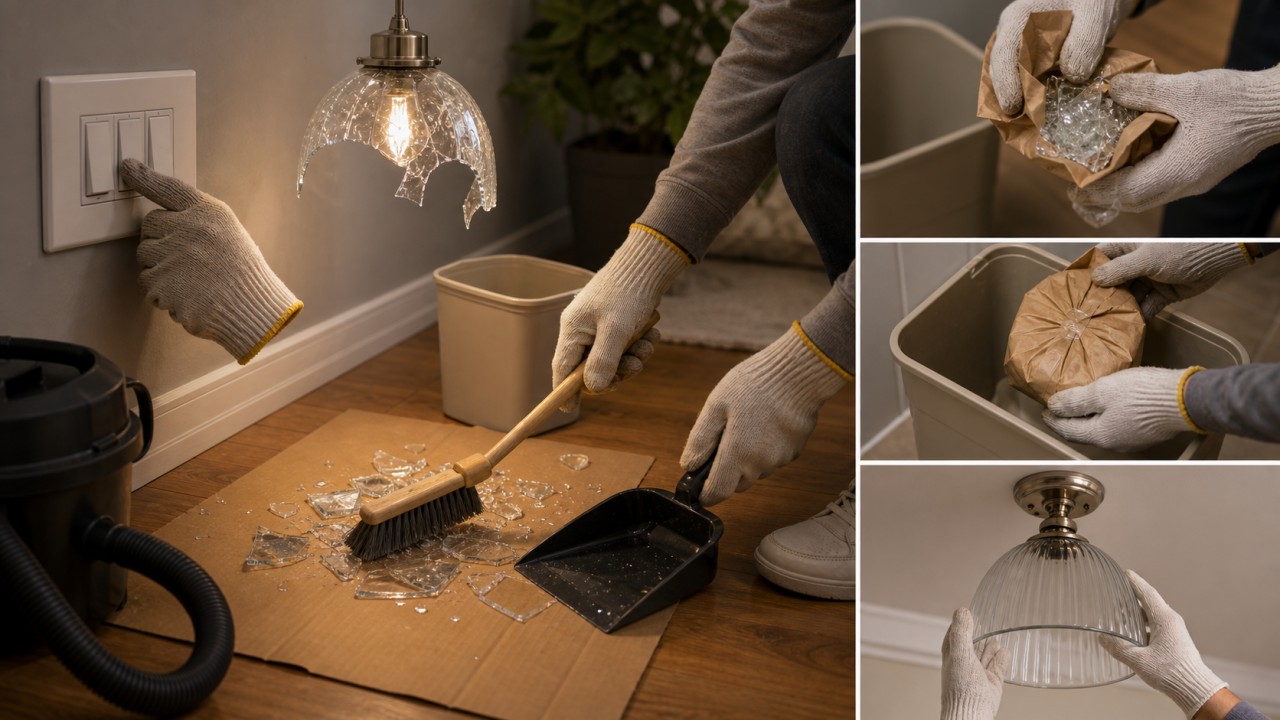
If a glass shade breaks, first turn off power and do not touch fragments with bare hands. Wait for the fixture to cool, wear thick gloves and shoes, and clean with cardboard, a broom, and a vacuum cleaner. Pick large pieces into a rigid container. Use wet paper towels or tape for tiny shards, then vacuum cracks and gaps. Wrap and label broken glass to protect others.
If broken glass remains hanging on the fixture, do not stand directly below and force it off. Check the fixing structure first and call a professional if needed. Inspect the housing, lampholder, wiring, LED board, and driver for damage or water entry. If the breakage may have been caused by overheating, mounting stress, or an incompatible bulb, solve the cause before replacing the shade.
Use an original same-specification replacement shade matching size, thickness, heat resistance, fixing method, and weight. Do not substitute ordinary glass or a nearly fitting shade casually. If the original was tempered, laminated, or borosilicate glass, the replacement should meet the same safety level.
Contact Us
Your feedback fuels our growth, and your questions drive our solutions.
We value your feedback, inquiries, and suggestions. Please feel free to get in touch with us
General inquiries
Please contact us via sales@bo-glass.com, and we will reply to you as soon as possible.
Interested to work with us
Drop your resume at info@bo-glass.com
and we will get back to you shortly.
We uses the contact information you provide to us to contact you about our relevent content, products, and services.