
Outdoor Lighting Glass Materials and Manufacturing Processes
Material and manufacturing route are one purchasing decision: a material that meets the thermal or optical target must also be available in the required geometry, quantity, tolerance, finish, and budget. This combined guide compares soda-lime, borosilicate, low-iron, opal, body-colored, and optical glass, then connects them to blowing, pressing, heat bending, flat-glass processing, CNC machining, tempering, sandblasting, etching, printing, coating, drilling, and edge finishing.
Glass Material Selection for Outdoor Lighting
- Thermal expansion
- Published examples: soda-lime float glass ≈ 8.3 × 10⁻⁶/K; BOROFLOAT 33 = 3.25 × 10⁻⁶/K over 20–300 °C.
- Strength context
- One float-glass bulletin lists typical design stresses of 19 MPa annealed, 39 MPa heat-strengthened and 77 MPa fully tempered at 0.8% breakage probability; shaped parts require their own design validation.
- Low-iron optics
- Published Pilkington data gives 91.1% light transmittance for 3 mm Optiwhite under ISO 9050 conditions. Thickness and product source must be stated. [data sheet]
- Borosilicate temperature
- SCHOTT lists 450 °C for long-term and 500 °C for short-term BOROFLOAT 33 use; these are material data, not permission to use a finished luminaire at those temperatures.
How should soda-lime, borosilicate, and low-iron glass be selected for outdoor lighting?
Soda-lime glass is a common basic material in outdoor lighting fixtures. The cost is relatively controllable and it is suitable for ordinary wall lights, garden lights, some covers and decorative glass shades. Borosilicate glass has better thermal shock resistance and is more suitable for luminaires with high temperature, significant temperature changes or close to high-power light sources. Low-iron glass reduces the green tint common in ordinary glass and is suitable for projects that require higher light transmittance, color reproduction and appearance clarity.
Actual trade-offs depend on fixture wattage, installation environment, glass thickness, target transmittance, budget and certification testing requirements. The material itself cannot alone determine the life of the complete luminaire, but appropriate material selection can help the complete luminaire achieve a more reasonable balance between light efficiency, weather resistance, thermal stability and cost.
Engineering decision: Compare materials with measurable properties. Published examples give linear expansion of about 8.3 × 10⁻⁶/K for soda-lime float glass and 3.25 × 10⁻⁶/K for BOROFLOAT 33. A 3 mm Pilkington Optiwhite example reports 91.1% light transmittance to ISO 9050. Use those figures only as screening references; obtain the selected material certificate and test the actual thickness and finish.
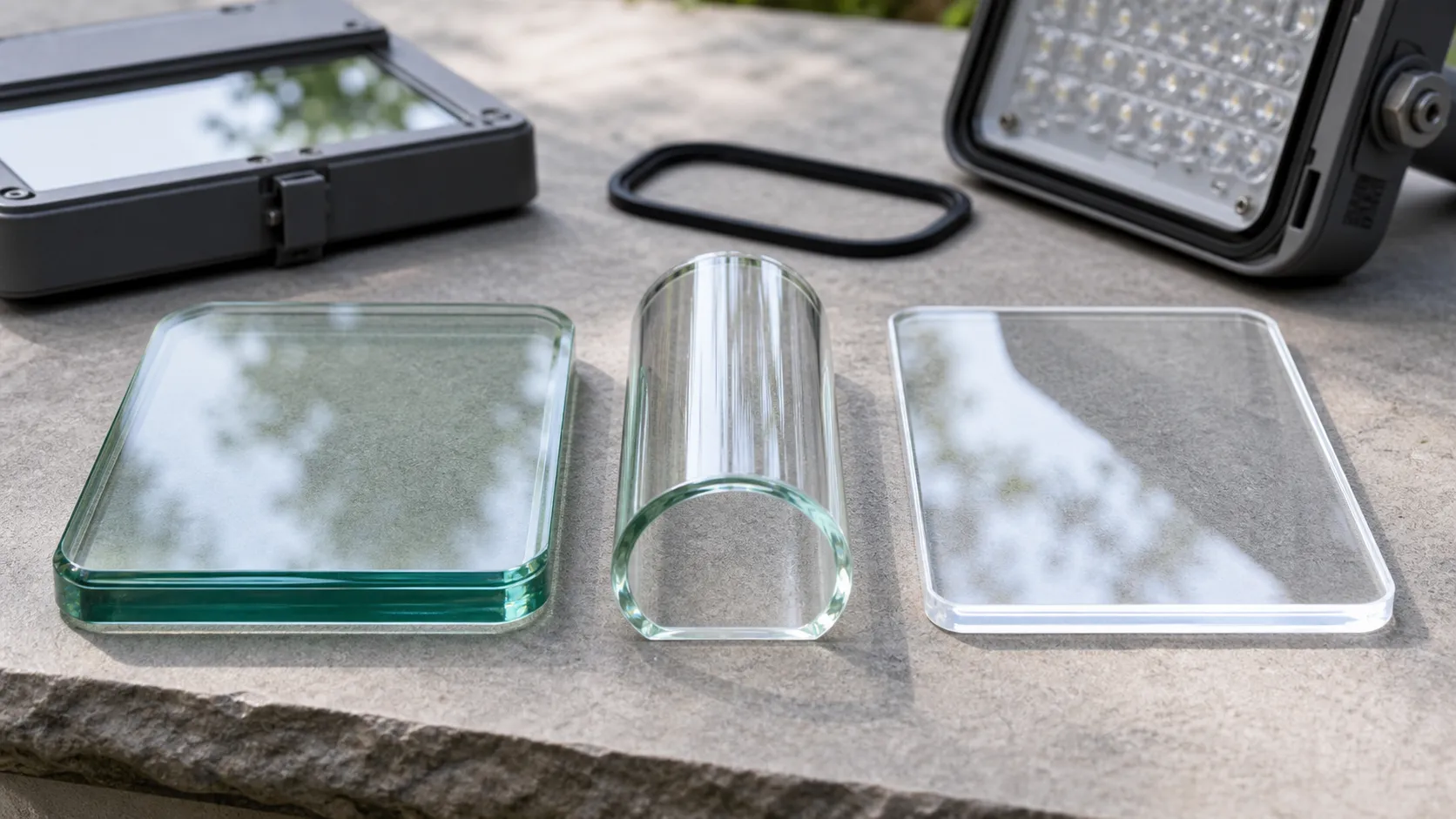
Why is high borosilicate glass suitable for outdoor lighting fixtures with significant high temperature and thermal shock?
High borosilicate glass has a low thermal expansion coefficient. When faced with rapid temperature changes, the internal thermal stress is usually smaller than ordinary soda-lime glass. Therefore, it is more suitable for high-temperature luminaires, higher-power outdoor luminaires, fountain luminaires, luminaires near industrial environments, or scenes with significant temperature differences between day and night.
However, high borosilicate glass does not mean that structural design can be ignored. Glass thickness, edge treatment, assembly stresses, sealing methods and fixture heat dissipation all affect ultimate reliability. For outdoor projects with a high risk of thermal shock, the thermal shock test of samples and the lighting aging test of the complete luminaire should be combined to confirm whether the material is suitable.
Engineering decision: The published BOROFLOAT 33 expansion coefficient is roughly 39% of the soda-lime example above, so the same temperature gradient produces less expansion mismatch. SCHOTT lists 450 °C long-term and 500 °C short-term material temperatures, but finished-part limits will usually be set much lower by edges, holes, coatings, seals and the luminaire structure. Declare Tmin, Tmax, dwell, transfer time and cycles for the product test. [SCHOTT data]
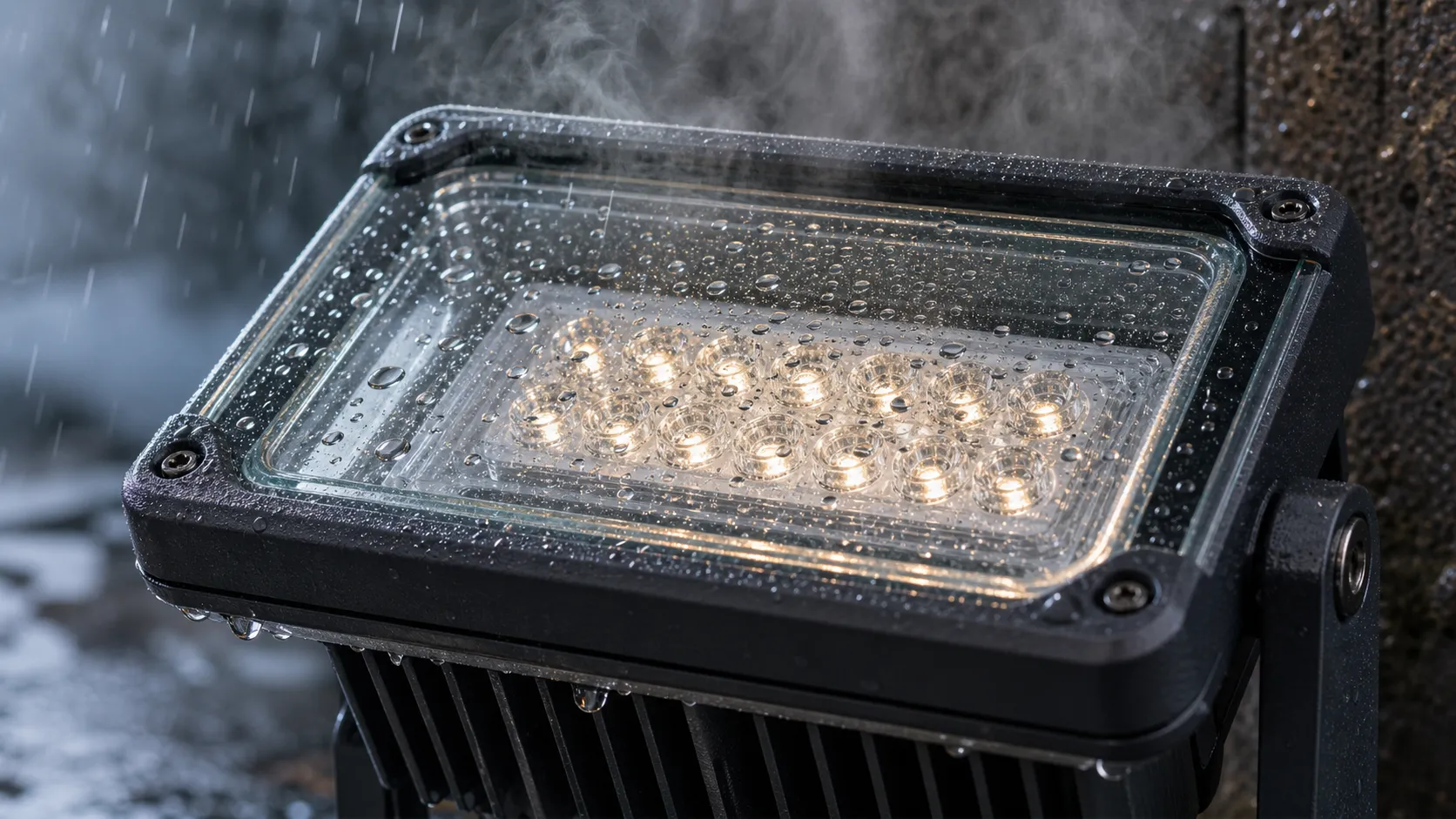
Can low-iron glass significantly improve light transmittance in outdoor lighting?
Low-iron glass is generally clearer and has a weaker green tint than ordinary transparent soda-lime glass. It can provide better light transmission and color rendering in thicker or larger protective cover glass and in high-end architectural lighting. It is worth considering for wall washers, floodlights, premium landscape projects and luminaires that require stable light color.
However, whether low-iron glass is worth using depends on the evaluation of luminaire power, glass thickness, optical structure, cost and customer target light efficiency. If the glass is thin and the light efficiency requirements are not high, the improvement brought by low-iron glass may not be obvious; if the project focuses on appearance clarity, color rendering and batch consistency, its value will be more prominent.
Engineering decision: Quantify the benefit on the thickness being purchased. One published low-iron example gives 91.1% luminous transmittance at 3 mm under ISO 9050 conditions; this number cannot be transferred to another source, thickness, coating or texture. Measure the ordinary-clear control and low-iron candidate on the same instrument and also compare CCT, Duv and complete-luminaire output.
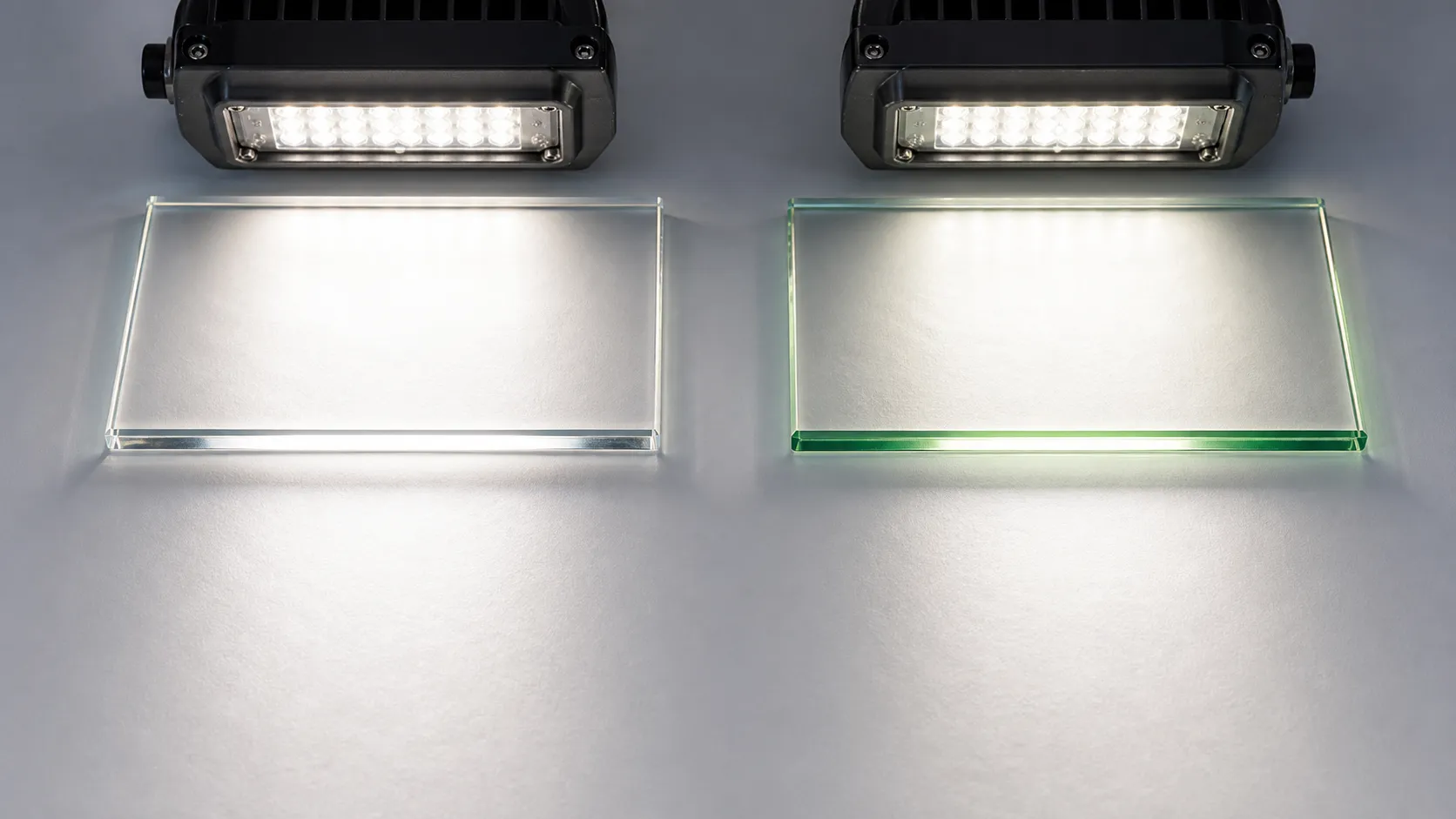
Which outdoor lighting lenses and windows are optical glasses suitable for?
Optical glass is suitable for outdoor lighting components that have higher requirements on beam angle, transmittance, refractive index, surface quality and imaging clarity, such as wall washer lenses, floodlight lenses, linear light optical windows, sensor windows, camera protection windows and special light distribution components.
Its optical stability and surface quality are more controllable, but cost, processing difficulty and design requirements are also higher. Ordinary outdoor luminaires do not necessarily require optical-grade glass. Such solutions are appropriate when standard protective cover glass or conventional pressed glass cannot meet requirements for beam shape, color, transmittance or long-term stability.
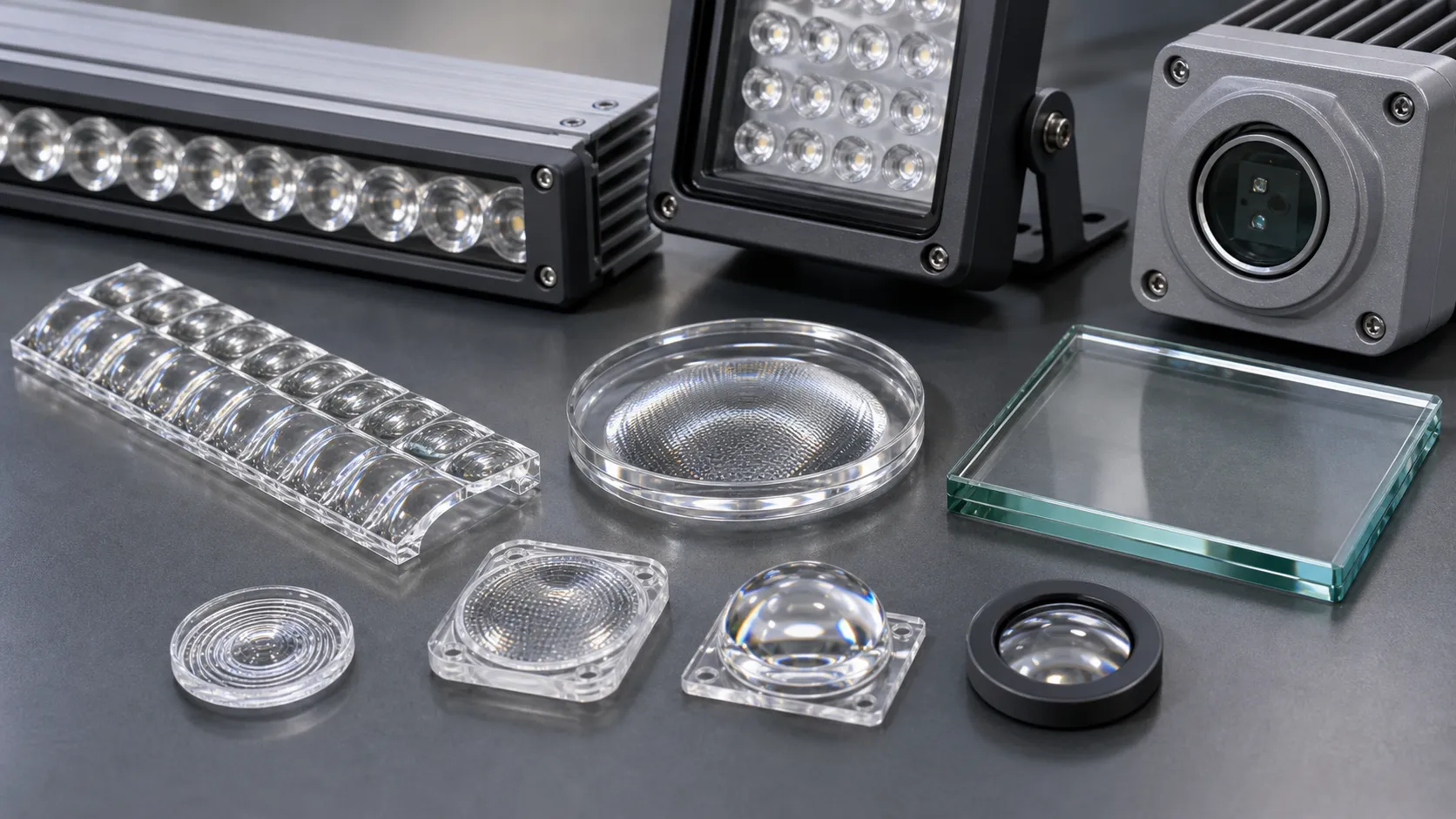
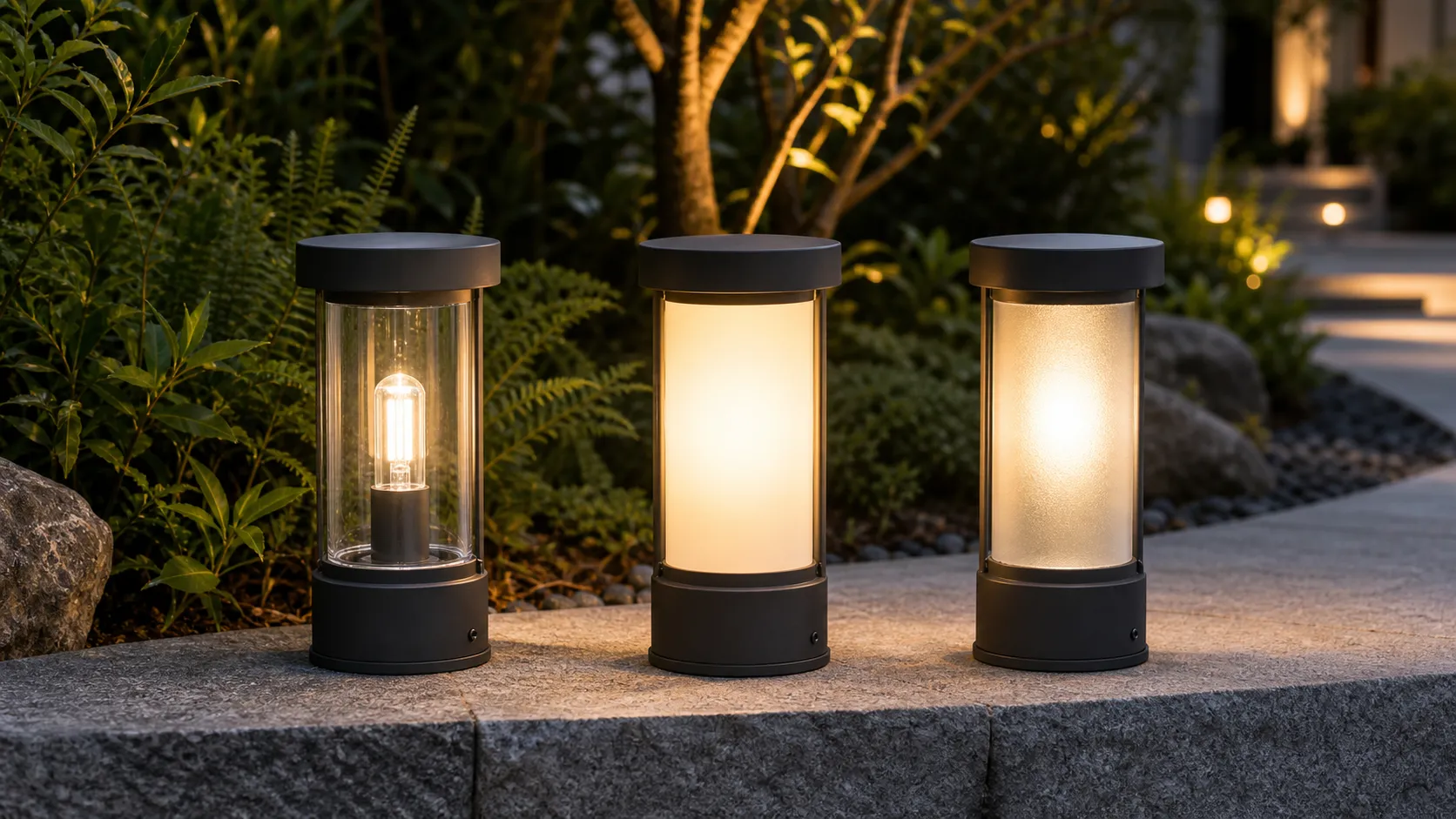
How should untreated clear glass, opal glass and clear glass with a frosted finish be selected?
Untreated clear glass is appropriate when maximum transmission or visual access is required and another optical component already controls the LED. Opal glass is a body-glass solution for strong source hiding and uniform luminance. A frosted or acid-etched finish is a surface process applied to a specified clear base glass and can provide an intermediate level of scattering.
When selecting, you should first look at the purpose of the luminaire: street lights, floodlights and wall washers usually pay more attention to high light transmittance and optical precision; garden lights, path lights, lawn lights and wall lights pay more attention to soft light and comfort. The appearance of the glass should also be considered in conjunction with cleaning and maintenance. If the outer surface is too coarsely frosted, it may be more likely to accumulate dust and leave watermarks.
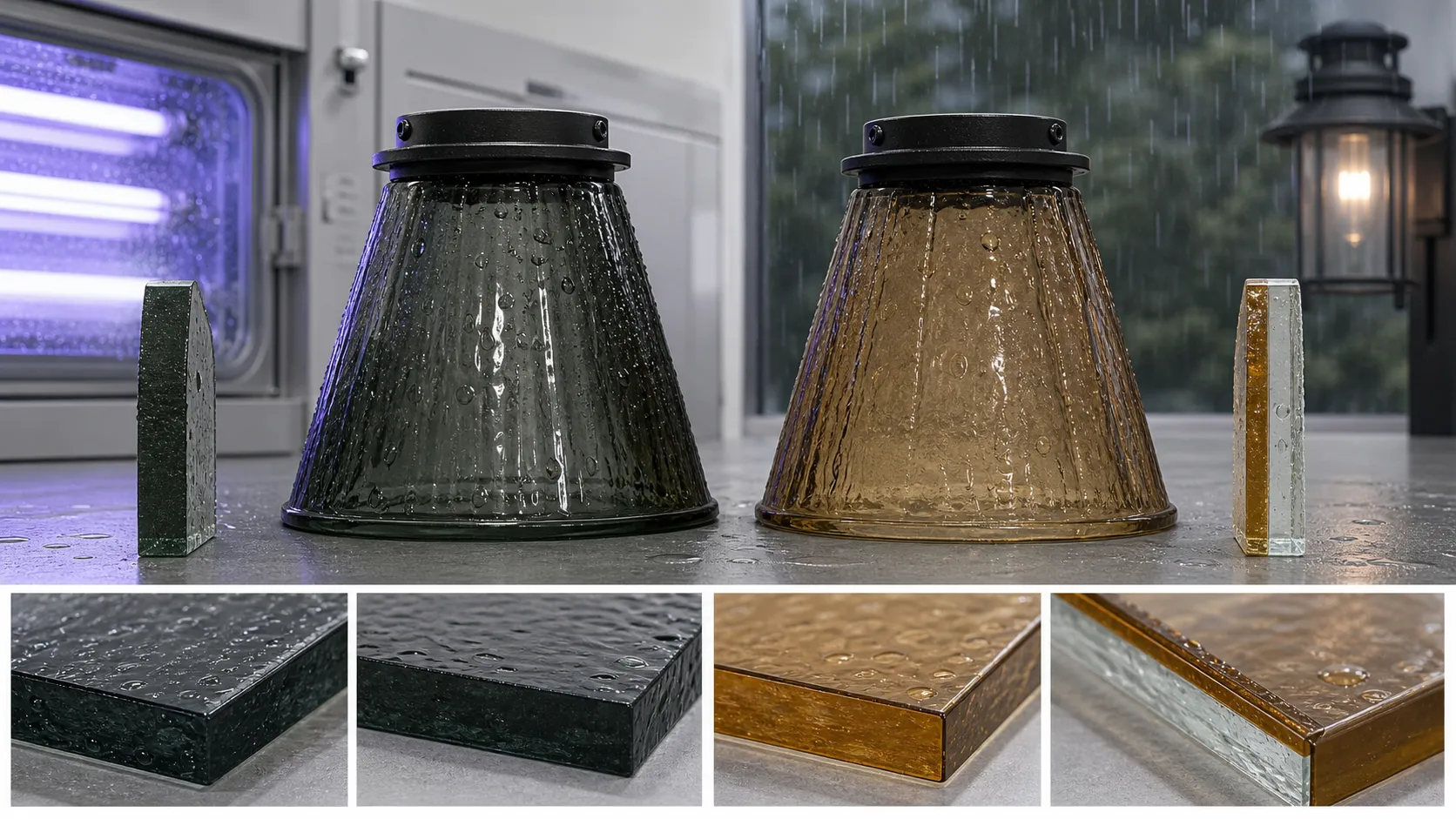
Which is more suitable for outdoor use: body colored glass or surface spray colored glass?
Body-colored glass is colored throughout the glass composition, so normal surface wear does not expose a contrasting clear substrate. It generally offers better long-term color stability and scrub resistance. Spray-coated glass provides greater flexibility for small-batch color customization and special effects, but coating adhesion, UV stability, cleaning resistance, and edge coverage must be validated.
However, when spraying the surface for outdoor use, it is important to confirm the adhesion, UV resistance, rain resistance, detergent resistance and wear resistance. It cannot simply be said that one type is better, the key depends on the project life, color requirements, processing costs and maintenance methods; high-end or long-term outdoor projects usually prefer stable body colors or proven weather-resistant coatings.
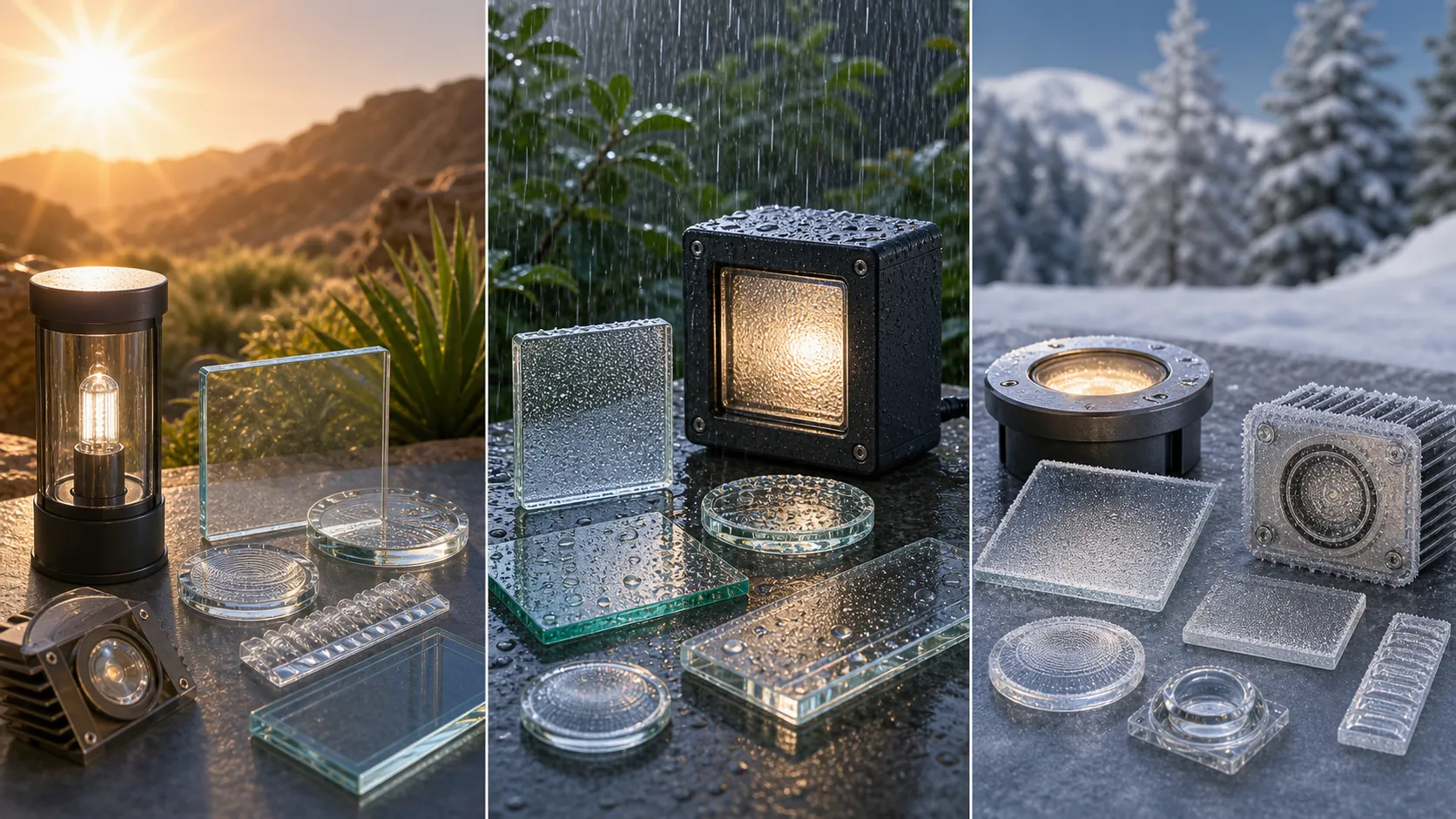
How should outdoor-lighting glass materials be selected for temperature, humidity, and UV exposure?
For outdoor lighting fixtures with high temperatures and significant temperature changes, priority should be paid to the thermal stability and edge stress control of the glass. If necessary, borosilicate glass or a more reliable heat treatment solution should be considered. In high humidity, underwater or long-term rain environments, you should focus on the glass edge, sealing surface, surface coating and compatibility with sealing materials.
The impact of ultraviolet rays on the glass body is generally less than that of many plastic materials, but it may still cause aging to surface coatings, inks, glues and seals. The material selection should not just look at the name of the glass, but also make a comprehensive judgment based on the working temperature of the complete luminaire, installation area, sun exposure time, salt spray or polluted environment, and the customer's expected lifespan.
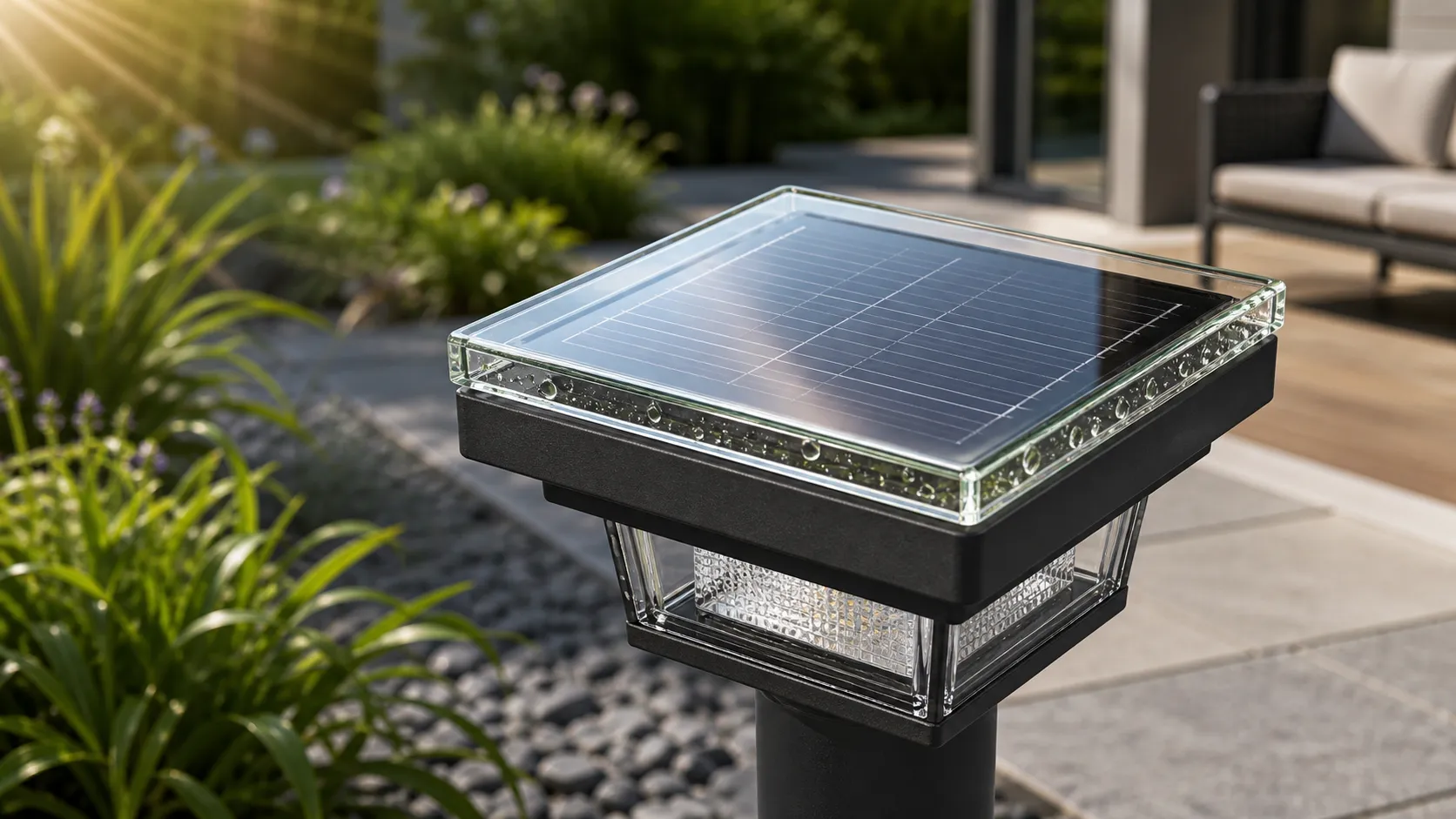
How does the protective cover glass of solar outdoor lights improve photovoltaic light input efficiency?
The protective cover glass of a solar outdoor light affects the efficiency of sunlight entering the photovoltaic panels. Glass with high transmittance, low iron, low reflection and flat surface helps reduce incident light loss and is especially suitable for products that require higher charging efficiency and appearance clarity. If the glass surface is prone to dust accumulation, watermarks or scratches, it will also reduce the long-term light absorption effect.
However, photovoltaic efficiency is not determined by the protective cover glass alone, but is also related to solar panel quality, tilt angle, installation direction, shading, surface cleaning and battery management system. Protective cover glass can help improve and stabilize light conditions, but the final power generation performance needs to be evaluated based on the overall machine structure and real outdoor use environment.
How does glass thickness affect fixture intensity, light transmittance and cost?
Increased glass thickness often helps improve mechanical strength and impact resistance, and can also improve safety margins in some pressure-bearing scenarios, such as underground lights, driveway lights and public area luminaires. However, increased thickness will also lead to increased weight, increased material costs, increased assembly pressure, and may cause a certain amount of light transmission loss or more obvious edge color.
When choosing the thickness, you should not just pursue thicker and safer, but also consider the span of the glass, the supporting structure, the tempering or heat treatment method, the compression level of the gasket, and the weight limit of the complete luminaire. The reasonable thickness should strike a balance between strength, light transmittance, cost, assembly and transportation, and be confirmed through sample assembly and complete-luminaire testing.
Engineering decision: Do not use a “twice as thick means twice as strong” rule. One soda-lime float-glass bulletin lists typical design stresses of 19 MPa annealed, 39 MPa heat-strengthened and 77 MPa fully tempered at 0.8% breakage probability, but formed parts, edge damage, holes and support conditions change the allowable design. Price the shortlisted thicknesses only after structural and optical verification.
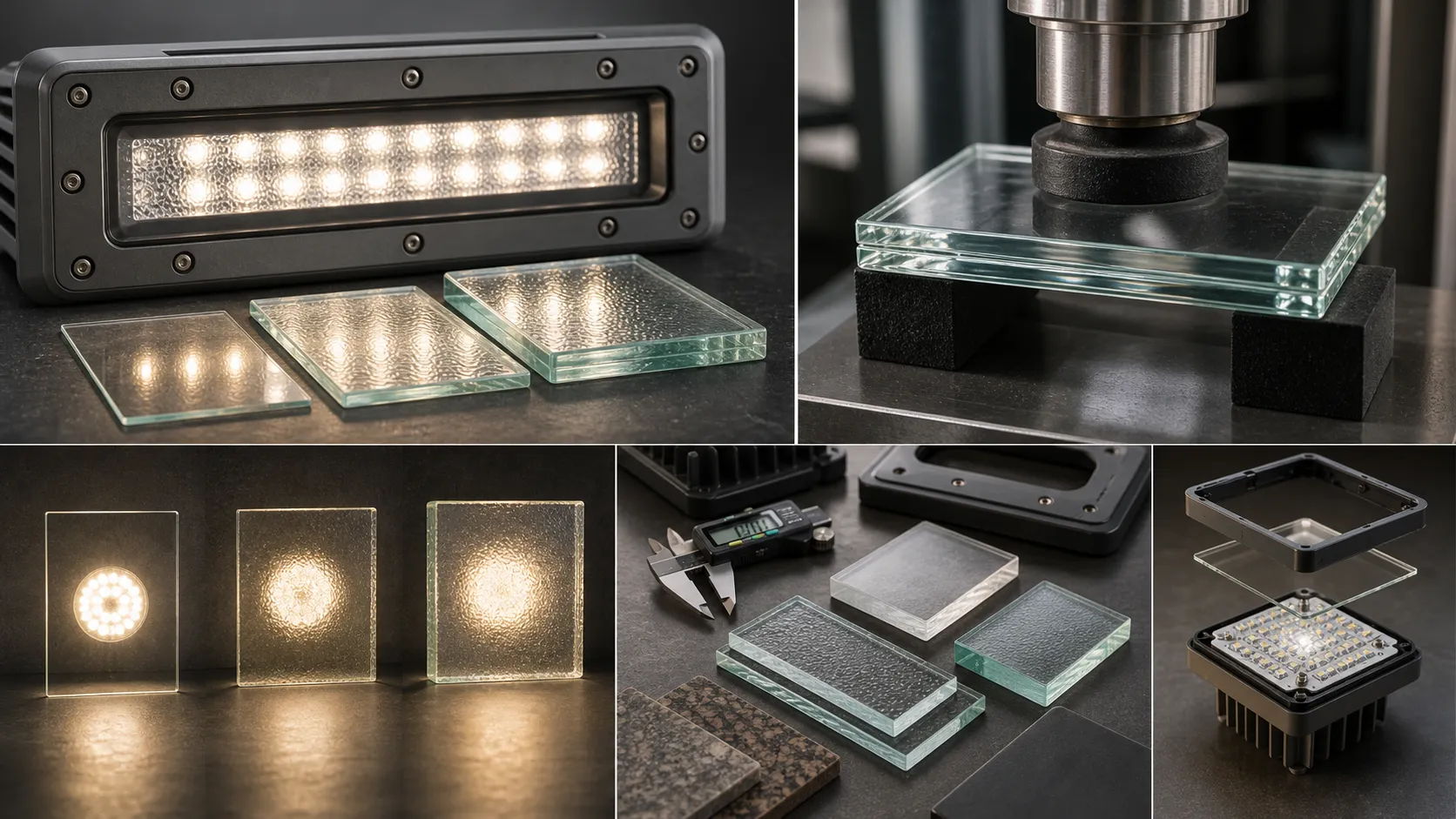
Glass Manufacturing Processes for Outdoor Lighting
- Fabrication sequence
- For heat-treated flat glass under ASTM C1048, cutting, drilling, notching, grinding, sandblasting and etching are completed before heat treatment.
- Annealing examples
- Published annealing points are about 548 °C for soda-lime float glass and 560 °C for BOROFLOAT 33; the actual lehr curve depends on geometry and wall thickness.
- Stress measurement
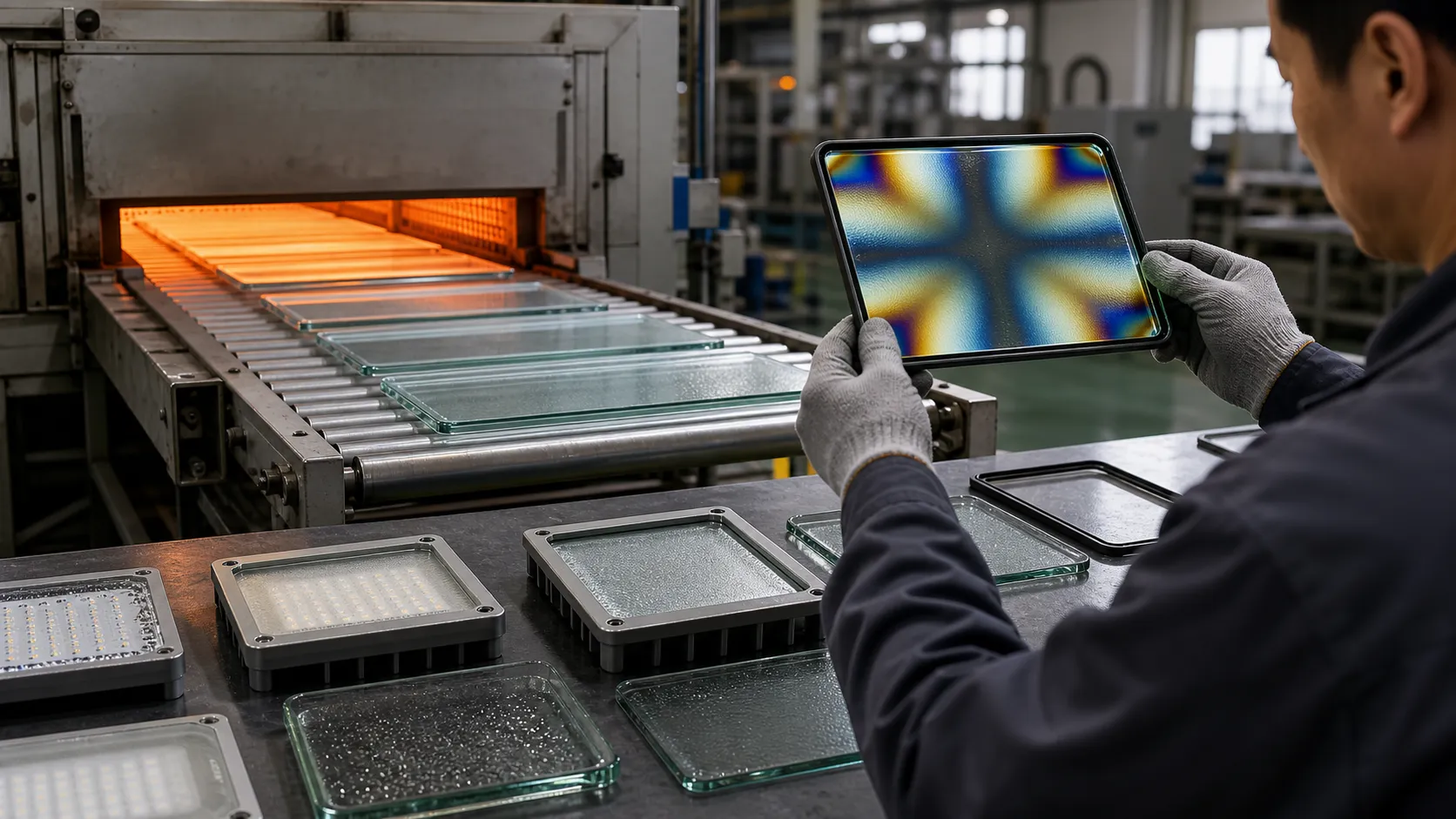
- ASTM C1279 covers non-destructive photoelastic edge and surface stress measurement for flat glass; formed shades need an agreed internal method.
- Process capability
- Track cavity/tool ID, first article, critical dimensions, wall-thickness distribution, appearance defects and annealing lot for every approved process route.
How do blown, pressed and heat-bent manufacturing methods differ for outdoor-lighting glass?
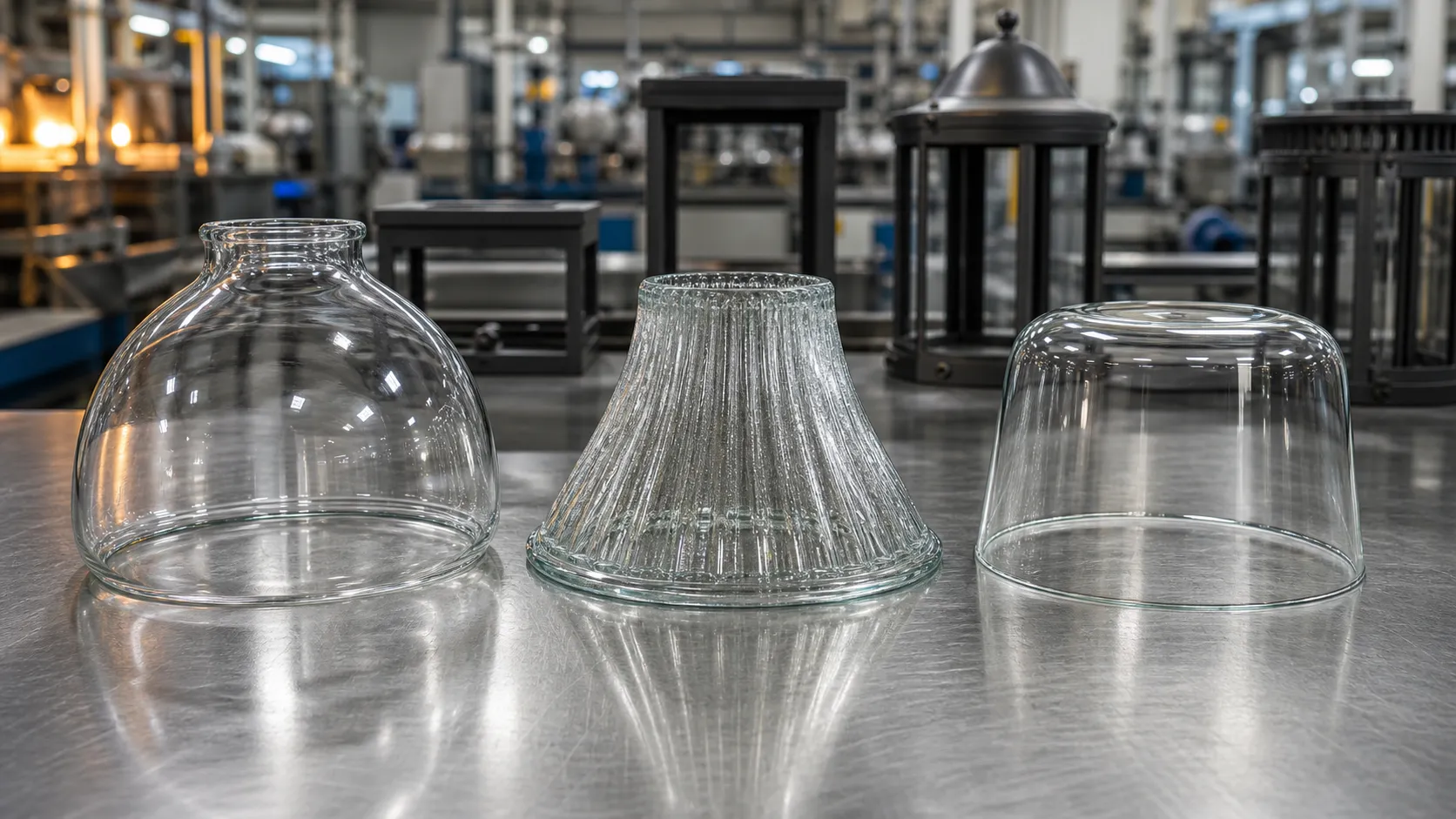
Blown glass is suitable for three-dimensional shapes such as spheres, lanterns, chandelier shades, and retro decorative shades. It has a handmade appearance and flexible shapes, but the dimensional consistency and wall thickness stability are usually not as good as mold pressed parts. When using blown glass for outdoor projects, pay special attention to opening size, edge treatments, annealing stresses, and batch appearance differences.
Pressed glass is suitable for mass production of glass shades and optical glass lenses that require stable dimensions, controlled thickness, defined textures or optical surfaces. Heat-bent glass is suitable for gently curved protective cover glass, glass windows and certain architectural exterior components. It can form larger curved surfaces, but bending radius, flatness, mold marks and assembly stress must be controlled.
How should you choose between a pressed and a CNC-machined optical glass lens?
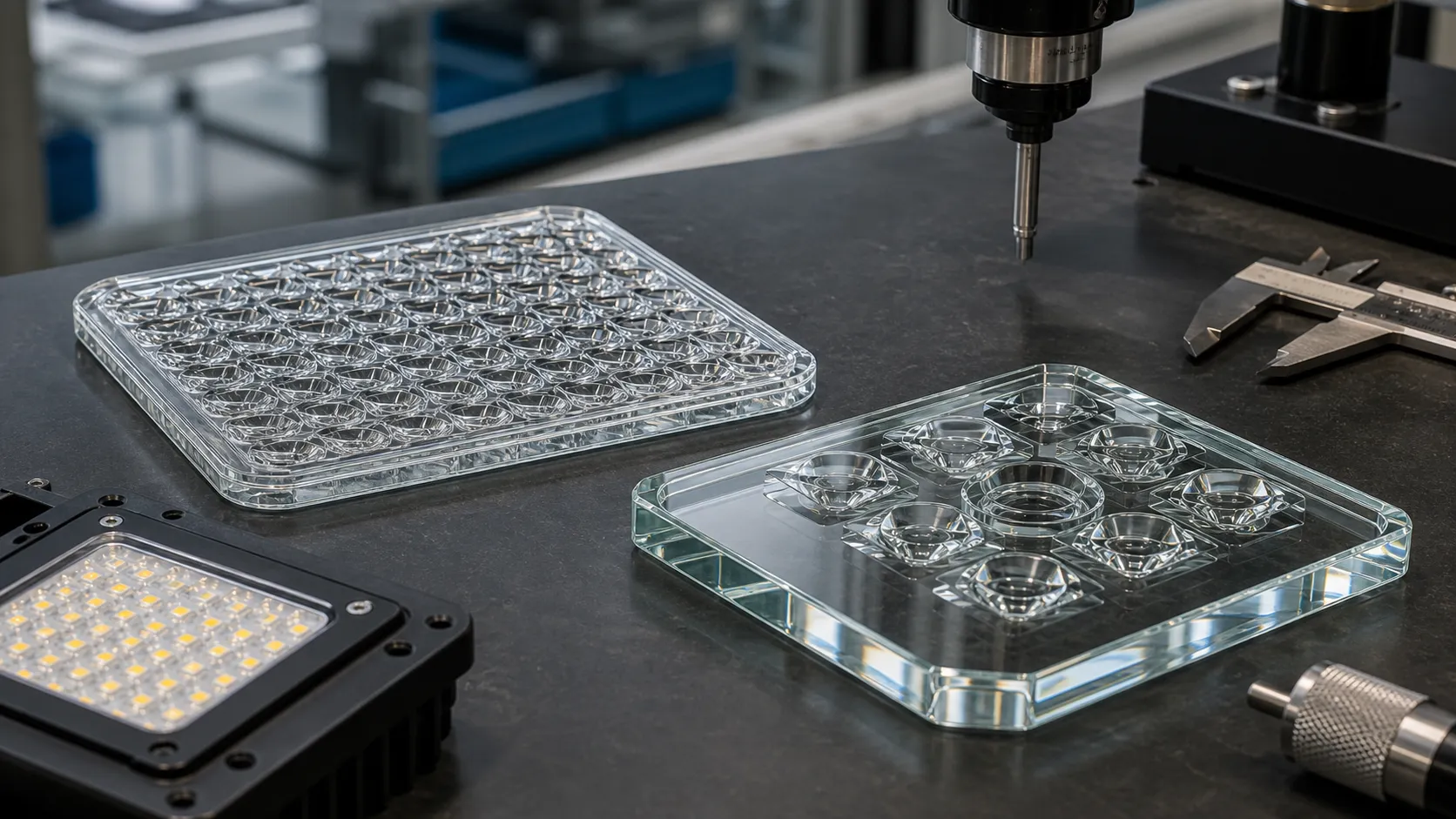
Pressed optical glass lenses are suitable for outdoor luminaires with large batches, relatively fixed structures, and stable optical surfaces. After mold opening, the cost of a single piece is relatively controllable and the batch consistency is good. It is suitable for wall washers, floodlights, linear lights or specific light distribution components. However, the initial mold cost and development cycle need to be included in the project plan.
CNC processing of optical glass lenses is more suitable for small batches, high precision, trial production verification or special shape requirements. It has higher flexibility and does not necessarily require complex molds. However, the processing cost is higher, and the cycle may also be affected by material and precision requirements. The selection should take into account batch size, optical accuracy, development time, budget, number of sample verifications and subsequent mass production stability.
When is it suitable for molding production of glass components for outdoor lighting fixtures?
When outdoor lighting glass components have stable batch sizes, fixed structures, complex curved surfaces, special textures, lens functions or higher consistency requirements, they are usually suitable for mold production. Mold opening can improve batch efficiency and dimensional stability, and also allows the protective cover glass, optical glass lens or embossed glass to better match the luminaire body structure.
If the project is still in the design verification stage, the order quantity is small, or the dimensions are frequently modified, the risk of direct mold opening is higher. A more reliable way is to first use cutting, hot bending, CNC, manual samples or simple molds to verify the structure and light effects, and then enter formal mold development after confirming the drawings, assembly and customer samples.
What processing techniques are suitable for small batches of customized glass components?
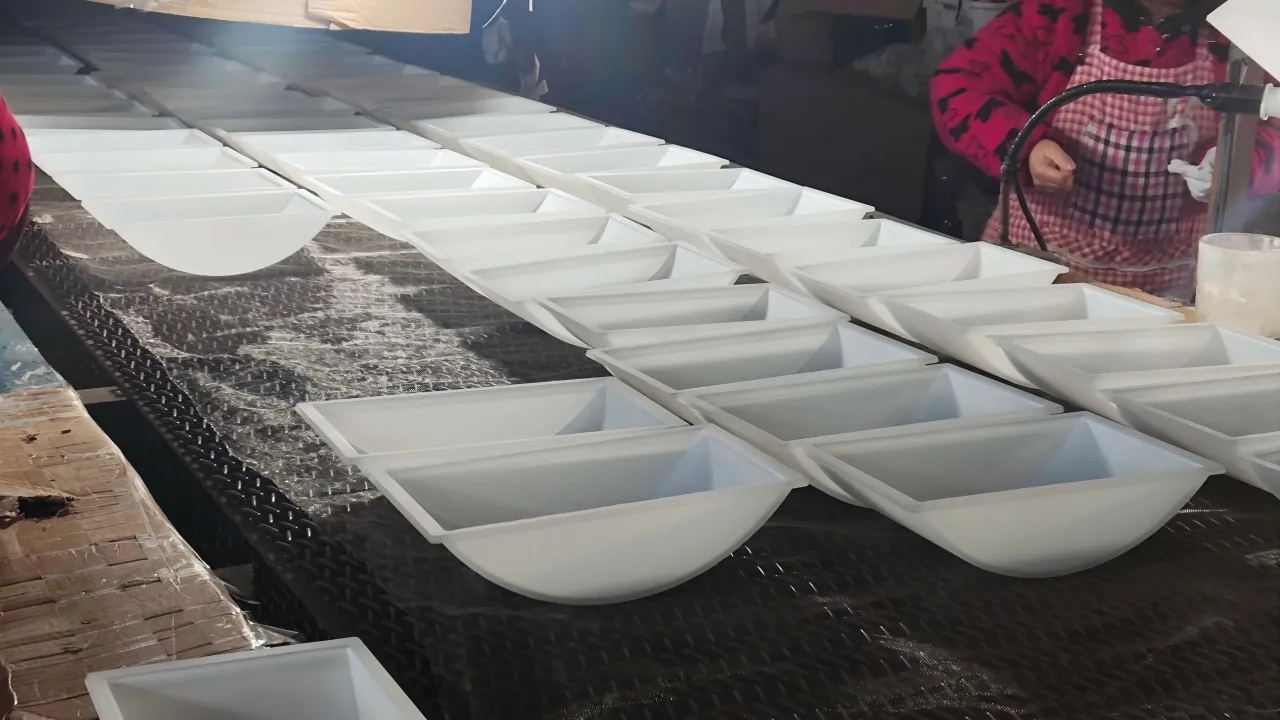
Small batches of customized outdoor lighting glass components are usually suitable for cutting, edge grinding, chamfering, drilling, silk screen printing, sand blasting, acid etching, heat bending, CNC processing or modification of existing molds. This can reduce the initial mold investment and make it easier to adjust the size, hole position, edge and surface effects at the sample stage.
For a three-dimensional glass shade, small batches may use blown glass or an existing mold with similar dimensions; protective cover glass is more commonly cut and edge-finished from sheet. Before selecting a process, confirm dimensional tolerances, appearance criteria, sealing-surface requirements and the intended mass-production route so that the sample process can be reproduced consistently in volume.
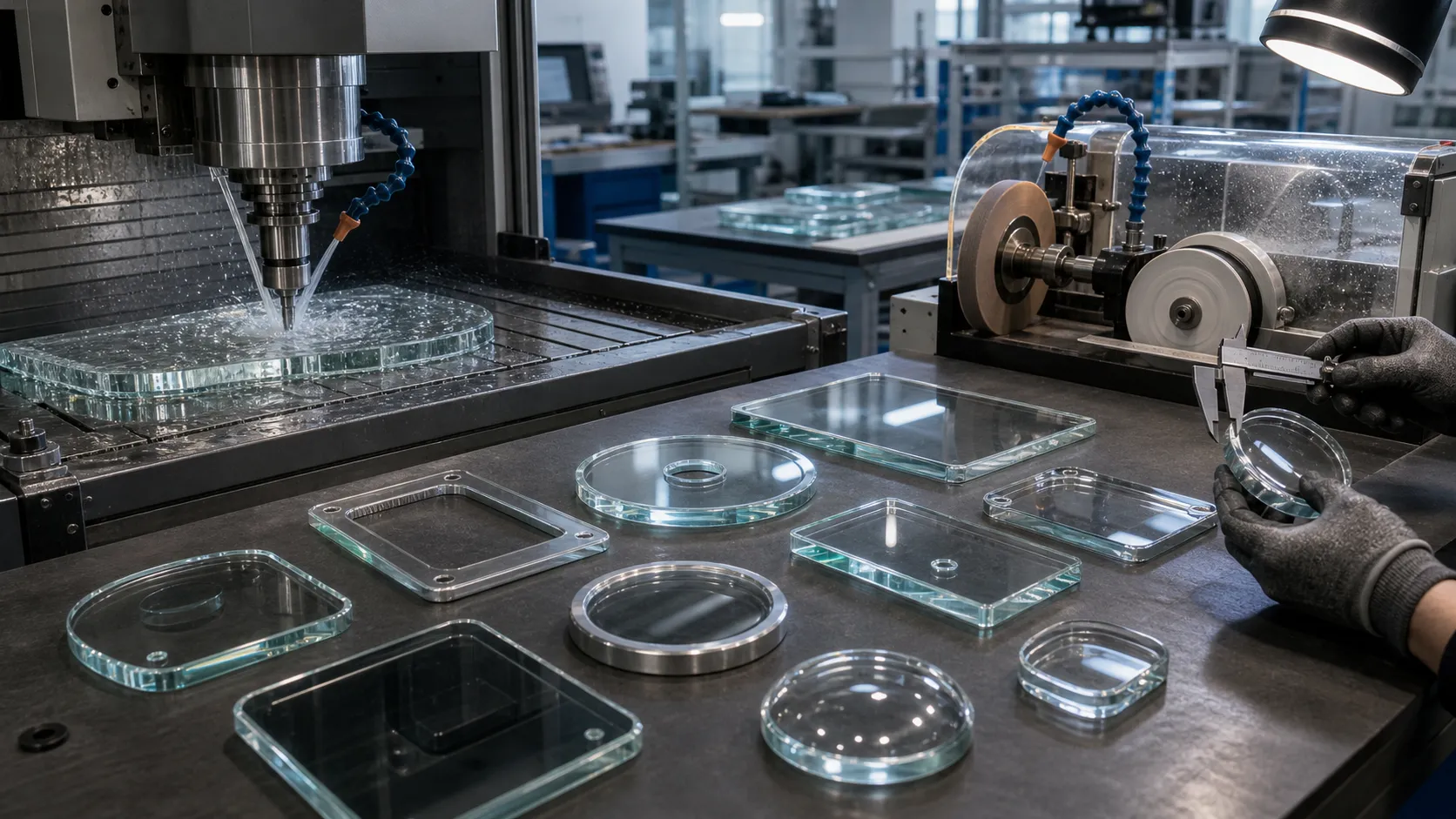
How do glass openings, edges and chamfers affect outdoor light fixture assembly?
Glass openings, edges and chamfers will directly affect the assembly safety, sealing effect and risk of breakage of outdoor lighting fixtures. Hole position deviation may cause screws, brackets or wire holes to be misaligned; improper hole edge treatment may cause stress concentration; edge chipping or insufficient chamfering may easily cause cracks during press installation, transportation or thermal cycling.
For outdoor luminaires that require water ingress protection, the glass edge and hole locations also affect gasket contact, adhesive bonding and pressure-frame stress. Hole diameter, spacing, edge distance, chamfer dimensions, edge-finishing grade and allowable edge chipping should be clearly specified in the drawings, and the fit between the glass, metal housing, gasket and fasteners should be verified at the sample stage.
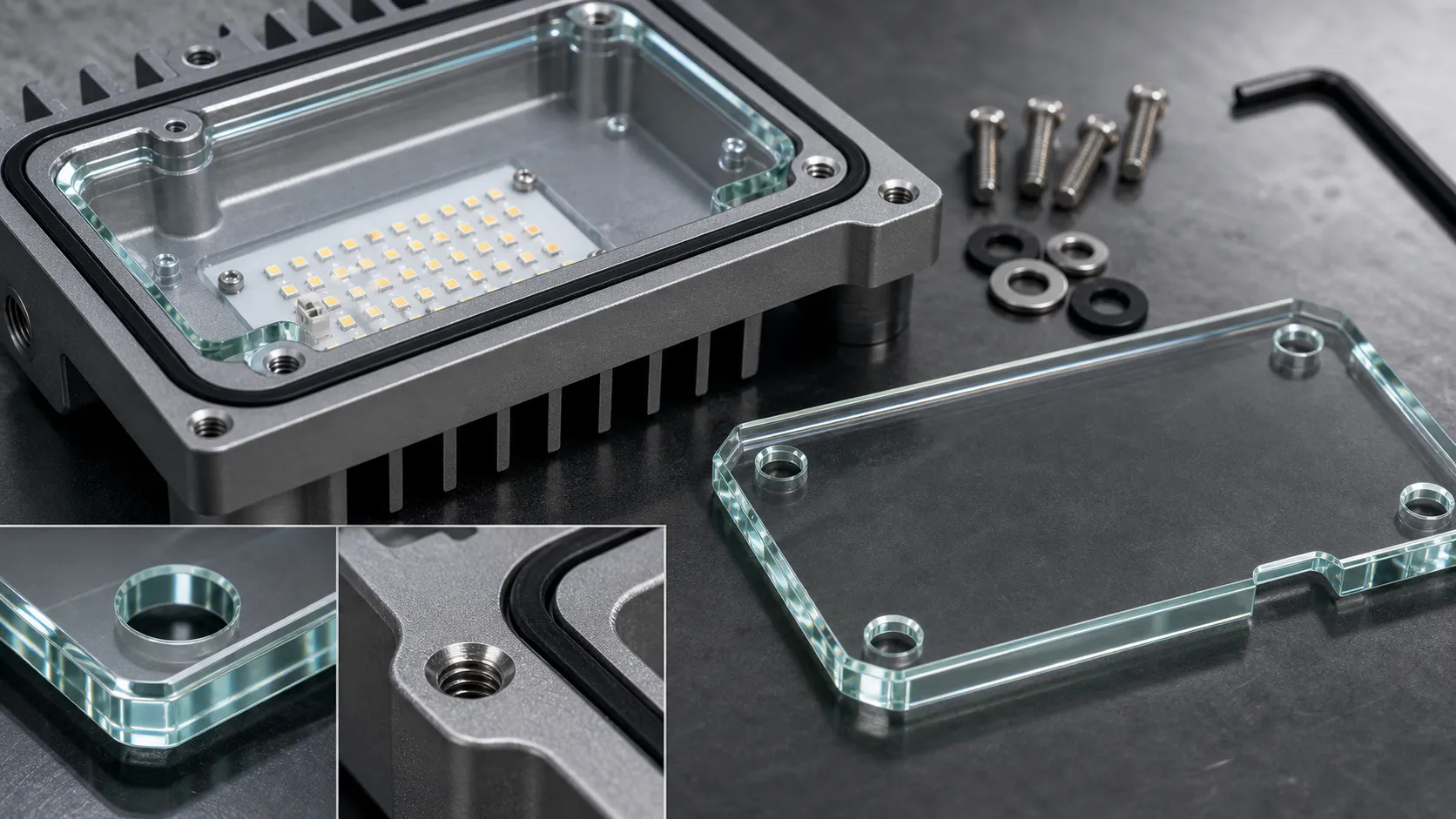
What is the difference between internal sandblasting and external sandblasting on the light efficiency and cleaning maintenance of outdoor lighting fixtures?
Internal sandblasting usually places the rough diffusion surface on the inside of the glass shade, leaving the outer surface relatively smooth, which can not only soften the light, hide the LED point light source, but also make it easier to clean outdoors and reduce dirt adhesion. For garden lights, wall sconces, and path lights, this approach is generally better for long-term outdoor maintenance.
The soft light effect of exterior sandblasting is also obvious, but the rough surface is directly exposed to rain, dust, oil and cleaning tools, and is prone to leaving watermarks, dust accumulation, or being scrubbed and worn. If the project must use exterior sandblasting, cleaning frequency, surface stain resistance, and customer maintenance conditions should be evaluated in advance to avoid long-term appearance deterioration despite good lighting effects.
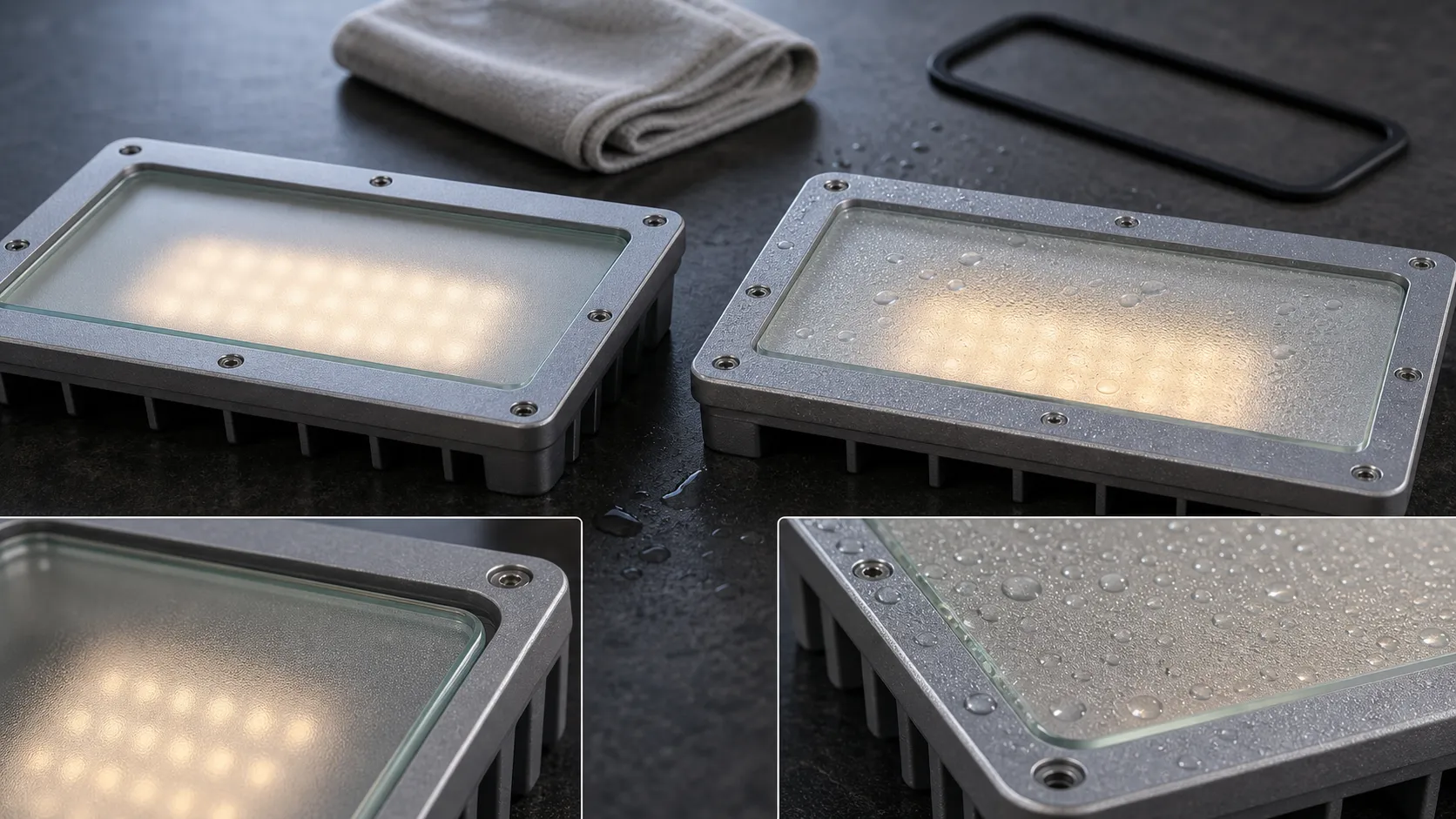
Are outdoor glass components suitable for anti-fog, anti-reflective or UV-resistant coatings?
Outdoor glass components can be coated with anti-fog, anti-reflective, easy-to-clean, hydrophobic or anti-UV coatings based on project needs, but coating location, weather resistance, scrub resistance and cost should be carefully evaluated. Anti-reflective coatings are suitable for highly transparent windows, solar panels or optical components sensitive to reflection; anti-fog or easy-to-clean coatings are suitable for high humidity, difficult maintenance or underwater related applications.
It should be noted that a lot of performance ultimately depends on the complete luminaire structure and usage environment. For example, fogging is often related to sealing, moisture, and thermal cycling, and cannot be completely solved by coating alone; UV resistance is more often caused by protective coatings, inks, glues, or surrounding materials. Test conditions, life expectancy and cleaning methods should be confirmed before applying the coating.
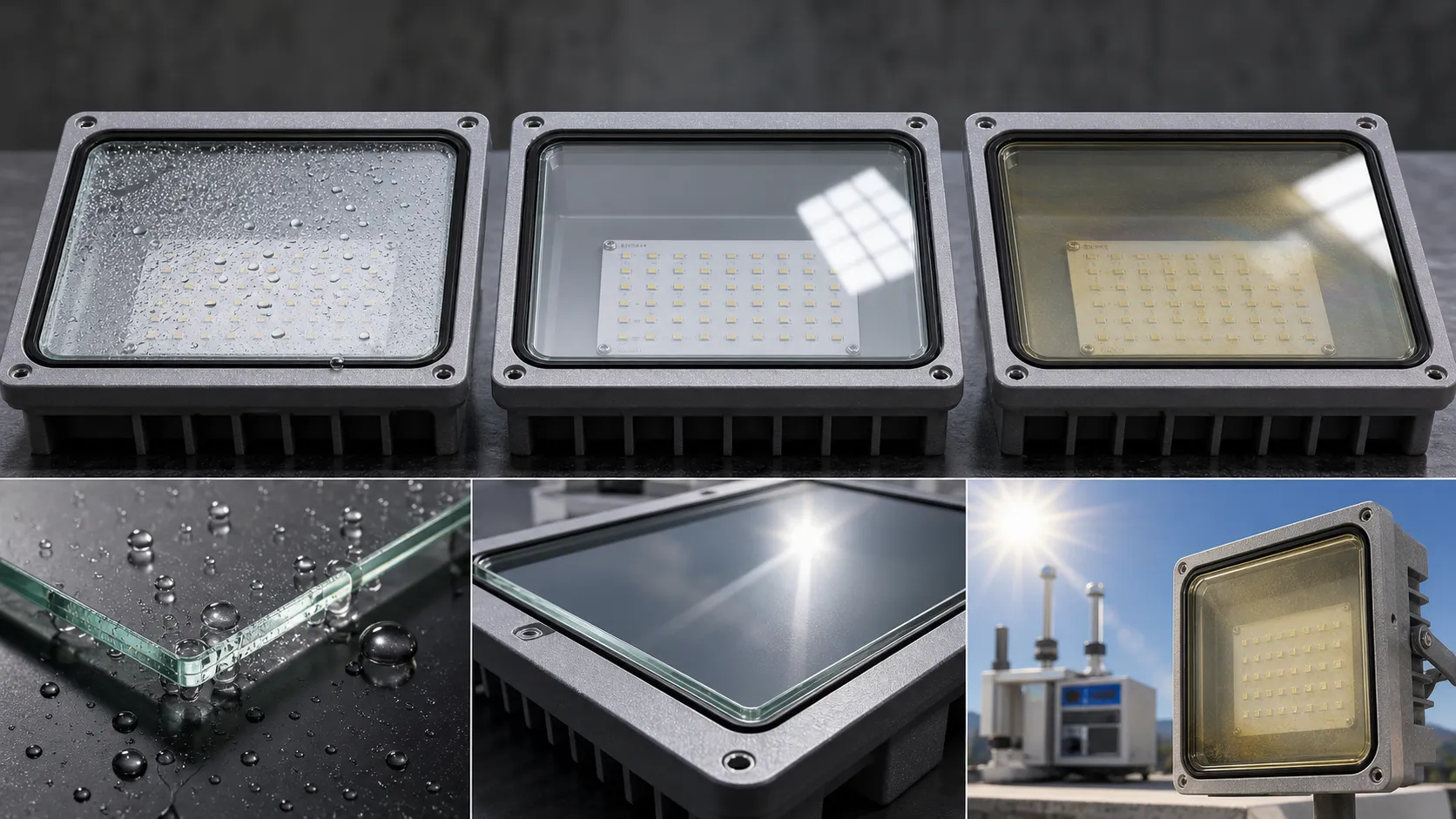
Why does the glass annealing process affect the life of outdoor luminaires?
The function of glass annealing is to reduce the stress remaining inside the glass during the molding and cooling process. If the annealing is insufficient, the glass is more likely to suffer from spontaneous breakage, edge-crack propagation and batch damage during processing, assembly, transportation, thermal cycling or external impact.
Outdoor luminaires are exposed to temperature differences, rain, sunlight and structural compression for long periods, and residual stress increases the risk of cracking. Annealing control is especially important for blown glass shades, pressed optical glass lenses, thick-walled glass and irregularly shaped components. Suppliers should control annealing for the specific product geometry and reduce risk through polarized stress inspection, sample assembly and thermal-cycling tests.
Engineering decision: Published annealing-point examples are about 548 °C for soda-lime float glass and 560 °C for BOROFLOAT 33, but a furnace setpoint alone does not prove stress relief. The record should include the time-temperature curve, part geometry and lot, followed by a polariscopic result. ASTM C1279 is relevant to photoelastic stress measurement of flat glass; formed shades need an agreed method and acceptance image. [ASTM reference]
Contact Us
Your feedback fuels our growth, and your questions drive our solutions.
We value your feedback, inquiries, and suggestions. Please feel free to get in touch with us
General inquiries
Please contact us via sales@bo-glass.com, and we will reply to you as soon as possible.
Interested to work with us
Drop your resume at info@bo-glass.com
and we will get back to you shortly.
Request a Custom Glass Quote
Tell us about your project or upload a drawing.
Your drawings remain confidential.
We uses the contact information you provide to us to contact you about our relevent content, products, and services.