
Indoor Lighting Glass Materials
Material choice sets the limits for transmission, diffusion, temperature resistance, appearance, durability, and cost. Start with the operating environment, then tune the optical effect.
Jump to a question (15)
- Functions and performance requirements of lighting glass
- How can high-transmittance glass lampshades directly improve system efficacy (lm/W) and help luminaires meet energy-efficiency standards?
- In energy-saving retrofits of existing luminaires, how much efficacy gain can be achieved by replacing only the glass shade?
- Besides wattage, what parameters should be considered when judging whether a lamp is energy-efficient?
- What is the relationship between a luminaire's energy-efficiency rating and its actual electricity savings?
- Why do high-efficacy luminaires cost more upfront but become more economical over the long term?
- Must a broken luminaire be discarded entirely, or can the light source or driver be replaced in some cases?
- How should old luminaires and light sources be handled to reduce environmental impact?
- Why are borosilicate glass lenses preferred over ordinary optical plastics for high-power LED spotlights?
- How should soda-lime and borosilicate glass be compared for reading lamps and children's desk lamps?
- How should clear glass, surface-frosted glass and opal glass be compared for task lamps?
- How should glass and PC diffusers be compared for kitchen and bathroom LED lighting?
- How should soda-lime glass, borosilicate glass, and crystal glass be selected for luminaires based on cost and performance?
- For spaces with different color-temperature preferences, what base-colored glass lampshades should be paired with them?
- For age-related vision decline, how should glass lampshades choose light color and haze to compensate visually?
Glass performance and system efficiency
Connect the glass component to luminaire efficacy, energy use, repairability, and lifecycle decisions.
Functions and performance requirements of lighting glass
Lighting glass is a key material for manufacturing electric light source devices and electrical components. It is mainly used to produce lamp tubes, bulb envelopes, stems, exhaust tubes, lamp reflectors, discharge tubes, etc. In recent years, the amount of glass used in electric light source production has far exceeded that of any other material.
Glass has become one of the essential materials for electric light source manufacturing due to its transparency, hardness, excellent corrosion resistance, heat resistance, electrical and optical properties, its ability to be shaped by a wide range of forming and processing methods, and the possibility of tailoring its properties by adjusting the chemical composition. Materials for electric light sources are also evolving with the continuous improvement in material performance and preparation techniques. Advances in light source technology have led to the constant upgrading of lighting products, with a variety of energy-saving electric light sources now flourishing. This, in turn, places higher demands on the glass used in electric light source materials.
Glass exhibits many physical and chemical properties. Depending on the application requirements, the main properties of electric light source glass include mechanical properties, thermal properties, electrical properties, vacuum-related properties, and chemical stability. As glass for electric light sources, it should generally meet the following requirements:
High light transmittance: the lamp should transmit all wavelengths in the visible spectrum. In the ultraviolet region, it should transmit the required UV radiation. Furthermore, the glass should not discolor or darken under irradiation.
Good thermal stability: it must withstand the thermal shock caused by switching the light on and off.
Good airtightness: the light source is either evacuated or filled with a certain amount of working gas, so the glass structure must be dense and gas-tight. The glass should also be easy to clean and outgas, and must be capable of forming a hermetic seal with metal lead wires without leakage.
Good mechanical strength at working temperature: it should be able to withstand the gas pressure generated during lamp fabrication and ignition.
Good electrical insulation properties: high electrical resistivity and low dielectric loss are required.
Good chemical stability: this is typically evaluated by weight loss upon exposure to alkali, acid, or water. In practice, it is often required that the glass material does not precipitate alkalis, lose its transparency, and maintain its properties for at least half a year. It is also expected that the bulb will not be corroded by the surrounding atmosphere or by the metal vapor introduced into the lamp at its working temperature.
Good sealing and processing performance: the glass should have an appropriate coefficient of thermal expansion and softening point, with only a small fluctuation range. It should also be easy to outgas in vacuum.
Minimal visible defects in the glass: bubbles, striae, crystals, and sand particles in the glass must be strictly controlled within acceptable limits.
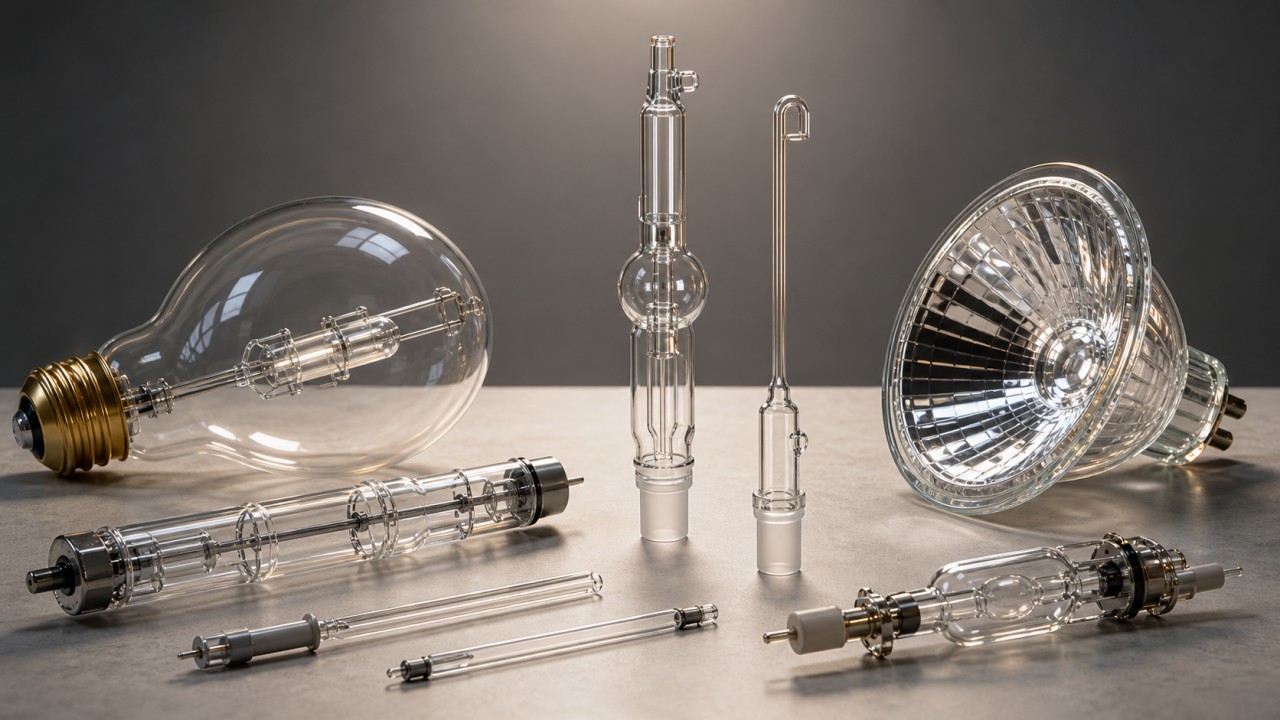
How can high-transmittance glass lampshades directly improve system efficacy (lm/W) and help luminaires meet energy-efficiency standards?
System efficacy, measured in lm/W, is the luminous flux output of the complete luminaire divided by input power. It is not the LED-chip efficacy. Since the glass shade affects delivered lumens, a high-transmittance shade can directly improve system efficacy. For example, a 10 W luminaire producing 800 lm after the shade is 80 lm/W. If a better glass shade raises output to 900 lm, the system efficacy becomes 90 lm/W.
The improvement comes from reducing absorption, reflection, and ineffective scattering. Low-iron glass, proper thickness, smooth surfaces, low-loss diffusion structures, and high-quality coatings can all reduce light loss. However, transparency alone is not enough. If a clear shade causes glare and users dim the lamp or replace the bulb, real energy performance may not improve. An efficient shade must balance high transmittance with necessary glare control.
For manufacturers, high-transmittance glass can help reach higher lumen output at the same power, or reduce LED power and heat at the same target brightness. It may also reduce LED count, driver load, and operating temperature, improving lifetime. Evaluation should include complete luminaire efficacy, light distribution, UGR, temperature rise, and maintained output, not just glass transmittance.
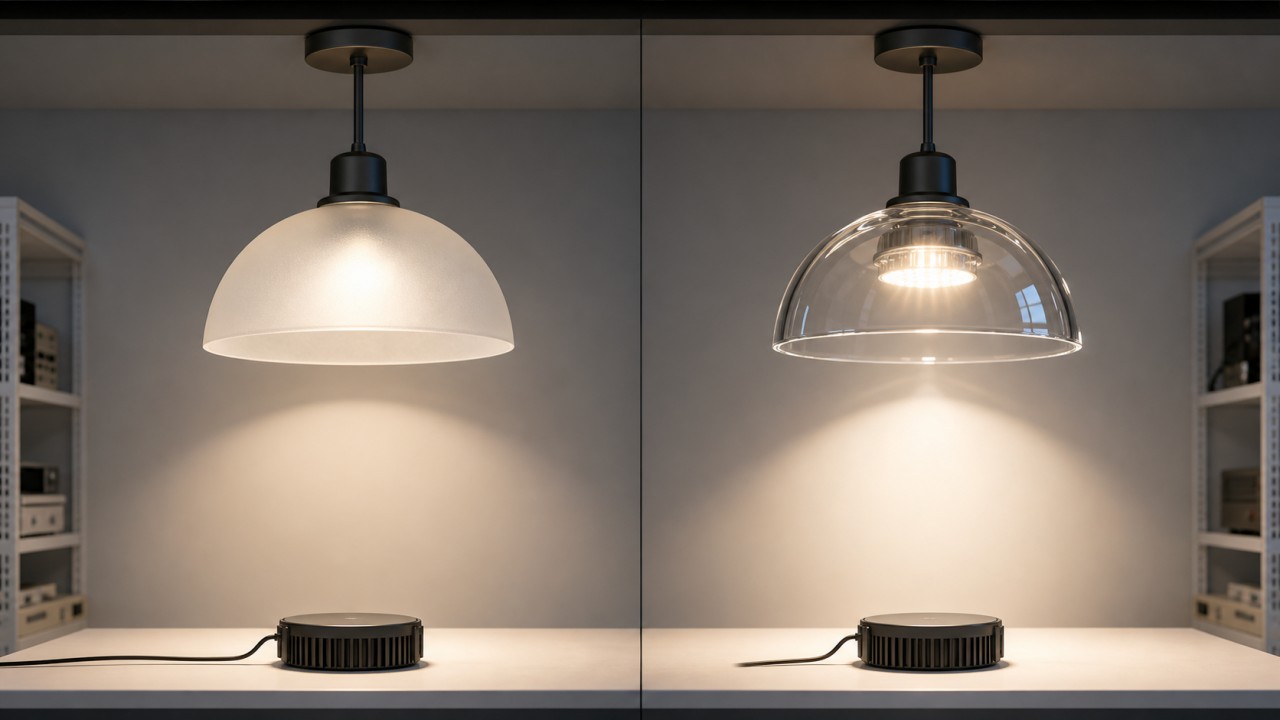
In energy-saving retrofits of existing luminaires, how much efficacy gain can be achieved by replacing only the glass shade?
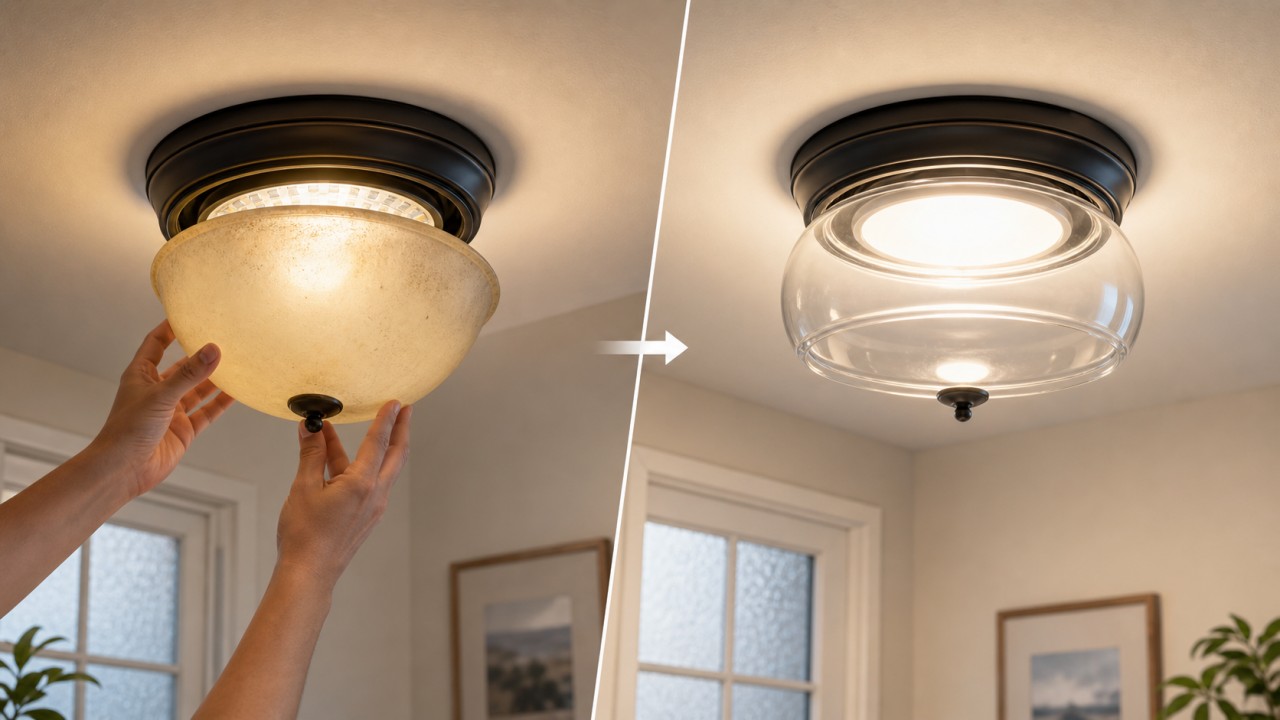
There is no defensible universal “10–30%” gain. The result depends on the original shade’s condition and optical loss, the replacement material and geometry, light-source distribution, enclosure reflectance, and whether cleaning is included in the comparison. Treat any broad percentage as a project-screening hypothesis, not a guaranteed saving.
Use the same luminaire body, LED module, driver, input voltage, stabilized temperature, mounting orientation, and laboratory setup. Test at least the original uncleaned condition, original cleaned condition, and proposed replacement condition. Report input power, total luminous flux, efficacy, intensity distribution, work-plane illuminance and uniformity, glare, chromaticity, shade surface temperature, LED/driver temperature, and ingress-protection implications. State the number of luminaires and shades tested and whether results come from a third-party lab, supplier, or BO-Glass internal test.
Calculate relative change from measured complete-luminaire results: gain (%) = (replacement output − cleaned-reference output) / cleaned-reference output × 100. Using a cleaned reference prevents accumulated dirt from being misrepresented as a material improvement. A separate maintenance comparison may quantify cleaning recovery and aged performance.
The replacement must also match fixing method, mass, clearances, heat dissipation, breakage safety, glare control, and sealing. Higher transmittance can increase direct luminance, while a new enclosure can change operating temperatures or invalidate the luminaire’s IP evidence. The retrofit is successful only if it improves useful light without compromising safety, comfort, or certification.
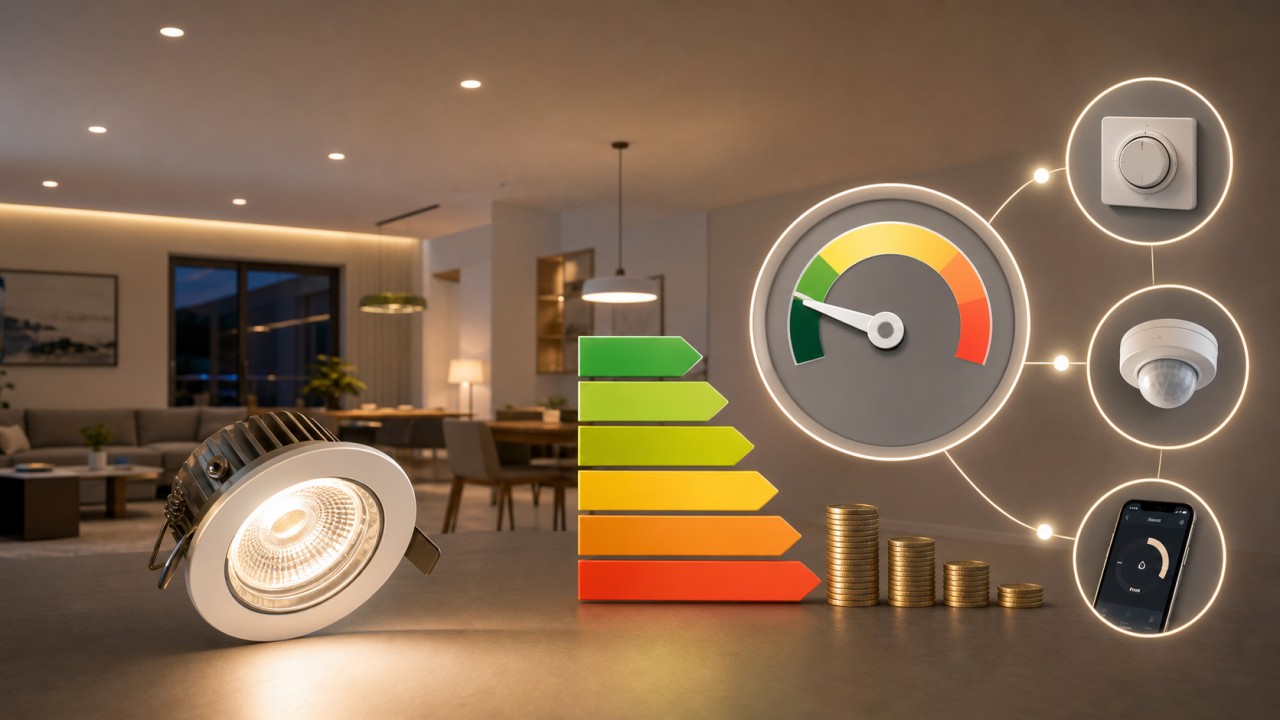
Besides wattage, what parameters should be considered when judging whether a lamp is energy-efficient?
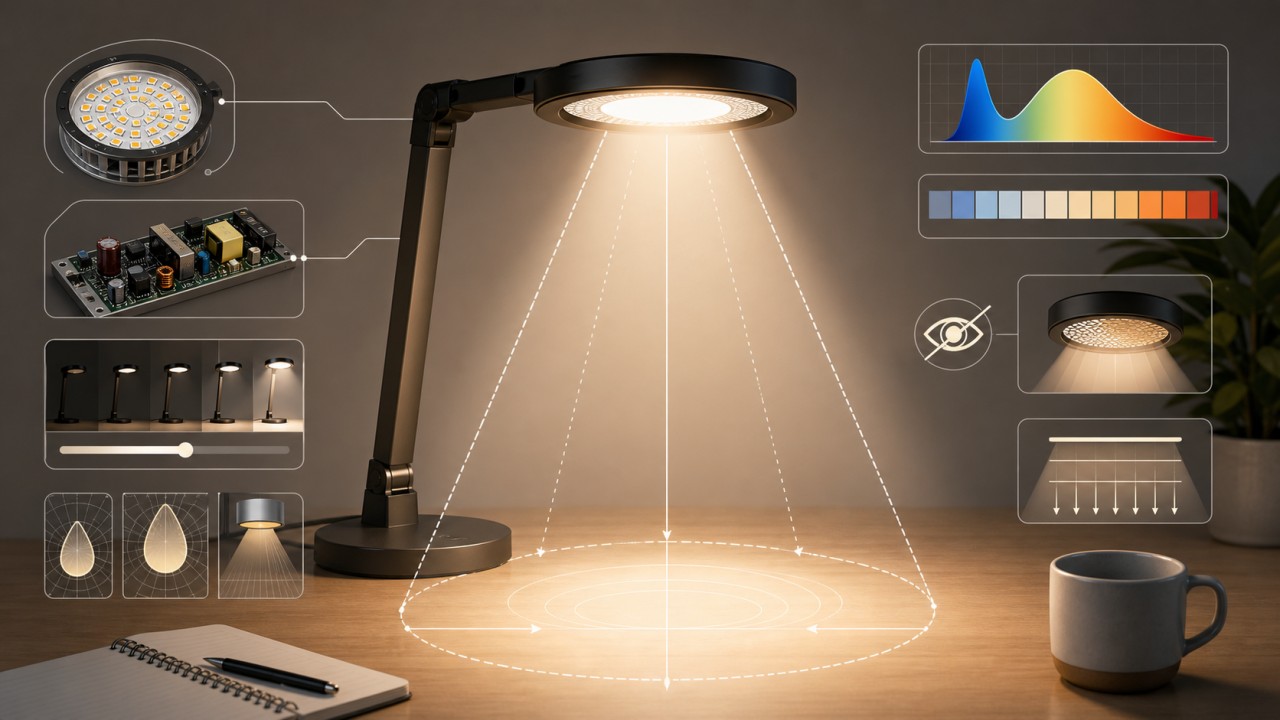
To judge whether a lamp is energy-efficient, do not look only at wattage. A low-power lamp that is not bright enough may require more fixtures or longer operating time. Key parameters include complete luminaire efficacy in lm/W, actual lumen output, whether the light distribution sends light where needed, and whether color quality and glare control allow users to use lower brightness comfortably.
Also check dimming ability, standby power, driver efficiency, power factor, lifetime, and lumen maintenance. A high-quality LED fixture may not have the lowest initial wattage, but if it has high efficacy, long life, slow lumen depreciation, and scene-based dimming, its long-term energy and replacement cost can be lower. For sensor lights, sensor accuracy also matters: false-on and false-off behavior both affect real energy saving.
The glass shade contributes too. High-transmittance, low-loss, easy-clean glass delivers more useful light from the same power. Good glare control prevents users from raising brightness unnecessarily. True energy efficiency means using the least electricity to provide enough comfortable light where it is actually needed.
What is the relationship between a luminaire's energy-efficiency rating and its actual electricity savings?
Energy efficiency rating reflects the efficiency of a luminaire under standard test conditions. It is usually related to complete luminaire efficacy, source efficiency, and driver losses. A higher rating generally means less power is needed for the same light output. But real savings also depend on operating hours, room needs, control method, and user behavior.
For example, a high-efficiency lamp installed in an area that does not need high brightness and left at full output may not save more than a medium-efficiency lamp with sensors and dimming. On the other hand, in kitchens, corridors, offices, and public areas that operate for long hours, higher efficiency can significantly reduce electricity cost and heat.
Energy rating is an important selection threshold, but not the whole story. Also check whether the light is useful, whether it is over-bright, whether it can be grouped and dimmed, whether lumen depreciation is low, and whether maintenance is easy. The ideal solution is high-efficiency luminaires combined with good lighting design and smart control, avoiding the problem of efficiently lighting places that do not need light.
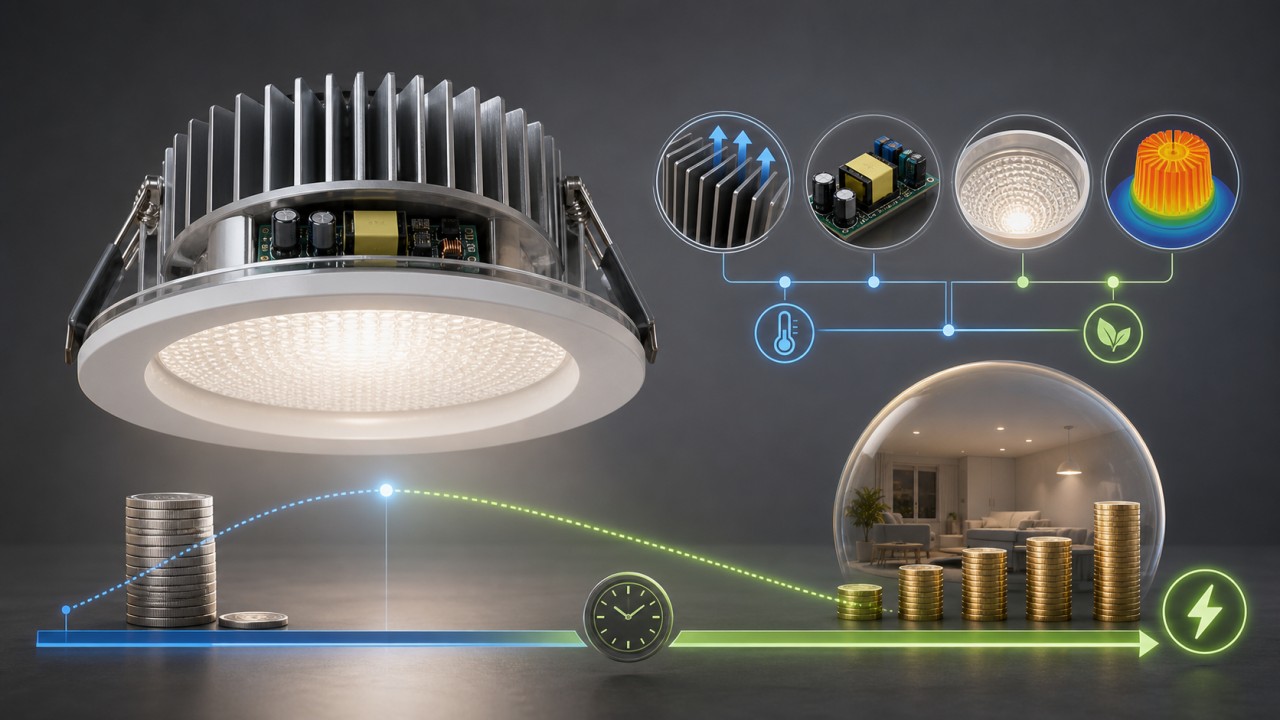
Why do high-efficacy luminaires cost more upfront but become more economical over the long term?
High-efficacy luminaires often cost more upfront because they use better LED chips, drivers, power supplies, heat sinks, optics, and structural materials. They convert electricity into light more efficiently and usually control temperature, glare, flicker, and lumen depreciation better. A cheap luminaire may cost less at purchase, but electricity, replacement, and maintenance can be higher over time.
Long-term value comes from three areas. First, energy saving: lower power for the same illuminance. Second, longer life: LEDs and drivers are less likely to fail early due to heat or poor components. Third, lower maintenance: shades yellow less, lumen depreciation is slower, and cleaning restores performance better. In spaces used for several hours every day, electricity and maintenance savings can offset the initial price difference within a few years.
The right method is life-cycle cost, not purchase price alone. Include product cost, electricity, expected lifetime, replacement labor, downtime, and comfort. In kitchens, studies, commercial spaces, and public corridors, high-efficacy reliable luminaires are often more economical than cheap fixtures.
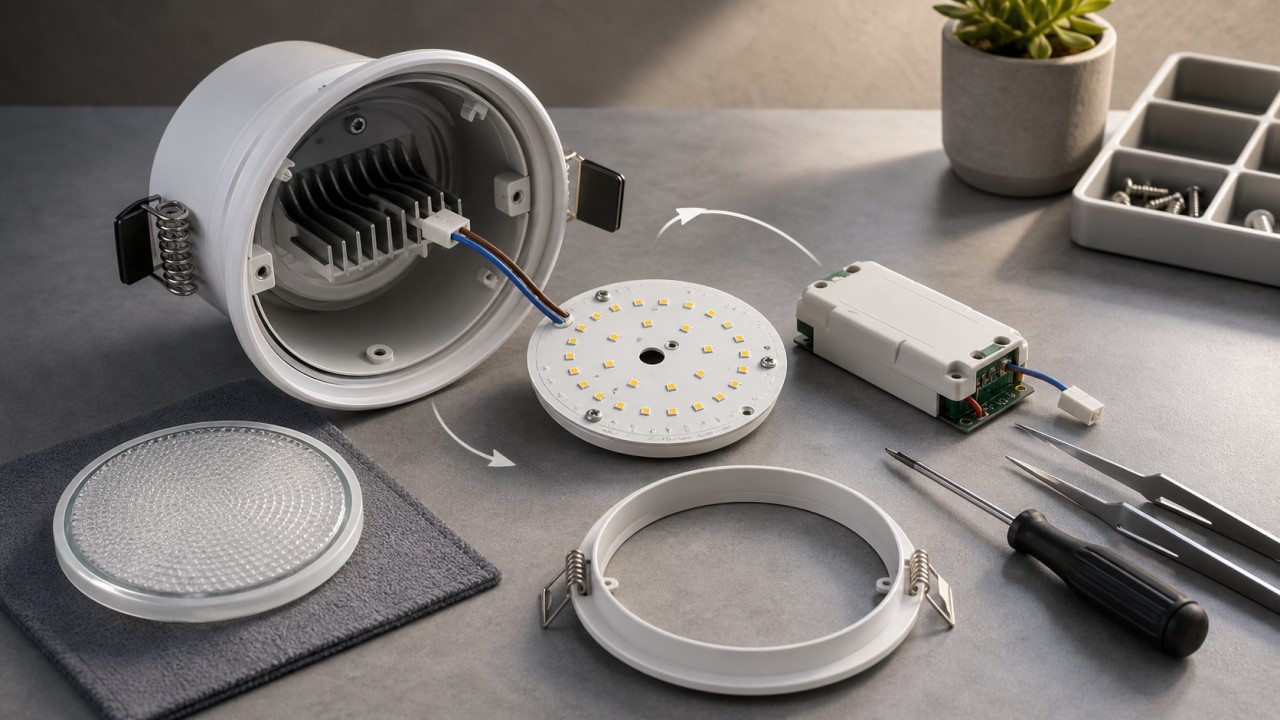
Must a broken luminaire be discarded entirely, or can the light source or driver be replaced in some cases?
A failed luminaire does not always need to be thrown away. Many failures come from the light source module, driver, terminal, switch, remote receiver, or sensor, while the housing, glass shade, and heat sink remain usable. If the fixture uses replaceable lamps or modular drivers, repair can be cheaper and more sustainable than replacing the whole luminaire.
Repair is practical when a standard E27, GU10, or similar lamp fails; when the LED driver fails but the LED module and housing remain good; when a remote or dimming module can be replaced; or when a broken glass shade can be replaced with an original part. Replacement parts must match voltage, current, power, IP rating, dimming protocol, and insulation requirements.
Repair is not recommended if the housing is burned, insulation is aged, water corrosion is present, the circuit board is widely damaged, the heat sink is deformed, the integrated fixture has no service parts, or post-repair safety cannot be guaranteed. Work involving mains voltage and drivers should be handled by qualified personnel. Choosing maintainable luminaires at the design and procurement stage is an important way to reduce waste.
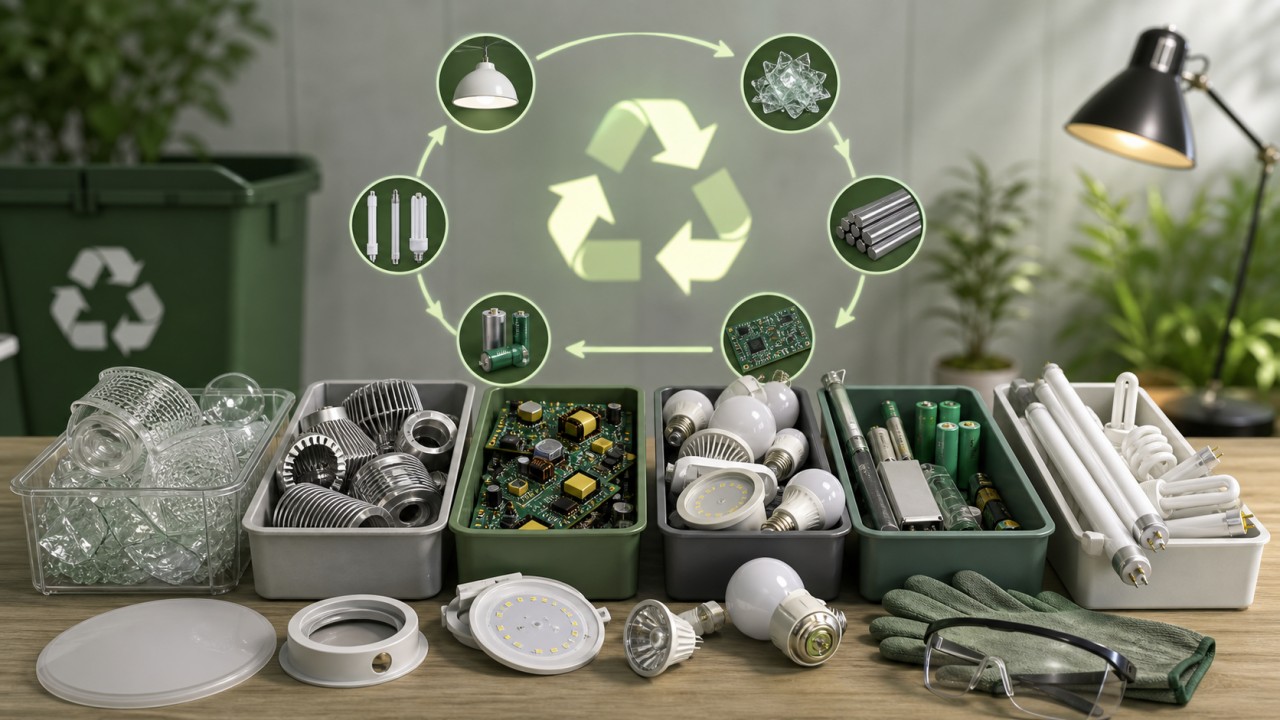
How should old luminaires and light sources be handled to reduce environmental impact?
Old luminaires should not simply be mixed with household waste. They may contain metal, glass, plastic, circuit boards, drivers, LED chips, mercury-containing lamps, or batteries. Proper sorting and recycling reduce environmental risks from heavy metals, electronic waste, and broken glass.
LED luminaires and drivers are electrical and electronic waste and should go to formal recycling points, property-management recycling, appliance recycling channels, or brand take-back programs. Fluorescent tubes and compact fluorescent lamps may contain mercury and must be handled carefully without breaking; send them to hazardous-waste or professional recycling channels. Glass shades may be treated as glass or construction waste according to local rules if uncontaminated. Broken glass should be wrapped and labeled to protect workers.
The best way to reduce environmental impact is to extend service life and improve repairability. Choose luminaires with replaceable sources, replaceable drivers, durable shades, and low lumen depreciation. During disposal, separate glass, metal, and electronic parts where possible. For projects, keep a batch recycling list recording luminaire model, material, and disposal route.
Material and appearance selection
Compare common glass families, diffuser appearances, colored glass, and glass-versus-plastic tradeoffs.
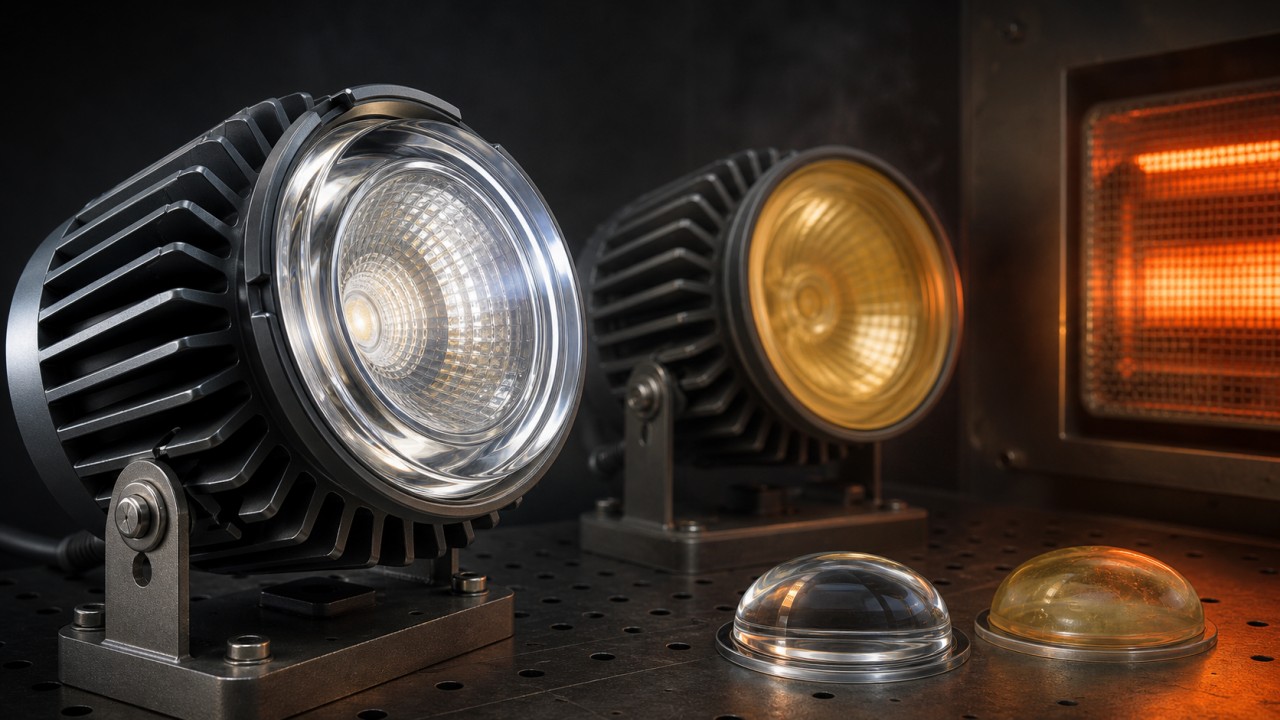
Why are borosilicate glass lenses preferred over ordinary optical plastics for high-power LED spotlights?
Long-term stability: core advantage under high temperature and UV High-power spotlights can expose optics to heat, UV, cleaning agents, and repeated thermal cycling. Borosilicate glass generally provides a low coefficient of thermal expansion and good long-term stability under specified temperature, radiation, and chemical conditions. It should not be described as immune to aging or guaranteed to remain unchanged for ten, fifty, or any other number of years. Coatings, contamination, surface corrosion, edge damage, mounting stress, and thermal gradients can still reduce optical or mechanical performance. Compare production-representative glass and polymer optics using defined aging conditions and measured transmittance, haze, colour shift, dimensions, surface condition, and beam performance.
Optical performance: sustained precision and high transmittance Borosilicate glass can offer high visible transmittance, dimensional stability, and surface hardness, but exact values depend on composition, thickness, surface finish, coating, wavelength range, and test method. Polymer performance likewise depends on resin grade, stabilizers, geometry, coating, and operating temperature. Verify the assembled spotlight at stabilized operating temperature for luminous flux, beam angle, intensity distribution, colour shift, stray light, and surface durability rather than assuming either material will retain a perfect optical surface.
Mechanical and safety properties: trade‑off between hardness and impact resistance Borosilicate glass has a Mohs hardness of 7–7.5, much higher than that of plastics, effectively resisting scratches from dust, sand, and cleaning tools. However, glass is brittle and has lower impact resistance than plastic — it may shatter under a strong blow. In high‑power spotlights, the lens is usually mounted in a relatively protected interior position or with a metal bezel, so the actual risk of mechanical impact is low. If higher impact resistance is needed (e.g., in sports arenas or industrial environments), tempered or laminated glass can be used. While plastics are tough and unlikely to break, their surface becomes brittle with aging, and impact resistance actually decreases over long‑term use.
Chemical and corrosion resistance Chemical compatibility depends on the complete optic, including coatings, inks, adhesives, seals, and edge treatments. Borosilicate glass often has good chemical durability, while some polymers are vulnerable to particular cleaners, solvents, oils, or stress-cracking agents. Neither material should be described as universally unaffected. Test the actual chemicals, concentrations, temperatures, exposure times, wiping cycles, and post-exposure optical and mechanical criteria.
Cost considerations: initial investment vs. long‑term value Polymer optics can reduce mass, cost, and manufacturing complexity; borosilicate optics can provide greater thermal and surface-stability margins. A credible life-cycle comparison needs the declared environment, operating temperature, annual hours, maintenance and cleaning regime, aging method, failure threshold, replacement accessibility, sample quantity, and measured retention data. Do not claim a 50-year no-replacement life without evidence covering the stated conditions.
Summary Borosilicate glass is a strong candidate when the measured thermal, dimensional, chemical, and surface-durability requirements justify it. Optical polymers can remain appropriate when impact resistance, low mass, complex moulded geometry, or cost is more important. Select between them from matched supplier data and complete-product testing, not from unconditional lifetime claims.
How should soda-lime and borosilicate glass be compared for reading lamps and children's desk lamps?
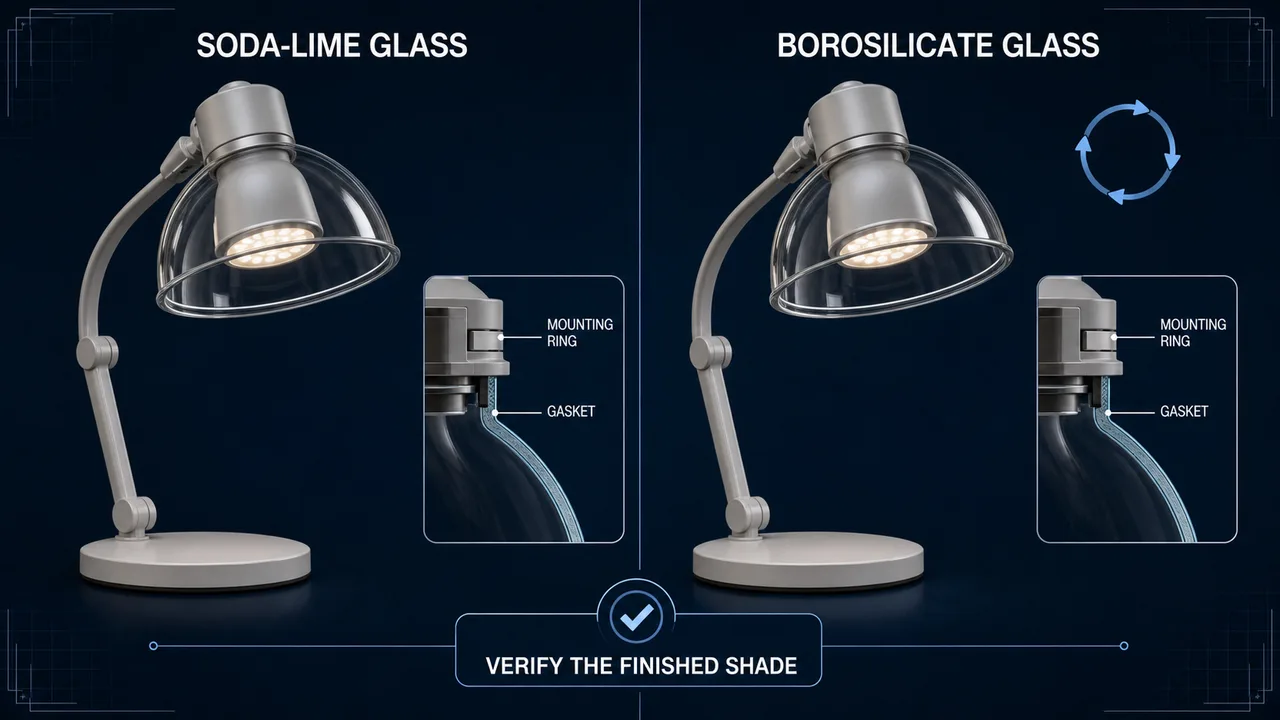
Borosilicate glass generally has a lower coefficient of thermal expansion than ordinary soda-lime glass and can provide a wider thermal-shock design margin. This does not mean that a shade cannot break near a hot source or after contact with a cooler medium.
Thermal-shock statement: Borosilicate glass generally provides a wider thermal-shock margin than ordinary soda-lime glass, but allowable temperature differences must be verified for the actual glass composition, geometry, wall thickness and uniformity, edge condition, surface damage, residual and mounting stress, temperature difference, heating rate, cooling rate, cycle count, and support method.
Impact resistance should be evaluated on the finished shade because wall thickness, curvature, surface condition, edge quality, tempering or strengthening, mounting, and the type and location of impact often affect performance more than the glass family alone. Borosilicate is primarily selected for thermal stability and chemical durability; it is not automatically more resistant to drops or blunt impact in every construction.
Breakage safety must be assessed separately. Ordinary untempered borosilicate glass can produce sharp fragments. Fragment size, retention, and injury risk depend on tempering, heat strengthening, lamination or protective film, thickness, residual stress, product geometry, edge support, and failure mode. Do not describe borosilicate fragments as inherently less sharp than soda-lime fragments.
For a reading lamp or children's desk lamp, first control accessible surface temperature, source clearance, wattage and misuse conditions, fixing reliability, and direct glare. Then qualify the complete shade and mounting assembly with declared thermal-cycle, impact, drop, retention, and breakage criteria appropriate to the target market and product standard.
For a material example, SCHOTT's BOROFLOAT® 33 technical data lists a low linear thermal-expansion coefficient but also states that impact resistance depends on fitting, size, thickness, impact type, drill holes, and other parameters. Supplier data is not a substitute for finished-product testing.
How should clear glass, surface-frosted glass and opal glass be compared for task lamps?
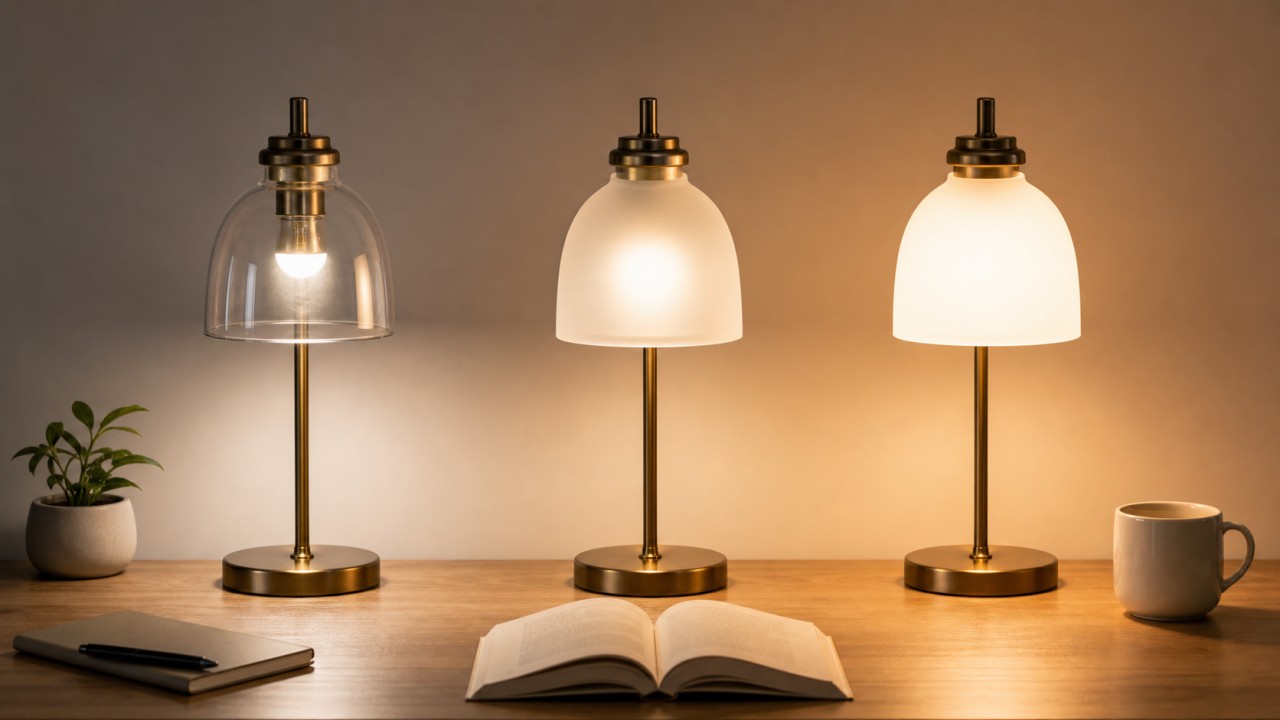
Clear glass normally preserves the highest source visibility and directional character. It may suit task lamps whose LED or bulb is recessed, shielded, or otherwise kept outside the normal line of sight. High transmittance alone does not establish useful task performance: the complete luminaire must still provide adequate illuminance and uniformity without excessive source luminance or reflected glare.
A surface-frosted treatment adds scattering at one or both glass surfaces. It can soften source images while retaining more directional output than a strongly opal construction, but the result depends on etch or blast texture, treated side, glass thickness, source distance, and fixture cavity. “Frosted” should therefore be specified as a finish with measured transmittance, haze, surface durability, and an approved illuminated sample.
Opal glass generally provides stronger source hiding because scattering occurs through an opacified or diffusing glass structure. It may create a larger, more uniform luminous surface, but it does not automatically conceal every source, remove all glare, eliminate hard shadows, or reduce eye fatigue. Source spacing, shade thickness, luminance, viewing angle, task illuminance, flicker, contrast, and surrounding ambient light remain important.
Select among these options by testing the finished task lamp in its intended geometry. Report task-plane illuminance and uniformity, visible source images, luminance or glare observations, beam distribution, colour shift, surface temperature, and cleaning durability. Users with low vision or precision tasks may need different light levels and distribution from users seeking softer ambient or bedside light.
How should glass and PC diffusers be compared for kitchen and bathroom LED lighting?
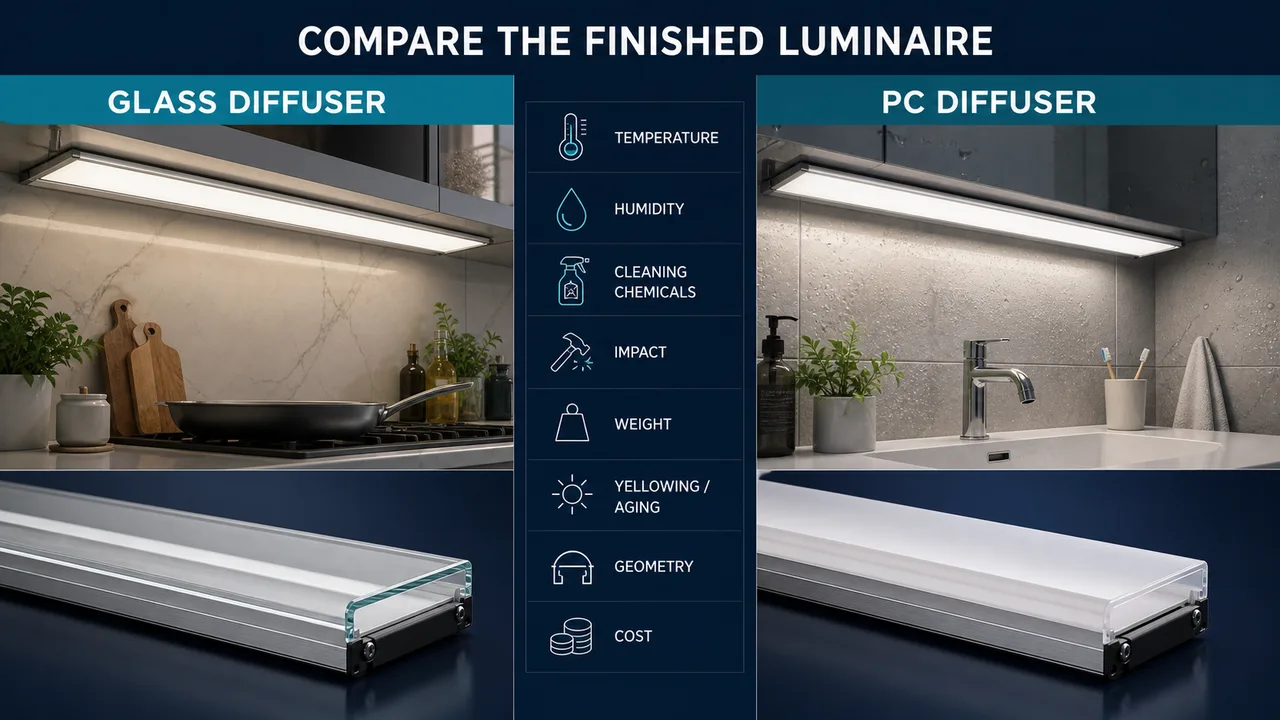
Neither glass nor polycarbonate (PC) should be treated as universally superior. The selection should compare the actual diffuser grade and construction under the declared temperature, humidity, cleaning chemicals, impact exposure, weight limit, optical-life target, yellowing requirement, geometry, manufacturing process, cost, and replacement strategy.
Glass can offer strong scratch resistance, dimensional stability, resistance to many household cleaners, and stable appearance at temperatures that would be unsuitable for some polymer grades. It can also be easier to clean in greasy environments. Its disadvantages may include higher mass, brittle failure, tighter edge and mounting requirements, less flexibility for snap-fit features, and higher forming or finishing cost for long complex profiles.
PC is lightweight, impact-tolerant, readily extruded into long integrated profiles, and compatible with clips, seals, and complex cross-sections. Performance varies substantially by resin grade, UV package, flame-retardant system, coating, wall thickness, processing history, and operating temperature. Yellowing, stress cracking, chemical compatibility, creep, and optical change must therefore be assessed using supplier data and accelerated tests that represent the intended environment.
Humidity alone does not establish which diffuser is better. In a bathroom, the complete luminaire's sealing, condensation management, accessible temperature, and electrical safety are decisive. In a kitchen, grease, detergents, heat, wiping, and ease of removal may dominate. Test the assembled luminaire for temperature rise, ingress where applicable, impact, cleaning resistance, luminous flux, distribution, colour change, and aged appearance before selecting the material.
How should soda-lime glass, borosilicate glass, and crystal glass be selected for luminaires based on cost and performance?
The choice among soda-lime glass, borosilicate glass, and crystal glass depends mainly on four factors: budget, thermal environment, mechanical safety, and decorative effect. All three can be used in luminaires, but they are not interchangeable in every application.
Soda-lime glass is the most common and cost-effective option. It has a stable supply chain and is easy to press, blow, edge-grind, frost, print, coat, and temper. Ordinary clear soda-lime glass has enough transmittance for most residential shades. It is suitable for ceiling-light covers, wall-lamp shades, table-lamp shades, decorative pendant shades, and low-power LED covers. Its weakness is thermal shock resistance. Because its thermal expansion is higher than that of borosilicate glass, it is more vulnerable when the shade is close to a hot source, when the temperature difference is large, or when the wall thickness is uneven. In simple terms, soda-lime glass is best for moderate-temperature, cost-sensitive, general-purpose fixtures.
Borosilicate glass is stronger in thermal shock resistance, chemical stability, and dimensional stability. Its low coefficient of thermal expansion allows it to tolerate rapid heating and cooling much better. It is a better choice for high-power LED spotlight lenses, glass parts close to the light source, kitchen and bathroom fixtures, outdoor or semi-outdoor lamps, sealed shades, and fixtures that must remain stable at elevated temperatures. It costs more and is usually harder to process, but it offers better safety and long-term reliability. For sealed lamps, high-temperature lamps, or products that are difficult to service, borosilicate glass can be more economical over the full product life.
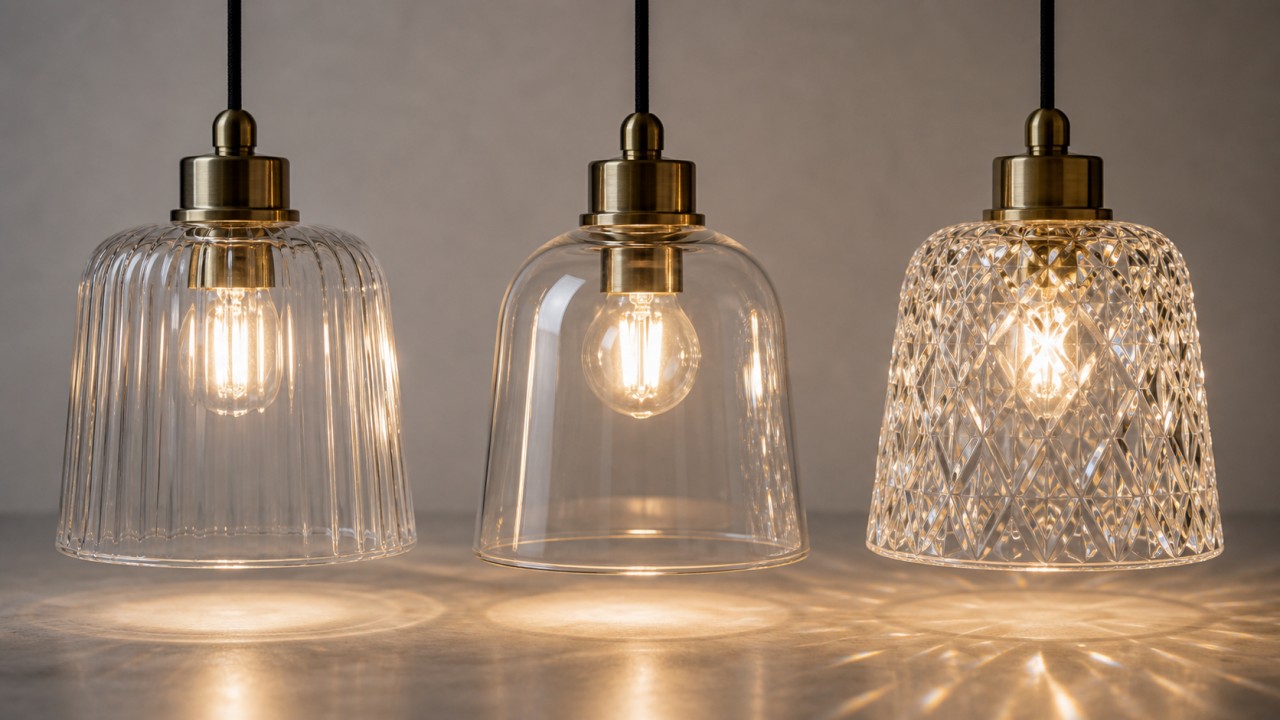
Crystal glass is valuable mainly for decoration rather than ordinary lighting efficiency. It usually has a higher refractive index and stronger sparkle, reflection, and prismatic effects. It is suitable for chandelier pendants, crystal arms, decorative prisms, and ornamental shade details. Crystal glass creates a luxurious visual effect, but it is heavier, more expensive, and can produce glare. Traditional lead crystal also raises environmental and heavy-metal compliance concerns, so many modern products use lead-free crystal or high-clarity glass. Crystal should not be treated as a universally "better" lampshade material. It is excellent for decorative layers, but not necessarily for large-area task lighting or high-temperature sealed shades.
A practical rule is: choose soda-lime glass for normal residential shades when cost matters and temperature is moderate; choose borosilicate glass for high heat, high power, thermal shock, sealed structures, or stricter safety requirements; choose crystal glass when sparkle, refraction, and decorative luxury are the main goals. Many fixtures combine materials, for example using soda-lime or borosilicate glass for the main shade and crystal glass for decorative pendants.
For spaces with different color-temperature preferences, what base-colored glass lampshades should be paired with them?
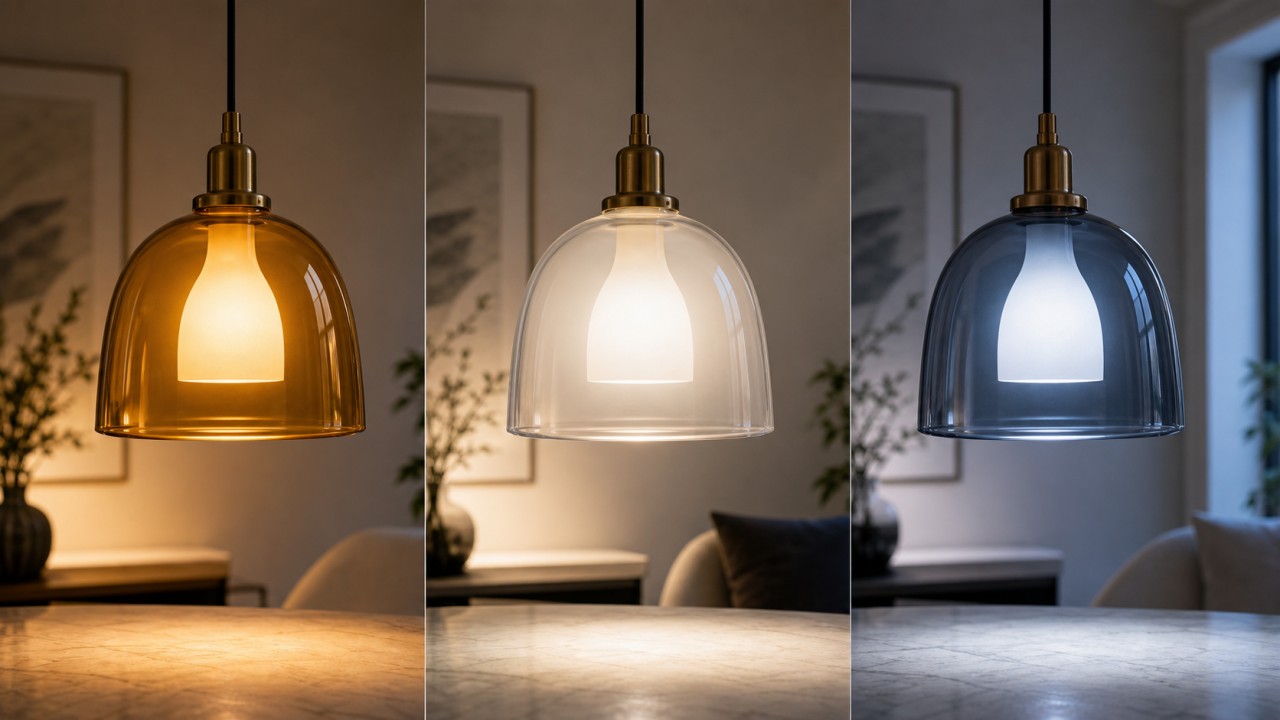
The base color of a glass shade should be matched with the desired feeling of the space and with the color temperature of the light source. The shade is not only a decorative shell. It acts like a filter: it can absorb some wavelengths, shift the perceived color temperature, reduce brightness, and change the way skin, wood, fabric, food, and wall colors appear. Therefore, choosing the wrong glass tint can make even a good LED lamp look dull, dirty, or unnatural.
For warm spaces using 2700-3000K light, such as bedrooms, dining rooms, lounge corners, and relaxed living rooms, warm or neutral-warm glass is usually the best match. Suitable options include clear low-iron glass, light amber glass, champagne glass, tea-colored glass, warm smoked glass, and milky opal glass with a warm LED source inside. These shades reinforce the cozy feeling and make wood, warm fabrics, and food look more inviting. However, strongly amber or brown glass should be used carefully. It may look beautiful as a decorative object, but it can reduce transmittance significantly and make the room too dim if used as the main light.
For neutral and practical spaces using 3500-4000K light, such as general living areas, hallways, open kitchens, wardrobes, and study-adjacent rooms, the safest choices are clear glass, low-iron glass, opal white glass, and very light grey glass. These shades do not strongly change the original light color, so the lamp remains visually stable. They are especially useful when the room contains many materials and colors, because they avoid pushing everything too yellow, too blue, or too green.
For cool or clean-looking spaces using 4000-5000K light, such as home offices, modern kitchens, utility rooms, and minimalist interiors, clear glass, low-iron glass, pale grey glass, lightly smoked glass, or very subtle blue-green glass can be used. These choices keep the light crisp and relatively neutral. But deep blue, deep green, and heavy smoke glass should not be used for general lighting unless the lamp is intentionally decorative. They reduce brightness and can distort color rendering.
The most common mistake is mixing strong tints against the intended color temperature. A cool white LED behind amber glass often does not become pleasantly warm; it may become grey-yellow and muddy because the glass absorbs part of the spectrum while the LED still has a cool spectral structure. Similarly, a warm LED behind blue or green glass can produce an unpleasant olive, dirty grey, or weak cyan tone. If the goal is simply to keep the original light color, use clear low-iron glass or opal glass rather than a saturated tinted shade.
Color rendering should also be considered. If the room needs accurate color judgment, such as a kitchen, dining area, makeup area, wardrobe, art corner, or study, the glass should not damage the lamp's CRI performance too much. Deeply colored glass may make red meat, green vegetables, skin tones, or clothing colors look inaccurate. For these rooms, use light-tinted or neutral glass and choose a high-CRI light source, preferably Ra 90 or higher.
In short, warm rooms can use warm or neutral glass; neutral rooms should use clear, opal, or light grey glass; cool modern rooms can use clear or subtly cool-toned glass. Deeply tinted glass is best treated as decorative accent lighting rather than main lighting. The shade color should support the desired atmosphere while preserving enough brightness and color fidelity.
For age-related vision decline, how should glass lampshades choose light color and haze to compensate visually?
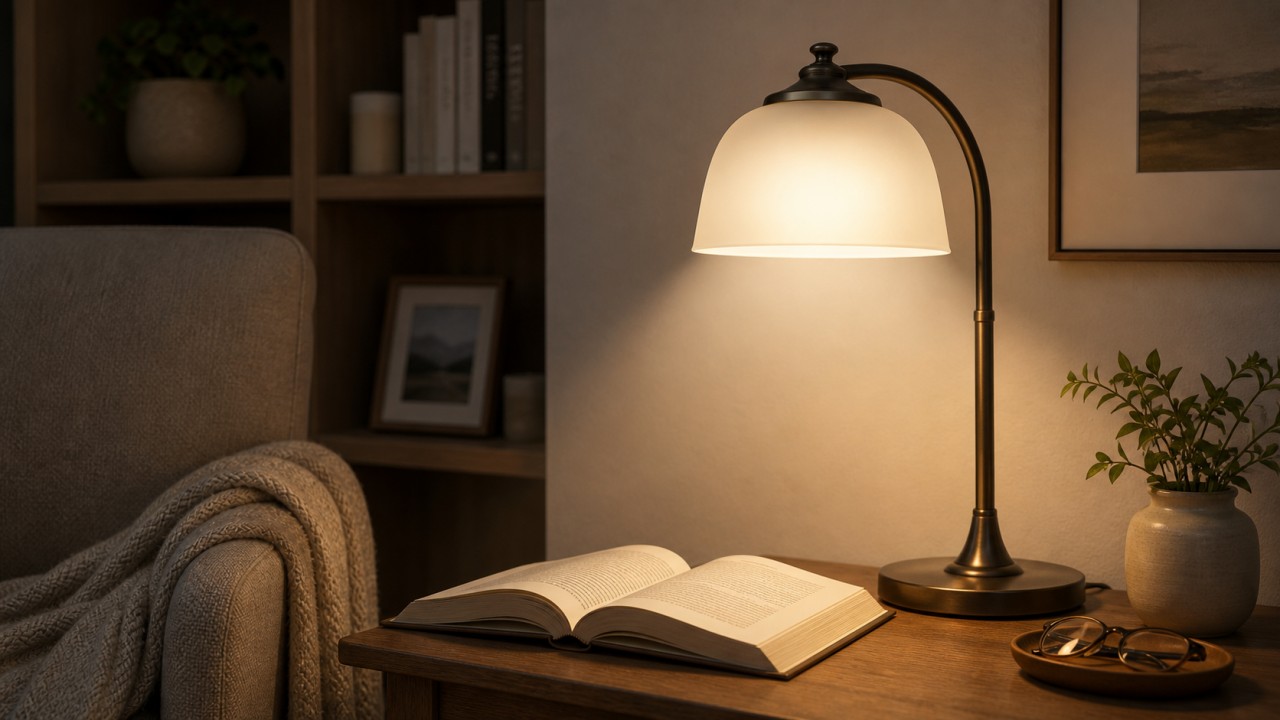
Common age-related visual changes include yellowing of the lens, smaller pupil size, lower contrast sensitivity, higher glare sensitivity, and slower dark adaptation. Lighting for older adults therefore needs to be brighter but not harsh, color-accurate but not excessively cool.
Glass shades should provide sufficient useful output while reducing high-luminance source images. A preliminary material screen may compare matched samples near 70–90% transmittance with low-to-moderate diffusion, but this is not a clinical or product acceptance range and must not be quoted without test conditions. Select the finished system by measuring task illuminance, uniformity, glare, flicker, colour rendering, and user viewing angles on the complete luminaire. Very low-transmittance shades can reduce detail visibility; fully clear shades can expose uncomfortable bright points.
For color temperature, 3000K-4000K is often suitable for daily activities: clearer than very warm light but less harsh than high-CCT cool white. CRI should preferably be Ra 90 or higher, with good red and skin-tone rendering, helping users judge food, medicine, and physical condition. Night lights should use low brightness, low CCT, and low mounting positions to avoid direct eye exposure. The overall principle is higher illuminance, lower glare, high color rendering, and soft diffusion.
Contact Us
Your feedback fuels our growth, and your questions drive our solutions.
We value your feedback, inquiries, and suggestions. Please feel free to get in touch with us
General inquiries
Please contact us via sales@bo-glass.com, and we will reply to you as soon as possible.
Interested to work with us
Drop your resume at info@bo-glass.com
and we will get back to you shortly.
We uses the contact information you provide to us to contact you about our relevent content, products, and services.