
Custom Outdoor Lighting Glass Purchasing and Quality Control
A purchasing guide should reduce uncertainty before quotation and sampling. Buyers need to identify the component function, installation environment, drawings or physical sample, material, geometry, critical tolerances, sealing interface, optical targets, cosmetic zones, test responsibility, order quantity, packaging route, and schedule. This guide explains how those inputs affect DFM review, tooling, MOQ, first-article approval, quality control, batch consistency, export packaging, and repeat orders.
Purchasing, Sampling, Quality Control, and Lead Time
- First article
- Release only after drawing revision, material, critical dimensions, optical values, appearance, assembly fit and required complete-luminaire tests are recorded.
- Sampling plan
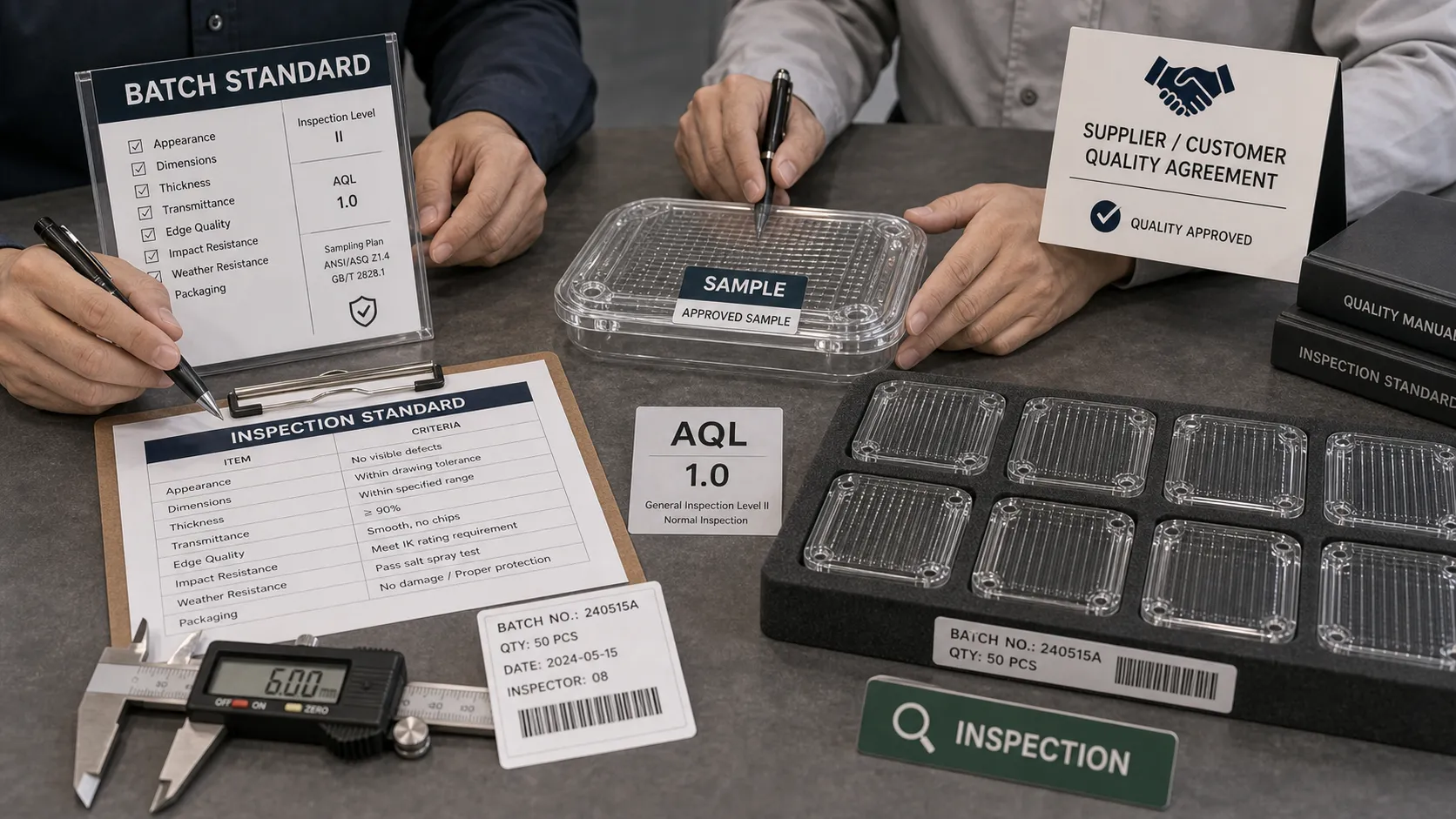
- If ISO 2859-1/AQL sampling is used, the inspection level, lot size, AQL and defect classes must be stated; “random inspection” is incomplete.
- Measurement system
- Record instrument resolution, calibration status, fixture and measurement points. A tolerance is meaningless if the gauge cannot resolve it reliably.
- Packaging validation
- Define orientation, drop/vibration profile, pallet load, route and acceptance. One carton design cannot be assumed valid for every glass geometry.
What information do I need to provide when purchasing glass components for outdoor lighting fixtures?
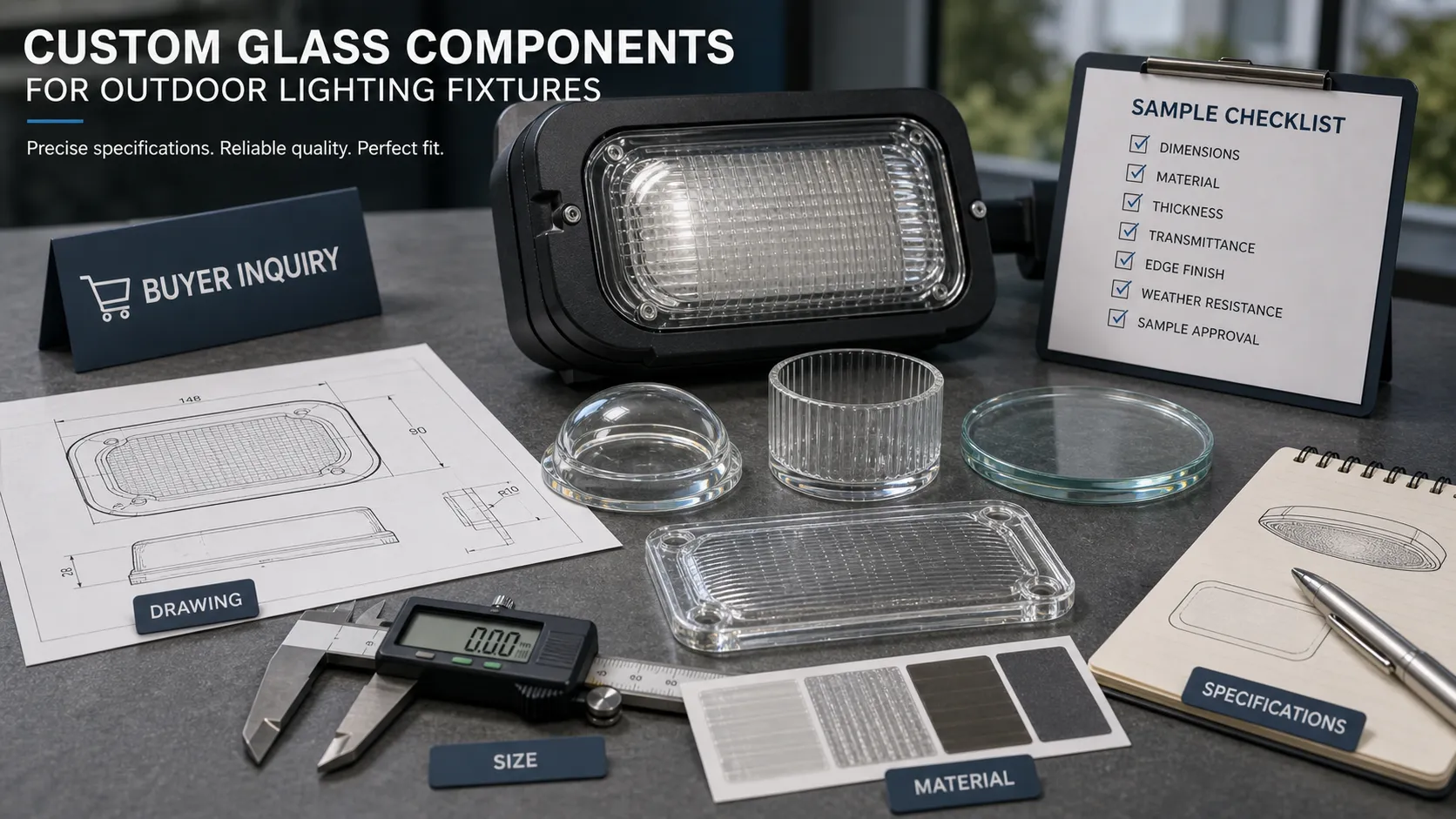
When purchasing glass components for outdoor lighting fixtures, it is recommended to provide the type of lighting fixture, application environment, glass usage, dimensional drawings, thickness, material, color, light transmittance or haze, edge treatment, hole location, surface finish, estimated quantity and target delivery time. If glass is involved in sealing, the housing structure, gasket position, frame pressing method and target protection level should also be described.
The more complete the information, the more accurate the quotation and sampling will be. For different scenarios such as underground lights, underwater lights, wall washers, wall lights, etc., the pressure-bearing, waterproof, temperature-resistant, low-glare or optical consistency requirements should also be specified to avoid suppliers only quoting ordinary glass components, only to later discover that they cannot be assembled or have insufficient performance.
Do I need to provide 2D drawings or 3D files for custom outdoor lighting glass?
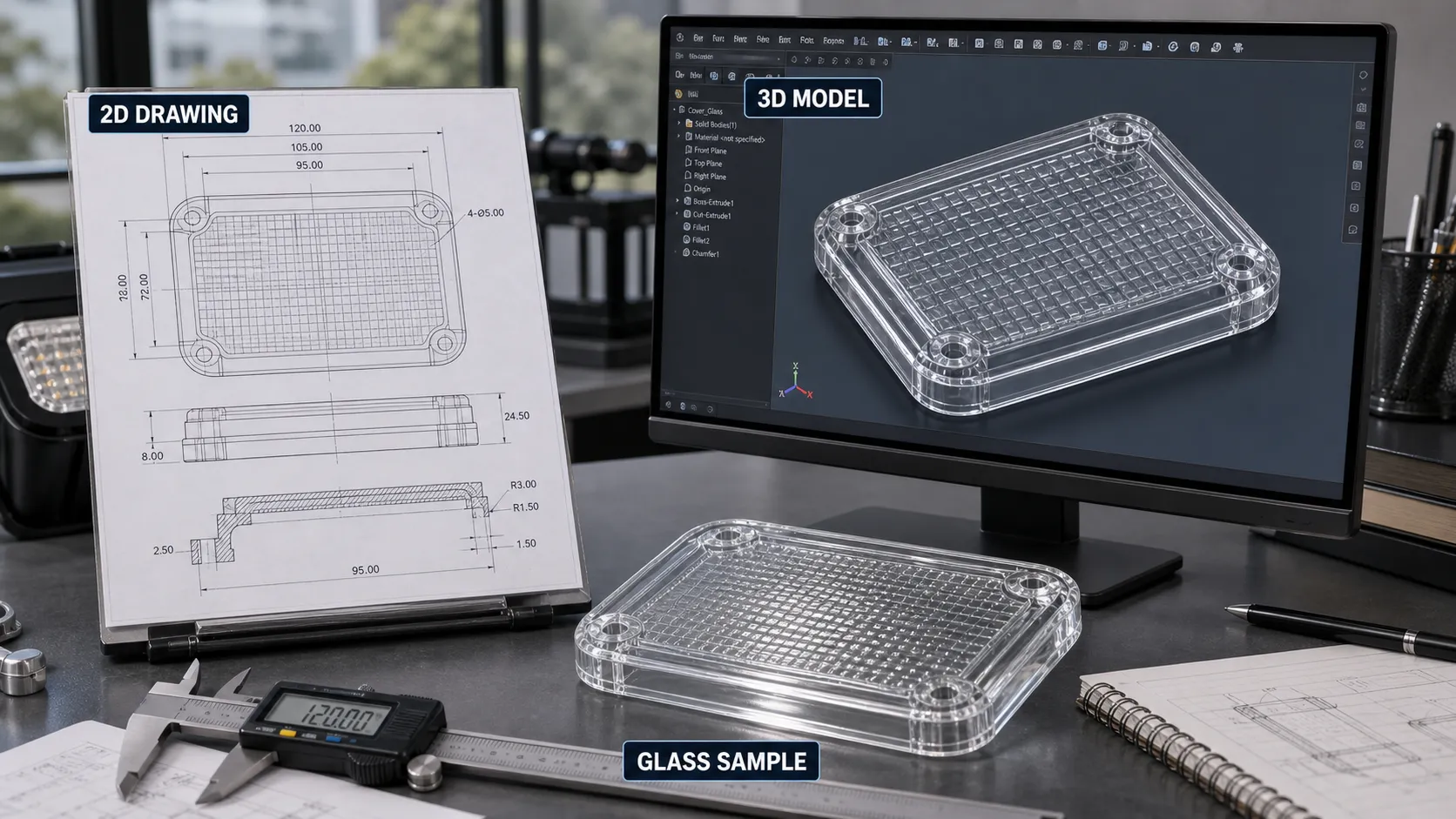
Custom outdoor light fixture glass is best provided with both 2D drawings and 3D files. 2D drawings are used to clarify key dimensions, tolerances, thickness, hole locations, chamfering, edging, surface treatment and inspection requirements; 3D files are helpful in understanding the glass surface, assembly space, luminaire body structure and sealing fit.
If only one file type can be provided, 2D drawings are usually sufficient for protective cover glass, while complex curved surfaces, specially shaped glass shades, optical glass lenses and pressed components require 3D files. Before mass production, approved dimensions, tolerances and appearance criteria should be formalized in controlled drawings.
Can outdoor glass components be reproduced from samples without drawings?
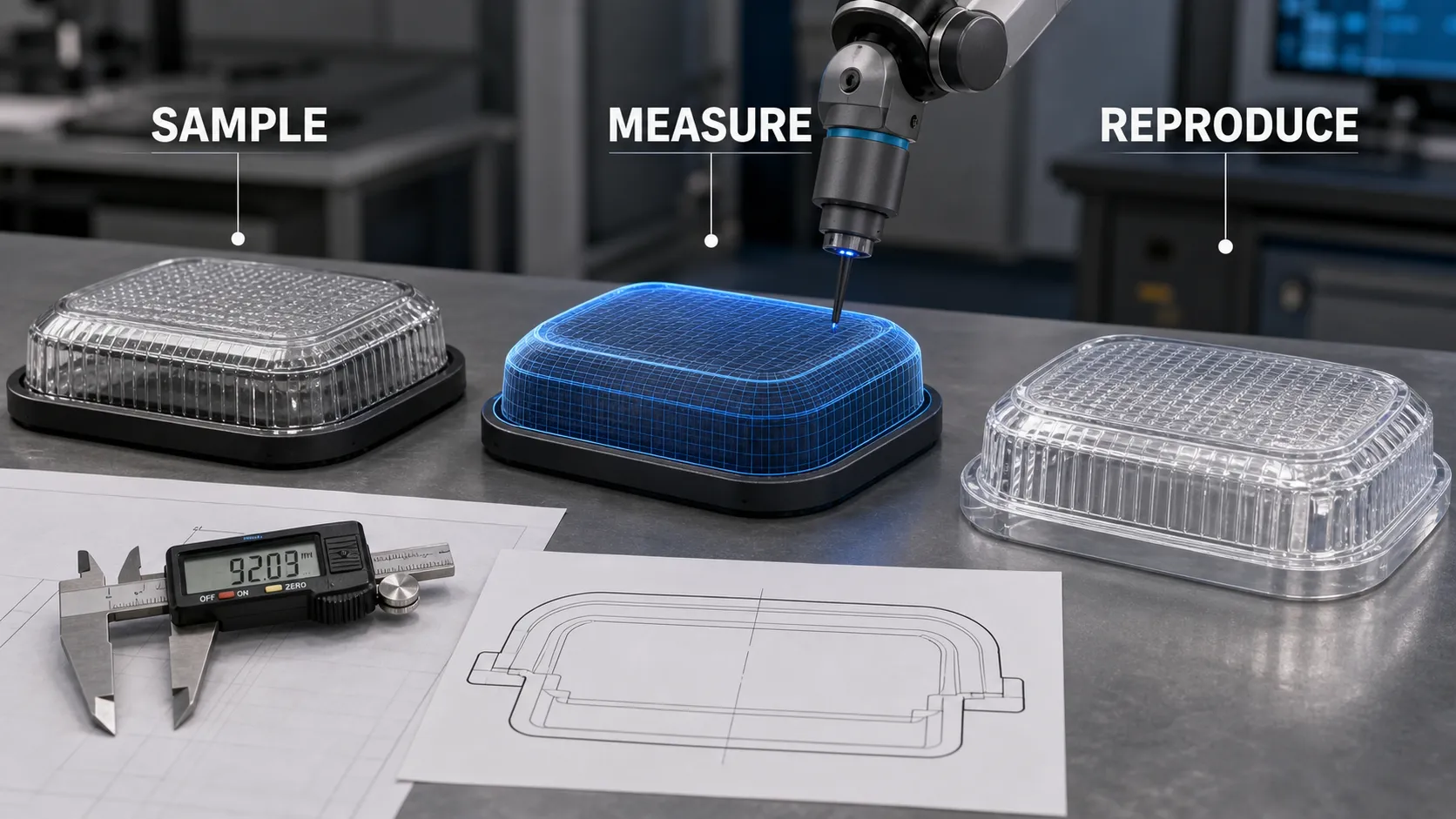
When drawings are unavailable, outdoor-lighting glass components can be reproduced from physical samples, but dimensions, thickness, curvature, opening, hole locations, color, light transmittance, haze, edge treatment and surface finish must first be measured. For blown glass shades, pressed optical glass lenses and specially shaped parts, the original manufacturing route and the need for new tooling must also be determined.
Sample reproduction is suitable for legacy-luminaire repair, replacement-part development and projects for which the customer lacks complete documentation, but a reproduced part is not automatically correct. Confirmation drawings should be prepared after measurement, and fit should then be verified through sample assembly and operating tests, especially for glass components that affect sealing, water ingress protection or optical performance.
Before quoting glass components for outdoor lighting fixtures, what parameters will directly affect the price and delivery time?
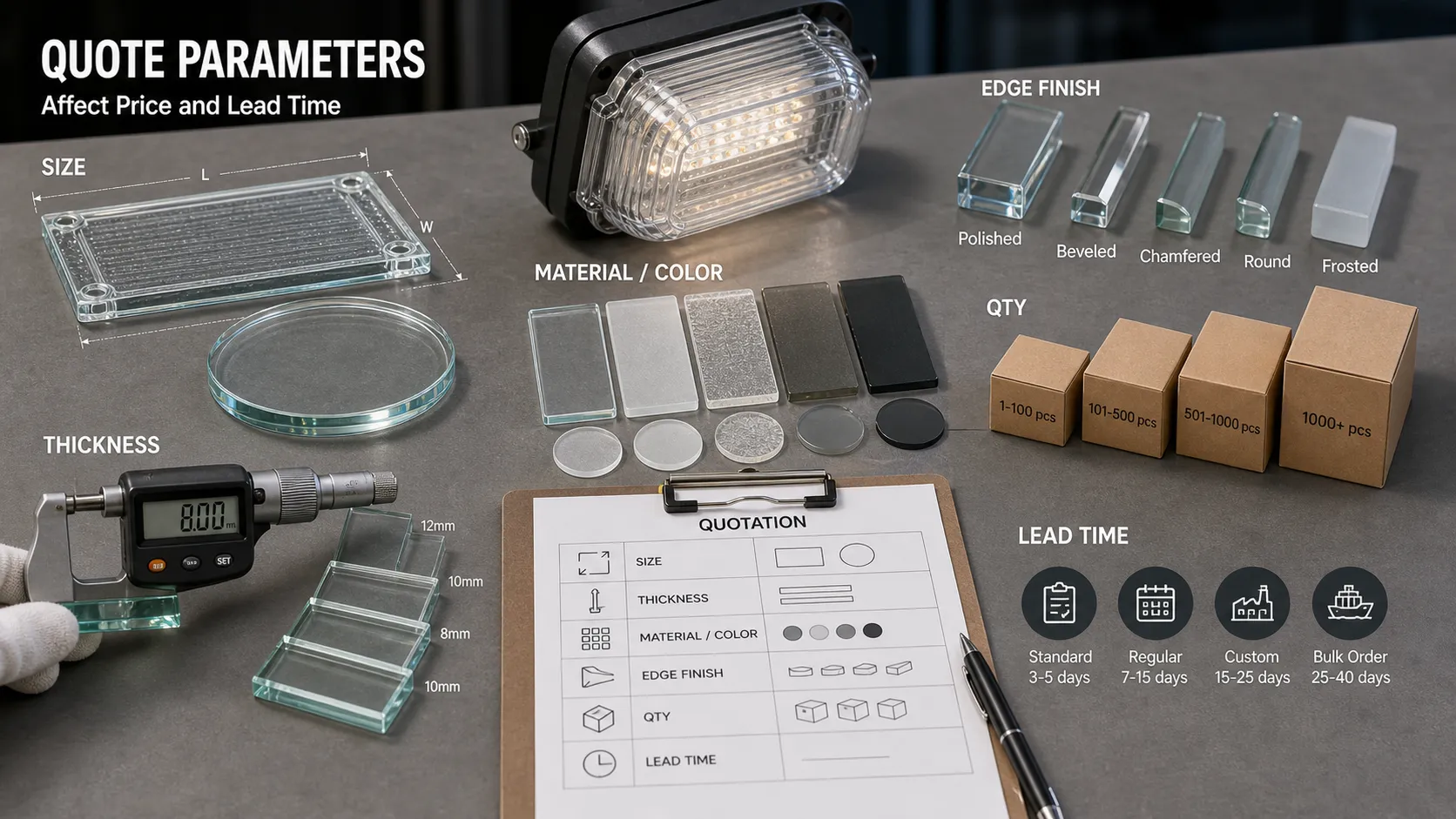
Before quoting glass components for outdoor lighting fixtures, the material, size, thickness, tolerance, quantity, edge treatment, openings, surface treatment, color, light transmittance or haze, whether it is tempered, whether it is molded, packaging method and delivery location will directly affect the price and delivery time. Complex curved surfaces, odd-shaped glass shades, pressed lenses, coatings or high-precision tolerances often increase development time and production costs.
For an accurate quotation, customers should provide drawings, sample photos, application details and estimated order quantities together. If the glass affects sealing, water ingress protection, load-bearing capacity or optical distribution, the target tests and assembly requirements should also be stated in advance to avoid requoting or project delays caused by later process changes.
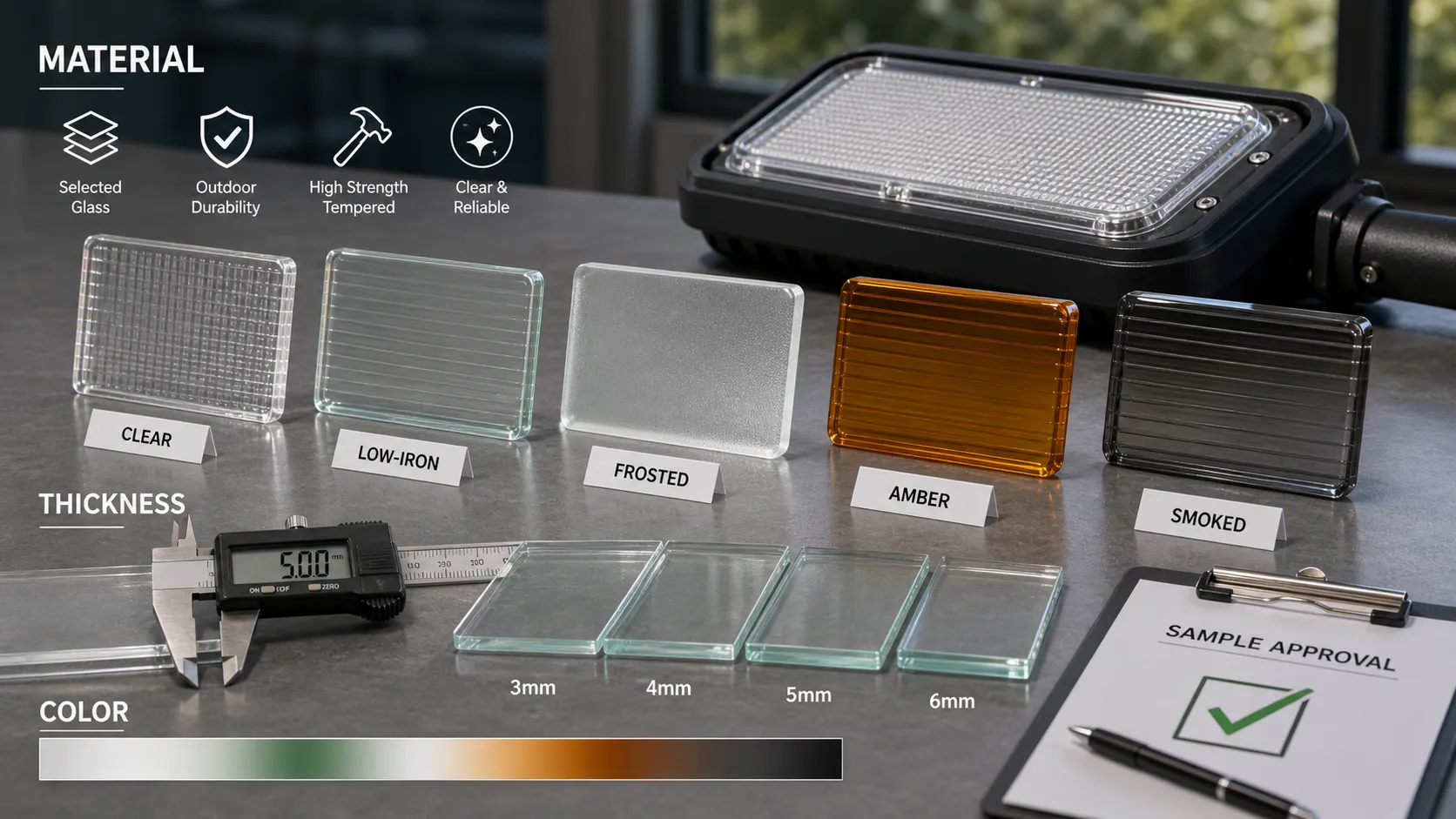
When purchasing glass for outdoor lighting fixtures, how should the material, thickness and color be confirmed on samples?
When purchasing glass for outdoor lighting fixtures, it is best to confirm the material, thickness and color through physical samples. The material determines weather resistance, heat resistance, light transmission and cost basis. The thickness affects the strength, weight, light transmittance and assembly space. The color affects the appearance during the day and the lighting effect at night.
When confirming the sample, you should not only look at a single piece of glass, but also put it into a luminaire body or observe it under conditions close to the real light source. Colored glass, opal glass, smoked glass and amber glass especially need to retain standard samples. The color and thickness of subsequent batches are subject to the confirmation samples and drawing requirements.
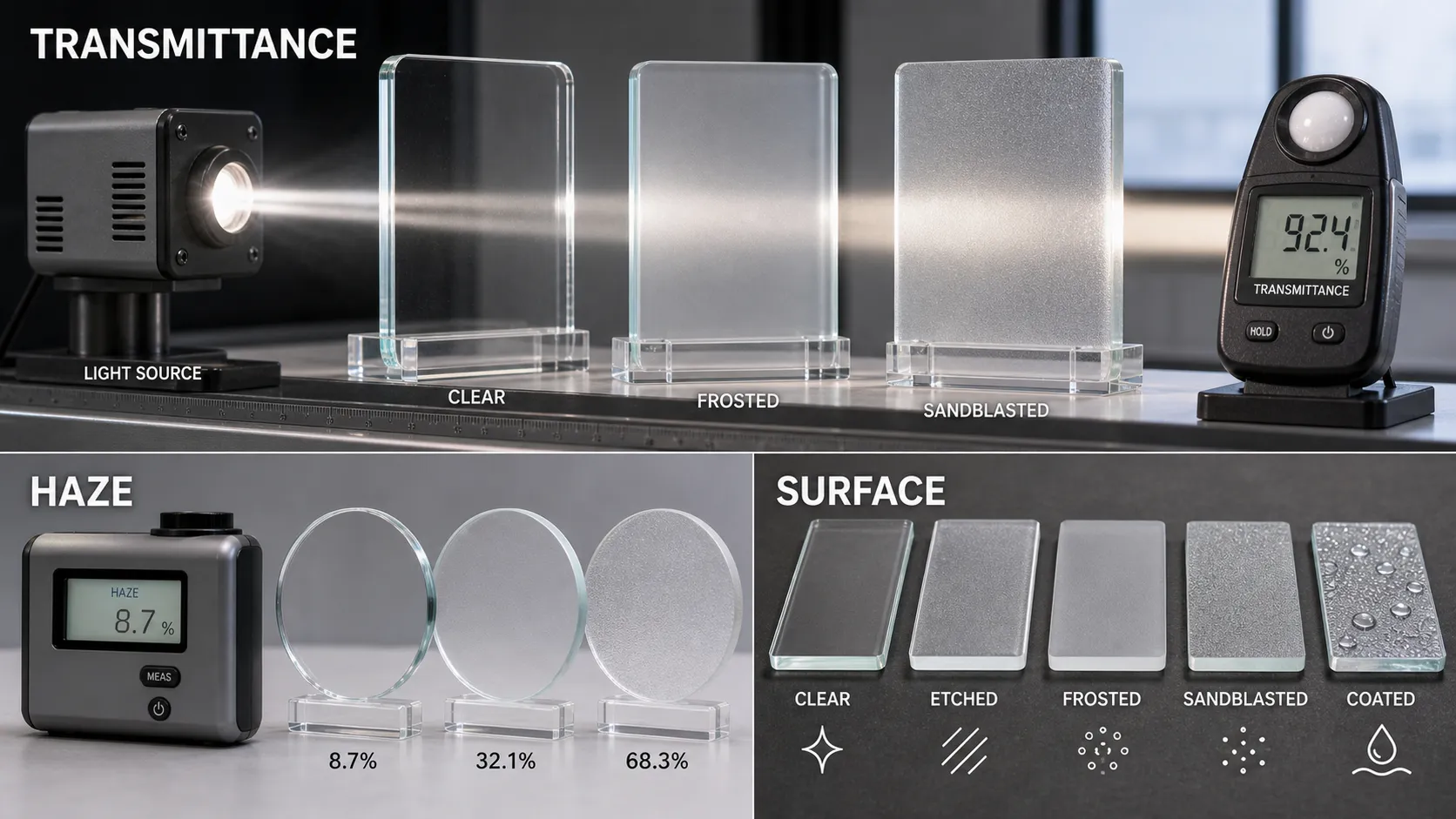
How are transmittance, haze and surface treatment confirmed at the sample stage?
Transmittance, haze and surface treatment should be confirmed at the sample stage with both data and lighting effects. Light transmittance affects brightness and energy efficiency, haze affects soft light and glare control, and sandblasting, acid etching, embossing, coating or silk-screening affects appearance, cleaning maintenance and long-term weather resistance.
When confirming the sample, it is recommended to look at three states at the same time: the unlit appearance, the light spot after lighting and the actual assembly effect. This avoids the possibility that a single piece of glass will look suitable, but when installed into a luminaire, it will suffer from insufficient brightness, exposed LED point sources, color temperature deviations, or difficulty in cleaning and maintenance.
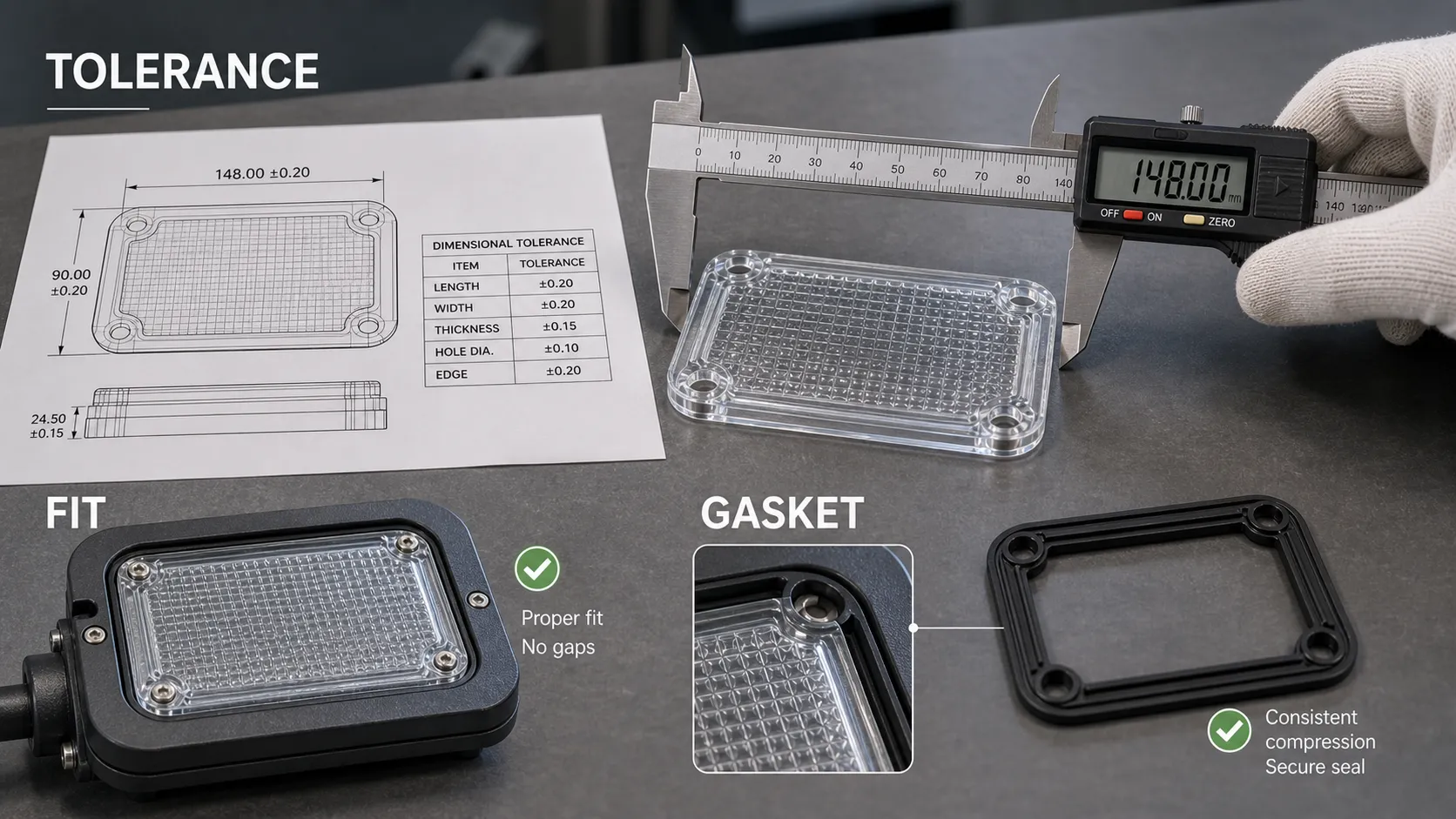
How should the dimensional tolerance of outdoor lighting glass be agreed upon?
Dimensional tolerances for outdoor-lighting glass should reflect the assembly design, gasket compression, housing tolerances and manufacturing process. For protective cover glass, specify length, width, thickness, hole locations, chamfers and flatness. For round or three-dimensional glass shades, focus on opening size, height, diameter and roundness.
The tolerance cannot be arbitrarily written too tight, otherwise the cost and yield will increase; nor can it be too wide, otherwise it will cause loose assembly, leakage or fracturing. A safer approach is to verify the assembly through samples first, and then write the acceptable range into the drawings and inspection standards.
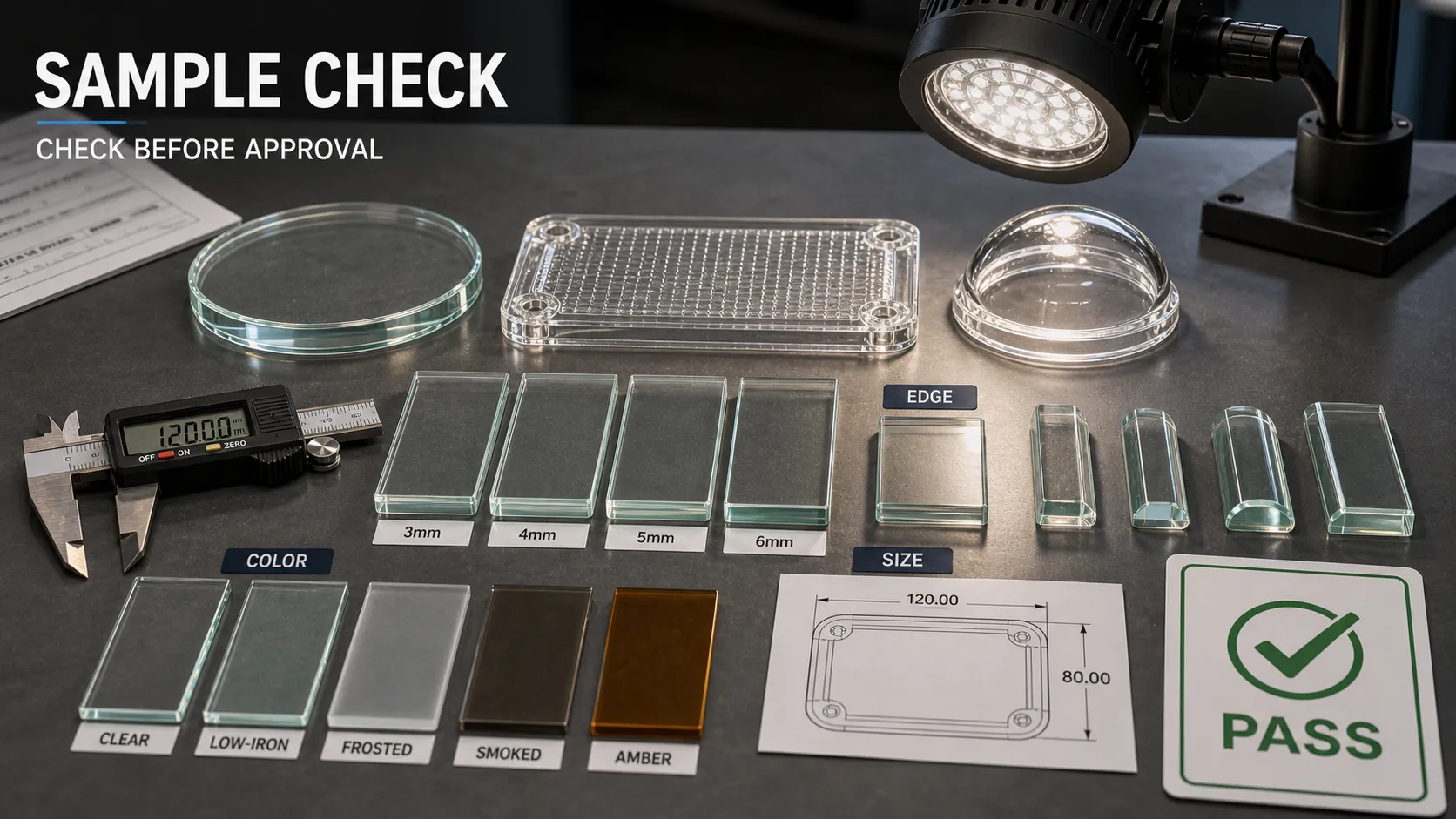
What items should be checked when confirming glass samples?
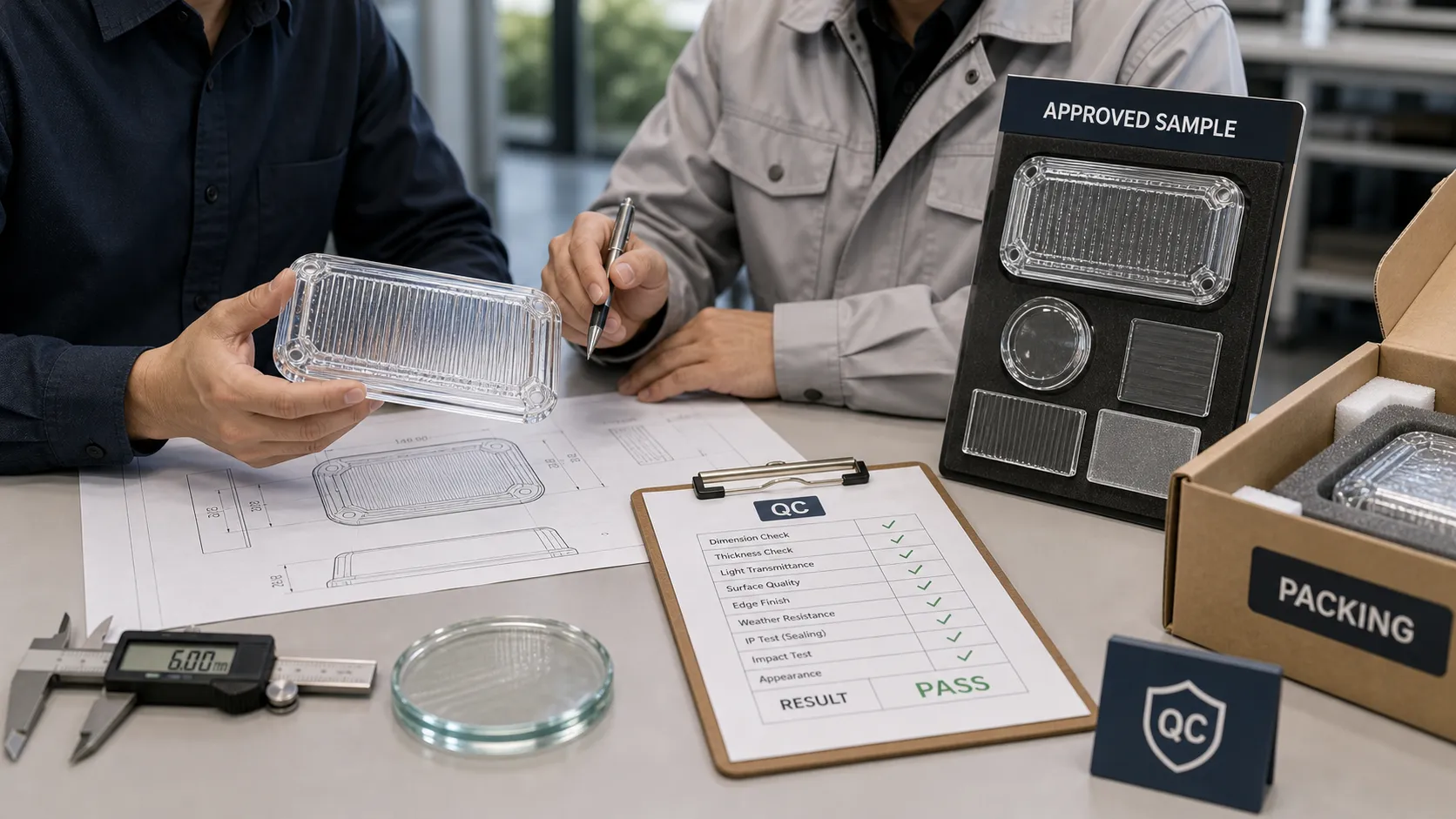
When confirming glass samples, the size, thickness, hole position, edge chamfering, edge grinding quality, surface scratches, bubbles, impurities, color, light transmittance, haze, texture consistency and assembly matching should be checked. If glass is used for sealing, check the flatness of the sealing surface and the fit with the housing and gasket.
The sample should not be assessed only for its appearance on a workbench; it should also be installed in the actual luminaire for operating, assembly, water ingress and, where necessary, thermal-cycling tests. The approved sample should be retained as the reference standard for appearance and performance during subsequent mass production.
What glass properties should be tested before bulk purchasing?
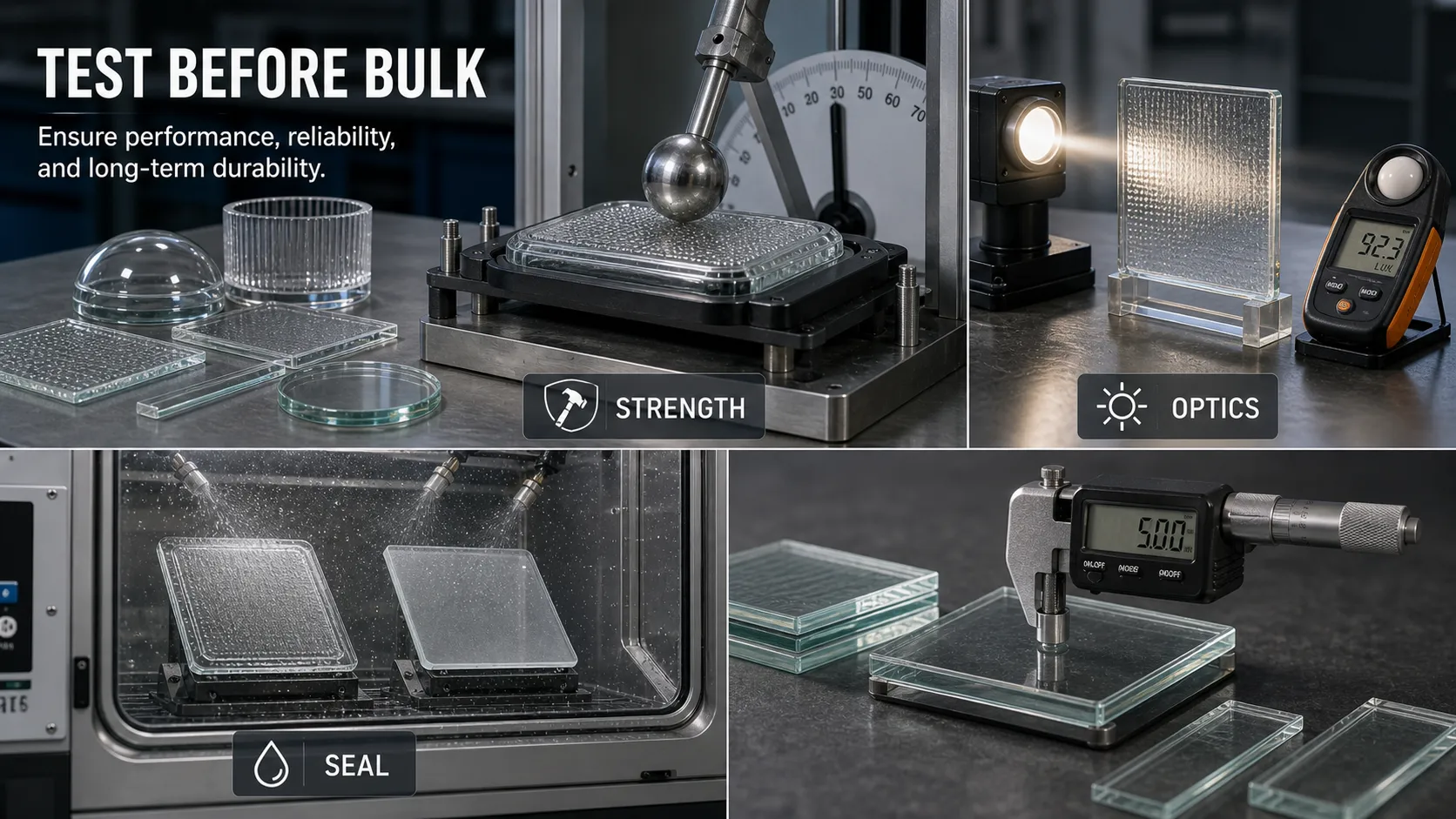
Before bulk purchasing, dimensional stability, appearance quality, light transmittance, haze, color consistency, edge safety, assembly fit and packaging reliability should be tested for the intended application. For underground, underwater, parking-lot or high-temperature luminaires, impact resistance, load-bearing capacity, thermal shock and sealing performance also require attention.
IP, IK, UL- or IEC-related results generally apply to the complete luminaire or enclosure system and are not determined by the glass pane alone. Glass suppliers can provide samples and supporting data, but critical risks should be verified using a complete luminaire prototype before mass production.
How can purchasing risks be reduced for outdoor-lighting glass components?
The key to reducing procurement risk is to define drawings, samples, materials, processes, tolerances, inspection standards and packaging requirements at an early stage. Do not place an order based on photos alone or move a sample directly into mass production before assembly verification, especially when the glass affects water ingress protection, load-bearing performance, optical distribution or special colors.
Confirmation samples, batch inspection records and packaging plans should be retained in project management, and the mold cycle, MOQ, spare parts ratio and delivery date should be confirmed in advance. For overseas projects, shipping damage, tariffs, replenishment cycles and long-term supply consistency also need to be considered.
How can assembly mismatch between glass components and the luminaire housing be prevented?
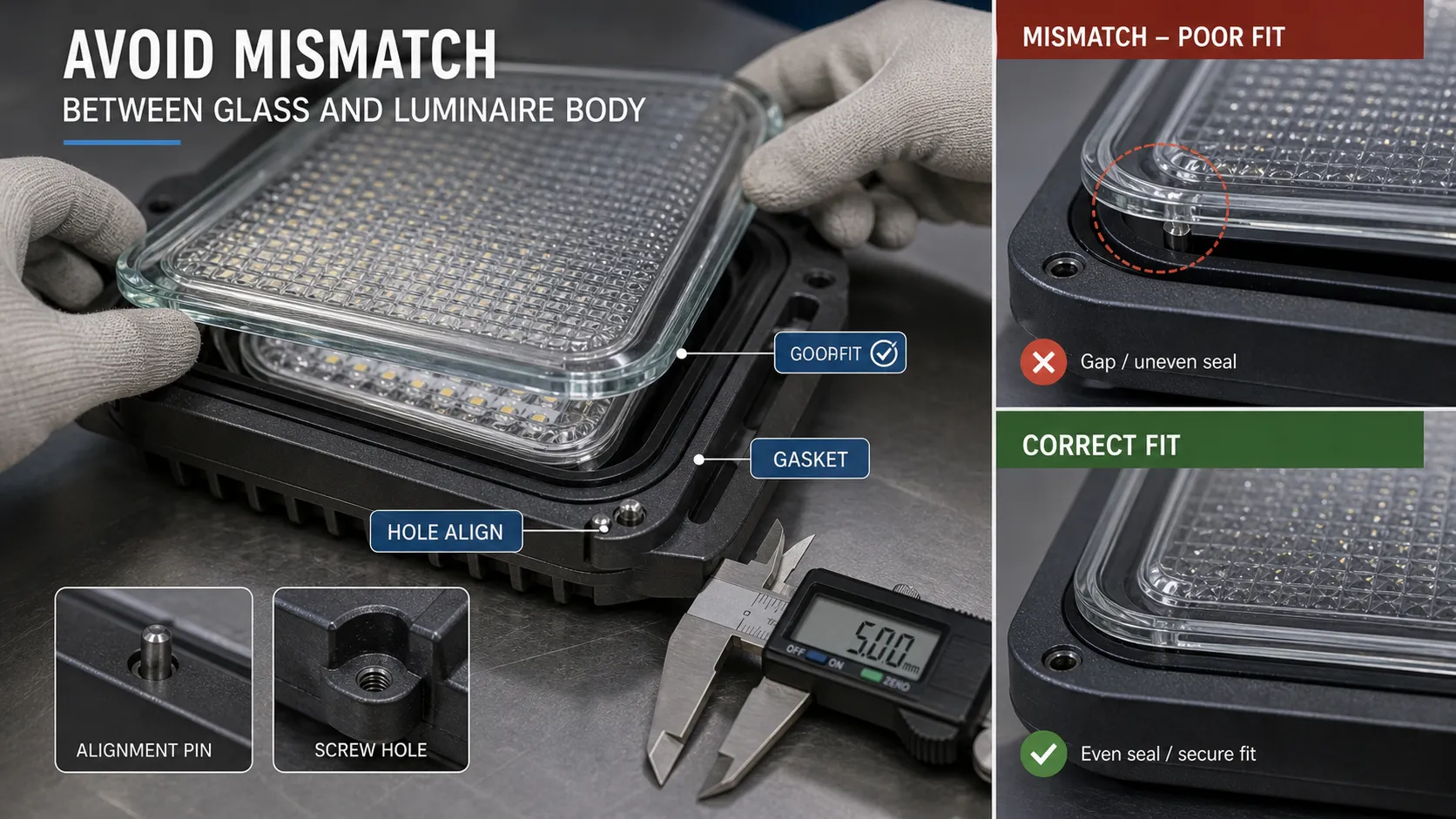
To prevent mismatch between the glass component and luminaire assembly, the glass supplier should review the actual retention and sealing structure rather than receiving only the overall dimensions. Gasket grooves, retaining frames, fastener positions, housing inside dimensions, adhesive bondline thickness and gasket compression all affect the required glass dimensions and edge specifications.
Real assembly testing should be conducted at the sample stage to check whether it is too tight, too loose, misaligned, warped, light leaked, cracked or affects the seal. Before batching, the final confirmed glass drawings, luminaire body drawings and assembly requirements should be unified to avoid mismatches after the luminaire body and glass are modified separately.
When purchasing outdoor lighting glass components in bulk, what aspects should the quality control process cover?
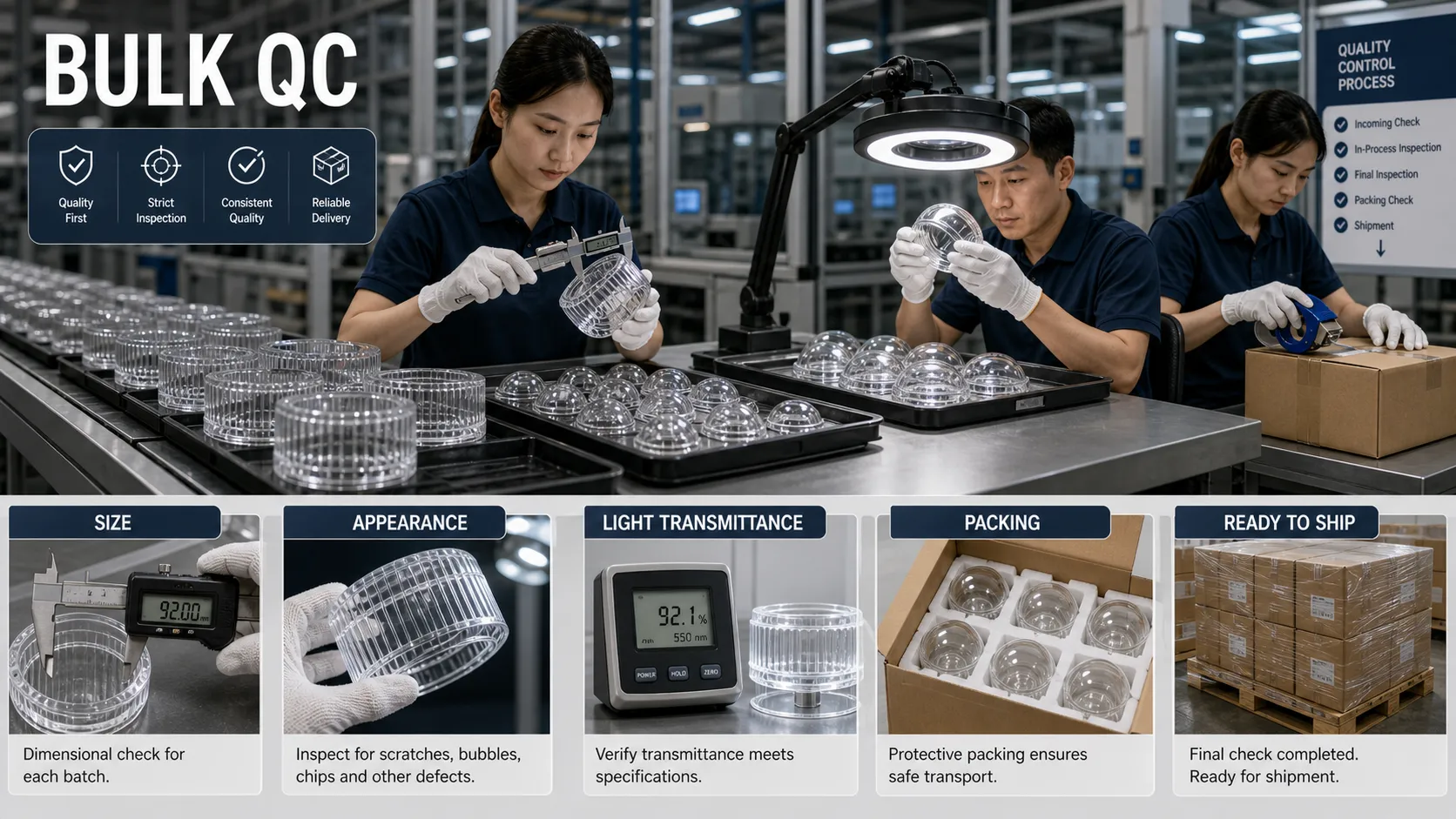
When purchasing outdoor-lighting glass components in bulk, quality control should cover drawing approval, material verification, first-article inspection, in-process sampling, dimensional and visual inspection, optical properties, assembly verification, packaging inspection and shipping records. Priorities vary by luminaire type: underwater luminaires depend on the sealing surface, underground luminaires on load-bearing capacity and edge quality, and wall washers on flatness and optical consistency.
For customers, the most important thing is to fix the confirmation sample, inspection standards and key dimensions. In this way, we can judge whether each batch of goods is close to the sample during mass production, instead of just relying on subjective appearance.
Engineering decision: Convert the approved sample into a control plan: drawing revision and material lot; critical dimensions and measurement points; transmittance/haze or L*, a*, b*/ΔE00 where relevant; appearance defect classes; first-article and in-process frequency; final sampling plan; and packaging verification. If ISO 2859-1/AQL is used, state inspection level, lot size, AQL and defect classification rather than only “random inspection”.
How do customers agree on incoming materials and batch inspection standards for outdoor lighting glass components?
Customers can agree on material type, thickness range, color range, light transmittance or haze requirements, appearance defect level, edge quality, hole position tolerance and packaging requirements in the order or inspection standards. For low-iron glass, borosilicate glass, colored glass, or optical glass, suppliers can also be required to keep material batch and inspection records.
The purpose of incoming material and batch inspection is not to increase the process, but to reduce batch color differences, thickness fluctuations, assembly mismatches and inconsistent light effects. For long-term projects, it is recommended to retain standard samples and agree on sampling inspection items and abnormal handling methods for each batch.
Which defects should be checked during glass appearance inspection?
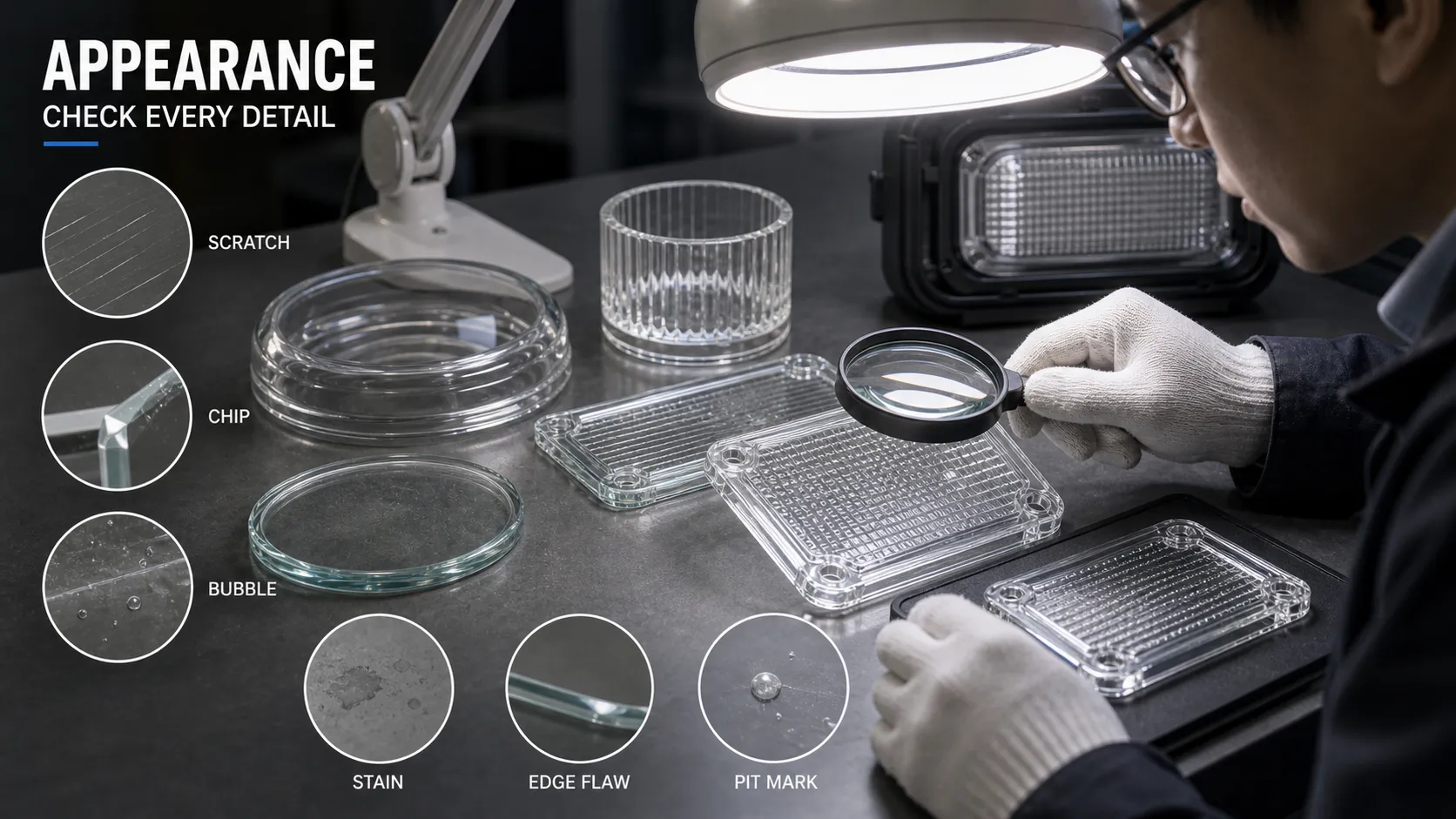
Glass appearance inspection mainly focuses on scratches, chipping, cracks, bubbles, impurities, stains, color difference, ripples, mold marks, uneven sandblasting, coating defects and silk screen offset, etc. Different defects have different effects on luminaires. Some affect the appearance, some affect the light spot, and some may bring safety risks.
Inspection standards should be divided into acceptable ranges based on usage scenarios. Decorative glass shades may allow a small amount of manual air bubbles, but wall-wash luminaire covers are more sensitive to scratches and flatness; underground luminaires and underwater luminaires are more stringent to edge cracks and sealing surface defects.
How should glass transmittance and haze be measured?
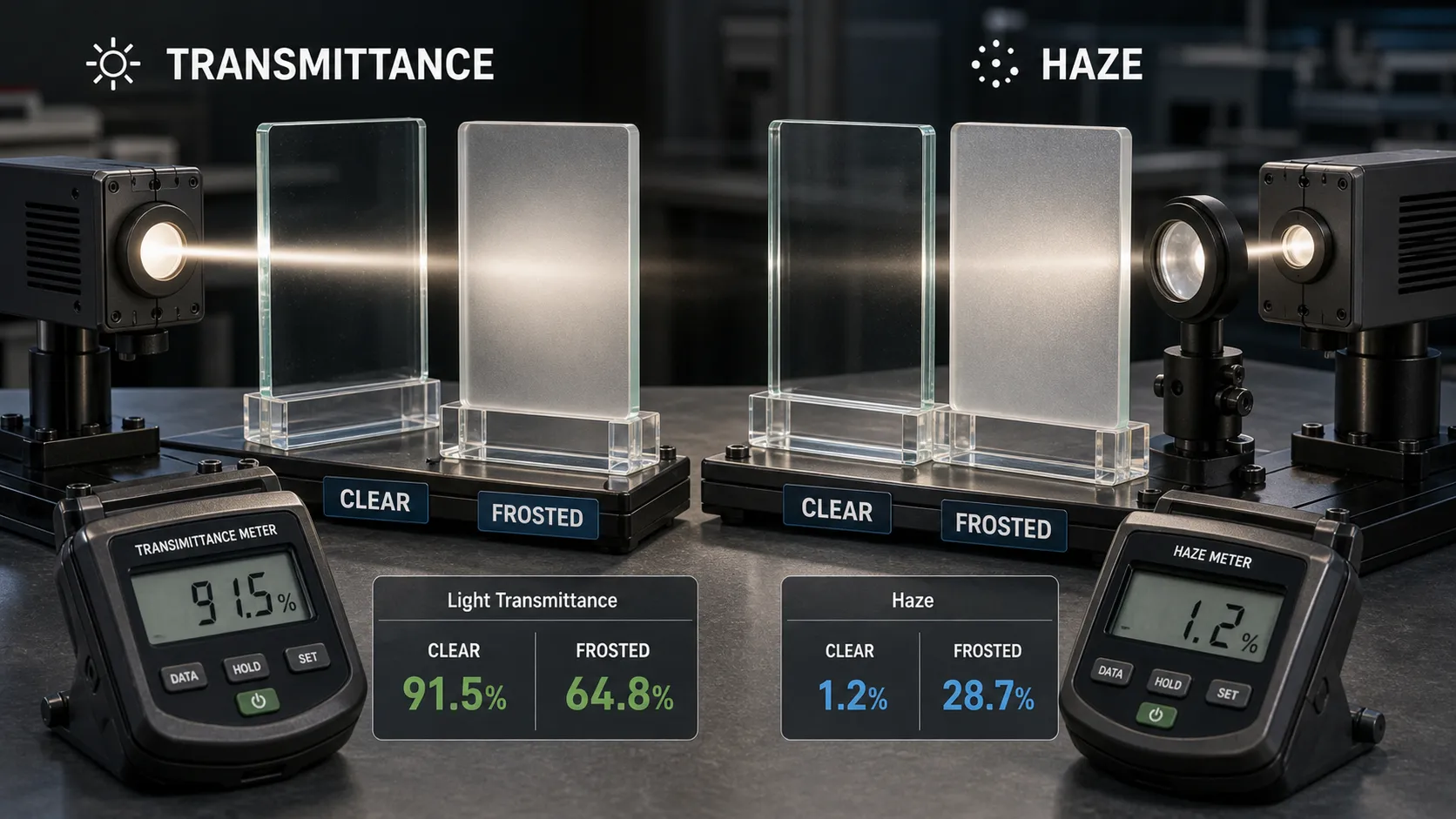
The transmittance and haze of glass can usually be tested with a transmittance haze meter or optical testing equipment, or can be verified by combining the lighting effect of a sample luminaire. The transmittance reflects the proportion of light passing through the glass, and the haze reflects the degree of light diffusion. The two jointly affect the brightness, soft light and glare-control effect.
For outdoor lighting projects, instrument data is only the basis. The spot, glare, color temperature change and uniformity in the actual lighting should also be looked at. During mass production, the sampling frequency and allowable range should be agreed upon to avoid inconsistent effects after different batches of glass are lit.
Engineering decision: For each sample, record material, thickness, treated side, instrument model, calibration status and geometry. Use at least three repeat readings as a practical internal starting point and retain the raw values, not only the average. For luminous transmittance, reference ISO 9050 where applicable; for haze, state the agreed integrating-sphere method and whether the result is total or regular transmittance based.
How should glass color consistency be controlled?
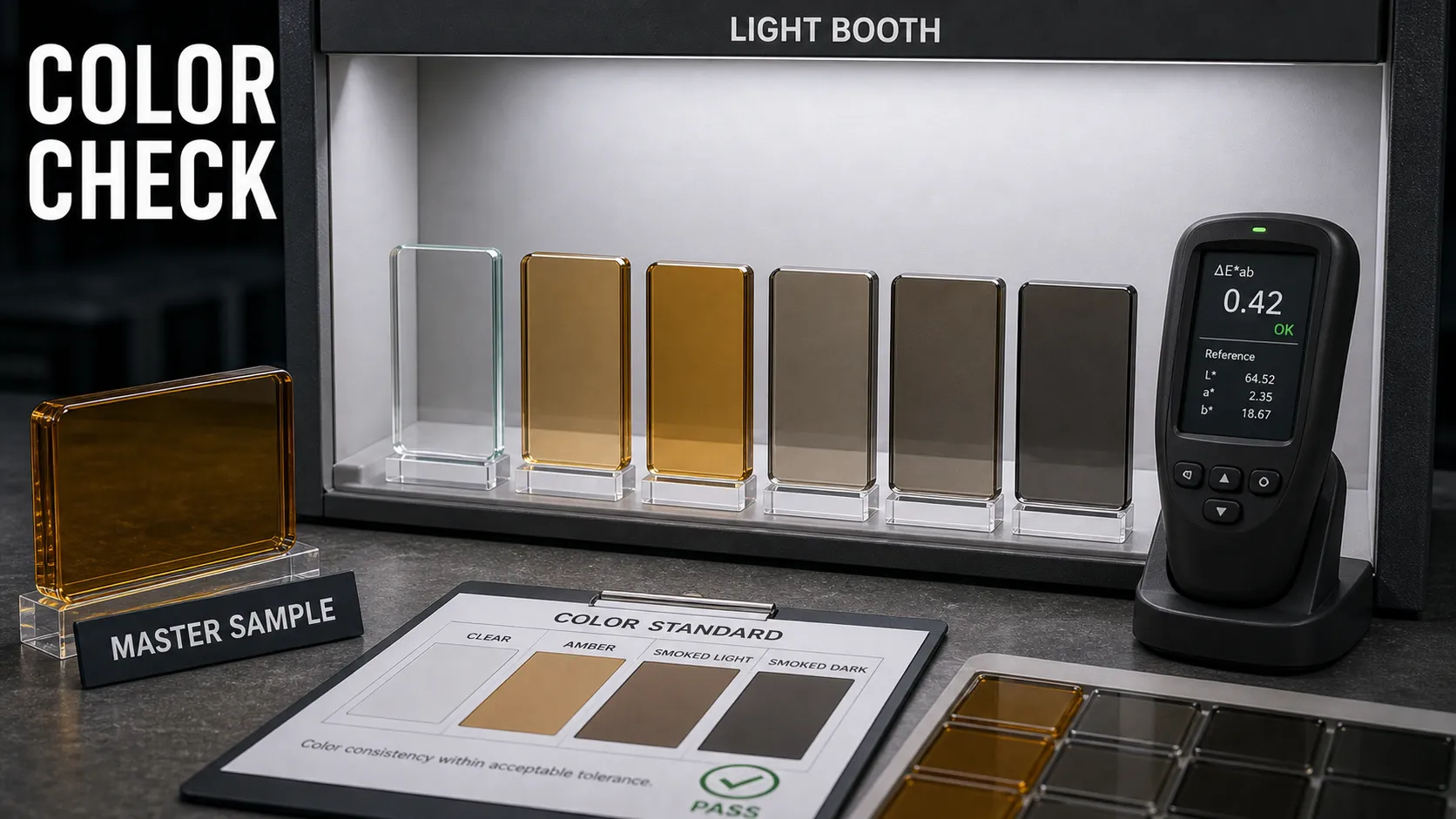
Glass color consistency can be managed through material-lot control, comparison with a retained master, colorimeter measurements, and illuminated-sample approval. Body-colored, tinted, smoked, amber, opal, spray-coated, and printed glass require defined color limits because small differences can become more visible after batch installation.
Controlling color should not only look at the unlit state, but also the color temperature and light transmittance of the luminaire after it is lit. It is recommended to keep customer confirmation samples to clarify the acceptable color difference range, and try to use the same batch of materials and the same process conditions for production in the same project.
How can dimensional consistency be maintained in mass-produced glass components?
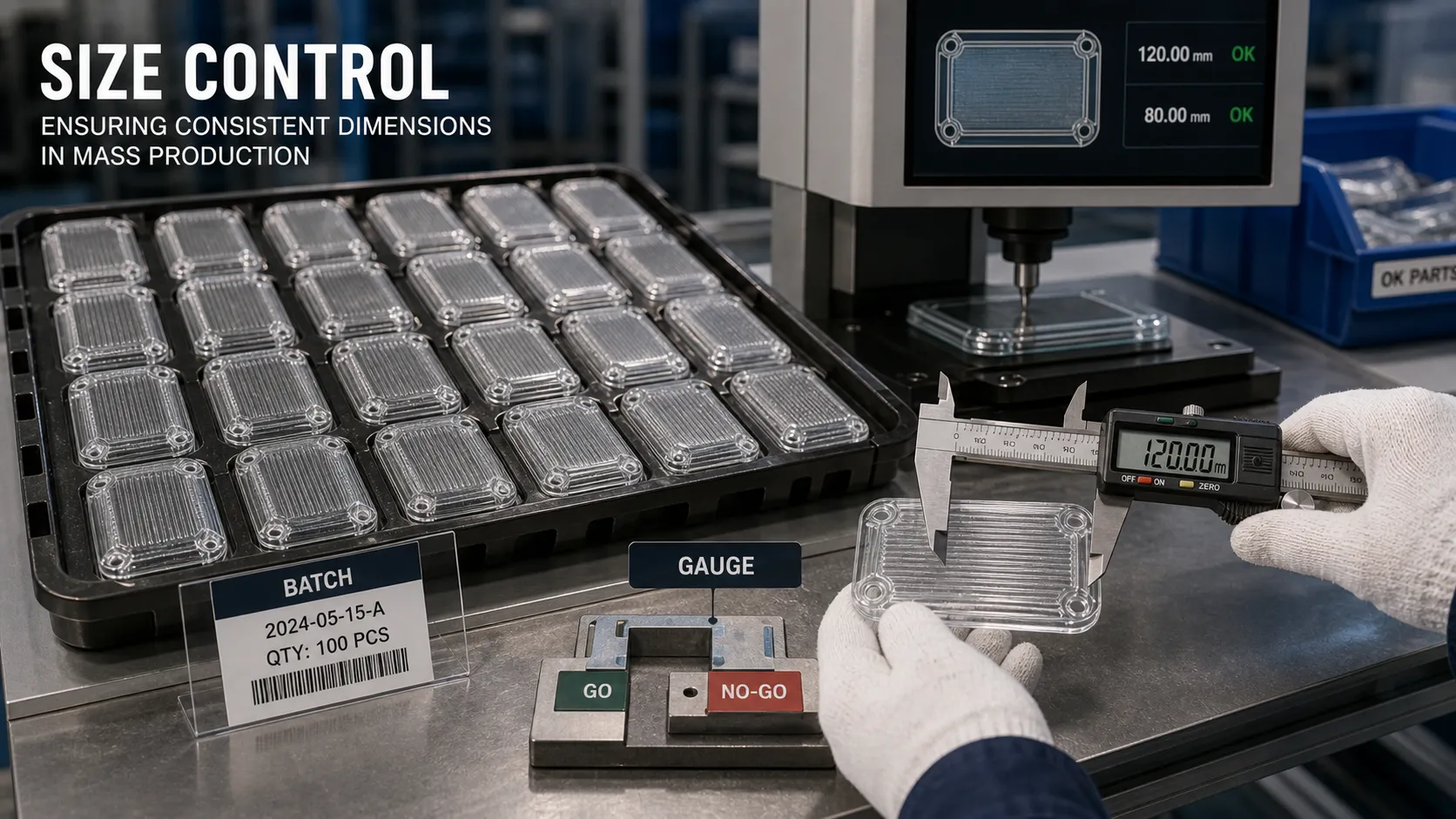
Consistent mass-production dimensions require controlled drawings, stable fixtures, verified mold condition, in-process sampling and first-article approval. Protective cover glass requires control of cutting, edge finishing and hole locations; blown or pressed glass shades and optical glass lenses require control of molds, temperature, forming time, annealing and post-processing.
Dimensional consistency is not a problem that is solved during final inspection, but is the result of process control. For outdoor luminaires that are sensitive to assembly, key dimensions should be monitored, such as mouth, thickness, sealing surface, hole spacing and flatness, to ensure that batches can be stably installed into the luminaire body.
How can color and optical consistency be maintained in mass-produced glass components?
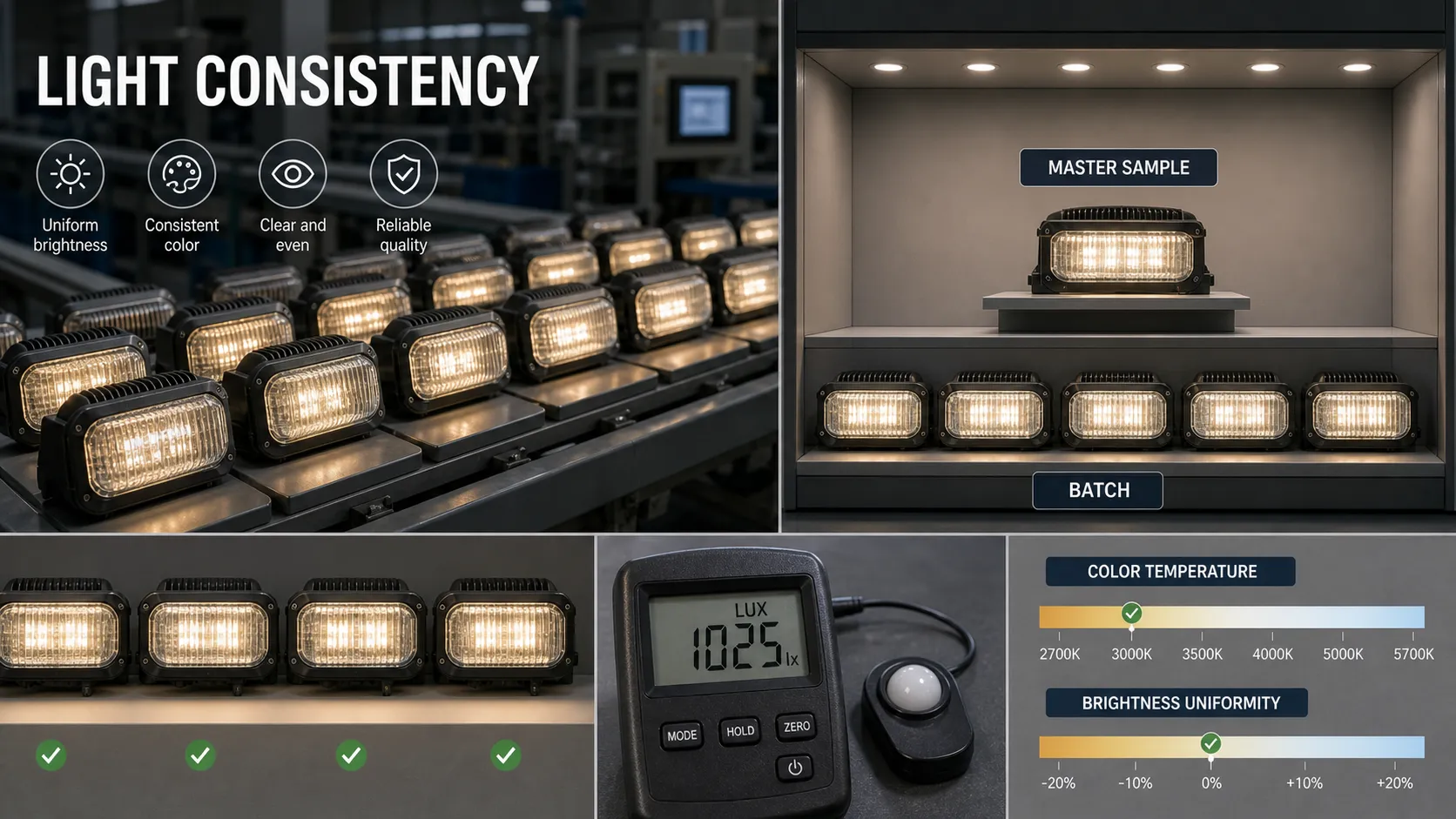
To ensure consistent color and light effects in mass production, it is necessary to control the raw material batch, glass thickness, opal diffusion level, sandblasting or acid etching uniformity, texture depth and surface treatment conditions. Fluctuations in any link may cause differences in brightness or color after the luminaire is lit.
For wall washers, landscape projects and luminaires installed in rows, it is recommended to carry out sample retention, spot inspection and comparison and lighting inspection. Color and light effect consistency should be written into the inspection standards, rather than judging compliance only after customer complaints.
What final inspections are required on glass components before shipment?
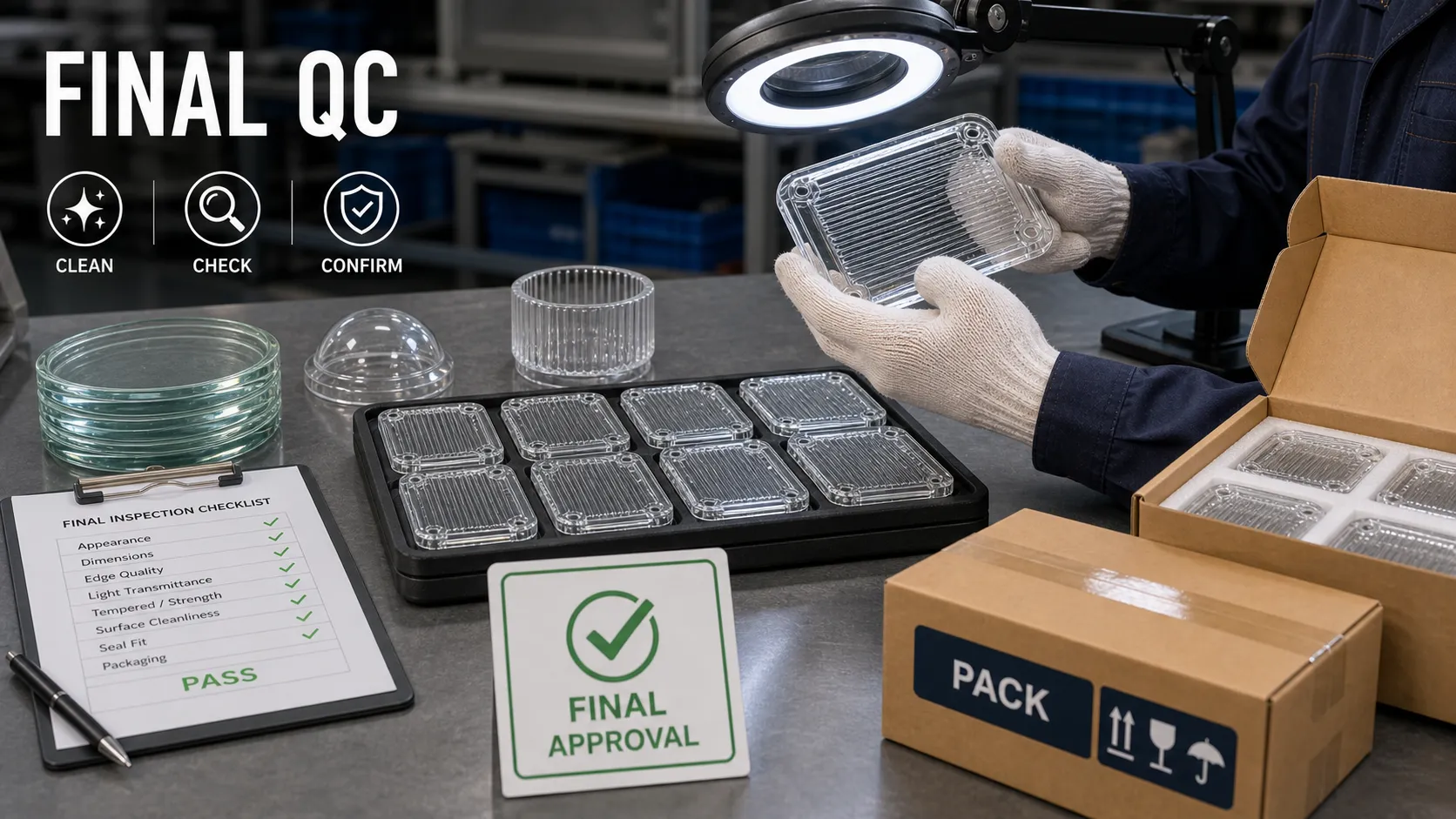
The quantity, size, thickness, appearance, edges, hole positions, color, light transmittance or haze, surface treatment, packaging labels and customer special requirements should be checked before shipment. For easily damaged, large-sized, special-shaped or export items, it is also necessary to focus on checking the packaging fixation, isolation materials and outer box strength.
If glass components are used in sealing, water ingress protection or optically critical locations, the sealing surface, flatness, assembly samples and inspection records should also be confirmed before shipment. Complete outgoing inspection reduces the risk of transit damage, mixed batches and assembly mismatches.
How can the development cycle for outdoor-lighting glass components be shortened?
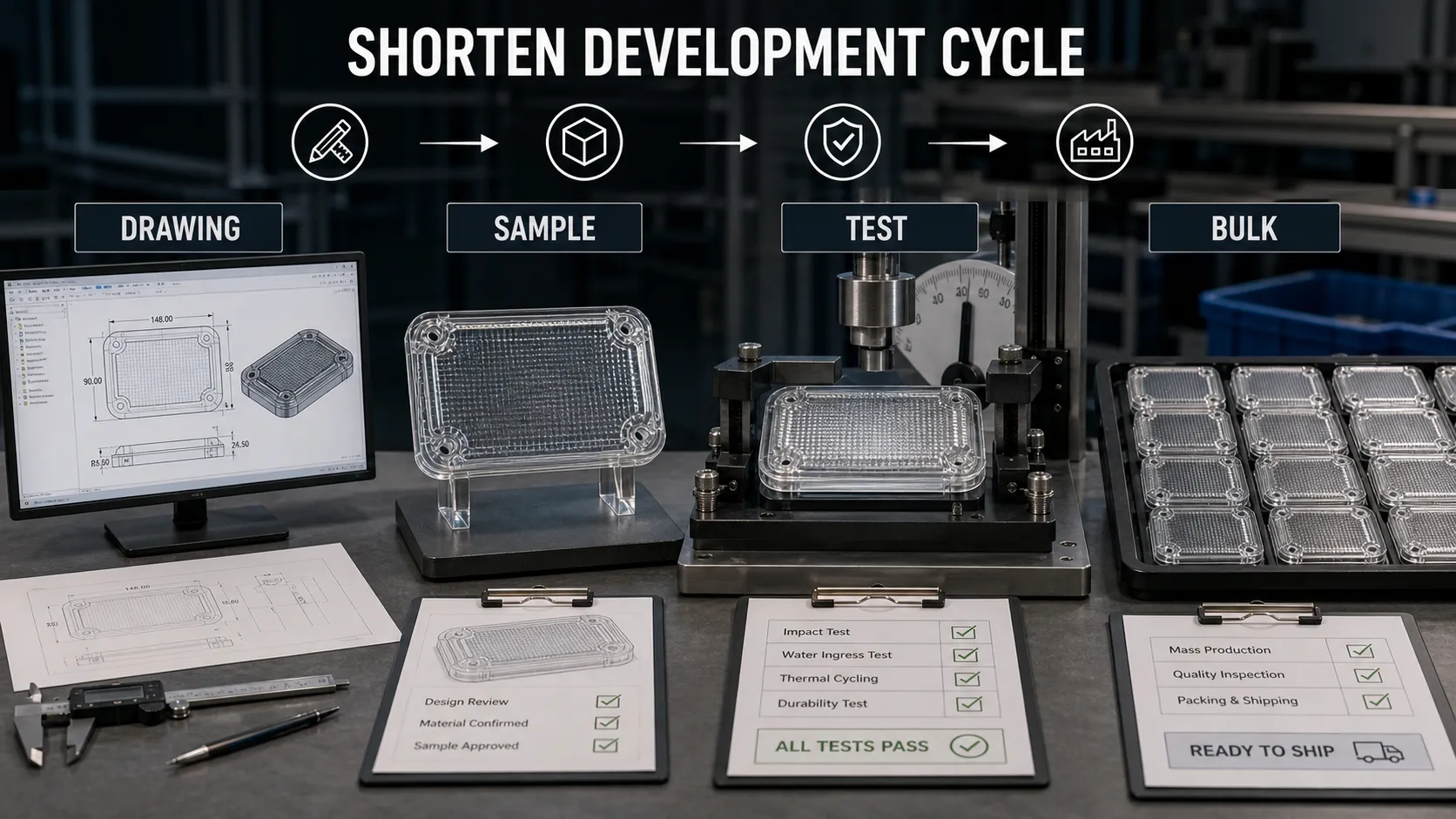
The key to shortening the development cycle is complete preliminary data, clear requirements, and reasonable sample paths. After customers provide accurate drawings, 3D files, target materials, surface treatments, quantities, and application scenarios, suppliers can more quickly determine the process, quote, and prototype cycle.
If the project is still in the exploration stage, you can first use existing processes or similar samples to verify the appearance and assembly before deciding whether to open a mold. Frequent revision of drawings, repeated color changes or failure to confirm the structure of the luminaire body are common reasons for delays in the development of glass components.
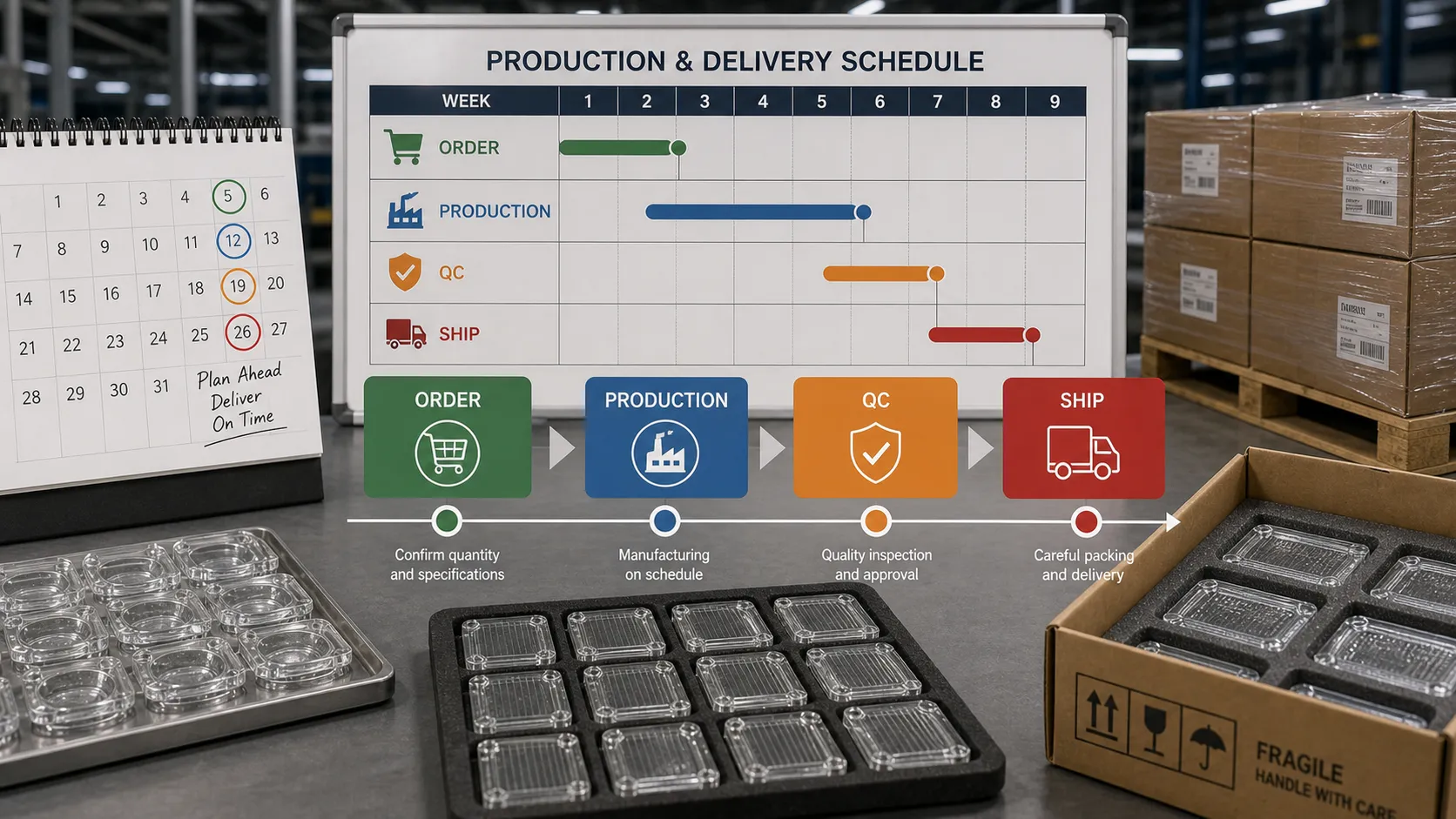
How should delivery schedules be planned for bulk outdoor-lighting glass orders?
Bulk orders for outdoor lighting glass components should be planned in advance for drawing confirmation, sample confirmation, mold development, material procurement, production scheduling, surface treatment, inspection, packaging and international shipping time. Complex curved surfaces, special-shaped glass shades, pressed lenses, colored glass and special coatings often require longer preparation periods.
For a long-term project, the customer should provide a rolling forecast or batch-delivery plan so the supplier can prepare materials and reserve production capacity. Planning backward from the final delivery date alone often overlooks sample revisions, packaging approval, holidays and shipping time.
How can glass-component breakage be reduced during international transport?
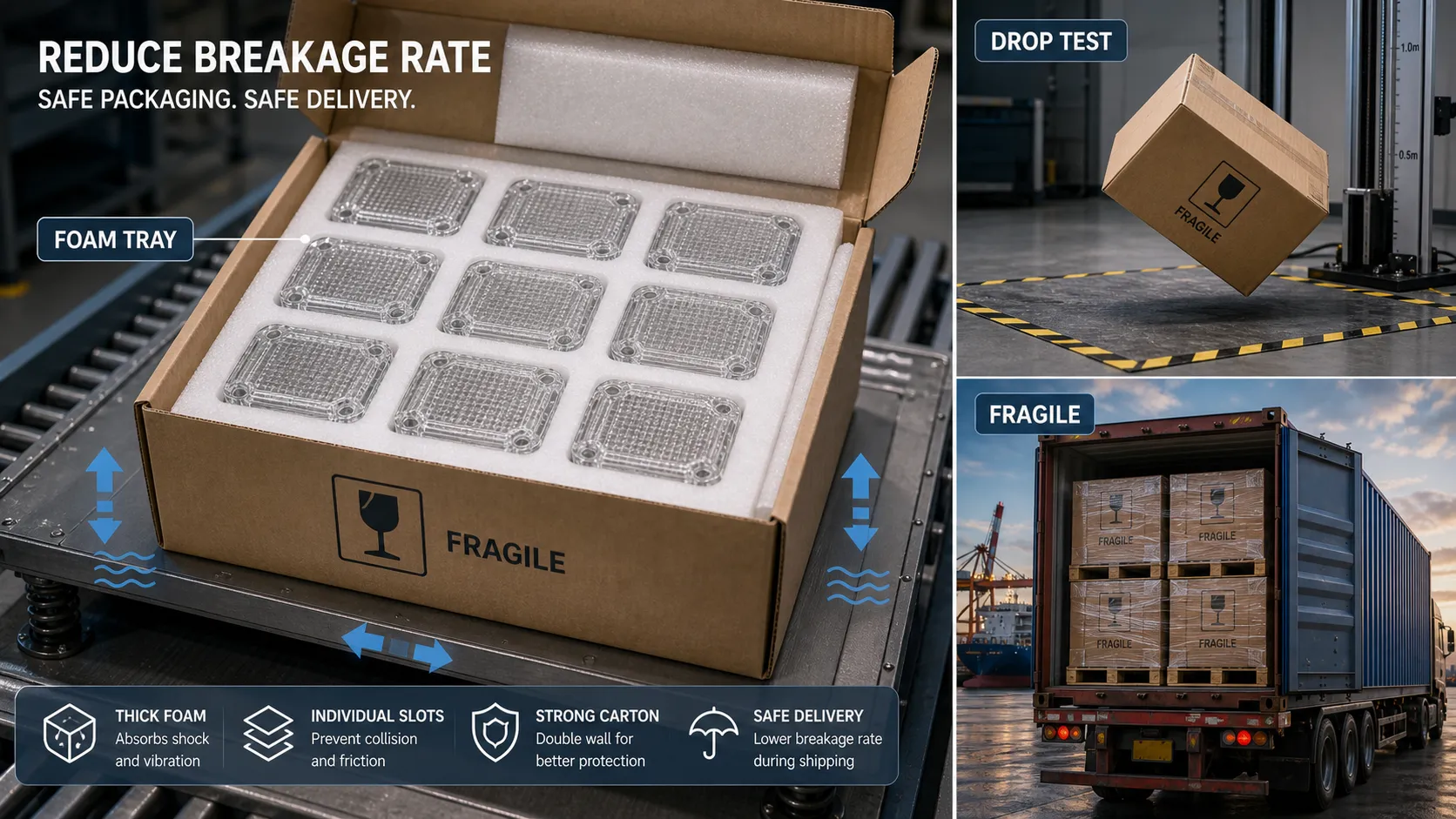
To reduce the breakage rate when transporting glass components internationally, packaging needs to be designed based on size, shape, weight and vulnerable locations. Flat glass should be prevented from being stressed at the corners, glass shades should be prevented from being squeezed and shaken, and special-shaped glass should be protected from weak parts with customized inner supports or isolation structures.
Cartons, crates, pallets, cushioning materials, partitions, stacking orientation and risk of falls all need to be considered. Export projects should also control the weight of single boxes, mark the fragile direction, and conduct packaging inspections or necessary transportation simulations before shipment to avoid products that are qualified but damaged in logistics.
When exporting outdoor lighting glass components, why should the packaging plan be confirmed in advance?
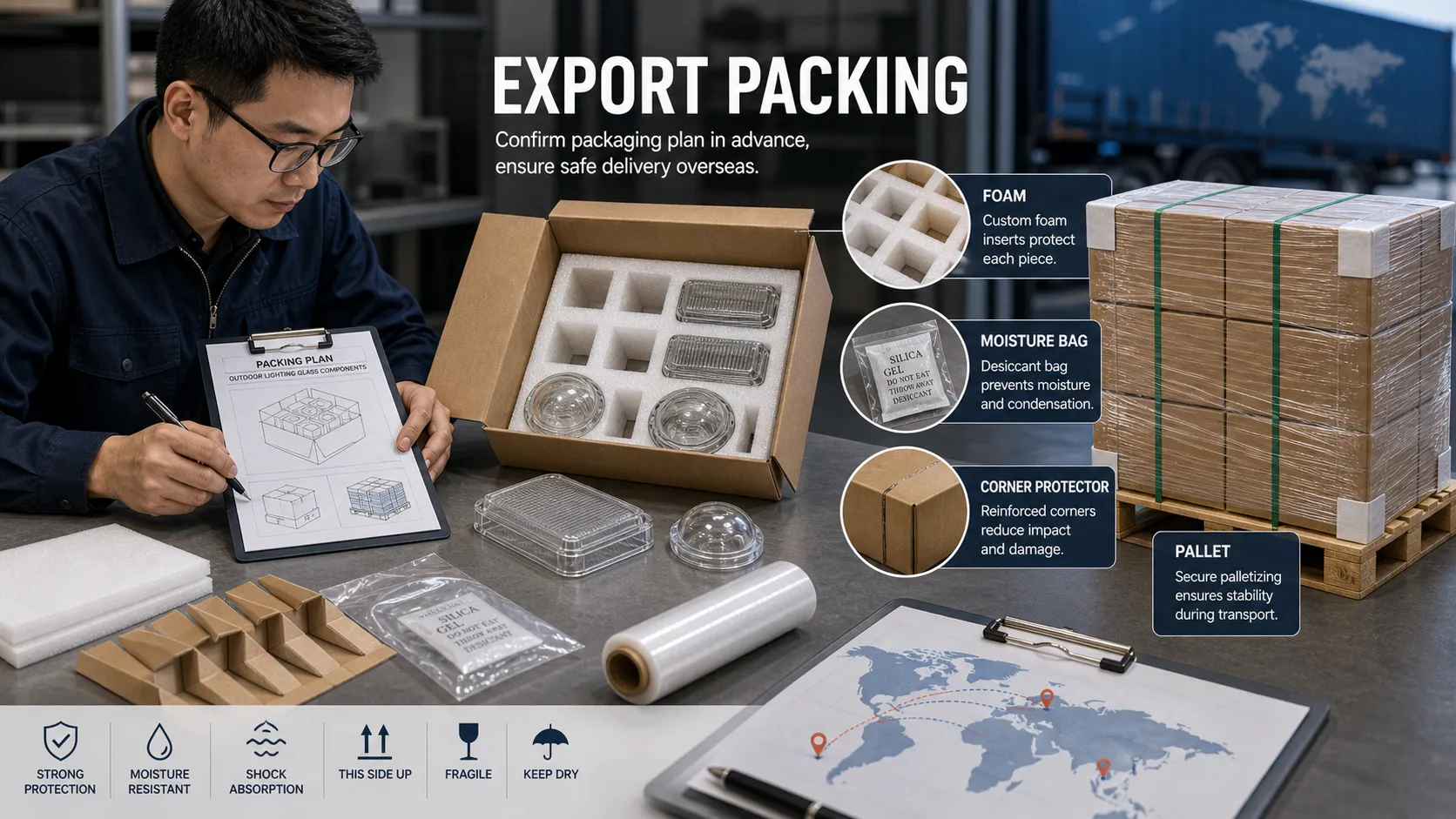
When exporting outdoor-lighting glass components, the packaging plan directly affects arrival breakage, surface scratches and assembly efficiency. Protective cover glass, blown glass shades, specially shaped glass and heavy underground-luminaire components have different stress points and therefore require different packaging methods.
Confirm the packaging plan in advance and verify whether the partitions, foam, inner supports, wooden boxes, pallets, box weights and stacking methods are appropriate in samples or first orders. For overseas customers, stable packaging is equally important as stable products, because transportation damage will bring replenishment cycles, project delays and additional costs.
Contact Us
Your feedback fuels our growth, and your questions drive our solutions.
We value your feedback, inquiries, and suggestions. Please feel free to get in touch with us
General inquiries
Please contact us via sales@bo-glass.com, and we will reply to you as soon as possible.
Interested to work with us
Drop your resume at info@bo-glass.com
and we will get back to you shortly.
Request a Custom Glass Quote
Tell us about your project or upload a drawing.
Your drawings remain confidential.
We uses the contact information you provide to us to contact you about our relevent content, products, and services.