
Aviation Lighting Standards & Compliance
How aviation lighting standards, qualification, test responsibility, documentation, and compliance claims apply to glass components.
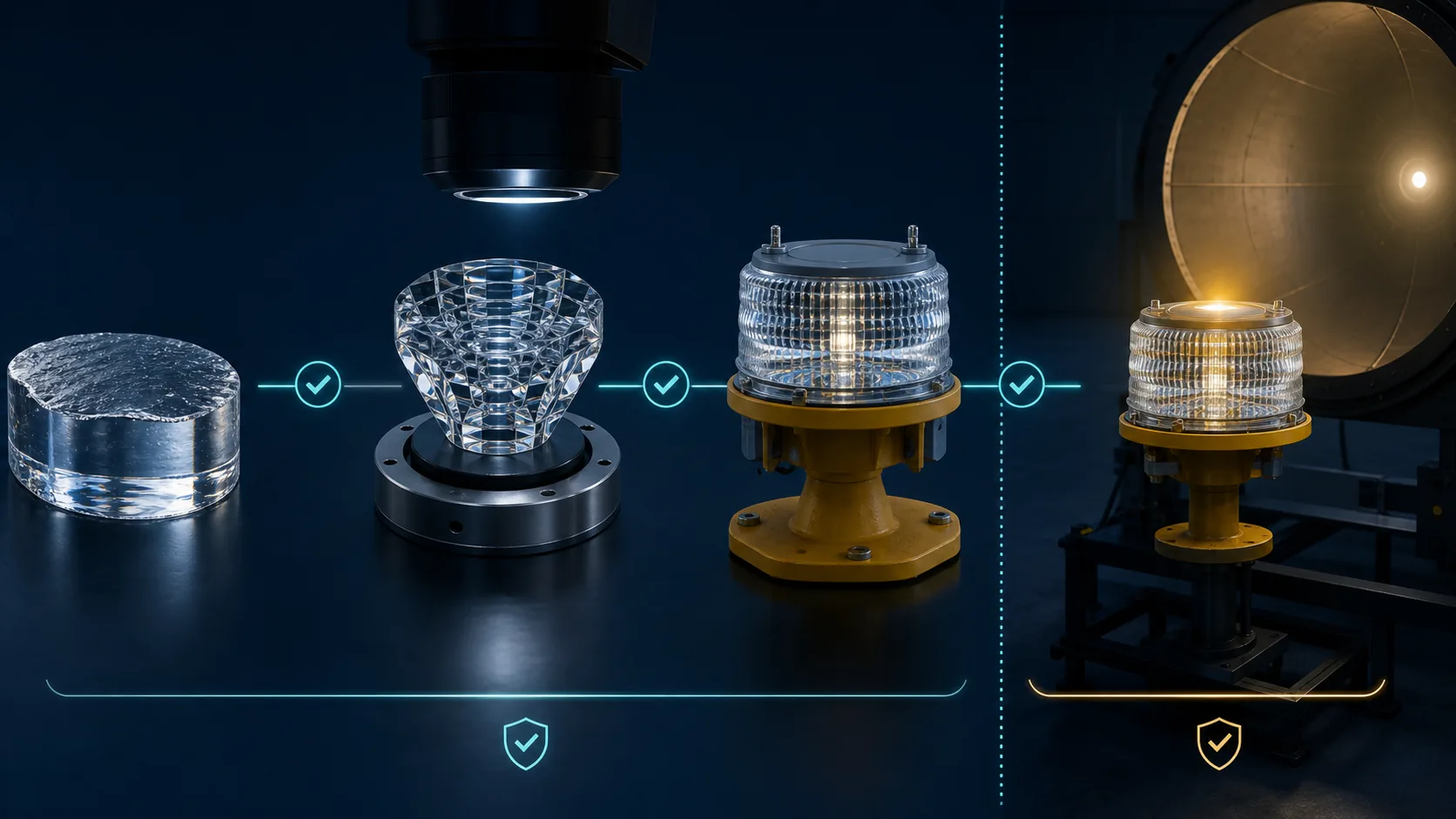
Standards applicability at a glance
Use this table to identify the likely starting document and responsibility owner. It is a routing aid, not a substitute for the contract, certification basis, approved equipment configuration or controlled document revision.
| Application | Primary documents | Typical glass contribution | Qualification or approval owner |
|---|---|---|---|
| Runway and taxiway lights | FAA AC 150/5345-46F | Geometry, transmission, color, material and component inspection | Complete-fixture manufacturer and applicable ALECP route |
| PAPI | FAA AC 150/5345-28H | Lens geometry, red filtering and optical datums | Complete PAPI system manufacturer and applicable ALECP route |
| Obstruction lights | FAA AC 150/5345-43J | Color, transmission and environmental durability | Complete-fixture manufacturer and applicable approval route |
| Airport signs | FAA AC 150/5345-44L | Panel or optical-component performance | Complete sign-equipment manufacturer |
| Aircraft exterior lights | Certification basis; FAA AC 20-30B; FAA AC 20-74 | Color, field of coverage, transmission and environmental durability | Aircraft or lighting-equipment design approval owner |
| Airborne environmental testing | RTCA DO-160G, with program-selected sections and categories | Component and material evidence supporting the installed equipment | Complete airborne-equipment program |
Aviation Lighting Standards, Qualification and Compliance
Standards become easier to use when the reader first understands what each document governs. A material certificate, a component test, a qualified light assembly, and an authority-approved installation are different layers of evidence. The questions in this chapter show how those layers fit together, so buyers can ask for documentation that is relevant to the glass without mistaking a supplier record for approval of the complete lighting system.
Standards map: FAA, ICAO and EASA applicability
The controlling framework depends on the equipment, market and approved program baseline. FAA airport-lighting advisory circulars define specifications and qualification routes for covered U.S. equipment. ICAO Annex 14 provides international Standards and Recommended Practices for aerodromes, while the EASA Easy Access Rules for Aerodromes consolidate the European aerodrome rules, certification specifications and guidance material. National requirements and customer specifications may add or modify obligations.
Do not treat similar terminology as proof that acceptance limits are identical. For each intended market, compare light type, color, beam distribution, intensity, environmental and mechanical tests, production controls, listing or approval route, document revision and national deviations. The glass drawing should receive only the characteristics that can be controlled at component level—such as material, geometry, color, spectral transmission, finish and inspection—while the equipment owner retains complete-fixture photometry and qualification responsibility.
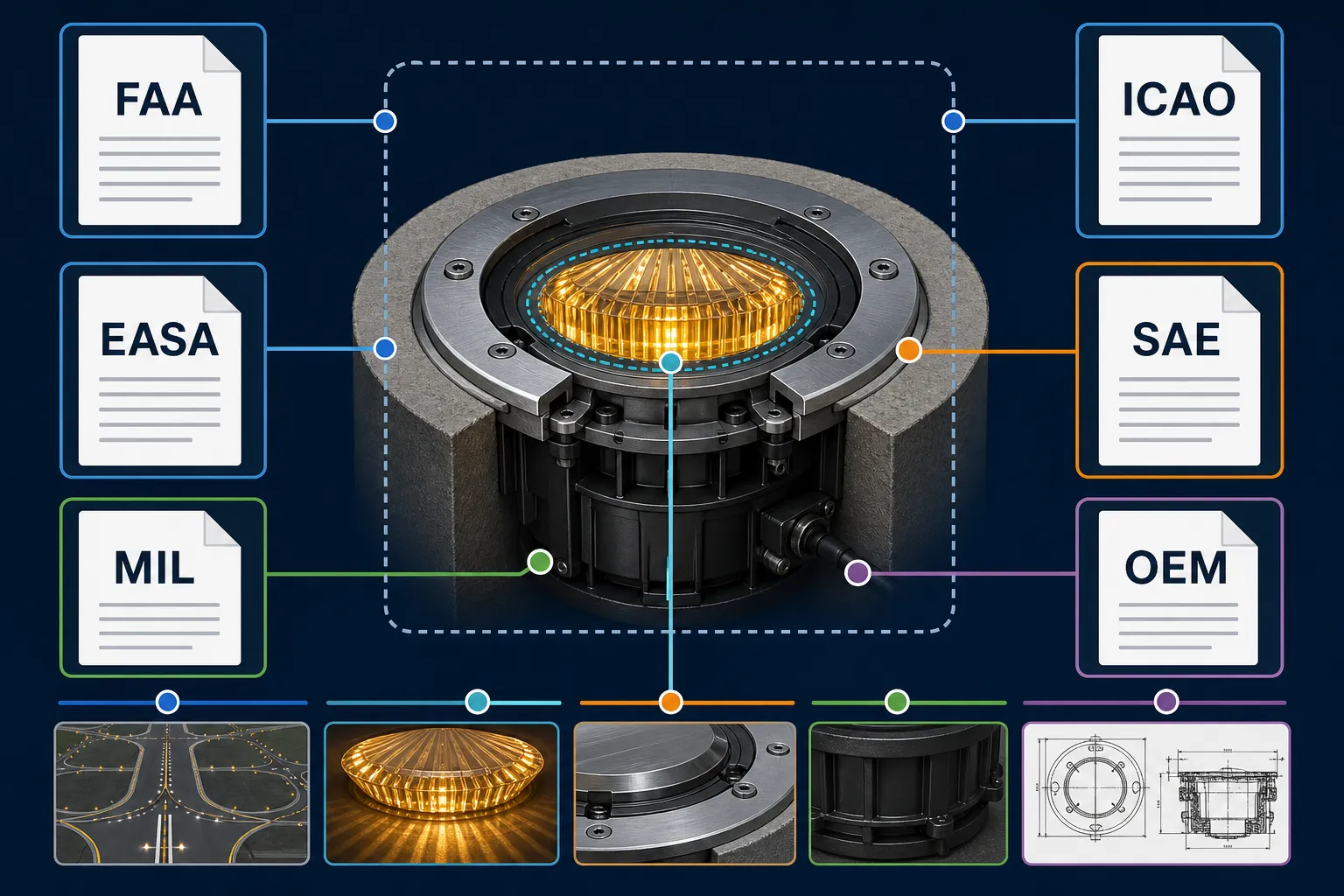
Evidence levels: specifications, component reports and equipment qualification
A governing specification states applicable requirements. A glass report records results for a defined specimen, method, condition and acceptance limit. Equipment qualification evaluates the identified complete assembly through the applicable program. An authority or program listing then applies only to the organization, equipment and configuration covered by its record.
| Evidence level | What it can demonstrate | What it does not demonstrate | Typical owner |
|---|---|---|---|
| Governing standard or customer requirement | The applicable technical, environmental, documentation or approval expectation | That a specific product has already met the requirement | Authority, standards organization or customer |
| Controlled component drawing and specification | The material, geometry, optical characteristics, finish, inspection and change baseline for the glass | Complete-fixture photometry, sealing or installed performance | Design authority or equipment manufacturer |
| Material certificate or component inspection report | Results and traceability for the stated material, specimen, part or production lot | Independent approval of the complete lighting equipment | Glass supplier, material producer or test laboratory |
| Complete-equipment qualification report | Performance of the identified assembly, build standard, test categories and conditions | Automatic acceptance of later substitutions or uncontrolled variants | Equipment manufacturer and approved test organization |
| Program listing or installation approval | The organization, equipment configuration and use covered by the approval record | A general certification transferable to every individual component | Certification body, authority or approval applicant |
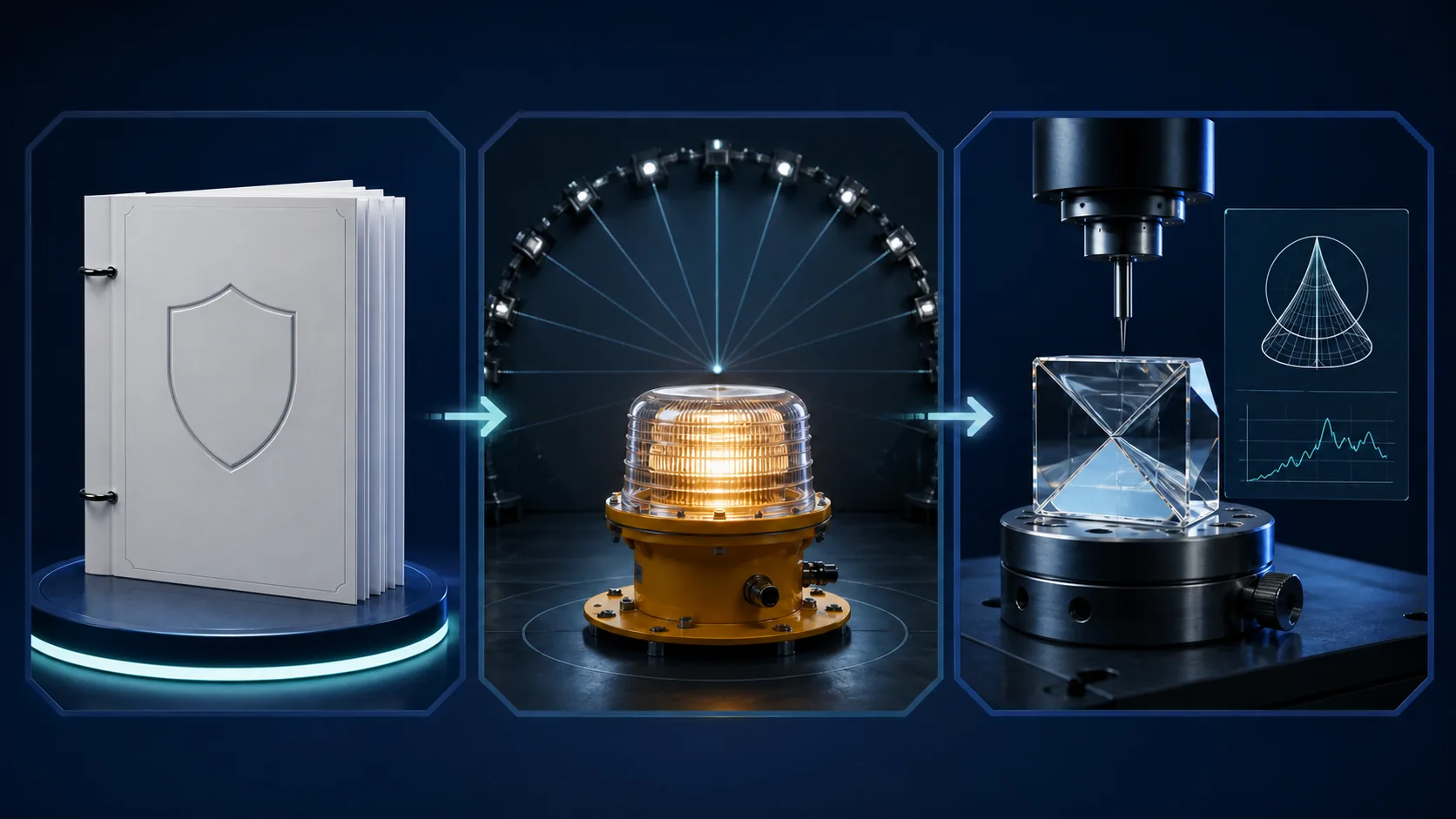
For each submitted record, identify the part number, drawing revision, material or production lot, test method, sample size, acceptance limit, result, deviations and approving organization. This makes the evidence auditable and prevents a certificate, logo or isolated test result from being interpreted beyond its documented scope.
These evidence levels are not interchangeable. A thermal-shock, spectral or dimensional report can support a fixture qualification, but it does not qualify the runway light or certify the glass independently. Likewise, qualification of one fixture does not authorize an unapproved replacement optic. Geometry, edges, coating, mounting stress, seals, housing stiffness and source heat can change assembly performance. Under RTCA DO-160G, the program selects the applicable sections, categories and equipment configuration; RTCA supplies test standards rather than product certification.
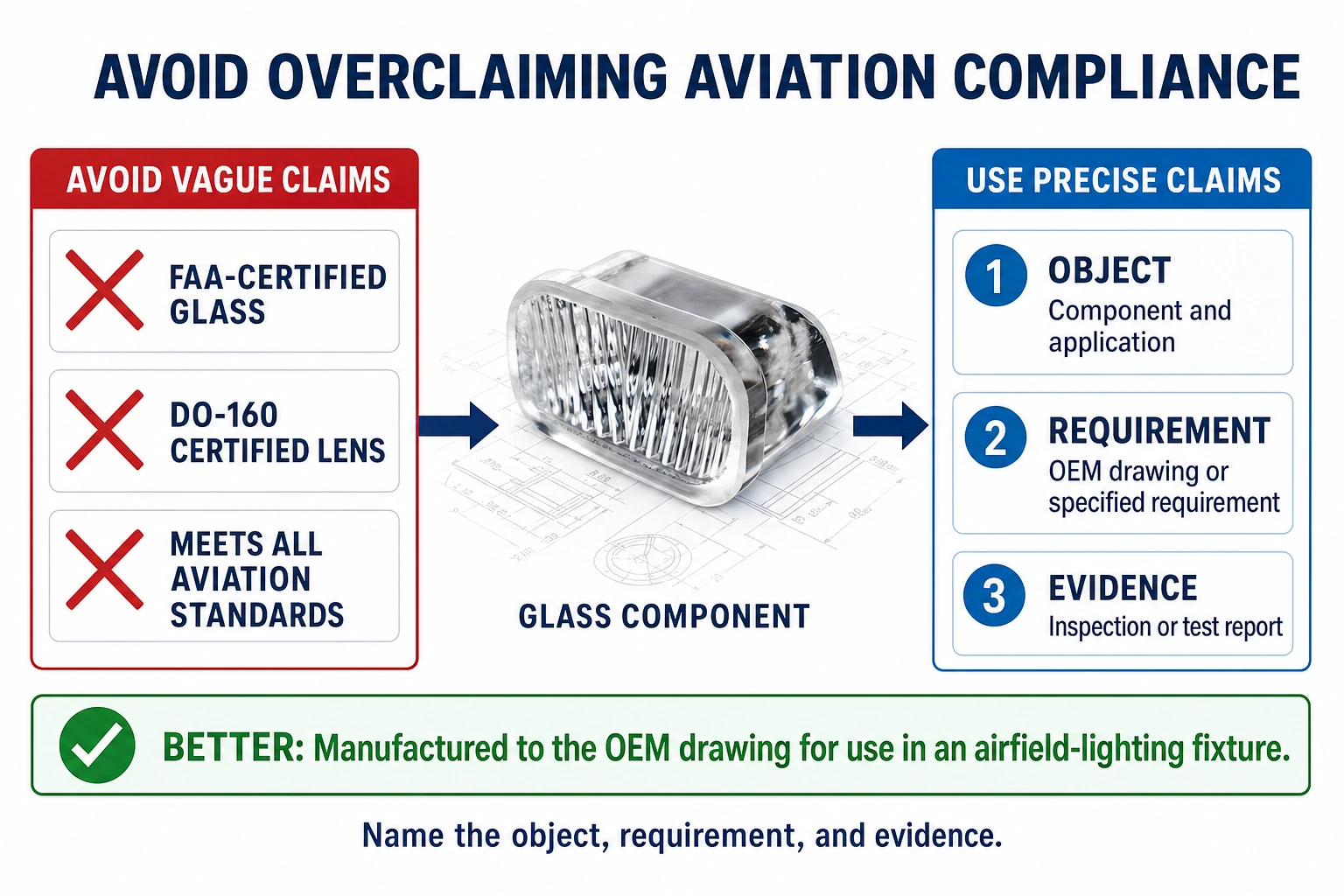
Technical files and marketing should identify the object and evidence precisely: report number, drawing and revision, specimen or build standard, test method and condition, laboratory, result, deviations and approval owner. Prefer “glass component tested for [property] under [method and condition]” or “manufactured to the controlled OEM drawing to support fixture compliance” over broad claims such as “FAA-certified glass” or “DO-160-certified glass.”
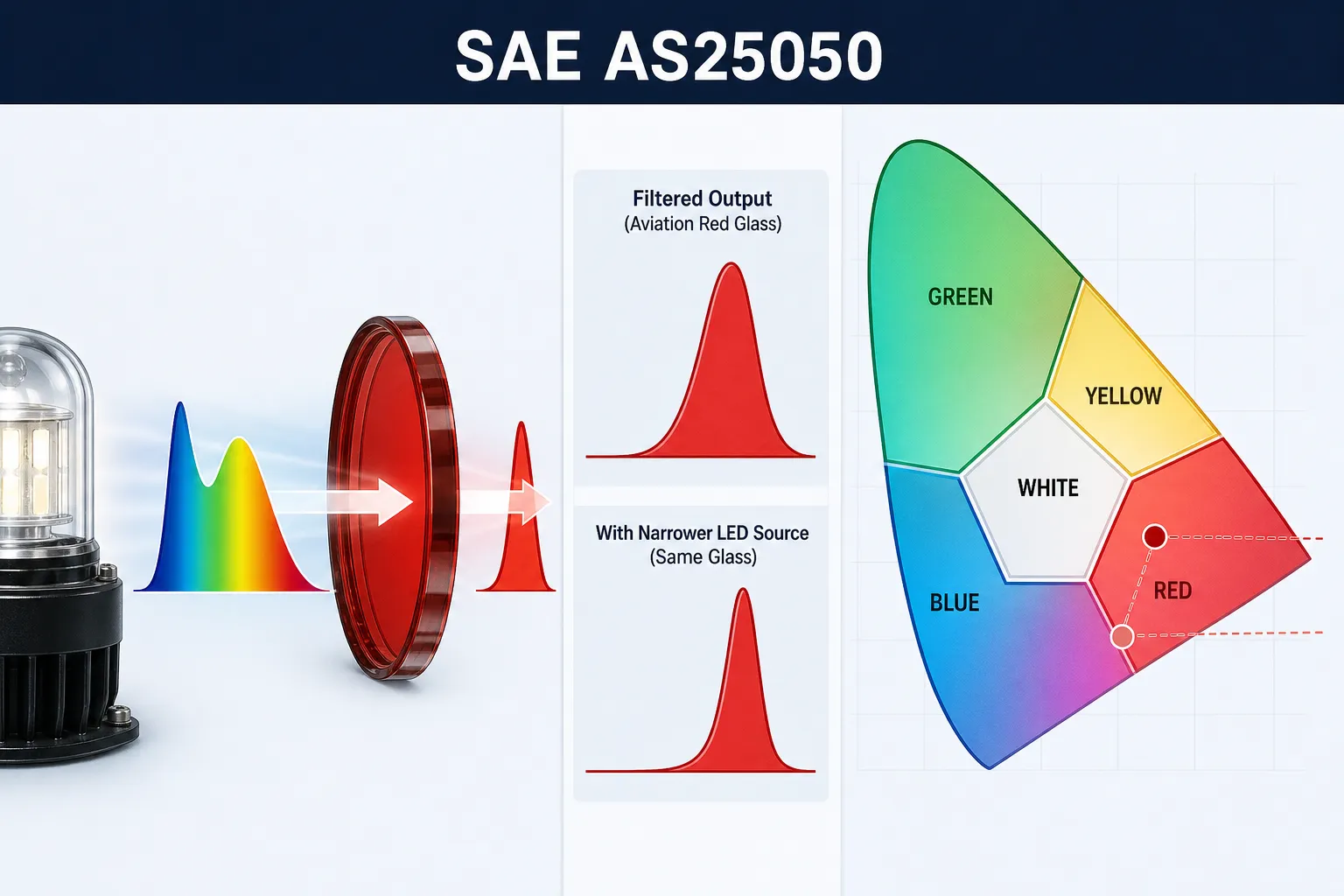
SAE AS25050 and colored light-transmitting components
SAE AS25050 addresses aeronautical-light colors and light-transmitting components such as lenses, filters and covers where it is incorporated by the controlling specification. Its applicability and edition should be stated by the project rather than assumed from the component type alone.
Colored glass affects both chromaticity and available intensity, but the result belongs to the complete optical chain. Source spectrum or LED bin, electrical operating point, glass thickness, temperature, incidence angle and other optics can move the final coordinates and output. Development testing should therefore use the intended source and finished optic; production control can use correlated measurements such as melt records, thickness, spectrophotometry, colorimetry or agreed fixture sampling.
MIL-C-7989 as a withdrawn legacy requirement
MIL-C-7989 is a withdrawn U.S. military specification for light-transmitting covers used in aeronautical lighting. It can still matter when a current FAA document, legacy drawing, approved configuration or customer specification incorporates a defined class or requirement. Withdrawal does not erase a requirement that remains contractually incorporated by reference.
A purchase specification should identify the applicable revision, class, component and project exceptions. Avoid the unsupported statement “MIL-C-7989 compliant.” Instead, translate the incorporated provisions into measurable material, geometry, optical and inspection requirements, and record the exact part, lot, test basis and approved deviations. Any proposed alternative remains subject to review by the equipment design or approval owner.
Which standards apply to aircraft exterior lighting glass?
Aircraft exterior lighting is governed first by the aircraft’s certification basis. For transport airplanes, requirements address landing lights, position-light configuration and coverage, aviation colors, and anti-collision-light coverage and intensity. Comparable provisions exist for other aircraft and rotorcraft categories. FAA AC 20-30B provides an active means of compliance for position and anti-collision light installations, while FAA AC 20-74 addresses measurement considerations.
Environmental qualification of airborne equipment often uses RTCA DO-160G or program-specific equivalents, with categories selected for the installation location. RTCA identifies DO-160G as the current published version; a future revision does not automatically replace a certified program baseline. Customer specifications, OEM standards, SAE aerospace standards, military requirements, or special mission requirements such as night-vision compatibility may also apply.
Within the installed light, the glass influences color, field of coverage, intensity, heat management, environmental sealing, impact and erosion resistance, and maintainability. The OEM should flow down only the relevant component requirements, specify the qualification configuration, and control changes. For legacy programs, confirm the type-design data and approved vendor status before proposing a new material or manufacturing route.

Revision control and allocation of fixture requirements
Use the revision named by the contract, certification plan, approved equipment specification or authority—not automatically the newest document found online. New designs may adopt current editions, while certified products can remain tied to an approved baseline. Maintain a standards register with document number, title, revision, issue date, source, applicability, responsible owner and change status. A named baseline plus formal change control is safer than an uncontrolled “latest revision” instruction.
Allocate requirements by starting with the complete-fixture function and credible failure mechanism. For photometry after environmental exposure, relevant glass controls may include prism angle, refractive index, spectral transmission, color, surface condition, coating durability, alignment datums and sealing interfaces. For structural or environmental tests, determine the real load, heat and pressure paths before assigning a fixture-level limit to a loose optic.
The allocation matrix should record the source requirement, responsible assembly, component contribution, design or process control, verification level, evidence record and change trigger. When a standard, material, coating, geometry or manufacturing route changes, the design authority evaluates impact and decides whether analysis, component testing or complete-equipment requalification is required.
How can marketing language avoid overclaiming aviation compliance?
Use statements that identify the object, requirement, and evidence. “FAA-certified glass” is usually too broad. Better wording is: “custom glass components manufactured to OEM drawings for use in fixtures designed to meet FAA airfield-lighting requirements,” or “finished lenses can be supplied with lot-level dimensional and spectral inspection when specified.” If a test was performed, state the specimen and condition rather than turning one result into a universal product property.
Avoid implying that ISO 9001 certification is a product approval. A quality-management-system certificate demonstrates that a certified scope and system were audited; it does not prove a particular lens meets FAA, EASA, ICAO, SAE, MIL, or DO-160 requirements. Similarly, a material trade name or supplier data sheet does not prove finished-part performance.
Maintain a claim register linking every public technical statement to a controlled source: certificate, report, drawing, material data, or official standard. Include expiry dates and scope. Require engineering or quality review when a webpage is updated. Where evidence is pending, use neutral language or omit the number. Precise claims build more trust with aerospace buyers because they show that the supplier understands configuration, test scope, and certification responsibility.
Official and standards references for this guide
Source status was reviewed on August 12, 2026. The contract, certification basis, approved equipment configuration and controlled document revision determine actual applicability. Obtain authorized copies of paid standards.
- FAA, AC 150/5345-46F - Specification for Runway, Taxiway, Heliport, and Vertiport Light Fixtures, active.
- FAA, AC 150/5345-28H - Precision Approach Path Indicator (PAPI) Systems, active.
- FAA, AC 150/5345-43J - Specification for Obstruction Lighting Equipment, active.
- FAA, AC 150/5345-53D - Airport Lighting Equipment Certification Program, active and accompanied by the May 2026 Addendum.
- RTCA, DO-160 - Environmental Conditions and Test Procedures for Airborne Equipment. RTCA identifies DO-160G as the current published version on the review date.
Contact Us
Your feedback fuels our growth, and your questions drive our solutions.
We value your feedback, inquiries, and suggestions. Please feel free to get in touch with us
General inquiries
Please contact us via sales@bo-glass.com, and we will reply to you as soon as possible.
Interested to work with us
Drop your resume at info@bo-glass.com
and we will get back to you shortly.
We uses the contact information you provide to us to contact you about our relevent content, products, and services.