
Optical Design for Lighting Glass
Optical design is a system problem: source, distance, glass geometry, surface texture, reflector, and room surfaces all interact. Use measured targets rather than appearance labels alone.
Jump to a question (29)
- How high should CRI / Ra be to count as good, and how do color-rendering needs differ by room?
- How does beam angle affect spatial perception, and where are narrow and wide beam angles suitable?
- What is the optical difference between downlights and spotlights, and which should dominate in a home?
- How should beam angle and installation distance be selected according to the size of the illuminated object, such as artwork, coffee tables, or dining tables?
- Besides enough brightness, what optical indicators should a study reading lamp consider?
- What lighting indicators matter most for a children's desk lamp?
- When chandeliers use crystal or glass pendants, how can sparkling refraction be balanced with glare control?
- Which optical indicators should be specified for flat glass panels in ceiling luminaires?
- How do glass lenses and reflectors affect beam-angle precision and beam quality in downlights and spotlights?
- By what optical principle does anti-glare glass in downlights separate useful light-emitting area from stray light?
- How do microstructured glass diffusers eliminate secondary spots and hot spots when spotlights illuminate walls?
- How much do AG anti-glare glass and ordinary frosted glass differ in anti-reflection and anti-dazzle performance for wall lamps?
- Is there a golden ratio between transmittance and haze for glass diffusers, and what values are recommended for different scenarios?
- For the same luminaire, how much can actual light output differ between clear glass and fabric-textured embossed glass?
- How can glass lampshade transmittance and haze be determined according to space function?
- When evaluating the optical quality of decorative glass lampshades, what metrics besides transmittance should be considered?
- What is UGR (Unified Glare Rating), and what reference limits apply to different residential spaces?
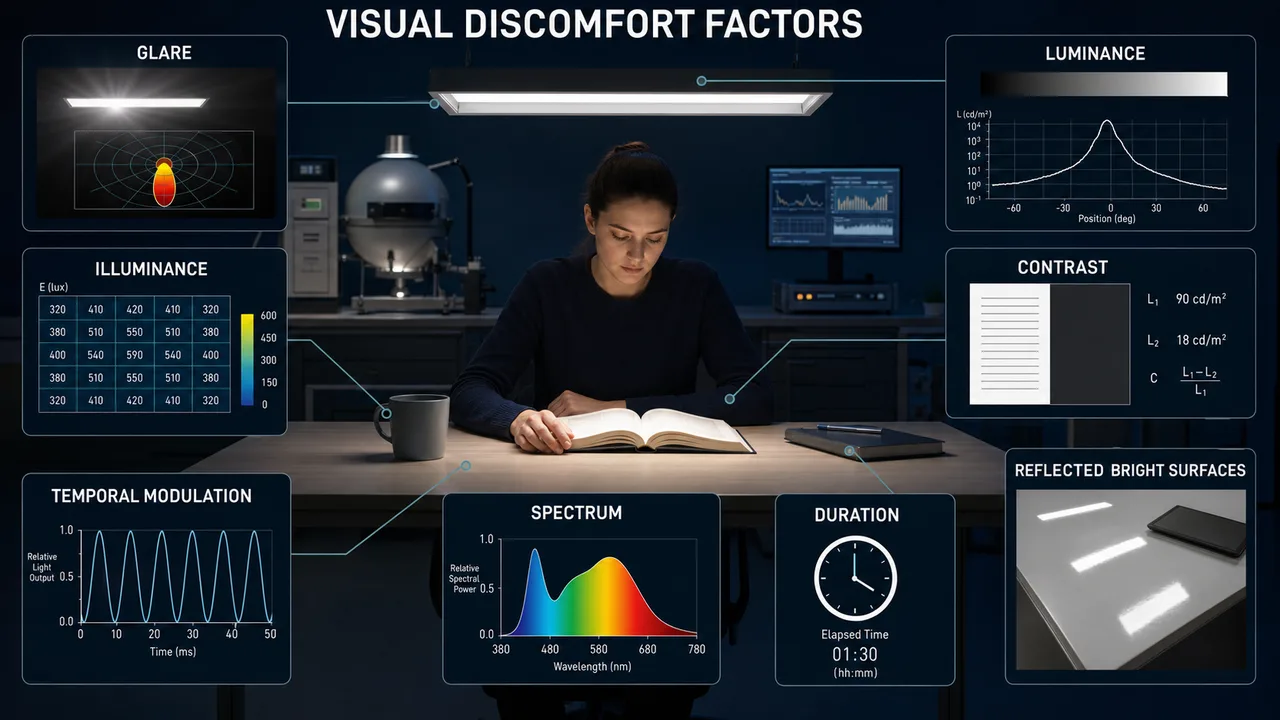
- Why do some luminaires look comfortable at first, but still cause eye fatigue after a long stay?
- What causes double images or multiple reflections in glass lampshades, and how can the structure avoid them?
- What are the key evaluation parameters for anti-glare glass lampshades, and how can they create a comfortable light environment?
- How can clear glass luminaires avoid visual discomfort caused by transparent glare?
- What are the different roles of softening panels, diffusion plates, and light guide plates in luminaires?
- How can secondary spots and stray light be reduced through luminaire structure and optical design?
- Why do some opal glass lampshades cause color-temperature shift, making a 3000K source look green or red?
- For tunable-white luminaires, how can glass shades remain optically neutral from 2700K to 6500K?
- How can long glass diffusers in LED linear lights avoid dark ends and a bright center?
- How much beam-angle deviation can glass-lens focal-length error cause, and how does it affect wall washing?
- What optical design methods do low-glare luminaires use besides relying on a glass cover?
Light distribution, glare, and color
Define measurable optical targets for visual comfort, beam control, diffusion, source hiding, and color stability.
How high should CRI / Ra be to count as good, and how do color-rendering needs differ by room?
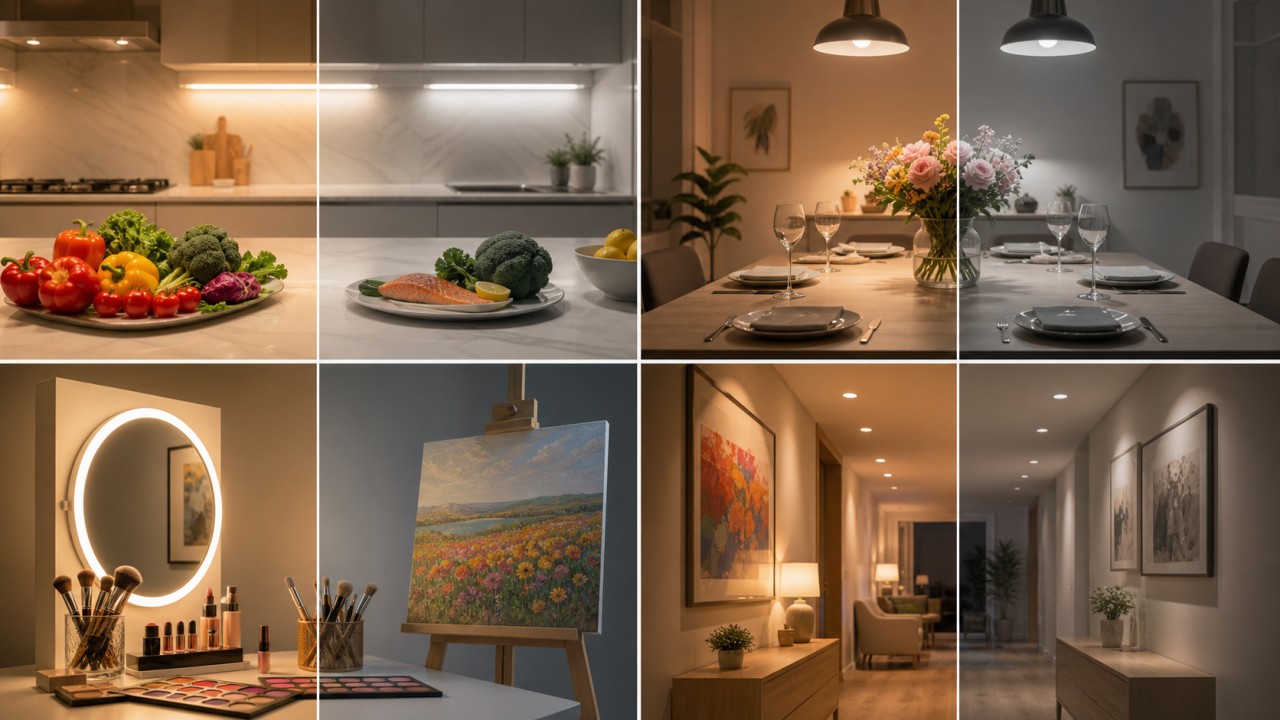
CRI Ra describes average colour rendering for a limited set of test colours; it is not a complete measure of colour quality and a value of 100 is not exclusive to one source type. Higher Ra can be useful where skin tones, food, artwork, finishes, or product colours matter, while circulation and storage areas may accept a less demanding target.
Specify colour quality from the task and target market rather than using universal labels such as “poor,” “excellent,” or “medical grade.” Where colour discrimination is important, review saturated-colour performance such as R9 and, when appropriate, additional colour-fidelity and gamut metrics. Confirm the complete luminaire because glass tint, coatings, temperature, dimming, and aging can change the transmitted spectrum.
How does beam angle affect spatial perception, and where are narrow and wide beam angles suitable?
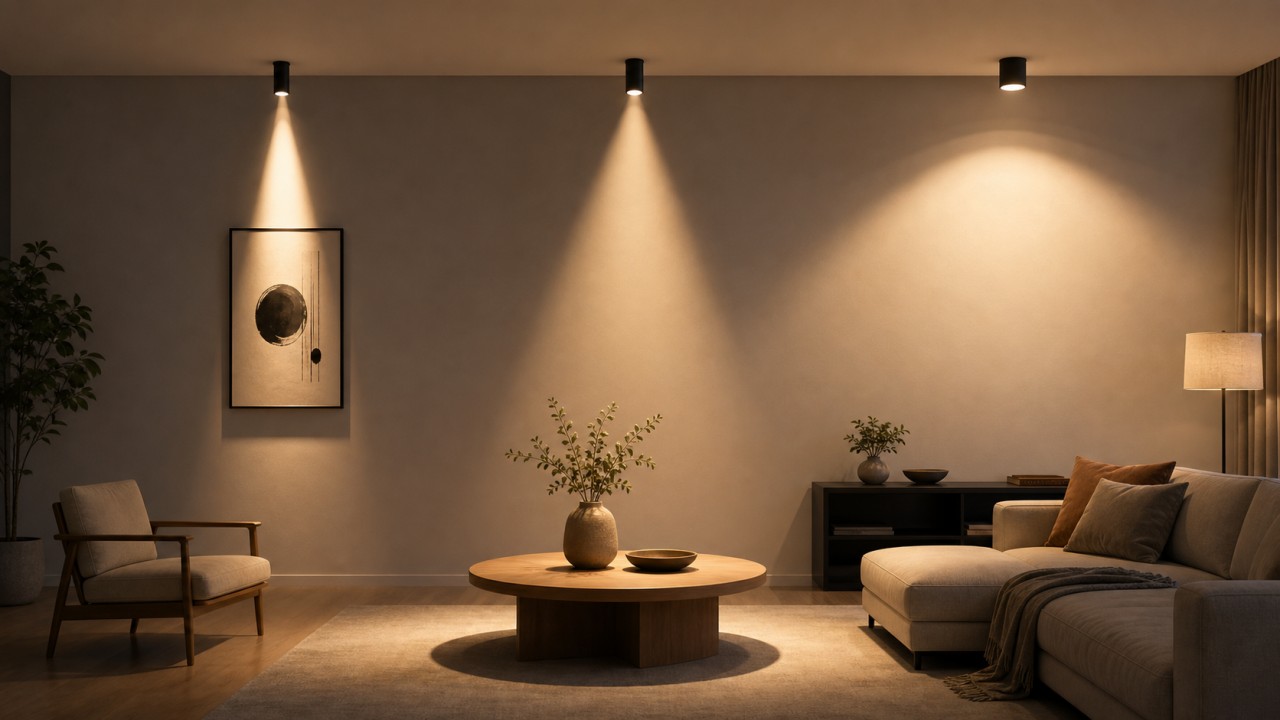
Beam angle describes the angular spread of the main intensity distribution, but it does not by itself describe field angle, cut-off, peak intensity, spill light, or edge softness. A narrower distribution can create stronger emphasis and contrast; a wider distribution can cover a larger area and support ambient or task lighting.
Choose the distribution together with mounting distance, target size, overlap, surface reflectance, observer position, and the contrast intended between the target and its surroundings. General lighting can include narrow beams when other layers provide adequate ambient illumination, so the decision should be checked with photometric data or a representative mock-up rather than a fixed beam-angle rule.
What is the optical difference between downlights and spotlights, and which should dominate in a home?
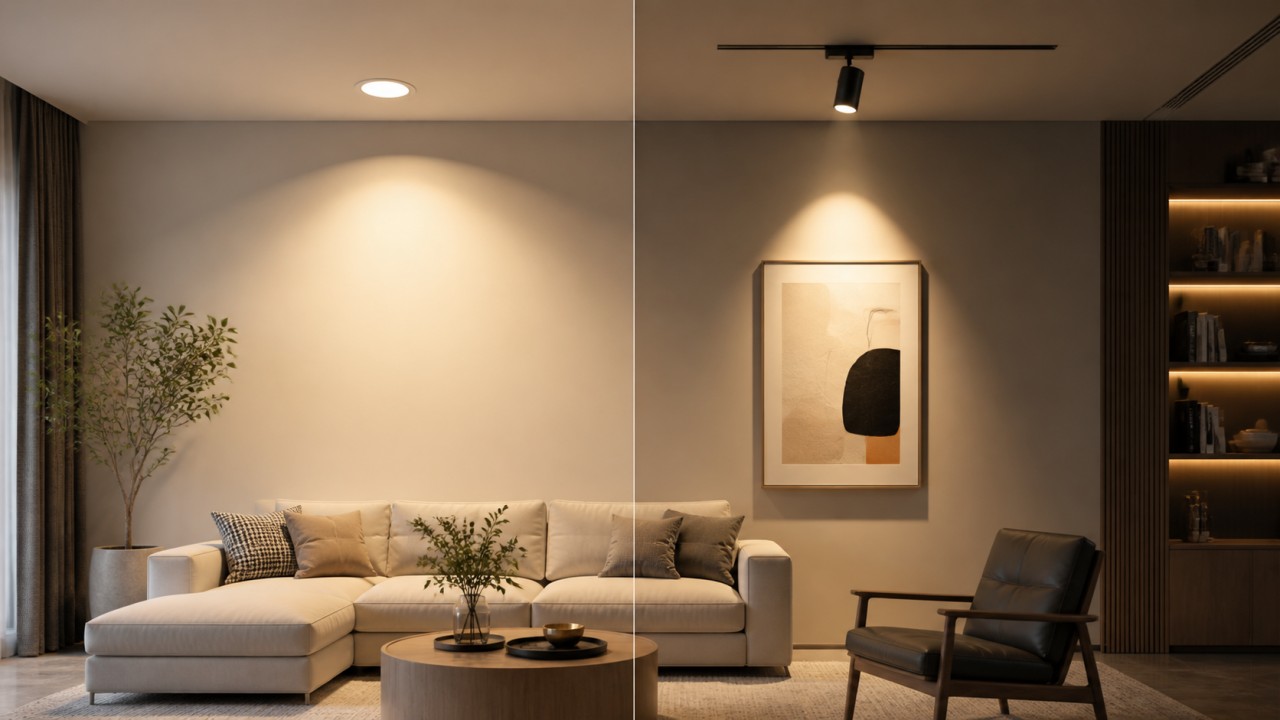
“Downlight” mainly describes mounting and downward output, while “spotlight” usually implies a more controlled or adjustable beam. The categories overlap: a downlight can have a narrow distribution, and a spotlight can use a relatively wide beam. Fixture names are therefore less reliable than the intensity distribution, cut-off angle, aiming range, luminous-aperture size, and glare performance.
Neither type should automatically dominate a home. Use broader or diffused distributions for useful ambient and task coverage, and controlled adjustable distributions for artwork, walls, tables, or architectural features. Confirm spacing, overlap, reflected glare, ceiling appearance, and scene controls from the actual photometric file and room geometry.
How should beam angle and installation distance be selected according to the size of the illuminated object, such as artwork, coffee tables, or dining tables?
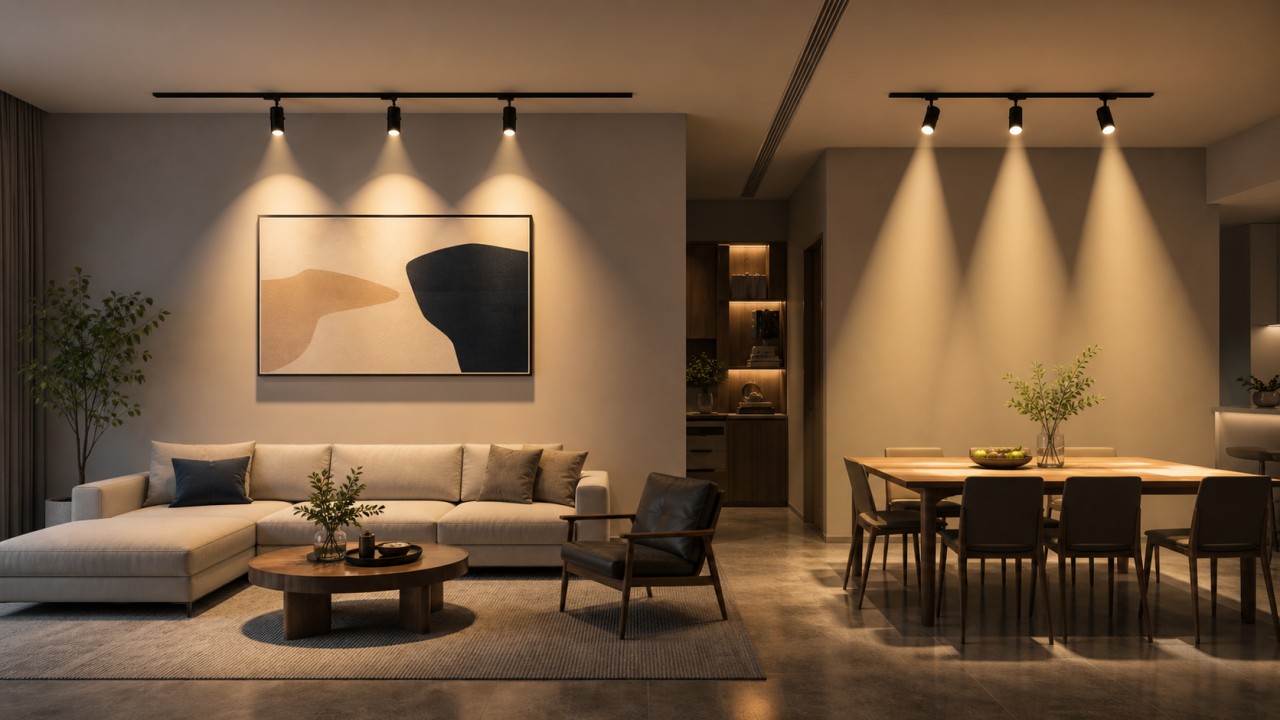
Start from the target dimensions and the distance between the luminaire and the illuminated plane. The nominal beam angle can provide an initial spot-size estimate, but real distributions include field light, asymmetry, aiming error, source size, lens tolerances, and surface reflection. Fixed offsets or spacing rules should therefore be treated only as early layout assumptions.
For artwork, tables, and displays, check whether the useful beam covers the target with the intended edge transition and overlap. Also evaluate glare from normal viewing positions, reflected highlights, heat or radiation-sensitive objects, and illuminance uniformity. Use the supplier's photometric data and approve a mock-up at the intended mounting distance.
Besides enough brightness, what optical indicators should a study reading lamp consider?
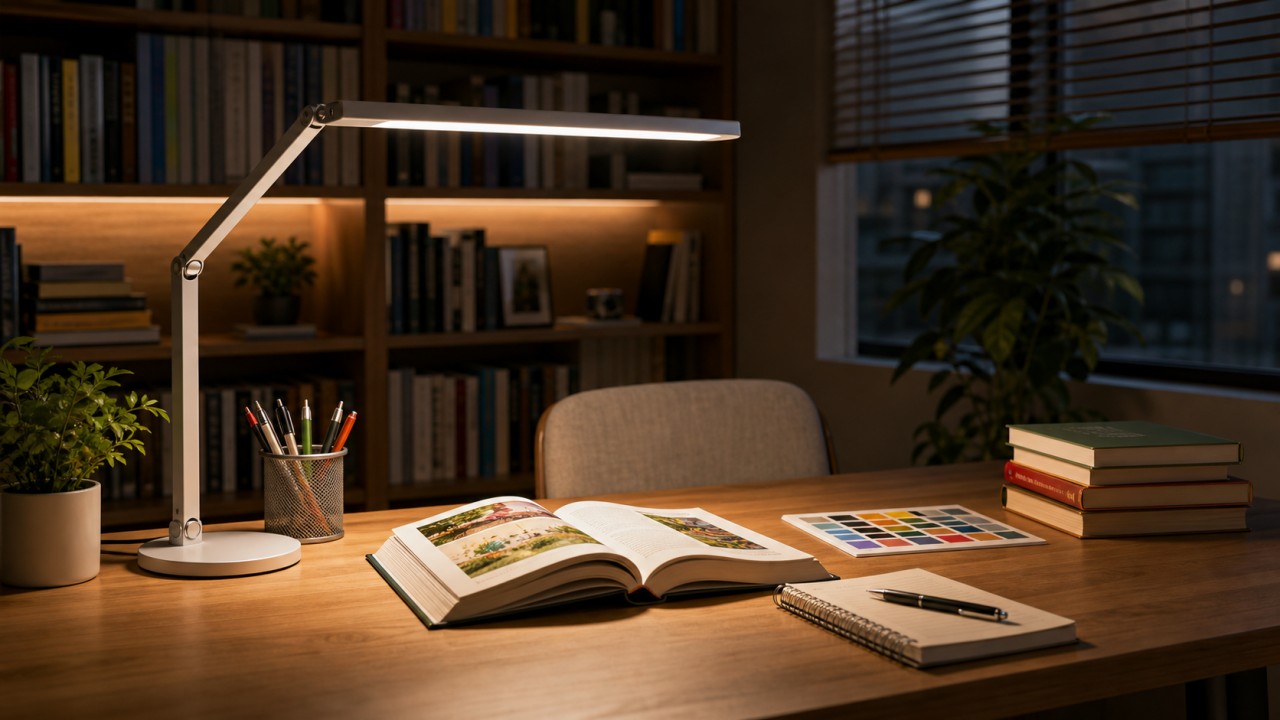
A reading lamp should be evaluated through task-plane illuminance and uniformity, luminous-area size and luminance, direct and reflected glare, temporal light modulation, colour quality, spectrum, adjustability, and the contrast between the desk and surrounding room. CRI can support colour recognition but low CRI alone should not be described as a proven cause of eye strain.
Recommended values depend on the applicable product standard, user, task, distance, ambient light, and target market. Check whether the source or bright reflector edges are visible in normal posture and whether glossy paper produces disturbing reflections. Approve the production lamp using declared measurement conditions rather than relying on marketing terms such as “flicker-free” or “eye-care.”
What lighting indicators matter most for a children's desk lamp?
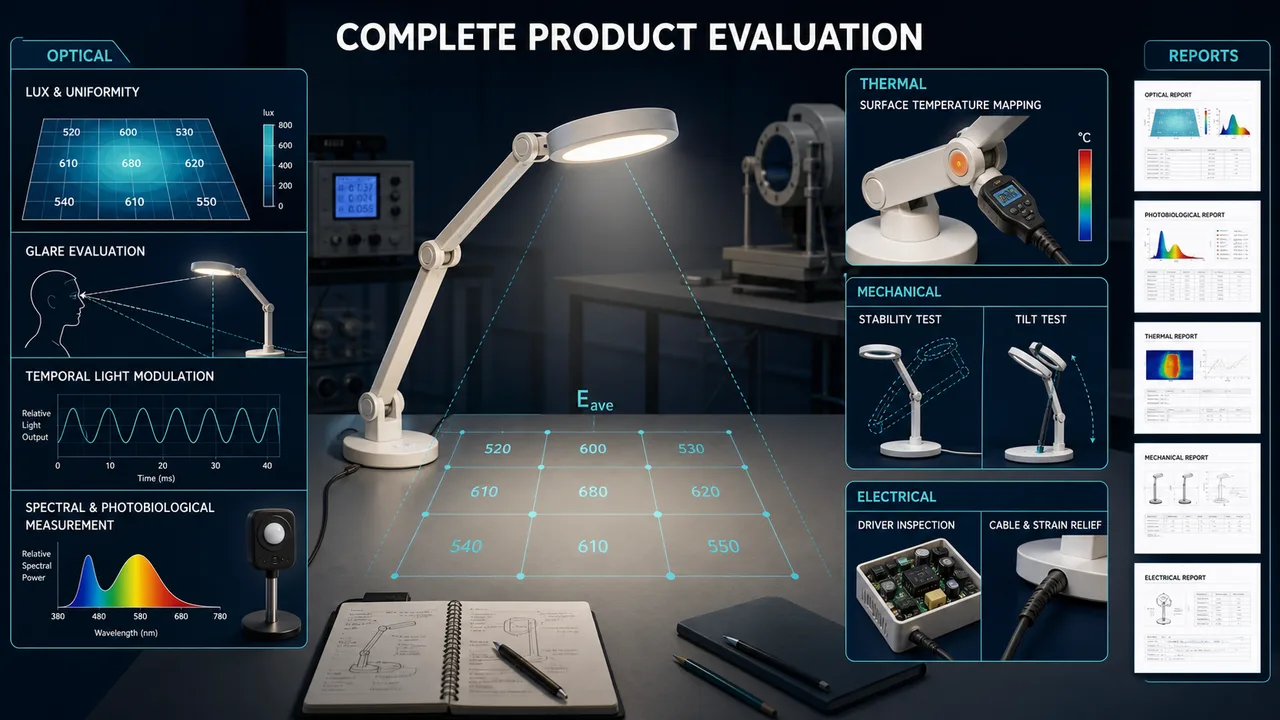
A children's desk lamp should be evaluated as a complete product. Relevant criteria can include task illuminance and uniformity, source luminance and glare, temporal light modulation, colour quality, accessible optical radiation, surface temperature, mechanical stability, electrical safety, adjustability, and foreseeable use. A shade material, LED package, CCT value, or isolated component result cannot establish “eye safety” on its own.
For optical radiation, request a report using the applicable photobiological-safety method and edition. The report should identify the tested operating mode, distance, geometry, spectrum, radiance or irradiance, exposure assumptions, and classification. Glare should be checked from expected sitting positions, with the emitting surface, reflector edges, and mirror-like reflections kept out of direct view where the design requires it.
Certification obligations depend on product classification, power supply, intended user, target market, and the regulations and standards currently applicable to that product. Do not state that every desk lamp in a country follows one identical certification route without confirming the current scope with the responsible certification body. Procurement files should record the applicable standard editions, certificate holder, model coverage, test configuration, and any national deviations.
During approval, measure the complete lamp on a representative desk with ambient room lighting present. Review illuminance, uniformity, glare, flicker, colour rendering, adjustability, stability, accessible temperatures, cable and driver safety, and the validity of the supplied reports for the exact production model.
When chandeliers use crystal or glass pendants, how can sparkling refraction be balanced with glare control?
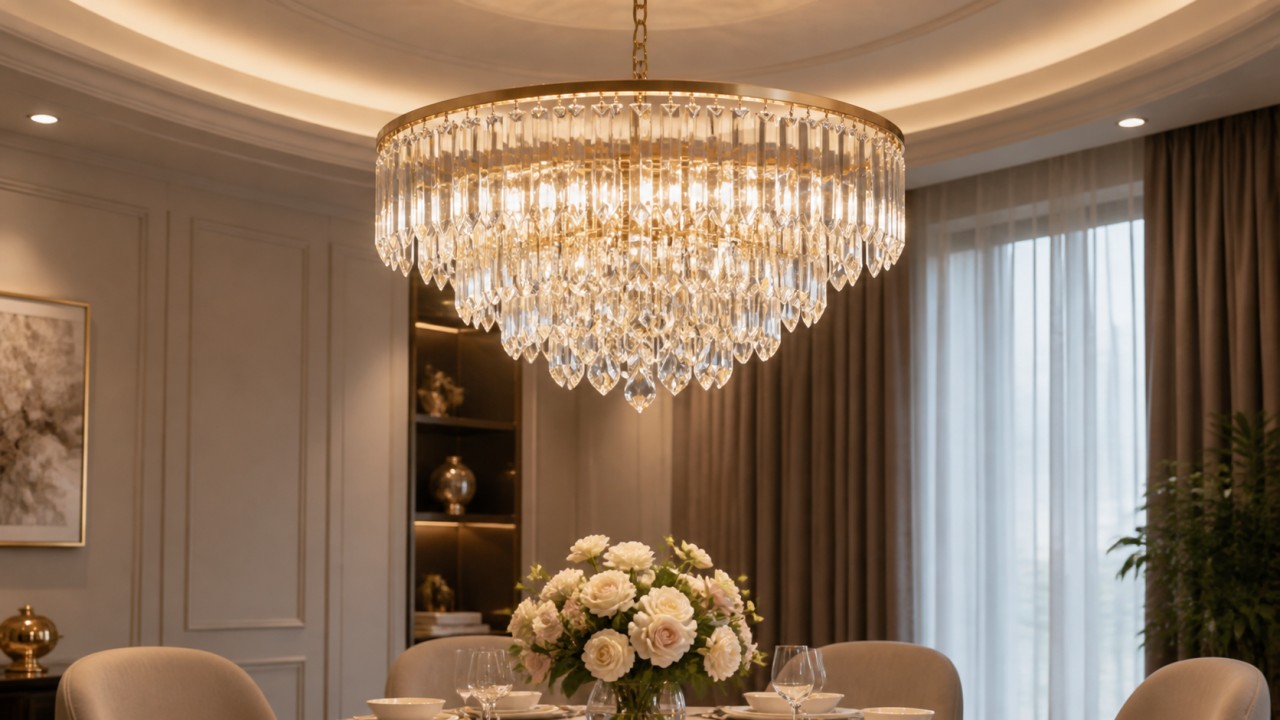
Sparkle comes from small high-contrast reflections and refractions, while discomfort occurs when those bright images reach common viewing directions at excessive luminance. Control source size and luminance, pendant orientation and density, shielding, mounting height, dimming range, and the position of reflective surfaces rather than assuming that a crystal composition or facet pattern alone determines comfort.
Hidden or diffused source arrangements can reduce direct source images while preserving decorative highlights, but they also change flux and colour appearance. Review the chandelier switched on and off from seated and standing positions, then verify illuminance, glare observations, temperature, suspension load, cleaning access, and replacement consistency on the complete assembly.
Which optical indicators should be specified for flat glass panels in ceiling luminaires?
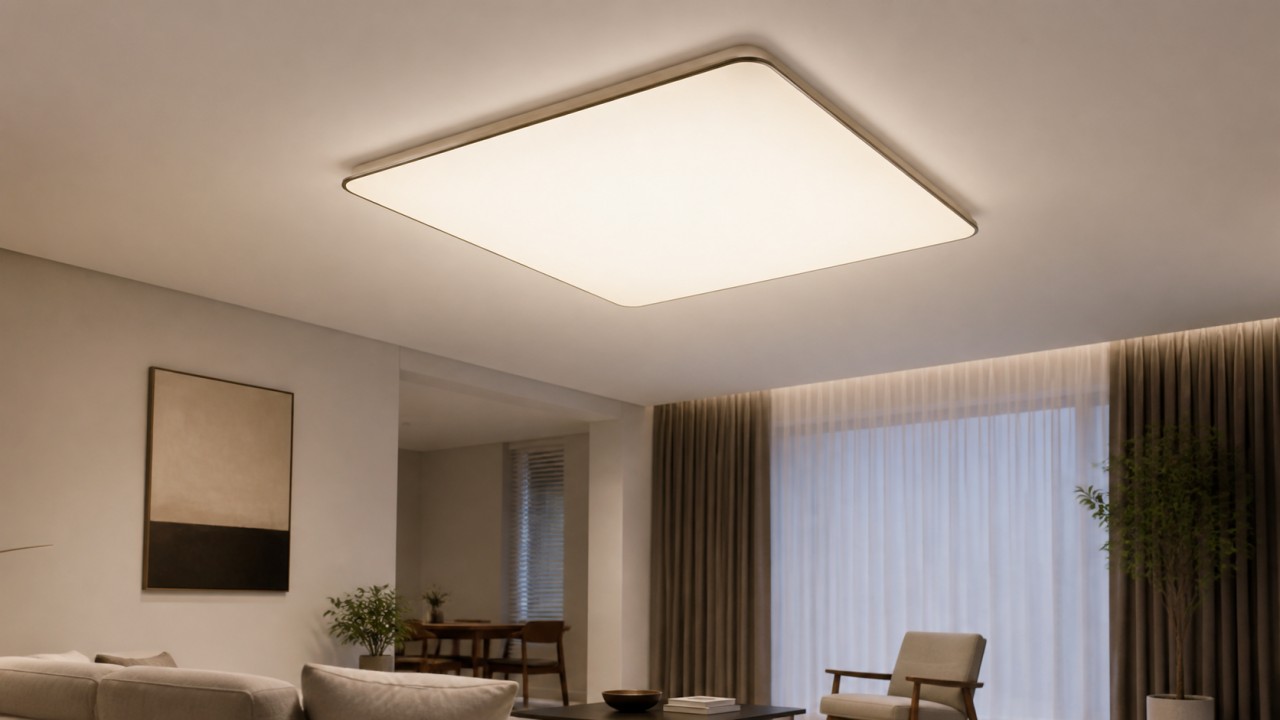
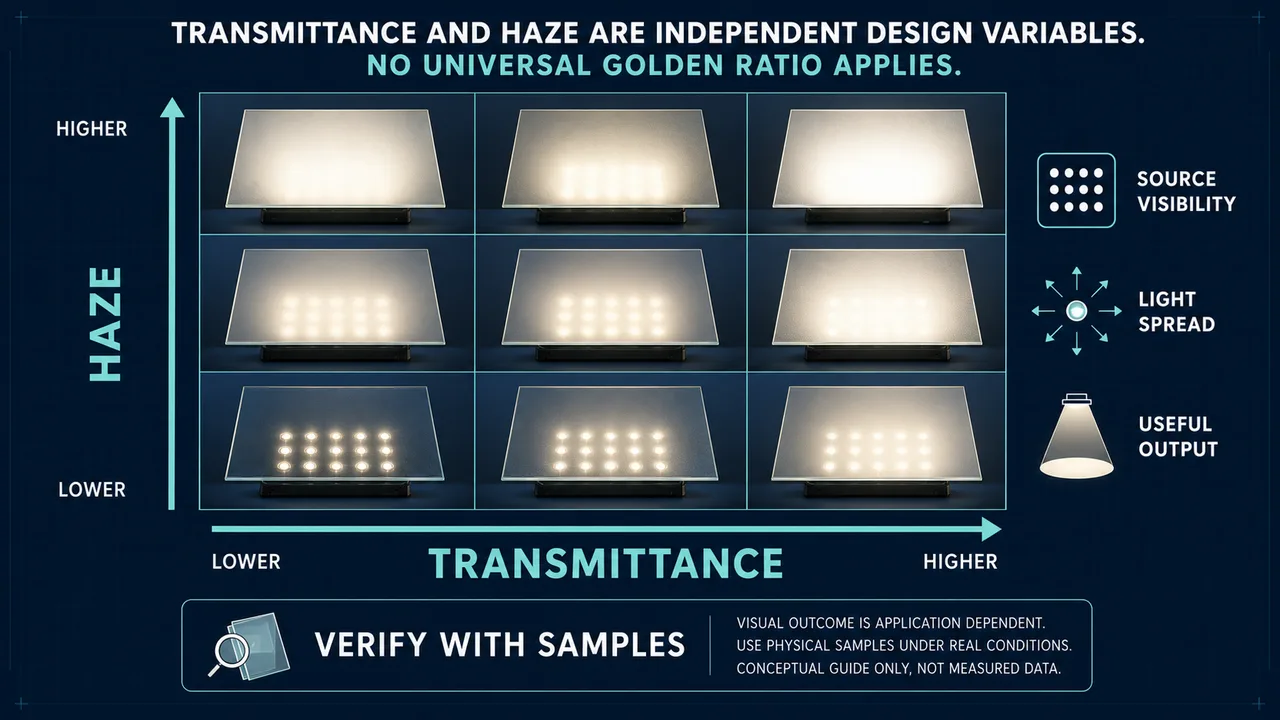
Flat ceiling-light glass should be specified through a combination of luminous transmittance, haze, angular distribution, source hiding, luminance uniformity, colour shift, dimensions, and surface quality. There is no universal haze or transmittance range that guarantees uniform room brightness. LED pitch, source-to-panel distance, cavity reflectance, panel size, mounting height, and room surfaces can change the result substantially.
High haze can improve mixing, but excessive scattering may reduce useful output or send more light toward unwanted angles. A high-transmittance sample can still show LED points, while a lower-transmittance opal sample can still have bright regions if the cavity is shallow or the source layout is uneven. Compare production-representative panels in the actual luminaire and record both individual optical values and the illuminated appearance.
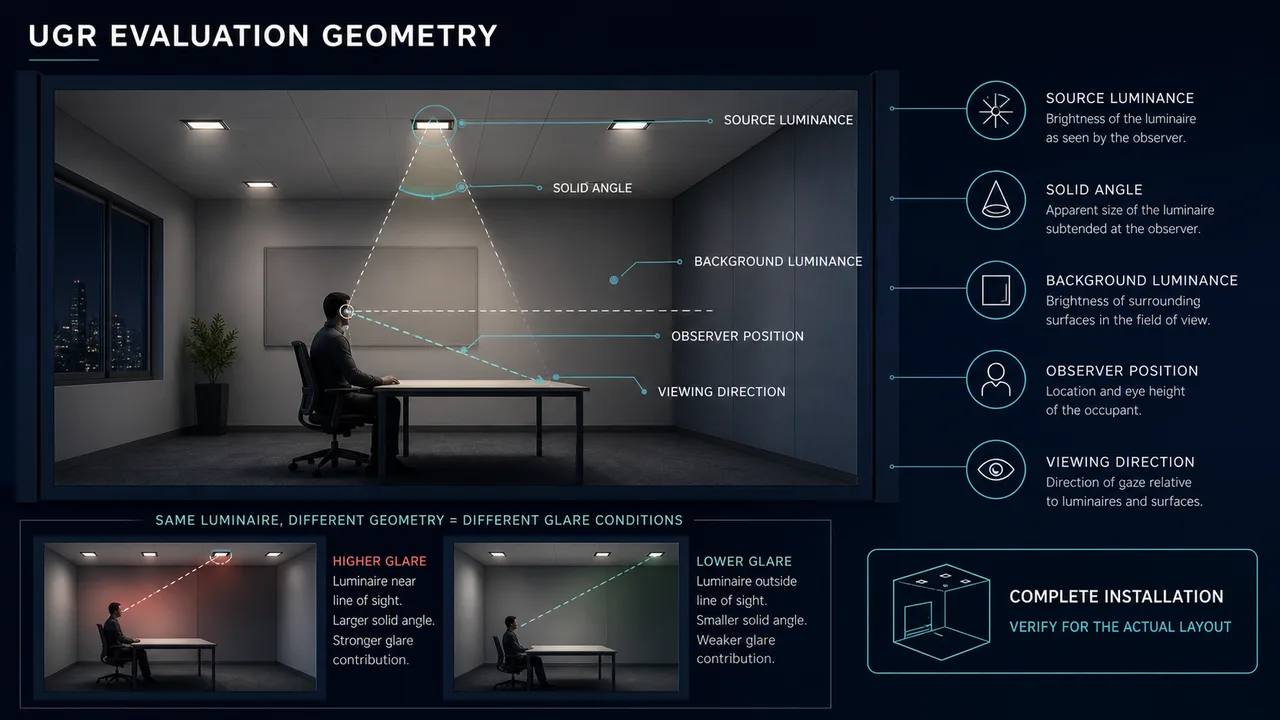
UGR is calculated for a complete lighting installation using luminaire intensity distribution, luminous-area size and luminance, observer position, background luminance, room geometry, and luminaire arrangement. A project may specify a value such as UGR 19 for a defined office or task-lighting condition, but that number is not a universal residential requirement and cannot be assigned to a glass panel alone.
Define the test geometry and acceptance method: panel orientation and treated side, spectral range, source and drive condition, measurement distance, luminance or image-uniformity method, photometric file, sample quantity, and tolerance. Confirm glare and room distribution with complete-luminaire photometry or a representative installation rather than treating one material number as a guarantee.
How do glass lenses and reflectors affect beam-angle precision and beam quality in downlights and spotlights?
Lenses redirect light by refraction; reflectors redirect it through controlled reflection. Either system can produce narrow, wide, symmetric, asymmetric, sharp-edged, or softly graded distributions. Accuracy depends on optical design, source size and position, refractive index or coating properties, surface profile, tooling, thermal condition, assembly datum, and production tolerances—not simply on whether the optic is glass, polymer, or metal.
Specify beam angle together with field angle, peak intensity, centre-to-edge distribution, stray light, colour uniformity, efficiency, and allowable variation between samples. Qualify production-representative optics in the complete luminaire because small LED-to-optic offsets or focal-length errors can dominate the result.
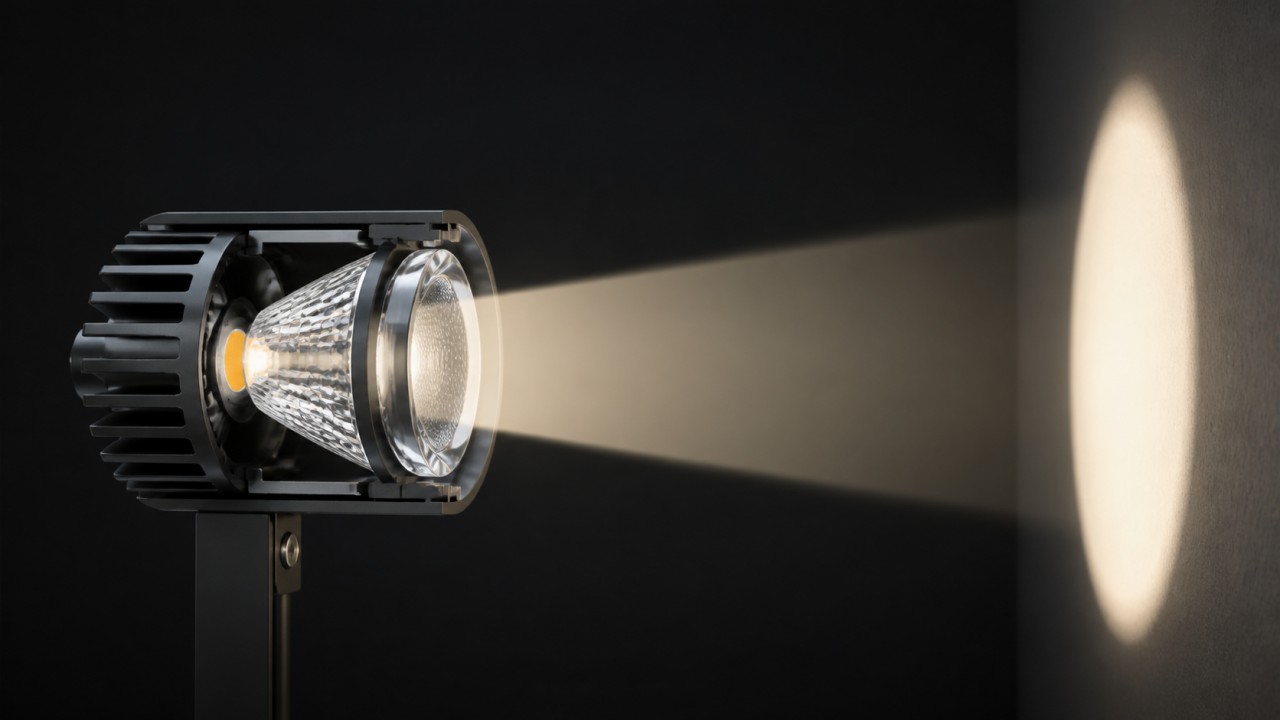
By what optical principle does anti-glare glass in downlights separate useful light-emitting area from stray light?
Micro-prismatic, textured, absorbing, or refractive structures can redirect, spread, reflect, or absorb selected ray paths. Their effect depends on incident angle, feature geometry, refractive index, source position, and the surrounding reflector or baffle. A glass cover alone does not reliably divide all light into “useful” and “stray” components or guarantee a particular glare value.
Develop the cover together with source recess, cut-off geometry, aperture luminance, reflector or lens, and internal surface treatment. Verify angular intensity, efficiency, stray light, source visibility, colour change, and glare for the complete luminaire under the intended installation geometry.
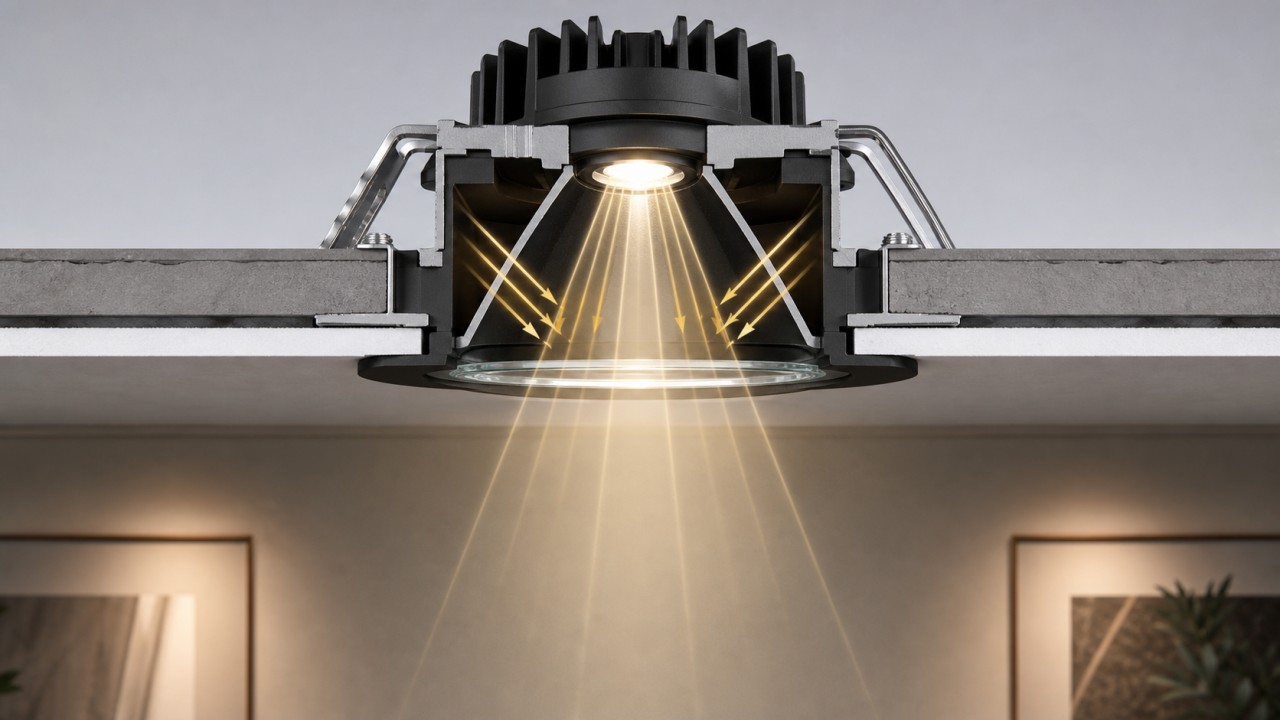
How do microstructured glass diffusers eliminate secondary spots and hot spots when spotlights illuminate walls?
Microstructured diffusers re-angle and mix rays, which can reduce the contrast of LED images, secondary rings, and central peaks. The result depends on feature geometry, haze, source size, position in the optical path, reflector or lens errors, mixing distance, and the target beam shape. A diffuser should not be described as completely eliminating artifacts without measured evidence.
Greater mixing normally trades against transmittance, peak intensity, beam width, or edge definition. Compare samples in the complete spotlight and report the wall-test distance, illuminance distribution, centre-to-edge variation, secondary-light level, beam angle, efficiency, colour uniformity, and sample-to-sample consistency.
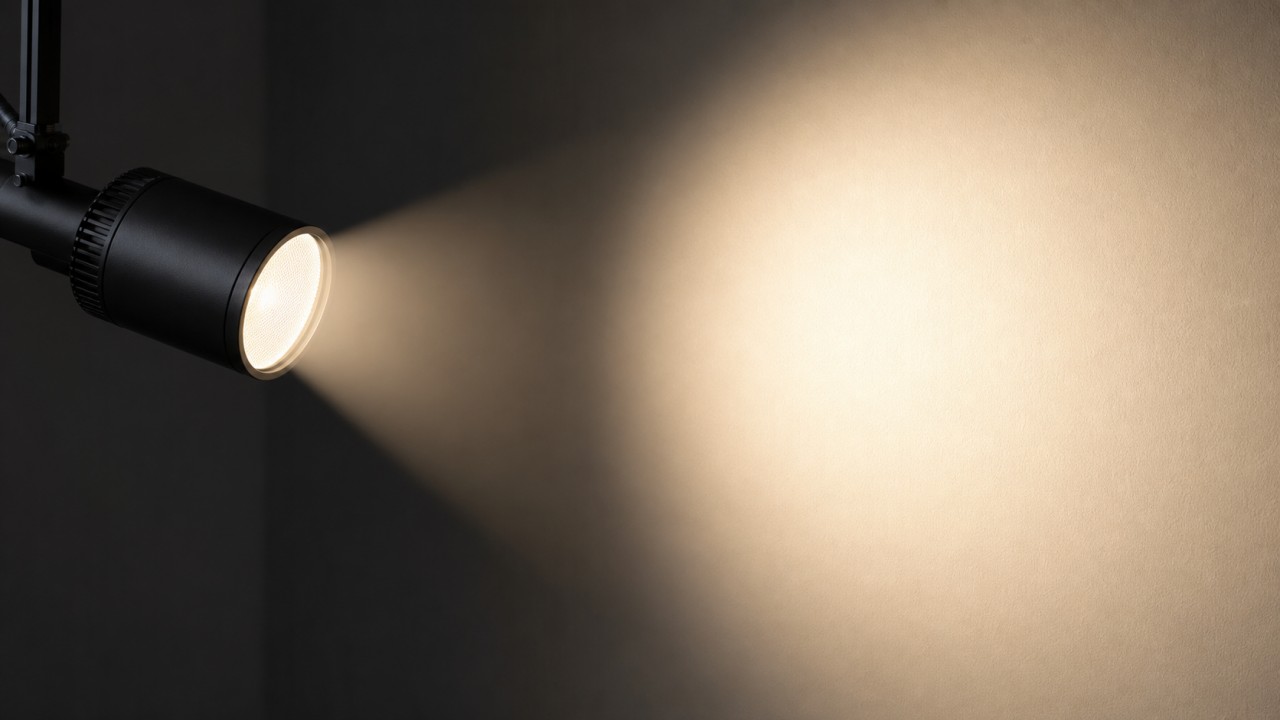
How much do AG anti-glare glass and ordinary frosted glass differ in anti-reflection and anti-dazzle performance for wall lamps?
AG and frosted surfaces both redistribute reflected and transmitted light, but performance varies with surface process, roughness spectrum, glass index, incident angle, contamination, and whether a coating is present. Reflectance and transmittance values cannot be assigned from the labels “AG” or “frosted” alone, and neither treatment automatically eliminates glare.
Compare total and specular reflectance, luminous transmittance, haze, image clarity, surface gloss, source visibility, and luminance from relevant viewing angles. Also test abrasion, cleaning chemicals, fingerprints, humidity, and optical change after aging. Select the surface from measured samples and the complete wall-lamp geometry.
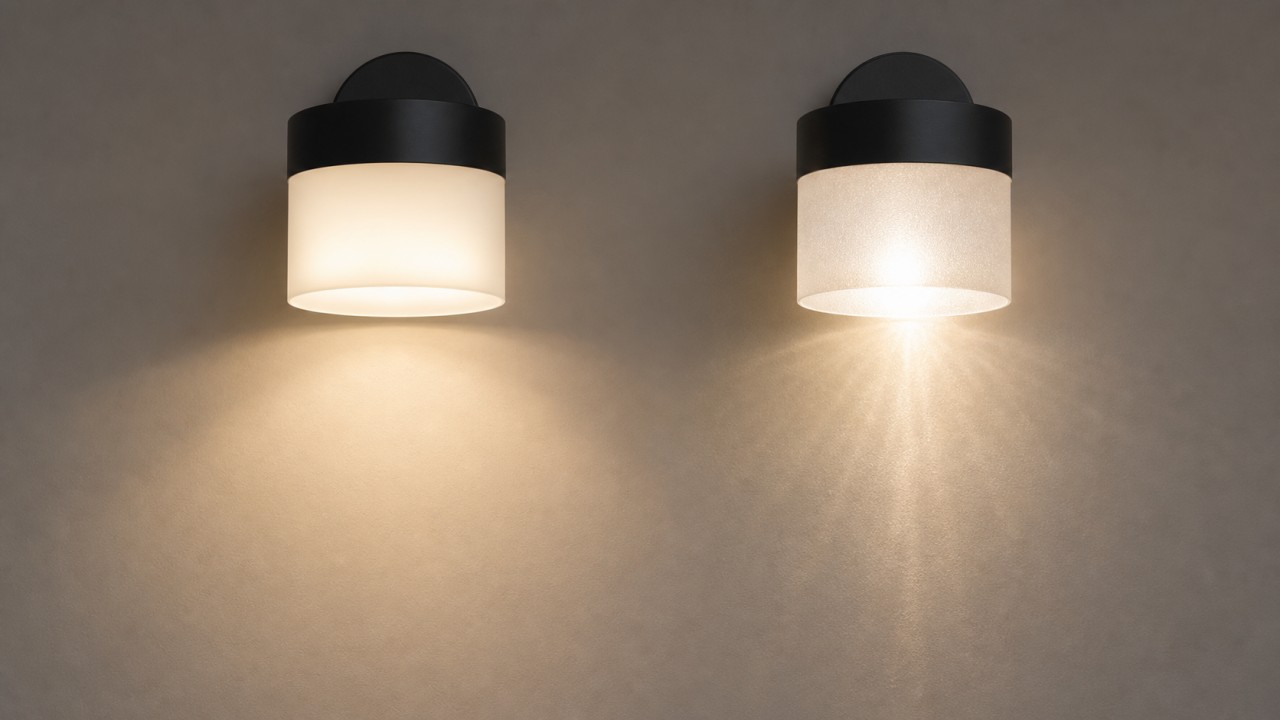
Is there a golden ratio between transmittance and haze for glass diffusers, and what values are recommended for different scenarios?
There is no universal "golden ratio" between transmittance and haze for glass diffusers. The two parameters solve different problems. Transmittance tells you how much light passes through the glass, so it directly affects luminaire efficiency and room brightness. Haze tells you how much of that transmitted light is scattered, so it affects softness, glare control, and whether LED points remain visible. A good diffuser is not simply the clearest or the milkiest one. It is the one whose transmittance, haze, LED spacing, mixing distance, and use scenario work together.
The ranges below are starting points for mock-up selection, not material specifications. They are only meaningful when samples use the same material family, thickness, geometry, finish, and measurement method. Do not compare a flat coupon value directly with a curved shade or complete-luminaire result.
For task lighting, begin by screening samples toward higher transmittance and lower-to-moderate haze. A provisional comparison band may be 85–92% luminous transmittance and 5–25% haze for matched flat samples. The luminaire must still control direct glare through source recess, shielding, lenses, reflectors, or a sufficiently large luminous area. Publish an exact value only with the test conditions listed above.
For general ambient lighting, compare samples that balance useful output with source hiding. A provisional band may be 70–85% transmittance and 30–60% haze for matched flat samples. Confirm the choice with the intended LED pitch, mixing distance, glass curvature, and complete-luminaire photometry; a coupon with acceptable haze may still show LED dots in a shallow fixture.

For the same luminaire, how much can actual light output differ between clear glass and fabric-textured embossed glass?
When the same luminaire changes from clear glass to fabric-pattern embossed glass, the optical efficiency usually drops noticeably. The exact amount depends on glass color, texture depth, thickness, haze, iron content, surface reflection, and the optical path of the fixture. The key is not simply whether the part is glass, but how much light it absorbs, reflects, and scatters.
A percentage difference is publishable only when both shades are tested on the same luminaire, LED module, driver setting, ambient condition, stabilization time, and photometric system. Record each shade’s material, mean thickness, curvature, texture depth, coating, sample quantity, and production batch. Report complete-luminaire luminous flux and efficacy; do not estimate fixture output from coupon transmittance alone.
Ordinary clear soda-lime glass usually has about 86-90% transmittance for a single sheet, while low-iron ultra-clear glass can reach about 91-92%. If the shade shape is simple, smooth, and not too thick, clear glass causes relatively small total lumen loss. Most loss comes from surface reflection and absorption in the glass. Its advantages are high efficiency, good beam preservation, and strong brightness. Its disadvantages are direct visibility of the light source, possible glare, double reflections, and a sharper lamp image.
How can glass lampshade transmittance and haze be determined according to space function?
When choosing a glass shade for a lighting fixture, transmittance and haze should not be treated as abstract laboratory numbers. They should be selected according to what the room actually needs the light to do. Transmittance describes how much visible light passes through the glass. Haze describes how much of that transmitted light is scattered. In simple terms, high transmittance gives more usable brightness, while higher haze makes the light softer, more diffused, and less likely to expose the LED points or bulb image directly.
For task-oriented spaces, transmittance should be the priority. Examples include kitchen countertops, reading desks, study rooms, dressing mirrors, workbenches, and laundry areas. In these places, users need to see edges, textures, ingredients, documents, or facial details clearly. Clear glass, low-iron glass, lightly frosted glass, or fine micro-textured glass is usually suitable. A practical target is high transmittance, often above 80-90%, with low to moderate haze. If the glass is completely clear, however, the fixture must control glare by using a recessed light source, a baffle, a reflector, a lens, or a sufficiently large luminous surface. Clear glass alone gives efficiency, but not comfort.
When evaluating the optical quality of decorative glass lampshades, what metrics besides transmittance should be considered?
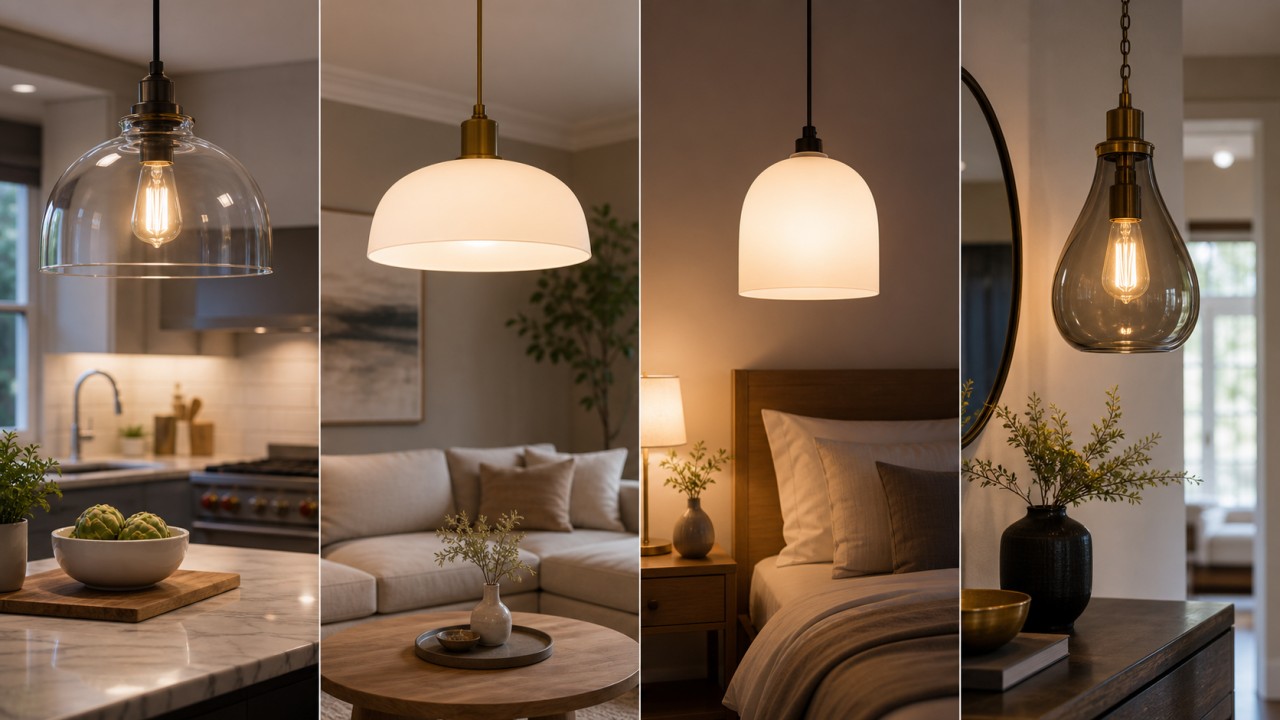
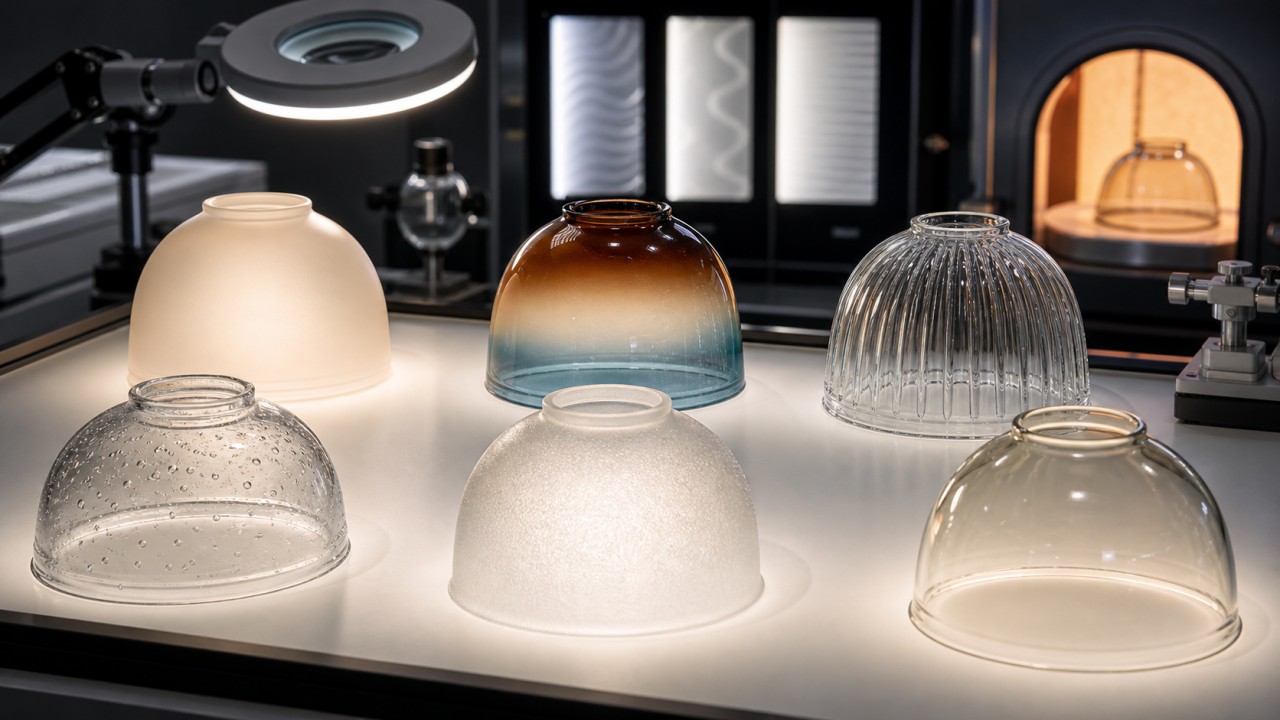
When evaluating the optical quality of a decorative glass lampshade, transmittance is only one part of the answer. A shade can transmit a lot of light and still look poor if the light is uneven, if the color is patchy, if the glass distorts the view in an uncontrolled way, or if internal defects become obvious when the lamp is switched on. Decorative glass should therefore be judged by a group of indicators rather than by brightness alone.
The first indicator is haze and diffusion behavior. Haze describes how much transmitted light is scattered. High-haze glass, such as opal or frosted glass, can hide the bulb or LED points and create a soft glowing surface. Low-haze glass keeps the view clearer and allows sharper shadow edges. For decorative lamps, neither high nor low haze is automatically better. The correct value depends on the intended visual effect. A pendant lamp meant to glow softly should have even diffusion. A clear glass chandelier meant to sparkle should preserve clarity and reflections. What matters is whether the diffusion is smooth and whether it avoids hot spots, bright dots, and uncomfortable glare.
What is UGR (Unified Glare Rating), and what reference limits apply to different residential spaces?
UGR means Unified Glare Rating. It evaluates discomfort glare in a lighting environment. A lower value means less glare; a higher value means the lighting is more likely to feel harsh, visually oppressive, or tiring. UGR is not a fixed value of a single bulb. It depends on luminaire luminance, luminous area, installation position, viewing direction, room size, and surface reflectance. The same luminaire can produce different glare impressions in a white living room and a small dark room.
Homes do not need to follow office limits mechanically, but reference values are useful. For study desks, children's learning areas, kitchen countertops, and mirror areas, aim for UGR <= 19 where possible. For living rooms, dining rooms, and general bedroom lighting, UGR <= 22 is usually acceptable. For corridors, entryways, and storage spaces where people stay briefly, UGR <= 25 can be acceptable. For bedside reading, TV-wall lighting, and movie-mode support lighting, the direct-view risk is higher, so values below 19 are preferable.
Reducing UGR is not just dimming the lamp. The key is to keep small high-luminance sources out of the eye. Use recessed anti-glare downlights, louvers, honeycomb grids, micro-prismatic glass, low-luminance diffusers, larger emitting surfaces, and proper cut-off angles. In homes, glare often comes from bad viewing geometry: a spotlight above the sofa aimed at the eyes, a pendant too low near the bed, or an exposed bulb above the dining table. Always check the lighting from sitting, lying, and walking positions, not only from a ceiling plan.
Why do some luminaires look comfortable at first, but still cause eye fatigue after a long stay?
A lamp that does not look glaring at first glance can still cause eye fatigue over time. "Not dazzling" only means there is no strong immediate discomfort when you look at it. Long-term fatigue is often caused by subtler issues: insufficient illuminance, uneven brightness distribution, flicker, poor color rendering, unsuitable color temperature, incomplete glare control, or excessive contrast between the task area and surroundings.
For example, a lamp with a thick opal shade may not look harsh, but if the desk receives only 150 lx, your eyes must work harder while reading. A very bright desk in a dark room forces your eyes to adapt repeatedly between bright and dark zones. Low-frequency flicker may not be obvious to the naked eye but can still increase visual stress. Low CRI can also make text, skin tones, and object edges less clear, causing the viewer to unconsciously strain.
The solution is to evaluate overall visual quality. Reading and study areas should generally reach 300-500 lx or more; detailed work may need higher levels. The surrounding ambient light should not be too dark, and the brightness ratio between the desk and background should be gentle. Choose low-flicker drivers, Ra >= 90 light sources, and color temperatures suited to the activity. Glare should be controlled by optics and structure, not only by a frosted cover. Good lighting lets people see clearly, steadily, and comfortably for a long time.
What causes double images or multiple reflections in glass lampshades, and how can the structure avoid them?
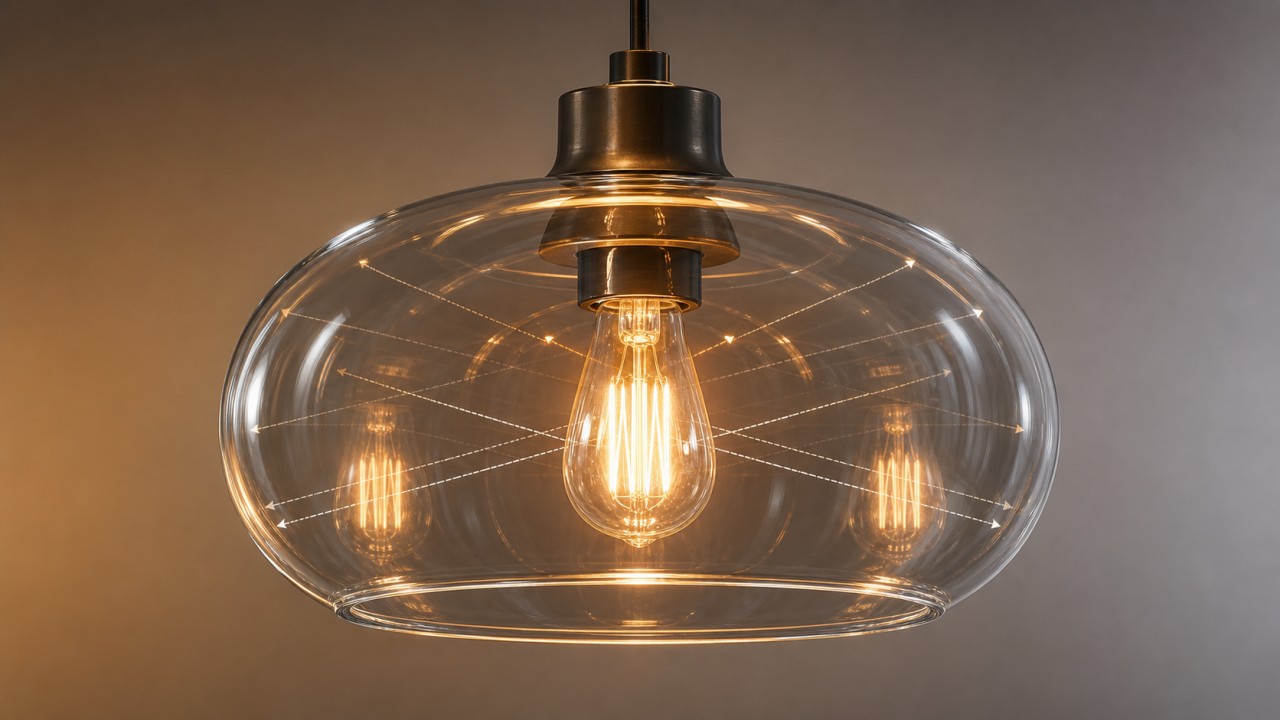
Double images and multiple reflections in a clear glass lampshade come from the two reflective interfaces of the glass. When light reaches the outer surface, part of it reflects. The rest enters the glass and part of it reflects again at the inner surface. If the glass is thick, the two surfaces are parallel, the source is bright, or the viewing angle is oblique, the reflected images separate and appear as ghost images. Curved glass, coated glass, and laminated glass can create even more secondary reflections.
The structure can reduce this problem in several ways. First, avoid direct view of small high-luminance sources. Use a diffuser, internal softening plate, or larger luminous surface so reflected images are less sharp. Second, avoid large parallel clear glass surfaces facing the viewer. Slight curvature, tilted installation, or non-parallel geometry can send reflections away from the main viewing direction. Third, use low-reflective coating or AG anti-glare treatment to reduce surface reflection. Fourth, control glass thickness and avoid unnecessary laminated layers or air gaps.
If clear glass is essential, as in vintage bulb pendants or display lights, treat ghosting as part of the design. Use lower-luminance filaments, frosted bulbs, smoked glass, or internal shields instead of exposing bright LED points. Clear flat glass should be used carefully in mirror lights, desk lamps, and TV-wall lighting because reflections can directly reduce visual comfort.
What are the key evaluation parameters for anti-glare glass lampshades, and how can they create a comfortable light environment?
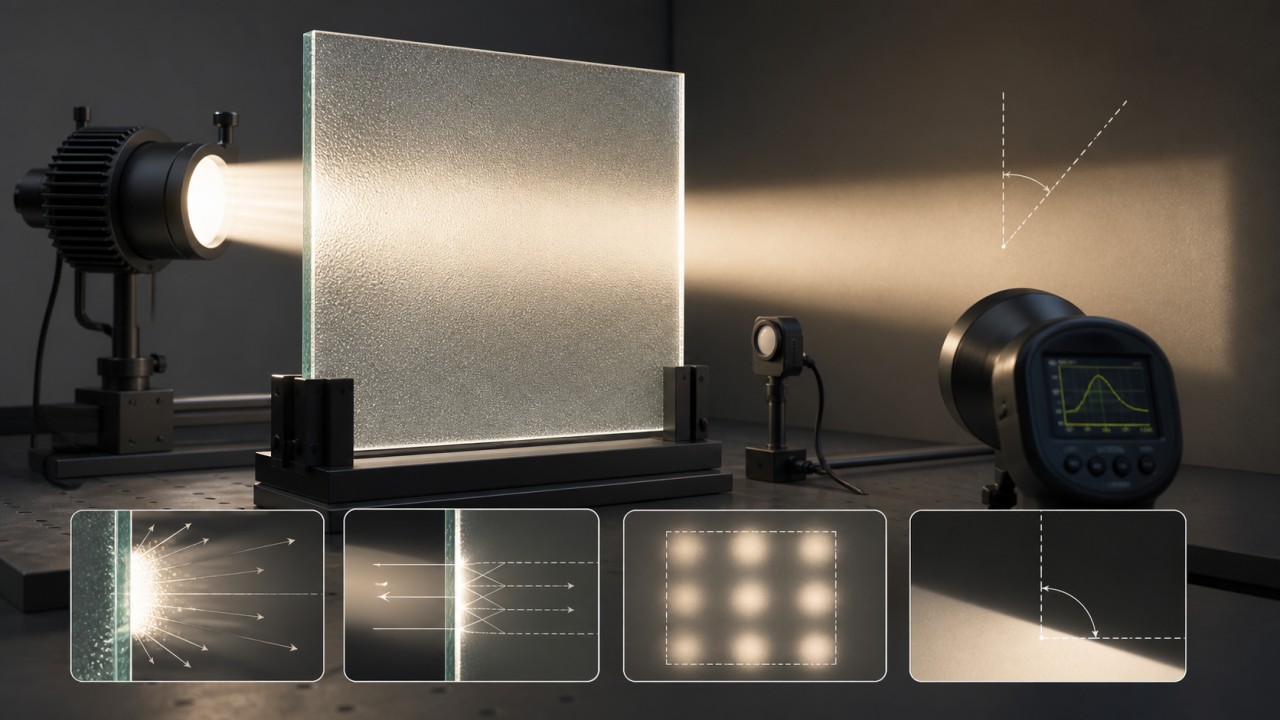
Anti-glare glass should not be evaluated only by how frosted it looks. Key parameters include transmittance, haze, surface reflectance, luminance uniformity, cut-off angle, UGR or equivalent glare evaluation, beam quality, and color shift. Too little transmittance makes the lamp dim. Too much haze wastes light and reduces detail. High reflectance creates mirror glare. Poor uniformity creates bright dots and hot spots.
Comfortable anti-glare design is usually a combination of material, optical structure, and installation angle. The glass may use AG treatment, micro-prisms, fine frosting, internal diffusion coating, or low-reflective coating. The luminaire can use a recessed source, reflector, honeycomb grid, shielding ring, louver, or large-area luminous surface. Installation should avoid common viewing directions, especially from sofas, beds, dining tables, desks, and TV-viewing positions.
A good anti-glare shade should hide high-luminance LED points, provide enough task illuminance, maintain surrounding ambient light, preserve natural color, and keep the shade surface soft and uniform. The best anti-glare design does not simply scatter all light. It keeps useful light where it is needed while preventing high-brightness light from entering the eyes directly.
How can clear glass luminaires avoid visual discomfort caused by transparent glare?
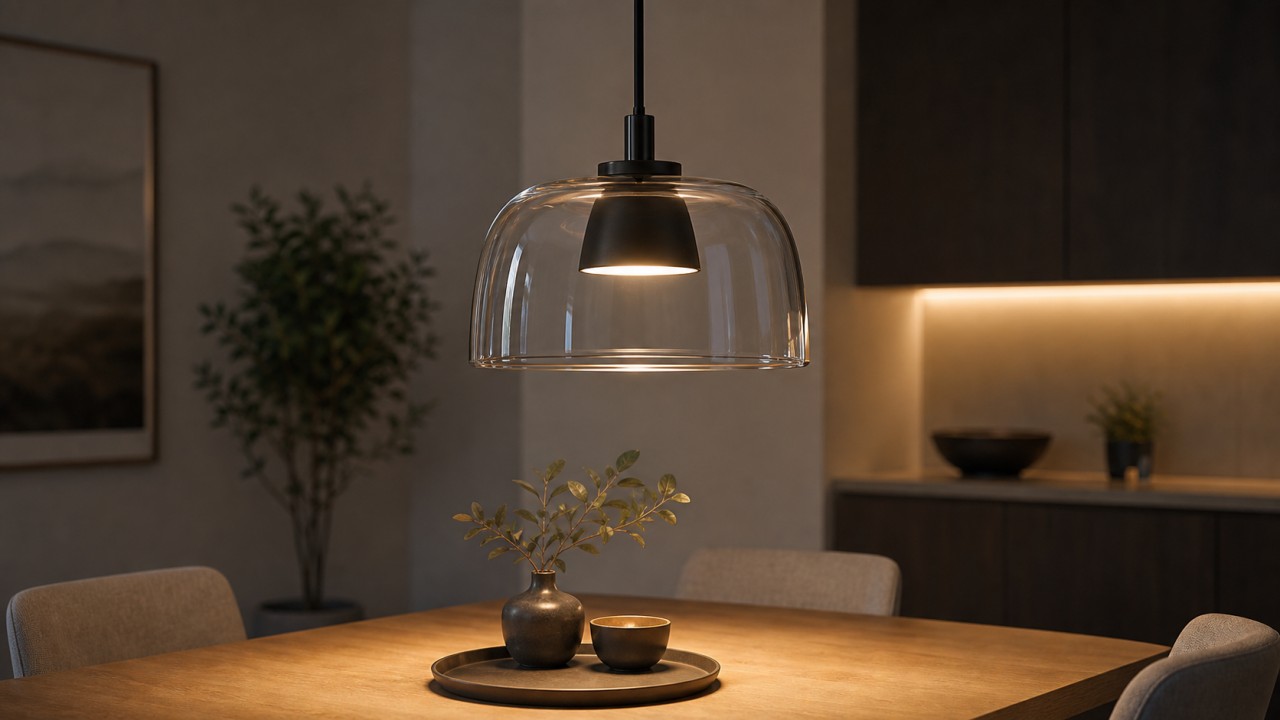
Clear glass luminaires are attractive because they feel transparent, light, and reflective. The risk is that the light source is almost unshielded and can create "transparent glare." This glare usually does not come from the glass alone, but from the bright filament, LED chip, reflector, or multiple reflections behind the glass.
To avoid transparent glare, first reduce source luminance. Do not place exposed high-power LED points inside a clear shade. Use frosted bulbs, lower-luminance filament lamps, opal inner sleeves, or shielded light engines. Second, control viewing angle. The bulb should not be directly visible from common sitting, lying, or walking positions. A dining pendant should direct light toward the table rather than people's eyes. A bedside pendant should not expose the bulb from the pillow position.
Third, reduce reflection through glass detail. Low-reflective glass, light smoked glass, subtle ripple glass, or partial frosting can help. An internal diffuser, small shield cup, or reflector can also be added. Clear glass is best used as an outer decorative layer, while the real anti-glare function is handled by an inner optical structure. This preserves transparency while preventing bright points from attacking the eye.
What are the different roles of softening panels, diffusion plates, and light guide plates in luminaires?
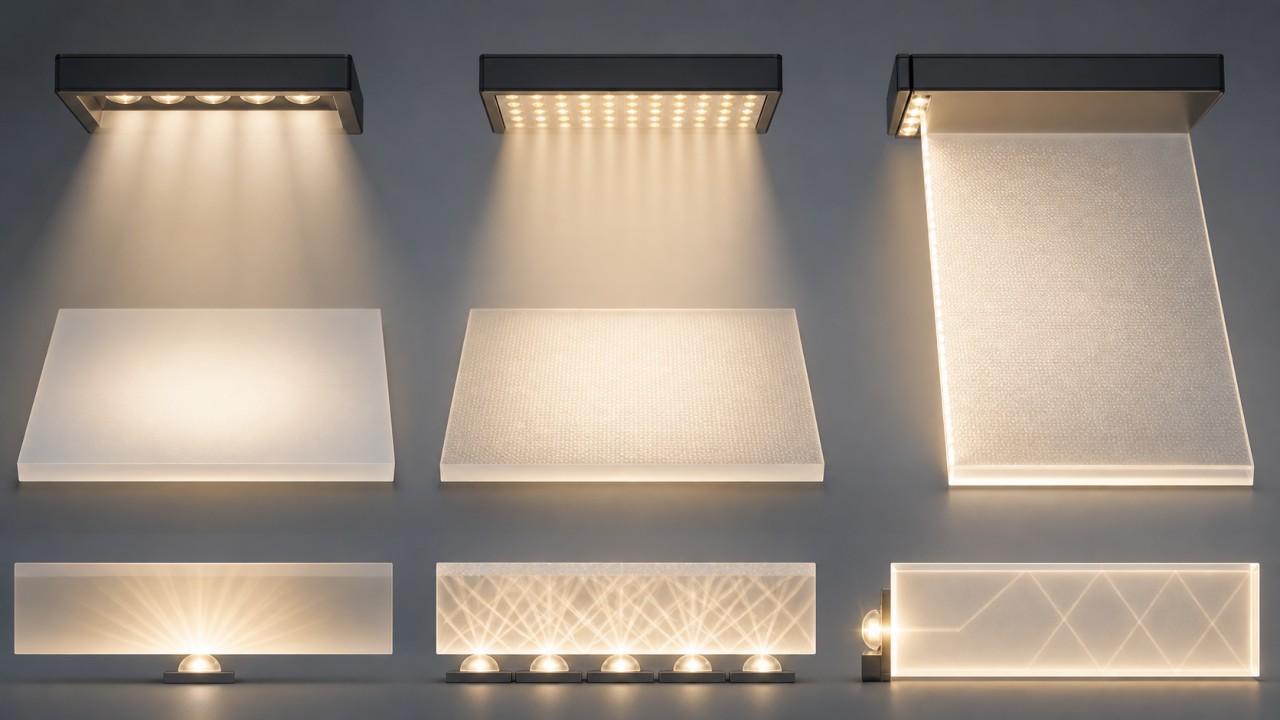
Softening panels, diffusion plates, and light guide plates all make light softer, but they do different jobs. A softening panel mainly reduces harshness and makes direct light feel gentler. A diffusion plate breaks up point or line sources and mixes LEDs into a more uniform luminous surface. A light guide plate transports and redistributes light, often in edge-lit panel lights.
A diffusion plate usually uses scattering particles, frosted surfaces, or microstructures. Its main purpose is to hide LED dots, reduce hot spots, and widen the beam. It sacrifices some efficiency but greatly improves uniformity. A softening panel may be a diffuser, but it can also be fabric, opal glass, micro-prismatic material, or any translucent layer focused on visual comfort.
A light guide plate is usually made from clear acrylic, PC, or glass. Light enters from the edge and exits gradually through printed dots, microstructures, or surface treatment. It is suitable for thin panel lights, linear lights, and backlight systems. The challenge is avoiding dark ends, bright centers, or bright input edges. This requires dot-density design, reflector film, and diffuser layers. In short: a softening panel improves comfort, a diffuser improves uniformity, and a light guide converts edge light into surface light.
How can secondary spots and stray light be reduced through luminaire structure and optical design?
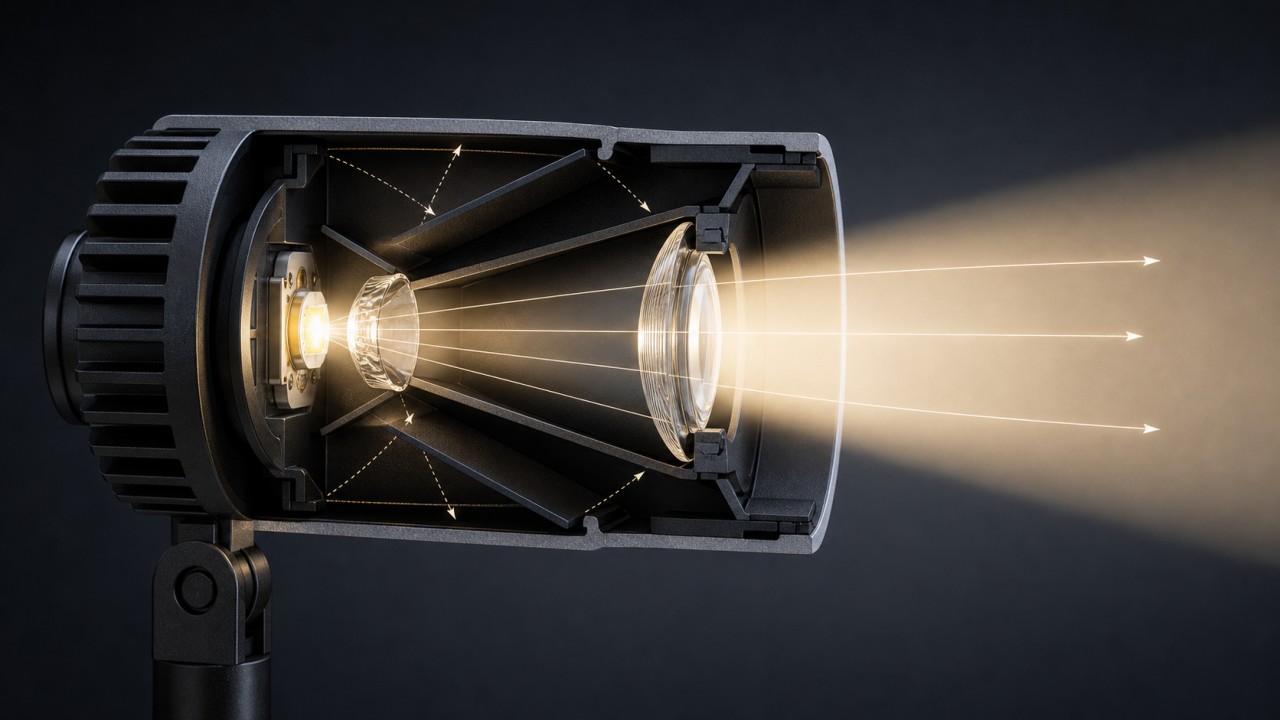
Secondary spots and stray light appear when light exits through paths that were not intended in the optical design. Common causes include lens-edge leakage, uneven reflectors, LED misalignment, internal reflection in glass, secondary reflection from the housing, uneven diffuser texture, and insufficient shielding. They can create extra rings, colored edges, ghost images, or dirty beam patterns on a wall.
Structurally, the first step is to control alignment. The LED, lens, reflector, and glass cover must share the same optical center, and assembly tolerances should be tight. Next, unwanted light needs absorption or blocking paths: matte black inner walls, shielding rings, ribs, honeycomb grids, and deep baffle structures. Bright exposed edges of reflectors or lenses should be avoided.
Optically, use precision lenses, micro-structured diffusers, secondary optics, gradient diffusion layers, or anti-glare glass to make the transition from center light to edge light smoother. Wall washers especially need controlled cut-off and edge light. Offset lenses or shields may be required. The goal is not to make the beam boundary disappear completely, but to create a clean main beam, natural edge transition, and no messy ghost patterns on the illuminated surface.
Why do some opal glass lampshades cause color-temperature shift, making a 3000K source look green or red?
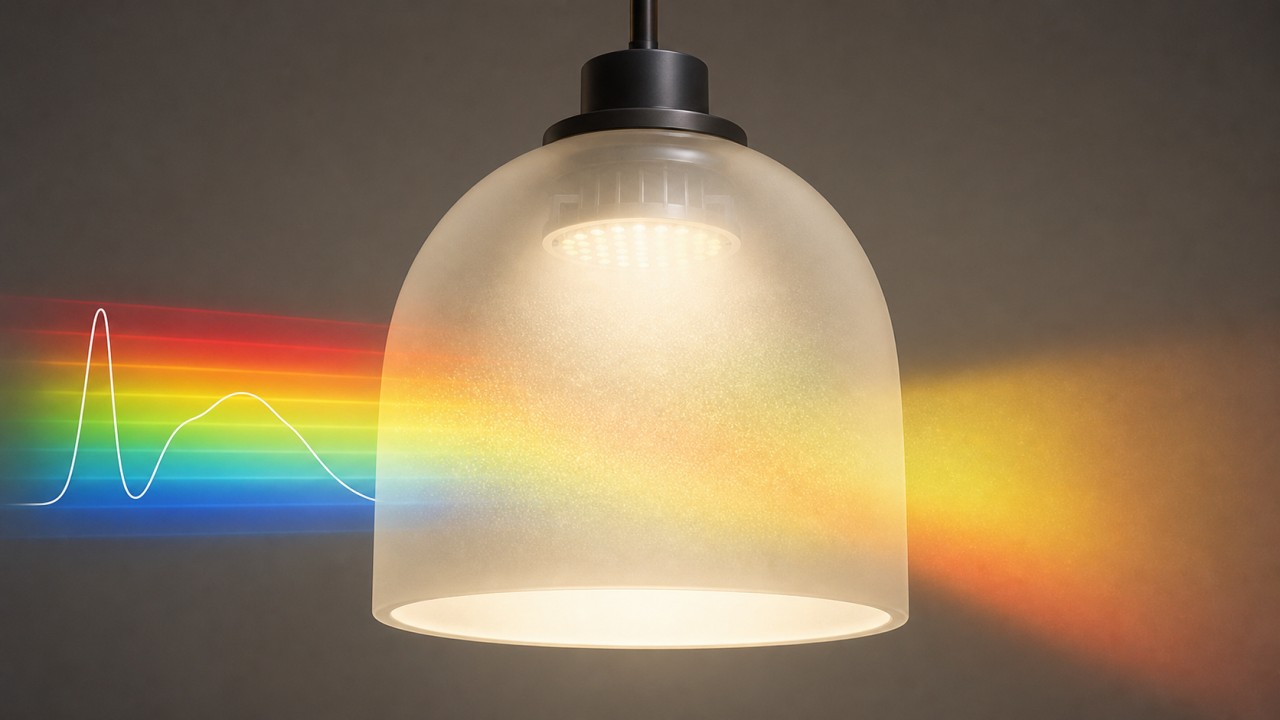
When opal glass makes a 3000K source look greenish, reddish, or overly yellow, the cause is usually the interaction among glass formula, diffusion material, thickness, coating, and the LED spectrum. The milky effect often comes from opacifiers, microcrystals, bubbles, or diffusion layers. These structures do not scatter and absorb all wavelengths equally, so they can change the spectral balance of the LED.
If the glass absorbs more blue light, 3000K may become warmer or redder. If red transmission drops or blue-green components become relatively stronger, the light can shift green. Uneven thickness creates different CCT in different areas: thicker regions may appear warmer or dimmer, while thinner regions appear whiter. Low-quality coatings or diffusion powders may also age under heat, increasing color shift over time.
To avoid CCT drift, choose optically neutral opal glass and test it with the actual LED source, not just by looking at the glass alone. Suppliers should provide transmitted spectrum, chromaticity shift, color difference after thermal aging, and batch color-difference data. The luminaire design should also control glass thickness, LED operating temperature, and mixing distance. For high-quality residential lighting, test the complete luminaire for CCT, Duv, and CRI, not only the bare LED.
For tunable-white luminaires, how can glass shades remain optically neutral from 2700K to 6500K?
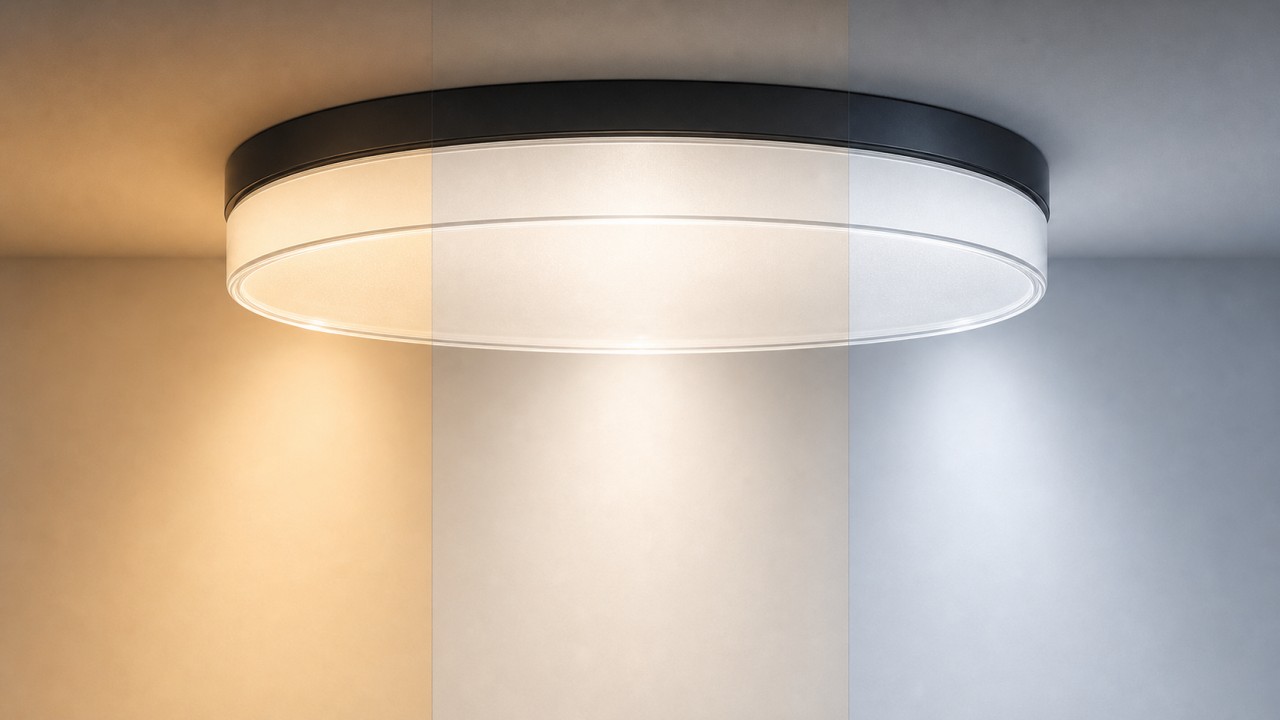
The challenge for tunable-white luminaires is that the spectrum changes while the shade should not favor one wavelength range too strongly. If the glass has a strong tint, selective absorption, or unstable coating, the color shift at 2700K, 4000K, and 6500K will not be consistent. Users may see warm light as dirty, cool light as greenish, or neutral light as unnatural.
To keep optical neutrality, choose low-iron clear glass, neutral opal glass, or diffusion glass verified by spectral testing. Avoid deep tea, amber, blue-green, heavy smoke, and strong iridescent coatings. If diffusion is needed, use a material with relatively smooth transmittance across the visible spectrum, rather than diffusion powders that strongly absorb blue or red light.
Verification should not be done at only one CCT. Test transmitted CCT, Duv, Ra/R9, and chromaticity shift at the lowest, middle, and highest color-temperature settings. Also test dimmed states, because some drivers change the mixing ratio at low output. For premium products, define shade-plus-luminaire color-tolerance requirements, such as acceptable Duv shift across the tunable range. In simple terms, the shade for tunable-white lighting should express itself as little as possible and let the source's intended color temperature appear faithfully.
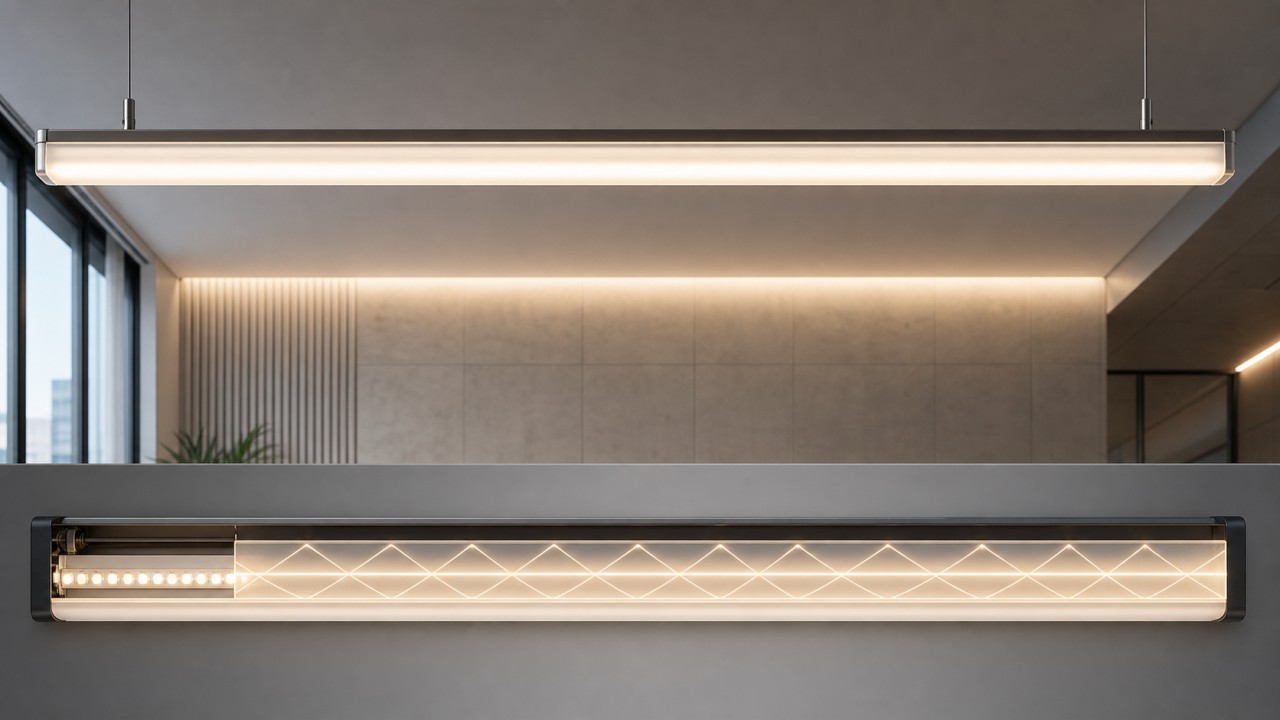
How can long glass diffusers in LED linear lights avoid dark ends and a bright center?
Dark ends and a bright center in LED linear lights usually come from LED layout, light input, mixing distance, reflector cavity, and diffuser design. A linear light looks simple, but uniformity requires the source, cavity, reflector film, diffuser, and end structure to be designed together.
First, LED spacing should be consistent, and the ends should not have long non-luminous zones. If end caps require empty space, add end compensation LEDs, increase end reflectance, or adjust LED pitch near the ends. Second, the distance between LEDs and the diffuser must be sufficient. If it is too shallow, LED dots and hot spots remain visible even with high-haze glass. Third, the inner cavity should use high-reflectance diffuse material so light can mix through multiple reflections.
The glass diffuser can also use gradient microstructures or gradient printed dots. Lower transmittance near bright zones and higher transmittance near dark ends can balance the luminance. End structures can include angled reflectors, white reflective end caps, or light-guide transition zones to reduce edge darkening. The final design should be verified by scanning luminance along the whole luminaire, not by measuring only the center point.
How much beam-angle deviation can glass-lens focal-length error cause, and how does it affect wall washing?
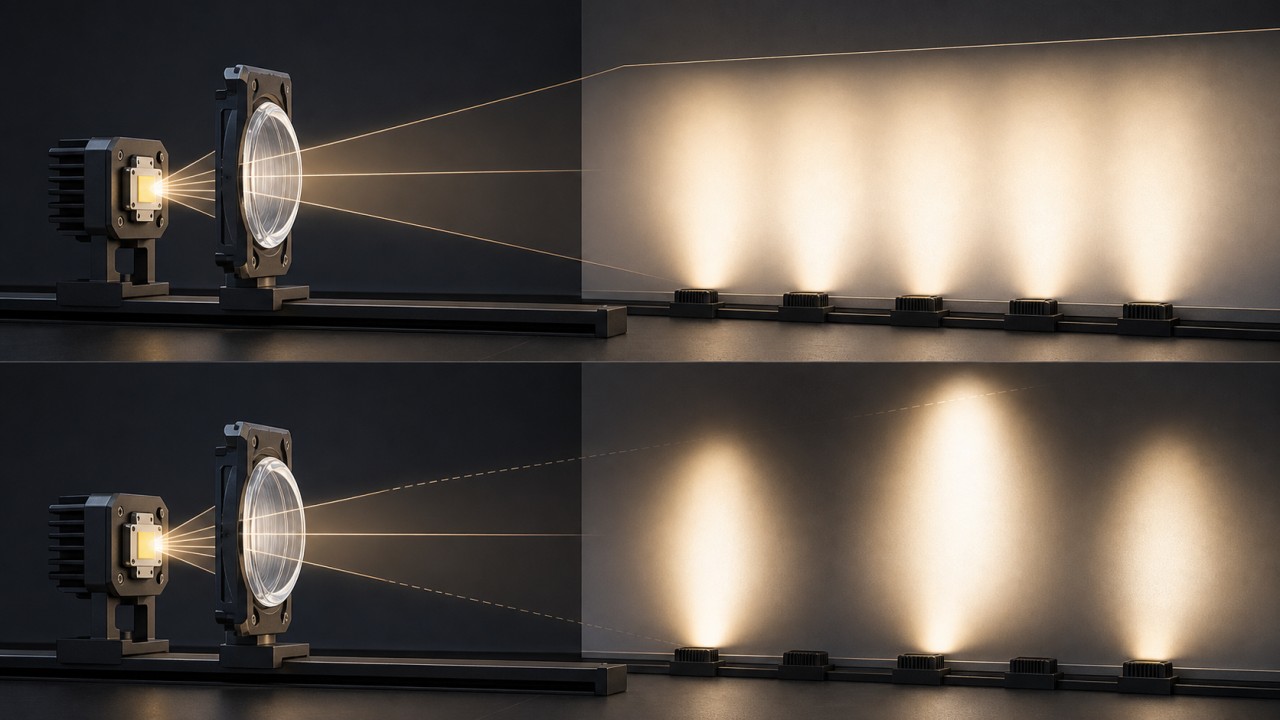
Focal-length error in a glass lens directly affects beam angle, center intensity, and beam-edge quality. The error can come from curvature radius, thickness, refractive index, assembly distance, and the position of the LED emitting surface. If the focal length becomes shorter or the LED shifts away from the focal point, the beam may widen and center intensity may drop. If the focal length becomes longer or the LED is positioned incorrectly, the beam may narrow and create hot spots.
The amount of deviation depends on the lens design and mounting distance, so there is no single universal number. Narrow-beam spotlights are more sensitive. For a 10-15 degree lens, a small focal or assembly error can shift the beam by several degrees and noticeably change center intensity. Wider beams such as 40-60 degrees are more tolerant. Wall washers are especially sensitive because the wall magnifies edge defects and unevenness. Focal error can cause inconsistent throw height, uneven scallops, bright-dark bands, and secondary spots.
Control methods include precision molds, curvature inspection, refractive-index batch control, tight LED-to-lens positioning tolerance, foolproof locating features, and complete luminaire photometric testing. Wall washers should be tested on an actual wall at the specified distance, checking start line, uniformity, edge transition, and overlap between adjacent fixtures. For projects, lens data alone is not enough; the complete luminaire optical effect must be verified.
What optical design methods do low-glare luminaires use besides relying on a glass cover?
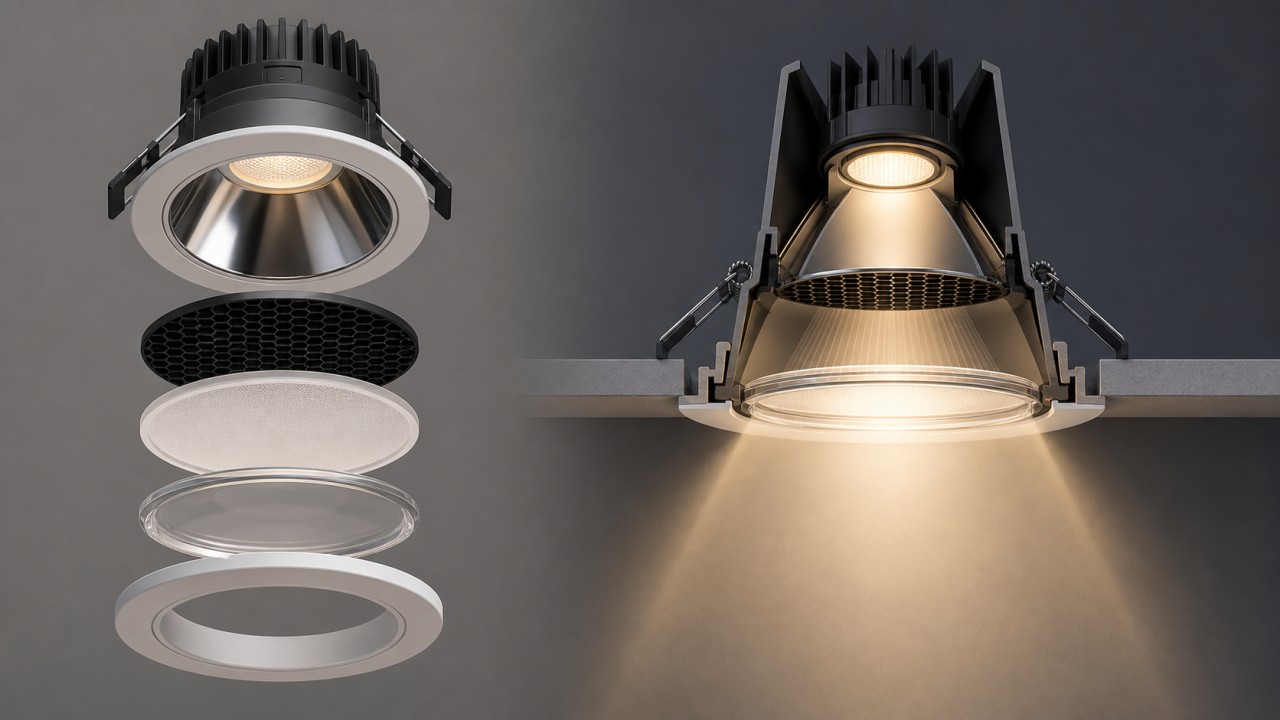
Low-glare design cannot rely only on a frosted glass cover. A frosted cover reduces source clarity, but if the emitting surface remains very bright or faces the eyes directly, glare still exists. True low-glare lighting needs multiple optical strategies.
Common methods include recessing the light source so the LED sits behind a cut-off angle; using reflectors or lenses to control the beam; adding honeycomb grids, louvers, shielding rings, black cups, or low-brightness apertures to reduce high-angle light; using micro-prisms, light guides, or secondary diffusion to turn bright points into a uniform surface; and applying matte black treatment inside the fixture to absorb stray light.
Installation and dimming also matter. Spotlights should not aim directly into common viewing directions. Wall washers should control reflected glare. Dining pendants should shield the direct view of the bulb where needed. Dimming can reduce brightness for different scenes, but it cannot replace optical glare control. A good low-glare luminaire controls source luminance, beam angle, reflection paths, fixture position, and surrounding brightness together.
Color consistency
Control visible variation across multi-lamp installations and production batches.
What is SDCM, and why is it important for color consistency in multi-lamp spaces?
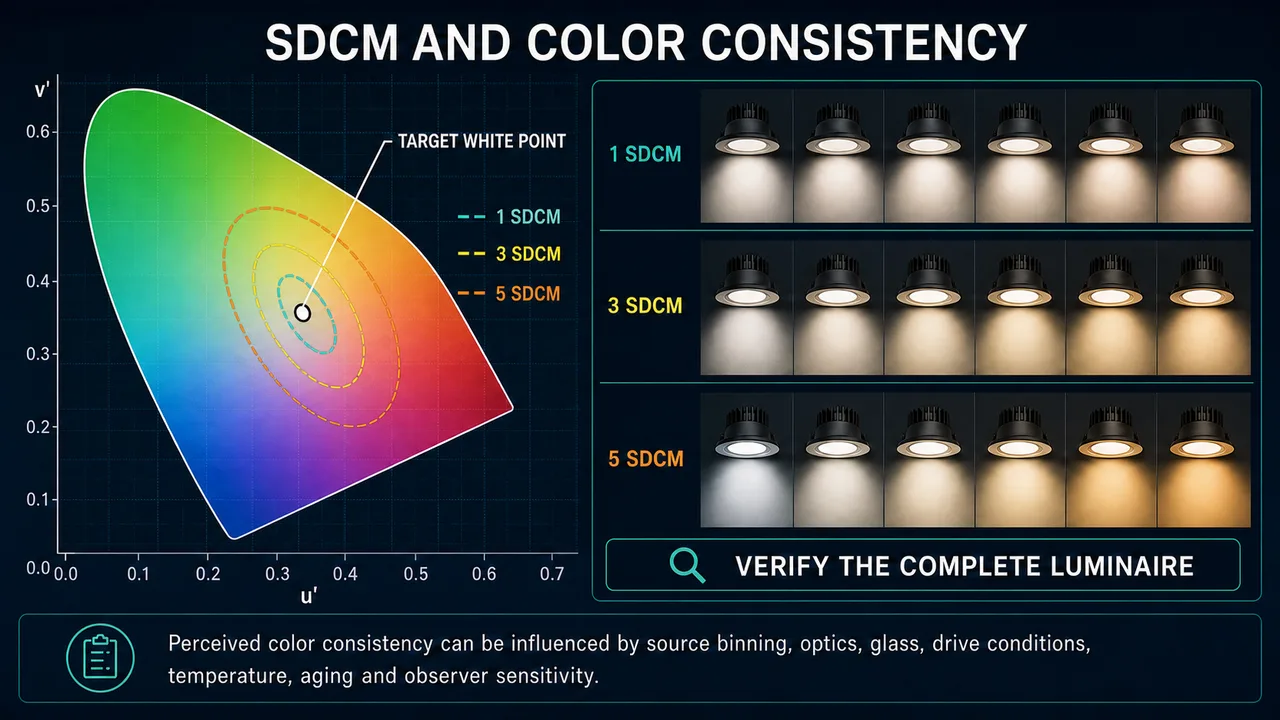
SDCM is commonly used to describe chromaticity variation in MacAdam-ellipse steps under defined measurement conditions. Smaller step values generally indicate tighter colour matching, but perceived differences also depend on luminance, adaptation, observer sensitivity, viewing angle, surrounding colours, optical materials, temperature, dimming level, and aging.
An SDCM target of 3 or lower is often used as a procurement starting point for luminaires installed together, while visually critical adjacent arrays may justify a tighter target. These values do not guarantee that every luminaire will look identical from every angle. LED binning, driver current, thermal conditions, glass spectral transmission, coatings, assembly tolerances, and batch drift can all change the apparent colour of the finished luminaire.
The specification should identify the reference chromaticity, measurement instrument and geometry, operating temperature and stabilization time, drive condition, sample quantity, batch-mixing rule, initial tolerance, and any maintained-colour requirement after aging. Approve a representative multi-luminaire installation or viewing board when visible consistency is commercially important.
Contact Us
Your feedback fuels our growth, and your questions drive our solutions.
We value your feedback, inquiries, and suggestions. Please feel free to get in touch with us
General inquiries
Please contact us via sales@bo-glass.com, and we will reply to you as soon as possible.
Interested to work with us
Drop your resume at info@bo-glass.com
and we will get back to you shortly.
We uses the contact information you provide to us to contact you about our relevent content, products, and services.