
Glass Cutting Process Guide
Welcome to the Glass Cutting Process Guide. This guide is designed to provide you with a systematic breakdown of the core technologies involved in the precision process of glass cutting.
This guide explains how both processes work, where each one is most useful, what affects cutting quality and cost, and what information is needed to evaluate a custom glass component.
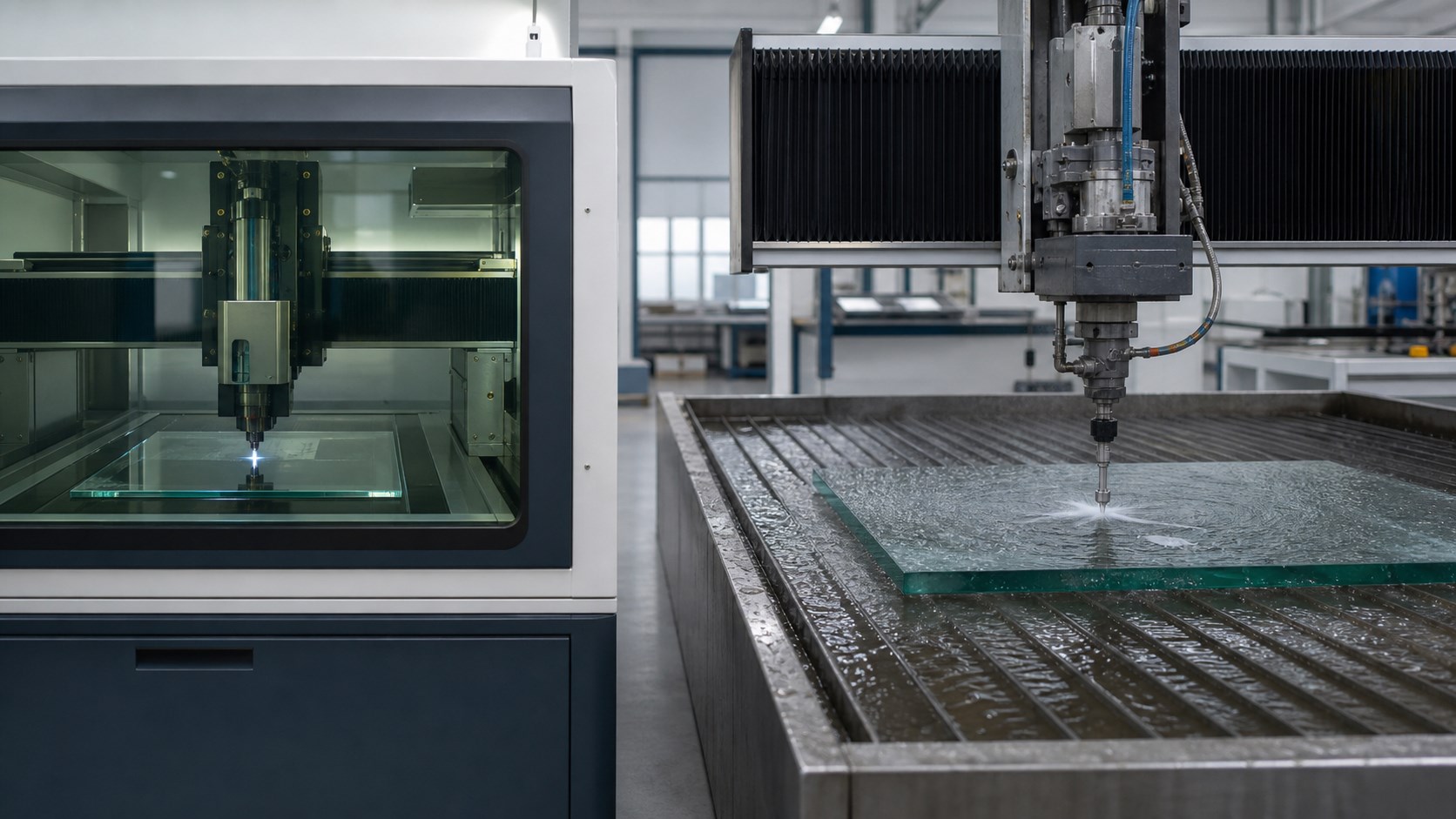
What Is Precision Glass Cutting?
Precision glass cutting is the controlled separation, profiling, slotting, or drilling of glass to produce a defined geometry and dimensional tolerance. Unlike conventional score-and-break methods, CNC laser and abrasive waterjet systems can follow programmed paths and create irregular profiles or internal features.
Industrial glass can also be processed by mechanical scoring and breaking, diamond saw cutting, CNC routing, grinding, and other specialized methods. This guide compares two CNC-based methods used for complex profiles and precision components: laser cutting and abrasive waterjet cutting.
Laser processing uses concentrated optical energy to initiate a controlled crack, remove material, or modify a narrow region inside the glass. Abrasive waterjet cutting uses the kinetic energy of a high-pressure water stream carrying abrasive particles to erode a kerf through the workpiece.
For a buyer, “precision” should describe a qualified result rather than a machine label. The drawing should define the profile, holes, minimum radii, dimensional and geometric tolerances, acceptable edge chips, surface condition, and any required secondary finishing. These requirements determine whether laser, waterjet, mechanical cutting, grinding, or a combined route is the most practical choice.
Important: process feasibility must be confirmed for the exact glass composition and condition. Annealed, chemically strengthened, heat-strengthened, tempered, laminated, coated, and optical glasses can respond differently. Fully tempered glass normally cannot be conventionally cut after tempering without losing structural integrity.
How Does Laser Glass Cutting Work?
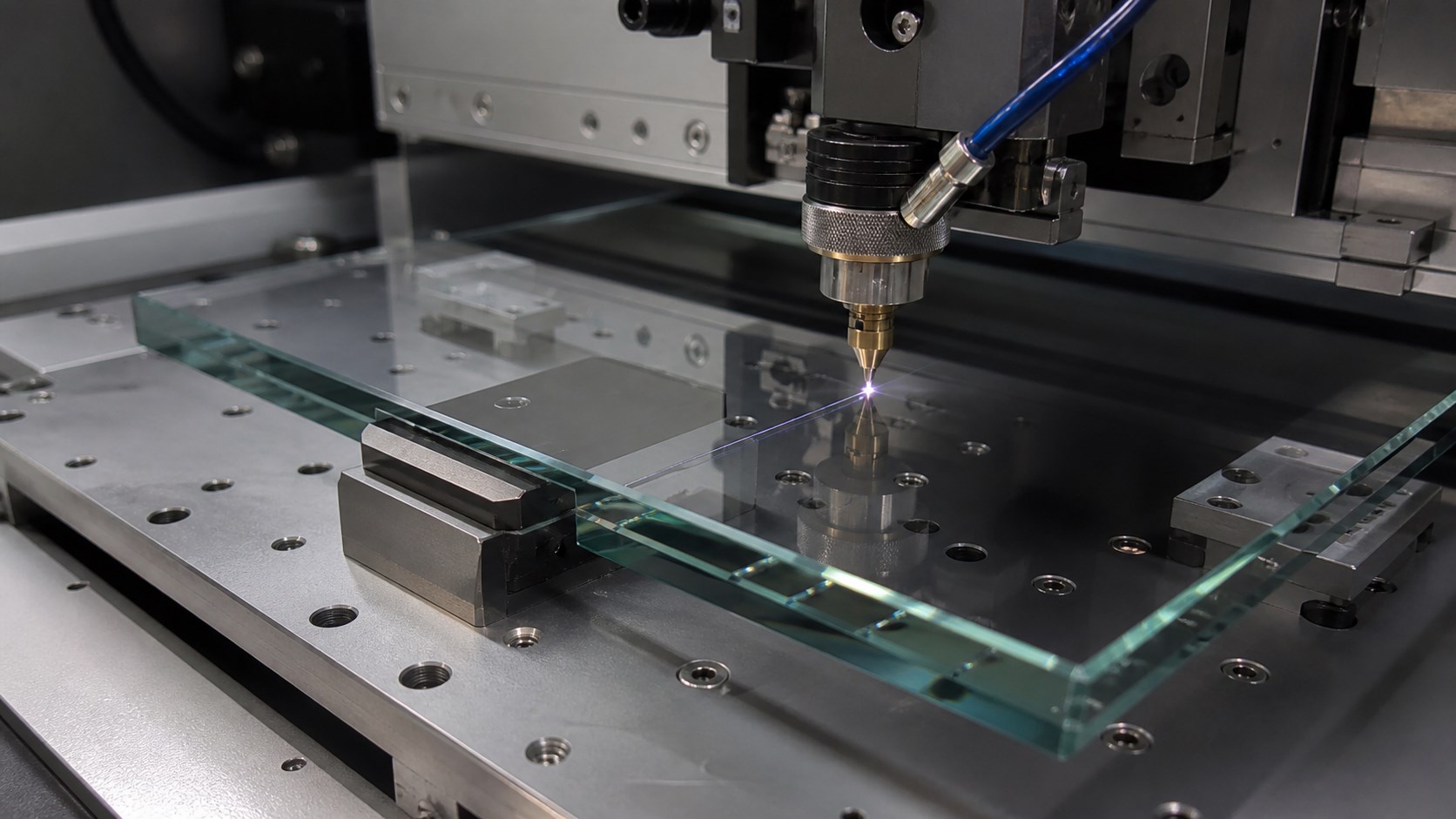
“Laser cutting” is not one process. Industrial systems use different wavelengths, pulse durations, beam shapes, and separation methods. This is why heat-affected zone, edge quality, thickness capability, and allowable glass types vary from one laser process to another.
CO₂ Thermal-Stress Cutting
A CO₂ laser heats a narrow path because its wavelength is readily absorbed near the surface of many glasses. Controlled cooling behind the beam creates a temperature gradient and tensile stress, guiding a crack along the programmed line. Because separation follows a crack rather than a fully ablated kerf, this method can deliver clean edges when the material, path, and process window are suitable.
Thermal-stress separation is often best for thin glass and relatively continuous contours. Tight internal corners, small holes, residual stress, edge defects, and incompatible coatings may increase breakage risk.
Ultrafast Laser Ablation
Picosecond and femtosecond pulses deposit energy over extremely short timescales. Nonlinear absorption can remove small volumes of transparent material with a much smaller heat-affected region than conventional long-pulse processing. The method is well suited to micro-holes, narrow slots, precision trimming, and other small features, although throughput falls as the volume of material to be removed increases.
Internal Modification and Controlled Cleaving
A focused ultrafast beam can create a continuous modified zone inside transparent glass. A subsequent mechanical or thermal step then separates the part along that weakened plane. This approach can produce a narrow effective cut path and high repeatability, but it requires a compatible material, accessible optical path, and carefully controlled separation step.
Applications and limitations: Laser suitability depends on glass composition, thickness, strengthening condition, coating structure, part geometry, and laser configuration. Soda-lime, borosilicate, aluminosilicate, fused silica, and chemically strengthened glass may require different wavelengths, pulse durations, beam-delivery strategies, and separation methods. Typical applications include thin display glass, optical components, sensors, microfluidic devices, narrow slots, small holes, and repeat-volume precision parts.
With a suitable laser source, beam-shaping system, and validated parameters, laser cutting can produce a narrow cut path and high-quality edges with limited micro-chipping. Grinding or polishing may still be required. Minimum feature sizes and internal radii are limited by the effective beam and process geometry. Ablation can also generate fine particles, fumes, and redeposited debris, so suitable extraction and cleaning may be required.
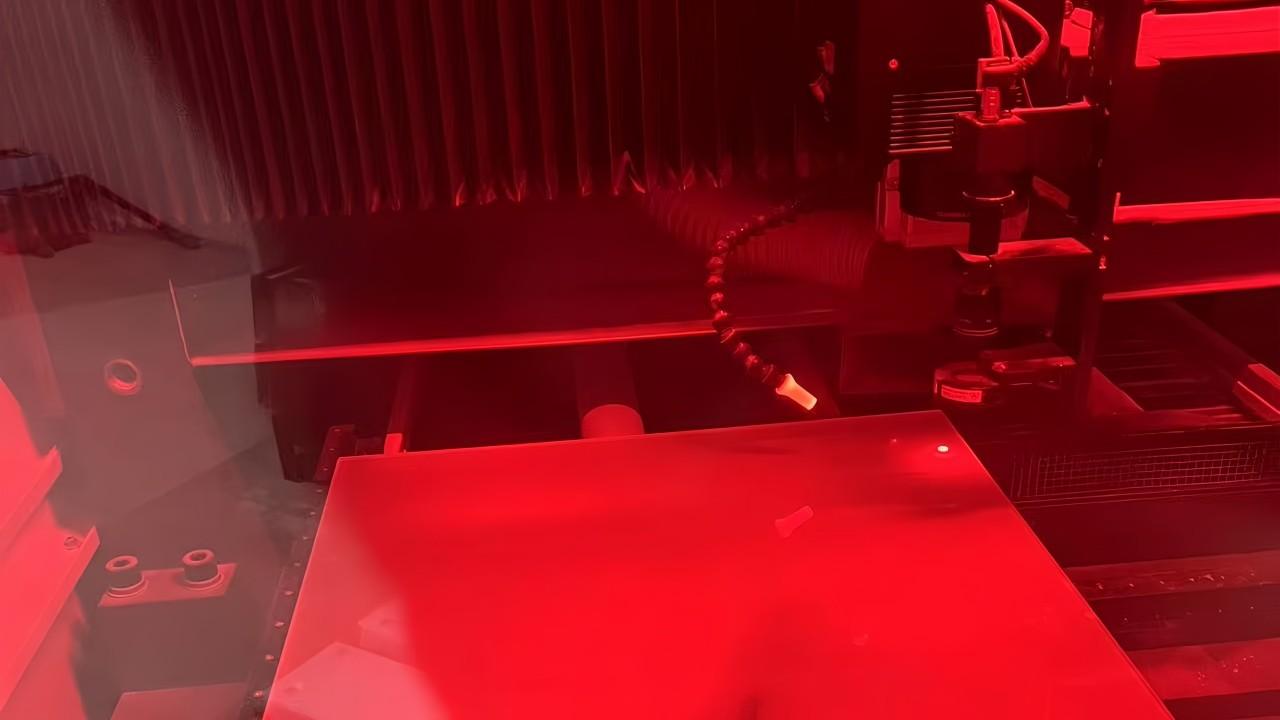
How Does Abrasive Waterjet Glass Cutting Work?
Waterjet Pressure and Abrasive Delivery
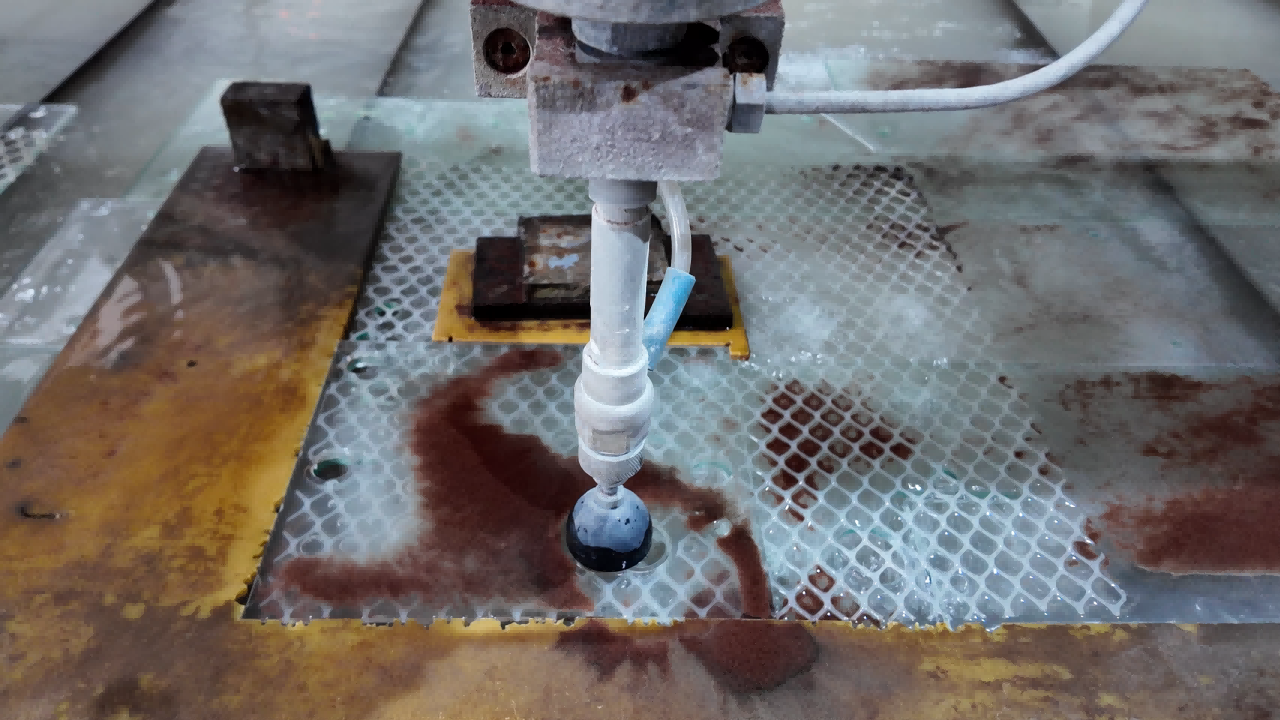
An abrasive waterjet system pressurizes water and passes it through a small orifice to produce a supersonic stream. Abrasive—commonly garnet—is introduced in a mixing chamber and accelerated through a focusing tube. Industrial glass profiling normally uses an abrasive waterjet rather than a pure-water jet.
How Abrasive Erosion Removes Glass
The high-speed abrasive particles remove glass through repeated impact, micro-cutting, and brittle fracture. The process creates an actual kerf and does not rely on bulk heating. It can be effective for annealed glass, laminated constructions, thick sections, large panels, and irregular profiles.

Piercing and Toolpath Control
Interior profiles are possible, but the piercing strategy must be selected carefully. Low-pressure or ramped piercing, scrap-area lead-ins, edge starts, or pre-drilled pilot holes may be used to reduce cracking risk. Cut speed, abrasive flow, standoff distance, nozzle condition, and machine motion influence taper, striation, edge roughness, chipping, and dimensional accuracy.
Taper and Edge Quality
Abrasive waterjet is a cold-cutting process that does not create a conventional heat-affected zone, thermal distortion, or a phase change caused by cutting heat. It still applies mechanical force: unsuitable piercing pressure, fixturing, support, or toolpath settings can cause localized cracking, edge chipping, or exit-side damage.
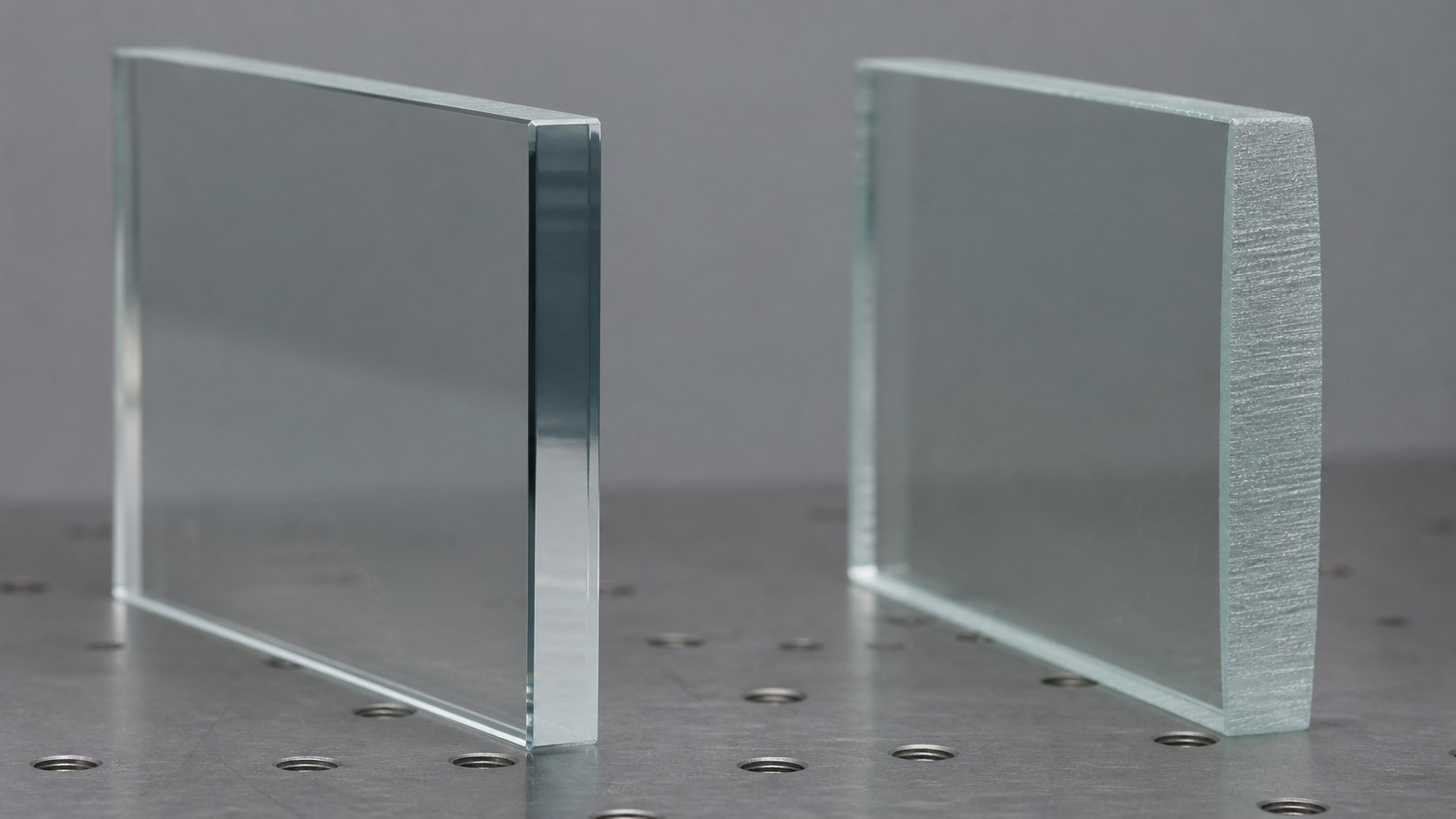
The kerf is generally wider than a laser cut path, and minimum internal radii are limited by the jet diameter and motion strategy. The edge normally has a matte or frosted texture and may require grinding or polishing for transparent, cosmetic, sealing, or strength-critical applications. Practical thickness limits depend on pump pressure, nozzle configuration, glass type, tolerance, edge requirement, geometry, and cutting time. Fully tempered glass should not be cut, drilled, or edge-trimmed by waterjet; profiles and holes should normally be completed before tempering.
Laser vs Waterjet Glass Cutting Comparison
In general, laser cutting prioritizes precision and small features, while abrasive waterjet cutting prioritizes thickness capability and material flexibility. The table is a selection guide rather than a substitute for material and drawing review.
| Comparison | Laser Cutting | Abrasive Waterjet |
|---|---|---|
| Best suited for | Thin precision parts, narrow kerfs, microfeatures, and repeat production | Thick glass, laminated glass, large panels, and frequently changing profiles |
| Suitable glass types | Depends strongly on composition, strengthening condition, coating, and laser configuration | Broad range of annealed and laminated glasses; coatings and interlayers require review |
| Thickness capability | Commonly selected for thinner precision parts; qualified range is process-specific | Often suitable for significantly thicker sections; practical limit is machine- and quality-dependent |
| Cutting tolerance | Potentially tight after material and geometry qualification | Project-specific; thickness, taper, speed, and nozzle condition are important |
| Kerf width | Generally narrower; some separation methods create no conventional open kerf | Generally wider and determined by the nozzle, abrasive stream, and process settings |
| Internal holes | Possible when hole size, glass condition, and laser method are compatible | Possible with a qualified low-risk piercing, lead-in, or pilot-hole strategy |
| Minimum internal radius | Limited by beam delivery, separation method, thickness, and crack control | Limited by effective jet diameter, thickness, and toolpath strategy |
| Edge taper | Typically low with suitable optics and parameters, but not universally zero | Possible; slower cutting and dynamic taper compensation may reduce it |
| Heat-affected zone | Process-dependent; limited with a properly selected ultrafast process | No conventional heat-affected zone, but mechanical damage remains possible |
| Edge finishing | May or may not be required, depending on the method and final edge specification | Depends on cut quality and whether a transparent, cosmetic, or strength-critical edge is required |
| Production speed | Often efficient for thin, repeated precision parts; ablation time rises with removed volume | Falls as thickness, path length, and edge-quality requirements increase |
| Prototype suitability | Good when the material-process combination is already qualified | Good for varied profiles because dedicated cutting tooling is usually unnecessary |
| Batch production suitability | Strong repeatability after process qualification and stable fixturing | Suitable with controlled nozzle wear, abrasive flow, fixturing, and inspection |
| Main limitation | Material compatibility, thickness, and process-development requirements | Piercing risk, taper, wider kerf, and possible secondary edge finishing |
| Relative cost | No universal cost advantage; setup, laser time, qualification, and inspection matter | No universal cost advantage; cutting time, abrasive, wear parts, and finishing matter |
What Types of Glass Can Be Cut?
Material names alone do not determine cutability. Composition, manufacturing history, residual stress, strengthening method, coating, interlayer, thickness, geometry, and edge acceptance criteria must all be reviewed. For a broader material overview, see the BO-Glass glass materials guide.
| Glass Type | Main Cutting Consideration |
|---|---|
| Soda-lime glass | Residual stress, piercing damage, and edge chipping |
| Borosilicate glass | Thermal response, micro-chipping, and final edge strength |
| Quartz glass and fused silica | Subsurface damage, cleanliness, and optical-edge requirements |
| Laminated glass | Interlayer delamination, water exposure, and exit condition |
| Coated glass | Coating damage, contamination, and the required edge keep-out zone |
| Chemically strengthened glass | Compressive-layer depth, residual stress, and separation stability |
| Fully tempered glass | Cutting, drilling, and edge shaping should normally be completed before tempering |
Soda-Lime Glass
Annealed soda-lime glass can be processed by several cutting methods. Laser feasibility depends on the selected wavelength and separation strategy; abrasive waterjet feasibility depends heavily on piercing, support, and edge-quality requirements.
Borosilicate Glass
Borosilicate glass is used for laboratory, lighting, thermal, and technical components. Its composition and low thermal expansion influence laser parameters, while waterjet settings must be selected to limit chipping and taper. See the custom borosilicate glass fabrication page for related material and design information.
Quartz Glass and Fused Silica
Quartz and fused silica are candidates for specialized laser and abrasive processes, but optical quality, subsurface damage, cleanliness, and post-cut polishing requirements often determine the final route.
Optical Glass
Optical glasses vary widely in composition and value. Material-specific trials, contamination control, edge inspection, and careful handling are usually required before production. Related applications are shown on the optical windows and viewports page.
Laminated Glass
Abrasive waterjet can profile some laminated constructions, but the interlayer, water exposure, exit condition, and risk of delamination must be evaluated. Laser suitability depends on the absorption and thermal response of every layer.
Coated Glass
Coatings may absorb laser energy, reflect it, contaminate optics, or be damaged near the cut. Waterjet impact and moisture can also lift or mark a coating. The coating type, coated side, keep-out zone, and cosmetic criteria should be included in the drawing review.
Chemically Strengthened Glass
Chemically strengthened glass contains a compressive surface layer. Some laser processes can machine compatible strengthened glass, but feasibility depends on stress depth, geometry, and laser strategy. It should not be treated as equivalent to annealed glass.
Fully Tempered Glass
Cutting, drilling, and edge shaping should normally be completed before thermal glass tempering. Fully tempered glass is generally unsuitable for conventional waterjet cutting because releasing the internal stress can cause complete breakage. Chemically strengthened parts follow a different process; see the chemical glass strengthening service. Any proposed post-strengthening process requires specialist review and validation.
Design Limits to Confirm Before Glass Cutting
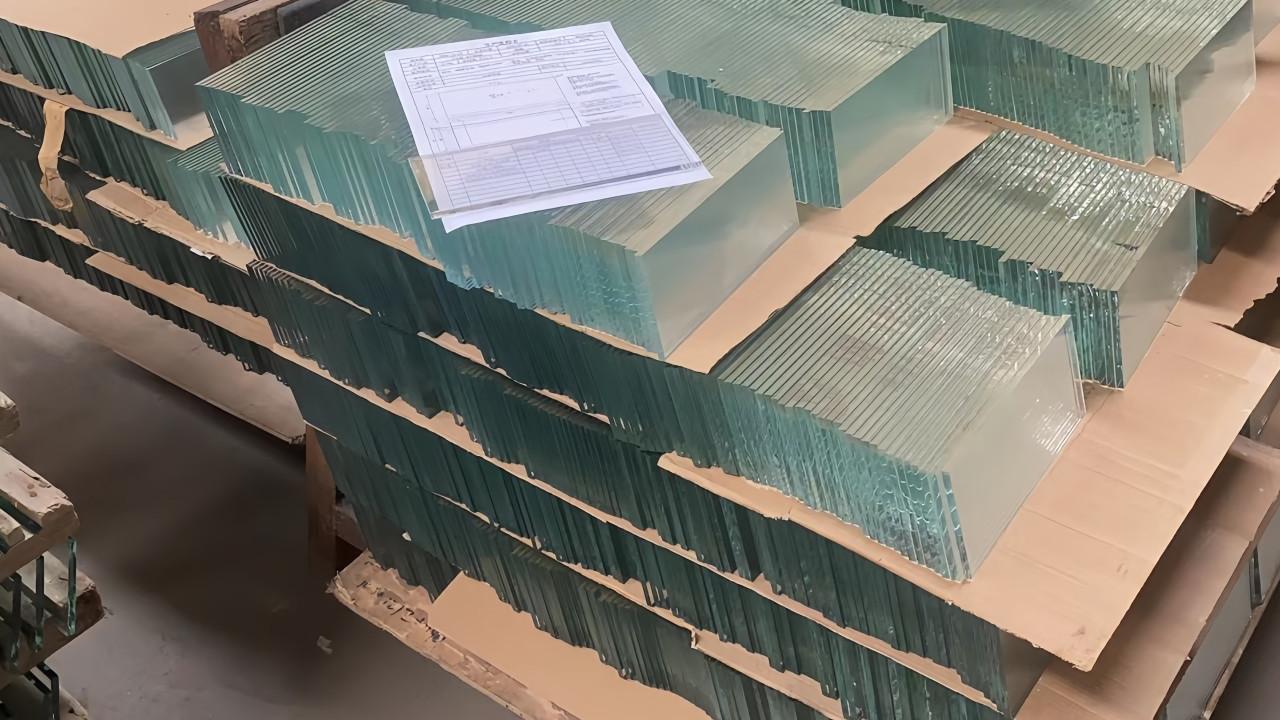
Thickness range, smallest hole diameter, minimum internal radius, maximum part size, and available edge finishing depend on the selected equipment and the exact glass specification. These values are confirmed during drawing review rather than presented as universal limits.
Laser cutting is generally considered first for narrow cut paths and small features in compatible thin glass. Abrasive waterjet is generally considered for thicker sections, large profiles, and laminated constructions. Hole feasibility also depends on the distance from the edge, the surrounding material, and—in waterjet cutting—the available piercing or lead-in strategy. See the BO-Glass drilling and machining resources for related process information.
Glass Cutting Tolerances and Edge Quality
What Determines Glass Cutting Tolerance?
Tolerance depends on glass type, thickness, overall part size, contour length, minimum feature size, material stress, fixturing, machine condition, and inspection method. Hole diameter and position tolerance may differ from the external profile tolerance. Cutting tolerance is confirmed according to the glass type, thickness, part size, geometry, and inspection method. A representative sample may be required before batch production.
Laser-Cut Edge Quality
Depending on the method, laser-cut glass may show micro-chipping, residual stress, recast or redeposited debris, or localized thermal damage. Internal-modification processes have different edge characteristics from ablation and thermal-stress separation, so one finish claim should not be applied to every laser process.
Waterjet-Cut Edge Quality
Waterjet edges may show taper, vertical striations, a matte texture, top-edge rounding, localized piercing damage, or exit-side chipping. Nozzle condition, standoff, abrasive flow, traverse speed, support, and taper compensation all affect the result.
When Is Edge Finishing Required?
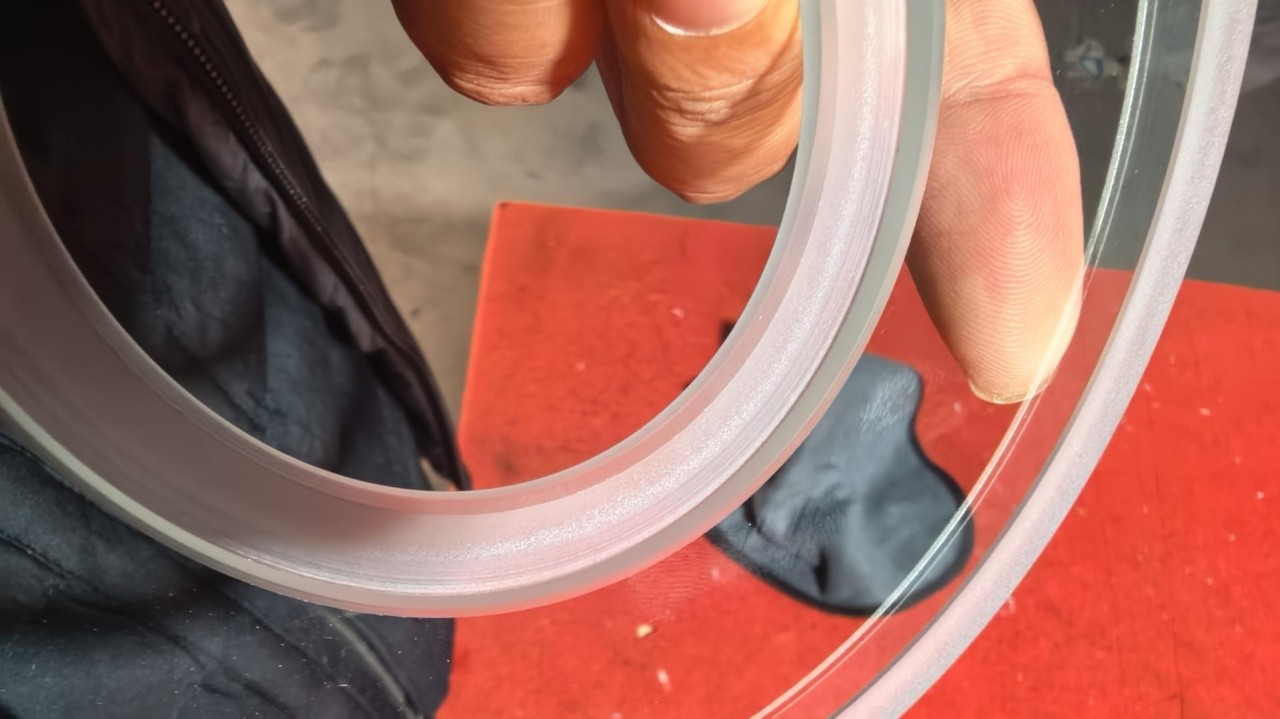
Grinding, arrissing, or polishing may be required when the edge is visible, optically functional, used for sealing, exposed to high stress, or subject to a defined chip limit. The required edge condition should be specified separately from dimensional tolerance. The glass edge grinding and polishing guide explains common finish levels and acceptance considerations.
How to Select the Right Cutting Process
Choose Laser Cutting When
- The part is thin, fragile, or requires a narrow cut path and small features.
- Non-contact processing and repeatability are more important than rapid removal of a large material volume.
- The glass composition and condition have already been qualified for the proposed laser method.
- Production volume can justify process development and equipment cost.
Choose Abrasive Waterjet When
- The material is thick, laminated, or difficult to process thermally.
- The part has a large or frequently changing profile and tooling flexibility matters.
- A heat-affected zone is unacceptable.
- A controlled piercing strategy and any required edge finishing can be included in the process plan.
Common Glass Cutting Problems and Solutions
Use the likely cause as a starting point, then validate the corrective action on representative glass before changing a production process.
| Problem | Likely Causes | Recommended Controls |
|---|---|---|
| Laser edge micro-cracks | Excess energy, residual stress, unstable cooling, contamination, or an edge defect | Adjust energy and scan speed, control cooling, inspect incoming glass, and define a measurable crack limit |
| Recast or redeposited debris | Incorrect focus, extraction, pulse overlap, energy density, or scan strategy | Optimize focus and pulse settings, improve extraction, inspect optics, and qualify the cleaning method |
| Waterjet taper | High traverse speed, nozzle wear, excessive standoff, or unsuitable abrasive flow | Reduce speed, maintain the nozzle, minimize standoff, and use taper compensation where available |
| Piercing cracks | Excessive starting pressure, poor support, or piercing too close to the finished edge | Use ramped piercing, start in scrap material or from an edge, and add suitable sacrificial backing |
| Exit-side chipping | Inadequate backing, vibration, excessive remaining jet energy, or an unsuitable lead-out | Improve support, adjust traverse and lead-out settings, and define separate exit-side acceptance limits |
| Batch dimensional variation | Machine drift, nozzle or optical wear, fixture movement, material variation, or inconsistent inspection | Calibrate equipment, control wear and fixturing, approve a first article, and retain the qualified process record |
What Affects the Cost of Laser and Waterjet Glass Cutting?
Part and Order Requirements
Pricing is driven by the part and its acceptance requirements rather than by machine type alone. The main factors are:
- Glass type and strengthening condition: these determine process compatibility and whether sample validation is required.
- Thickness and overall dimensions: thicker or larger parts generally increase cutting and handling time.
- Holes and contour complexity: the number and diameter of holes, path length, small internal radii, and closely spaced features affect cycle time and risk.
- Tolerances: tighter dimensional or geometric requirements may require slower cutting, qualification, and additional inspection.
- Edge finish: grinding, polishing, arrissing, or cosmetic edge requirements add secondary operations.
- Coatings and laminates: multilayer structures may require special handling, trials, cleaning, or protection.
- Order quantity: programming and qualification are distributed differently across prototype and repeat-production orders.
- Inspection and packaging: measurement reports, traceability, cleaning, protective packaging, and shipping requirements affect total cost.
Laser Cutting Cost Factors
Laser quotations may include programming and setup, sample qualification, laser operating time, equipment depreciation, optical-component maintenance, extraction and cleaning, inspection, and any secondary edge finishing. The balance changes with the laser process and production volume.
Abrasive Waterjet Cost Factors
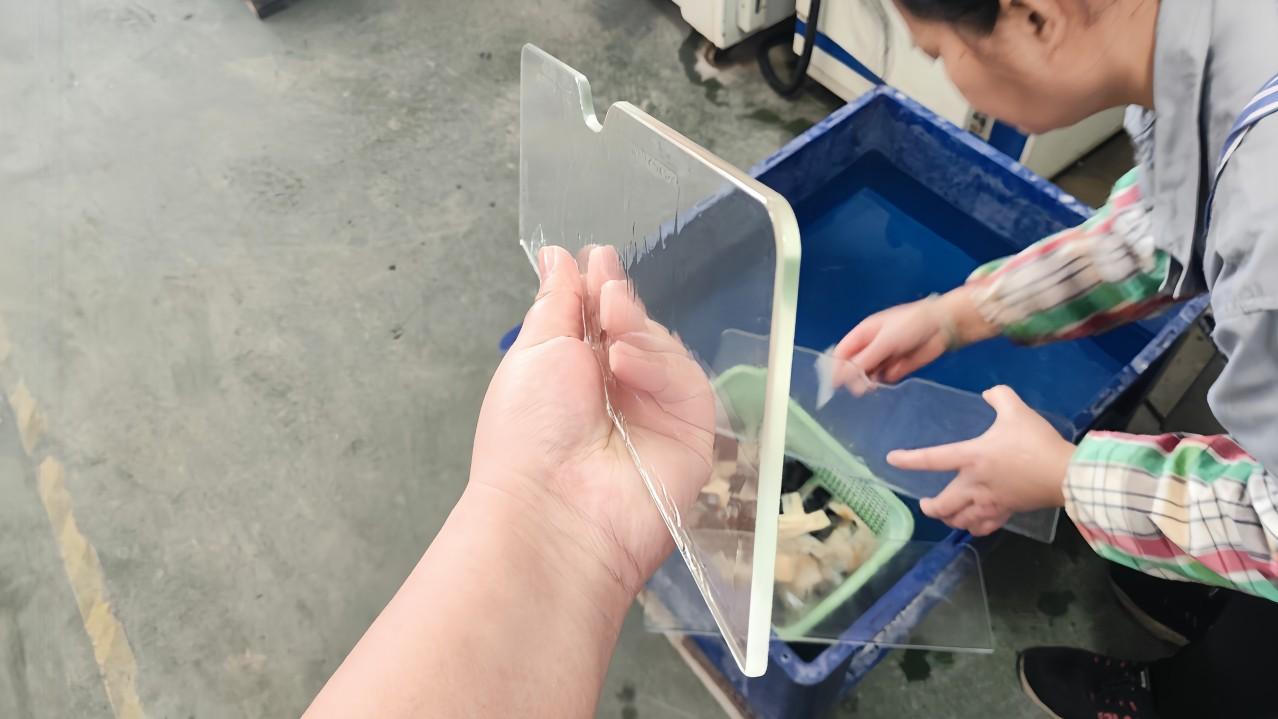
Waterjet quotations may include cutting time, abrasive consumption, pump and nozzle wear, water treatment, drying and cleaning, sludge treatment, inspection, and secondary finishing. Abrasive consumption is one of the principal variable costs, and its impact generally increases with thickness, cutting time, pressure, and edge-quality requirements.
Is Laser or Waterjet Glass Cutting More Cost-Effective?
Neither process is always cheaper. Laser cutting may provide a lower unit cost for qualified thin parts produced in repeat volumes, especially when narrow kerfs and minimal secondary finishing are required. Waterjet cutting may be more economical for prototypes, thick glass, large irregular profiles, and projects that do not justify extensive laser-process development. The final cost depends on cutting time, setup, material risk, edge finishing, inspection, and order quantity.
BO-Glass Project Experience and Case Studies
General process guidance is only a starting point. Real projects also involve application-specific material selection, geometry changes, secondary finishing, inspection criteria, packaging, and the transition from samples to repeat production.
The BO-Glass glass fabrication case studies provide a direct route to project examples across lighting, aerospace and airfield applications, industrial equipment, electronics, healthcare, specialty glass, and other custom manufacturing fields. Use these examples together with the technical guidance on this page when preparing a new drawing or request for quotation.
How BO-Glass Evaluates Custom-Cut Glass Components
As a custom technical glass manufacturer, BO-Glass evaluates the drawing and coordinates the appropriate cutting and secondary-finishing process through qualified production resources. The available laser configuration, waterjet route, production location, and any partner processing are confirmed for the specific quotation rather than assumed from the general technologies described in this guide.
A typical custom project follows a controlled sequence so that process selection and acceptance criteria are agreed before batch production:
- Drawing and material review: confirm the glass composition, strengthening condition, coating or laminate, dimensions, tolerances, and application.
- Process selection: evaluate laser cutting, abrasive waterjet cutting, or a combined machining route against the geometry and edge requirements.
- Sample cutting: qualify the material, piercing or separation strategy, fixturing, and process window on representative blanks.
- Edge inspection: check micro-chipping, cracks, taper, striations, debris, coating damage, and any specified cosmetic limits.
- Dimensional measurement: inspect the profile, holes, internal radii, and other drawing characteristics using the agreed method.
- Batch parameter control: approve a first article, monitor equipment and wear condition, and apply the documented inspection frequency.
- Cleaning and protective packaging: remove process residue with a compatible method and protect finished surfaces and edges for shipment.
Frequently Asked Questions
Can a Waterjet Cut Tempered Glass?
Fully thermally tempered glass is generally unsuitable for conventional abrasive waterjet cutting. Cutting or drilling releases the locked-in stress and can cause the entire panel to fragment. Profiles, holes, and edge shaping should normally be completed before tempering. Chemically strengthened glass behaves differently, but its compressive-layer depth and the proposed cutting method still require project-specific review.
Which Method Produces a Smoother Glass Edge?
A qualified laser process can produce a narrow cut path and high-quality edge on compatible thin glass, while abrasive waterjet commonly leaves a matte edge with possible taper or striations. Neither method guarantees a finished optical or strength-critical edge. Glass type, thickness, process settings, and acceptance criteria determine whether subsequent grinding, arrissing, or polishing is required.
Can Laser Cutting Produce Holes Inside Glass?
Yes, some laser configurations can create through-holes, blind features, or modified regions inside transparent glass. Feasibility depends on the laser architecture, absorption mechanism, glass composition, thickness, hole diameter, edge distance, and required surface quality. Ultrafast ablation and internal-modification processes solve different problems, so a drawing and representative material sample may be needed before production.
Is Laser or Waterjet Cutting Better for Thick Glass?
Abrasive waterjet is generally the first process considered for thicker glass because it removes material without a conventional heat-affected zone and can handle a broad thickness range. The practical limit still depends on pressure, nozzle configuration, geometry, cutting time, taper, and edge requirements. Laser processes are commonly favored for thinner precision parts and smaller features.
Does Cut Glass Require Edge Polishing?
Not always. A concealed, non-structural edge may be acceptable as cut when its chip and roughness limits are satisfied. Polishing or grinding is more likely when the edge is visible, used for sealing, optically functional, exposed to mechanical stress, or required to meet a cosmetic specification. Edge finish should therefore be stated separately from dimensional tolerance.
Information Required for a Cutting Quotation
To evaluate a custom glass cutting project, provide:
- a dimensioned 2D drawing and, where useful, a 3D model;
- glass type, supplier, tempering or strengthening condition, coating, and interlayer details;
- overall dimensions, thickness, hole dimensions, internal radii, and edge distances;
- dimensional and geometric tolerances and the intended measurement method;
- edge finish, chip allowance, cosmetic criteria, and strength requirements;
- order quantity, intended application, and delivery requirement;
- inspection reports, cleaning, packaging, and traceability requirements.
Request a process review: Send us your drawing, glass specification, thickness, tolerance, and order quantity. BO-Glass will evaluate whether laser cutting, abrasive waterjet cutting, or a combined machining process is more suitable and confirm the proposed production route.
Contact Us
Discuss Your Custom Glass Project
Share your drawing, photos or dimensions, together with the intended use and target quantity. We will review your requirements and discuss the next steps.
Sales Enquiries
Email sales@bo-glass.com with your part description, intended use and target quantity.
Send Your Design
Use the form to upload a drawing or describe an existing part. Mark critical dimensions and tell us which surfaces or features matter most.
Request a Custom Glass Quote
Upload a drawing or share dimensions, quantity, intended use and finish. Include any heat, pressure or chemical exposure.
Your drawings remain confidential.
We use the contact details you provide to respond to your enquiry. See our Privacy Policy for more information.