
BO-GLASS / MATERIALS & CUSTOM COMPONENTS
Soda-Lime Glass: Properties, Processing and Custom Components
Use material properties, service conditions and critical features to choose a forming route and plan inspection for custom soda-lime glass parts.
Your drawings remain confidential.


Real component photographs. Shape, surface finish and service conditions determine the requirements for each design.

Swipe to view brands ↔
01 / Material fundamentals
What Is Soda-Lime Glass?
Soda-lime glass, also called soda-lime-silica glass, is a family of silicate glasses rather than one universal formulation. Its silica-based structure is modified with sodium and calcium compounds to balance melting, forming and finished-product properties. It is widely used where clarity, workable shapes and production cost matter.
- Silica (SiO2) forms the main glass network. The structure is disordered rather than a repeating crystal lattice.
- Soda (expressed as Na2O in the finished composition) helps reduce processing temperatures. Changing the modifier content also changes properties such as expansion and resistance to water.
- Lime (CaO) helps stabilize the composition. Together with other constituents, it supports useful durability while retaining the ability to form the glass.
Magnesia, alumina, iron and intentional colorants can also be present. Their amounts affect forming behavior, color and durability. A published float-glass composition is an example of a particular product family; it is not a recipe or certificate for every blown or pressed component. For background, see Pilkington's raw-material overview and SCHOTT's introduction to glass structure.
For selection, identify the intended glass specification, color, forming route and finished-part requirements together. The label “soda-lime” alone does not establish optical, thermal or chemical suitability.
02 / Reference data and their limits
Key Properties of Soda-Lime Glass
The following values are a starting point for engineering review. They refer to the soda-lime-silica float glass in Pilkington ATS-129, September 2026, using its general entries rather than its separate Optiwhite™ temperature values. They are not BO-GLASS production specifications. Confirm the selected formulation and finished component before using reference data for a design decision.
| Parameter | Reference value | Material / condition | Engineering meaning | Source |
|---|---|---|---|---|
| Density | 2,500 kg/m³ 2.50 g/cm³ | Float glass; temperature not stated for this entry | Estimate mass from the actual glass volume. | [1] |
| Mean linear thermal expansion | 8.3 × 10⁻⁶ K−1 | Float glass; 75–575°F, approximately 24–302°C | Estimate free dimensional change over a temperature interval. | [1] |
| Thermal conductivity | 0.937 W/(m·K) | Float glass; 75°F, approximately 24°C | Temperature can remain uneven during heating or cooling. | [1] |
| Refractive index | 1.523 | Float glass; 0.5893 µm, sodium D line; temperature not stated | Refraction and interface reflection depend on wavelength. | [1] |
| Softening point | 715°C | Float glass; ASTM C338 | A viscosity-related material reference, not a service-temperature rating. | [1] |
| Annealing point | 548°C | Float glass; ASTM C336 | A reference for stress relaxation during controlled heat treatment. | [1] |
| Strain point | 511°C | Float glass; ASTM C336 | A lower-temperature stress-relaxation reference; time remains important. | [1] |
Float glass reference values. Select a parameter to see its conditions. Source: ATS-129, September 2026.
Density2,500 kg/m³
Equivalent value: 2.50 g/cm³
Condition: Float glass; temperature not stated for this entry
Engineering meaning: Estimate mass from the actual glass volume.
Mean linear thermal expansion8.3 × 10−6 K−1
Condition: Float glass; 75–575°F, approximately 24–302°C
Engineering meaning: Estimate free dimensional change over a temperature interval.
Thermal conductivity0.937 W/(m·K)
Condition: Float glass; 75°F, approximately 24°C
Engineering meaning: Temperature can remain uneven during heating or cooling.
Refractive index1.523
Condition: Float glass; 0.5893 µm, sodium D line; temperature not stated
Engineering meaning: Refraction and interface reflection depend on wavelength.
Softening point715°C
Condition: Float glass; ASTM C338
Engineering meaning: A viscosity-related material reference, not a service-temperature rating.
Annealing point548°C
Condition: Float glass; ASTM C336
Engineering meaning: A reference for stress relaxation during controlled heat treatment.
Strain point511°C
Condition: Float glass; ASTM C336
Engineering meaning: A lower-temperature stress-relaxation reference; time remains important.
03 / Heat, time and restraint
Thermal Behavior and Temperature Limits
A softening point is not a safe operating temperature. It describes viscosity under a defined test. The annealing and strain points describe stress-relaxation behavior at different viscosities; they are not temperature limits for an assembled cover. Duration, temperature distribution, loads and mounting all affect the finished part.
Uniform heating changes size; uneven heating creates competing movement
A freely supported part heated uniformly can expand without the restraint associated with a rigid clamp. A nearby lamp, hot fluid on one side or a cool metal rim can instead produce regions that try to expand by different amounts. The resulting stress depends on the temperature field and constraints, not just the highest measured temperature.
Thickness and the direction of temperature change matter
Under comparable surface heat-transfer conditions, a thicker wall usually takes longer to equalize in temperature. Adding thickness may help a mechanical requirement while increasing a transient inner-to-outer temperature difference. Thick bases, abrupt transitions and local metal contact therefore need review together.
During rapid external cooling, the surface tries to contract before the hotter interior and can develop tensile stress. For a simple wall heated quickly from outside, the surface may initially be in compression while the interior is in tension. Local heating and mounting can place tension elsewhere. Equal nominal temperature changes during heating and cooling do not necessarily create equal breakage risks.
Annealing and strengthening have different purposes
Annealing reduces residual stress left by forming and cooling. Applicable thermal strengthening introduces surface compression to improve resistance to mechanical and thermal stress. Neither makes soda-lime glass a low-expansion material. Feasibility depends on the shape, thickness and process; a treatment available for flat sheet cannot be assumed suitable for every hollow or pressed part.
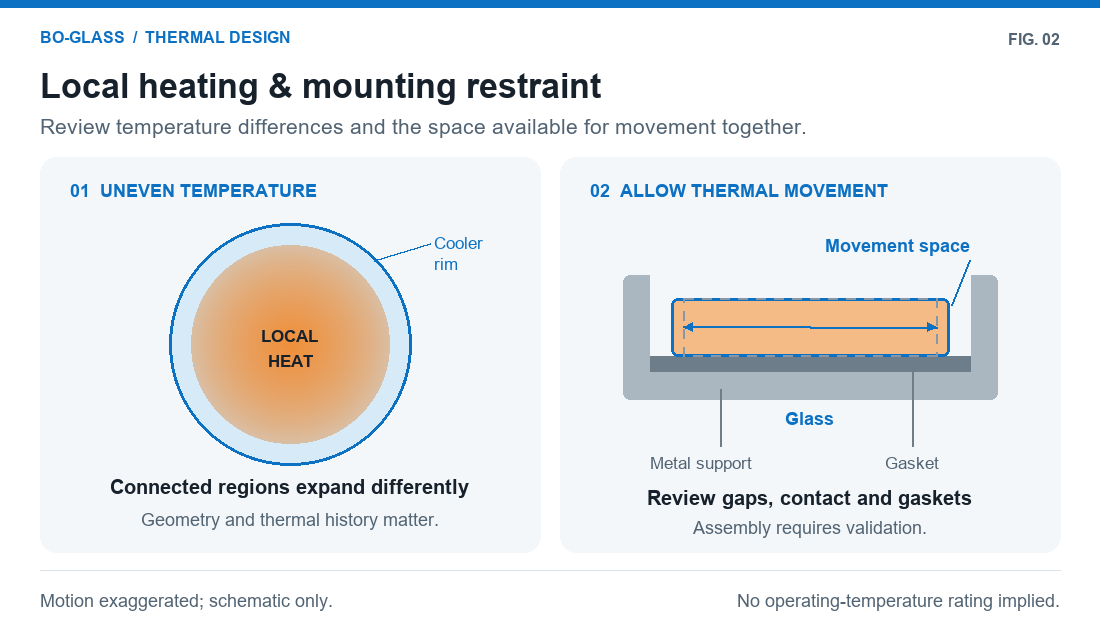
For review, provide temperatures at relevant locations, heating and cooling rates, dwell times, cycles, wall sections, supports, gaskets and loads. Assess lower-expansion materials when the thermal conditions warrant it, and validate representative finished assemblies under agreed conditions. See the guide to thermal expansion, thermal shock and temperature limits.
04 / Light, thickness and appearance
Optical Transmission, Thickness and Color
Light reaching a glass part can be reflected, absorbed or transmitted. The result varies with wavelength, composition, optical path and surface condition. A single transmission percentage without a wavelength range, specimen thickness and measurement setup is therefore incomplete.
At wavelengths absorbed by the material, a longer path through otherwise comparable glass generally increases absorption. Thick rims and curved walls can show a different color or brightness from thinner regions. Iron contributes to the familiar tint of standard clear soda-lime glass; lower-iron compositions can reduce it, but do not eliminate interface reflection. Confirm availability and performance for the intended forming formulation.
- Transmission describes how much incident light passes through under the stated measurement conditions.
- Haze describes scattering within the angular limits of an applicable method. It is different from total transmitted light.
- Clarity and diffusion concern how sharply objects can be seen and how light is redistributed. A bright cover can still obscure an image; a frosted cover may hide a lamp without producing uniform illumination.
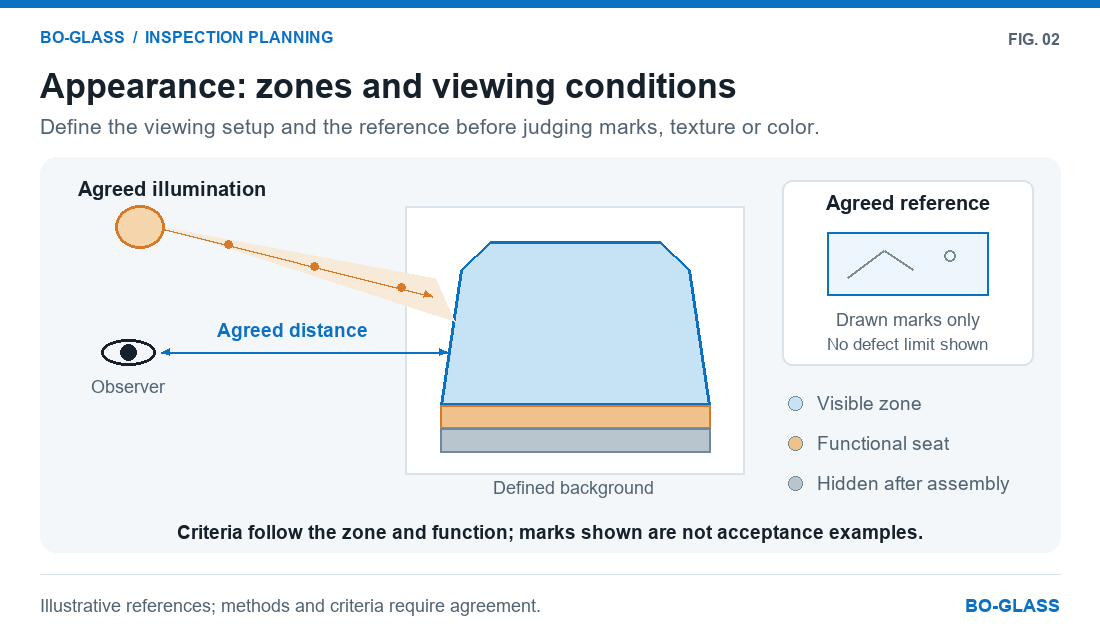
Frosting, texture, coatings and colored or diffusing compositions should be selected around the optical function. Evaluate a lighting cover with the intended source, spacing and viewing conditions. For inspection, define the wavelengths or illuminant, local thickness, measurement area, collection geometry, color reference and acceptable variation. Curved finished parts may need a fixture or assembly-level method rather than a flat-coupon value.
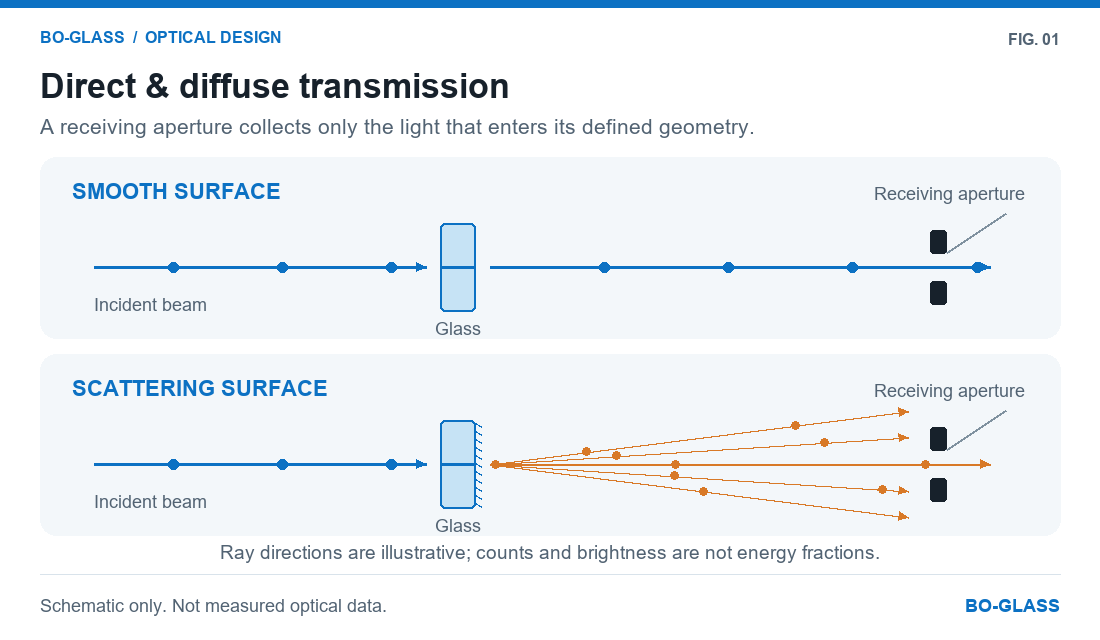
For measurement concepts, see BYK's transparency measurement guide. For component decisions, see our optical transmission, thickness and color guide.
05 / Defects, contact and load
Mechanical Strength and Surface Quality
Glass breaks when the local tensile stress and the condition of a flaw combine unfavorably. Scratches, edge chips, machining damage and sharp features can therefore matter as much as nominal wall thickness. A breaking-strength value from a published specimen test is not an allowable load for an arbitrary component.
Holes, slots, threads and abrupt section changes alter how stress is distributed. Tight metal contact, excessive assembly force or an overcompressed or unsuitable gasket can add local loads; thermal expansion can change those loads in service. Define the contact surfaces and load path, and assess the complete assembly rather than the glass shape alone.
Specify edge and rim condition, permissible marks by functional zone, handling protection and critical assembly dimensions. A polished appearance does not prove that a part has the required strength, and residual-stress observation does not substitute for load or thermal-shock validation. Agree the relevant specimen or finished-component tests where performance is critical.
Annealing addresses manufacturing stress; suitable strengthening can increase the stress a part can withstand, but does not remove the need to control flaws and contact. Treatment, machining sequence and inspection need to be reviewed together. Pilkington ATS-186 discusses heat-treated flat glass and its processing effects; it should not be read as qualification of a custom hollow component.
06 / Media, cleaning and storage
Chemical Durability and Weathering
Chemical suitability depends on the substance, concentration, temperature, contact time and repeated exposure. “Glass” does not establish compatibility with every cleaner, process fluid or outdoor environment. DWK's material guidance distinguishes soda-lime formulations from more hydrolytically resistant borosilicate grades; confirm the actual composition and service conditions.
Moisture trapped against glass during storage can produce alkaline conditions that roughen the surface and create haze. Condensation, repeated wetting and drying, and deposits left on the surface can cause problems that ordinary washing may not reverse. Strong alkaline contamination also needs attention. Pilkington ATS-104 explains these mechanisms for flat glass and gives handling and cleaning guidance.
- For cleaning: establish an approved, compatible procedure for the glass and any coating or decoration. Use clean tools and avoid abrasive grit; evaluate changes in chemicals or cleaning cycles before production use.
- For storage: keep parts dry and protected from condensation, separate contact surfaces appropriately, and avoid trapping moisture in packaging.
- For service: identify fluids, fumes, cleaners and likely residues, including temperatures and exposure cycles. Decide whether acceptable change concerns appearance, transmission, contamination or function.
A coating may help a specific surface requirement but adds its own adhesion, cleaning, wear and temperature limits. Where exposure is demanding, compare suitable alternative materials and test the actual glass, finish and contacting media. A corrosion class for one glass grade or test does not establish complete assembly compatibility.
07 / Forming and finishing
Forming Routes and Secondary Processing
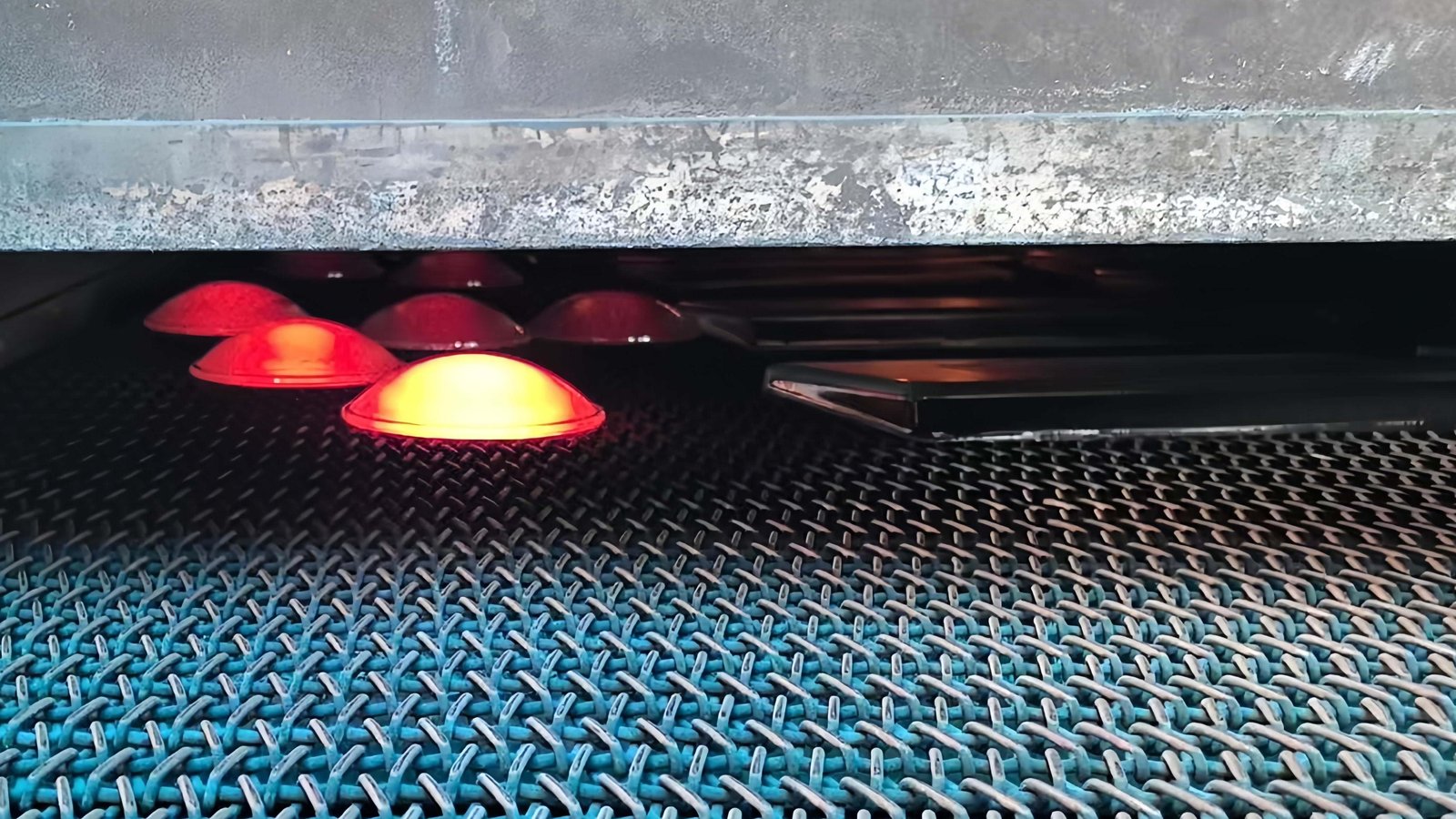
Choose the forming route around the shape and the surfaces that control function. Soda-lime glass can be formed from a melt into a hollow or moulded part, or supplied as float sheet for secondary fabrication. These routes belong to the same broad material family, but they do not offer identical control of wall profile, surface form or dimensions.
| Route | Useful starting shapes | What to review early |
|---|---|---|
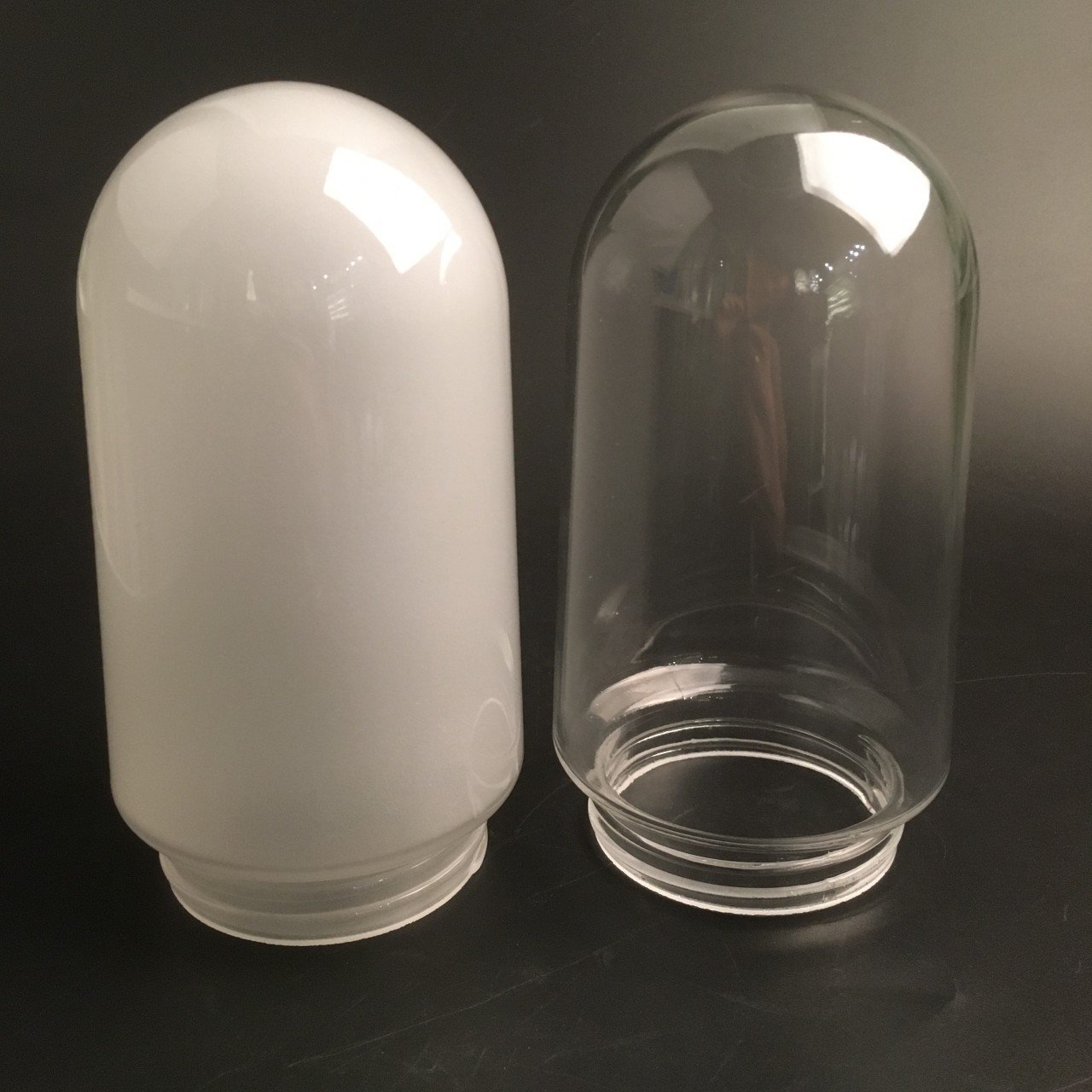
| Blowing | Hollow shades, rounded covers and open-ended bodies. | Wall distribution, openings and seams. A mould may control the outside while the inside follows the forming and cooling conditions. |
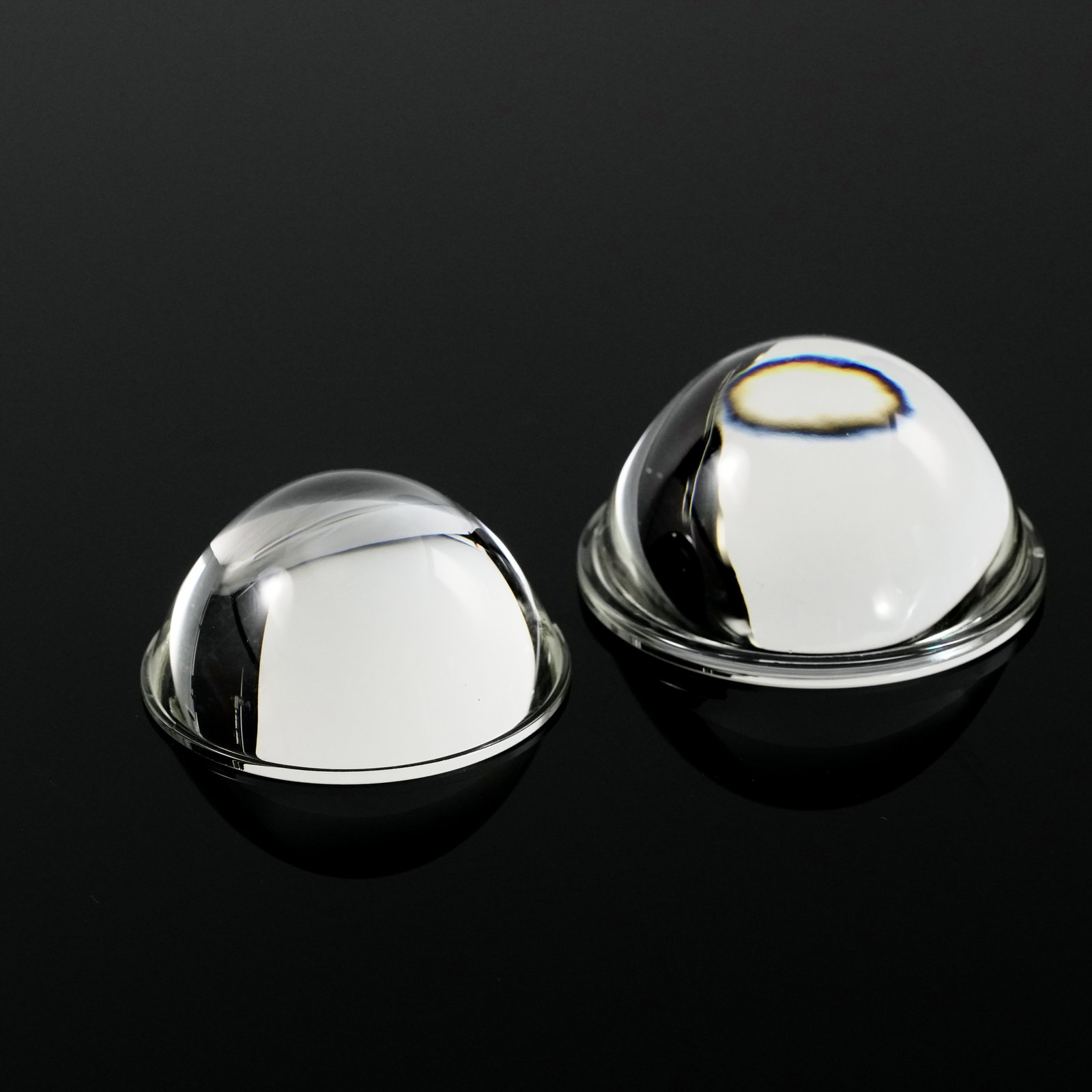
| Pressing | Moulded covers, defined contours, relief and surface patterns. | Access for the plunger, release direction, draft, thick regions and parting lines. Critical interfaces may need secondary finishing. |
| Float-sheet fabrication | Flat windows, discs, panels and cut profiles with holes or slots. | Stock thickness, edge distances, machined edge quality, flatness and finishing sequence. A deep hollow body requires a different forming approach. |
Cutting, grinding and polishing can establish functional rims or mating surfaces. Frosting and texturing alter scattering and appearance; printing and coatings add surface functions with their own exposure and cleaning limits. Specify the treated area and the required result, rather than the finish name alone. Review all machining and edge work before any applicable thermal tempering, because subsequent cutting or drilling can disrupt the strengthened stress state.
08 / Designing the component
Design Guidelines for Custom Components
Begin with the function: which surface locates the part, which area transmits or diffuses light, and which rim contacts the gasket or hardware? This makes it possible to concentrate dimensional control where it affects fit and performance, while leaving noncritical formed surfaces appropriate freedom.
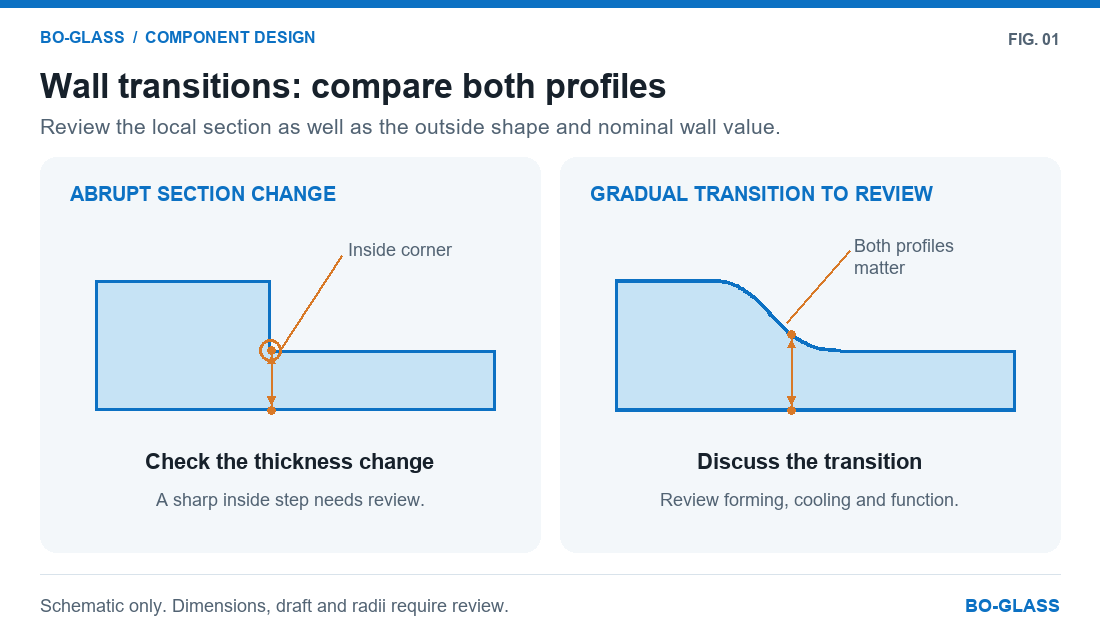
- Wall profile: show the nominal section, local minimum requirements and measurement positions separately. Avoid abrupt transitions into thick bases or rims where practical; unequal sections cool and change temperature at different rates.
- Radii and openings: blend internal as well as external transitions. Define the functional opening, finished rim, permitted chips and any edge treatment, rather than relying on a photograph or a single outside dimension.
- Tool release and seams: identify press or mould-opening direction, draft, undercuts and acceptable parting-line locations. A seam that is acceptable on a decorative body may be unsuitable on a gasket seat or a visible optical zone.
- Fit and mounting: define the datum, contact surfaces, gasket and retention method. Allow for dimensional variation, differential expansion and assembly forces; tightening a rigid metal fitting should not be the method used to compensate for an undefined glass dimension.
- Tolerances: agree feature-specific limits and measurement methods during drawing review. Include secondary processing where a formed surface alone cannot meet the required interface.
There is no universal wall thickness, draft angle or tolerance for every blown or pressed part. Confirm the proposed geometry against the selected composition, forming route, size, finishing operations and validation plan.
09 / Choosing between materials
Soda-Lime Glass vs Borosilicate and Fused Silica
Select the composition and the manufacturing route together. A lower thermal expansion coefficient can reduce expansion for a given temperature change, but it does not remove surface flaws, mounting restraint or the need to validate a finished assembly. Optical grade, thickness, surface finish and the exact chemical exposure can also change the decision.
| Requirement | Soda-lime glass | Borosilicate glass | Fused silica |
|---|---|---|---|
| Temperature changes | A practical candidate where the thermal cycle, geometry and mounting are suitable; assess rapid or local heating carefully. | Low-expansion grades are worth evaluating when thermal gradients or dimensional change are important. | Very low expansion can support demanding thermal or dimensional requirements; grade and finished-part conditions still matter. |
| Optical function | Clear, low-iron, coloured and diffusing options can serve many visible-light applications. | Evaluate the grade's spectrum, optical quality and thickness for the required wavelength range. | Specialty grades are used where UV transmission, purity or homogeneity justify the material choice. |
| Chemical environment | Check the medium, concentration, temperature, contact time and cleaning cycle. | Some grades offer higher hydrolytic durability; confirm reagent-specific data rather than assuming universal resistance. | Specify grade and exposure conditions. Purity alone does not establish compatibility with a process chemical. |
| Shape and project cost | Established blowing, pressing and sheet-fabrication routes make it a useful starting point for many custom shapes. | Check available feedstock, forming capability, tooling and finishing for the actual geometry. | Confirm available form and specialist fabrication. Obtain a finished-part quotation when its properties are needed. |
Start with soda-lime when it meets the defined requirements; review borosilicate when thermal behaviour or hydrolytic durability is a limiting factor; consider an appropriate fused-silica grade when purity or spectral performance drives the specification. Compare quotations for the same geometry, optical quality, inspection scope and quantity. Raw-material labels alone cannot establish a reliable cost ranking.
Reference products illustrate grade differences: SCHOTT BOROFLOAT® 33 technical details and Corning HPFS® fused silica. These are material references, not confirmation that every custom forming route uses those products.
10 / Evidence and acceptance
Inspection, Applications and Case Studies
A useful specification connects every critical requirement to a feature or zone, an agreed limit or reference, a measurement or test method, and a recorded acceptance decision. An approved sample can define appearance, but it does not replace missing dimensional or functional requirements.
| Check | What to specify | What the check establishes |
|---|---|---|
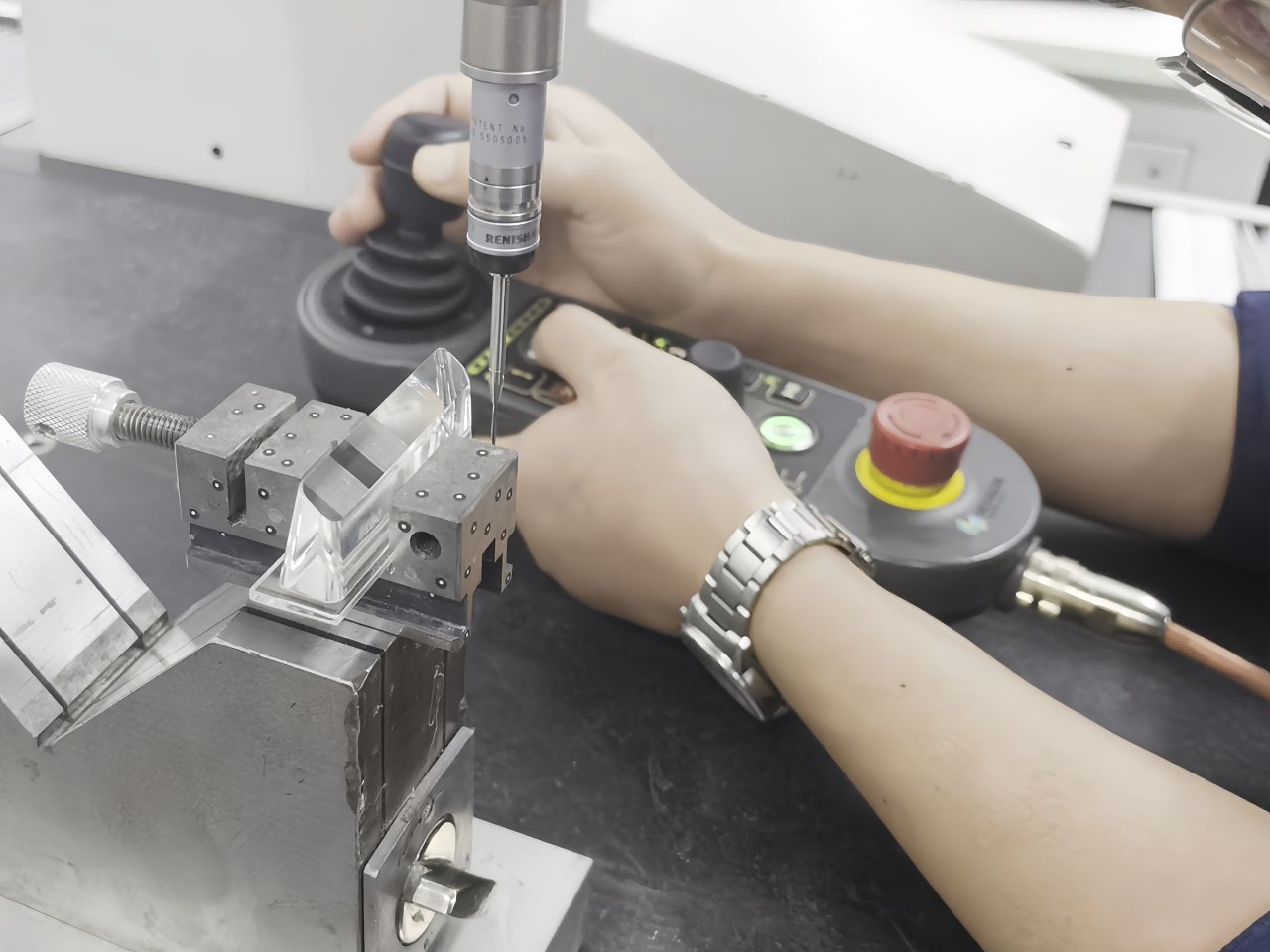
| Dimensions and fit | Datums, locations, limits, wall-profile positions and the measurement or mating setup. | Agreement with the specified geometry or fit under the stated setup. |
| Appearance and edges | Viewing zones, illumination, background, distance and limits or reference samples for marks and edge defects. | Visual acceptance under repeatable conditions, rather than an undefined “defect-free” claim. |
| Residual stress | An applicable observation or measurement method, component orientation and acceptance basis. | Information about the residual-stress state; it is not a substitute for strength or thermal-shock validation. |
| Function | Relevant optical, temperature-cycle, load or assembly-sealing conditions, together with pass/fail criteria. | Performance for the tested component or assembly and conditions, within the agreed validation scope. |
Separate design qualification from routine batch acceptance. Tests used to establish that a design works may be destructive or involve a complete assembly; production checks verify the agreed characteristics and sampling plan for each lot. A change to glass, wall profile, finish or mounting can require a review of the qualification basis.

Product examples and a documented project
Soda-lime glass is used for many lighting and decorative components where shape, appearance and forming options meet the intended service conditions. The examples below show different design priorities. Only the threaded-cover example includes the project-specific dimensions and initial order quantity stated here.

Product example
Clear pendant shades
Clear soda-lime glass with a textured surface for pendant and chandelier lighting. The transparent body and texture make appearance a central design requirement.
Design focus: define the visible zones, texture reference, rim and mounting interface. Evaluate brightness and appearance with the intended light source.
View clear glass shades ↗
Product example
Flower-shaped glass shades
A decorative soda-lime glass shade with a flower-shaped profile for an E14 lamp base. Its shaped petals provide visual form as well as glass section changes to review.
Design focus: review the petal transitions, opening, edge quality and fit. The decorative shape alone does not establish allowable lamp temperature or thermal performance.
View decorative glass shades ↗
Project case
Threaded lighting covers
A custom graphite mandrel formed the threaded openings of these hand-blown covers.
Project diameters: 85–150 mm
Initial batch: 200 pieces
Project checks: thread fit was checked on the customer’s metal base, and water sealing was checked on the assembled fixture.
Read the threaded-cover project ↗For a new part, confirm the composition, forming route, finish, tolerances and required tests during the technical review.
References and Data Scope
Published material data support the explanations above. Product grade, specimen condition and test method remain part of each reference. Confirm their relevance to the chosen formulation and finished component.
- Pilkington ATS-129: Properties of Soda-Lime Silica Float Glass, September 2026. Reference properties, temperature interval, wavelengths and characteristic-temperature test methods.
- Pilkington: Raw Materials. Typical float-glass constituents; distinguish raw materials from the finished oxide composition.
- SCHOTT: The Nature of Glass, Technical White Paper No. 1. Glass network, composition and property relationships.
- Pilkington ATS-104: Protecting Flat Glass Surfaces. Moisture, alkaline attack, contamination, cleaning and storage; source scope is flat glass.
- Pilkington ATS-186: Installation of Heat Treated Clear and Tinted Flat Glass. Heat treatment and processing considerations; source scope is flat glass.
- BYK Instruments: Transparency Measurement. Transmission, haze, clarity and measurement geometry.
- DWK Life Sciences: Glass Types & Properties. Composition-dependent properties and chemical durability of named glass families.
- SCHOTT: BOROFLOAT® Technical Details. A named borosilicate product with grade-specific thermal, optical and chemical data.
- Corning: High Purity Fused Silica. Fused-silica grades and optical-material selection.
- Corning: Pharmaceutical Glass Tubing Specifications — Definitions. Annealing- and strain-point definitions; source scope is glass tubing.
Component recommendations and schematics are engineering explanations. Product examples and the project facts above are identified separately from reference-material data.
Explore the Detailed Technical Guides
Ordering and Project FAQs
Share the drawing, intended use, quantity and required finish. Mark the critical interfaces, optical zones and any temperature, chemical or load exposure. We review material, forming route, tooling, samples and inspection requirements before production is agreed. See how ordering works.
Can we start from a drawing or sample?
Send a dimensioned drawing where available. Photographs or a reference sample can support an initial discussion; confirm the final dimensions and acceptance requirements before tooling and production.
Will a new mould be required?
This depends on the shape and suitable tooling available. Confirm dedicated tooling, modifications, cost and ownership in the project quotation.
What are the MOQ and lead time?
They depend on the material, geometry, tooling, finishing and inspection scope. Include sample quantity, initial order, repeat demand and target date for project-specific confirmation.
Contact Us
Discuss Your Custom Glass Project
Share your drawing, photos or dimensions, together with the intended use and target quantity. We will review your requirements and discuss the next steps.
Sales Enquiries
Email sales@bo-glass.com with your part description, intended use and target quantity.
Send Your Design
Use the form to upload a drawing or describe an existing part. Mark critical dimensions and tell us which surfaces or features matter most.
Request a Custom Glass Quote
Upload a drawing or share dimensions, quantity, intended use and finish. Include any heat, pressure or chemical exposure.
Your drawings remain confidential.
We use the contact details you provide to respond to your enquiry. See our Privacy Policy for more information.