
What is the production equipment for hot-bent glass?
The hot bending furnace is an important equipment for hot bending. It can be divided into several types of heating energy, such as oil, gas, and electric heating. The structure of oil and gas is relatively complex, and the temperature control and adjustment are inconvenient. The electric heating hot bending furnace has the advantages of a simple structure, convenient temperature control, easy operation, and no pollution to the glass, so it is widely used.
The hot bending furnace requires that the electric heating elements are arranged reasonably to achieve local heating, and the placement direction of the glass must be consistent with the direction of the electric heating wire. The aquarium exhibition room and counter glass often use bent hot bending glass. The technical difficulty of bending glass during hot bending is the bending of straight edges, and defects such as horizontal marks are prone to occur at the corners. In addition to the reasonable formulation of the temperature system, electric auxiliary heating should be provided at the bend to avoid defects. Spherical glass, curved arched corridors, and glass wash basins are often designed with professional hot-bending furnaces due to the complex process of hot bending.
Glass hot bending furnaces can be divided into three types: single-chamber furnaces, circulating types, and reciprocating types from the perspective of structure. Among them, reciprocating hot bending furnaces and circulating hot bending furnaces both belong to continuous production, with a production cycle of dozens of minutes, and higher production efficiency than single-chamber hot bending furnaces.
What is a single chamber furnace?
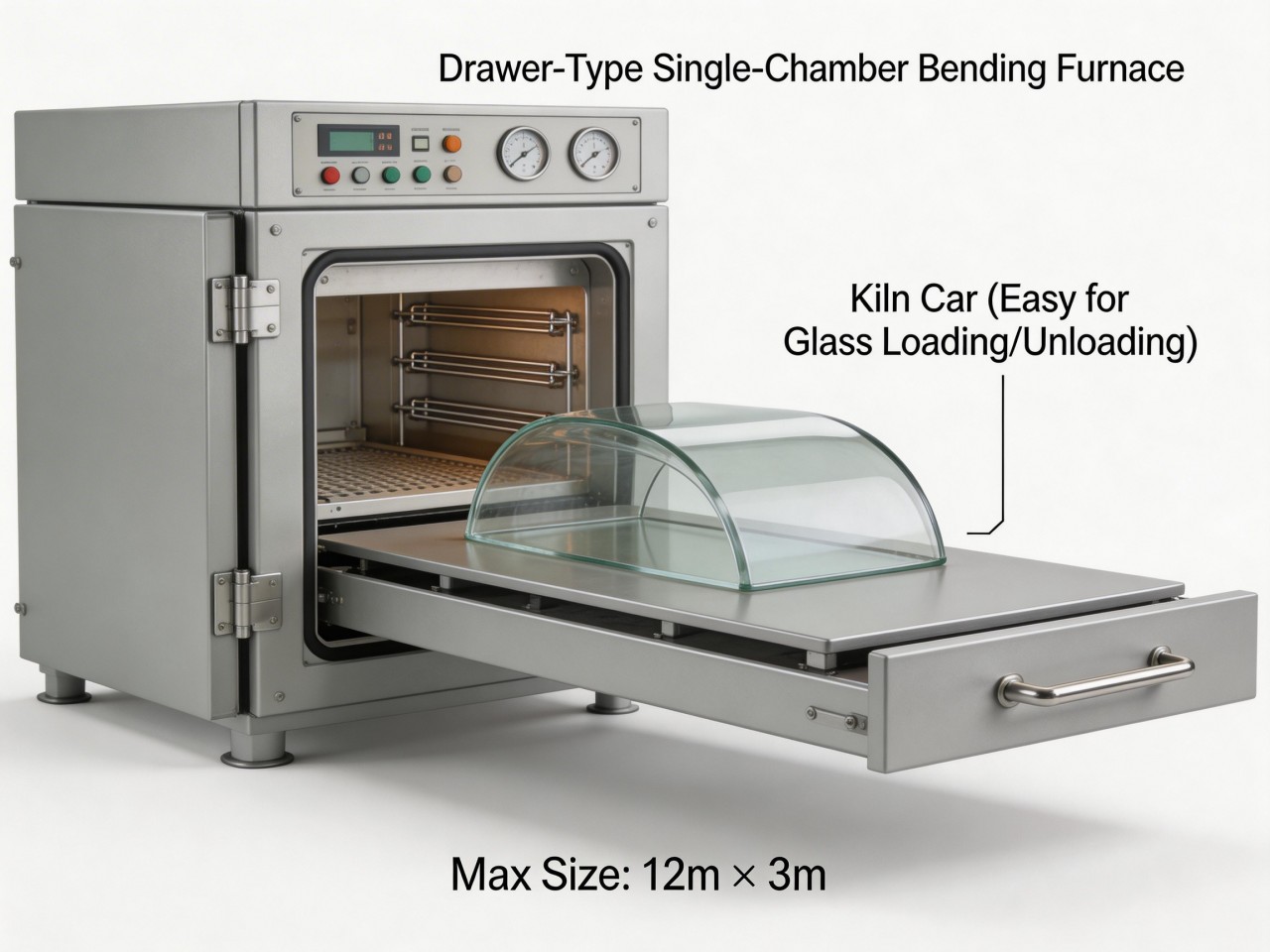
A single-chamber furnace is the most common hot-bending furnace. There are two types: drawer type and lift type.
Since architectural glass is produced in small batches and many specifications, it is most economical and convenient to use a single-chamber furnace. A single-chamber furnace has only one station, and the glass is heated, bent, and annealed at this station. The advantage of a single-chamber furnace is that it can adapt to various products of different specifications, and does not require a continuous process system. Each furnace has corresponding process parameters according to different products. The single-chamber furnace is simple to make, easy to handle, well sealed, and relatively low energy consumption. The disadvantages are low efficiency and a long bending cycle. The drawer-type single-chamber furnace has a structure like a drawer, and the kiln car is a flat car with only the front face, which provides great convenience for the loading and unloading of glass. At present, the largest size of glass that can be bent by a single-chamber furnace has reached 12m×3m. The lifting single-chamber furnace has a structure that is fully sealed on all sides and the top, and the bottom of the furnace has a certain height. The glass enters from the bottom of the furnace, and the bottom can be raised and lowered. The bending mold enters the bending platform by an external track and rises to the bending position. The bent glass products are discharged from the reverse process.
What is a reciprocating hot bending furnace?
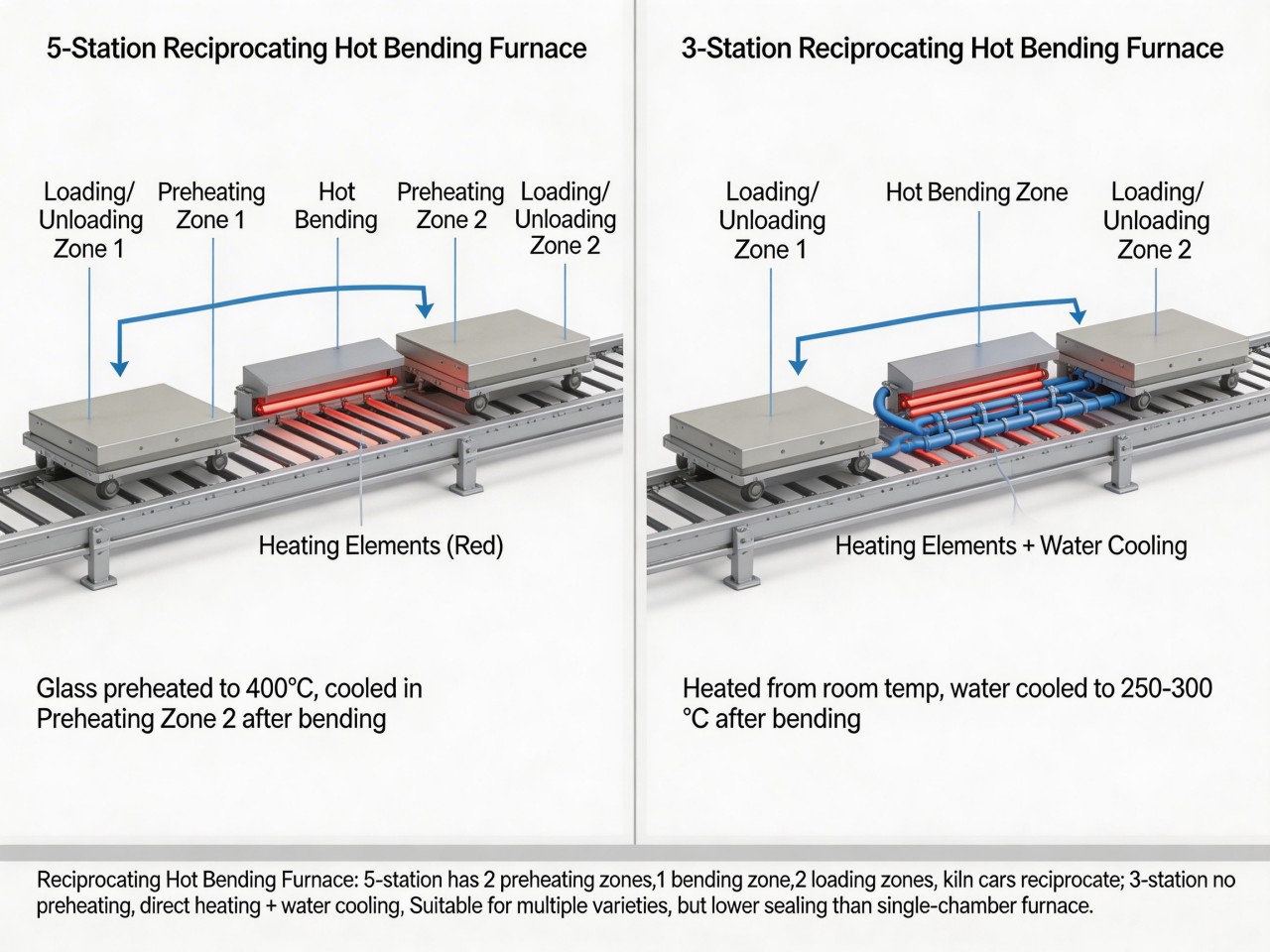
There are two types of reciprocating heat bending furnaces: 5-station and 3-station. The 5-station furnace has 2 loading and unloading areas, 2 preheating areas, 1 heat bending area, and 2 kiln cars. The glass is heated to about 400℃ in the preheating area and enters the heat bending area. After heat bending, it returns to the preheating area to cool down. Another kiln car enters the heat-bending area, and so on. The 3-station furnace has only 2 unloading areas one heat bending area, and also 2 kiln cars. In the heat bending area, the glass is directly heated from room temperature to the heat bending temperature according to the temperature system. After heat bending, it cools down to 250-300℃ and then returns to the loading and unloading area.
The reciprocating heat bending furnace can adapt to different glass products and does not require a continuous temperature system, but the sealing degree is not as good as that of the single-chamber furnace, and the structure is more complicated than that of the single-chamber furnace.
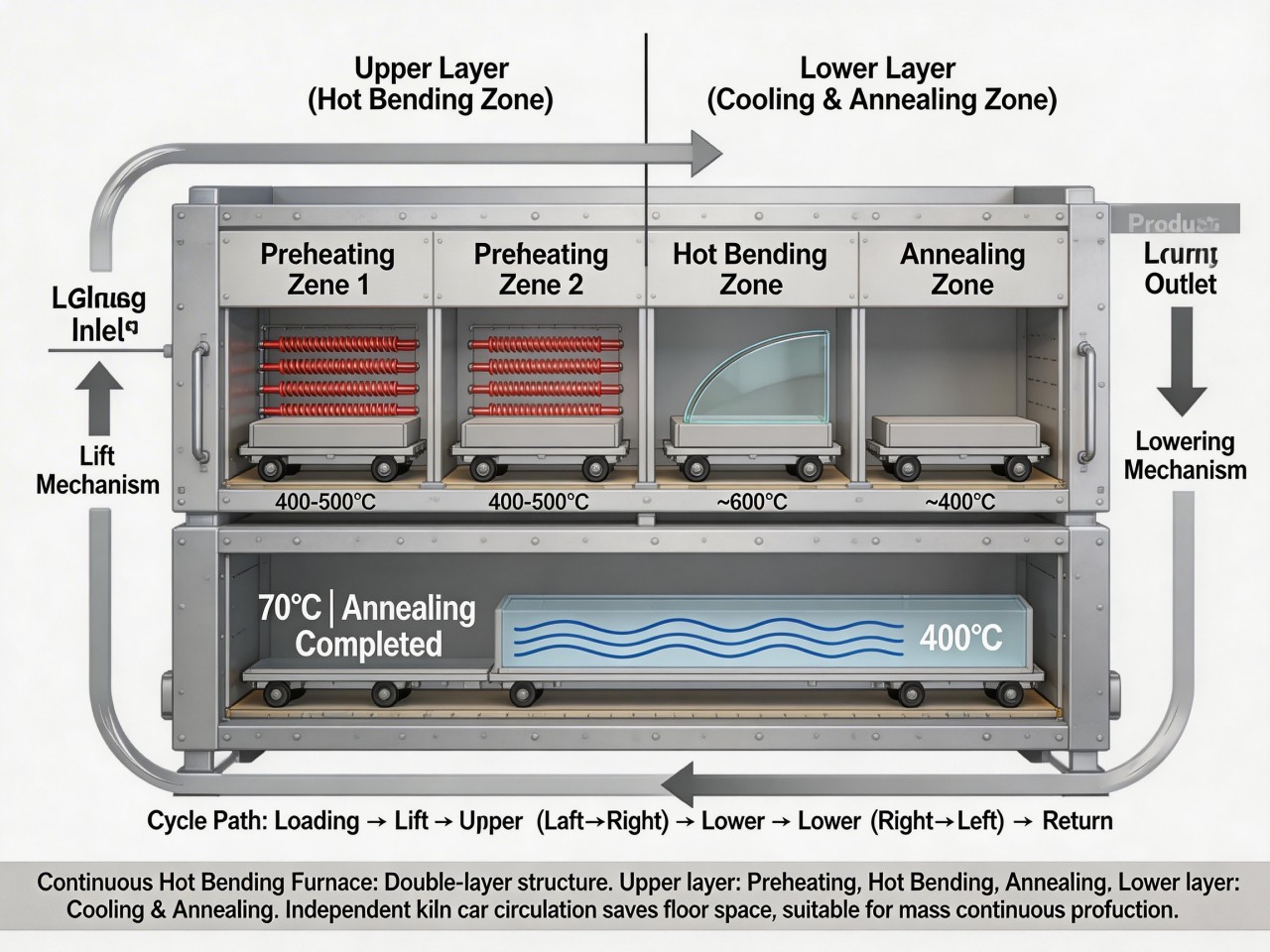
What is a Circulation Bending Furnace?
Contact Us
Your feedback fuels our growth, and your questions drive our solutions.
We value your feedback, inquiries, and suggestions. Please feel free to get in touch with us
General inquiries
Please contact us via sales@bo-glass.com, and we will reply to you as soon as possible.
Interested to work with us
Drop your resume at info@bo-glass.com
and we will get back to you shortly.
We uses the contact information you provide to us to contact you about our relevent content, products, and services.