
Horizontal tempered glass production line
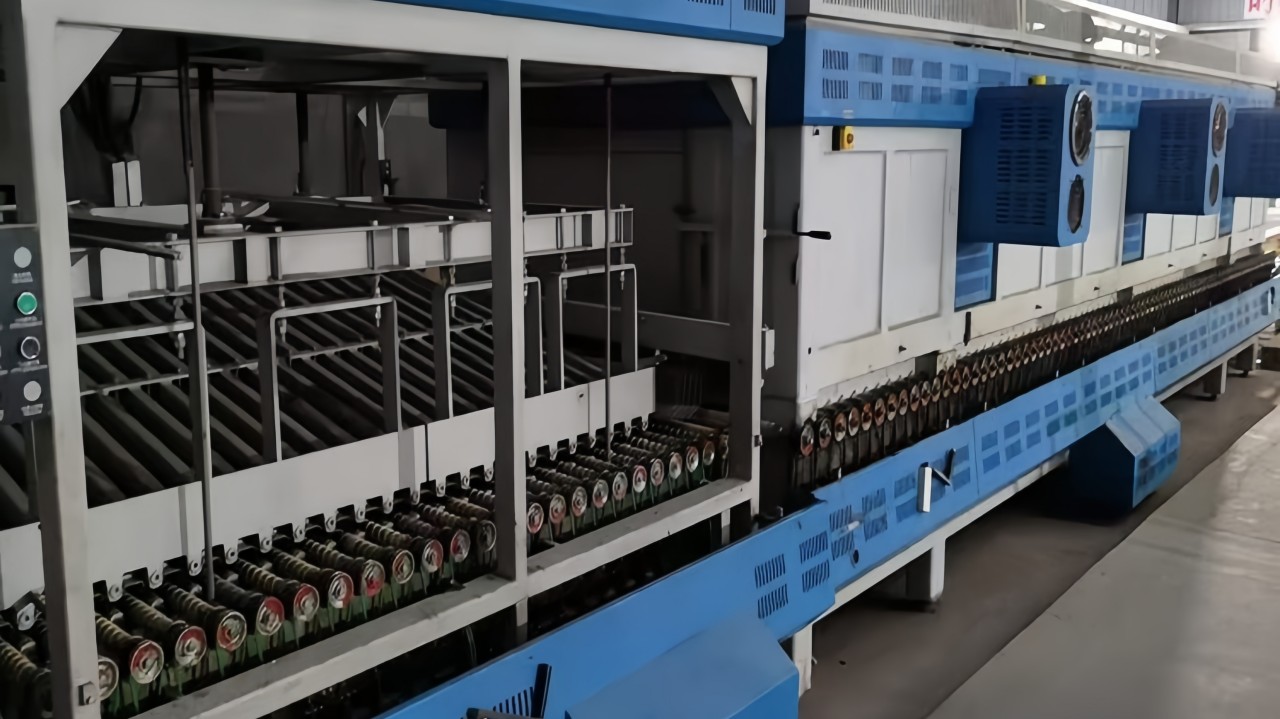
The horizontal tempered glass production line is an equipment system that transports glass horizontally and tempers the glass through heating and rapid cooling processes.

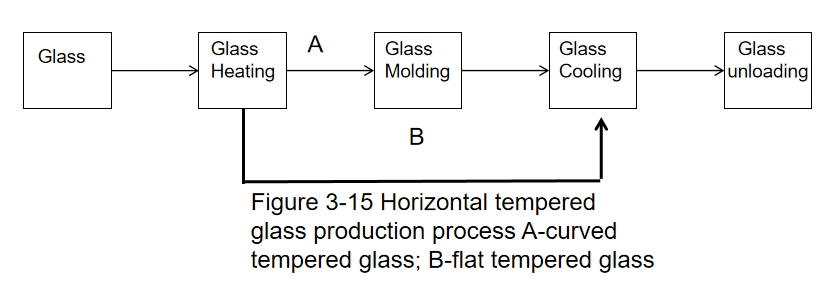
Horizontal tempered glass production line refers to a production line in which the glass is heated, formed, quenched and other processes are carried out on a horizontal roller to finally complete the tempering of the glass flat surface, single curved surface, double curved surface, folded surface, S-shaped surface, etc.The production process of horizontal tempered glass is shown in Figure 3-15
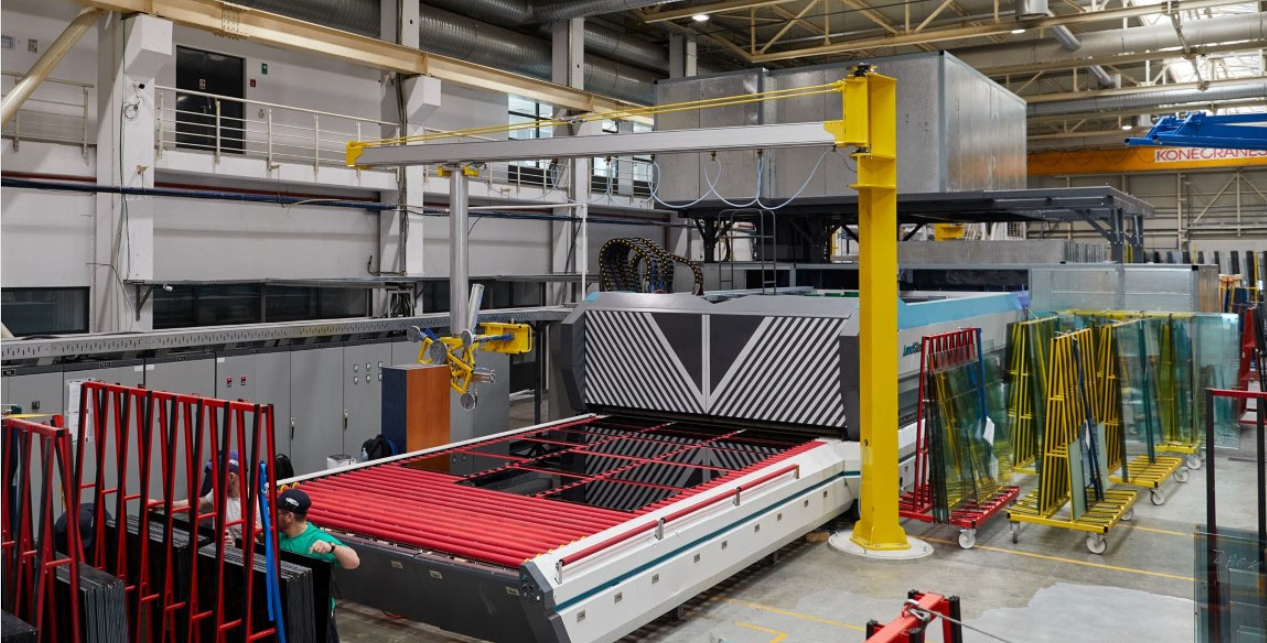
(1) Loading/unloading platform The loading platform is at the beginning of the tempered glass production line. This part can be connected to the pre-treatment washing and drying machine. Its other end is connected to the furnace entrance of the heating furnace. The loading platform is mainly composed of a rubber roller surface, a transmission sprocket, a glass table, an automatic rotating wheel, a motor and a reducer, a frame, etc.
The unloading platform is at the end of the tempered glass production line. It is mainly composed of an asbestos rope winding roller, a transmission sprocket, a glass receiving platform, an automatic rotating wheel, a motor and a reducer, a frame, etc.
The loading platform and the unloading platform are respectively equipped with photoelectric switches and counters to measure and control the glass travel distance. The programmable controller used for the loading/unloading platform conveying control measures the length of the glass through the photoelectric switch and the counter, and makes this length prepare for the heating operation time, operation speed, and output time of the glass in the heating zone. When the glass initial point is measured, the heating furnace door can automatically calculate and open. When the glass end is measured, the furnace door automatically closes after a few seconds. After all the glass enters the furnace, the loading platform automatically stops moving. The unloading station is just the opposite. When the glass runs to the photoelectric switch on the roller, the equipment automatically stops moving. The loading/unloading station is equipped with a stop button for manual control to facilitate loading and unloading.
② Hanging/support device The hanging device is above the furnace and is mainly used to hang the upper furnace heating element. The support device is below the furnace and is mainly used to support the lower furnace heating element. At the same time, it protects the furnace wire from being damaged by broken glass after the glass explodes. The distance of hanging/support is related to the heating radiation rate of the glass. The hanging/support device can also isolate the furnace, keep the furnace clean, and prevent the heating material from being damaged.
③ Insulation heating system According to the principle of glass heating, glass absorbs less infrared radiation consumes more energy at low temperatures, and receives radiation heating faster at high temperatures. Therefore, choosing suitable radiation materials is an excellent way to heat glass evenly and save energy. In the 1980s, foreign companies began to use insulation heating materials, to improve the heat absorption rate and heating uniformity of glass. Foreign countries also use furnace wires to directly heat glass, causing the glass to heat too quickly locally, and the glass warping is higher than the insulation heating furnace. The stress uniformity of glass cooling is lower than that of uniform heating devices. To reduce this phenomenon, a dome furnace wire arrangement can be used so that the distance of furnace wire radiation to glass is equal, reducing the problem of tempering stress non-uniformity.
④ Rapid cooling system is used when special conditions occur in glass and the heating furnace needs to be cooled rapidly. Cold air is quickly introduced into the furnace for cooling through the air pipe and upper air inlet in the furnace. Another purpose of the air pipe in the furnace is to adjust the upper and lower heating balance of glass in the furnace.
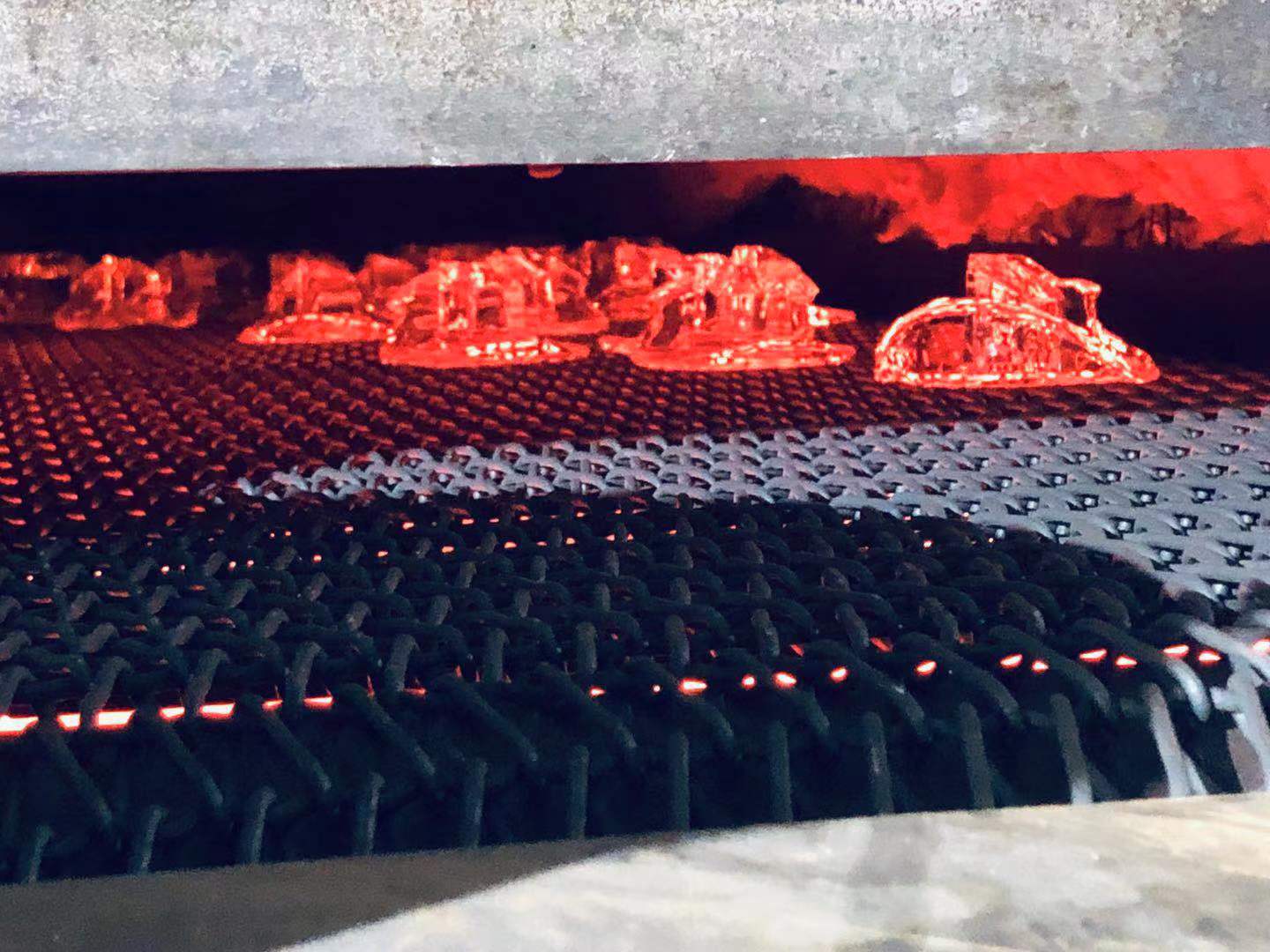
⑥ The transmission system of the heating furnace roller is mainly composed of chains, sprockets or friction wheels, steel belts or friction wheels, point motors, and reducers. The belt rotates under the drive of the DC or AC motor and the reducer and drives the glass to reciprocate. The transmission device is equipped with an emergency DC fast operation system, the purpose of which is to quickly send the glass in the furnace to the outside of the furnace in the event of a sudden power outage, to prevent the glass from falling into the furnace and keep the furnace clean.
The transmission system also has an emergency furnace body lifting device. This part can be manual, pushing up the upper furnace body through a balancing device and a chain device; it can also be automatic, automatically lifting the upper furnace body through an electric motor, a reducer, and lead screw nuts set up around the furnace body.
The horizontal tempering wind grid is generally composed of several upper and lower wind boxes, a lifting device, a guide device, a balancing system, a broken glass conveying system, an air supply system, and a rack.

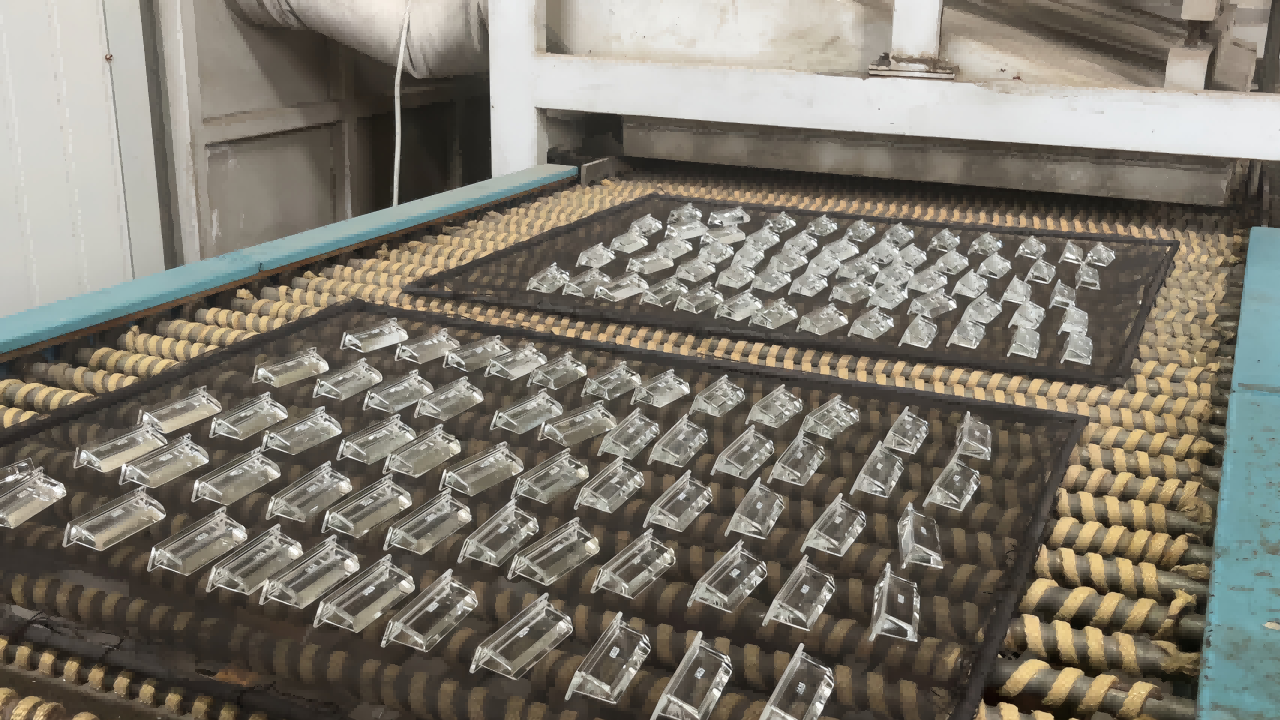
The structure and number of the wind grille of the lower wind grille are the same as those of the upper wind grille, but the nozzle of the wind grille is installed at the upper end of the wind distribution flat tube, and there is a certain gap between each wind grille. When the glass is occasionally broken during production, the broken glass falls into the broken glass conveyor below through this gap.
The cooling device design of a new tempering furnace of a foreign company has four characteristics: it is equipped with a nozzle with a special structure, the thin glass can be cooled simultaneously with cold air and compressed air, the speed of the fan is adjusted by the frequency converter to control the wind speed and wind pressure, and the equipment structure is simplified.
③ The broken glass conveyor is generally a plate or crawler conveyor. The conveyor is installed under the lower wind cabinet, from the cooling device near the heating furnace to the bottom of the unloading platform, and baffles are provided above the transport plate and near the steel frame structure on both sides. After the broken glass falls into the conveyor plate, the broken glass conveyor can be turned on to send the broken glass to the bottom of the unloading platform, directly falling into the broken glass trolley or manually cleaned.
④The outer shell of the anechoic chamber is made of small steel and steel plates with four walls and a top cover, forming a sealed chamber. Except for a slit at both ends, for glass to pass through, the components in the cooling device are covered in it; there are doors and observation windows on the side, and many noise reduction plates are installed on the top. These noise reduction plates are composed of many exhaust channels. Exhaust gas can be discharged from these channels to reduce noise. The anechoic chamber also limits the noise generated by the gas flowing out of the wind grid to spread outward, thereby reducing the intensity of noise in the workshop and environmental pollution.
⑤The air curtain is set between the heating furnace and the cooling device and consists of air ducts. A row of small nozzles are drilled on the corresponding surfaces of the two air ducts, and the air inlet is connected to the air distributor, and there is an adjusting valve to control its air supply. The air is ejected from the closely packed small nozzles to form an air curtain. When the wind grid blows cold air to cool the glass, the air curtain blows air at the same wind pressure, and the formed air curtain is sealed at the inlet end of the cooling device, thereby preventing the cold air in the wind grid from entering the heating furnace. One of the functions of the air curtain is to quickly pre-cool the glass through the air curtain, and the tempering degree is improved to a certain extent. The tempering degree of the glass produced by the tempering equipment without the air curtain is about 10MPa higher, and the heating time can be reduced by about 10s.
⑥ The lifting device is composed of a drive device, a pulley group, and a steel wire rope. It is automatically controlled by a microcomputer and can adjust the height of the nozzle to the glass surface according to the thickness of the tempered glass. This height refers to the distance from the tip of the upper wind grid to the highest point of the roller glass fiber rope or heat-resistant soft material belt. The lifting height can be adjusted between 300 and 600mm. The lower wind grid is opened or closed with the upper follower through a linkage mechanism such as a sprocket and a chain.
⑧ The air supply device should match the structure of the wind grid and the size of the cooling capacity. It is mainly composed of a fan, a mixing air box, a wind grid, a butterfly valve, a pressure transmitter, an air outlet adjustment plate, and a pipeline. The mixing air box fully mixes the air sent by the fan in the air box and then sends it to each wind grid to ensure that the output air volume of the wind grid is as uniform as possible at each point and the cooling of the glass is uniform.
Contact Us
Your feedback fuels our growth, and your questions drive our solutions.
We value your feedback, inquiries, and suggestions. Please feel free to get in touch with us
General inquiries
Please contact us via sales@bo-glass.com, and we will reply to you as soon as possible.
Interested to work with us
Drop your resume at info@bo-glass.com
and we will get back to you shortly.
We uses the contact information you provide to us to contact you about our relevent content, products, and services.