
Custom Outdoor Lighting Glass Manufacturer
This commercial capability page focuses on what BO-GLASS can manufacture and how a project moves from drawing or physical sample to tooling, prototype, inspection, packaging, and volume production. It covers glass shades, protective cover glass, optical glass lenses, and glass windows across outdoor-lighting applications, with links to published manufacturing capabilities and released case studies. Technical claims remain tied to the approved drawing, sample, inspection record, and tested assembly.
BO-GLASS Outdoor Lighting Glass Solutions
- Quotation input
- Minimum pack: drawing revision, component category, material, thickness, tolerances, finish, optical target, order quantity and required tests.
- Prototype comparison
- Use an A/B matrix with the same luminaire and LED; record fit, sealing compression, transmittance/haze, CCT/Duv and any complete-luminaire test.
- Repeat-order control
- Release against the approved master, drawing revision, material lot and agreed inspection values rather than photographs or verbal descriptions.
- Claim traceability
- Any published number should carry a sample/lot ID, method, equipment, conditions, result and date. Otherwise it remains a design target, not BO-GLASS evidence.
For which outdoor lighting fixtures can BO-GLASS provide custom glass components?
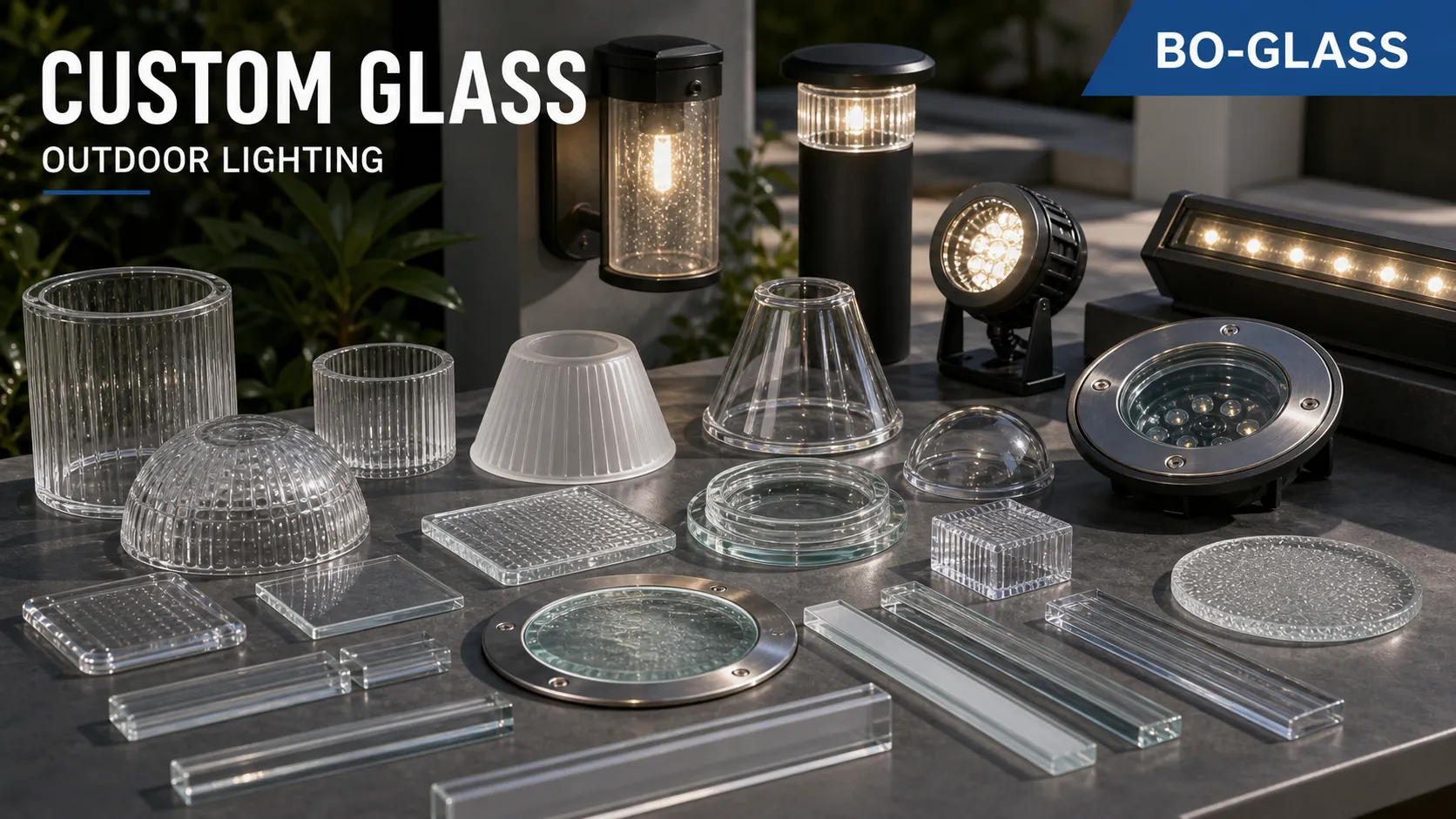
BO-GLASS can provide custom glass components for a wide range of outdoor lighting products, including courtyard lights, garden lights, path lights, lawn lights, outdoor wall lights, wall-pack lights, wall washers, floodlights, linear lights, underground lights, well lights, underwater lights, pool lights, fountain lights, street lights, parking-lot lights and outdoor decorative lights.
Customizable options include glass shades, protective cover glass, optical glass lenses and glass windows made from specified soda-lime, borosilicate, low-iron, opal or body-colored glass, with separate processes such as internal frosting/acid etching, embossing, heat bending, pressing or coating. Material and finish are confirmed independently.
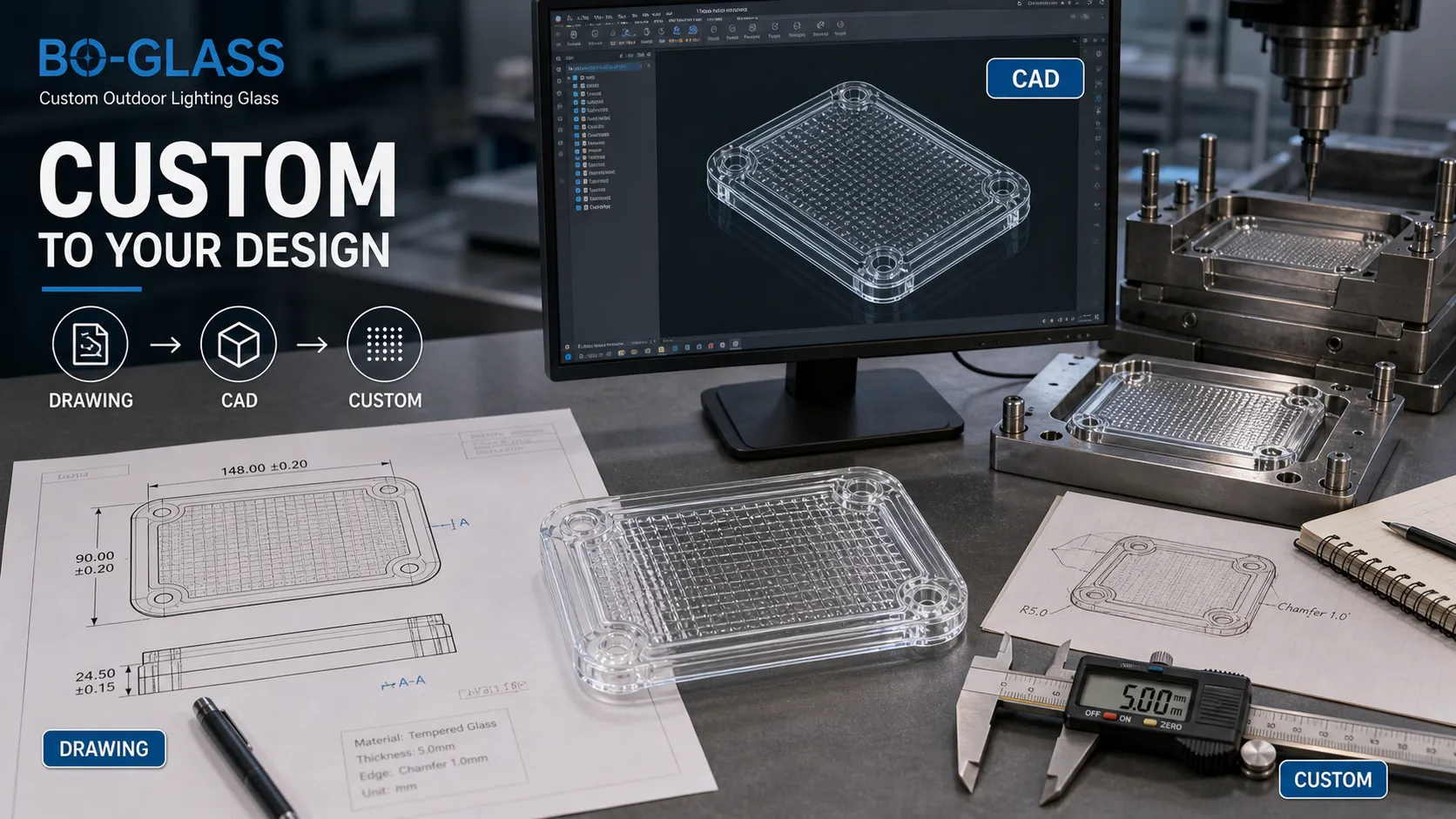
How does BO-GLASS customize outdoor lighting glass according to customer drawings?
After receiving the customer’s 2D drawings, 3D models, or assembly drawings, BO-GLASS reviews the glass material, dimensions, thickness, tolerances, hole positions, edge treatment, surface finish, color, light transmittance, and haze requirements. If the glass forms part of a sealed or load-bearing interface, the review also covers sealing-land geometry, opening dimensions, retaining-frame compression, support conditions, and assembly clearances.
After confirming the feasibility of the process, quotation, sampling, sample inspection and customer confirmation can be arranged. Before mass production, it is recommended to fix the final confirmed samples, drawings and inspection standards to ensure that the size, appearance and assembly performance of subsequent orders are consistent with the confirmed samples.
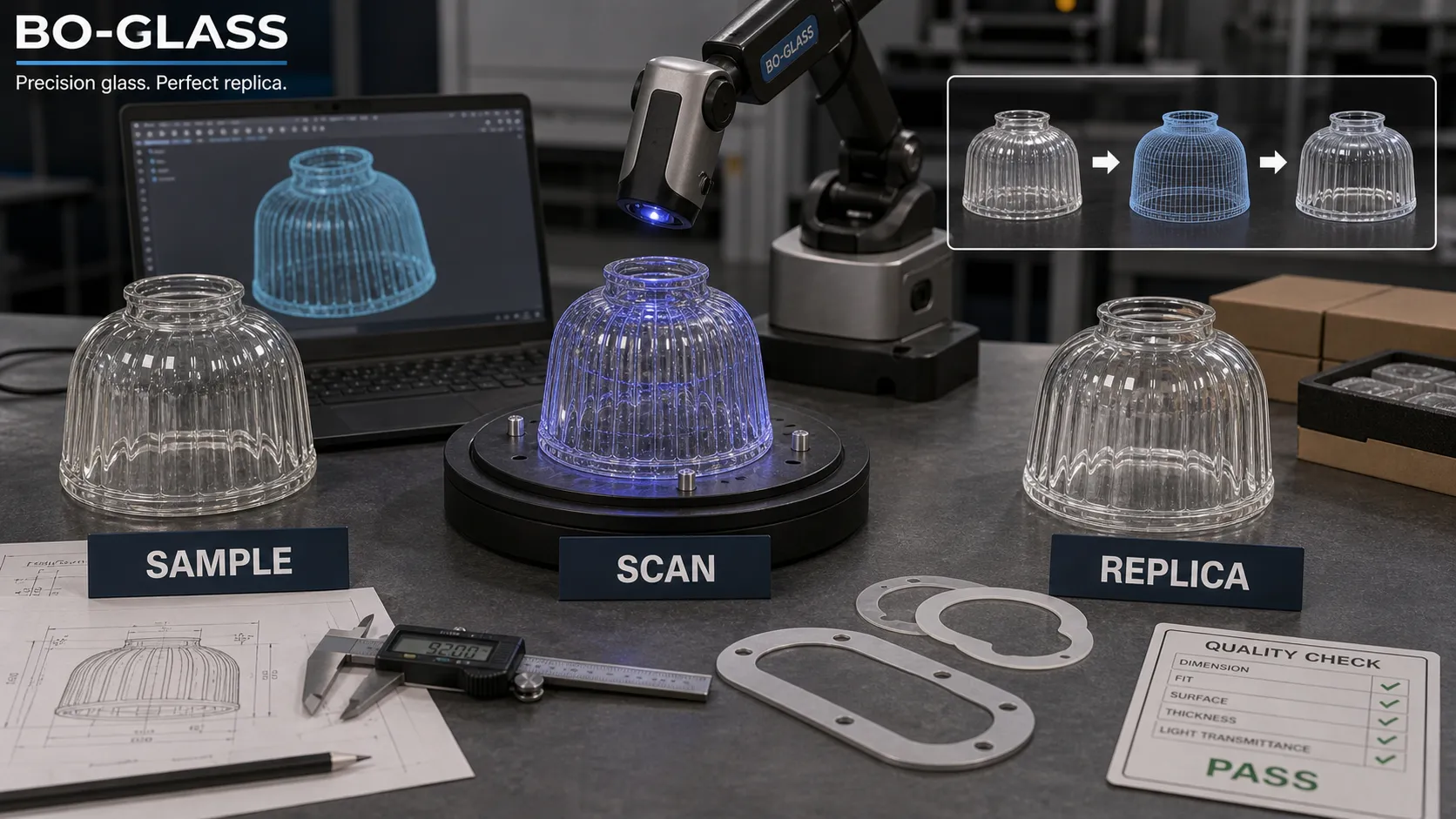
How does BO-GLASS replicate a glass shade or protective cover glass from a sample?
If the customer does not have complete drawings, BO-GLASS can conduct mapping and copy evaluation based on physical samples. The overall dimensions, thickness, curvature, mouth, hole position, color, light transmittance, haze, texture, edge treatment and surface treatment are usually evaluated, and the original sample is judged to be suitable for production by cutting, hot bending, blowing, pressing, CNC or mold opening.
After the sample is copied, it is recommended to make a confirmation sample first and install it into the customer's luminaire body for testing to check the size matching, appearance effect, light efficiency and sealing fit. For key applications such as underwater lights, underground lights, and wall washers, replica samples should also be tested and confirmed with the complete luminaire structure.
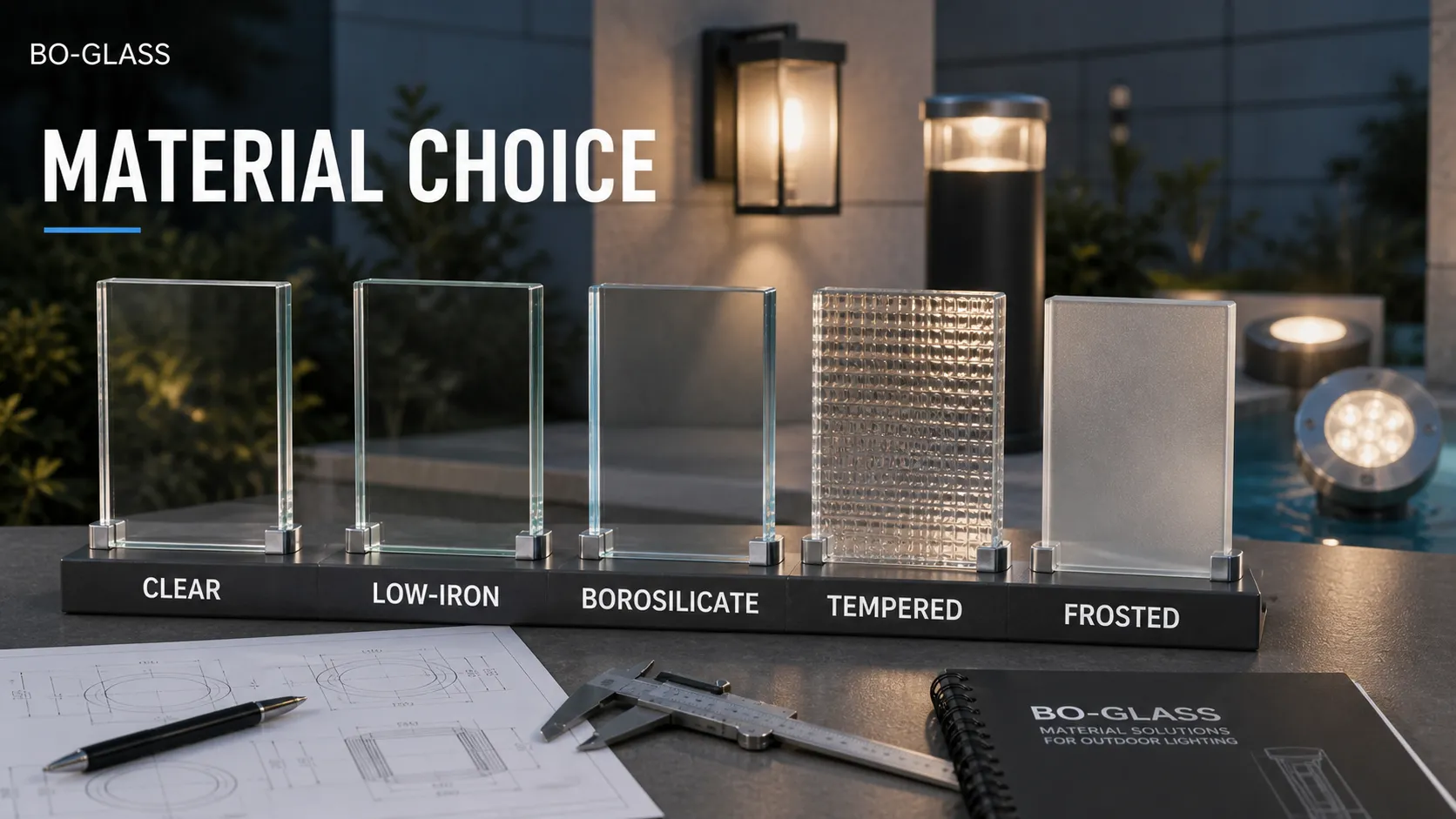
How does BO-GLASS help customers choose the right glass material?
BO-GLASS can compare soda-lime, borosilicate, low-iron, opal, body-colored or optical glass as material options, then separately evaluate surface processes such as frosting, acid etching, sandblasting, embossing or coating. The decision should reflect temperature, optics, outdoor exposure, appearance, volume and cost.
Material selection should not be based on unit price alone. It should account for luminaire power, installation location, glass thickness, weather-resistance requirements, light transmission, haze, color stability and assembly structure. High-temperature, thermal-shock, underwater, in-ground or specification-driven architectural projects should prioritize long-term stability and project risk control.
How does BO-GLASS help customers optimize glass thickness, edges and sealing structures?
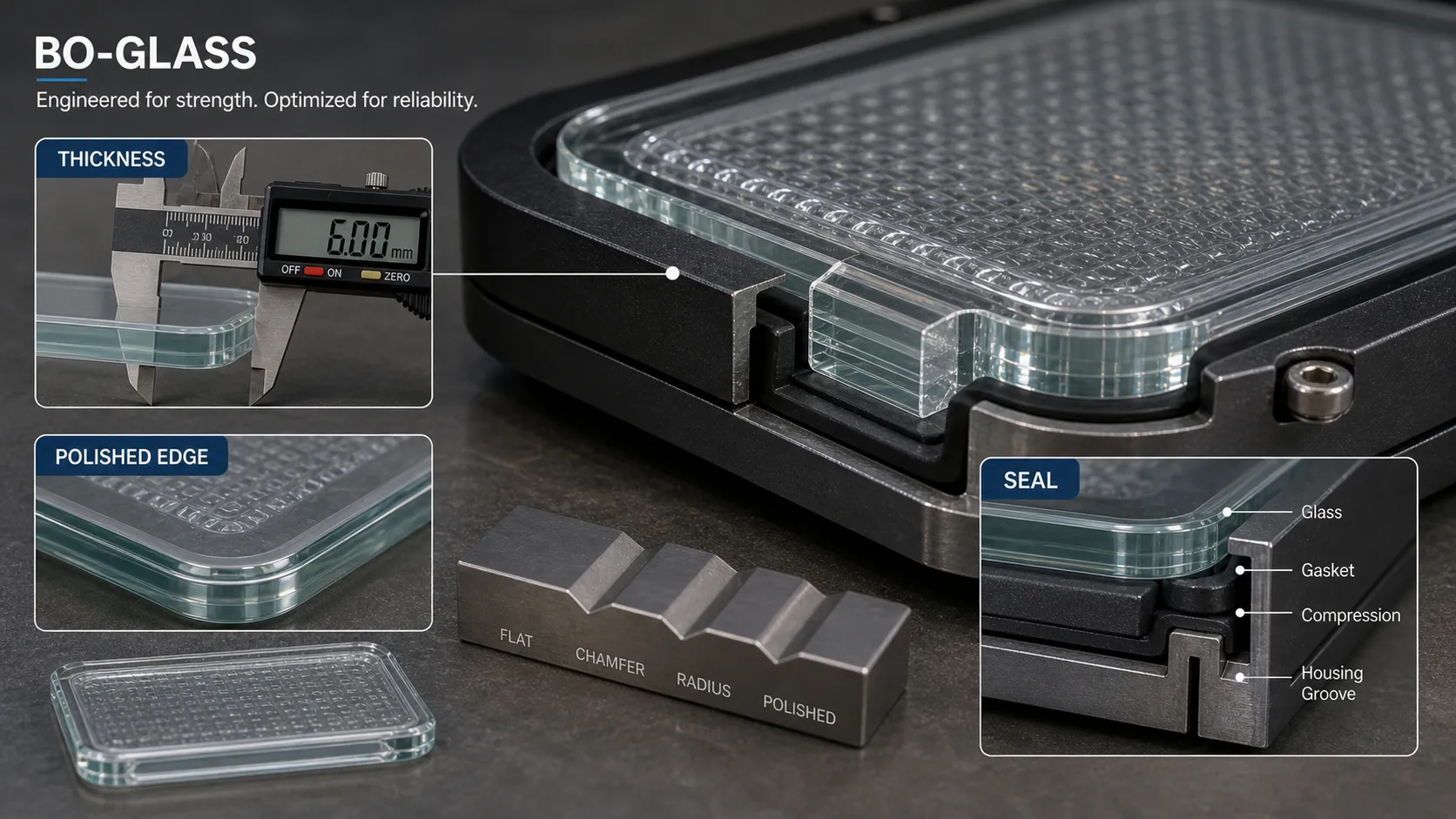
BO-GLASS can assist customers in evaluating glass thickness, edge chamfering, edge grinding methods, mouth flatness and sealing surface quality based on glass size, luminaire structure, installation method and usage scenario. Thickness affects strength, weight, light transmittance and cost, while edge treatment affects assembly safety, edge chipping risk and seal stability.
If the glass interfaces with seals, retaining frames, adhesive or metal housings, BO-GLASS advises customers to pay close attention to dimensional and thickness tolerances, clamping uniformity and assembly gaps. Glass components can improve the structural reliability of the complete luminaire, but final sealing, water ingress protection and impact resistance must still be confirmed through complete-luminaire testing.
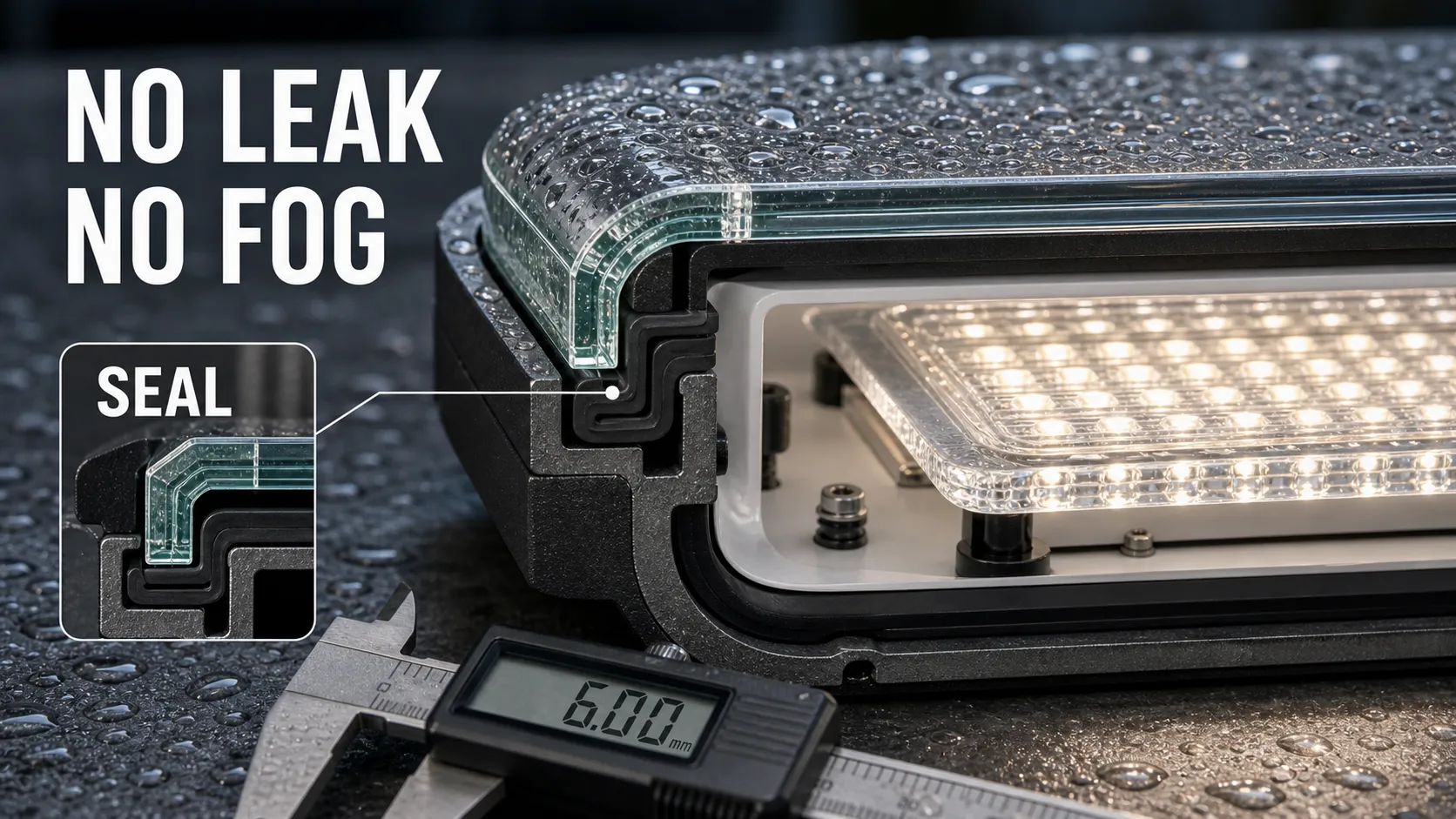
How does BO-GLASS help customers reduce the risk of water leakage and fogging through glass dimensions, tolerances and sealing surface processing?
Water leakage and fogging are usually the result of the complete luminaire structure, sealing materials, assembly processes and thermal cycling, and cannot be attributed solely to a single piece of glass. BO-GLASS can help customers control key risks from the glass end, such as improving sealing surface flatness, controlling thickness and shape tolerances, optimizing edge treatment, reducing chipping, and ensuring more stable contact between the glass and the gasket or housing.
For underwater luminaires, underground luminaires, wall luminaires and wall washers, BO-GLASS can cooperate with customer prototypes for assembly verification and detect in advance problems with glass dimensions that are too tight, too loose, insufficient compression or uneven sealing surfaces. The final risk of water leakage and fogging still needs to be confirmed by combining the complete luminaire IP, thermal cycling and lighting tests.
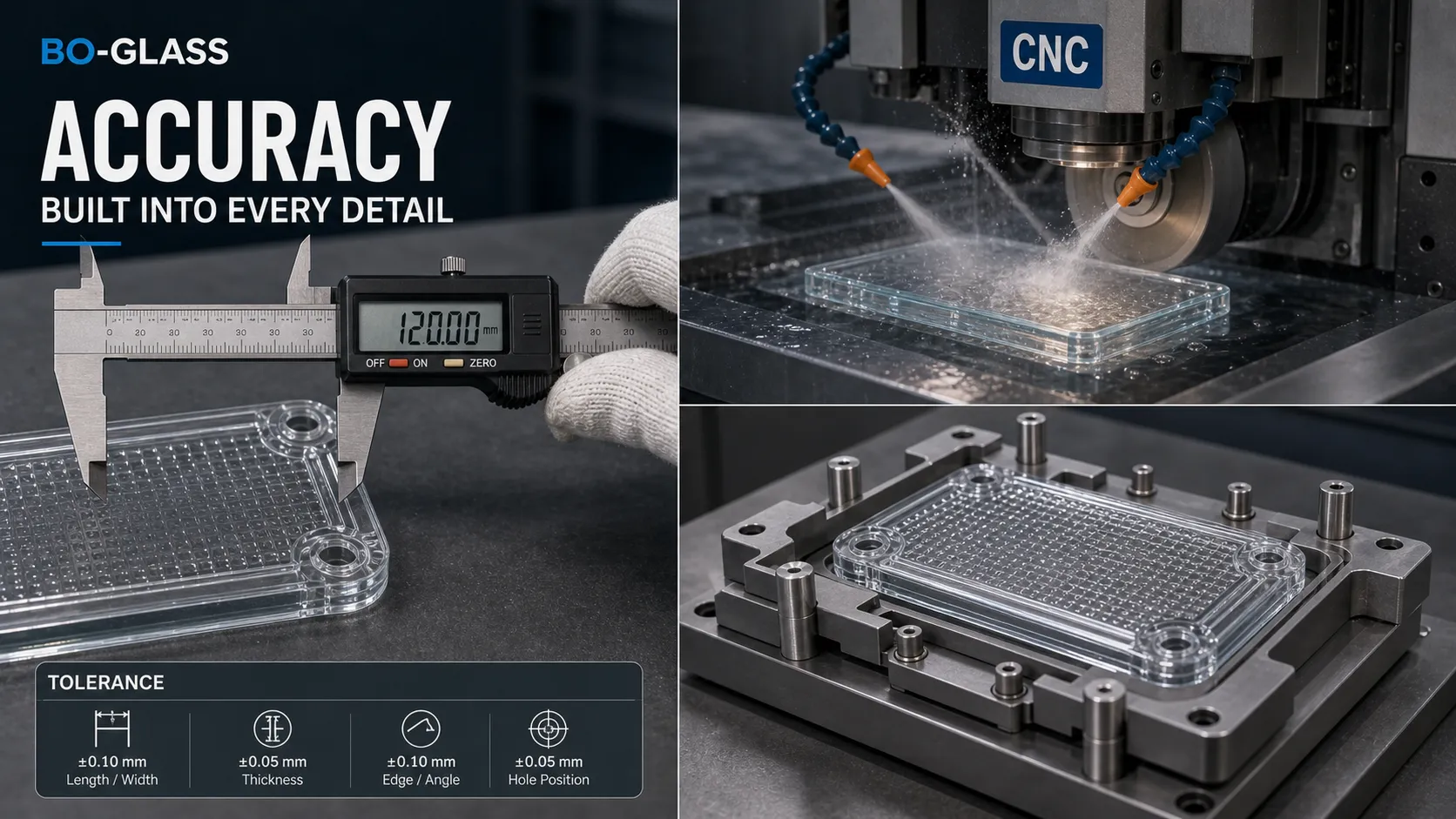
How does BO-GLASS control the critical dimensions and processing accuracy of outdoor lighting glass components?
BO-GLASS controls dimensions according to the luminaire assembly requirements: length, width, thickness, hole locations and flatness for protective cover glass; opening size, height, diameter and roundness for glass shades; curvature and optical-surface geometry for optical glass lenses; and clear aperture and edge geometry for glass windows. Critical dimensions are defined in drawings, approved samples and inspection standards.
The goal of this control is to reduce assembly mismatches, seal compression anomalies, and lot-to-lot variations. For waterproof, pressure-bearing or optically sensitive outdoor luminaires, BO-GLASS can cooperate with customers to conduct sample assembly verification, and then use the confirmed dimensional requirements for mass production.
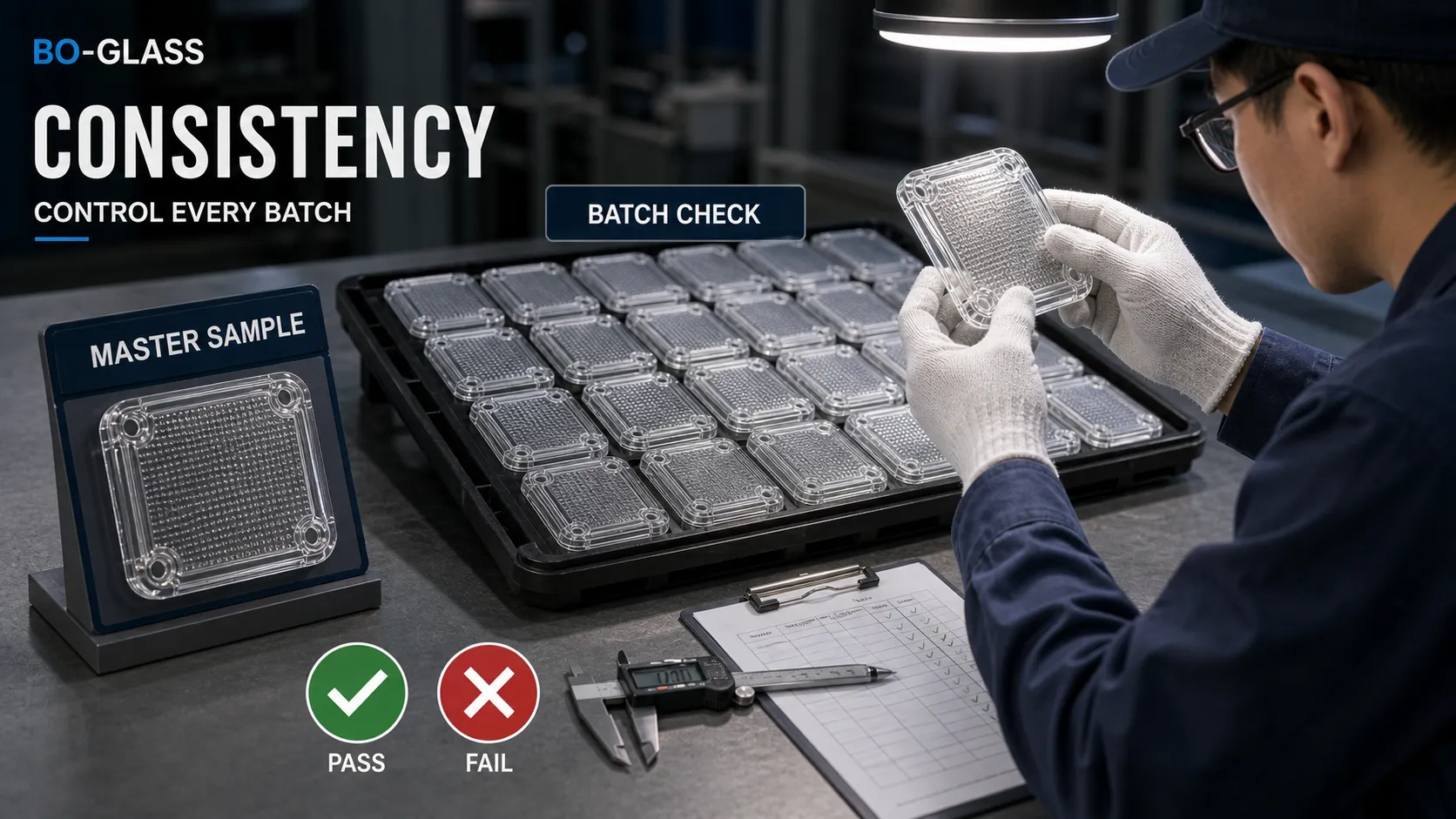
How does BO-GLASS control batch consistency through sample standards and in-process inspection?
BO-GLASS will control batch consistency through customer confirmation samples, drawing versions, material batches, first article inspection, process sampling inspection and shipping inspection. For outdoor lighting glass components, size, color, light transmittance, haze, texture, edge quality and surface treatment can all affect the final fit and lighting effect.
For wall washers, patio projects and architectural lighting installed in rows, batch differences will be easier to see. Therefore, BO-GLASS will recommend that customers clarify the acceptable range at the sample stage and inspect it according to the same standard in batches to reduce the risk of discrepancies in repeated orders.
Engineering decision: A credible batch record should show the retained-master ID, drawing revision, material and production lot, measurement frequency and actual distributions for critical dimensions. Optical batches should add transmittance, haze and L*, a*, b*/ΔE00 under fixed settings. Until those values are published from a named lot, the wording should be treated as a control method, not proof of achieved consistency.
How does BO-GLASS design glass packaging solutions for export orders?
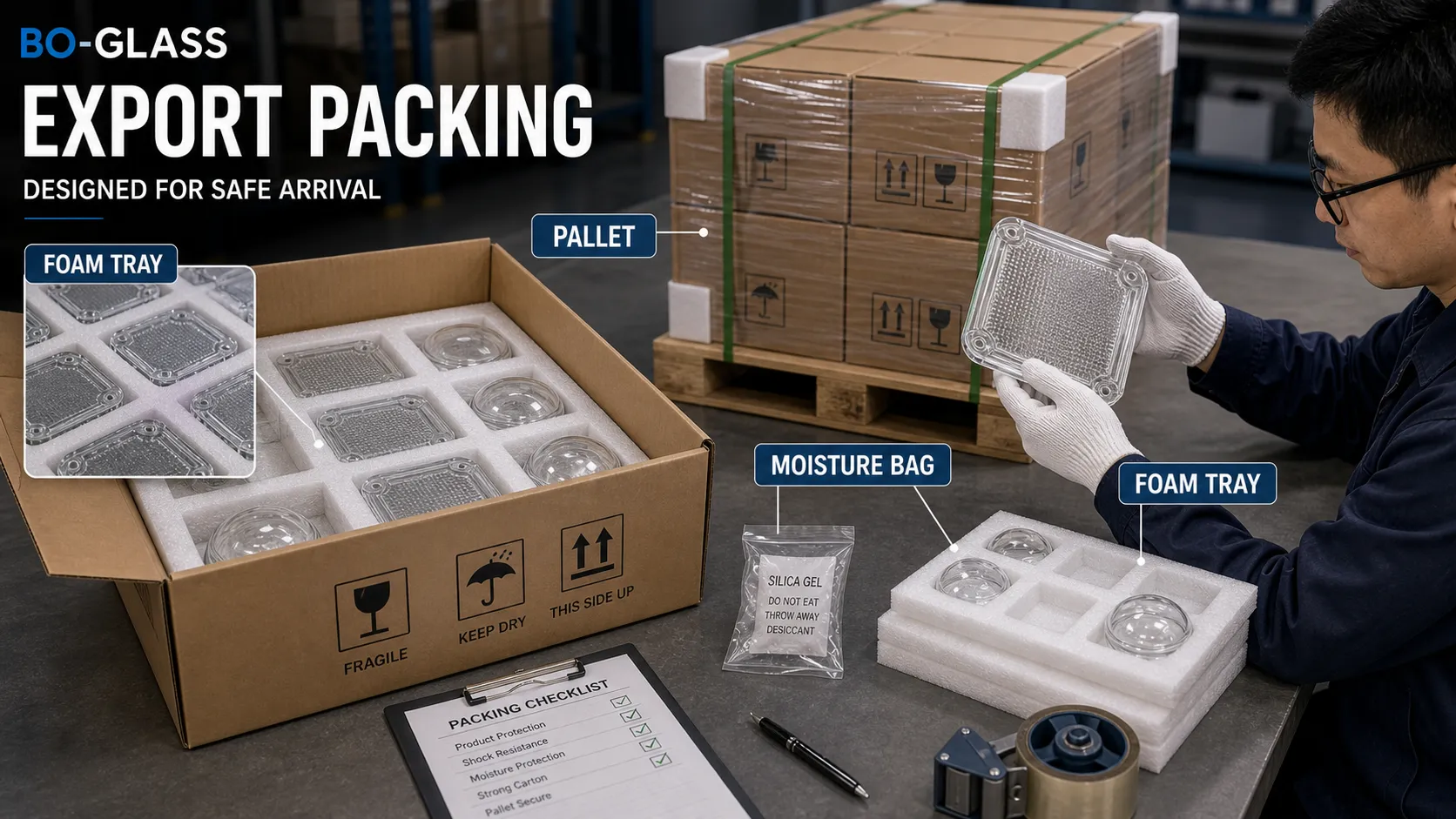
BO-GLASS designs export packaging around the component’s size, shape, weight, vulnerable edges, and transport route. Flat glass requires corner, edge, and surface protection. Three-dimensional glass shades require protection against compression, vibration, and contact between adjacent parts. Special-shaped components may require dedicated internal supports or isolation around weak areas.
Export packaging also needs to consider long-distance transportation, container loading, stacking, warehousing and customer unpacking efficiency. Through appropriate cartons, foam, partitions, pallets or wooden box solutions, we can help customers reduce transportation damage, replenishment delays and project site losses.
How does BO-GLASS provide long-term supply services for overseas outdoor lighting manufacturers?
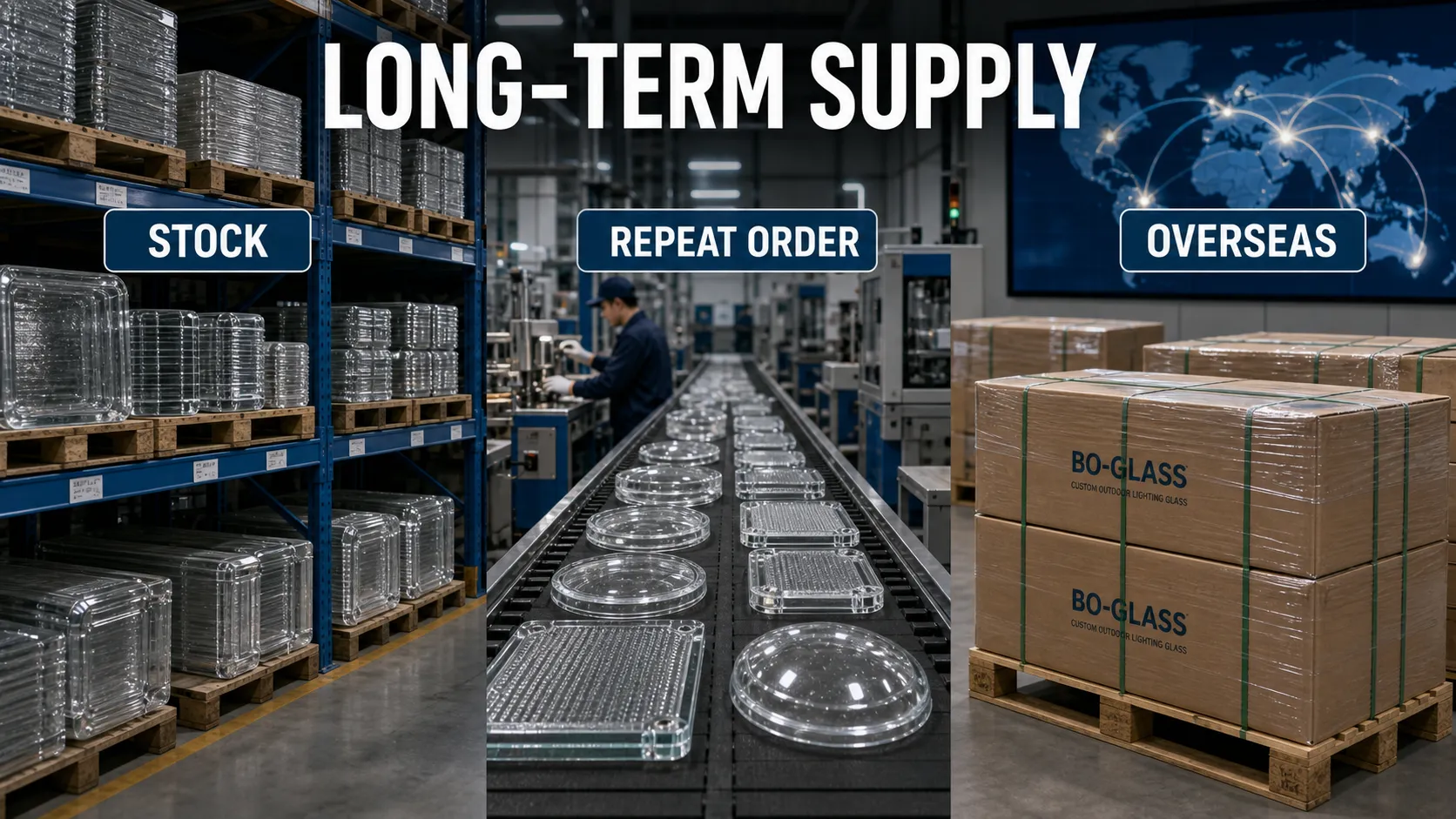
BO-GLASS can provide drawing evaluation, sample development, material suggestions, mass production, quality inspection, packaging export and repeat order support to overseas outdoor lighting manufacturers. For long-term cooperation projects, confirmation samples, drawing versions, inspection standards and packaging records can be kept to help keep subsequent orders consistent.
The key to long-term supply is not just a single delivery, but stable materials, stable processes, stable dimensions and stable communication. BO-GLASS can plan production around customer forecasts and project schedules, reduce repeated development work, and lower the risk of assembly mismatches between the glass components and the luminaire housing, batch variation, and transport damage.
Contact Us
Your feedback fuels our growth, and your questions drive our solutions.
We value your feedback, inquiries, and suggestions. Please feel free to get in touch with us
General inquiries
Please contact us via sales@bo-glass.com, and we will reply to you as soon as possible.
Interested to work with us
Drop your resume at info@bo-glass.com
and we will get back to you shortly.
Request a Custom Glass Quote
Tell us about your project or upload a drawing.
Your drawings remain confidential.
We uses the contact information you provide to us to contact you about our relevent content, products, and services.