
Custom Large-Format Glass Headlamp Lenses for Lamborghini Heritage Vehicles
A heritage headlamp lens is not just a replacement part. It preserves the identity of the car.

For owners of classic Lamborghini vehicles, maintaining originality means preserving every visible component, including the glass lenses that define the appearance of the front lighting system.
Lamborghini needed 500 replacement glass headlamp lenses for a specific vehicle model that was no longer in production. The factory that had originally manufactured the component had discontinued it, leaving no active supply source for the heritage parts program.
The replacement lens measured approximately 600 mm diagonally, making it significantly larger than a typical passenger-car headlamp lens. It also had to reproduce the dimensions, surface quality, optical clarity, and authentic appearance of the original component.
Several large glass manufacturers had already declined the project because of the limited order quantity, substantial tooling investment, demanding quality requirements, and difficulty of producing such a large component on standard equipment.
BO-Glass needed to develop a practical manufacturing solution for a large-format automotive glass lens that combined heritage authenticity with precise fitment and small-batch production.
Custom Large-Format Glass Headlamp Lenses
The Challenge
The client was not simply looking for a transparent glass cover with a similar outline. The replacement lens had to fit the original headlamp assembly, preserve the vehicle’s design language, deliver consistent optical quality, and meet the appearance standards associated with a top-tier luxury automotive brand.
At the same time, the requirement was limited to 500 pieces. This quantity was too small for conventional mass-production economics but still large enough to require a stable, repeatable manufacturing process.
Producing a 600 mm Glass Lens
The lens measured approximately 600 mm diagonally, making it one of the largest automotive glass lenses BO-Glass had been asked to produce.
The size affected almost every stage of manufacturing. The mold was substantially heavier than a standard lamp-lens mold, the quantity of molten glass required for each piece was much greater, and the glass had to travel more than 300 mm from the center of the mold to reach the outer edges.
A lens of this scale could not simply be placed into an existing small-part production process. The press capacity, mold support, pressing force, glass temperature, material quantity, handling method, and annealing cycle all needed to be reviewed.
Modifying the Existing Glass Press
The standard glass press was not originally designed for a component of this size.
The platen area, press stroke, guide rails, mold-lifting system, and structural loading all had to be evaluated before production could begin. Without modification, the heavy mold could create uneven pressure, excessive side loading, or incomplete glass distribution.
The press therefore needed to be adapted without compromising its structural integrity or preventing it from producing smaller components in the future.
Handling the Large Mold
The upper and lower mold sections each weighed approximately 150 to 200 kg. Installing, removing, and adjusting a mold of this size required dedicated lifting equipment and coordinated handling.
A standard mold change could be completed relatively quickly, but the large-format mold required considerably more time for positioning, alignment, and safety checks.
Even a small alignment error could affect the lens dimensions, glass thickness, edge quality, or fit inside the original headlamp assembly.
Controlling Glass Flow
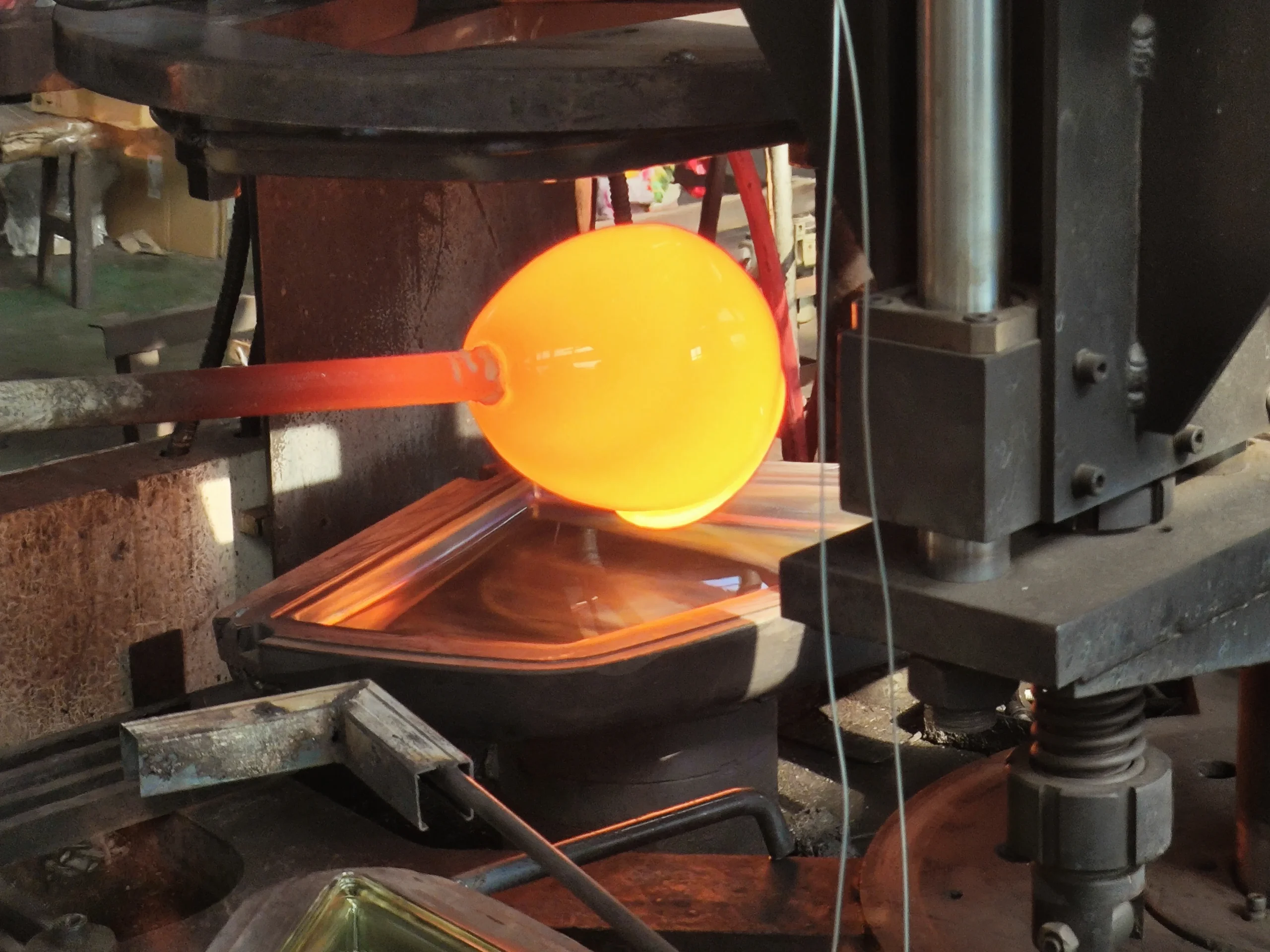
Approximately 3 to 4 kg of molten glass was required for each lens. The glass had to be transferred from the furnace to the press while maintaining sufficient temperature and workable viscosity.
If the glass cooled too quickly, it would not reach the corners and outer edges of the mold. This could create incomplete filling, undersized edges, visible flow lines, or dimensional variation.
If excessive pressure was applied, the glass could escape through the mold gaps and create flashing around the lens. The pressing process therefore needed enough force to fill the mold without damaging the tooling or producing unnecessary excess glass.
Maintaining Dimensional Accuracy
The new lens had to match the original component closely enough to fit the existing headlamp structure.
The overall contour, edge profile, curvature, mounting areas, and external dimensions all needed to remain within the agreed tolerance. Warpage or uneven cooling could make an otherwise clear lens unsuitable for installation.
Because of the size of the component, even a small percentage of dimensional variation could become a visible or functional problem at the edges.
Annealing a Large, Relatively Flat Lens
Large glass components develop internal stress if different areas cool at different speeds. The wide surface of the headlamp lens increased the risk of uneven cooling, distortion, and delayed cracking.
The lens also needed to remain properly supported during annealing. An unsuitable support surface could allow the warm glass to sag or leave contact marks on the optical area.
A longer and more controlled annealing cycle was therefore required compared with a standard lamp lens.
Meeting Luxury Automotive Quality Standards
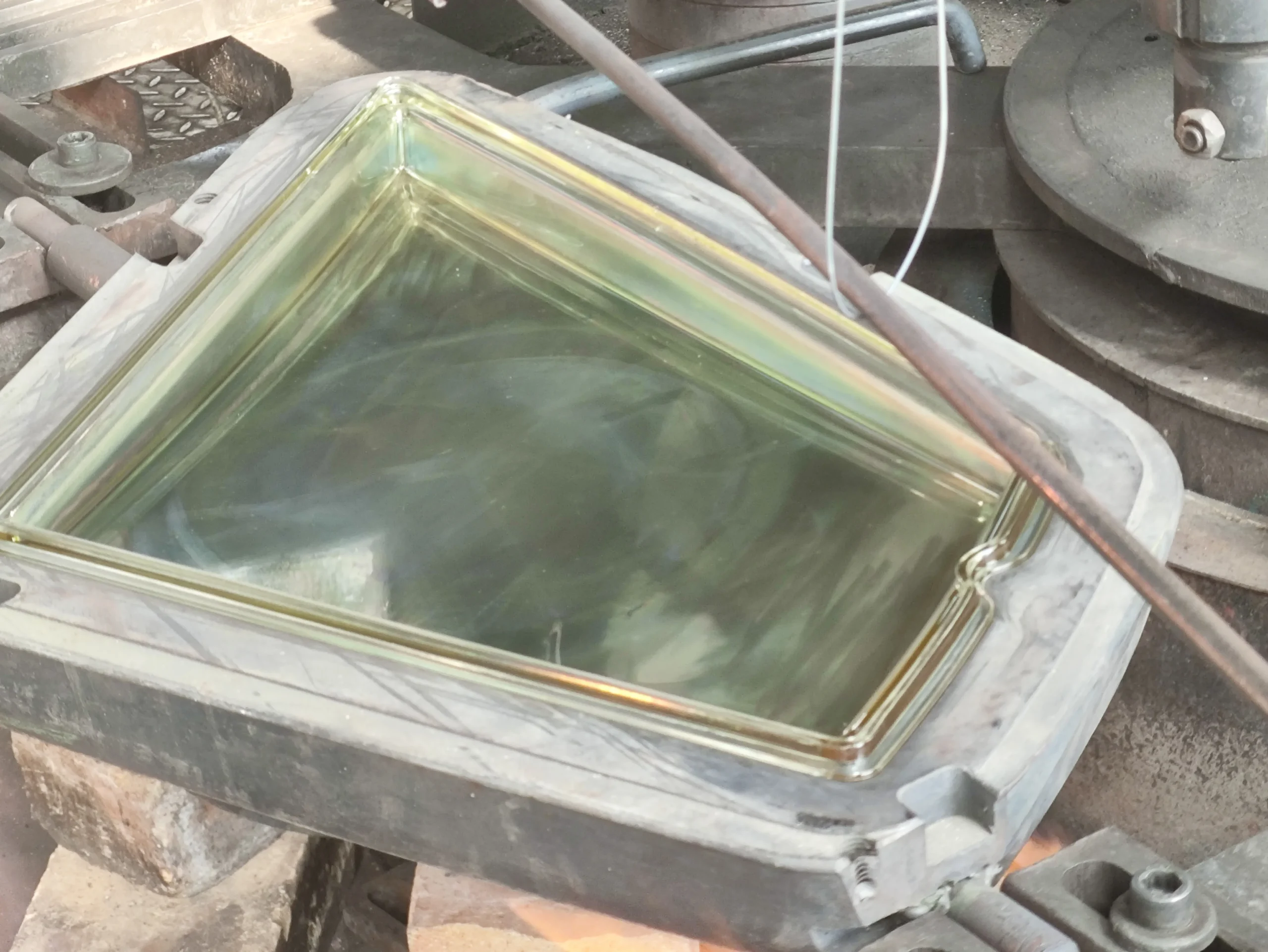
The lens needed high optical clarity, uniform thickness, accurate dimensions, and clean surfaces without visible bubbles, inclusions, scratches, pitting, tooling marks, or distortion.
The limited order quantity did not reduce the quality requirement. Each finished lens still had to meet the appearance and fitment expectations of an official heritage replacement component.
BO-Glass needed to achieve this quality while accounting for the learning curve and higher rejection risk associated with a newly developed large-format mold.
Our Solution
BO-Glass developed a dedicated large-format pressed-glass manufacturing process combining press modification, custom mold engineering, controlled glass gathering, multi-stage pressing, extended annealing, phased sampling, and individual quality inspection.
Instead of treating the product as an enlarged standard lens, we designed the process around the specific challenges created by its size, weight, geometry, optical surface, production quantity, and heritage application.
Custom Press Modification
BO-Glass designed and fabricated a reinforced steel bed to support the large mold and distribute the pressing force more evenly across its surface.
The custom bed extended the effective working area of the press while providing a more stable base for the tooling. The press stroke and stop settings were adjusted to accommodate the assembled mold, and the guide system was reinforced to manage the additional weight and side loading.
The mold-lifting system was also rebalanced so the heavy upper section could move smoothly during opening and closing.
The press modification process took approximately three months from initial engineering evaluation to implementation.
Large-Format Mold Engineering
A dedicated mold was developed for the 600 mm glass lens.
The mold structure had to withstand repeated contact with molten glass while maintaining a smooth surface and stable dimensions. Ductile iron was selected for its ability to handle the thermal and mechanical stresses associated with glass pressing.
The mold surfaces were machined carefully to reproduce the original lens geometry and achieve the required surface quality. Particular attention was given to the overall contour, edge profile, mounting areas, curvature, and dimensional relationship between the upper and lower mold sections.
Controlled Mold Venting
Air needed a controlled path out of the mold as the molten glass moved toward the outer edges.
If the vents were too small or poorly positioned, trapped air could create bubbles, incomplete filling, or surface defects. If the vents were too large, molten glass could escape and form fins or excessive flashing.
BO-Glass evaluated the expected glass-flow path and positioned the vents around critical areas of the mold. The vent structure was then refined during the sampling stage according to the actual appearance of the pressed lenses.
Multi-Stage Pressing Profile
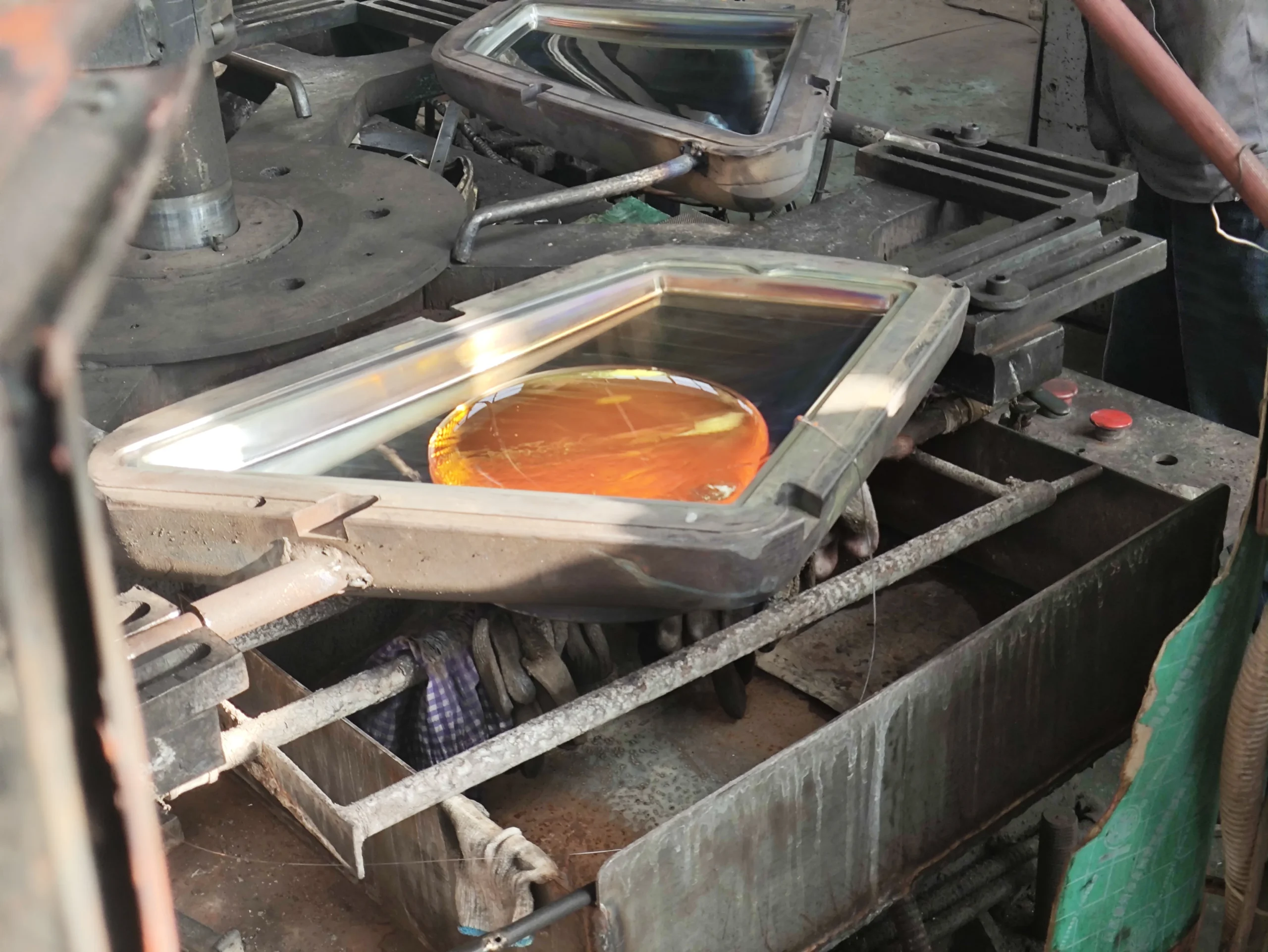
A dedicated pressing profile was developed to help the molten glass spread evenly across the large mold.
The process began with controlled initial pressure to distribute the glass outward from the center.
Full pressure was then applied to move the glass into the corners and outer edges. A defined dwell period allowed the material to begin setting before pressure was released and the mold was opened.
The timing of each stage was adjusted according to the glass temperature, flow behavior, surface appearance, and dimensional results observed during sampling.
This controlled sequence reduced the risk of incomplete edges, excessive flashing, uneven thickness, and surface dullness.
Controlled Glass Gathering and Transfer
Each lens required approximately 3 to 4 kg of molten glass.
BO-Glass established a controlled gathering procedure to improve consistency in material quantity and temperature. Experienced operators transferred the glass from the furnace to the press as quickly and steadily as possible to reduce heat loss.
Because handling a gather of this size is physically demanding, trained operators worked in rotation to maintain consistent timing and reduce fatigue-related variation.
Extended Annealing
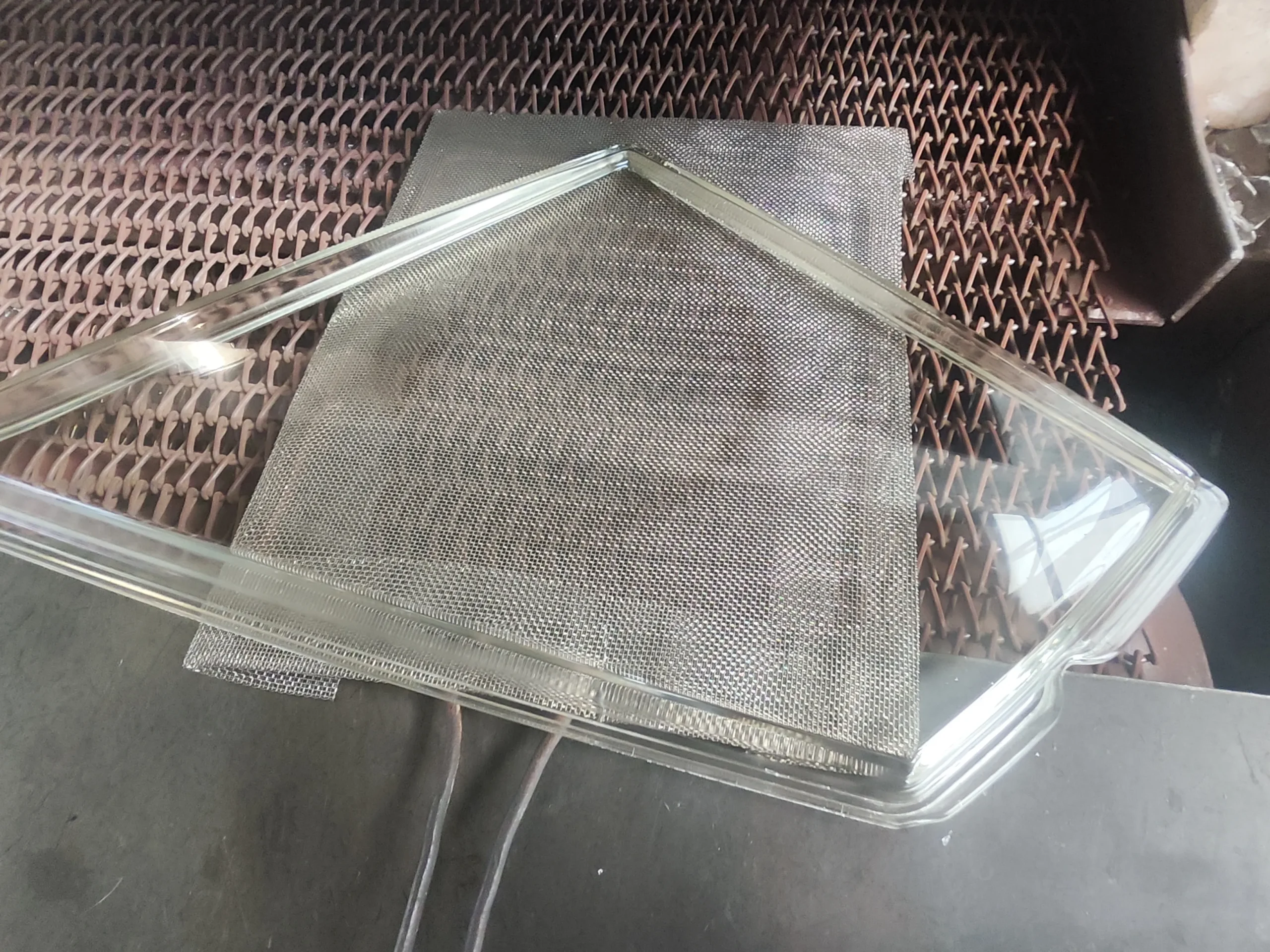
After pressing, each lens was transferred to the annealing oven while still hot.
The large lens was held within a controlled temperature range long enough for heat to equalize throughout the component. It was then cooled gradually to reduce internal stress and minimize the risk of cracking or warpage.
The total annealing cycle was extended to approximately 12 to 18 hours, compared with the shorter cycle normally used for standard-sized glass lenses.
Dedicated support points held the lens around its edges during annealing. This helped maintain the required contour without placing marks on the primary optical surface.
Phased Sampling and Process Development
BO-Glass began with trial pieces rather than moving directly into the full 500-piece production run.
The first samples were used to evaluate:
– Glass quantity and gathering temperature
– Mold temperature
– Pressing pressure and timing
– Edge filling
– Overall dimensions
– Lens curvature
– Surface quality
– Thickness distribution
– Annealing performance
– Fitment against the approved reference
The results were documented, and the mold or pressing parameters were adjusted where necessary. This phased approach allowed the process to stabilize before full production.
Individual Quality Inspection
Every finished lens was inspected individually using controlled lighting, backlighting, dimensional gauges, and contour-checking tools.
The inspection focused on:
– Optical clarity
– Overall dimensions
– Edge profile and mounting geometry
– Surface scratches or tooling marks
– Visible bubbles or inclusions
– Glass thickness consistency
– Warpage or distortion
– Complete filling around the outer edges
– General conformity with the approved sample
Lenses that did not meet the agreed visual or dimensional standards were removed from the finished batch and remelted where possible.
The Result
BO-Glass established a repeatable manufacturing process for a 600 mm pressed-glass headlamp lens that had previously been unavailable through the original supply chain.
The modified press, reinforced mold support, controlled glass-gathering process, multi-stage pressing profile, and extended annealing cycle made it possible to produce the large component in a limited batch without relying on a mass-production line.
The finished lenses reproduced the dimensions, contour, optical character, and authentic glass appearance required for the heritage vehicle application. Each piece was inspected for surface quality, dimensional accuracy, thickness consistency, edge filling, and distortion before approval.
The project provided Lamborghini with a practical source for 500 discontinued replacement lenses, allowing the heritage parts program to support owners who wanted to preserve the originality and value of their classic vehicles.
For BO-Glass, the project demonstrated that traditional glass-pressing equipment can remain highly valuable when it is supported by suitable engineering modifications and experienced process control. A component that was too large for a standard press and too limited in quantity for a conventional mass-production supplier became achievable through the right combination of tooling, technique, and quality management.
Why Choose BO-Glass?
Large-format automotive glass projects often involve challenges that cannot be solved by simply enlarging a standard production process. Mold weight, press capacity, glass-flow distance, annealing time, handling requirements, dimensional variation, and optical quality all become more difficult as the component increases in size.
BO-Glass combines traditional pressed-glass manufacturing with practical equipment engineering. When a component exceeds the normal working area of our equipment, we can evaluate the press structure, mold support, stroke, guide system, lifting method, and operating process to determine whether a controlled modification can make production possible.
Our small-batch capability is particularly suitable for discontinued automotive parts and heritage vehicle programs. We can develop dedicated tooling and produce limited quantities without requiring the extremely large orders expected by automated mass-production facilities. This gives clients a practical route for supporting rare vehicles whose original components are no longer commercially available.
We use phased sampling to understand how the glass behaves inside a new mold before beginning full production. Glass quantity, temperature, pressure, pressing time, venting, edge filling, surface quality, and annealing performance can be refined progressively. Once the approved process has been established, the settings are documented to support consistent repeat production.
Large glass components also require careful stress control. BO-Glass can develop extended annealing cycles and dedicated support methods based on the size, thickness, and geometry of the product. This reduces the risk of warpage, distortion, internal stress, and delayed cracking.
Every finished lens is inspected individually for optical clarity, dimensions, surface condition, thickness consistency, edge quality, and conformity with the approved sample. BO-Glass supports demanding projects that require engineering flexibility, experienced operators, careful communication, and the willingness to solve manufacturing problems that conventional high-volume suppliers may decline.
Contact Us
Your feedback fuels our growth, and your questions drive our solutions.
We value your feedback, inquiries, and suggestions. Please feel free to get in touch with us
General inquiries
Please contact us via sales@bo-glass.com, and we will reply to you as soon as possible.
Interested to work with us
Drop your resume at info@bo-glass.com
and we will get back to you shortly.
We uses the contact information you provide to us to contact you about our relevent content, products, and services.