
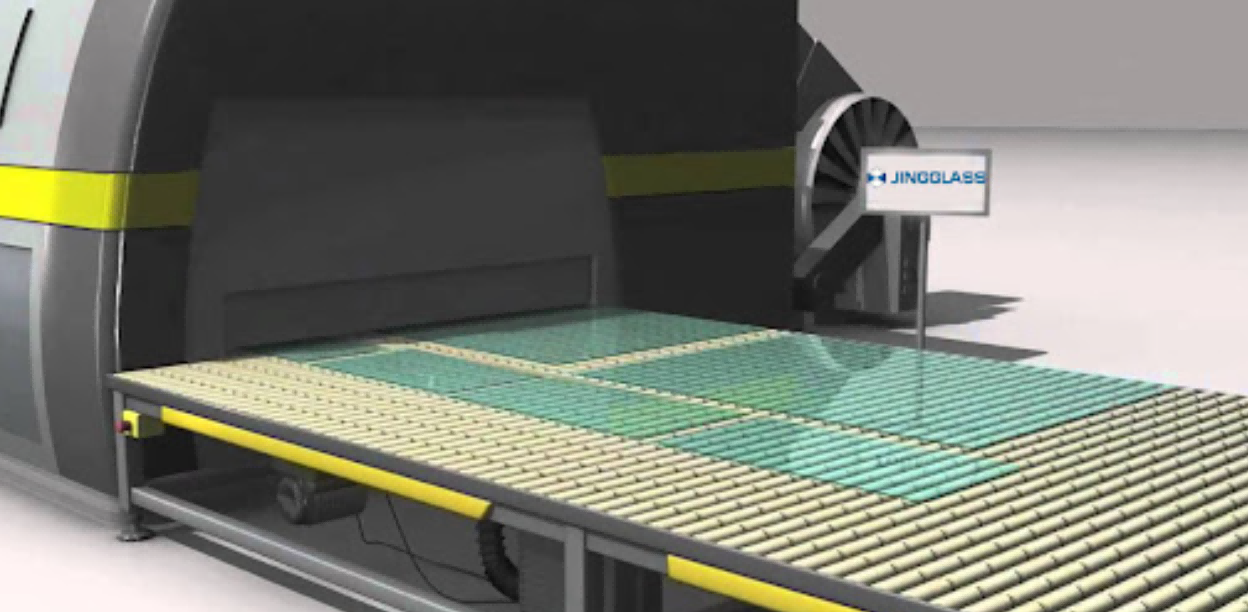
Air cushion tempered glass production line
The air cushion tempered glass production line uses airflow to support the glass sheets for heating and cooling to reduce scratches and improve tempering quality.
Air cushion tempered glass production line
(2) Air cushion tempering electric heating furnace The air cushion heating furnace consists of a frame, conveying wheels and transmission devices, an air cushion bed, and an upper heating device. The air cushion bed is installed on the second section of the heating furnace and the cooling equipment. The front section of the heating furnace is in the form of electric heating. The conveying relies on metal rollers and high-temperature-resistant glass cloth wrapping. The rear section is the air cushion heating the bed surface. The purpose is to increase the heat absorption rate of the glass at high temperatures, while reducing the scratches of the glass on the metal rollers, ceramic rollers, or molten quartz rollers by foreign objects, and can also ensure the high-temperature flatness of the glass. Each bed surface is kept on the same plane, otherwise, the glass will be blocked by the uneven bed surface during operation and cannot run.
The air cushion bed is at a certain inclination angle with the horizontal plane. High-temperature gas is ejected from the air cushion bed to lift the glass. When the glass leaves the air cushion bed surface at a certain height, it is driven by the edge friction wheel to reciprocate or move forward to other workstations. The flat air cushion bed can be composed of nozzles or ceramic bed surfaces. The curved air cushion bed is made of ceramic surface. When the air cushion heating bed is composed of nozzles, the nozzles are arranged in an array to form a bed surface. The bed surface is supported on a frame, and the height of the frame can be adjusted. The inclination angle of the bed surface can be changed by adjusting the height of the frame. The nozzles on the bed surface are concentrated on a wind, and the gas is supplied by a unified gas source, and the pressure of the air cushion is ensured to be uniform. When making curved glass, the ceramic bed surface used is to process appropriate small holes on the bed surface. The ceramic bed surface is connected to the bellows, the gas is supplied by the same gas source, and the pressure of the air cushion is ensured to be uniform. The upper part of the heating furnace is an electric heating device and a small amount of heating gas is used to ensure the uniformity of heating.
(3) Gas supply system The gas supply system uses high calorific value gas fuels, such as natural gas, cracked petroleum gas, and petrochemical gas, as the main heat source. It has a complete set of mixed-ratio combustion and pressure regulation devices. The high-temperature gas is transported to the air cushion and the upper heater through pipelines and sprayed out from densely distributed small nozzles. The gas supply system includes a blast system, a pressure air supply system, a gas mixing system, a flow control system, etc. The pressure of the heating gas supplied to the lower bed of the air cushion must be higher than that of the upper bed to lift the glass, so the upper and lower pressures must be adjusted separately. The height and pressure of the glass lifted are determined by the thickness of the glass.
(4) Exhaust system The exhaust gas generated by the air cushion heating is discharged from the heating furnace through a pipeline. The pipeline is equipped with a door for automatic adjustment.
(5) Cooling bed This part is one of the key equipment for air cushion tempered glass. It consists of a quenching section and a cooling section. Small equipment can combine the two sections into one section and adjust them in time. The structure of the cooling bed surface is the same as that of the heating bed surface. The cooling air pressure and air volume of the glass in the quenching section are high, while the cooling section uses low pressure and small air volume. In addition to the array arrangement of the cooling nozzles, it should be noted that the arrangement should be at a certain angle to the running direction of the glass so that the cooling uniformity of the glass is the best. During cooling, the hot air flow should be discharged in time, so an exhaust hole is set in the cooling box. The cooling nozzles should also be installed on the same box, and the cooling air source should be provided by a unified air supply system. The height, aperture, arrangement position, and spacing of the nozzles should be strictly controlled, otherwise, there will be problems such as glass running jams and uneven cooling.
(6) Conveying system The glass conveyor uses roller surface friction to drive the glass to run, except for the loading platform, unloading platform, and the front section of the heating furnace. The rest of the glass conveyor uses a circular steel plate (disc) to rub the side of the glass to drive the glass to run. The disc is installed at the upper end of each vertical shaft, and the lower end is driven by a worm gear through a motor, a reducer, a clutch, and other devices to change the running direction and speed. Other forms of transmission such as chains are also used.
(7) Control system The control system of the air cushion tempered glass production line needs to control the gas volume, temperature, pressure, and conveying speed throughout the entire process to ensure that the glass is coordinated throughout the entire tempering process. The pressure and flow part needs to measure the fuel value of the gas supply system and the temperature of the bed surface to determine the air mixing ratio and the pressure gauge flow, etc. The cooling bed surface measures the glass floating height and the surface stress of the glass, and adjusts the cooling gas pressure and flow of the bed surface. The temperature difference at the measuring point in the heating furnace is controlled within ±5°C. The glass conveying speed is controlled so that the latter section is higher than or equal to the former section.
Table 3-17: Main Technical Parameters of Air Cushion Tempering Equipment
| Item | Parameter |
|---|---|
| Bent Tempered Glass | |
| Glass Specification | 790 mm × 1770 mm |
| Glass Thickness | 3 - 6 mm, minimum 2.3 mm |
| Glass Product Shape | Single-sided bent; with heating wire, enameled or non-enameled, one straight edge |
| Glass Conveying Speed | 4600 mm/min |
| Bent Glass Curvature Radius | Approximately 1000 mm |
| Product Curvature Conformity | ≤ 1.5 mm |
| Product Quality | Meets ANSI.Z26.1 standards (USA) |
| Maximum Fragment Mass | 4.25 g/piece |
| Production Capacity (Automotive Side Windows) | 350 - 1000 pieces/h; Average: 500 - 700 pieces/h |
| Glass Conveying Interval Distance | Minimum 200 mm |
| Average Yield Rate | 90% - 98% |
| Flat Tempered Glass | |
| Glass Specification (Maximum Size) | 1520 mm × 2440 mm |
| Glass Specification (Minimum Length) | 630 mm |
| Glass Thickness | 3 - 8 mm, minimum 2.3 mm |
| Glass Product Shape | One straight edge |
| Glass Conveying Speed | 4600 mm/min |
| Production Capacity (3 mm) | 235 m²/h |
| Production Capacity (5 mm) | 290 m²/h |
| Production Capacity (6 mm) | 250 m²/h |
| Average Yield Rate | 90% - 95% |
Contact Us
Your feedback fuels our growth, and your questions drive our solutions.
We value your feedback, inquiries, and suggestions. Please feel free to get in touch with us
General inquiries
Please contact us via sales@bo-glass.com, and we will reply to you as soon as possible.
Interested to work with us
Drop your resume at info@bo-glass.com
and we will get back to you shortly.
Request a Custom Glass Quote
Tell us about your project or upload a drawing.
Your drawings remain confidential.
We uses the contact information you provide to us to contact you about our relevent content, products, and services.