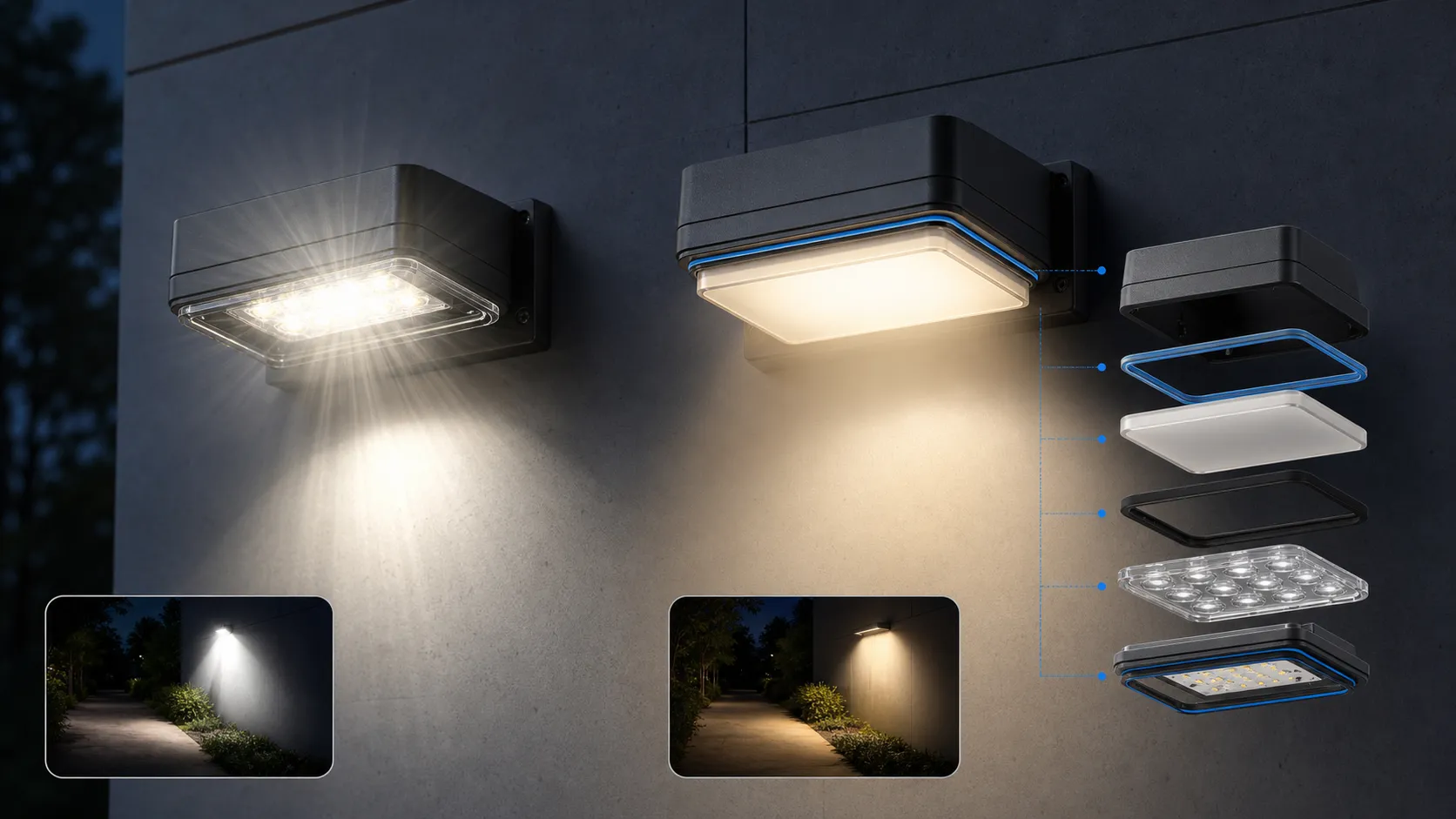
Outdoor Lighting Glass Components Guide

Learn how to select glass shades, protective cover glass, optical glass lenses, and glass windows for outdoor luminaires. Compare application risks, materials, manufacturing processes, optical performance, sealing, durability, and purchasing requirements across 14 focused engineering guides.
Outdoor Lighting Glass Components Guide - Complete English Edition

Chapter 1: Outdoor Lighting Types and Glass Component Basics

What are the different requirements for glass shades, glass covers and glass lenses for different types of outdoor luminaires?

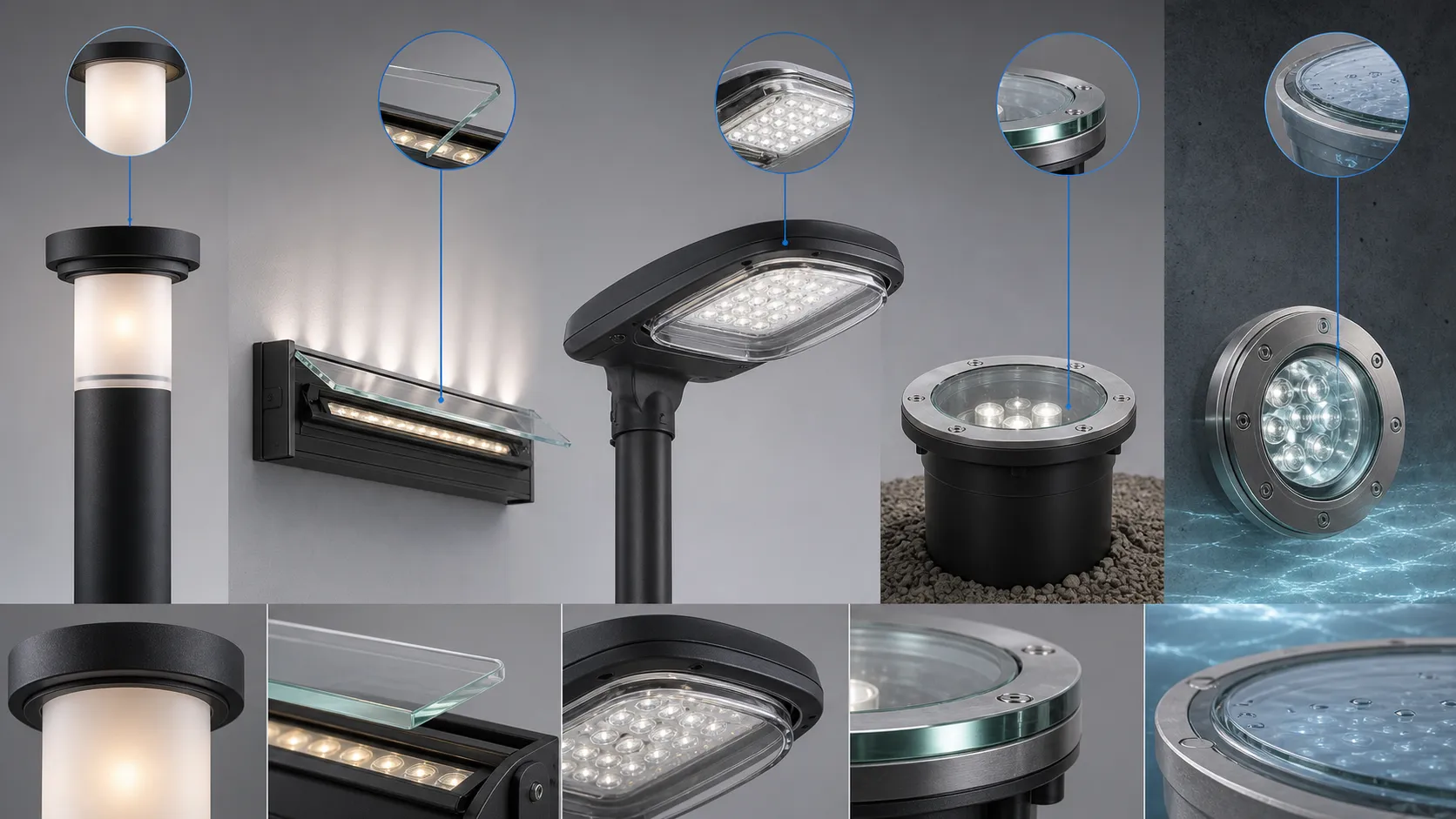
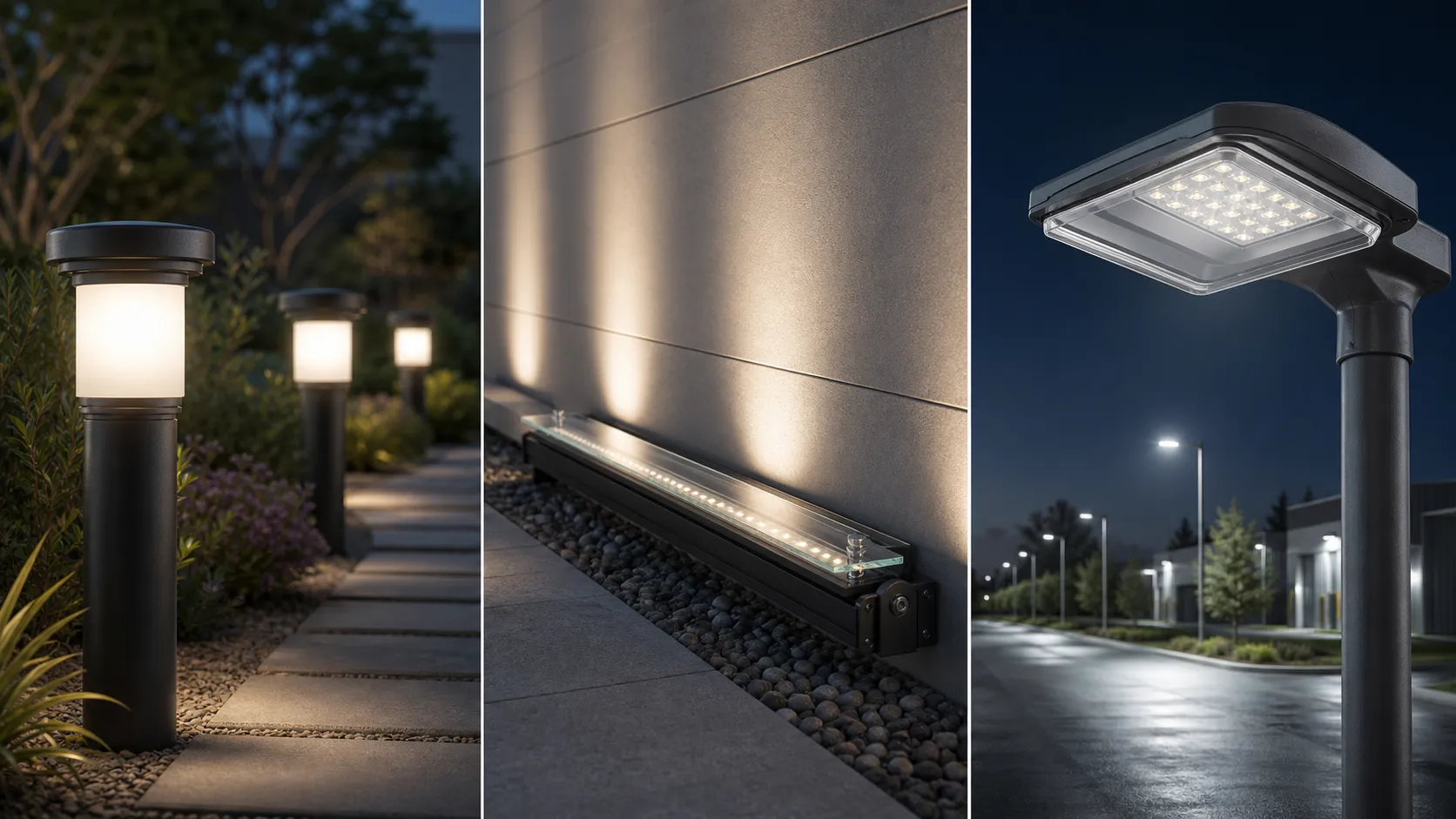
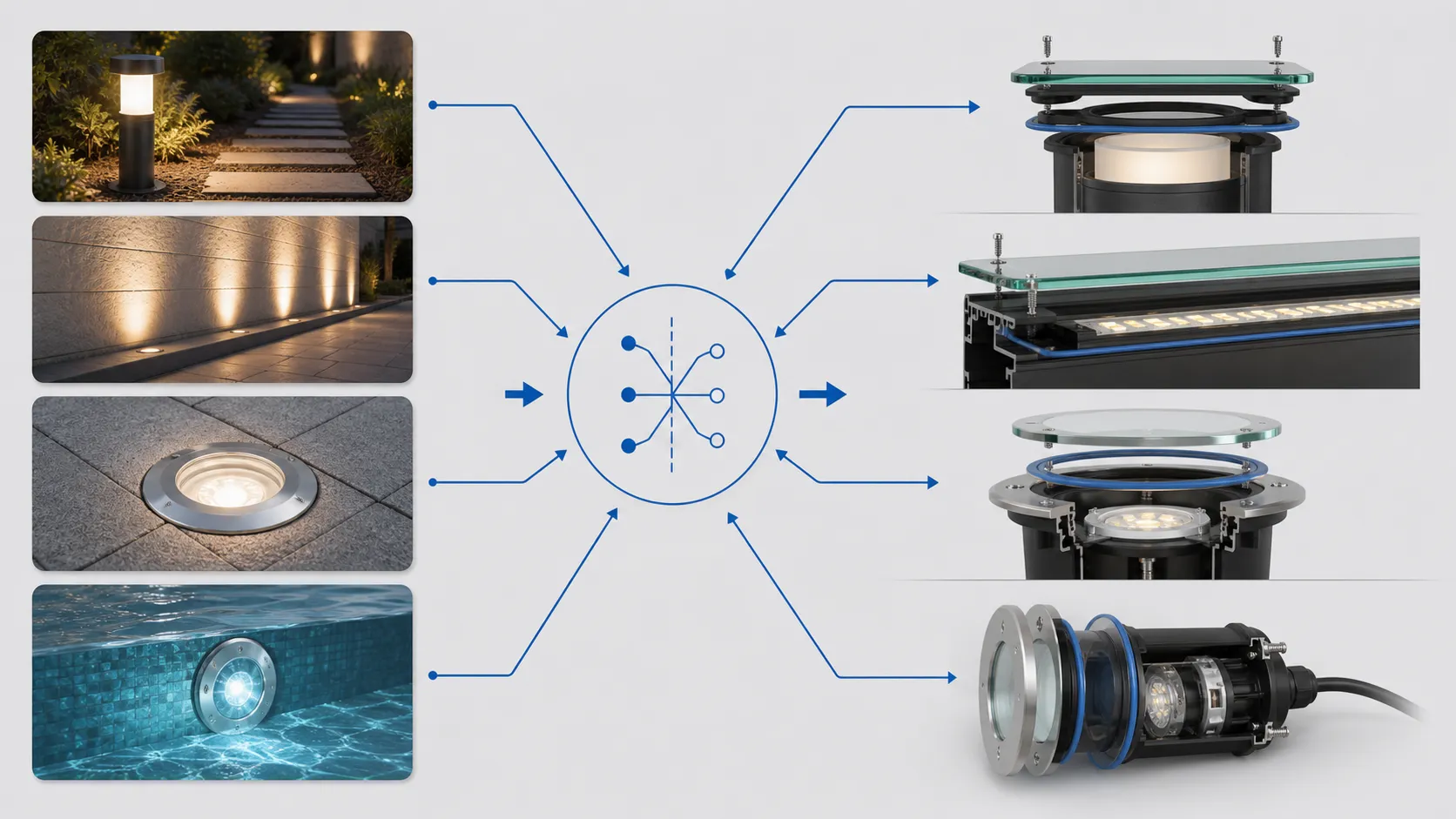
Different types of outdoor lighting fixtures have very different requirements for glass components. Garden lights, garden lights, outdoor chandeliers and decorative wall lights usually pay more attention to the shape, soft light and appearance texture of the glass cover; wall washers, floodlights, street lights and wall pack lights pay more attention to the light transmittance, flatness, sealing fit and long-term weather resistance of the glass cover; underground lights, underwater lights and industrial lights pay more attention to pressure bearing, impact resistance, edge safety and sealing reliability.

When purchasing or customizing, you should not only select glass based on the name of the luminaire, but also confirm the specific requirements for the glass cover, glass cover or glass lens based on the application scenario, installation method, light emission direction and complete luminaire structure.

What are the different requirements for glass shades, glass covers and glass lenses for different types of outdoor luminaires?

What are the differences in the glass requirements for landscape lighting, architectural lighting and road lighting?

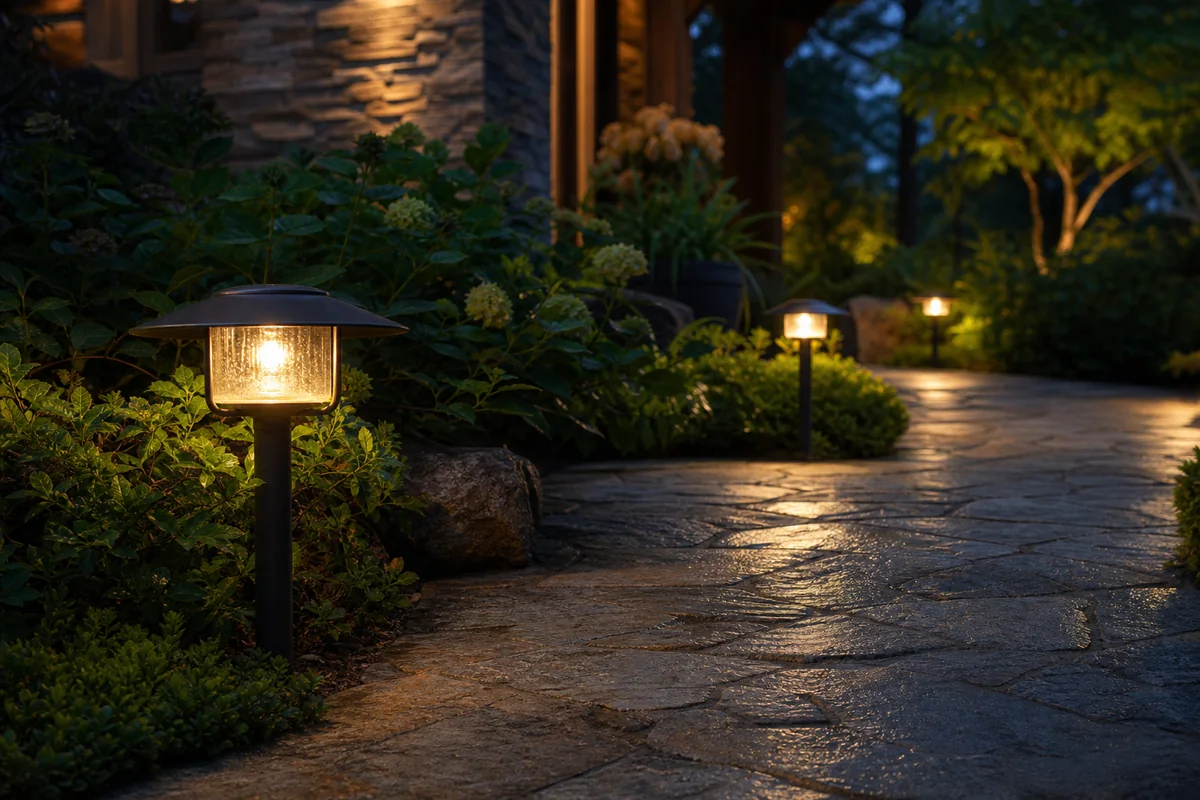
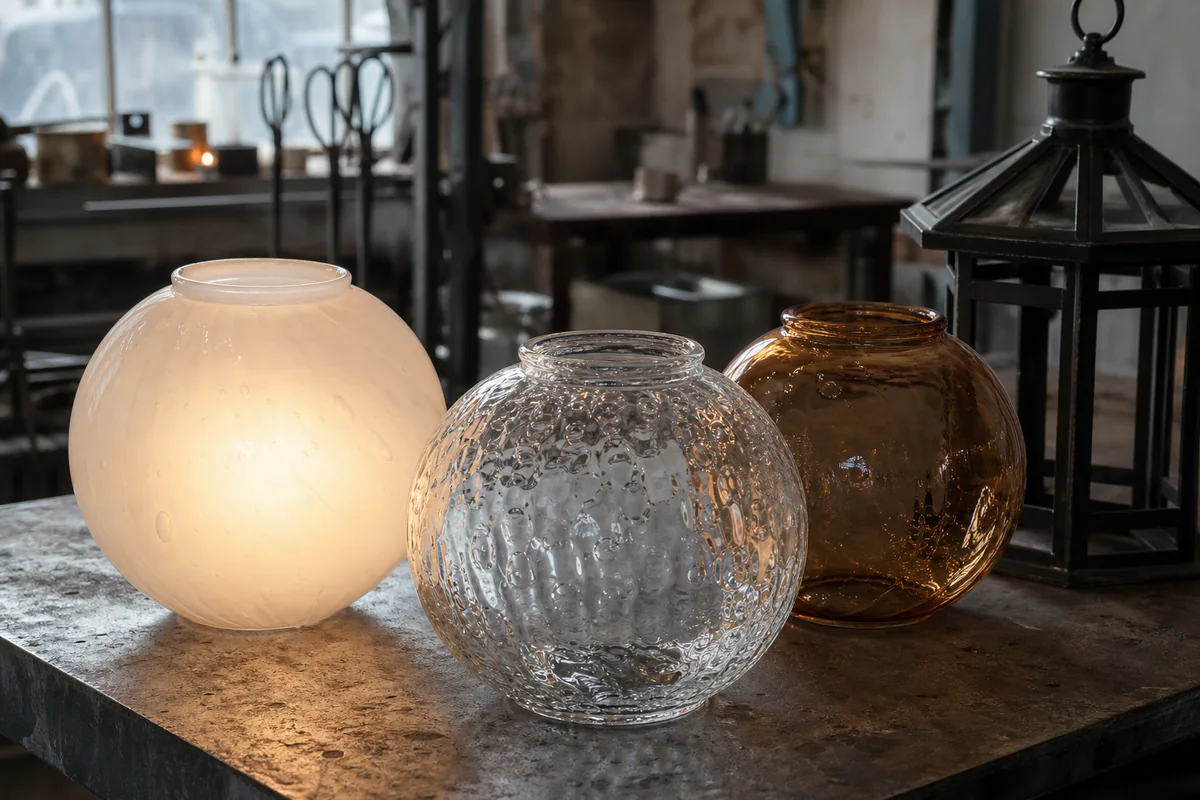
Landscape lighting pays more attention to visual atmosphere. Glass pieces usually require soft light, low glare, texture decoration and color performance, such as opal glass, frosted glass, water ripple glass or amber glass. It focuses on whether people are comfortable when viewing at close range and whether the luminaires have texture.

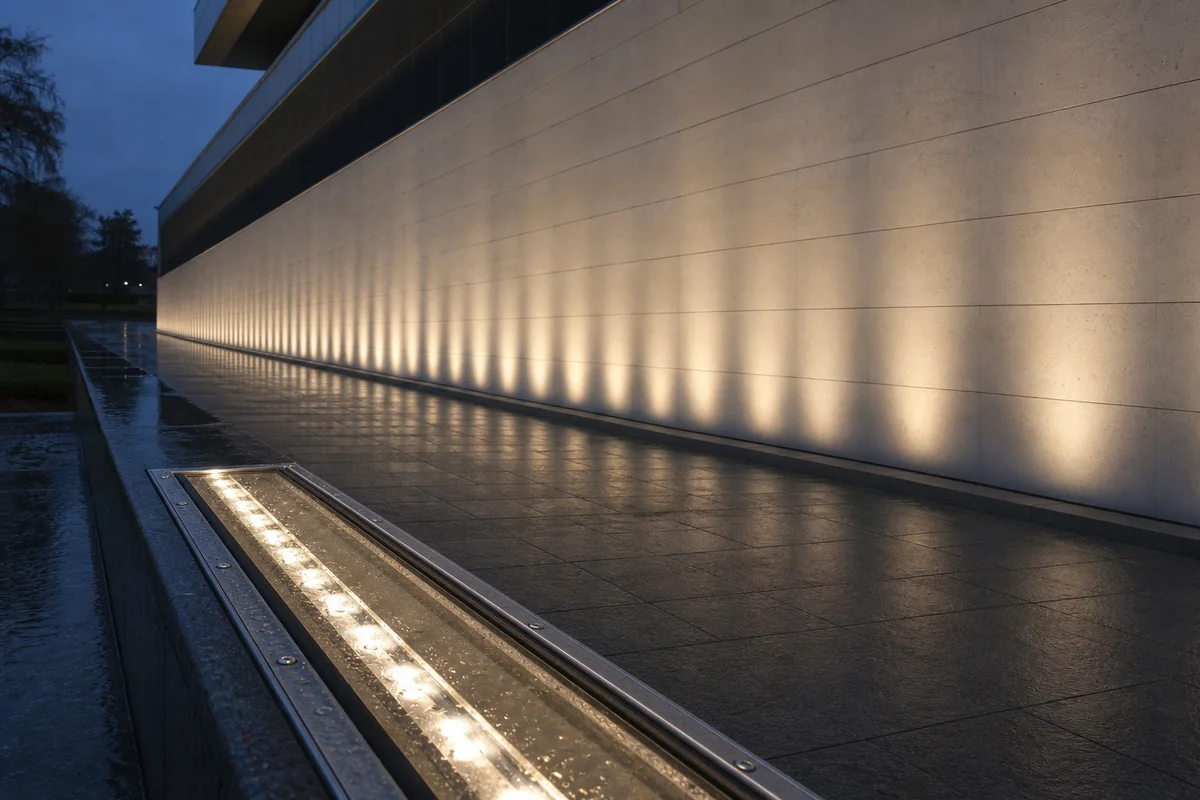
Architectural lighting pays more attention to beam consistency and wall effect. Wall washers, linear lights and floodlights often require flat glass covers, stable light transmission, and small batch color variation. The lens also needs to control the beam angle and spot edge. Road lighting places more emphasis on light distribution efficiency, impact resistance, anti-fouling maintenance and long-term weather resistance. Glass components must strike a balance between high light transmittance, low glare and low maintenance.

What are the differences in the glass requirements for landscape lighting, architectural lighting and road lighting?

Why can’t outdoor lighting just look at brightness, but also at glass structure and optical effects?

Brightness can only indicate how much light the luminaire has, but it does not indicate whether the light is comfortable, even, or in the right position. If outdoor lighting only pursues brightness, it is prone to dazzling glare, cluttered light spots, excessive spill light, or intrusion from neighborhood light.

The light transmittance, haze, texture, curvature and thickness of the glass will change the actual light emission effect; the assembly structure of the glass and the housing will affect watersampling, dust-resistant, heat dissipation and lifespan. Therefore, a good outdoor lighting glass solution must look at both optical effects and structural reliability, not just light source power or nominal brightness.

Why can’t outdoor lighting just look at brightness, but also at glass structure and optical effects?

Which outdoor light fixtures require glass shades, and which ones are better suited to glass covers?

Courtyard lights, garden lights, outdoor chandeliers, lantern lights, retro wall lights and decorative landscape lights are usually more suitable for using glass shades. Glass shades can envelop light sources to create a look, while softening the light with frosted, opalescent, embossed or colored effects.

Wall washers, floodlights, street lights, underground lights, wall package lights and most industrial lighting are more suitable for using glass covers. The glass cover is mainly responsible for sealing, protecting and maintaining stable light emission. It usually requires flat dimensions, safe edges, high light transmittance, and can reliably cooperate with gaskets, pressure frames or glue.

Which outdoor light fixtures require glass shades, and which ones are better suited to glass covers?

What is the difference between a glass cover, a glass cover, a glass lens and a glass window?

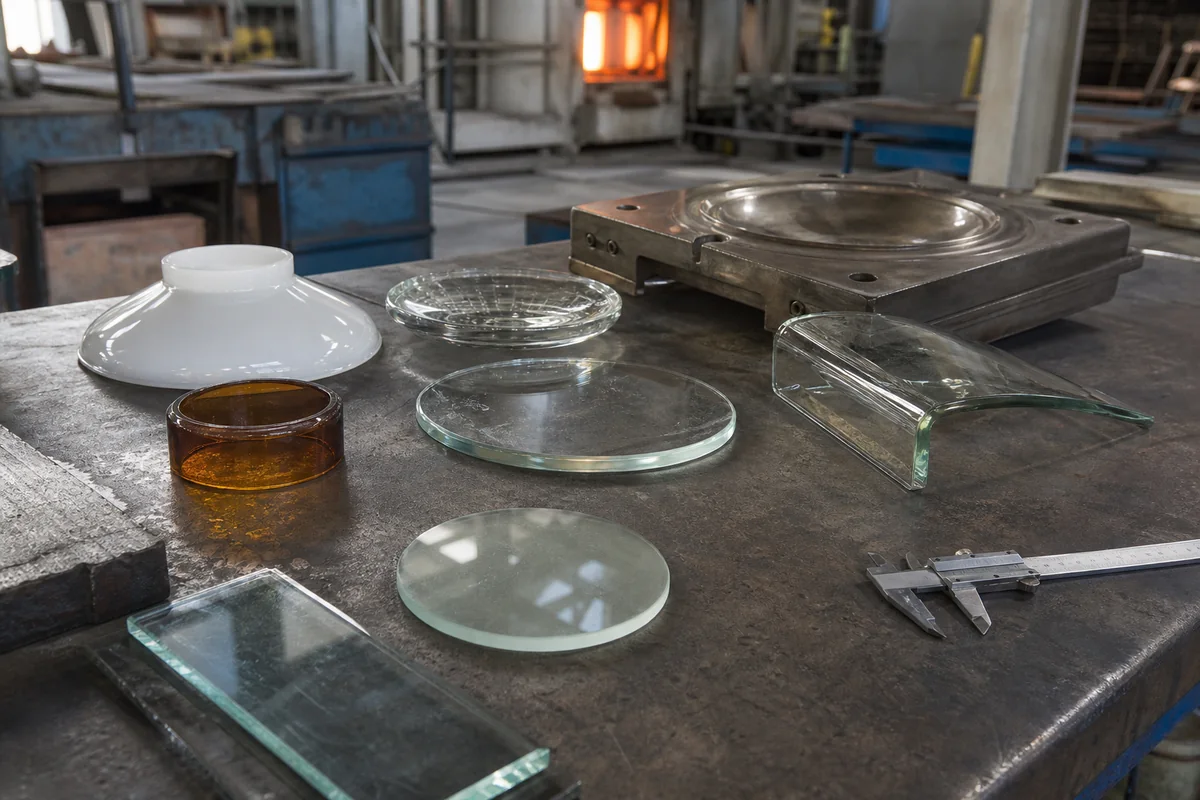
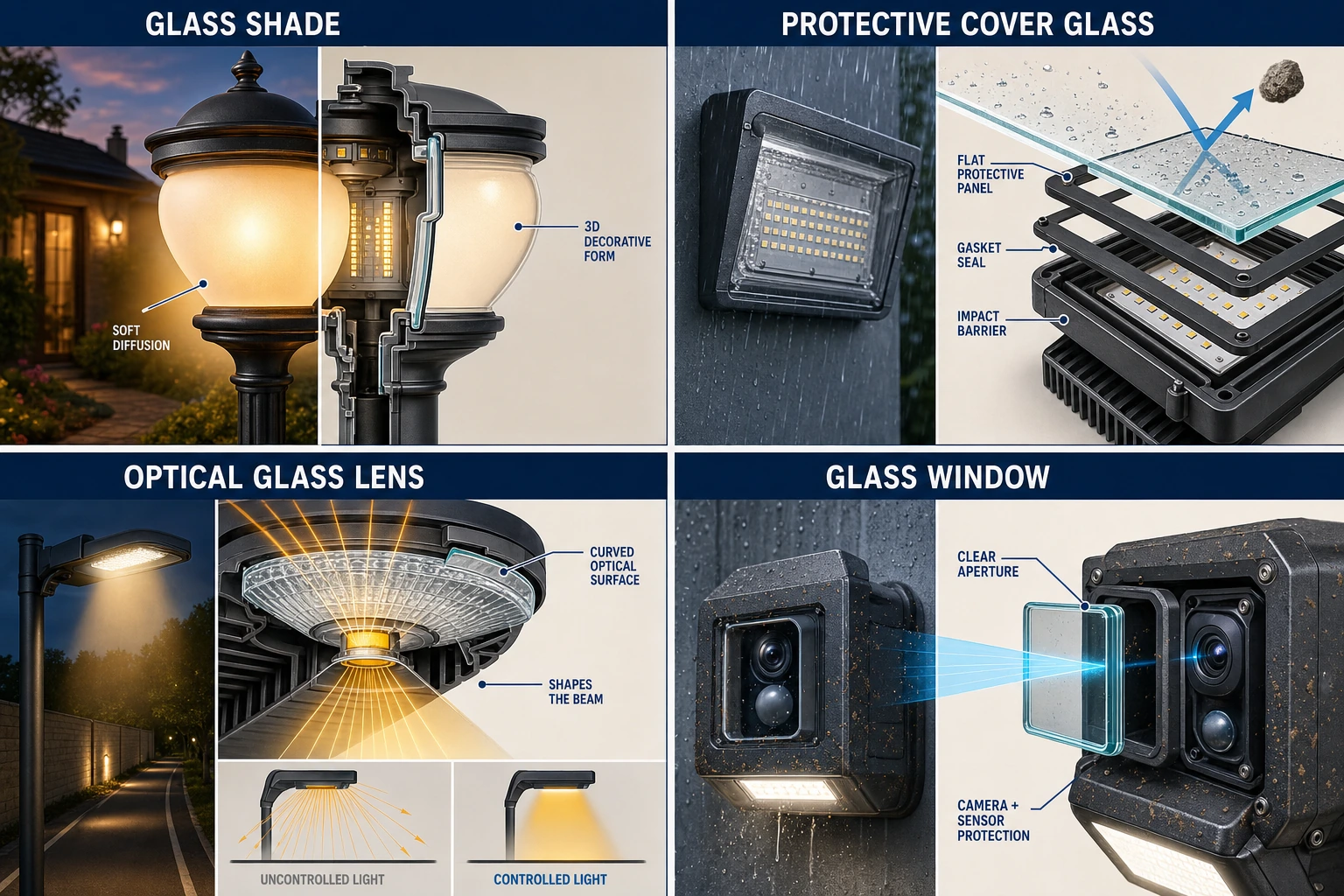
The glass cover is usually a three-dimensional shell, which not only protects the light source, but also participates in the appearance and light diffusion of the luminaire. It is commonly seen in garden lights, wall luminaires, chandeliers and decorative lights. Glass covers are mostly flat or slightly curved, focusing on sealing and protection. They are commonly used in wall washers, floodlights, underground lights and street lights.

The glass lens has a clear optical surface, which is used to change the beam angle, light distribution curve or spot shape, and is suitable for luminaires with high light control requirements. Glass windows are mostly used for local light transmission or functional areas, such as cameras, sensors, display windows, solar panel protection windows, etc. The focus is on transparency, protection and functional compatibility.

What is the difference between a glass cover, a glass cover, a glass lens and a glass window?

Why can’t the glass components of outdoor lighting fixtures just be used as protective covers?

The glass components of outdoor lighting certainly play a protective role, but it is not just a shell that blocks rain and dust. Glass transmittance, haze, color, texture, thickness and curvature all affect light efficiency, glare, spot and fixture appearance, as well as seal compression, assembly tolerances and long-term reliability.

For B2B luminaire projects, the glass components should be designed as part of the overall luminaire optical and structural system. It can help the complete luminaire improve protection, light control and decorative effects, but ultimately waterproof, dust-resistant, impact resistance and optical performance need to be verified in combination with the housing, light source, seals and assembly process.

Why can’t the glass components of outdoor lighting fixtures just be used as protective covers?

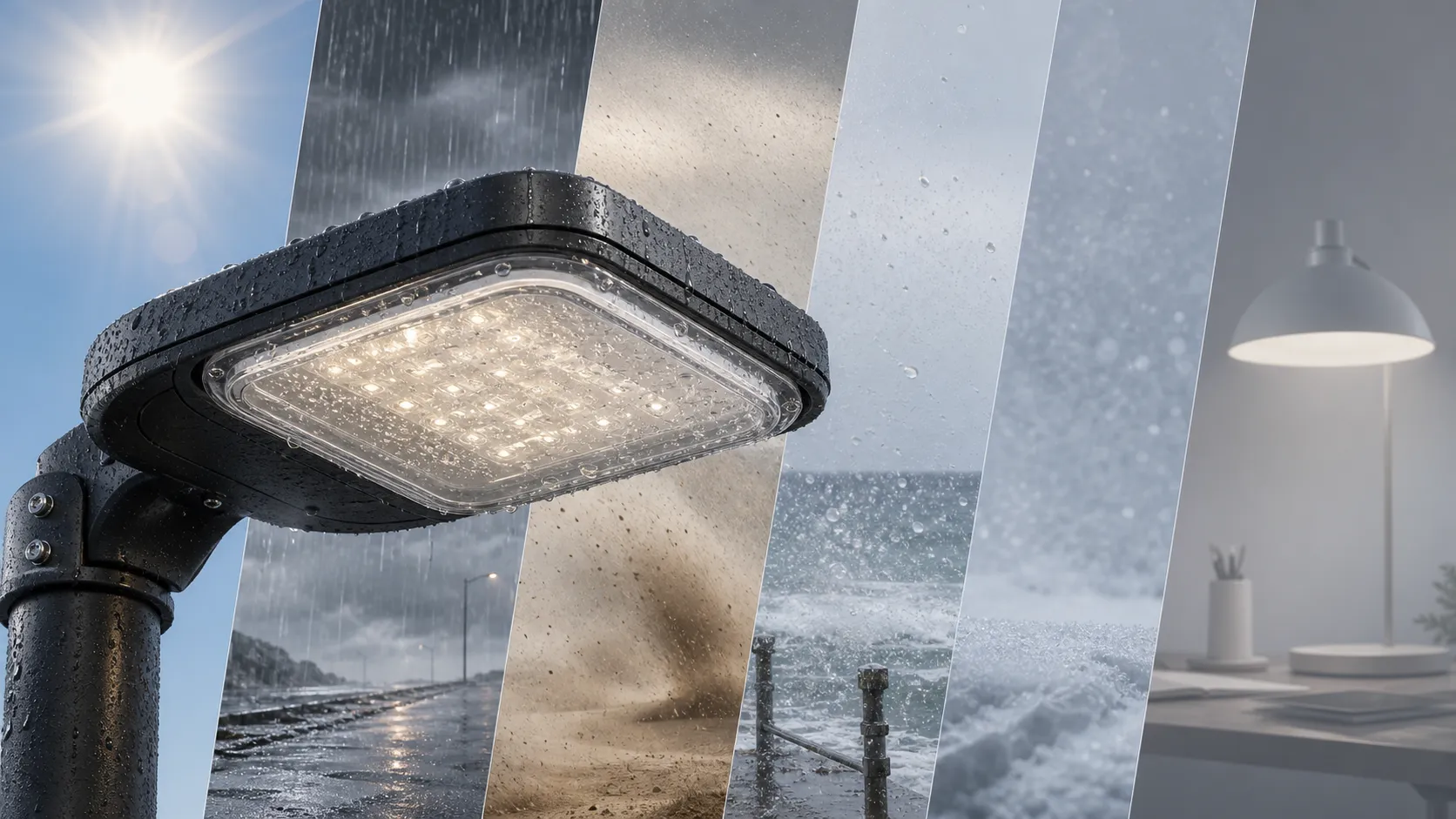
Why do outdoor lighting fixtures rely more on weather-resistant glass pieces than indoor lighting fixtures?

Outdoor luminaires are exposed to sunlight, rain, temperature differences between day and night, wind and sand, salt spray, dust and pollutants for a long time, and the use environment is far more complicated than indoors. Although the glass body is not prone to yellowing like plastic, the edge quality, surface treatment, coating, sealing surface and assembly stress will still be affected by the environment.

Weather-resistant glass pieces can reduce cracking, fogging, clouding, loss of light transmission, seal failure and frequency of maintenance. For outdoor projects, glass pieces must not only look good when new, but also maintain consistent transparency, appearance and safety after several years of use.

Why do outdoor lighting fixtures rely more on weather-resistant glass pieces than indoor lighting fixtures?

When selecting glass for outdoor lighting fixtures, should you consider the usage scenario or the structure of the fixture first?

When selecting glass for outdoor lighting fixtures, you should first consider the usage scenario and then the structure of the lighting fixture. The usage scenario determines the main risks and performance priorities. For example, underwater lights focus on long-term sealing and water pressure, underground lights focus on load-bearing and impact resistance, wall washers focus on optical consistency, and garden lights focus on soft light and decoration.

The structure of the luminaire determines whether this solution can be implemented, including sealing groove design, ring pressing method, glue bonding, screw position, housing tolerance, heat dissipation path and maintenance method. A safer sequence is to first clarify the scene goals, and then determine the optical requirements, structural sealing, glass materials, processing technology and cost delivery.

When selecting glass for outdoor lighting fixtures, should you consider the usage scenario or the structure of the fixture first?

How do the glass components of outdoor lighting affect the waterproof, dust-resistant and service life of the complete luminaire?

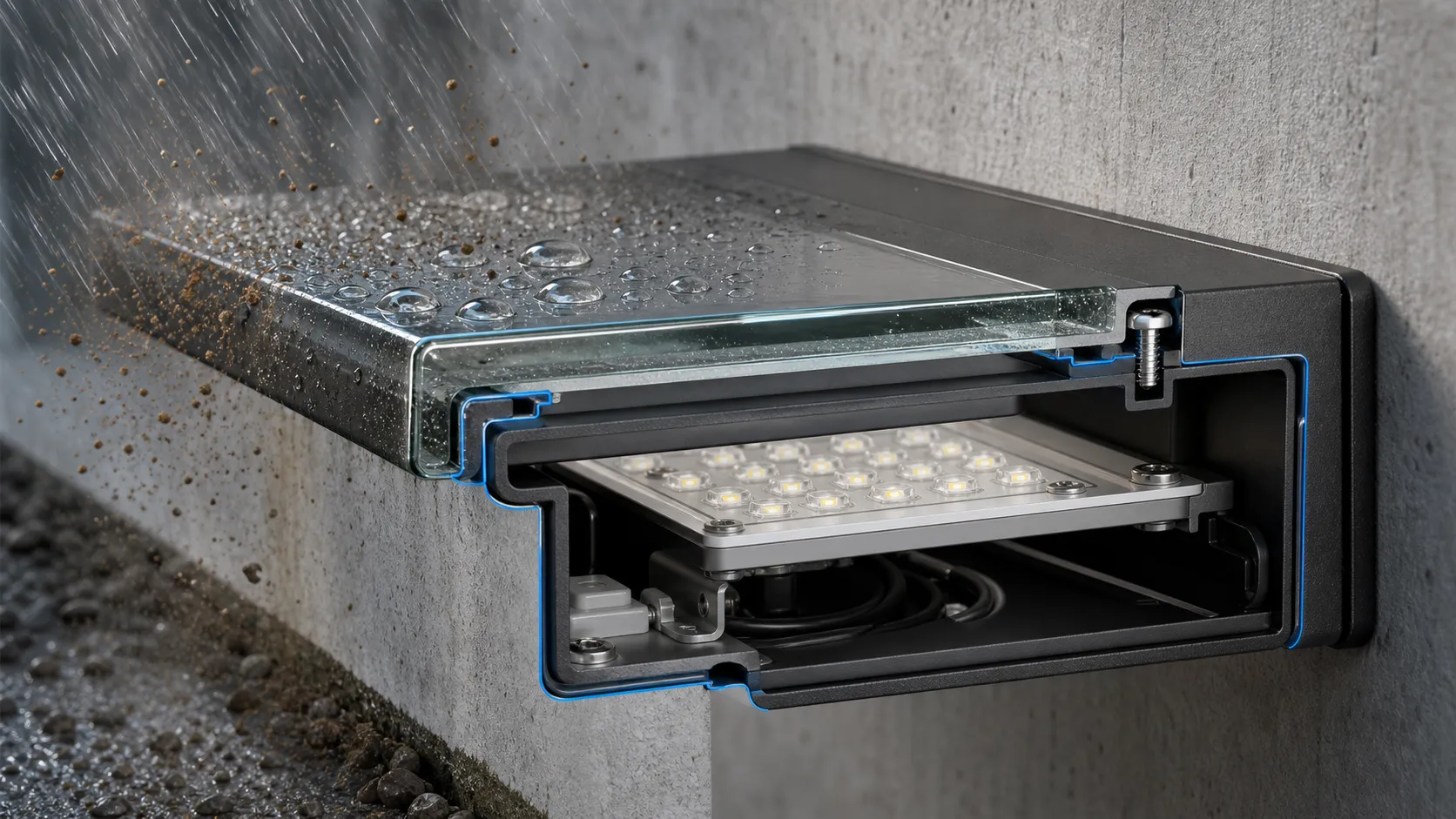
The cooperation between the glass components and the housing will directly affect the waterproof and dust-resistant capabilities of the complete luminaire. Glass size, thickness tolerance, edge flatness, chamfer quality and sealing surface condition will all affect the compression level and contact uniformity of the gasket; if the fit is poor, it is easy for water to penetrate, dust, condensation or insects to enter.

Chips at the edge of the glass, local stress, tight assembly or uneven stress may also lead to cracking after transportation, installation or thermal cycling. Proper glass construction improves IP rating stability, reduces maintenance frequency, and extends the life of the LEDs, power supply, seals, and complete luminaire housing.

How do the glass components of outdoor lighting affect the waterproof, dust-resistant and service life of the complete luminaire?

When customizing outdoor lighting glass, why do we need to confirm the transmittance, thickness, tolerance and sealing structure at the same time?

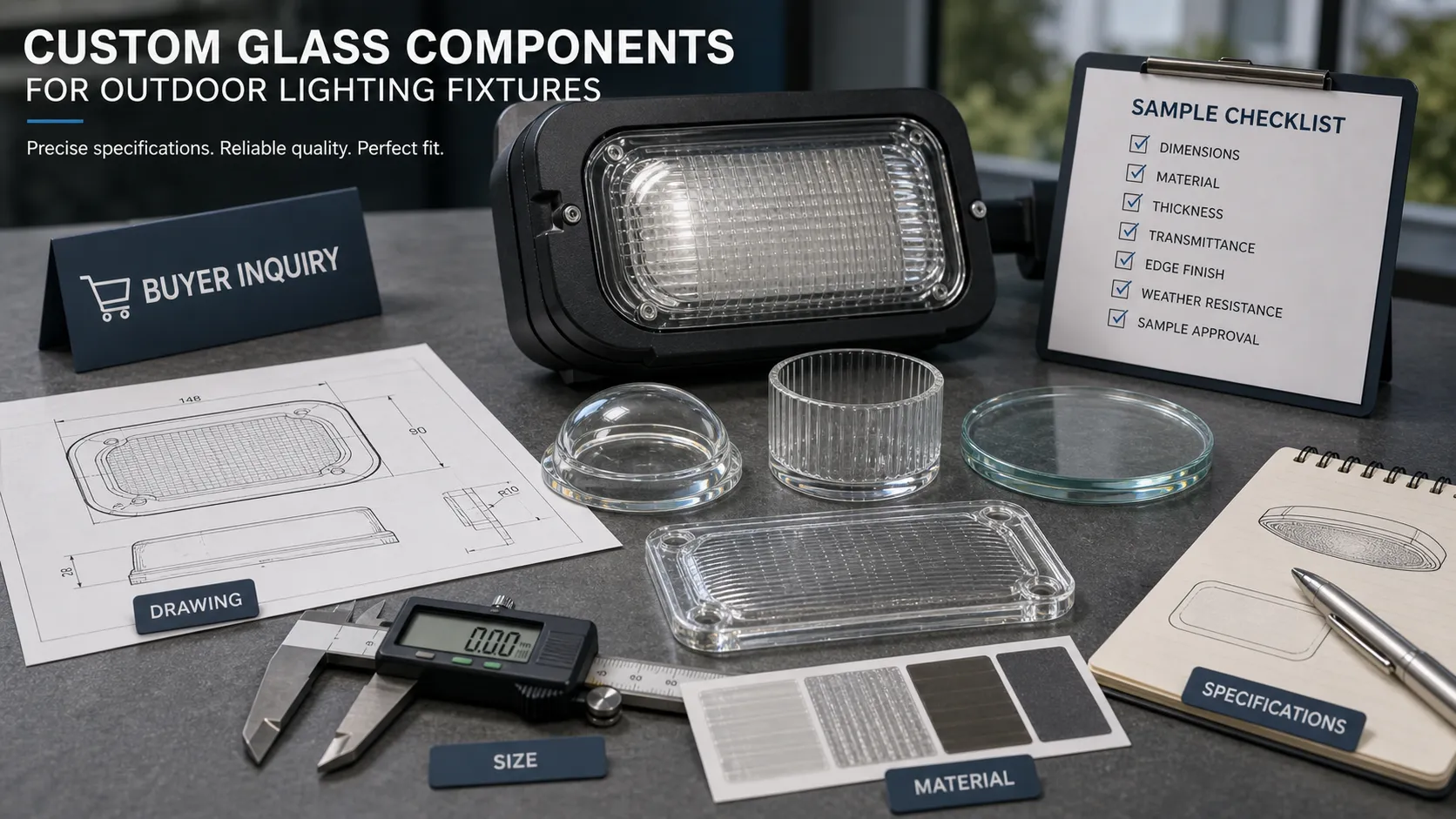
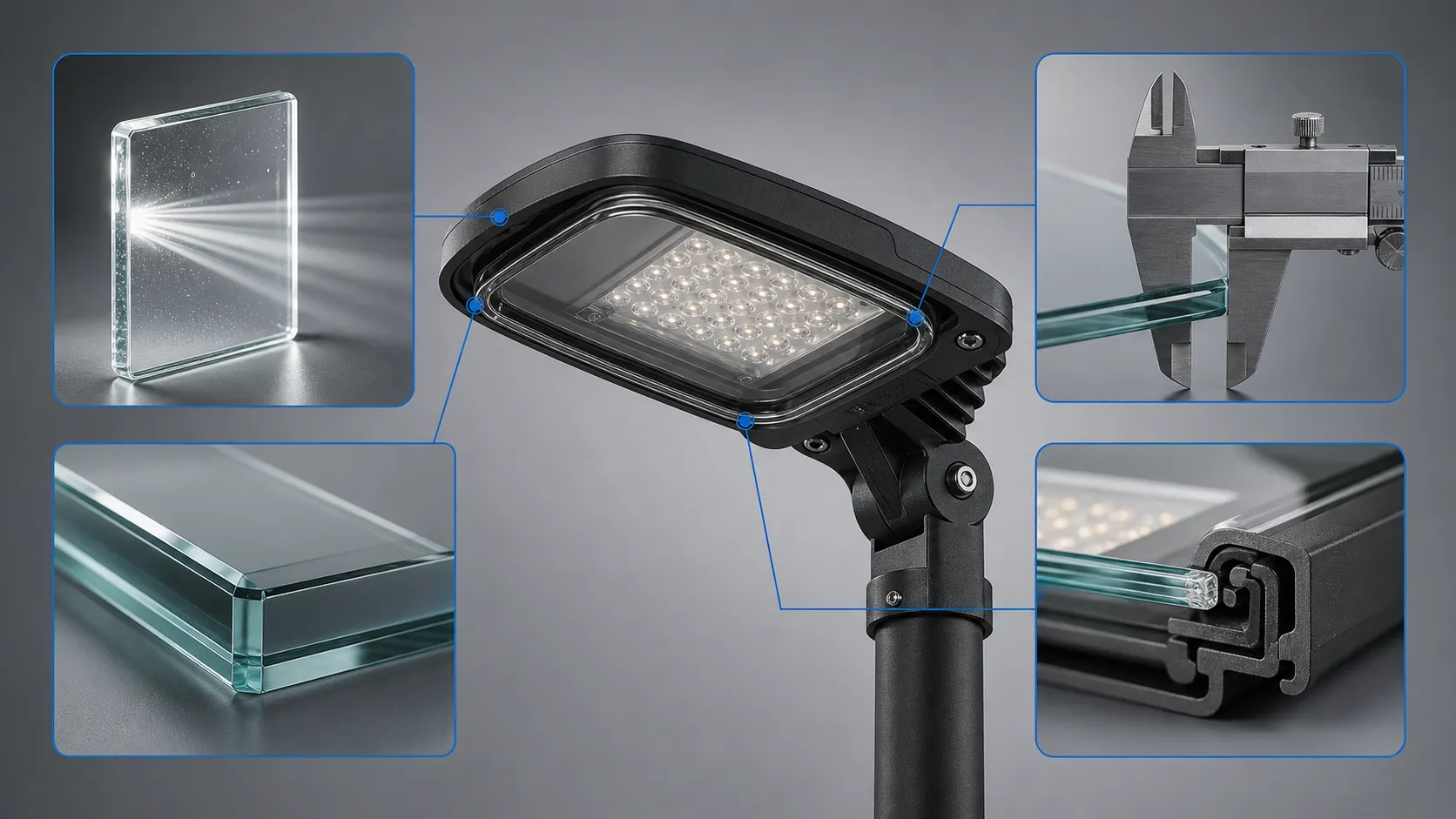
When customizing the glass for outdoor lighting fixtures, the transmittance determines the light efficiency, the thickness affects the strength and weight, the dimensional tolerance affects the assembly, and the sealing structure affects the watersampling and lifespan of the complete luminaire. If you only confirm one of the parameters, it is easy for the sample to look good, but it will leak, crack, or have inconsistent light effects when assembled in batches.

A more reliable development method is to simultaneously confirm the glass material, thickness, light transmittance or haze, edge treatment, dimensional tolerance, sealing surface requirements and luminaire body coordination method. Glass components can help the complete luminaire achieve target performance, but IP, IK, thermal shock and long-term reliability should still be confirmed through complete-luminaire testinging.

When customizing outdoor lighting glass, why do we need to confirm the transmittance, thickness, tolerance and sealing structure at the same time?

Chapter 2: Glass Components for Landscape Path, Garden, and Courtyard Lights

Should I choose clear glass, frosted glass or opal glass for landscape path lights?

The glass selection for landscape path lights depends on the installation height, whether the light source is exposed, and the nighttime effect you want to create. Transparent glass has high light transmittance and is suitable for luminaires with mature light-shielding structures or decorative filament light sources inside. However, if the LED luminaire beads are directly seen, dazzling glare will easily occur.

Frosted glass can soften the light and reduce the stimulation of point light sources, making it suitable for lighting most courtyard paths and walking trails. Opal glass has stronger light-shielding ability, can better hide LED point light sources, and produces more uniform light, but the light transmittance will be lower. If the project pays more attention to comfort and atmosphere, frosted or opalescent glass is usually preferred; if brightness and transparent decoration are more important, transparent glass can be selected with a built-in glare control structure.

Should I choose clear glass, frosted glass or opal glass for landscape path lights?

How to achieve soft light in a garden luminaire glass shade without significantly reducing the brightness?

To achieve soft light in garden lights, you cannot just rely on making the glass very white or very thick, otherwise the luminous flux will be significantly lost. A more appropriate approach is to choose frosted, acid-etched or light opal glass with moderate haze to allow light to be evenly diffused while retaining sufficient light transmittance.

Structurally, the LED light source can be moved back to increase the distance between the light source and the glass cover, or a reflective cup, diffusion cover and light shield can be added internally to allow the light to mix first and then pass through the glass. In this way, the glass does not need to bear all the diffusion tasks, which can not only reduce the glare of point light sources, but also maintain the actual brightness and layering of the garden lights.

How to achieve soft light in a garden luminaire glass shade without significantly reducing the brightness?

Why should we focus on glare control when using lawn luminaire glass shades?

The lawn luminaire is installed in a low position, and people's eyes often see the luminaire directly from the side or diagonally above. If the glass cover is too transparent and the LED point light source is exposed, it is easy to produce dazzling glare when walking at night, affecting the comfort of courtyards, hotels and public landscapes.

Therefore, lawn luminaire glass shades usually need to be frosted, opal, embossed or have internal light-shielding structures to allow more light to fall on the ground and surrounding plants instead of directly entering human eyes. A good lawn luminaire is not that the brighter the better, but that it makes the light soft, low, and controllable while ensuring safe illumination.

Why should we focus on glare control when using lawn luminaire glass shades?

How to combine the decorative effect and outdoor weather resistance of garden luminaire glass shade?

Garden luminaire glass shades are usually both optical and appearance components. If you want a decorative effect, you can choose opal, amber, soot, water ripple, bubble or embossed glass to give the luminaire a stronger style expression; but when using it outdoors, you should also pay attention to glass thickness, edge treatment, stress control and surface cleaning convenience.

In terms of weather resistance, priority should be given to glass materials with stable body and surface technology suitable for outdoor use to avoid treatment methods that are easy to peel off, fade or accumulate dirt. During assembly, a reasonable tolerance should be left between the glass cover and the metal housing, and the gasket, drainage and ventilation design should be used to reduce the risk of cracking, water intrusion and fogging after thermal cycling.

How to combine the decorative effect and outdoor weather resistance of garden luminaire glass shade?

What shape and haze glass cover is suitable for mushroom luminaire?

Mushroom luminaires usually pursue a low, soft, downward or annular diffused landscape effect. The shape of the glass cover can be selected from hemispherical, mushroom-shaped, dome-shaped or short cylindrical. Curved glass can make the luminaire body softer and help the light transition naturally to the surroundings.

In terms of haze, mushroom luminaires are generally not suitable for completely transparent glass unless there is a good light-shielding and reflective structure inside. Medium to high haze frosted glass, opal glass or lightly textured glass are more commonly used, which can hide LED point light sources, reduce close-range glare, and create a more uniform halo around lawns, flower borders and path edges.

What shape and haze glass cover is suitable for mushroom luminaire?

When using a cylindrical glass cover for landscape column lights, how to prevent the LED point light source from being exposed?

The cylindrical glass cover makes it easy to see the internal light source from all angles. If transparent glass is used directly, the LED point light source will be very obvious. The solution is usually to use opal glass, frosted glass, internal sandblasted glass or fine-textured glass to allow the light to diffuse on the glass surface before it emerges.

At the same time, the structure can add internal diffusion tubes, reflective columns, light-shielding rings, or hide the LED light sources in the upper and lower end caps to emit light through reflection and secondary diffusion. The diameter, height and distance of the light source of the glass cover are also important. The smaller the space, the easier it is to see the luminaire beads. Therefore, small-diameter column luminaires require high haze glass or internal light mixing structures.

When using a cylindrical glass cover for landscape column lights, how to prevent the LED point light source from being exposed?

Why are opal glass or frosted glass commonly used in outdoor garden lights?

Outdoor garden lights are often used within close range of human activities. The luminaires must not only provide basic lighting, but also create a comfortable atmosphere. Opal glass and frosted glass can hide LED point light sources, reduce transparent glare, and make the light softer and more uniform, so they are more suitable for daily courtyard environments than pure transparent glass.

In addition, the opal and frosted effects can weaken the visibility of the internal structure and dust, making the luminaire tidier during the day and night. It should be noted that the light transmittance of opal glass is usually lower than that of clear glass. When selecting, the light source power, installation spacing and expected illumination should be combined to avoid sacrificing too much actual brightness for soft light.

Why are opal glass or frosted glass commonly used in outdoor garden lights?

Is it suitable to use opal glass or frosted glass for modern garden lights?

Opal glass and frosted glass are suitable for many modern garden lights, especially when the fixture design emphasizes clean lines, hidden light sources and a soft visual atmosphere. They can reduce the visibility of LED chips, drivers and internal brackets, making the luminaire look simpler during the day and more comfortable at night. However, the choice should still be matched with the optical target of the product. If the garden light is mainly used for ambient lighting, opal or frosted glass is usually a good direction. If the fixture needs longer projection distance, higher illuminance or precise beam control, a clearer glass cover, internal lens or mixed optical structure may be more suitable. Sample testing is important because haze, thickness and glass color will all affect final brightness and visual softness.
Is it suitable to use opal glass or frosted glass for modern garden lights?

How does the glass cover of a smart garden light take into account both light transmission and signal penetration?

For smart garden lights, the glass cover must first maintain enough light transmission and diffusion for the lighting function, while avoiding unnecessary metalized coatings or overly thick decorative layers that may affect wireless modules, sensors or indicator windows. Clear, frosted or lightly diffused glass is usually easier to coordinate with Wi-Fi, Bluetooth, Zigbee or low-voltage control modules than a fully metal-coated outer surface. Signal performance is still a whole-luminaire issue, not something the glass alone can guarantee. The antenna position, metal housing, driver layout, sensor window and sealing structure all need to be considered together. In custom development, it is better to reserve a non-metallic signal area, confirm glass thickness and coating type, and test the complete fixture in the real installation environment before mass production.
How does the glass cover of a smart garden light take into account both light transmission and signal penetration?

How does the color of landscape light glass affect the nighttime atmosphere and lighting effects?

Glass color will directly change the visual temperature and spatial mood of the luminaire. Amber and brown glass will make the light appear warmer and are suitable for villas, hotels, courtyards and retro-style projects; smoked gray glass will have a more high-end feel during the day, but will reduce part of the brightness at night, making the light effect more restrained.

Colored glass will also change the original color temperature and color rendering effect of the LED. Especially strong-colored glass such as blue, green, and red will significantly affect the color of the object being illuminated. If a landscape project requires stable color temperature and real plant colors, the glass color should not be too heavy; if the main pursuit is decorative atmosphere, colored glass can be used to enhance the style, but the light effect of the sample must be confirmed in advance.

How does the color of landscape light glass affect the nighttime atmosphere and lighting effects?

How does the path light glass cover prevent light from shining directly into pedestrians' eyes?

Path lights must avoid direct exposure to human eyes. First, the direction of the light must be controlled so that more light shines toward the ground instead of radiating horizontally. The glass cover can be frosted, opalescent, embossed or with a shading area structure to reduce the sense of exposed light source caused by transparent glass.

The structure of the luminaire can be added with an upper cover, built-in reflector cup, downlighting light source or louver-type glare control design, so that the light can be reflected and diffused before leaving the luminaire. Pay attention to height and spacing when installing. Low path lights should not be too bright, otherwise even if the glass is soft, it may cause uncomfortable bright spots at close range.

How does the path light glass cover prevent light from shining directly into pedestrians' eyes?

Why is it easy for water, insects and dust to accumulate inside the glass shade of a garden luminaire?

Garden lights remain outdoors for long periods, so water, insects, and dust inside the glass shade are usually not just a glass problem; they are caused by sealing, drainage, and ventilation design. Insufficient gasket compression, an uneven glass opening, loose housing seams, or poorly protected wire openings can allow rainwater and moisture to enter.

Insects and dust often enter through heat-dissipation holes, bottom gaps, cable entries, or assembly gaps. The design should distinguish between areas that need to be fully sealed and areas that need ventilation and drainage, so moisture does not enter and then become trapped. The glass opening size, edge flatness, and fit with the housing are key to reducing this problem.

Why is it easy for water, insects and dust to accumulate inside the glass shade of a garden luminaire?

How to choose between decoration and maintenance convenience for landscape light glass pieces?

Highly decorative glass, such as deep embossed, water-ripple, bubble, colored, or complex custom-shaped glass, can improve the perceived quality of the luminaire, but it may also accumulate dust more easily, leave water marks, or be harder to keep consistent in mass production. Maintenance convenience requires a glass surface that is easy to clean, with fewer dead corners and a structure that is easy to remove and install.

Project selection should consider the installation location and maintenance conditions. For high-end hotels, villa entrances, and key landscape nodes, more expressive glass textures can be used; for large-area path lights, lawn lights, and public area luminaires, it is more suitable to choose glass solutions that resist staining, are easy to clean, and can be replaced consistently.

How to choose between decoration and maintenance convenience for landscape light glass pieces?

How can high-end courtyard projects enhance the quality of lighting fixtures through glass textures?

High-end courtyard projects can enhance the texture of luminaires through water ripples, vertical lines, cloth patterns, bubbles, hammer patterns, fine frosted or gradient fogged glass. These textures not only affect the look and feel of materials during the day, but also change the light and shadow levels at night, turning the luminaires from ordinary lighting products into part of the landscape.

When choosing textures avoid looking at just a static appearance, but also look at the effects of flare, glare and shadows when lit. A texture that is too deep may cause messy spots or difficulty in cleaning, while a texture that is too shallow may lack a sense of design. A safer approach is to use samples to test under real color temperature, real installation height and real background environment, and then determine the mass production texture and glass color.

How can high-end courtyard projects enhance the quality of lighting fixtures through glass textures?

Chapter 3: Glass Components for Facade Lighting and Wall Washers

Why do architectural wall washers need high-consistency long glass covers?

Architectural wall washers are usually installed in rows on the edge of exterior walls, curtain walls or facades. When multiple luminaires emit light continuously, the human eye can easily see brightness breakpoints, color difference and uneven light spots. If the light transmittance, thickness, flatness or surface treatment of the long glass cover is inconsistent, it will directly affect the continuity of light and dark on the entire wall.

Therefore, the wall washer glass cover must not only be transparent, but also ensure batch consistency, edge straightness, surface cleanliness and assembly stability. Especially for linear wall washers, slight warping, scratches or haze changes on the glass cover may be amplified into obvious light and shadow problems on the wall.

Why do architectural wall washers need high-consistency long glass covers?

How does the wall washer glass lens affect the beam angle and wall spot?

Wall washer glass lenses change light direction through curvature, thickness, and optical surfaces, thereby determining beam angle, projection distance, and wall spot shape. Narrow-angle lenses are suitable for tall walls, long-distance projection, and key facade emphasis, while wide-angle lenses suit close-range wall washing and uniform illumination.

If lens focal length, curvature, or installation position deviates too much, the wall may show widened spots, divergent edges, local bright spots, or dark areas. For architectural projects, lens design should be verified together with LED layout, distance from the wall, and installation angle; glass lens parameters should not be evaluated in isolation.

How does the wall washer glass lens affect the beam angle and wall spot?

How to avoid uneven brightness of linear wall washers with dark ends and bright middle?

The linear wall washer appears dark at both ends and bright in the middle, which is usually related to LED arrangement, end structure occlusion, lens continuity and glass cover consistency. If the frame of the glass cover is too wide at both ends, the thickness of the glue layer is different, or the transition at the end of the lens is not handled well, the light output from the end will be weakened.

The solution should start with the complete optical system of the luminaire, including optimizing LED spacing, end fill light, lens splicing, cover flatness and installation angle. Glass components need to maintain consistent light transmission in the length direction, stable edge processing, and avoid optical breakpoints caused by black edges, gaps or local stress at the ends.

How to avoid uneven brightness of linear wall washers with dark ends and bright middle?

How to improve the light transmittance and weather resistance of exterior wall floodlight glass covers?

Outdoor facade floodlights usually require high brightness and longer projection distance, so the glass cover should prioritize high transmittance, low impurity content, and a flat surface. Ordinary clear glass can meet many projects, while low-iron glass is more suitable for architectural lighting projects with higher requirements for efficiency, color rendering, and color temperature stability.

For weather resistance, attention should be paid to edge treatment, tempering or heat-treatment quality, sealing-surface flatness, and coating durability. Outdoor floodlights face rain, sand, ultraviolet exposure, and pollutants for long periods. The glass cover should reduce light loss and be easy to clean, avoiding scratches, dirt buildup, or coating failure that could affect long-term transmittance.

How to improve the light transmittance and weather resistance of exterior wall floodlight glass covers?

How does building facade lighting glass reduce glare and light pollution?

Glass for building facade lighting is designed so that light reaches the building surface rather than scattering into the sky, windows or the eyes of passers-by. Although the transparent cover has low light loss, if the angle and shading design of the luminaire are insufficient, it is easy to produce spilled light and glare.

The light output range can be controlled through low-glare glass, micro-textured diffusion, hoods, honeycomb grilles, precise lenses and reasonable installation angles. The glass piece itself should remain optically neutral and consistent to avoid stray light caused by surface reflections, scratches, or uneven haze. Good facade lighting should highlight the building's outline while minimizing interference with surrounding residents and the night sky.

How does building facade lighting glass reduce glare and light pollution?

How to control the light direction of the glass cover of the up and down wall luminaire?

Up and down wall lights usually form wall beams through the upper and lower light outlets. The role of the glass cover or glass window is to protect the light source and stabilize the light boundary. If the glass is too diffuse, the edge of the beam will become softer and the range will become wider; if the glass is too transparent, glaring light sources or internal structures may be visible.

When controlling the direction of light emission, the glass form, internal reflective cup, light shield, lens, and opening size must be designed together. Top light and bottom light can use different haze or different lens structures to meet the needs of decorative spots, functional lighting and glare control. The fit between the glass edge and the housing must also be stable, otherwise the beam symmetry will be affected.

How to control the light direction of the glass cover of the up and down wall luminaire?

How does the glass cover of the outdoor wall luminaire take into account security brightness and visual comfort?

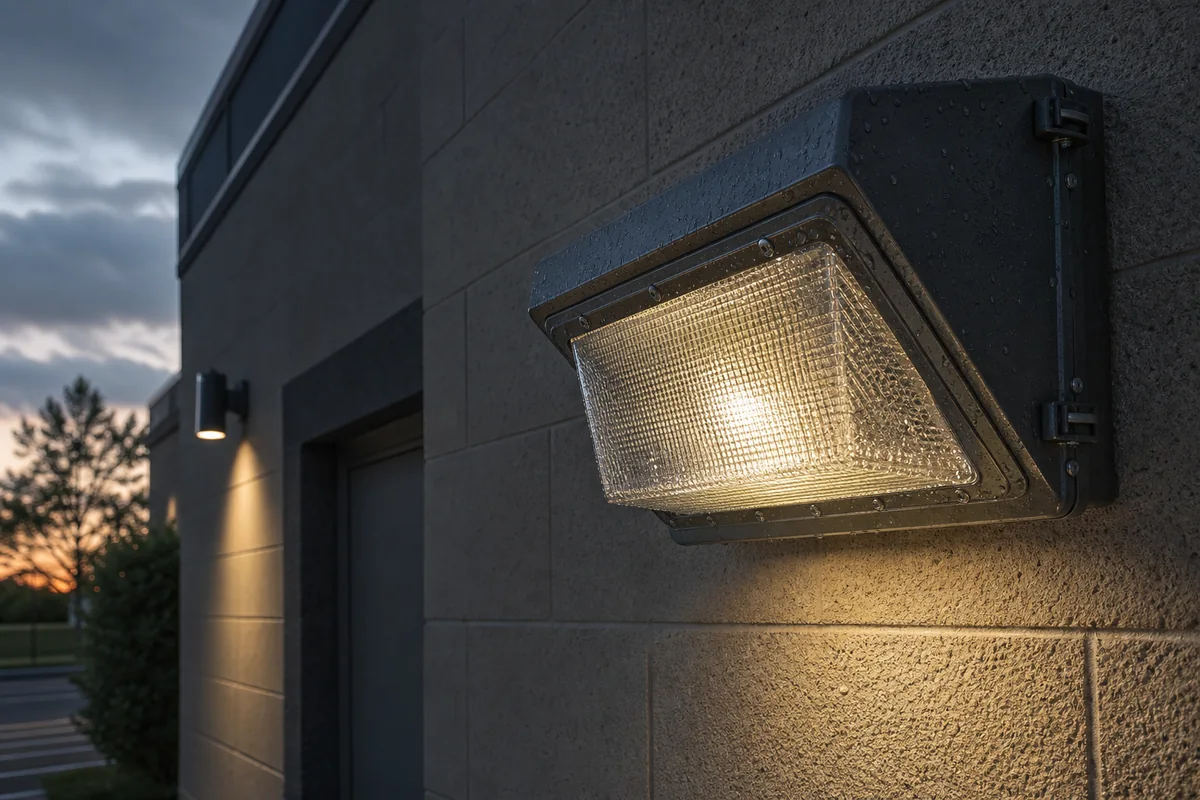
Outdoor wall-mounted lights are often used on building exterior walls, passages, parking lot entrances and public areas, and need to provide sufficient security brightness. However, if the glass cover is too transparent and the LED array is directly exposed, it will produce a strong glare at night, especially when the human eye is close to the height of the luminaire.

A better approach is to use moderately diffused glass, internal lenses or light-shielding structures to allow light to evenly cover walls and floors while reducing frontal glare. The glass cover must also have reliable sealing and impact resistance, because wall-mounted lights are exposed to rain, dust, sand and human contact all year round.

How does the glass cover of the outdoor wall luminaire take into account security brightness and visual comfort?

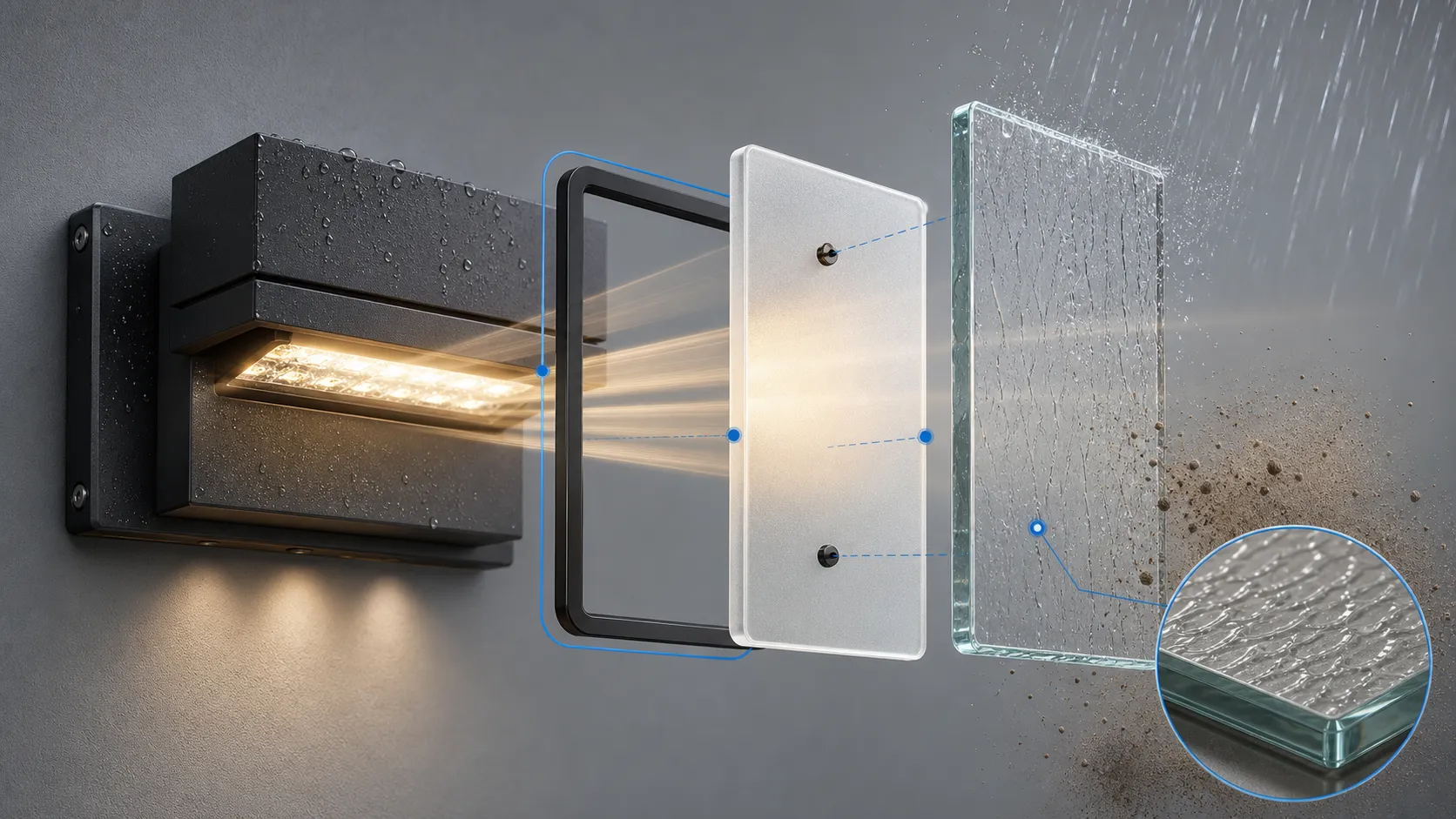
How do the glass components of building exterior wall lights cope with long-term rain and wind and sand?

Building exterior wall lights are subject to long-term rain erosion, wind and sand friction, dust deposition and adhesion of pollutants. Glass components should have stable surface hardness, good edge processing and reliable sealing surface to avoid cracking and water leakage due to edge chipping, scratches or assembly deformation.

In areas with heavy sandstorms or heavy pollution, the glass surface should be as smooth as possible with as few dead corners as possible to facilitate self-cleaning by rainwater and manual maintenance. For coastal, desert or high-rise building projects, you should also pay attention to the corrosion resistance of the metal frame, screws and sealing materials, because the glass itself is stable, but the failure of the surrounding structure will also affect the life of the complete luminaire.

How do the glass components of building exterior wall lights cope with long-term rain and wind and sand?

Will scratches on the glass surface of the wall washer affect the light spot on the wall?

Whether scratches on the glass surface of the wall washer affect the light spot depends on the scratch location, depth, direction and the projection distance of the luminaire. Slight and small scratches may not be obvious in ordinary floodlight, but when linear wall washing, narrow-angle projection or wall hitting at close range, scratches may cause stray light, bright lines, shadows or uneven local light spots.

Especially for long glass covers, if scratches appear continuously along the length, visible lines may be formed on the wall after lighting. Therefore, the surface of wall washer glass should be protected during production, packaging, transportation and assembly, and friction with hard particles should also be avoided during cleaning.

Will scratches on the glass surface of the wall washer affect the light spot on the wall?

How do architectural lighting glass components cooperate with the luminaire structure to reduce glare, uplight and light pollution?

Reducing glare, uplight and light pollution in architectural lighting cannot be achieved by relying on glass components alone, but must be combined with lenses, sunshades, installation angles, luminaire power and control strategies. Glass covers or glass lenses can help reduce stray light and unwanted surface reflections through high light transmission, low reflection, moderate diffusion and stable flatness.

The core of DarkSky and low-glare design is to control the direction of the beam, avoid over-illumination, and reduce uplight and light spill. Glass components are one of the important components that affect the results, but the final effect needs to be confirmed through the complete optical design of the luminaire, on-site lighting and project requirements.

How do architectural lighting glass components cooperate with the luminaire structure to reduce glare, uplight and light pollution?

How to choose low-presence glass cover for minimalist outdoor architectural lighting?

Minimalist outdoor architectural lighting usually wants the luminaire to disappear into the facade, so the glass cover should be visually clean, flat and low-reflection. Clear or low-iron glass with controlled thickness, good flatness and neat edge processing is often more suitable than heavy textured or strongly colored glass, because it can protect the optical system without adding too much visual weight to the fixture. At the same time, low presence does not mean ignoring performance. The glass cover still needs to match the sealing structure, thermal expansion, mounting pressure and required optical effect of the complete luminaire. If glare control is important, the design may need internal shielding, lens control or a lightly diffused glass surface, and the final appearance should be checked with the actual housing color, facade material and night lighting effect.
How to choose low-presence glass cover for minimalist outdoor architectural lighting?

In large-scale construction projects, how does the batch color difference of glass components affect the overall facade effect?

Large-scale construction projects often use a large number of luminaires of the same type. If there are differences in color, light transmittance or haze between different batches of glass components, local areas that are brighter, darker, yellower or grayer may be formed on the facade after lighting. This difference may not be noticeable on a single part, but is amplified by the building surface when installed in rows.

Therefore, for batch projects, glass samples, material sources, color ranges, light transmittance and haze standards must be confirmed in advance. During production, materials should be supplied from the same batch and processed with the same process as much as possible, and optical consistency should be randomly checked before shipment. For high-end building facades, glass piece consistency and LED color tolerance are equally important.

In large-scale construction projects, how does the batch color difference of glass components affect the overall facade effect?

Why should the outdoor linear luminaire glass cover focus on controlling straightness and flatness?

Outdoor linear lights usually form a continuous light strip, and the straightness and flatness of the glass cover will directly affect the appearance lines, sealing pressure, and light uniformity. If the cover is bent, warped, or has an unstable width, there may be uneven gaps, uneven pressure frames, uneven glue lines, or the risk of local leakage after installation.

From an optical point of view, the flatness difference may also change the local light emission angle, causing the continuous light band to change in light and dark. In particular, long-sized cover plates are more likely to be deformed by force during transportation and assembly, so dimensional tolerances, flatness standards, packaging support methods, and on-site installation requirements need to be clarified.

Why should the outdoor linear luminaire glass cover focus on controlling straightness and flatness?

Chapter 4: Glass Components for Outdoor Wall Lights and Wall Packs

Should I choose clear glass cover or frosted glass cover for outdoor wall luminaire?

Choosing transparent glass or frosted glass for outdoor wall luminaires mainly depends on the style of the luminaire, whether the light source is exposed and the installation location. Transparent glass is suitable for retro filaments, candle bulbs or wall luminaires that already have a light-shielding structure inside. It can retain the clear layering and decoration of the luminaire body. However, if the LED luminaire beads are directly seen, it will be easily dazzling at night.

Frosted glass is more suitable for modern outdoor wall sconces and scenes installed close to human eye level. It can soften the light, hide the details of the light source, and make the walls of porches, corridors and courtyards more comfortable. If the project pays more attention to atmosphere and low glare, frosted or opalescent glass is preferred; if the retro transparent texture is more important, low-brightness light sources or internal glare control structures should be used.

Should I choose clear glass cover or frosted glass cover for outdoor wall luminaire?

How to avoid transparent glare when using outdoor wall luminaire glass shades?

Clear glare typically comes from exposed LEDs, highlight spots in reflectors, or specular reflections from glass surfaces. To avoid this problem, you cannot just use the glass as a transparent protective cover, but let the light source pass through blocking, reflection or diffusion before entering the line of sight.

Common practices include using inner frosted glass, light textured glass, opalescent inner sleeve, light shield, filament-type low-brightness light source or top-cover under-illumination structure. For wall luminaires installed at doorways, balconies and corridors, the light angle must also be controlled to prevent the front of the luminaire from facing directly into people's sight.

How to avoid transparent glare when using outdoor wall luminaire glass shades?

How to improve the waterproof, dust-resistant and impact resistance of wall-mounted luminaire glass cover?

Wall-mounted lights are usually installed on building exterior walls or public passages. The glass cover must not only protect the light source, but also withstand rain, dust, wind and sand, and occasional collisions. The key to improving waterproof and dust-resistant performance is to make the glass cover dimensionally stable, have smooth edges, and form a continuous and reliable sealing surface with the gasket, pressure frame or adhesive structure.

In terms of impact resistance, thickened glass, tempered glass, or a more reasonable frame protection structure can be selected according to the application to avoid direct exposure of the glass edge to stress. The glass cover should not only look at the thickness, but also whether the installation force is even, whether the edges are chamfered, and whether the housing can disperse the impact.

How to improve the waterproof, dust-resistant and impact resistance of wall-mounted luminaire glass cover?

Why is the glass cover of outdoor wall luminaire easy to crack during assembly?

Common reasons for cracks in the glass cover assembly of outdoor wall luminaires are mismatched dimensional tolerances on the mouth, over-tightening of the metal housing, uneven stress on the screws, chipping at the edge of the glass, or failure to control the residual stress inside the glass. Glass itself has strong compression resistance, but is very sensitive to point stress, edge defects and local distortion.

During assembly, avoid allowing screws, metal buckles or hard shells to directly press on the weak edges of the glass. It is best to use silicone rings, soft pads, uniform compression rings or reasonable gaps to buffer them. Before mass production, samples must be used to verify assembly tolerances to confirm that the glass will not sustain stress due to thermal expansion and contraction or installation deviation.

Why is the glass cover of outdoor wall luminaire easy to crack during assembly?

How to control the assembly tolerance between the wall luminaire glass shade and the metal housing?

A reasonable gap needs to be maintained between the wall luminaire glass cover and the metal housing. It should not be too loose to cause shaking, water intrusion and abnormal noise, nor too tight to cause assembly stress and cracking due to thermal cyclings. Tolerance control depends on the size of the glass opening, the inner diameter of the housing, the compression level of the gasket, and the fixing method.

Usually the gasket should be responsible for the main compression and buffering function, rather than having the glass hit the metal head-on. For blown or pressed glass covers, the batch size will fluctuate to a certain extent. Assembly allowance should be reserved during design, and fault tolerance should be improved through limit steps, soft washers and uniform compression structures.

How to control the assembly tolerance between the wall luminaire glass shade and the metal housing?

How to prevent water leakage through the glass cover of outdoor wall luminaire?

Water seepage from the back panel of outdoor wall luminaires is often not caused by the glass alone, but is a watersampling problem caused by the glass cover, back panel, wall, wire holes and screw holes. Rainwater may flow down the wall, enter between the back panel and the wall, and then enter the luminaire through the wiring holes or assembly gaps.

During design, reliable sealing gaskets, drainage paths and wire hole waterproof structures should be installed on the back panel, and there should also be a continuous sealing surface between the glass cover and the housing. During installation, if the wall surface is uneven, the screws are not tightened, or the sealant is incomplete, the watersampling effect will be reduced. Therefore, the watersampling of wall luminaires must take into account both the product structure and on-site installation conditions.

How to prevent water leakage through the glass cover of outdoor wall luminaire?

Is tea glass, amber glass or textured glass suitable for retro outdoor wall sconces?

Vintage outdoor wall sconces often use tea, amber, and textured glass to create a warm, nostalgic, and handmade feel. Amber glass will make the light warmer and is suitable for brass, black metal, antique bronze and other shells; brown glass is more restrained, has a retro color filter effect during the day, and will not change the atmosphere as obviously as amber at night.

Textured glass can add depth without drastically changing the color temperature, such as ripples, vertical lines, bubbles or hammered glass. The actual choice depends on the style of the project: if you want a warm atmosphere, choose amber, if you want a low-key retro look, choose brown, if you want light, shadow and texture, choose textured glass. You can also combine light-colored glass with textures.

Is tea glass, amber glass or textured glass suitable for retro outdoor wall sconces?

How to take into account appearance, soft light and cleaning and maintenance of outdoor wall luminaire glass shade?

The appearance, soft light and ease of maintenance of an outdoor wall light glass shade need to be considered together. Frosted, opalescent, and textured glass can enhance the soft light effect and also hide internal LEDs and dust, but if the surface is too rough or deeply textured, it may be more susceptible to dust, watermarks, and smudges.

A more balanced solution is to choose glass with frosted inside and smooth outside, which can diffuse light and facilitate cleaning of the outer surface. For wall luminaires with high installation locations or inconvenient maintenance, the glass shape should minimize grooves and dead corners; for key decorative locations, textured glass can be used appropriately to enhance the texture.

How to take into account appearance, soft light and cleaning and maintenance of outdoor wall luminaire glass shade?

How to hide glaring LED luminaire beads with transparent wall luminaire glass shade?

The transparent wall luminaire glass shade itself does not hide the LED luminaire beads, so it needs to be processed through the internal structure. You can use opal inner tubes, frosted diffusers, light hoods, reflective cups or low-brightness linear light sources to keep the LEDs from being directly exposed to the human eye.

Another approach is to place the light source above, below or behind, allowing the light to be reflected from the wall or reflected inside the luminaire body before being revealed. If you must retain a completely transparent retro look, choose filament-type LEDs, low-brightness warm light sources, or bulbs with frosted shades to avoid direct visibility of high-spot light sources.

How to hide glaring LED luminaire beads with transparent wall luminaire glass shade?

How do outdoor wall light glass components cope with sealing failure caused by thermal cycling?

When outdoor wall lights are heated during the day, cool down at night, and washed by rain, pressure changes will occur inside the luminaire body, and the glass, metal housing, and gaskets will also undergo slight displacements due to thermal expansion and contraction. If there is no buffer space in the structure, the seal may gradually compress and fail, and the glass may crack due to long-term stress.

To deal with thermal cycling, it is necessary to choose weather-resistant sealing materials, control the compression of the gasket, and avoid an excessively tight fit between the glass and the metal. If necessary, a vent valve or reasonable drainage structure can be added to reduce the risk of negative-pressure water absorption and internal condensation. Glass edge flatness and thickness tolerances can also affect seal stability.

How do outdoor wall light glass components cope with sealing failure caused by thermal cycling?

Can the outdoor wall luminaire glass cover be sandblasted, embossed or electroplated?

The outdoor wall luminaire glass cover can be sandblasted, embossed, acid etched, coated or partially decorated, but the process must be selected based on outdoor weather resistance and maintenance requirements. Sandblasting and acid etching can create a soft light effect, and embossing can bring about texture and light and shadow changes, making it suitable for decorative wall luminaires.

The plating or metallization effect should be used with caution, especially if the outer surface plating is exposed to rain, ultraviolet rays and detergents for a long time, it may peel off, become discolored or mottled. A safer approach is to place the easily damaged treatments on the inside, or choose a surface process with better body color, pressed texture, and weather resistance.

Can the outdoor wall luminaire glass cover be sandblasted, embossed or electroplated?

How does the wall-mounted light glass cover reduce the glare of security lighting at night?

When wall-mounted lights are used for security lighting, they tend to have high brightness. If the glass cover is completely transparent and faces the human eye, it is easy to produce strong glare. To reduce glare, we can start from three aspects: glass, light source and structure: the glass can choose moderate haze or micro-texture, the light source can use lenses to distribute light, and the structure can add light-shielding frames or downward illumination angles.

The emphasis is on allowing light to cover passages, walls and floors, rather than shining directly outward horizontally. Although excessive haze can soften the light, it may reduce efficiency and expand spilled light. Therefore, security wall lights should strike a balance between brightness, coverage and visual comfort.

How does the wall-mounted light glass cover reduce the glare of security lighting at night?

Chapter 5: Glass Covers for In-Ground Lights and Well Lights

Why should we focus on load-bearing and impact resistance for underground light glass covers?

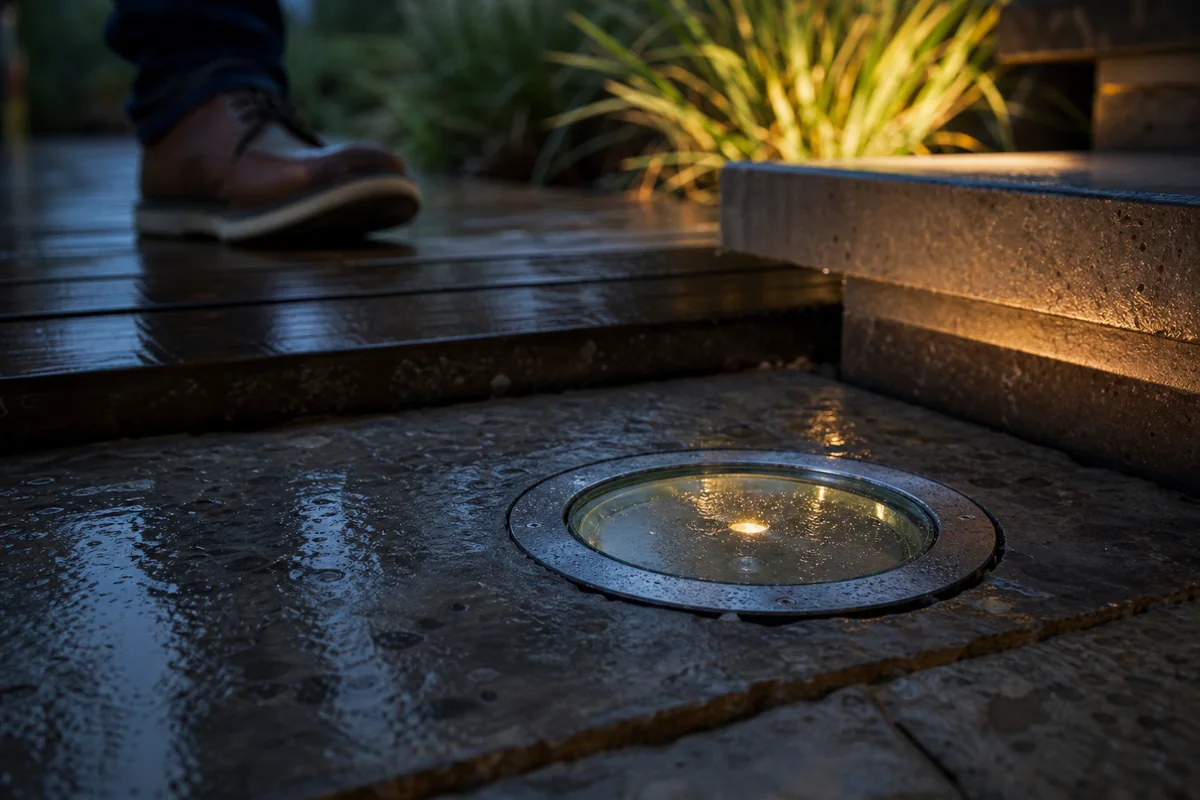
Underground lights are installed on the ground or near the ground. The glass cover must not only transmit light, but also withstand trampling, tool collisions, falling objects, and even vehicle crushing. It does not mainly withstand environmental aging like ordinary glass shades, but directly faces mechanical pressure and surface wear.

If the strength of the glass is insufficient, the edge support is uneven, or the assembly structure is unreasonable, edge chipping, cracks, and water intrusion may occur. In serious cases, it may cause safety risks. Therefore, the glass cover of the underground luminaire should also consider the glass thickness, tempering quality, support area, pressure frame structure and actual use load.

Why should we focus on load-bearing and impact resistance for underground light glass covers?

How to choose the thickness of the glass cover for underground luminaires?

The thickness of the underground luminaire glass cannot be simply determined by the size of the luminaire, but must be combined with the installation location, force type, glass span, support method and whether there are vehicles passing through. Relatively thin tempered glass can be used in general pedestrian areas, but driveways, plazas and public areas require higher thickness and more reliable structural support.

Thicker glass generally provides greater strength, but also increases weight, cost and light loss, and can impact heat dissipation and assembly space. A safer approach is to conduct a stress assessment based on the complete luminaire structure, and then conduct trampling, impact and waterproof tests on samples, rather than just selecting the thickness based on experience.

How to choose the thickness of the glass cover for underground luminaires?

What pressure and wear resistance requirements does the driveway underground light glass need to meet?

Driveway underground light glass needs to withstand vehicle tire pressure, local impact, sand and gravel friction and long-term rain cement and sand pollution. The glass cover should usually be made of thicker tempered glass or a specially designed pressure-bearing glass structure, and the edges of the glass should be fully supported to avoid excessively large suspended spans in the middle.

In terms of wear resistance, the glass surface should be kept as hard and clean as possible to avoid being worn by sand, tires and cleaning tools for a long time. Driveway scenes should also focus on slip resistance, drainage and thermal shock resistance, as vehicle parking, sun exposure and rain cooling will subject the glass to more complex environmental changes.

What pressure and wear resistance requirements does the driveway underground light glass need to meet?

Why is the glass cover of an underground luminaire prone to water intrusion and fogging?

The underground luminaire is located in a low position and is often surrounded by water, sediment and moisture. The luminaire body is often buried in soil, stone or concrete, and the external water pressure and moisture are stronger than ordinary wall luminaires. As long as there is uneven sealing between the glass cover and the housing, aging of the glue layer, insufficient tightening of the screws, or uneven edges, water will easily leak.

Fogging usually comes from internal residual moisture, negative-pressure water absorption of thermal cycling, or water vapor that cannot be discharged after sealing. To reduce such problems for underground lights, the flatness of the glass edge, the compression of the gasket, the watersampling of the outlet hole, the drainage structure and assembly testing are all critical.

Why is the glass cover of an underground luminaire prone to water intrusion and fogging?

How can the edge chamfering of underground light glass reduce the risk of chipping and cracking?

The edge of the underground luminaire glass is a sensitive location for stress and sealing. Sharp edges are prone to micro-chips during transportation, installation, frame pressing and stepping. Small chipping will become the starting point of cracks, which will gradually expand after thermal cycling or external impacts.

By chamfering, grinding and polishing, sharp edges can be removed, reducing stress concentration and reducing the risk of installing a cutting hand. For load-bearing underground lights, edge treatment is not only an appearance issue, but also a safety and lifespan issue. In particular, it is necessary to avoid direct contact between the glass edge and the metal.

How can the edge chamfering of underground light glass reduce the risk of chipping and cracking?

Does the glass surface of underground lighting need anti-slip or anti-wear treatment?

When underground lights are installed on sidewalks, steps, squares or driveways, whether the glass surface requires anti-slip treatment depends on the frequency of traffic, ground slope, rainwater environment and project safety requirements. For slippery areas, fine textures, anti-slip spots, etching patterns or other surface treatments can be considered, but the treatment method cannot significantly damage the light transmission and spot effects.

In terms of anti-wear, the hardness of the glass itself is relatively high, but long-term sand friction will still cause fine scratches and reduced light transmittance. Although a surface that is too rough will increase anti-slip, it will also be easier to accumulate dirt and difficult to clean. Therefore, the glass of underground luminaires must balance anti-slip, safety, light transmittance and maintenance convenience.

Does the glass surface of underground lighting need anti-slip or anti-wear treatment?

How does the glass cover of an underground light affect the light angle and spot shape?

If the underground luminaire glass cover is an ordinary flat plate, it mainly plays a protective and sealing role and has a relatively limited impact on light distribution. However, glass thickness, surface reflection and stains will still cause a certain amount of light loss. If you use glass with curved surfaces, textures or lens structures, the light angle and spot shape will be significantly changed.

For example, when narrow-angle underground lights are used for projection on trees, columns and walls, the flatness of the glass and the accuracy of the lens will affect the edge of the beam; diffused glass can make the light spot softer, but may reduce the projection distance. When selecting, you should decide whether the glass is mainly for protection or also responsible for optical control according to the lighting objectives.

How does the glass cover of an underground light affect the light angle and spot shape?

Is it suitable to use flat glass or pressed glass lens for underground lights?

If the underground light is mainly used for basic lighting, sign lighting or there is already a lens inside for light distribution, it is usually suitable to use a flat glass cover. Flat glass has a simple structure, stable sealing surface, easy processing and maintenance, and is suitable for most engineering projects.

If you need a specific beam angle, elliptical spot, narrow angle projection or special wall washing effect, you can consider pressed glass lenses. Pressed glass lenses can undertake more light control functions, but have higher requirements on molds, dimensional accuracy, assembly position and batch consistency, and the cost and development cycle will also increase.

Is it suitable to use flat glass or pressed glass lens for underground lights?

How do underground light glass components fit into stainless steel or aluminum alloy shells?

Underground luminaires commonly use stainless steel face rings, aluminum alloy luminaire bodies, or a combination of both. When the glass components are matched with the metal housing, it is necessary to prevent the glass from directly bearing the hard pressure of the metal, and uniform support and sealing should be achieved through gaskets, cushions, pressure frames or step structures.

Stainless steel has high strength but less elastic buffering, and aluminum alloy has good heat dissipation but more obvious thermal expansion. Both materials will affect the glass stress and sealing stability. When designing, the glass diameter, thickness, edge chamfering, pressing force and gasket compression level should be controlled to ensure that the glass is not locally squeezed during installation, stepping on and thermal cycling.

How do underground light glass components fit into stainless steel or aluminum alloy shells?

How does outdoor underground light glass deal with rain, sand, and trampling?

When dealing with rainwater, the key to outdoor underground light glass is reliable sealing and smooth drainage; to deal with sediment, the key is surface wear resistance, easy cleaning, and no accumulation of dirt on the edges; to deal with trampling, the key is glass strength, support structure, and installation flatness. The three often occur at the same time, so you cannot choose glass based on a single performance.

In actual projects, the glass cover should be kept flat with the surrounding area of ​​the luminaire body to avoid stumbling blocks or water accumulation edges. If the installation location is easily covered by sediment, you should choose a surface that is more wear-resistant and easy to clean, and maintain it regularly. Otherwise, long-term dirt will significantly reduce the light output.

How does outdoor underground light glass deal with rain, sand, and trampling?

Will the light transmittance be affected after long-term grinding of the surface of the underground luminaire glass?

Long-term grinding of underground luminaire glass will affect the light transmittance and spot quality. Slight scratches may only make the glass look gray, but a large number of scratches will increase scattering, causing the light to weaken and the edges of the spot to become messy. Narrow-angle projection and decorative light effects are particularly susceptible to this.

Grinding usually comes from friction with sand, shoe soles, tires, cleaning tools and hard particles. Ways to reduce the impact include choosing the right thickness and finish, avoiding installation directly under the path of high-wear wheels, keeping it drained and clean, and using soft tools rather than hard dry scraping during maintenance.

Will the light transmittance be affected after long-term grinding of the surface of the underground luminaire glass?

How to improve the IP protection level of underground light glass components through structural design?

Underground luminaire glass components can help improve the IP protection level of the complete luminaire through flat sealing surfaces, stable thickness tolerances, reliable edge processing and reasonable frame pressure. The sealing contact width between the glass and the housing, the compression level of the gasket, and the uniformity of pressing will all affect the waterproof and dust-resistant test results of the complete luminaire.

However, IP65, IP67 or IP68 ratings belong to the capabilities of the luminaire housing system and cannot be understood to mean that the glass cover alone is certified. Underground lights must also verify the outlet, housing seams, screw holes, glue and installation structure at the same time. The final results should be confirmed by the waterproof and thermal cycling tests of the complete luminaire.

How to improve the IP protection level of underground light glass components through structural design?

Chapter 6: Glass Components for Underwater, Pool, and Fountain Lights

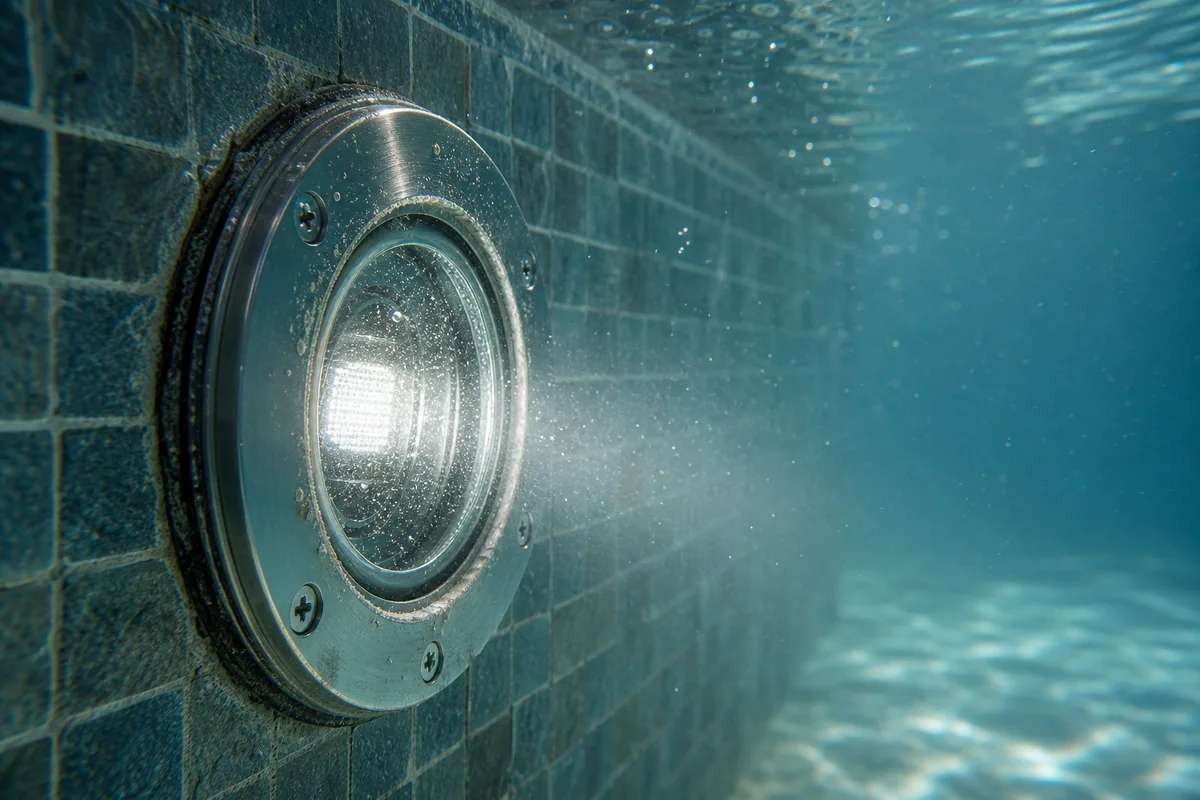
Why should we focus on long-term sealing of the underwater luminaire glass cover?

Underwater luminaires have been in a water-immersed environment for a long time. The glass cover is not only a protective piece, but also one of the most critical pressure interfaces of the complete luminaire sealing system. Ordinary outdoor luminaires mainly face rain and short-term water accumulation, while underwater luminaires have to withstand the long-term effects of continuous water pressure, temperature changes, chemical water quality and cleaning and maintenance.

If the sealing surface between the glass cover and the housing is unstable, water will continue to find the weakest point to penetrate, eventually causing condensation, short circuits, corrosion and light degradation. The underwater luminaire glass cover must simultaneously control the glass flatness, thickness tolerance, edge quality, gasket compression level and compression structure. It cannot only depend on whether the glass itself is thick enough.

Why should we focus on long-term sealing of the underwater luminaire glass cover?

Is flat glass or hemispheric glass suitable for swimming pool light glass cover?

The choice of flat glass or hemispheric glass for swimming pool lights depends on the structure of the luminaire, light angle, installation location and appearance requirements. The flat glass cover has a simple structure and the sealing surface is easy to control, making it suitable for recessed swimming pool lights, wall-mounted underwater lights and products that require a flat appearance.

Hemispheric glass can create a larger light angle and softer visual effect, and can also make the appearance of the luminaire more characteristic of traditional underwater luminaires, but requires higher sealing, stress and processing consistency. If the project values ​​reliable sealing and low maintenance, flat glass is usually more reliable; if a wide range of diffusion and decorative effects are required, hemispheric glass can be considered and strengthened structural verification.

Is flat glass or hemispheric glass suitable for swimming pool light glass cover?

How is the thickness of underwater light glass determined based on water pressure and structure?

The thickness of the underwater luminaire glass should be determined based on the installation depth, water pressure, glass diameter or span, support method, whether it is tempered, and the safety factor. The deeper the water, the larger the glass area, and the narrower the supporting edges, the higher the requirements for glass thickness and structural strength.

But thickness is not the only indicator. Whether the edge of the glass is evenly supported, whether the compression ring is flat, and whether the gasket causes local stress will all affect the actual safety. A more reliable approach is to confirm the thickness by combining structural calculations, sample hydrostatic tests, thermal cycling tests and long-term water immersion tests, rather than simply applying fixed values.

How is the thickness of underwater light glass determined based on water pressure and structure?

Why is the underwater luminaire glass prone to internal condensation and fogging?

Condensation and fogging inside the underwater luminaire usually come from internal residual moisture, loose sealing, negative-pressure water absorption caused by thermal cycling, or excessive ambient humidity during production and assembly. The interior of the luminaire heats up after it is turned on and cools down rapidly after it is turned off. Water vapor will condense on the cooler inner surface of the glass to form fog.

Such problems are not necessarily caused by the glass material itself, but are more related to the sealing structure, drying treatment, outlet watersampling and assembly process. Reducing fogging requires controlling the humidity of the assembly environment, using reliable gaskets or potting structures, and adding desiccants, pressure-equalizing vent structures, or more stringent air tightness tests when necessary.

Why is the underwater luminaire glass prone to internal condensation and fogging?

How to design the sealing surface between the underwater light glass and the metal housing?

The sealing surface between the underwater luminaire glass and the metal housing should be as continuous, flat and wide as possible, and the gasket should be evenly pressured. The edge of the glass cannot be pressed directly against the metal. It should be cushioned and sealed by a silicone ring, rubber ring or other water-resistant sealing material.

The sealing structure must avoid local deformation caused by single-point screw compression, and also prevent the gasket from losing its rebound after over-compression. The processing flatness of the metal housing, the rigidity of the press ring, the screw distribution and the glass thickness tolerance must be controlled together, so that the glass can maintain a stable seal under long-term water pressure and thermal cycling.

How to design the sealing surface between the underwater light glass and the metal housing?

How do pool light glass pieces handle chlorine, scale and detergents?

Pool light glass has been exposed to chlorine, scale and detergents for a long time. The glass body is usually relatively stable, but surface dirt, coatings, sealing materials and metal accessories are easily affected. Chlorine will accelerate the aging of certain metal parts and seals, and scale will adhere to the glass surface, reducing light transmittance and affecting the appearance.

Glass components should be made of materials and processes that have a flat surface, are easy to clean, and have good chemical resistance and stability. If anti-scale or hydrophobic coatings are used, confirm their resistance to chlorine water and detergents. During maintenance, strong acids, alkalis and hard tools should be avoided to avoid damaging the glass surface or surrounding sealing structure.

How do pool light glass pieces handle chlorine, scale and detergents?

How does the fountain luminaire glass cover withstand the impact of water flow and temperature changes?

In addition to long-term contact with water, fountain lights are also subject to water flow impact, bubble vibration, nozzle drop water pressure, and rapid cooling after the luminaire is lit and heated. The glass cover needs to have sufficient mechanical strength and thermal stability, and the edges must avoid stress concentration.

The structure should allow the glass to bear even force to prevent water flow from directly impacting weak parts of the glass or edge joints. For applications close to nozzles, high-frequency switching, or where temperature changes are significant, consider borosilicate glass, tempered glass, or thicker glass structures, and verify reliability through thermal shock and water flow shock testing.

How does the fountain luminaire glass cover withstand the impact of water flow and temperature changes?

How does underwater landscape light glass maintain light transmittance and color performance?

Underwater landscape lights are often used in swimming pools, fountains, water features and underwater decoration. The glass needs to maintain high light transmittance and optical neutrality to avoid significantly changing the LED color temperature and RGB color. Transparent low-iron glass is suitable for projects with higher requirements on brightness and color reproduction, while standard clear glass is suitable for general landscape lighting.

If you use frosted, opalescent or colored glass, it will add soft light and decorative feeling, but it may also reduce the brightness or change the color expression. For RGB or variable color temperature fixtures, be especially careful with glass color and haze, and it is best to test in real water with a sample light, as water depth, water quality, and glass all work together to affect the final visual effect.

How does underwater landscape light glass maintain light transmittance and color performance?

How to avoid uneven color mixing in the glass cover of underwater RGB luminaires?

If the glass cover of the underwater RGB luminaire is too transparent, the LED color chips are too close, or the light mixing distance is insufficient, it is easy to see separated color spots of red, green, and blue, and uneven color mixing may also occur on the water surface and pool wall. Glass covers can help with light mixing through moderate haze, opalescent diffusion, or textured diffusion.

However, excessive glass haze will reduce brightness and projection distance, so it is also necessary to match the internal diffusion cover, reasonable LED arrangement, reflective cavity and the distance from the light source to the glass. For high-end swimming pool and fountain projects, different color scenes should be tested under real installation distance and water environment, rather than just looking at the white light effect.

How to avoid uneven color mixing in the glass cover of underwater RGB luminaires?

How can the glass cover of a smart underwater luminaire avoid uneven mixing of different colors of light?

For smart underwater RGB luminaires, uneven color mixing is usually related to LED spacing, optical lens design, distance to the glass cover, diffusion level and water projection distance. A suitable glass cover can help soften color transitions by using controlled haze, opal diffusion or a properly curved surface, but it should not blur the beam so much that output efficiency and projection definition are lost. The glass also needs to work with the complete optical structure. If red, green and blue LEDs are too close to the glass or arranged unevenly, the cover alone may not fully solve color separation. During development, the supplier should confirm glass thickness, transmittance, haze and curvature with real RGB modules, then test color uniformity underwater because water depth, viewing angle and installation distance can all change the final mixed-light effect.
How can the glass cover of a smart underwater luminaire avoid uneven mixing of different colors of light?

Why does the edge treatment of underwater luminaire glass affect the waterproofing stability?

The edge of the underwater luminaire glass is directly involved in sealing and stressing. Edge chipping, burrs, unevenness or size fluctuations will affect the gasket contact. Even if the front side of the glass is intact, micro-cracks on the edges may expand due to compression, thermal cycling or water pressure, creating the risk of water leakage and rupture.

Through edge grinding, chamfering and polishing, stress concentration can be reduced, gaskets can contact more evenly, and the risk of assembly cuts and edge chipping during transportation can also be reduced. Underwater lights generally have higher edge quality requirements than regular outdoor lights because repair costs and safety risks are higher if the seal fails.

Why does the edge treatment of underwater luminaire glass affect the waterproofing stability?

How do underwater luminaire glass components help the complete luminaire achieve IP68 long-term water immersion protection?

Underwater luminaire glass components can help the complete luminaire achieve IP68 long-term water immersion protection requirements through appropriate thickness, edge flatness, sealing surface quality, tolerance control and assembly structure. It should be noted that the IP rating is a classification of the dust-proof and waterproof capabilities of electrical equipment enclosures according to IEC 60529, and is not an independent certification of a single glass piece itself.

In actual projects, the glass cover must also work with the metal housing, gasket, compression ring, outlet structure and potting process. Whether IP68 can ultimately be established should be based on the complete-luminaire water-pressure, water immersion, thermal cycling and third-party or project test results.

How do underwater luminaire glass components help the complete luminaire achieve IP68 long-term water immersion protection?

How to reduce scale adhesion and maintenance frequency of underwater luminaire glass cover?

To reduce the adhesion of scale on the underwater luminaire glass cover, you must first make the surface as smooth as possible with as few grooves and rough textures as possible to avoid water flow stagnation and mineral deposition. Clear glass with a smooth exterior is generally easier to clean than rough, sandblasted surfaces and is better for long-term pool and fountain maintenance.

Consider scale-resistant, hydrophobic, or easy-to-clean coatings, but be sure to verify the coating's longevity with chlorine, detergents, and repeated scrubbing. Maintenance should be done regularly with a soft cloth to avoid scratching with hard objects after scale has solidified for a long time. Good water circulation and water quality control will also significantly reduce the frequency of cleaning the glass cover.

How to reduce scale adhesion and maintenance frequency of underwater luminaire glass cover?

Chapter 7: Glass Components for Roadway, Parking Lot, and Area Lighting

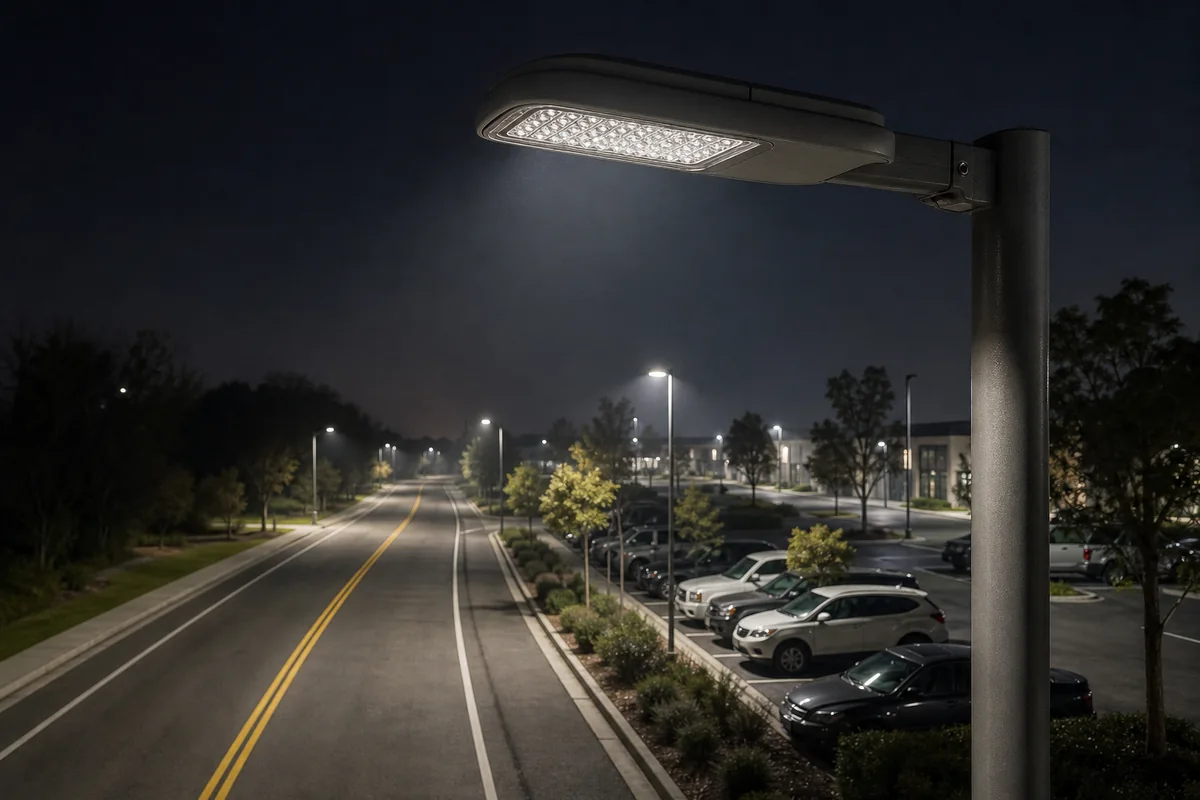
Is it suitable to use glass lens or glass cover for LED street lights?

Whether LED street lights are suitable for using glass lenses or glass covers depends on the light distribution scheme of the luminaires. If the main light distribution has been completed by the LED secondary lens, the outer layer usually uses a high-transmittance glass cover, which is mainly responsible for protection, dust-resistant, waterproof and impact resistance.

If the glass itself needs to participate in light distribution, such as improving weather resistance life, reducing the aging of plastic lenses, or achieving special beam control, glass lenses can be considered. However, the cost, weight and processing accuracy of glass lenses require higher requirements, and batch consistency must also be strictly controlled. Most modern LED street lights use a combination of internal lenses and external glass covers.

Is it suitable to use glass lens or glass cover for LED street lights?

How do road lighting glass lenses affect the light distribution curve?

The light distribution curve of road lighting determines how light is distributed to driveways, sidewalks and surrounding areas. Glass lenses change the direction of light through curvature, refractive surface, thickness and installation position, and can form effects such as polarized light, wide light, narrow light or bat-wing light distribution.

Insufficient lens accuracy or installation deviation will cause uneven road illumination, dark spots, bright spots, increased glare, or light overflowing from the road boundary. Therefore, the glass lens of road luminaires cannot only look at the light transmittance, but also needs to be optically verified based on the LED position, luminaire pole height, road width, luminaire spacing and standard illumination requirements.

How do road lighting glass lenses affect the light distribution curve?

How can street light glass components reduce glare, spilled light and light pollution?

The key to reducing glare and light pollution with streetlight glass components is to accurately project light onto roads and pedestrian areas, rather than projecting horizontally or scattering towards the sky. The transparent cover should maintain low reflection and high flatness to avoid stray light caused by scratches, stains or uneven texture on the surface.

If it is necessary to soften the light, a moderate diffusion or glare control structure can be used, but the beam cannot be excessively diverged. A more effective way is to combine glass components with lenses, hoods, luminaire installation angles and light-cutting designs to allow the luminaires to meet the road illumination while reducing glare, spilled light and neighborhood light intrusion.

How can street light glass components reduce glare, spilled light and light pollution?

Why should the impact resistance level be considered for parking lot light glass covers?

Parking lot lights are usually installed in areas with intensive vehicle and human activity, and may be subject to stone splashes, tool collisions, ball impacts or vandalism. If the impact resistance of the glass cover is insufficient, it will cause falls, cuts, watersampling failure and increased maintenance costs after breakage.

It should be noted that the IK level is a classification of the electrical equipment enclosure's ability to withstand external mechanical impact according to IEC 62262, and should generally be understood as the ability of the complete luminaire or enclosure system. Glass thickness, tempered quality, edge protection and frame-pressing structure can help the complete luminaire improve its impact resistance, but the final results such as IK08 and IK10 should be confirmed through the complete-luminaire testing.

Why should the impact resistance level be considered for parking lot light glass covers?

How do high pole luminaire glass components cope with sandstorm, rain and high-altitude maintenance problems?

The installation height of high pole luminaires is high, and the maintenance cost and risk are greater than ordinary luminaires. Therefore, the glass components must emphasize long-term stability and low maintenance. Wind and sand will wear away the glass surface, and rainwater and pollutants will cause dirt accumulation. If the light transmittance of the glass decreases, it will be troublesome to clean and replace it at high altitude.

Glass components should have surfaces that are highly transparent, wear-resistant, and easy to clean, and ensure reliable sealing surfaces to avoid fogging due to water ingress. Structurally, the fixing strength and wind vibration resistance of the glass must also be considered to prevent sealing failure due to vibration, temperature difference or loose screws in high-altitude environments.

How do high pole luminaire glass components cope with sandstorm, rain and high-altitude maintenance problems?

Will the glass of road luminaires turn yellow or become cloudy after long-term outdoor use?

Glass bodies are generally less susceptible to UV yellowing than many plastic diffuser covers, which is an advantage of using glass covers for road lighting fixtures. However, after long-term outdoor use, the glass surface may still look cloudy due to dust, oil, rain marks, bird droppings, salt spray and minor scratches.

The real concerns are surface contamination, coating durability, edge contamination, seal failure and internal condensation. If the glass surface treatment is not appropriate or cleaning and maintenance is insufficient, the actual light transmittance and appearance will decrease even if the glass body does not age significantly.

Will the glass of road luminaires turn yellow or become cloudy after long-term outdoor use?

How much light loss will be caused by dirt on the surface of street luminaire glass cover?

There is no fixed value for light loss caused by dirt on the surface of the street luminaire glass cover. It will be affected by the type of pollution, dust thickness, rain erosion, installation angle and maintenance cycle. Light dust may only cause a small amount of light loss, but oil, sediment, scale, bird droppings or long-term dust accumulation will significantly reduce the light transmittance.

In road lighting, dirty glass not only reduces the brightness, but may also change the light distribution, causing uneven illumination on the road surface. Glass surfaces and reasonable inclination angles that are easy to clean and have less dust accumulation should be selected during design, and regular cleaning should be considered in the project maintenance plan. Otherwise, long-term light decay will be mistaken for LED light source attenuation.

How much light loss will be caused by dirt on the surface of street luminaire glass cover?

How to maintain long-term and stable light transmission effect of area lighting glass components?

Area lighting is usually used in squares, parks, parking lots, logistics venues and public spaces. To maintain high light transmittance for a long time, glass materials must be optically stable, have few impurities and have a smooth surface. For projects that require high light efficiency, you can consider low-iron glass or high-quality transparent tempered glass.

At the same time, surface scratches, coating aging, sealing failure and external contamination must be controlled. The glass structure should be convenient for rainwater flushing and manual cleaning, and avoid deep texture or dust accumulation in dead corners. Long-term high light transmittance is not determined solely by materials, but also depends on surface technology, packaging and transportation, installation protection and later maintenance.

How to maintain long-term and stable light transmission effect of area lighting glass components?

How can road lighting glass reduce maintenance frequency and replacement costs?

Road lighting glass reduces maintenance frequency. The key is to reduce dirt adhesion, breakage risk and sealing failure. The highly transparent, wear-resistant and easy-to-clean glass cover can delay light loss; the stable edge treatment and frame pressure structure can reduce edge chipping, cracking and water intrusion.

Reducing replacement costs also considers standardized dimensions, removable construction and spare parts consistency. For large-volume road projects, the more stable the specifications of glass components, the easier it is to purchase and replace them later. Paying more attention to controlling the glass structure and assembly method during the design stage can usually reduce the cost of high-altitude maintenance and replacement of the complete luminaire in the future.

How can road lighting glass reduce maintenance frequency and replacement costs?

What is the difference in outdoor life between street luminaire glass lenses and plastic lenses?

Glass lenses are generally better than plastic lenses in terms of UV resistance, high temperature resistance, yellowing resistance and surface hardness. They are less likely to age and discolor after long-term outdoor use, and can better maintain optical stability. For high temperature, high UV or long-life roadway lighting, this is a clear advantage of glass lenses.

Plastic lenses are light in weight, flexible in processing, and low in cost. They are suitable for complex free-form surface light distribution and mass production. However, they may face yellowing, fogging, cracking or surface aging problems outdoors for a long time. The actual choice should be a combination of optical design, cost, weight, weathering requirements and lifetime goals, rather than simply assuming that one material is absolutely better.

What is the difference in outdoor life between street luminaire glass lenses and plastic lenses?

How to choose between light efficiency and weather resistance for road lighting glass components?

Road lighting glass components must have high light transmittance and long-term weather resistance. Choosing clear and high-permeability glass can improve light efficiency, but if the glare control, impact resistance and sealing design are insufficient, the actual use experience and lifespan will be affected; choosing high haze or thick glass, although softer and stronger, may reduce efficiency and increase energy consumption.

Reasonable choices should be based on road grade, light pole height, light distribution requirements, maintenance cycles and environmental conditions. Ordinary urban roads attach great importance to light efficiency and low glare balance, while coastal, sandy or public risk areas need to strengthen weather resistance, wear resistance and impact resistance. The best solution is to let the glass bear the protection and stable light transmission, and let the precise light distribution be completed by the lens and the luminaire structure.

How to choose between light efficiency and weather resistance for road lighting glass components?

How can parking lot luminaire glass avoid glare from strong light at night?

Parking lot lights are usually installed at low or medium heights, so that both vehicle drivers and pedestrians may directly see the front of the lights. If the glass is completely transparent and the LED array is exposed, it is easy to produce strong light glare at night, affecting safety and comfort.

Frontal brightness can be reduced through moderately diffused glass, micro-textured covers, internal lenses, glare control grilles or blackout frames. The glass should not be overly opalized, otherwise it will reduce the ground illumination and expand the scattering range. A more ideal approach is to control the light to cover the parking spaces and passages downwards, while reducing the highlights in the horizontal line of sight.

How can parking lot luminaire glass avoid glare from strong light at night?

Chapter 8: Glass Components for Step, Deck, and Small Recessed Lights

Why are outdoor step lights more suitable for soft glass covers?

Outdoor step lights are usually installed at people's feet, knee height or low on the wall, so users will see the lights at close range. If the glass cover is too transparent, the LED point light source or strong bright area will easily be dazzling, which will affect the comfort of walking at night.

The soft glass cover can diffuse the light more evenly, reduce abrupt bright spots, and allow the edges of steps and walking paths to be softly illuminated. The goal of step lights is not to illuminate the space very brightly, but to clearly indicate height differences, boundaries and walking directions. Therefore, frosted, opalescent or moderately fogged glass is usually more suitable than pure transparent glass.

Why are outdoor step lights more suitable for soft glass covers?

How can step luminaire glass reduce glare and abrupt light spots at night?

To reduce glare, step lights must first avoid direct exposure of the LED light source to human eyesight. The glass can be frosted, opalescent, fine-textured, or sandblasted on the inside to allow light to diffuse first and then shine through, reducing front-facing highlights.

At the same time, the structure of the luminaire should allow more light to shine downward or diagonally downward instead of directly horizontally. The haze of the glass cover cannot be too high, otherwise it will cause insufficient brightness or excessive light spots; it is ideal to combine the light-shielding structure, reflective surface and moderate diffusion glass to make the step outline clear but not dazzling.

How can step luminaire glass reduce glare and abrupt light spots at night?

How to prevent deck light glass cover from cracking due to stepping on it?

Deck lights are often installed on wooden decks, patios, planks, or outdoor surfaces where the glass cover may be directly exposed to stepping on, furniture feet, and occasional impacts. Preventing breakage cannot only rely on thickening the glass, but also ensuring that there is sufficient support under the glass to avoid hanging in the middle and stress at the edge points.

The glass cover should be made of tempered glass or reinforced structure with appropriate thickness, and should be chamfered, edged and framed for protection. After installation, it is best for the glass surface to be flush with the deck or surface ring to avoid forming protruding stress points; if used in public areas, it should also be evaluated together with anti-slip, impact resistance and long-term maintenance requirements.

How to prevent deck light glass cover from cracking due to stepping on it?

What are the difficulties in processing small-sized glass covers?

Small-sized glass covers look simple, but the processing difficulties are concentrated. Because of the small size, errors in edge grinding, chamfering, hole opening, silk screen printing or surface treatment are more likely to account for a larger proportion, and slight deviations may lead to poor assembly or uneven appearance.

Small glass pieces are also more likely to chip, scratch, or be lost during the cutting, edge grinding, and cleaning processes, making batch consistency control more difficult. If you also need special shapes, hole positions, rounded corners or high-precision tolerances, you must confirm the processing technology, fixture method and inspection standards in advance. You cannot just quote and produce according to the idea of ​​​​ordinary large plate glass.

What are the difficulties in processing small-sized glass covers?

How to control the dimensional tolerance of embedded step light glass?

Recessed step lights have higher requirements on glass size tolerances because the glass needs to accurately fit the metal frame, plastic parts, gaskets or wall openings. If the size is too large, it may not fit in or cause assembly stress; if the size is too small, gaps, shaking, leakage, and uneven appearance may occur.

When controlling tolerances, the length, width, thickness, fillet, hole position, edge chamfer and surface flatness requirements of the glass should be clearly defined, and the glass supplier should be informed of the actual assembly structure. For batch projects, it is best to use samples to verify the compression level and assembly feel of the gasket first, and then solidify the confirmed dimensional standards into drawings and inspection specifications.

How to control the dimensional tolerance of embedded step light glass?

Why do the glass edges of step luminaires have to be chamfered and polished?

Step light glass edges must be chamfered and polished, mainly for safety, fit and longevity. The edges of untreated glass are sharp and can easily cut your hands during installation. It is also prone to small chipping during transportation and pressing. These small defects can become the starting point for subsequent cracking.

Chamfering removes sharp edges, and polishing reduces microcracks and stress concentrations. For recessed or low-mounted outdoor lighting fixtures, the glass edge is often in contact with the gasket, face frame and wall structure. The more stable the edge quality, the smoother the assembly, the better the watersampling and long-term reliability.

Why do the glass edges of step luminaires have to be chamfered and polished?

How does the glass of small outdoor lighting fixtures take into account both watersampling and heat dissipation?

The space of small outdoor lighting fixtures is limited, and the glass must be involved in sealing without preventing internal heat from being released. Watersampling usually requires a reliable sealing surface between the glass and the housing, but if the luminaire body is completely enclosed and the heat dissipation path is insufficient, the LED and driver temperatures will rise, affecting lifespan.

The design should allow the glass to be responsible for front protection and sealing, while at the same time dissipating heat through the metal housing, back panel or heat dissipation structure. If necessary, vent valves, potting or partition sealing methods can be used to reduce negative-pressure water absorption caused by thermal cycling. The glass thickness, gasket compression and assembly clearance must be coordinated with the thermal design of the complete luminaire.

How does the glass of small outdoor lighting fixtures take into account both watersampling and heat dissipation?

Does the glass cover of the step luminaire need anti-slip treatment?

Whether the glass cover of the step luminaire requires anti-slip treatment depends on whether the glass is located in a stepable area. If the glass is installed on a vertical wall or on the side of a step, anti-slip safety is usually not required; if the glass is on a tread, deck, or a location where people will directly step on it, anti-slip safety should be considered.

Anti-slip treatment can use fine textures, etched points, light frosting or anti-slip patterns, but care should be taken not to significantly affect the light transmittance and cleaning convenience. If the surface is too rough, it will accumulate dust, scale and become dirty, which will increase the difficulty of maintenance. Therefore, the anti-slip grade should be selected according to the actual traffic environment and should not be over-treated.

Does the glass cover of the step luminaire need anti-slip treatment?

How to reduce the risk of cutting hands during installation of small outdoor glass components?

Small outdoor glass components are easy to be directly picked up, pressed in or adjusted by hand during installation. If the edges are sharp, have obvious chipping, or are too small to be easily grasped, the risk of hand injuries will increase. The first step in reducing risk is to chamfer, grind and polish the edges to ensure there are no sharp corners or burrs.

Packaging and construction are also important. Glass components should be packaged separately to avoid hidden edge chipping caused by collision with each other; suction cups, gloves or special tools can be used during installation to avoid direct contact of fingers with the edges. For mass installation projects, glass edge safety standards should be written into the inspection requirements, rather than just relying on the careful operation of on-site personnel.

How to reduce the risk of cutting hands during installation of small outdoor glass components?

How to avoid local stress cracking of step luminaire glass components?

Local stress cracking of step luminaire glass often results from over-tightening of the assembly, misaligned screws, uneven metal frame, uneven compression of the gasket, or minor defects at the edge of the glass. Although small-sized glass has a small area, if the stress is concentrated, it will also crack after transportation, installation or thermal cycling.

To avoid local stress, the glass needs to be evenly stressed, avoid hard contact, and buffer it with soft seals, limit steps, and reasonable tolerances. The edges of the glass should be chamfered and polished, and holes and special-shaped corners should be designed to avoid sharp corners. Assembly tests and thermal cycling tests should be performed at the sample stage to confirm that the glass will not fail due to long-term pressure.

How to avoid local stress cracking of step luminaire glass components?

Chapter 9: Outdoor Decorative Lights and Custom Glass Shades

What types of glass shades are suitable for outdoor decorative lights?

Outdoor decorative lights can choose clear glass, frosted glass, opal glass, embossed glass, bubble glass, amber glass, brown glass or blown glass shade according to style and light output needs. Clear glass is suitable for displaying bulbs and internal structures, frosted or opal glass is better for soft light and hiding LED point lights, and textured and colored glass emphasizes the decorative atmosphere.

When selecting, don't just look at the appearance, but also consider outdoor weather resistance, cleaning and maintenance, assembly methods and batch consistency. For B-end projects, the glass shade must not only comply with the design language, but also be able to stably adapt to the luminaire body, seals, and packaging and transportation requirements.

What types of glass shades are suitable for outdoor decorative lights?

How does the glass cover of an outdoor chandelier cope with wind swaying and temperature changes?

The glass cover of outdoor chandeliers will be affected by wind swaying, hanging chain swings, thermal cycling and rain erosion, so the glass itself and the fixed structure must be reliable enough. Hard contact should be avoided between the glass opening cover, hanging points, compression rings and metal parts. It is best to buffer the vibration through soft pads, gaskets or limiting structures.

Temperature changes will cause glass, metal housings and seals to expand and contract to varying degrees. During design, a reasonable assembly gap should be reserved, the edge quality and annealing stress of the glass should be controlled, and the glass should be prevented from being under local stress for a long time. For large or special-shaped chandelier glass shades, it is best to conduct assembly and swing tests at the sample stage.

How does the glass cover of an outdoor chandelier cope with wind swaying and temperature changes?

Is clear glass or textured glass suitable for outdoor lantern lights?

If you are pursuing a traditional, transparent and bulb-visible effect for outdoor lanterns, you can use transparent glass, which is especially suitable for retro filament light sources or designs with internal light-shielding structures. But clear glass exposes LED point sources, wiring, and internal dust, making it more likely to produce glare at night.

Textured glass is more suitable for lantern lights that need to soften the light, enhance the decorative feel, or hide the internal structure. Water ripples, vertical lines, bubbles and hammered glass can give lanterns a textured feel during the day and richer light and shadow at night. The actual choice should be determined based on the style of the luminaire, the brightness of the light source, the installation height and the frequency of maintenance.

Is clear glass or textured glass suitable for outdoor lantern lights?

Why are amber, brown or bubble glass commonly used in retro outdoor luminaires?

Retro outdoor luminaires often use amber, brown or bubble glass because these glasses can create a warmer, softer and handmade visual effect. Amber will significantly enhance the warm light atmosphere, brown is more low-key and calm, and bubble glass can make the glass shade look closer to traditional blown glass.

It should be noted that the color and bubble effects will affect the light transmittance and color temperature perception. When used in outdoor projects, both daytime appearance and nighttime lighting effects are important to check, as well as color stability, batch consistency, and ease of surface cleaning.

Why are amber, brown or bubble glass commonly used in retro outdoor luminaires?

What is the difference between tinted glass, smoked glass and amber glass in outdoor lighting fixtures?

Brown glass is more retro and low-key, which can reduce the straightforwardness of transparent glass and make luminaires more layered during the day; smoked glass is more modern and suitable for black, dark gray, stainless steel or minimalist style shells; amber glass is warmer and more suitable for antique copper, brass and country retro style luminaires.

From the perspective of light efficiency, these colored glasses will change the perception of light and may reduce some light transmittance. Brown and smoke gray are generally more restrained, while amber has a more obvious impact on color temperature. In engineering projects, samples should be used to confirm color depth, lighting effects and batch differences to avoid overall color inconsistency after batch installation.

What is the difference between tinted glass, smoked glass and amber glass in outdoor lighting fixtures?

Is the color of the outdoor decorative glass shade body colored or surface sprayed?

The color of outdoor decorative glass shades can come from body coloring, surface spraying, coating or baking paint. Body coloring is usually more stable in color and less likely to be exposed due to scratches or outdoor aging. It is suitable for long-term outdoor applications and projects that require higher weather resistance.

Surface spraying or coating color selection is more flexible and suitable for small batch customization and special appearance effects, but it is necessary to focus on confirming adhesion, UV resistance, detergent resistance and wear resistance. For outdoor lighting fixtures, if surface color layers are used, the location, maintenance methods and life expectancy of the inner and outer surfaces should be as clear as possible to avoid complaints of fading, falling off or color difference in the future.

Is the color of the outdoor decorative glass shade body colored or surface sprayed?

How to ensure that outdoor colored glass shades reduce fading risk over long-term outdoor use?

To improve long-term color stability for outdoor colored glass shades, priority should be given to body tinted glass or a proven weather-resistant coating process. The color of body tinting comes from the glass material itself and is generally less susceptible to fading due to scrubbing, UV rays and rain than ordinary surface spraying.

If the project must use spray, plated or electroplated colors, weathering testing, adhesion, cleaning agent resistance and batch color variation ranges should be confirmed at the sample stage. Long-term non-fading cannot only be judged by the supplier's verbal promise, but should be judged in combination with the use environment, process instructions, sample testing and the customer's target lifespan.

How to ensure that outdoor colored glass shades reduce fading risk over long-term outdoor use?

How do bubble glass and water corrugated glass affect the light and shadow effects of outdoor luminaires?

Bubble glass will create a fine, slightly flickering visual layer in the light, making it suitable for outdoor luminaires with a strong retro, handmade feel and decorative atmosphere. Water-corrugated glass stretches and refracts light, creating a softer flow around walls, floors or glass shades.

The focus of this type of textured glass is not to increase illumination, but to enhance decorative light and shadow. If the texture is too deep, it may cause messy spots, uneven light and dark, or difficulty in cleaning. If the texture is too shallow, it may not be obvious enough. Batch projects should confirm the sample effect under real light sources, real installation heights and night environments.

How do bubble glass and water corrugated glass affect the light and shadow effects of outdoor luminaires?

Are blown glass shades suitable for long-term outdoor use?

Blown glass shades can be used in long-term outdoor lighting fixtures, but control of material, thickness, opening size, annealing stress and assembly structure is required. Its advantages are flexible shape and strong handmade texture, suitable for decorating chandeliers, lanterns, garden lights and high-end landscape lights.

However, the dimensional consistency of blown glass is usually not as good as that of molded glass. Tolerances must be reserved during batch assembly, and assembly risks must be controlled through mouth grinding, edge treatment and inspection standards. If the installation environment is windy, has a large temperature difference, or is difficult to maintain, the thickness of the glass, fixing method, and packaging and transportation plan need to be specially evaluated.

Are blown glass shades suitable for long-term outdoor use?

How to control the batch appearance consistency of outdoor decorative glass shades?

The batch appearance consistency of outdoor decorative glass shades mainly depends on the mold, material batch, color control, texture depth, wall thickness and post-processing process. If the transparency, number of bubbles, color depth and opening size fluctuate too much, it will be very obvious when comparing installations in rows or the same project.

Controlling consistency requires establishing confirmation samples during the sampling stage, including color samples, texture samples, size samples and lighting effect samples. During mass production, acceptable standards for color difference, bubbles, ripples, thickness differences and appearance defects should be clarified, and random inspections should be carried out before shipment. Decorative glass allows a certain sense of handcrafting, but the project must have a controllable scope.

How to control the batch appearance consistency of outdoor decorative glass shades?

How do high-end hotel and villa projects use glass shades to enhance the atmosphere?

High-end hotel and villa projects can enhance the atmosphere through the material, color, texture and light diffusion of glass shades. Opal glass can create a soft and quiet courtyard atmosphere, amber and brown glass can enhance a warm retro feel, and water ripples, bubbles and embossed glass can make luminaires more detailed during the day and night.

For projects like this, avoid looking at the beauty of a single glass shade, and look at the continuous effect of the entire group of fixtures in paths, walls, courtyards and entrance spaces. Glass tint, light transmittance and texture should be consistent at the project level and coordinated with brass, stainless steel, aluminum alloy or ferrous metal housings.

How do high-end hotel and villa projects use glass shades to enhance the atmosphere?

How to prevent rainwater from accumulating inside the glass cover of outdoor decorative luminaires?

Water accumulation inside the glass cover of outdoor decorative luminaires usually comes from improper sealing, improper opening direction, missing drainage path, or deviation in on-site installation angle. Decorative luminaires often have complex shapes for appearance. If water pockets are formed at the bottom, mouth or joints, it is easy for water, insects and dust to accumulate.

There should be a clear drainage path for rainwater during design, and there should be a reasonable seal or drainage gap between the glass opening cover and the metal housing to prevent water vapor from entering and not being able to drain out. For upside-down, hoisting or lantern-type structures, also check the lowest point of the glass cover, screw holes and wire holes to ensure that long-term outdoor use will not form hidden water accumulation areas.

How to prevent rainwater from accumulating inside the glass cover of outdoor decorative luminaires?

Chapter 10: Glass Material Selection for Outdoor Lighting

How to choose between soda-lime glass, borosilicate glass and low-iron glass in outdoor lighting?

Soda-lime glass is a common basic material in outdoor lighting fixtures. The cost is relatively controllable and it is suitable for ordinary wall lights, garden lights, some covers and decorative glass shades. Borosilicate glass has better thermal shock resistance and is more suitable for luminaires with high temperature, significant temperature changes or close to high-power light sources. Low-iron glass reduces the green tint common in ordinary glass and is suitable for projects that require higher light transmittance, color reproduction and appearance clarity.

Actual trade-offs depend on fixture wattage, installation environment, glass thickness, target transmittance, budget and certification testing requirements. The material itself cannot alone determine the life of the complete luminaire, but appropriate material selection can help the complete luminaire achieve a more reasonable balance between light efficiency, weather resistance, thermal stability and cost.

How to choose between soda-lime glass, borosilicate glass and low-iron glass in outdoor lighting?

Why is high borosilicate glass suitable for outdoor lighting fixtures with significant high temperature and thermal shock?

High borosilicate glass has a low thermal expansion coefficient. When faced with rapid temperature changes, the internal thermal stress is usually smaller than ordinary soda-lime glass. Therefore, it is more suitable for high-temperature luminaires, higher-power outdoor luminaires, fountain luminaires, luminaires near industrial environments, or scenes with significant temperature differences between day and night.

However, high borosilicate glass does not mean that structural design can be ignored. Glass thickness, edge treatment, assembly stresses, sealing methods and fixture heat dissipation all affect ultimate reliability. For outdoor projects with a high risk of thermal shock, the thermal shock test of samples and the lighting aging test of the complete luminaire should be combined to confirm whether the material is suitable.

Why is high borosilicate glass suitable for outdoor lighting fixtures with significant high temperature and thermal shock?

Can low-iron glass significantly improve light transmittance in outdoor lighting?

Low-iron glass is generally clearer and has a lighter green tone than ordinary transparent soda-lime glass. It can bring better light transmission and color reproduction in thicker glass, larger cover panels or high-end architectural lighting. For wall washers, floodlights, high-end landscape projects and luminaires that require stable light color, low-iron glass can be considered.

However, whether low-iron glass is worth using depends on the evaluation of luminaire power, glass thickness, optical structure, cost and customer target light efficiency. If the glass is thin and the light efficiency requirements are not high, the improvement brought by low-iron glass may not be obvious; if the project focuses on appearance clarity, color rendering and batch consistency, its value will be more prominent.

Can low-iron glass significantly improve light transmittance in outdoor lighting?

Which outdoor lighting lenses and windows are optical glasses suitable for?

Optical glass is suitable for outdoor lighting components that have higher requirements on beam angle, transmittance, refractive index, surface quality and imaging clarity, such as wall washer lenses, floodlight lenses, linear light optical windows, sensor windows, camera protection windows and special light distribution components.

Its advantage is that the optical stability and surface quality are more controllable, but the cost, processing difficulty and design requirements are also higher. Ordinary outdoor luminaires do not necessarily require optical glass. Only when ordinary cover plates or ordinary pressed glass cannot meet the requirements for light spot, color, light transmittance or long-term stability, optical glass solutions are more suitable.

Which outdoor lighting lenses and windows are optical glasses suitable for?

How to choose between transparent glass, opal glass and frosted glass in outdoor lighting fixtures?

Transparent glass has high light transmittance and is suitable for luminaires that require maximum light efficiency, display the bulb structure, or have a mature light distribution system inside. Opal glass has strong diffusion ability and can hide LED point light sources to make the light more uniform, but it will reduce the light transmittance to a certain extent. Frosted glass is between the two, which can soften the light and retain better brightness performance.

When selecting, you should first look at the purpose of the luminaire: street lights, floodlights and wall washers usually pay more attention to high light transmittance and optical precision; garden lights, path lights, lawn lights and wall lights pay more attention to soft light and comfort. The appearance of the glass should also be considered in conjunction with cleaning and maintenance. If the outer surface is too coarsely frosted, it may be more likely to accumulate dust and leave watermarks.

How to choose between transparent glass, opal glass and frosted glass in outdoor lighting fixtures?

Which is more suitable for outdoor use: body colored glass or surface spray colored glass?

The color of the main body colored glass comes from the glass material itself. Generally, the weather resistance and scrub resistance are more stable, and it is not easy to be exposed due to surface wear. It is suitable for long-term outdoor use and projects that require high color stability. Surface-sprayed stained glass offers more flexibility in color selection and is suitable for small batch customization, special effects or cost-controlled projects.

However, when spraying the surface for outdoor use, it is important to confirm the adhesion, UV resistance, rain resistance, detergent resistance and wear resistance. It cannot simply be said that one type is better, the key depends on the project life, color requirements, processing costs and maintenance methods; high-end or long-term outdoor projects usually prefer stable body colors or proven weather-resistant coatings.

Which is more suitable for outdoor use: body colored glass or surface spray colored glass?

How to choose outdoor lighting glass materials according to temperature, humidity and ultraviolet environment?

For outdoor lighting fixtures with high temperatures and significant temperature changes, priority should be paid to the thermal stability and edge stress control of the glass. If necessary, borosilicate glass or a more reliable heat treatment solution should be considered. In high humidity, underwater or long-term rain environments, you should focus on the glass edge, sealing surface, surface coating and compatibility with sealing materials.

The impact of ultraviolet rays on the glass body is generally less than that of many plastic materials, but it may still cause aging to surface coatings, inks, glues and seals. The material selection should not just look at the name of the glass, but also make a comprehensive judgment based on the working temperature of the complete luminaire, installation area, sun exposure time, salt spray or polluted environment, and the customer's expected lifespan.

How to choose outdoor lighting glass materials according to temperature, humidity and ultraviolet environment?

How does the glass cover of solar outdoor lights improve photovoltaic light input efficiency?

The glass cover of a solar outdoor light affects the efficiency of sunlight entering the photovoltaic panels. Glass with high transmittance, low iron, low reflection and flat surface helps reduce incident light loss and is especially suitable for products that require higher charging efficiency and appearance clarity. If the glass surface is prone to dust accumulation, watermarks or scratches, it will also reduce the long-term light absorption effect.

However, photovoltaic efficiency is not determined by the glass cover alone, but is also related to solar panel quality, tilt angle, installation direction, shading, surface cleaning and battery management system. Glass covers can help improve and stabilize light conditions, but the final power generation performance needs to be evaluated based on the overall machine structure and real outdoor use environment.

How does the glass cover of solar outdoor lights improve photovoltaic light input efficiency?

How does glass thickness affect fixture intensity, light transmittance and cost?

Increased glass thickness often helps improve mechanical strength and impact resistance, and can also improve safety margins in some pressure-bearing scenarios, such as underground lights, driveway lights and public area luminaires. However, increased thickness will also lead to increased weight, increased material costs, increased assembly pressure, and may cause a certain amount of light transmission loss or more obvious edge color.

When choosing the thickness, you should not just pursue thicker and safer, but also consider the span of the glass, the supporting structure, the tempering or heat treatment method, the compression level of the gasket, and the weight limit of the complete luminaire. The reasonable thickness should strike a balance between strength, light transmittance, cost, assembly and transportation, and be confirmed through sample assembly and complete-luminaire testinging.

How does glass thickness affect fixture intensity, light transmittance and cost?

Chapter 11: Glass Manufacturing Processes for Outdoor Lighting

What is the difference between blown glass, pressed glass and heat-bent glass in outdoor glass shades?

Blown glass is suitable for three-dimensional shapes such as spheres, lanterns, chandelier shades, and retro decorative shades. It has a handmade appearance and flexible shapes, but the dimensional consistency and wall thickness stability are usually not as good as mold pressed parts. When using blown glass for outdoor projects, pay special attention to opening size, edge treatments, annealing stresses, and batch appearance differences.

Pressed glass is suitable for mass production of glass shades and glass lenses with stable dimensions, controllable thickness, clear texture or lens structure, and is suitable for engineering luminaires with high consistency requirements. Thermal bent glass is suitable for curved cover panels, curved windows and some architectural exterior parts. The advantage is that it can form larger curved surfaces, but the bending radius, flatness, mold marks and assembly stress must be controlled.

What is the difference between blown glass, pressed glass and heat-bent glass in outdoor glass shades?

How to choose between pressed glass lens and CNC machined glass lens?

Pressed glass lenses are suitable for outdoor luminaires with large batches, relatively fixed structures, and stable optical surfaces. After mold opening, the cost of a single piece is relatively controllable and the batch consistency is good. It is suitable for wall washers, floodlights, linear lights or specific light distribution components. However, the initial mold cost and development cycle need to be included in the project plan.

CNC processing of glass lenses is more suitable for small batches, high precision, trial production verification or special shape requirements. It has higher flexibility and does not necessarily require complex molds. However, the processing cost is higher, and the cycle may also be affected by material and precision requirements. The selection should take into account batch size, optical accuracy, development time, budget, number of sample verifications and subsequent mass production stability.

How to choose between pressed glass lens and CNC machined glass lens?

When is it suitable for molding production of glass components for outdoor lighting fixtures?

When outdoor lighting glass components have stable batch sizes, fixed structures, complex curved surfaces, special textures, lens functions or higher consistency requirements, they are usually suitable for mold production. Mold opening can improve batch efficiency and dimensional stability, and also allows the glass cover, glass lens or embossed glass to better match the luminaire body structure.

If the project is still in the design verification stage, the order quantity is small, or the dimensions are frequently modified, the risk of direct mold opening is higher. A more reliable way is to first use cutting, hot bending, CNC, manual samples or simple molds to verify the structure and light effects, and then enter formal mold development after confirming the drawings, assembly and customer samples.

When is it suitable for molding production of glass components for outdoor lighting fixtures?

What processing techniques are suitable for small batches of customized glass components?

Small batches of customized outdoor lighting glass components are usually suitable for cutting, edge grinding, chamfering, drilling, silk screen printing, sand blasting, acid etching, heat bending, CNC processing or modification of existing molds. This can reduce the initial mold investment and make it easier to adjust the size, hole position, edge and surface effects at the sample stage.

If it is a three-dimensional glass shade, you can consider blown glass or existing molds with similar specifications for small batches; if it is a flat cover, cutting and grinding is more common. When selecting a process, you must confirm in advance the dimensional tolerances, appearance standards, sealing surface requirements and whether it will be transferred to mass production in the future to avoid that the sample process cannot be stably copied to batch orders.

What processing techniques are suitable for small batches of customized glass components?

How do glass openings, edges and chamfers affect outdoor light fixture assembly?

Glass openings, edges and chamfers will directly affect the assembly safety, sealing effect and risk of breakage of outdoor lighting fixtures. Hole position deviation may cause screws, brackets or wire holes to be misaligned; improper hole edge treatment may cause stress concentration; edge chipping or insufficient chamfering may easily cause cracks during press installation, transportation or thermal cycling.

For outdoor luminaires that require watersampling, the edge of the glass and the hole position will also affect the gasket contact, glue adhesion and pressure frame stress. The hole diameter, hole distance, edge distance, chamfer size, edge grinding level and allowable edge chipping range should be clearly stated in the drawings, and the cooperation between the glass and the metal housing, gasket and fasteners should be verified at the sample stage.

How do glass openings, edges and chamfers affect outdoor light fixture assembly?

What is the difference between internal sandblasting and external sandblasting on the light efficiency and cleaning maintenance of outdoor lighting fixtures?

Internal sandblasting usually places the rough diffusion surface on the inside of the glass shade, leaving the outer surface relatively smooth, which can not only soften the light, hide the LED point light source, but also make it easier to clean outdoors and reduce dirt adhesion. For garden lights, wall sconces, and path lights, this approach is generally better for long-term outdoor maintenance.

The soft light effect of exterior sandblasting is also obvious, but the rough surface is directly exposed to rain, dust, oil and cleaning tools, and is prone to leaving watermarks, dust accumulation, or being scrubbed and worn. If the project must use exterior sandblasting, cleaning frequency, surface stain resistance, and customer maintenance conditions should be evaluated in advance to avoid long-term appearance deterioration despite good lighting effects.

What is the difference between internal sandblasting and external sandblasting on the light efficiency and cleaning maintenance of outdoor lighting fixtures?

Are outdoor glass pieces suitable for anti-fog, anti-reflective or anti-UV coatings?

Outdoor glass components can be coated with anti-fog, anti-reflective, easy-to-clean, hydrophobic or anti-UV coatings based on project needs, but coating location, weather resistance, scrub resistance and cost should be carefully evaluated. Anti-reflective coatings are suitable for highly transparent windows, solar panels or optical components sensitive to reflection; anti-fog or easy-to-clean coatings are suitable for high humidity, difficult maintenance or underwater related applications.

It should be noted that a lot of performance ultimately depends on the complete luminaire structure and usage environment. For example, fogging is often related to sealing, moisture, and thermal cycling, and cannot be completely solved by coating alone; UV resistance is more often caused by protective coatings, inks, glues, or surrounding materials. Test conditions, life expectancy and cleaning methods should be confirmed before applying the coating.

Are outdoor glass pieces suitable for anti-fog, anti-reflective or anti-UV coatings?

Why does the glass annealing process affect the life of outdoor luminaires?

The function of glass annealing is to reduce the stress remaining inside the glass during the molding and cooling process. If the annealing is insufficient, the glass is more likely to suffer from self-cracking, edge crack expansion and batch damage during processing, assembly, transportation, thermal cyclings or external impact.

Outdoor luminaires are exposed to temperature differences, rain, sunlight and structural compression for a long time, and residual stress will amplify the risk of cracking. Annealing control is especially important for blown glass covers, pressed glass lenses, thick-walled glass and odd-shaped glass components. When purchasing, suppliers should be required to control the annealing process in conjunction with the product structure, and reduce risks through polarized stress inspection, sample assembly, and thermal cycling testing.

Why does the glass annealing process affect the life of outdoor luminaires?

Chapter 12: Optical Effects, Glare, and Visual Comfort

How to choose the light transmittance of outdoor lighting glass?

The light transmittance of outdoor lighting glass should be selected based on the purpose of the lighting, installation height, target illumination and visual comfort. Street lights, floodlights, wall washers and solar lights usually pay more attention to high light transmittance to reduce light loss; garden lights, path lights and wall lights cannot only pursue light transmittance, but also consider glare control and light softness.

Higher light transmittance does not necessarily mean better final effect. If the LED point light source is directly visible, high-transmittance transparent glass may cause glare; if opal white or frosted glass is used, the light transmittance will decrease, but it can improve uniformity and comfort. A safer approach is to combine the sample luminaire test to confirm whether the glass transmittance, light source power and light distribution structure can jointly achieve the project goals.

How to choose the light transmittance of outdoor lighting glass?

How to choose the haze of outdoor lighting glass?

Glass haze determines how much light is diffused. Low haze glass is closer to the transparent effect and is suitable for luminaires that require high brightness, high light efficiency or have internal lens light distribution; medium haze is suitable for most garden lights, wall luminaires and path lights, which can soften LED point light sources while retaining better brightness; high haze glass is more suitable for hiding light sources and creating a uniform luminous surface.

If the haze is too low, it may cause glare, while if the haze is too high, the illumination may be reduced, the beam range may be expanded, or the light may appear dull. Outdoor projects should choose a haze based on viewing distance, installation height, LED arrangement and maintenance requirements, and confirm the nighttime effect by lighting a sample, rather than just looking at the unlit glass appearance.

How to choose the haze of outdoor lighting glass?

What are the differences in light transmittance requirements for landscape lights, street lights, wall washers and underwater lights?

Landscape lights usually pay more attention to atmosphere and comfort. The higher the light transmittance, the better. Many garden lights, lawn lights and path lights use frosted or opalescent glass to soften the light. Street lights and area lighting pay more attention to energy efficiency and road illumination. Glass covers usually require higher light transmittance and are matched with lenses and cutoff structures to control glare.

Wall washers are very sensitive to light transmittance and consistency. If the long glass cover has uneven light transmission, it will affect the light spot on the wall. Underwater lights must take into account light transmittance, color performance and long-term underwater sealing. Scale and water quality on the glass surface will also affect the actual light output. The selection of light transmittance of different luminaires should serve the overall optical goal, rather than using a unified standard.

What are the differences in light transmittance requirements for landscape lights, street lights, wall washers and underwater lights?

Why can opal glass hide LED point light sources?

The scattering structure inside or on the surface of opalescent glass will turn the strong point light source emitted by the LED into a larger light-emitting surface, thus weakening the outline and highlights of the luminaire beads. For garden lights, column lights, wall lights and decorative lights, this diffusion ability can make the light more even and reduce the glare when viewed at close range.

However, the ability of opalescent glass to hide LEDs is usually accompanied by a certain amount of light loss. The higher the degree of opalescence, the lower the light transmittance may be. The degree of opalescence should be selected when designing based on the number of LEDs, distance from the light source to the glass, glass thickness and target brightness. If the space is too small or the LED is too close to the glass, you may still see local bright spots even with opal glass.

Why can opal glass hide LED point light sources?

How does frosted glass achieve soft light and glare control effects?

Frosted glass is treated with rough surface or acid etching, sandblasting, etc. to cause light to scatter when passing through the glass, thereby reducing the direct brightness of the LED point light source. It softens the light and reduces the harsh reflections and localized highlights common with clear glass.

The glare control effect of frosted glass needs to be coordinated with the structure of the luminaire. If the power of the light source is too high and the installation angle is directed at the human eye, frosted glass alone cannot completely solve the glare; if the outer surface is frosted, dust accumulation, watermarks and difficulty in cleaning must also be considered. Outdoor luminaires often adopt a solution with frosted interior and smooth exterior surface to achieve a balance between soft light and maintenance.

How does frosted glass achieve soft light and glare control effects?

How do striped and patterned glass change the direction of light from outdoor lighting fixtures?

Striped glass and embossed glass will change the direction of light refraction and scattering through surface texture, causing the luminaire to produce stretched, diffused, rippled or dispersed light and shadow effects. Vertical grained glass may make light diffuse more obviously in the horizontal direction, water rippled glass will create a softer dynamic feel, and finely embossed glass can weaken point light sources and increase decorative levels.

This type of glass is more suitable for landscape lights, decorative wall lights, lantern lights and garden lights. If used for wall washers, floodlights, or luminaires that require precise light distribution, the texture may cause spot deformation or stray light, so it must be confirmed with a sample luminaire. The role of textured glass should be understood as helping to adjust light and appearance, rather than replacing professional lens light distribution.

How do striped and patterned glass change the direction of light from outdoor lighting fixtures?

How to avoid dazzling transparent glare from transparent glass?

Transparent glass itself does not diffuse light. If LED luminaire beads, reflective cups or high-brightness light sources are directly visible, dazzling transparent glare will easily occur. To avoid this problem, you should start from the position of the light source, the light-shielding structure, the built-in lens, the reflective cavity and the installation angle, rather than relying solely on the glass cover.

Clear glass is suitable for fixtures that require high light transmittance, display bulbs, or protection of internal optical systems. If it is used for wall lights, path lights or garden lights near human height, it can be used with low-brightness filament light sources, built-in diffusion covers, light-shielding rings or partial frosted structures. This not only retains the transparent appearance, but also reduces the discomfort caused by looking directly at the light source.

How to avoid dazzling transparent glare from transparent glass?

Will colored glass change the original color temperature of the LED?

Colored glass often changes the visual color temperature and color rendering of LED light. Amber glass will make the light appear warmer, brown and smoky gray glass will reduce some of the brightness and change the overall look, and blue, green or red glass will filter the spectrum more significantly, shifting the color of the object being illuminated.

If the project requires accurate color temperature and good color rendering, colored glass should be used with caution and the lighting effect should be confirmed through a sample luminaire. If the main goal is to create a decorative atmosphere, colored glass can become part of the design language, but color depth, batch consistency and light transmittance must still be controlled to avoid obvious color differences in the same project.

Will colored glass change the original color temperature of the LED?

How to choose a glass cover that won’t cast color for RGB outdoor lighting fixtures?

RGB outdoor lighting fixtures need to choose glass covers that are optically neutral, color stable, and have uniform light transmission. Clear low-iron glass or light haze neutral diffusion glass is more suitable for maintaining the original expression of red, green, blue and mixed colors; glass with obvious colors will filter part of the spectrum, causing some colors to be darkened or cast.

If there is uneven color mixing in RGB luminaires, it can be improved through moderate haze, internal diffusion cover, increasing light mixing distance and optimizing LED arrangement instead of using colored glass to correct it. The final effect should be tested under the actual control mode, installation distance and night environment, especially checking whether the white light, warm color, blue and gradient scenes are consistent.

How to choose a glass cover that won’t cast color for RGB outdoor lighting fixtures?

How does outdoor lighting glass take into account brightness, comfort and glare control?

Outdoor lighting glass must take into account brightness, comfort and glare control. The key is to design the glass as part of the complete luminaireing optical system. Highly transparent glass is good for brightness and efficiency, and frosted, opalescent or textured glass is good for soft light and hiding the light source, but excessive diffusion will reduce the effective illumination or expand the spilled light.

A more reasonable solution is to let the glass assume the functions of protection, moderate diffusion and appearance, while the LED arrangement, lens, reflector, light-shielding structure and installation angle jointly control glare. For engineering projects, it is best to confirm the ground illumination, direct viewing brightness, spot uniformity and viewing comfort through a sample luminaire lighting test.

How does outdoor lighting glass take into account brightness, comfort and glare control?

How to reduce light pollution and neighborhood light intrusion through glass design?

Glass design can help reduce stray light, surface reflections and unnecessary glare, but light pollution and neighborhood light intrusion are ultimately determined by the overall light distribution, installation angle, power and control method. Highly transmissive, low-reflective, flat, and optically stable glass covers help light travel in the direction it was designed, rather than being scattered by scratches, stains, or uneven surfaces.

For outdoor projects that require low glare, micro-diffusion glass, hoods, lenses and cutoff structures can be used to allow more light to fall on the target area and reduce upward light and horizontal spill light. Glass components are one of the important components that affect the results, but they should ultimately be confirmed through complete-luminaire optical testing and on-site lighting evaluation.

How to reduce light pollution and neighborhood light intrusion through glass design?

Chapter 13: Watersampling, Sealing, Condensation, and Fogging

Why is it easy for water to enter the glass cover of outdoor luminaires?

The glass cover of outdoor lighting fixtures is prone to water ingress. Usually it is not the glass material itself that absorbs water, but weak points between the glass, shell, gasket, glue, wire holes and assembly structure. Rain may enter through glass openings, pressure frame gaps, screw holes, back panels, cable outlets or housing seams, especially in wind and rain, water accumulation and thermal cycling environments.

Glass components will affect the risk of water intrusion, such as opening size, edge flatness, thickness tolerance and sealing surface quality will all affect whether the gasket is compressed evenly. However, the waterproof capability is the result of the complete luminaire system and needs to be confirmed by combining housing design, sealing materials, assembly process and the IP test of the complete luminaire.

Why is it easy for water to enter the glass cover of outdoor luminaires?

Is fogging inside the glass cover of outdoor luminaires a glass problem or a structural problem?

In most cases, fogging inside the glass cover of outdoor luminaires is not a problem with the glass itself, but is caused by structural sealing, internal moisture and thermal cycling. If moisture is brought into the interior of the luminaire during assembly, or if the sealing is not tight enough to allow moisture to enter, the water vapor will condense on the cooler inner surface of the glass to form fog when the temperature drops.

The surface temperature, thickness and temperature difference between the inside and outside of the glass will affect the fogging performance, but the root cause usually lies in the overall luminaire structure and assembly control. To reduce fogging, it is necessary to control the humidity of the assembly environment, the compression level of the gasket, the watersampling of the outlet, necessary drying treatment and breathable balance design, and verify it through the complete luminaire thermal cycling and lighting test.

Is fogging inside the glass cover of outdoor luminaires a glass problem or a structural problem?

How does the glass cover cooperate with the housing and gasket to form a reliable sealing structure?

The sealing structure between the glass cover and the housing should ensure that the contact surface is continuous, flat, and wide enough, and the gasket or glue layer should be evenly stressed. Common methods include pressure frame and gasket, step groove and glue, screw pressing structure and potting structure. The specific choice depends on the type of luminaire, installation direction, maintenance method and target protection requirements.

When designing, it is necessary to avoid direct contact between glass and metal, and to avoid local stress on the glass caused by single-point compression. Glass size tolerance, thickness tolerance, edge chamfer, housing flatness and gasket compression should be confirmed together, and the final waterproof stability needs to be confirmed through the complete luminaire assembly test and IP test.

How does the glass cover cooperate with the housing and gasket to form a reliable sealing structure?

How does the gasket material affect the long-term waterproof stability between the glass and the housing?

The material of the gasket will significantly affect the long-term waterproof stability between the glass and the housing. Silicone, EPDM, rubber and other materials have different performances in terms of temperature resistance, UV resistance, hydrolysis resistance, resilience and compression permanent deformation. If the material selection is not suitable, it may be sealed in the short term, but it will easily age, harden, lose rebound or produce water leakage in the long term.

The glass component itself must provide a flat and stable sealing contact surface, and the gasket is responsible for compensating tolerances and buffering forces. The two need to be matched in design, especially to confirm the gasket compression level, contact width, assembly pressure and long-term environmental conditions. Ultimately, the waterproofing stability must be judged based on the complete-luminaire testing.

How does the gasket material affect the long-term waterproof stability between the glass and the housing?

How does glass edge flatness affect fixture sealing?

The flatness of the glass edge will directly affect the contact uniformity of the gasket or glue layer. If the edge of the glass has warping, wavy, chipping or local level differences, the gasket may be over-pressed in some locations and under-compressed in other locations, thereby forming a water leakage channel.

For luminaires with high waterproof requirements such as underground lights, underwater lights, wall washers and wall-mounted lights, the flatness and edge grinding quality of the glass are particularly important. The edge processing, flatness, chamfering and allowable defect range should be clearly stated in the drawings, and samples should be used to verify whether the glass and the housing sealing surface can fit stably.

How does glass edge flatness affect fixture sealing?

Will the glass thickness tolerance affect the gasket compression?

Glass thickness tolerances will affect the amount of seal ring compression, especially in pressure frames, slots or stepped seal structures. When the glass is thick, the gasket may be over-compressed, resulting in difficulty in assembly, excessive stress on the glass, or loss of rebound in the gasket; when the glass is thin, the gasket may be under-compressed, which may cause water leakage, looseness, or dust intrusion.

Therefore, outdoor lighting glass cannot only have a nominal thickness, but must also agree on an acceptable thickness tolerance, and match this tolerance with the gasket design, pressure frame height and housing processing tolerance. During mass production, thickness stability will directly affect the assembly consistency and protection test results of the complete luminaire.

Will the glass thickness tolerance affect the gasket compression?

How do the glass components of outdoor luminaires cooperate with the complete luminaire structure to take into account dust prevention and heat dissipation?

To achieve dustsampling, the glass components of outdoor lighting fixtures usually need to form a reliable closed structure with the housing and seals to prevent dust, insects and particles from entering the light source cavity. However, if the luminaire is completely enclosed and has insufficient heat dissipation paths, the internal heat may not be effectively discharged, affecting the life of the LED, power supply and sealing materials.

The solution is not to let the glass alone be responsible for heat dissipation, but to let the glass complete front protection and light transmission. The heat dissipation is mainly completed through the metal housing, back plate, heat dissipation ribs or structural heat conduction paths. If necessary, vent valves, partition sealing or potting solutions can be added to reduce dust and water ingress, as well as pressure changes caused by thermal cycling.

How do the glass components of outdoor luminaires cooperate with the complete luminaire structure to take into account dust prevention and heat dissipation?

Why does the thermal cycling cause negative pressure in outdoor luminaires to absorb water?

When the outdoor luminaire is lit, the internal air heats up and expands. When it is turned off or encounters rain to cool down, the internal air shrinks, and a pressure difference occurs between the inside and outside of the luminaire. If there are tiny weak points in the sealing structure, external water vapor or water droplets may be sucked into the luminaire body under negative pressure. This is one of the reasons why many outdoor luminaires repeatedly fog up and get water ingress.

The fit of the glass cover, seal and housing affects this risk. A stable sealing surface, appropriate compression and weather-resistant sealing materials can reduce the probability of water absorption; for luminaires with large temperature differences or large sealing volumes, a pressure-equalizing vent structure can also be considered. Finally, it needs to pass the thermal cycling, rain and complete luminaire waterproof test verification.

Why does the thermal cycling cause negative pressure in outdoor luminaires to absorb water?

How do glass openings, hole spacing, and hole edge treatments increase sealing risks?

Glass openings increase sealing and strength risks, especially when the holes are located close to the edges, the holes are large, the edges of the holes are rough, or the area around the holes needs to be compressed by screws. The edge of the hole is prone to stress concentration, and if the sealing gasket is not in uniform contact, it may also become a water leakage path.

If outdoor lighting fixtures must make holes in the glass, the requirements for hole diameter, hole spacing, edge spacing, chamfering and hole edge polishing should be clearly defined, and try to avoid allowing screws to press hard on the glass directly. The waterproof structure should be designed with gaskets, glue or metal pressing parts. The complete luminaire after opening still needs to be tested for watersampling and assembly reliability.

How do glass openings, hole spacing, and hole edge treatments increase sealing risks?

How do glass dimensions, tolerances and sealing surfaces help improve IP protection stability for the complete luminaire?

Glass size, tolerance and sealing surface quality can help the complete luminaire improve IP protection stability, because the length, width, diameter, thickness, flatness and edge quality of the glass will affect the compression of the gasket and the force of the pressure frame. If the size of the glass fluctuates too much, some luminaires in the same batch may be pressed too tightly and some cannot be pressed, resulting in unstable waterproof test results.

It should be noted that the IP rating is a classification of the dust-resistant and waterproof capabilities of electrical equipment enclosures according to IEC 60529, and is not a separate certification for glass components. Glass components help the complete luminaire achieve the target IP rating by stabilizing its size and sealing surface quality, but ultimately the complete luminaire still needs to be tested and confirmed in conjunction with the housing, outlet, screws, glue and assembly process.

How do glass dimensions, tolerances and sealing surfaces help improve IP protection stability for the complete luminaire?

Do outdoor glass components need to be tested for waterproof assembly in conjunction with the luminaire body?

A single glass piece usually cannot completely simulate the waterproof result of the complete luminaire, but before leaving the factory, the size, flatness, edge quality, thickness tolerance and sealing surface can be inspected according to customer needs, and if necessary, sample assembly testing can be done with the customer's luminaire body. In this way, problems such as mismatch between the glass and the housing, abnormal compression of the gasket, or uneven stress on the pressure frame can be discovered in advance.

For projects with higher watersampling requirements such as underground lights, underwater lights, wall-mounted lights and wall washers, it is recommended to conduct watersampling, water immersion, thermal cycling or lighting aging tests on the complete luminaire during the sample stage. Glass suppliers can provide critical dimensional and surface quality support, but the final IP rating should be based on complete-luminaire testinging.

Do outdoor glass components need to be tested for waterproof assembly in conjunction with the luminaire body?

What are the differences in glass sealing points between underwater lights, underground lights and wall lights?

The focus of the glass sealing of underwater luminaires is long-term water immersion, water pressure, water resistance of the gasket and uniformity of compression. The glass edge and sealing surface must be stable and reliable. In addition to being waterproof, underground lights also have to face sediment, stagnant water, trampling and vehicle pressure, so the glass pressure bearing, edge support and sealing structure are all critical.

The sealing of wall luminaires focuses more on the direction of rainwater flow, water leakage on the back panel, wall installation, watersampling of wire holes and the coordination of the glass opening cover. All three types of luminaires require collaborative design of glass and housing, but the sources of risks are different, and the same set of glass sizes and sealing ideas cannot be simply applied. Finally, it should be confirmed through the complete-luminaire testing of the corresponding scene.

What are the differences in glass sealing points between underwater lights, underground lights and wall lights?

Chapter 14: Weather Resistance, Corrosion, Safety, and Long-Term Use

What weather resistance factors should be considered for outdoor glass shades?

Outdoor glass shades need to consider environmental factors such as sunlight exposure, ultraviolet rays, rain, humidity, temperature difference between day and night, wind and sand, salt spray, dust, bird droppings and detergents. The glass body is generally stable, but edges, surface treatments, coatings, sandblasted layers, inks, glues and seals are subject to long-term environmental effects.

When selecting a model, you should not only look at the appearance of the new sample, but also evaluate the light transmittance, color stability, cleaning difficulty and assembly reliability after years of outdoor use. For coastal, desert, high temperature, high cold or high humidity projects, the glass material, thickness, edge treatment and complete luminaire sealing structure should be designed accordingly.

What weather resistance factors should be considered for outdoor glass shades?

Will the glass body age and turn yellow if exposed to sunlight for a long time?

Glass bodies are generally less susceptible to yellowing from UV exposure than many plastic diffuser covers, which is an advantage of using glass in outdoor lighting. The color of standard clear glass, low-iron glass and borosilicate glass is generally relatively stable under long-term sunlight exposure.

But this does not mean that the luminaire will not change color or become cloudy in the long term. Surface dirt, rain marks, salt spray, coating aging, ink fading, seal failure and internal condensation can all affect the final appearance and light transmission. Therefore, when evaluating outdoor life, the glass body, surface treatment and complete luminaire structure should be looked at together.

Will the glass body age and turn yellow if exposed to sunlight for a long time?

Why do outdoor glass shades become cloudy?

Common causes for outdoor glass shades to become cloudy include dust deposition, rain watermarks, bird droppings, oil stains, salt spray crystals, fine scratches on the surface, scale or internal condensation. The glass body may not age, but surface contamination and micro-damage will make it look gray and foggy.

If the luminaire is poorly sealed and water vapor enters the glass shade, it will also form a fog film or stains on the inside of the glass. Reducing turbidity requires selecting easy-to-clean surfaces, avoiding rough treatment on the outside, controlling the sealing structure, and developing maintenance intervals based on the environment. Coastal, sandy and highly polluted areas should pay special attention to long-term cleaning convenience.

Why do outdoor glass shades become cloudy?

What issues should be paid attention to when using glass components for outdoor lighting fixtures in coastal areas?

The main risks in coastal areas are salt spray, high humidity, strong winds, rain and a mix of pollutants. The glass body usually has good corrosion resistance, but salt will adhere to the surface of the glass to form stains, and will also accelerate the aging of the metal frame, screws, brackets, glue and seals.

Therefore, the glass components of coastal outdoor lighting fixtures must pay attention to edge treatment, surface cleanliness, sealing surface stability and cooperation with metal parts. Housing and fastener materials are also critical, as corrosion of the structure around the glass may result in reduced holding force, seal failure or loosening of the glass.

What issues should be paid attention to when using glass components for outdoor lighting fixtures in coastal areas?

Will the high salt spray environment affect the glass surface and metal accessories?

The corrosion effect of high salt spray environment on the glass body is usually less than that on metal accessories and sealing materials, but the salt will leave white crystals, watermarks and dirty films on the glass surface, reducing the light transmittance and affecting the appearance. If the glass is coated, sprayed or roughened on the outside, its salt spray and cleaning resistance also need to be confirmed.

Metal fittings are more likely to be a source of problems. Once the pressure frame, screws and shell are corroded, it may cause uneven pressure of the glass, failure of the gasket or loosening of the assembly structure. Coastal projects should evaluate glass, metal, seals and surface treatments as a system.

Will the high salt spray environment affect the glass surface and metal accessories?

How to prevent water vapor and mildew on glass shades in high humidity environments?

In a high-humidity environment, water vapor, dirt film and mildew are easy to form on the outside of the glass shade, while the inside may condense and fog due to poor sealing or moisture brought in by the assembly. The rougher the glass surface and the more structural dead spots, the easier it is for water to accumulate and contaminants to adhere.

To prevent moisture and mildew, it is necessary to make the outer surface as easy to clean as possible, avoid water accumulation in the glass shade structure, and maintain a reliable seal or reasonable drainage and ventilation between the glass and the housing. For sealed luminaires, the humidity of the assembly environment should also be controlled, and long-term performance should be verified through the complete luminaire thermal cycling and heat and humidity tests.

How to prevent water vapor and mildew on glass shades in high humidity environments?

How will desert and sandy environments wear down outdoor glass shades?

Fine sand particles in desert and sandy environments will continue to wash away the glass surface, which may cause fine scratches, surface fogging and reduced light transmittance in the long term. Low-mounted luminaires, windward-facing luminaires and in-ground lights are particularly susceptible to sand and dust abrasion and buildup.

The glass itself has a high hardness, but it does not mean that it will not be scratched by wind and sand for a long time. When designing, try to avoid grooves and exposed rough surfaces that are prone to sand accumulation, choose exterior surfaces that are easier to clean, and reduce wear through structural shading, installation angles, and maintenance plans. For high wind and sand projects, packaging, transportation and on-site installation protection are also important.

How will desert and sandy environments wear down outdoor glass shades?

How do outdoor glass shades in cold areas deal with ice, snow, freezing and thawing?

Outdoor glass shades in cold areas have to face low temperatures, ice and snow coverage, melting snow and refreezing, and thermal shock. The glass body can usually withstand low temperatures, but if there are micro-cracks on the edges, the assembly is too tight, or water gets inside, freeze-thaw expansion may amplify the risk of cracks and seal failure.

During design, water accumulation inside the glass shade should be avoided to ensure reliable drainage paths and sealing structures. The edges of the glass must be chamfered, ground and residual stress controlled, and reasonable tolerances must be left between the housing and the glass. For luminaires that may suddenly light up and heat up after being covered with snow, attention should be paid to thermal shock and complete luminaire temperature rise tests.

How do outdoor glass shades in cold areas deal with ice, snow, freezing and thawing?

How to avoid thermal stress cracking of outdoor lighting glass in high temperature areas?

The glass of outdoor luminaires in high-temperature areas will be affected by sunlight exposure, the luminaire's own heating, and sudden rainfall and cooling. If the glass thickness is uneven, the edges are defective, the annealing stress is high, or the assembly is too tight, thermal expansion and contraction may cause thermal stress cracking.

Risk reduction can be achieved from three aspects: material, structure and process: when necessary, choose glass with better thermal stability, control annealing and edge quality, avoid hard pressing of the metal housing on the glass, and allow the luminaire to have a reasonable heat dissipation path. Reliability should ultimately be confirmed through sample lighting, thermal cycling and rain simulation tests.

How to avoid thermal stress cracking of outdoor lighting glass in high temperature areas?

What impact will the temperature difference between day and night have on the glass of outdoor lighting fixtures?

The temperature difference between day and night will cause the glass, metal housing, gaskets and glue to expand and contract to varying degrees. After long-term repeated cycles, it may lead to compression changes of the gasket, fatigue of the adhesive layer, uneven stress on the glass, or the expansion of micro-cracks.

The glass components themselves need to control thickness, edge quality and residual stress, and the assembly structure must avoid excessive tightness and hard contact. For areas with significant temperature differences, luminaires should focus on verifying the sealing, fogging, loosening and cracking conditions after thermal cycling, rather than just looking at whether the initial assembly is qualified.

What impact will the temperature difference between day and night have on the glass of outdoor lighting fixtures?

Will rain, dust and bird droppings reduce the light transmittance of glass?

Rain, dust and bird droppings will all reduce the light transmittance of glass, but the degree depends on the thickness of the contamination, cleaning frequency, glass installation angle and surface condition. Slight floating dust may not have much impact, but long-term accumulation of dust, rain marks, bird droppings and oil stains will significantly reduce the light output and worsen the appearance of the luminaire.

The smoother the outer surface of the glass, the easier it is to be washed away by rain and manual cleaning, and the more stable the long-term light transmission effect will be. For products that are inconvenient to maintain, such as high pole lights, wall-mounted lights, underground lights and underwater lights, anti-fouling, drainage and cleaning convenience should be considered during the design stage.

Will rain, dust and bird droppings reduce the light transmittance of glass?

How to reduce dirt adhesion and cleaning frequency for outdoor glass shades?

To reduce the adhesion of dirt to outdoor glass shades, you must first avoid the outer surface being too rough, the texture too deep, or the formation of dead corners where water accumulates. Glass with a smooth outside, few grooves in the structure, and an installation angle that facilitates drainage is more likely to remain transparent through rainwater erosion and regular cleaning.

Easy-to-clean, hydrophobic or antifouling coatings can be considered depending on project needs, but coating life can be affected by UV light, detergents, scrubbing frequency and environmental contamination. A more prudent strategy is to combine easy-to-clean construction, appropriate surface preparation and a maintenance program, rather than relying solely on a single coat.

How to reduce dirt adhesion and cleaning frequency for outdoor glass shades?

How do glass pieces maintain their transparency and appearance for long-term outdoor use?

To maintain the transparency and appearance of glass components for long-term outdoor use, it needs to be controlled from several aspects including material, surface, edge, sealing and maintenance. The material should be stable, the surface should be easy to clean, the edges should reduce chipping and stress, and the sealed structure should avoid internal water ingress and fogging.

Packaging, shipping and installation can also affect long-term appearance, with scratches, contamination and assembly stresses likely to show up after use. It is recommended for engineering projects to retain sample standards, clarify appearance defects, light transmittance, color and cleaning requirements, and conduct necessary inspections before batch shipment.

How do glass pieces maintain their transparency and appearance for long-term outdoor use?

Does outdoor lighting glass need impact testing?

Whether the glass of outdoor lighting fixtures requires impact testing depends on the installation location, usage environment and project requirements. Underground lights, parking lot lights, public area luminaires, low-mounted wall luminaires and luminaires that are easily touched or bumped usually require more attention to their impact resistance.

It should be noted that the impact resistance results usually belong to the capabilities of the complete luminaire or housing system, and are not determined by the glass sheet alone. Glass thickness, tempering quality, edge protection, pressed frame structure and installation method will all affect the test results. Key items should be confirmed through sample or complete-luminaire testinging, rather than judging solely by glass thickness.

Does outdoor lighting glass need impact testing?

What does IK rating mean for outdoor glass luminaires?

The IK level is the IEC 62262 classification of the electrical equipment enclosure's resistance to external mechanical impact. It is used to describe the enclosure system's ability to withstand external impact. For outdoor lighting fixtures with glass covers or glass shades, the glass is one of the important components that affects the IK test results.

However, grades such as IK08 and IK10 should not be understood as independent certification of single panes of glass. The final result is related to the glass thickness, tempering state, support method, pressure frame structure, housing material and impact location, and should be subject to the test of the complete luminaire or housing system.

What does IK rating mean for outdoor glass luminaires?

What mechanical strength requirements does the glass cover of an underground light need to meet?

The glass cover of the underground light needs to consider trampling, impact from falling objects, sand wear, vehicle pressure and long-term outdoor temperature difference. The forces on pedestrian areas, landscaped areas and driveway areas vary greatly and therefore glass thickness, tempering, support structure and surface anti-skid requirements will also differ.

The mechanical strength should not only look at the glass itself, but also the face ring support, pressure frame stress, glass span and installation flatness. Driveway or public area projects should be confirmed through pressure, impact, abrasion and waterproof testing of the complete luminaire to avoid partial suspension of the glass or breakage caused by edge stress.

What mechanical strength requirements does the glass cover of an underground light need to meet?

Does underwater lighting fixture glass require thermal shock testing?

It is generally recommended to pay attention to the risk of thermal shock when it comes to underwater luminaire glass, especially in applications where the luminaire power is high, the glass is thick, the switches are frequent, or the water temperature changes significantly. After the luminaire is lit, the glass is heated, and thermal stress may occur when it is washed by cold water or the environment cools down rapidly.

Whether special thermal shock testing is required depends on the luminaire structure, glass material, power, installation depth and project standards. Glass materials can help reduce risks, but final reliability still depends on the heat dissipation, sealing, compaction structure and actual working conditions of the complete luminaire, and should be confirmed through sample or complete-luminaire testinging.

Does underwater lighting fixture glass require thermal shock testing?

Does glass for parking lot and public area lighting fixtures need a higher impact rating?

Parking lot and public area luminaires are generally more susceptible to external impacts, flying rocks, tool strikes, or vandalism than private garden lights, so there is a greater need for attention to impact-resistant design. The appropriate thickness, tempering method and protective structure of the glass cover or glass shade should be selected based on the installation height, probability of personnel contact and project safety requirements.

Higher impact resistance is not achieved only by thickening the glass. The shell, pressure frame, supporting surface and fixing method are equally important. If the project clearly requires an IK level, the test results of the complete luminaire or housing system should be used as the basis, and the glass components should be matched to the test goals during the design stage.

What are the safety risks if an outdoor glass shade breaks?

Broken outdoor glass shades may bring risks such as cuts, falling, water intrusion, electric leakage, light source exposure, sealing failure and appearance complaints. Broken underground lights and step lights may also pose a potential safety hazard, while broken underwater lights may pose higher electrical and waterproof risks.

Risk reduction requires starting from the glass material, thickness, tempering, edge processing, assembly stress and packaging and transportation. For luminaires in public areas, the fragmentation status, replaceability and maintenance procedures after breakage should also be considered to avoid small problems turning into safety accidents.

What are the safety risks if an outdoor glass shade breaks?

Does the glass of outdoor lighting fixtures need to be tempered?

Not all outdoor lighting glass needs to be tempered. Whether to temper it depends on the application scenario, size, thickness, stress mode, thermal shock risk and project requirements. In-ground lights, parking lot lights, common area fixtures and larger covers are often better suited to consider tempering or strengthening.

However, tempered glass is not suitable for cutting, drilling or edging after processing, and the size and hole location must be confirmed in advance. For small decorative glass shades, complex blown parts or special optics, it is also possible to use non-tempered solutions and reduce the risk through structural protection and edge treatments. The final selection should be based on the overall luminaire design and test objectives.

Does the glass of outdoor lighting fixtures need to be tempered?

How to judge whether a glass piece is suitable for outdoor lighting?

To determine whether glass components are suitable for outdoor lighting, you should look at material stability, light transmittance or haze, thickness, edge quality, dimensional tolerance, surface treatment, temperature difference resistance, assembly matching and maintenance convenience. Just looking good or having a single piece of glass be strong is not enough.

A more reliable way to judge is to put the glass into the actual luminaire body and check the sealing, light efficiency, glare, heat dissipation, impact resistance and thermal cycling performance. For engineering projects, packaging and transportation, batch consistency and supply capabilities should also be confirmed to ensure that sample effects can be consistently reproduced in batch orders.

How to judge whether a glass piece is suitable for outdoor lighting?

When doing IEC/UL testing of outdoor lighting fixtures, what results do the glass cover and sealing structure usually affect?

When outdoor luminaires undergo IEC or UL related testing, the glass cover and sealing structure usually affect the results such as watersampling, dustsampling, impact resistance, thermal shock, temperature rise, insulation safety and mechanical fixation. The thickness, tolerance, edge quality, sealing surface flatness and assembly method of the glass will all affect the stability of the complete-luminaire testing.

It should be noted that IEC 60598, UL 1598, etc. usually focus on the design, structure and performance requirements of complete luminaires, and do not replace the certification of the complete luminaire with ordinary glass components alone. Glass suppliers can provide materials, dimensions, processing and related testing support, but final certification or project acceptance should be based on full luminaire testing and third-party reports.

When doing IEC/UL testing of outdoor lighting fixtures, what results do the glass cover and sealing structure usually affect?

How can the risk of glass breakage be reduced through thickness, edge treatment and packaging design?

To reduce the risk of glass breakage, it is necessary to simultaneously control thickness, edge treatment, structural stress, and packaging and transportation. Appropriate thickness can increase the safety margin, chamfering, edge grinding and polishing can reduce edge micro-cracks and stress concentration, and reasonable assembly can prevent the glass from being hard pressed by metal or partially suspended.

Packaging design is equally important. There should be isolation and buffering between glass components, and large-sized or special-shaped parts should be prevented from shaking, corner collision and pressure during transportation. For bulk export items, packaging methods, drop risks, stacking directions and on-site handling processes will all affect the final breakage rate.

How can the risk of glass breakage be reduced through thickness, edge treatment and packaging design?

Chapter 15: Maintenance, Cleaning, and Long-Term Use

How should outdoor glass shades be cleaned to avoid scratches?

When cleaning outdoor glass shades, you should first rinse away the surface sediment and hard particles with clean water, and then scrub with a soft cloth, sponge or neutral detergent. Avoid direct dry rubbing. Sand, metal shavings and hard brushes are common causes of fine scratches, especially in underground lights, low garden lights and windy and sandy environments.

For engineering projects, cleaning methods should be specified in the maintenance manual. Avoid using strong acids and alkalis, rough scouring pads or hard scrapers. If the glass surface is coated, sandblasted, screen-printed or anti-fouling treated, you also need to confirm the compatibility of the cleaning agent, otherwise the glass may be scratched or the surface functional layer may be damaged.

How should outdoor glass shades be cleaned to avoid scratches?

How to deal with frosted glass and sandblasted glass after they are stained with oil?

Frosted and sandblasted glass surfaces are more likely to attract oil, dust and fingerprints because the slightly rough surface allows contaminants to get trapped in the tiny bumps. When handling, use warm water, neutral detergent and a soft brush to clean gently, and avoid repeated rubbing with strong solvents or hard brushes.

For long-term maintenance of outdoor luminaires, it is recommended to give priority to a structure with a sandblasted interior and a smooth outer surface, so that the soft light effect is retained on the inside and the outside is easier to clean. When external sandblasting or deep frosting is used outdoors, the maintenance frequency and environmental pollution must be evaluated in advance to avoid oil stains that are difficult to clean later and affect the appearance.

How to deal with frosted glass and sandblasted glass after they are stained with oil?

How to avoid watermark residue on outdoor transparent glass covers?

Watermarks on outdoor transparent glass covers are mostly related to rain minerals, natural drying after cleaning, mixed dust deposition and insufficient surface inclination. The key to avoiding watermarks is to make the glass surface easy to drain, reduce water accumulation areas, and rinse with a clean soft cloth or deionized water after cleaning to reduce residue.

From a design perspective, the outer surface of the transparent cover should be as smooth as possible to avoid water pockets and water accumulation on the edges. For high-end architectural lights, wall washers and solar lights, consider easy-to-clean or hydrophobic coatings, but still confirm the coating's outdoor life and scrub durability.

How to avoid watermark residue on outdoor transparent glass covers?

How to clean and prevent scale on the surface of underwater luminaire glass?

Scale on the surface of underwater luminaire glass mainly comes from calcium and magnesium ions in the water, chlorine water environment and poor water circulation. Slight scale can be softened and wiped off with a cleaning agent suitable for swimming pools or fountain systems. Avoid using metal scrapers or hard emery cloths when cleaning to avoid scratching the glass or damaging the sealing edges.

Preventing scale requires starting from both glass surface and water quality management. The outer surface of the glass should be as smooth as possible and have as few grooves as possible to facilitate water flushing and manual cleaning. At the same time, controlling water quality and regularly maintaining the circulation system can also reduce scale deposition. Anti-scale coatings can be used as a secondary solution, but resistance to chlorine water and scrubbing should be verified.

How to clean and prevent scale on the surface of underwater luminaire glass?

How to reduce sediment wear on the surface of underground luminaire glass?

Sand and sand wear on the glass surface of underground luminaires usually comes from sand and gravel particles brought by shoe soles, tires, cleaning tools and rain. To reduce wear and tear, the first step is to make the glass flush with the ground or surface ring after installation to avoid forming raised stress points or sand-accumulated edges. At the same time, try to avoid locations where vehicle tires will directly run over them for a long time.

During maintenance, the sediment should be washed away before wiping to avoid dry wiping with sand. Structurally, the risk of wear can be reduced by protecting edges with stainless steel face rings, proper drainage, and choosing appropriate thickness and surface treatment. In long-term high wear scenarios, the glass cover should be planned as a maintainable and replacement part.

How to reduce sediment wear on the surface of underground luminaire glass?

How can the glass cover of outdoor lighting fixtures reduce insect intrusion, dust accumulation and maintenance frequency through structural design?

To reduce insect infestation, dust accumulation and maintenance frequency, it is necessary to deal with the glass cover and luminaire body structure at the same time. Glass openings, wire holes, heat dissipation holes, back panels and assembly gaps should avoid forming passages for insects and dust to enter; locations that require ventilation should control entry paths through insect screens, labyrinth structures or zoning designs.

Glass cover shape also affects maintenance frequency. The smoother the outer surface, the fewer grooves and dead corners where water accumulates, and the easier it is to be washed away by rain and cleaned manually. For garden lights, courtyard lights and outdoor chandeliers, drainage, ventilation and sealing should be considered at the same time to prevent water vapor, insects and dust from entering and being unable to be discharged.

How can the glass cover of outdoor lighting fixtures reduce insect intrusion, dust accumulation and maintenance frequency through structural design?

How often do outdoor lighting glass covers need maintenance?

There is no unified fixed value for the maintenance cycle of the glass cover of outdoor luminaires. It should be determined based on the installation environment, luminaire height, pollution level, glass surface treatment and project lighting requirements. Ordinary courtyards and residential scenes may be cleaned every few months to six months, while highly polluted roads, coastal, sandstorm, underground and underwater scenes may require more frequent maintenance.

For B2B projects, it is best to plan the maintenance cycle in advance in the project plan. High pole lights, architectural wall washers, underwater lights and large-area underground lights have high maintenance costs. When selecting glass, priority should be given to ease of cleaning, stain resistance, wear resistance and replaceability, rather than waiting for the light transmittance to drop significantly before processing.

How often do outdoor lighting glass covers need maintenance?

How much light decay will a glass shade that is not cleaned for a long time cause?

Glass glass shades that are not cleaned for a long time will cause light loss, but the specific proportion depends on the type of contamination, thickness, installation angle and environmental conditions. Slight floating dust may have limited impact, but long-term dust, oil, scale, bird droppings and sand coverage will significantly reduce the light transmittance and make the light spots darker, scattered or uneven.

This type of light attenuation is easily mistaken for LED light source attenuation, but may actually be caused by contamination on the glass surface. If an engineering project has requirements for illumination maintenance, glass contamination and maintenance cycles should be included in the design, rather than just looking at the initial parameters of the light source.

How much light decay will a glass shade that is not cleaned for a long time cause?

Will the glass coating become ineffective due to daily wiping?

Glass coatings have the potential to gradually fail due to daily wiping, cleaning agents, UV rays and environmental contamination, depending on the coating type, location and abrasion resistance level. Anti-reflective, anti-fog, hydrophobic, easy-to-clean, colored or metallized coatings do not have the same durability, and exterior surface coatings are generally more susceptible to wear and tear than interior surfaces.

If outdoor luminaires rely on coatings for optical or antifouling effects, the coating's resistance to weathering, scrubbing, and cleaning agents should be confirmed during the design phase. The maintenance documents should also specify the cleaning methods that can be used to avoid damaging the coating with strong solvents, hard brushes or abrasive powders.

Will the glass coating become ineffective due to daily wiping?

Can the outdoor glass cover still be used after its surface is scratched?

Whether the outdoor glass cover can continue to be used after the surface is scratched depends on the scratch depth, location, quantity and lighting application. Minor superficial scratches may only affect the appearance and a small amount of light transmission, but deep scratches, edge cracks, hole edge cracks or scratches at pressure-bearing locations may cause breakage and safety risks.

For underground lights, underwater lights, parking lot lights and public area lighting fixtures, more careful evaluation should be done after scratches, because the glass also performs pressure-bearing, protective or sealing functions. If scratches affect the light spot, sealing, strength or user safety, they should be replaced in time, rather than just judging from the appearance.

Can the outdoor glass cover still be used after its surface is scratched?

Will the watersampling be affected if the glass cover of the luminaire is loose?

Loose glass covers of light fixtures often affect watersampling, dustsampling and long-term safety. Once the glass cover is loose, the compression of the gasket may be insufficient, the glue layer may crack, and the stress on the pressure frame will also change, making it easier for rain, dust and insects to enter the luminaire body.

Looseness may also cause the glass to continue to shift due to wind vibration, thermal expansion and contraction, or external forces, increasing the risk of chipping and cracking. After finding looseness, you should check the condition of the pressure frame, screws, gaskets, glue and glass edges, and confirm whether reassembly or replacement of parts is needed through the complete luminaire waterproof inspection.

Will the watersampling be affected if the glass cover of the luminaire is loose?

How to tell whether the glass of outdoor lighting fixtures needs to be replaced?

To determine whether the glass of outdoor lighting fixtures needs to be replaced, you can look at four aspects: safety, sealing, light efficiency and appearance. If the glass has cracks, chipped edges, deep scratches, looseness, obvious deformation, seal failure or repeated internal fogging, replacement should be given priority.

If the glass surface is scratched for a long time, the scale is severe, the light transmittance is significantly reduced, or the spot quality is affected, the replacement cost and maintenance value should also be evaluated. For B2B projects, it is recommended to establish regular inspection standards and manage the glass status together with the IP of the complete luminaire, glare control, illumination maintenance and safety maintenance.

How to tell whether the glass of outdoor lighting fixtures needs to be replaced?

Chapter 16: Purchasing, Sampling, Quality Control, and Lead Time

What information do I need to provide when purchasing glass components for outdoor lighting fixtures?

When purchasing glass components for outdoor lighting fixtures, it is recommended to provide the type of lighting fixture, application environment, glass usage, dimensional drawings, thickness, material, color, light transmittance or haze, edge treatment, hole location, surface technology, estimated quantity and target delivery time. If glass is involved in sealing, the housing structure, gasket position, frame pressing method and target protection level should also be described.

The more complete the information, the more accurate the quotation and sampling will be. For different scenarios such as underground lights, underwater lights, wall washers, wall lights, etc., the pressure-bearing, waterproof, temperature-resistant, low-glare or optical consistency requirements should also be specified to avoid suppliers only quoting ordinary glass components, only to later discover that they cannot be assembled or have insufficient performance.

What information do I need to provide when purchasing glass components for outdoor lighting fixtures?

Do I need to provide 2D drawings or 3D files for custom outdoor lighting glass?

Custom outdoor light fixture glass is best provided with both 2D drawings and 3D files. 2D drawings are used to clarify key dimensions, tolerances, thickness, hole locations, chamfering, edging, surface treatment and inspection requirements; 3D files are helpful in understanding the glass surface, assembly space, luminaire body structure and sealing fit.

If only one kind of information can be provided, 2D drawings of flat cover panels can usually be evaluated first; complex curved surfaces, special-shaped glass shades, lenses or pressed parts require 3D files. Before final mass production, the confirmed dimensions, tolerances and appearance standards should be solidified into formal drawings to reduce communication errors.

Do I need to provide 2D drawings or 3D files for custom outdoor lighting glass?

Can outdoor glass pieces be reproduced from samples without drawings?

When there are no drawings, outdoor glass components can be copied based on physical samples, but the size, thickness, curvature, mouth, hole position, color, light transmittance, haze, edge treatment and surface technology need to be measured first. For blown glass covers, pressed glass lenses and special-shaped parts, it is also necessary to determine the process route of the original sample and whether mold opening is required.

Sample reproduction is suitable for old luminaire repair, replacement parts development and projects where the customer does not have complete information, but reproduction does not mean that it is completely correct. It is best to form confirmation drawings after surveying and mapping, and then confirm the match with the luminaire through sample assembly and lighting tests, especially glass components involving sealing, watersampling or optical effects.

Can outdoor glass pieces be reproduced from samples without drawings?

Before quoting glass components for outdoor lighting fixtures, what parameters will directly affect the price and delivery time?

Before quoting glass components for outdoor lighting fixtures, the material, size, thickness, tolerance, quantity, edge treatment, openings, surface treatment, color, light transmittance or haze, whether it is tempered, whether it is molded, packaging method and delivery location will directly affect the price and delivery time. Complex curved surfaces, odd-shaped glass shades, pressed lenses, coatings or high-precision tolerances often increase development time and production costs.

In order to make the quotation more accurate, it is best for customers to provide drawings, sample photos, application scenarios and estimated order quantities at the same time. If the glass is used for sealing, watersampling, pressure-bearing or optical light distribution, the target testing and assembly requirements should also be stated in advance to avoid re-quoting or project delays due to process changes later.

Before quoting glass components for outdoor lighting fixtures, what parameters will directly affect the price and delivery time?

When purchasing glass for outdoor lighting fixtures, how should the material, thickness and color be confirmed on samples?

When purchasing glass for outdoor lighting fixtures, it is best to confirm the material, thickness and color through physical samples. The material determines weather resistance, heat resistance, light transmission and cost basis. The thickness affects the strength, weight, light transmittance and assembly space. The color affects the appearance during the day and the lighting effect at night.

When confirming the sample, you should not only look at a single piece of glass, but also put it into a luminaire body or observe it under conditions close to the real light source. Colored glass, opal glass, smoked glass and amber glass especially need to retain standard samples. The color and thickness of subsequent batches are subject to the confirmation samples and drawing requirements.

When purchasing glass for outdoor lighting fixtures, how should the material, thickness and color be confirmed on samples?

How are transmittance, haze and surface treatment confirmed at the sample stage?

Transmittance, haze and surface treatment should be confirmed at the sample stage with both data and lighting effects. Light transmittance affects brightness and energy efficiency, haze affects soft light and glare control, and sandblasting, acid etching, embossing, coating or silk-screening affects appearance, cleaning maintenance and long-term weather resistance.

When confirming the sample, it is recommended to look at three states at the same time: the unlit appearance, the light spot after lighting and the actual assembly effect. This avoids the possibility that a single piece of glass will look suitable, but when installed into a luminaire, it will suffer from insufficient brightness, exposed LED point sources, color temperature deviations, or difficulty in cleaning and maintenance.

How are transmittance, haze and surface treatment confirmed at the sample stage?

How should the dimensional tolerance of outdoor lighting glass be agreed upon?

The dimensional tolerance of outdoor lighting glass should be agreed based on the assembly structure, gasket compression, housing tolerance and processing technology. For flat covers, the length, width, thickness, hole position, chamfer and flatness are usually required; for round or three-dimensional glass shades, the opening size, height, diameter and roundness must be focused on.

The tolerance cannot be arbitrarily written too tight, otherwise the cost and yield will increase; nor can it be too wide, otherwise it will cause loose assembly, leakage or fracturing. A safer approach is to verify the assembly through samples first, and then write the acceptable range into the drawings and inspection standards.

How should the dimensional tolerance of outdoor lighting glass be agreed upon?

What items should be checked when confirming glass samples?

When confirming glass samples, the size, thickness, hole position, edge chamfering, edge grinding quality, surface scratches, bubbles, impurities, color, light transmittance, haze, texture consistency and assembly matching should be checked. If glass is used for sealing, check the flatness of the sealing surface and the fit with the housing and gasket.

The sample should not only look at the appearance on the desktop, but also be installed into the actual luminaire body for lighting, assembly, watersampling or necessary thermal cycling verification. The confirmed sample should be saved as a standard sample, which will be used as a reference for appearance and performance in subsequent mass production.

What items should be checked when confirming glass samples?

What glass properties should be tested before bulk purchasing?

Before bulk purchasing, it is recommended to test dimensional stability, appearance quality, light transmittance, haze, color consistency, edge security, assembly matching and packaging reliability according to the application. For underground lights, underwater lights, parking lot lights or high-temperature luminaires, attention should also be paid to impact resistance, pressure bearing, thermal shock and sealing performance.

It should be noted that IP, IK, UL ​​or IEC related results usually belong to the complete luminaire or enclosure system test and are not determined independently by the glass monolith. Glass suppliers can cooperate in providing samples and data, but it is best to verify key risks through a complete luminaire prototype before mass production.

What glass properties should be tested before bulk purchasing?

How to reduce the purchase risk of glass components for outdoor lighting fixtures?

The key to reducing procurement risks is to clearly explain the drawings, samples, materials, processes, tolerances, inspection standards and packaging requirements in the early stage. Do not just place an order based on photos, and do not directly mass-produce the sample before assembly and verification, especially glass components involving watersampling, load-bearing, lens light distribution or special colors.

Confirmation samples, batch inspection records and packaging plans should be retained in project management, and the mold cycle, MOQ, spare parts ratio and delivery date should be confirmed in advance. For overseas projects, shipping damage, tariffs, replenishment cycles and long-term supply consistency also need to be considered.

How to reduce the purchase risk of glass components for outdoor lighting fixtures?

How to avoid mismatch between glass components and luminaire body assembly?

To avoid mismatch between glass components and luminaire body assembly, first let the glass supplier understand the actual assembly structure, not just provide the overall dimensions. The sealing groove, pressure frame, screw position, shell inner diameter, glue thickness and gasket compression will all affect the glass size and edge requirements.

Real assembly testing should be conducted at the sample stage to check whether it is too tight, too loose, misaligned, warped, light leaked, cracked or affects the seal. Before batching, the final confirmed glass drawings, luminaire body drawings and assembly requirements should be unified to avoid mismatches after the luminaire body and glass are modified separately.

How to avoid mismatch between glass components and luminaire body assembly?

When purchasing outdoor lighting glass components in bulk, what aspects should the quality control process cover?

When purchasing outdoor lighting glass components in bulk, quality control should cover drawing confirmation, material confirmation, first article inspection, process sampling inspection, dimensional inspection, appearance inspection, optical indicators, assembly verification, packaging inspection and shipping records. Different luminaires have different priorities. For underwater luminaires, the sealing surface is important. For underground luminaires, the focus is on pressure bearing and edges. For wall washers, the focus is on flatness and optical consistency.

For customers, the most important thing is to fix the confirmation sample, inspection standards and key dimensions. In this way, we can judge whether each batch of goods is close to the sample during mass production, instead of just relying on subjective appearance.

When purchasing outdoor lighting glass components in bulk, what aspects should the quality control process cover?

How do customers agree on incoming materials and batch inspection standards for outdoor lighting glass components?

Customers can agree on material type, thickness range, color range, light transmittance or haze requirements, appearance defect level, edge quality, hole position tolerance and packaging requirements in the order or inspection standards. For low-iron glass, borosilicate glass, colored glass, or optical glass, suppliers can also be required to keep material batch and inspection records.

The purpose of incoming material and batch inspection is not to increase the process, but to reduce batch color differences, thickness fluctuations, assembly mismatches and inconsistent light effects. For long-term projects, it is recommended to retain standard samples and agree on sampling inspection items and abnormal handling methods for each batch.

How do customers agree on incoming materials and batch inspection standards for outdoor lighting glass components?

Which defects should be checked during glass appearance inspection?

Glass appearance inspection mainly focuses on scratches, chipping, cracks, bubbles, impurities, stains, color difference, ripples, mold marks, uneven sandblasting, coating defects and silk screen offset, etc. Different defects have different effects on luminaires. Some affect the appearance, some affect the light spot, and some may bring safety risks.

Inspection standards should be divided into acceptable ranges based on usage scenarios. Decorative glass shades may allow a small amount of manual air bubbles, but wall-wash luminaire covers are more sensitive to scratches and flatness; underground luminaires and underwater luminaires are more stringent to edge cracks and sealing surface defects.

Which defects should be checked during glass appearance inspection?

How to detect glass transmittance and haze?

The transmittance and haze of glass can usually be tested with a transmittance haze meter or optical testing equipment, or can be verified by combining the lighting effect of a sample luminaire. The transmittance reflects the proportion of light passing through the glass, and the haze reflects the degree of light diffusion. The two jointly affect the brightness, soft light and glare-control effect.

For outdoor lighting projects, instrument data is only the basis. The spot, glare, color temperature change and uniformity in the actual lighting should also be looked at. During mass production, the sampling frequency and allowable range should be agreed upon to avoid inconsistent effects after different batches of glass are lit.

How to detect glass transmittance and haze?

How to control the color consistency of glass?

Glass color consistency can be managed through material batch control, standard sample comparison, colorimeter testing and lit sample confirmation. Stained glass, smoked glass, amber glass and opal glass especially need to control the color depth, because the color difference will be amplified after batch installation.

Controlling color should not only look at the unlit state, but also the color temperature and light transmittance of the luminaire after it is lit. It is recommended to keep customer confirmation samples to clarify the acceptable color difference range, and try to use the same batch of materials and the same process conditions for production in the same project.

How to control the color consistency of glass?

How to ensure consistent size of glass components in mass production?

Ensuring consistent dimensions in mass production requires stable drawing standards, processing fixtures, mold status, process sampling and first article confirmation. The flat cover needs to control the cutting, edge grinding and hole position; the blown or pressed glass needs to control the mold, temperature, molding time, annealing and post-processing.

Dimensional consistency is not a problem that is solved during final inspection, but is the result of process control. For outdoor luminaires that are sensitive to assembly, key dimensions should be monitored, such as mouth, thickness, sealing surface, hole spacing and flatness, to ensure that batches can be stably installed into the luminaire body.

How to ensure consistent size of glass components in mass production?

How to ensure consistent color and light effect of glass components in mass production?

To ensure consistent color and light effects in mass production, it is necessary to control the raw material batch, glass thickness, opal diffusion level, sandblasting or acid etching uniformity, texture depth and surface treatment conditions. Fluctuations in any link may cause differences in brightness or color after the luminaire is lit.

For wall washers, landscape projects and luminaires installed in rows, it is recommended to carry out sample retention, spot inspection and comparison and lighting inspection. Color and light effect consistency should be written into the inspection standards, rather than judging compliance only after customer complaints.

How to ensure consistent color and light effect of glass components in mass production?

What final inspections are required on glass components before shipment?

The quantity, size, thickness, appearance, edges, hole positions, color, light transmittance or haze, surface treatment, packaging labels and customer special requirements should be checked before shipment. For easily damaged, large-sized, special-shaped or export items, it is also necessary to focus on checking the packaging fixation, isolation materials and outer box strength.

If glass components are used for sealing, watersampling or optically critical locations, the sealing surface, flatness, assembly samples and inspection records should also be confirmed before shipment. Complete outgoing inspection reduces the risk of incoming damage, batch mixes and assembly mismatches.

What final inspections are required on glass components before shipment?

How to shorten the development cycle of glass components for outdoor lighting fixtures?

The key to shortening the development cycle is complete preliminary data, clear requirements, and reasonable sample paths. After customers provide accurate drawings, 3D files, target materials, surface treatments, quantities, and application scenarios, suppliers can more quickly determine the process, quote, and prototype cycle.

If the project is still in the exploration stage, you can first use existing processes or similar samples to verify the appearance and assembly before deciding whether to open a mold. Frequent revision of drawings, repeated color changes or failure to confirm the structure of the luminaire body are common reasons for delays in the development of glass components.

How to shorten the development cycle of glass components for outdoor lighting fixtures?

How to plan the delivery date in advance for bulk orders of outdoor lighting glass components?

Bulk orders for outdoor lighting glass components should be planned in advance for drawing confirmation, sample confirmation, mold development, material procurement, production scheduling, surface treatment, inspection, packaging and international shipping time. Complex curved surfaces, special-shaped glass shades, pressed lenses, colored glass and special coatings often require longer preparation periods.

If it is a long-term project, it is recommended that the customer provide a rolling forecast or batch delivery plan in advance to facilitate the supplier's material preparation and production capacity arrangement. The production time is only calculated backwards based on the final delivery date, often ignoring sample modifications, packaging confirmation, holidays and shipping cycles.

How to plan the delivery date in advance for bulk orders of outdoor lighting glass components?

How to reduce the breakage rate during international transportation of glass components?

To reduce the breakage rate when transporting glass components internationally, packaging needs to be designed based on size, shape, weight and vulnerable locations. Flat glass should be prevented from being stressed at the corners, glass shades should be prevented from being squeezed and shaken, and special-shaped glass should be protected from weak parts with customized inner supports or isolation structures.

Cartons, crates, pallets, cushioning materials, partitions, stacking orientation and risk of falls all need to be considered. Export projects should also control the weight of single boxes, mark the fragile direction, and conduct packaging inspections or necessary transportation simulations before shipment to avoid products that are qualified but damaged in logistics.

How to reduce the breakage rate during international transportation of glass components?

When exporting outdoor lighting glass components, why should the packaging plan be confirmed in advance?

When exporting outdoor lighting glass components, the packaging plan will directly affect the arrival breakage rate, surface scratches and customer assembly efficiency. Flat cover plates, blown glass shades, special-shaped glass and heavy underground luminaire glass have different stress points, so they cannot simply use the same packaging method.

Confirm the packaging plan in advance and verify whether the partitions, foam, inner supports, wooden boxes, pallets, box weights and stacking methods are appropriate in samples or first orders. For overseas customers, stable packaging is equally important as stable products, because transportation damage will bring replenishment cycles, project delays and additional costs.

When exporting outdoor lighting glass components, why should the packaging plan be confirmed in advance?

Chapter 17: BO-GLASS Outdoor Lighting Glass Solutions

For which outdoor lighting fixtures can BO-GLASS provide custom glass pieces?

BO-GLASS can provide customized glass components for a variety of outdoor lighting products, including courtyard lights, garden lights, path lights, lawn lights, outdoor wall lights, wall package lights, wall washers, floodlights, linear lights, underground lights, well lights, underwater lights, pool lights, fountain lights, street lights, parking lot lights and outdoor decorative lights, etc.

Customizable glass types include glass shades, glass covers, glass lenses, glass windows, frosted glass, opal glass, stained glass, embossed glass, heat-bent glass and pressed glass pieces. The specific plan will be confirmed based on the luminaire structure, installation environment, optical effects, protection requirements and batch demand.

For which outdoor lighting fixtures can BO-GLASS provide custom glass pieces?

How does BO-GLASS customize outdoor lighting glass according to customer drawings?

After the customer provides 2D drawings, 3D files or assembly drawings, BO-GLASS will first confirm key parameters such as glass material, size, thickness, tolerance, hole position, edge treatment, surface technology, color, light transmittance or haze. If the glass is involved in sealing or bearing pressure, the sealing surface, opening size, frame pressing method and assembly clearance will also be checked.

After confirming the feasibility of the process, quotation, sampling, sample inspection and customer confirmation can be arranged. Before mass production, it is recommended to fix the final confirmed samples, drawings and inspection standards to ensure that the size, appearance and assembly performance of subsequent orders are consistent with the confirmed samples.

How does BO-GLASS customize outdoor lighting glass according to customer drawings?

BO-GLASS How to replicate a glass shade or glass cover from a sample?

If the customer does not have complete drawings, BO-GLASS can conduct mapping and copy evaluation based on physical samples. The overall dimensions, thickness, curvature, mouth, hole position, color, light transmittance, haze, texture, edge treatment and surface technology are usually measured, and the original sample is judged to be suitable for production by cutting, hot bending, blowing, pressing, CNC or mold opening.

After the sample is copied, it is recommended to make a confirmation sample first and install it into the customer's luminaire body for testing to check the size matching, appearance effect, light efficiency and sealing fit. For key applications such as underwater lights, underground lights, and wall washers, replica samples should also be tested and confirmed with the complete luminaire structure.

BO-GLASS How to replicate a glass shade or glass cover from a sample?

How does BO-GLASS help customers choose the right glass material?

BO-GLASS can assist in comparing soda-lime glass, borosilicate glass, low-iron glass, colored glass, opal glass, frosted glass or optical glass solutions based on the usage scenarios, temperature environment, optical requirements, appearance requirements and cost targets of the customer's luminaires.

Material selection will not only look at the unit price, but will be judged based on the power of the luminaire, installation location, glass thickness, weather resistance requirements, light transmittance, haze, color stability and assembly structure. For high temperature, thermal shock, underwater, underground or high-end construction projects, material recommendations will be more biased towards long-term stability and project risk control.

How does BO-GLASS help customers choose the right glass material?

How does BO-GLASS help customers optimize glass thickness, edges and sealing structures?

BO-GLASS can assist customers in evaluating glass thickness, edge chamfering, edge grinding methods, mouth flatness and sealing surface quality based on glass size, luminaire structure, installation method and usage scenario. Thickness affects strength, weight, light transmittance and cost, while edge treatment affects assembly safety, edge chipping risk and seal stability.

If the glass is mated with seals, pressure frames, glue or metal housings, BO-GLASS advises customers to pay attention to dimensional tolerances, thickness tolerances, press uniformity and assembly gaps. Glass components can help improve the structural reliability of the complete luminaire, but the final sealing, watersampling and impact resistance performance still need to be confirmed through the complete-luminaire testing.

How does BO-GLASS help customers optimize glass thickness, edges and sealing structures?

How does BO-GLASS help customers reduce the risk of water leakage and fogging through glass dimensions, tolerances and sealing surface processing?

Water leakage and fogging are usually the result of the complete luminaire structure, sealing materials, assembly processes and thermal cycling, and cannot be attributed solely to a single piece of glass. BO-GLASS can help customers control key risks from the glass end, such as improving sealing surface flatness, controlling thickness and shape tolerances, optimizing edge treatment, reducing chipping, and ensuring more stable contact between the glass and the gasket or housing.

For underwater luminaires, underground luminaires, wall luminaires and wall washers, BO-GLASS can cooperate with customer prototypes for assembly verification and detect in advance problems with glass dimensions that are too tight, too loose, insufficient compression or uneven sealing surfaces. The final risk of water leakage and fogging still needs to be confirmed by combining the complete luminaire IP, thermal cycling and lighting tests.

How does BO-GLASS help customers reduce the risk of water leakage and fogging through glass dimensions, tolerances and sealing surface processing?

How does BO-GLASS control the critical dimensions and processing accuracy of outdoor lighting glass components?

BO-GLASS will control key dimensions around the customer's luminaire body assembly requirements, such as the length, width, thickness, hole position and flatness of the flat cover, the mouth, height, diameter and roundness of the glass cover, as well as the curvature and optical surface of the glass lens. Critical dimensions will be specified in drawings, samples and inspection standards.

The goal of this control is to reduce assembly mismatches, seal compression anomalies, and lot-to-lot variations. For waterproof, pressure-bearing or optically sensitive outdoor luminaires, BO-GLASS can cooperate with customers to conduct sample assembly verification, and then use the confirmed dimensional requirements for mass production.

How does BO-GLASS control the critical dimensions and processing accuracy of outdoor lighting glass components?

How does BO-GLASS control batch consistency through sample standards and in-process inspection?

BO-GLASS will control batch consistency through customer confirmation samples, drawing versions, material batches, first article inspection, process sampling inspection and shipping inspection. For outdoor lighting glass components, size, color, light transmittance, haze, texture, edge quality and surface treatment can all affect the final fit and lighting effect.

For wall washers, patio projects and architectural lighting installed in rows, batch differences will be easier to see. Therefore, BO-GLASS will recommend that customers clarify the acceptable range at the sample stage and inspect it according to the same standard in batches to reduce the risk of discrepancies in repeated orders.

How does BO-GLASS control batch consistency through sample standards and in-process inspection?

How does BO-GLASS design glass packaging solutions for export orders?

BO-GLASS will design an export packaging solution based on the size, shape, weight, fragile edge location and mode of transportation of the glass piece. Flat glass focuses on protecting corners and surfaces, glass shade glass focuses on preventing extrusion and shaking, and special-shaped glass requires the design of inner supports or isolation structures for weak locations.

Export packaging also needs to consider long-distance transportation, container loading, stacking, warehousing and customer unpacking efficiency. Through appropriate cartons, foam, partitions, pallets or wooden box solutions, we can help customers reduce transportation damage, replenishment delays and project site losses.

How does BO-GLASS design glass packaging solutions for export orders?

How does BO-GLASS provide long-term supply services for overseas outdoor lighting manufacturers?

BO-GLASS can provide drawing evaluation, sample development, material suggestions, mass production, quality inspection, packaging export and repeat order support to overseas outdoor lighting manufacturers. For long-term cooperation projects, confirmation samples, drawing versions, inspection standards and packaging records can be kept to help keep subsequent orders consistent.

The key to long-term supply is not just a single delivery, but stable materials, stable processes, stable dimensions and stable communication. BO-GLASS can arrange production plans according to customer forecast orders and project pace, reduce repeated development costs, and help customers reduce the risk of mismatched glass components assembly, batch differences and transportation damage.

How does BO-GLASS provide long-term supply services for overseas outdoor lighting manufacturers?

Contact Us

Your feedback fuels our growth, and your questions drive our solutions.

We value your feedback, inquiries, and suggestions. Please feel free to get in touch with us

General inquiries

Please contact us via sales@bo-glass.com, and we will reply to you as soon as possible.

Interested to work with us

Drop your resume at info@bo-glass.com
and we will get back to you shortly.

    We uses the contact information you provide to us to contact you about our relevent content, products, and services.