
How to repair hand-blown glass?
Handling and repairing hand-blown Glass requires skill and precision. One of the most critical aspects is maintaining consistent temperature control. Glass must be frequently heated in a furnace to remain workable, typically kept at around 1000°C to 1200°C (1832°F to 2192°F). This prevents internal stresses that can cause cracking. Additionally, using heating tools such as jacks, paddles, and tweezers preheated to about 200°C (392°F) helps avoid thermal shock and ensures that the Glass can be formed without cracking.
Microcracks formed during the blowing process can sometimes be repaired by uniformly heating the glass to 900°C to 1000°C (1652°F to 1832°F), allowing the glass to “heal” as its molecules rearrange themselves. Surface imperfections can be smoothed out with gentle reheating and polishing. In some cases, new molten glass, usually at 1100°C (2012°F), can be applied to the damaged area to strengthen or reshape the glass, ensuring a seamless bond between the old and new glass.
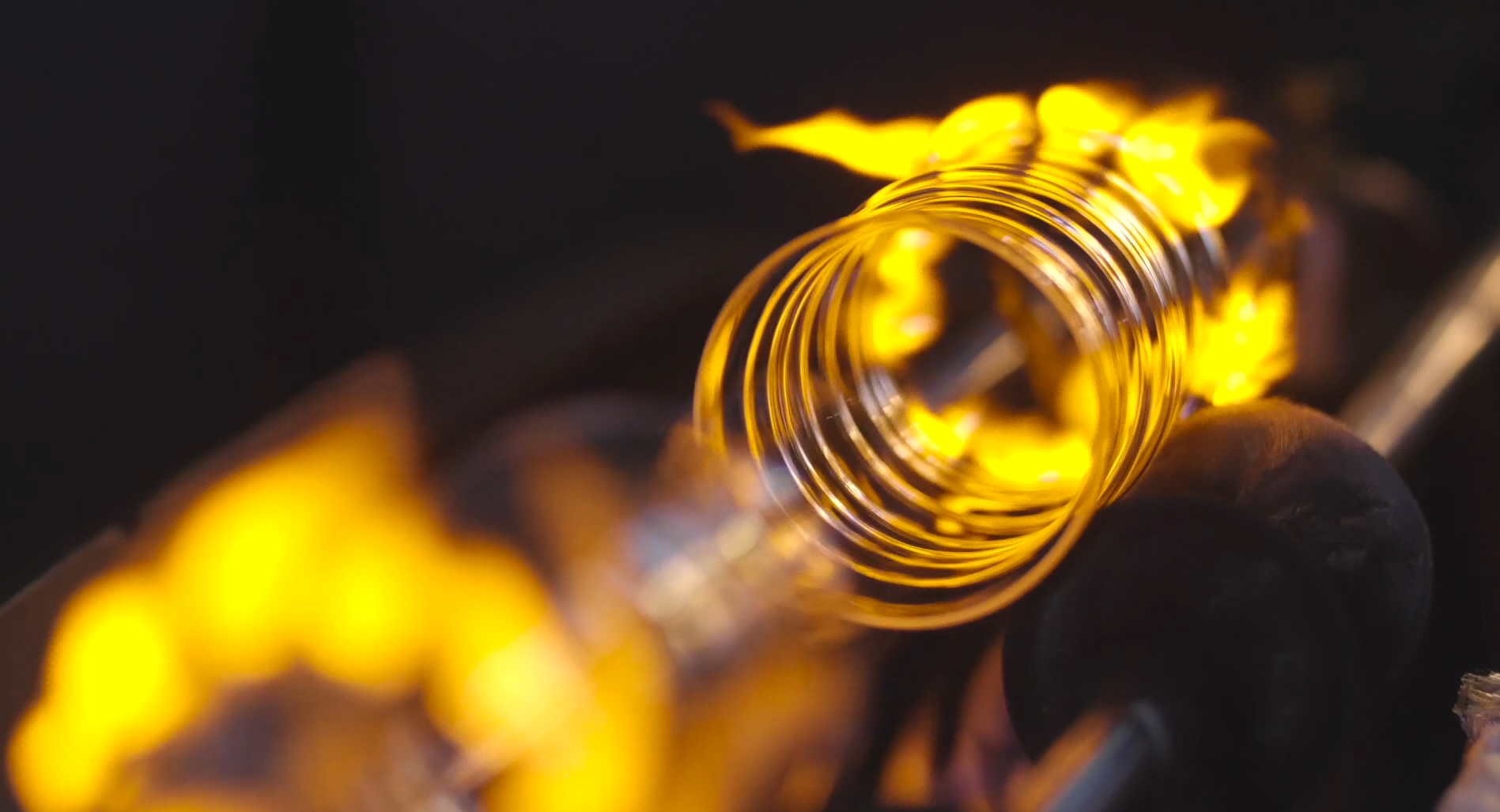
Once the piece has cooled, surface imperfections (such as scratches or rough edges) can be polished and smoothed using a diamond polishing wheel, typically at 3000 to 5000 RPM. Excess glass (such as plastic prints) can be removed with a grinder. The annealing process involves cooling the glass in an annealing lehr, typically starting at 520°C to 560°C (968°F to 1040°F) and gradually cooling over several hours, or even up to 24 hours for larger pieces, to prevent stress fractures.
Bubbles in glass are a common problem, and minimizing their formation requires careful grinding and temperature control. If bubbles are present, the area can be reheated to approximately 950°C (1742°F), and molten glass can be added to fill the void. Care must ensure that the repaired area blends seamlessly with the surrounding glass.
Contact Us
Discuss Your Custom Glass Project
Share your drawing, photos or dimensions, together with the intended use and target quantity. We will review your requirements and discuss the next steps.
Sales Enquiries
Email sales@bo-glass.com with your part description, intended use and target quantity.
Send Your Design
Use the form to upload a drawing or describe an existing part. Mark critical dimensions and tell us which surfaces or features matter most.
Request a Custom Glass Quote
Upload a drawing or share dimensions, quantity, intended use and finish. Include any heat, pressure or chemical exposure.
Your drawings remain confidential.
We use the contact details you provide to respond to your enquiry. See our Privacy Policy for more information.