
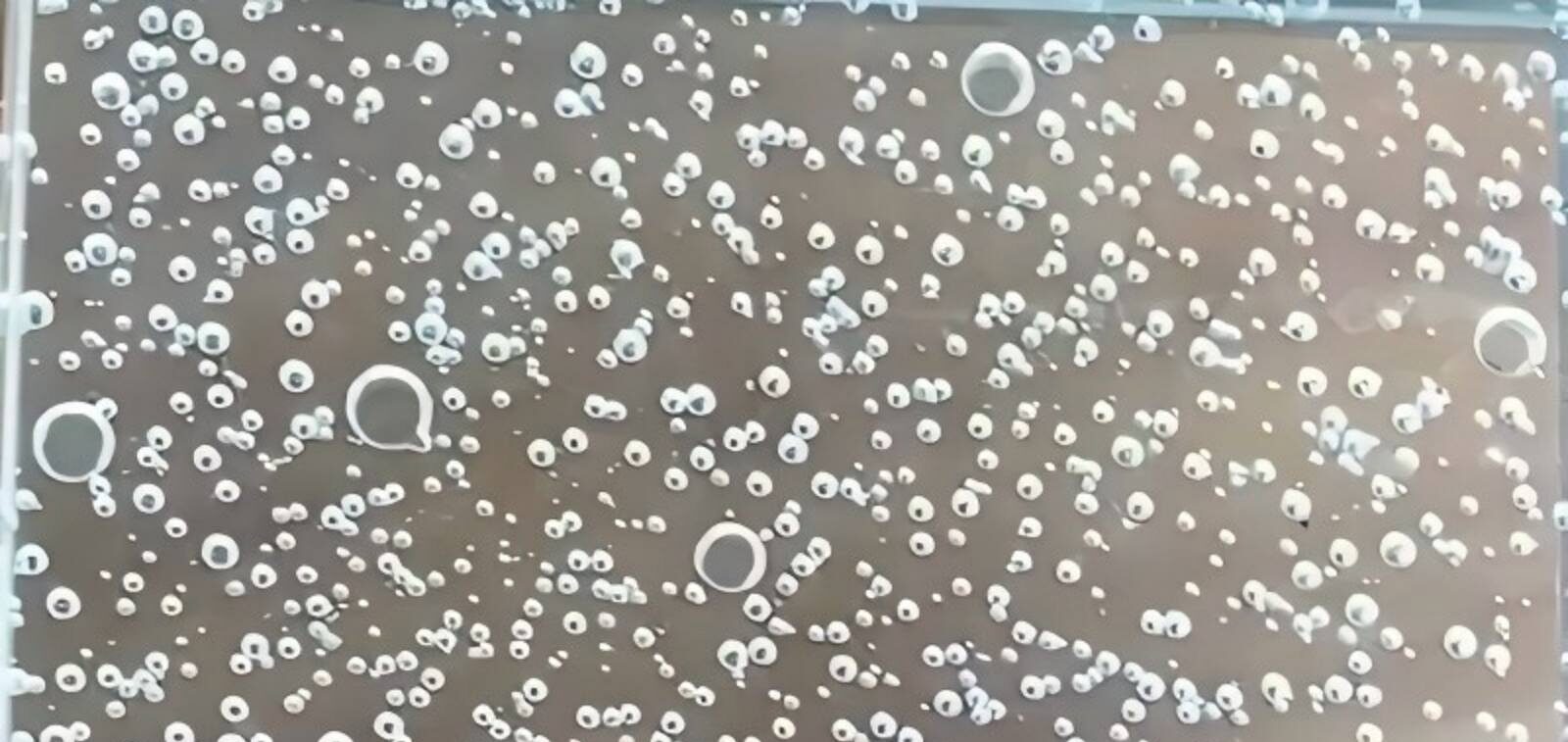
What Causes Bubbles in Glass Screen Printing?
Bubbles are caused by trapped air, solvent evaporation, or contamination during the mixing or application of ink or coating materials.
What causes bubbles and how to deal with them?
Inadequate Pre-Printing Treatment of the Glass: Bubbles are more likely to form if the glass surface is contaminated with dust, oil, or other impurities. To prevent this, the glass must be properly cleaned and treated before printing to ensure a pristine surface.
Bubbles in the Ink: Bubbles can be introduced when solvents and additives are added and mixed during the ink preparation. These bubbles may dissipate naturally over time if the ink has a low viscosity. However, in high-viscosity inks, some bubbles may not escape easily. While some bubbles might break naturally during the transfer process of printing, others may become larger and more problematic. To address this, defoamers can be added to the ink. The typical defoamer used is around 0.1% to 1%, but excessive use can have the opposite effect and worsen bubble formation. Even when bubbles are present, using ink with the correct viscosity and good levelling properties can help achieve a smooth and flat ink film. If bubbles are not adequately removed and remain in the ink, they can create an uneven, crater-like surface on the printed film.
Fast Printing Speed: Printing excessively high speeds can result in uneven ink distribution and bubble formation. To mitigate this, it is advisable to lower the printing speed to improve the uniformity and quality of the ink film.
If none of these measures effectively eliminates the bubbles from the printed product, it may be necessary to consider using a different type of ink that is less prone to bubble formation. Properly managing these factors will help achieve a flawless and smooth printed surface on the glass.

Contact Us
Discuss Your Custom Glass Project
Share your drawing, photos or dimensions, together with the intended use and target quantity. We will review your requirements and discuss the next steps.
Sales Enquiries
Email sales@bo-glass.com with your part description, intended use and target quantity.
Send Your Design
Use the form to upload a drawing or describe an existing part. Mark critical dimensions and tell us which surfaces or features matter most.
Request a Custom Glass Quote
Upload a drawing or share dimensions, quantity, intended use and finish. Include any heat, pressure or chemical exposure.
Your drawings remain confidential.
We use the contact details you provide to respond to your enquiry. See our Privacy Policy for more information.