
Types of Vacuum Deposition
Resistor evaporation deposition method
The resistance heating source is made of high-impedance material. When the current passes through the heating source, a large amount of heat energy is generated, which is used to heat the evaporation material. The heating source is a heating body that supports the evaporated material. The shapes include an ingle-strand spiral, a multi-strand spiral, a “concave” boat, a square boat, a conical single-strand wire, etc. They are direct heating evaporation sources. The indirect heating evaporation source consists of a crucible and a heating body. The powdered evaporation material is placed in the crucible, and the heating body is installed outside the crucible. The crucible is heated by the heating body to heat the powdered evaporation material indirectly. To accelerate the heating of the powdered evaporation material and improve the heating efficiency, the heating body is divided into two parts: one part is installed outside the crucible, and the other part is inserted into the powdered evaporation material to heat the powdered evaporation material together. This type is a comprehensive heating evaporation source. Schematic diagram of the shape of the resistance evaporation source
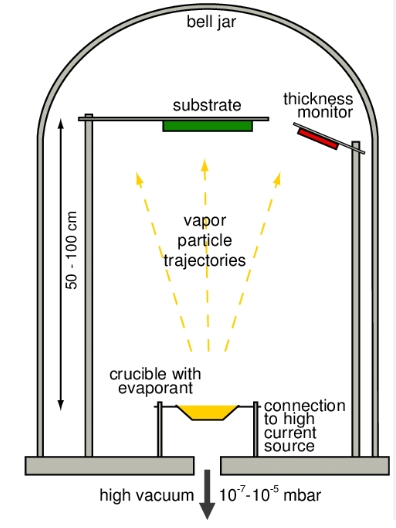
① To prevent the evaporation source material and the evaporation material (film material) from evaporating together, the material of the evaporation source heating body must have a sufficiently low vapour pressure at the evaporation vacuum and heating temperature of the evaporation material.
② The melting point of the evaporation source material must be higher than the melting point of the evaporation material to ensure that the evaporation source material can maintain a particular strength and not deform when the evaporation material evaporates rapidly.
③ The evaporation source material should have stable chemical properties and not react chemically with the evaporation material during the evaporation process to avoid affecting the quality of the film.
④ It must be able to load the evaporation material to be evaporated. For example, when a filamentary evaporation source is used, the evaporation material must be able to adhere to the heating body of the resistance heating source during the melting process.
Resistance heating evaporation is generally used for evaporation coating of materials with a relatively low melting point, especially for large-scale production with relatively low requirements for coating quality. To date, the resistance heating evaporation process is still widely used in producing aluminium-plated mirrors. Several shapes of commonly used evaporation sources and typical application examples are shown in Table 4-4.
4-4 Evaporation Sources, Materials, and Applications
| Evaporation Source Shape | Material | Typical Application |
|---|---|---|
| Single-Strand Spiral | Tungsten | Direct evaporation of refractory alloys; used for heat emission glass coating. Prone to erosion, shortening lifespan. |
| Multi-Strand Spiral | Tungsten, Molybdenum | Used for uniform aluminum evaporation in mirror coating; improves efficiency over single-strand designs. |
| Concave Boat | Graphite | Continuous evaporation of aluminum materials. |
| Square Boat | Boron Nitride | Continuous aluminum evaporation. |
| Conical Single-Strand Wire | Tungsten, Molybdenum | Used for evaporating granular metal materials. |
| Crucible with Spiral Heating Element | Tungsten, Molybdenum | Ideal for evaporating granular metals with stable heating. |
Vacuum evaporation coating is limited by vacuum evaporation conditions, and has the following requirements for evaporation materials:
a. When using a filamentary evaporation source, it must be wetted with the evaporation source material.
b. The evaporation temperature must be lower than the maximum temperature that the evaporation source can withstand, and the impurity content must be
c. It has good chemical stability and vacuum thermal stability.
d. It has a firm bond with the substrate.
e. It has little outgassing in a vacuum, and there are no volatile substances.
d. It has a firm bond with the substrate.
e. It has little outgassing in a vacuum, and there are no volatile substances.
f. It does not corrode the evaporation source and equipment.
g. It is easy to use and easy to obtain.
The evaporation materials for vacuum evaporation coating include metals, metal alloys, and compounds. When glass is used as a substrate for vacuum evaporation coating, the most commonly used evaporation material is metal, followed by alloys, and compounds are rarely used. Some commonly used metal evaporation materials are introduced below.
Aluminum begins to evaporate rapidly above 1100℃, becoming a highly fluid liquid that wets and penetrates refractory surfaces. In a vacuum environment, its chemical activity intensifies, leading to reactions with crucible materials or causing the crucible itself to evaporate. To mitigate these issues, tungsten or tantalum wire resistance heating is favored over electron beam heating. Due to aluminum’s low surface tension at high temperatures, continuous aluminum wire feeding is often used to ensure uniform evaporation and prevent droplet aggregation.
Chromium, with a melting point of 1900℃, can evaporate at 1397℃ due to achieving a vapor pressure of 1 Pa. Its exceptional adhesion properties make it ideal for use as a bonding layer on glass and ceramic substrates. Chromium is typically evaporated using concave boats, square boats, or conical wires, with tungsten often used as the heating material to withstand high temperatures. Electroplating chromium onto tungsten wires improves thermal contact and evaporation efficiency, but thorough degassing of the wires is necessary to maintain process stability during heating.
Evaporation Materials, Uses, and Sources
| Evaporation Material | Use | Evaporation Source |
|---|---|---|
| Aluminum (wire or sheet) | Silver-colored coating | Multi-strand spiral |
| Gold and Copper Alloys (sheet or granule) | Gold or copper-colored coating | Multi-strand spiral or conical single-strand wire |
| Titanium Compounds (powder) | Protective film | Boat-shaped source |
| Oxides | Protective film | Boat-shaped source |
| Reflective Film Alloys (wire) | Brown reflective film | Multi-strand spiral |
Electron beam evaporation method
Electron beam vacuum deposition can be categorized based on the type of electron beam sources, such as ring guns, straight guns, E-type guns, and hollow cathode guns. The ring gun emits an electron beam from a circular cathode, which is then focused and directed onto the material inside the crucible, causing it to evaporate. Despite its simplicity, the ring gun has low power and efficiency, limiting its use to laboratory applications. As a result, more efficient electron beam sources are now preferred for industrial-scale production.
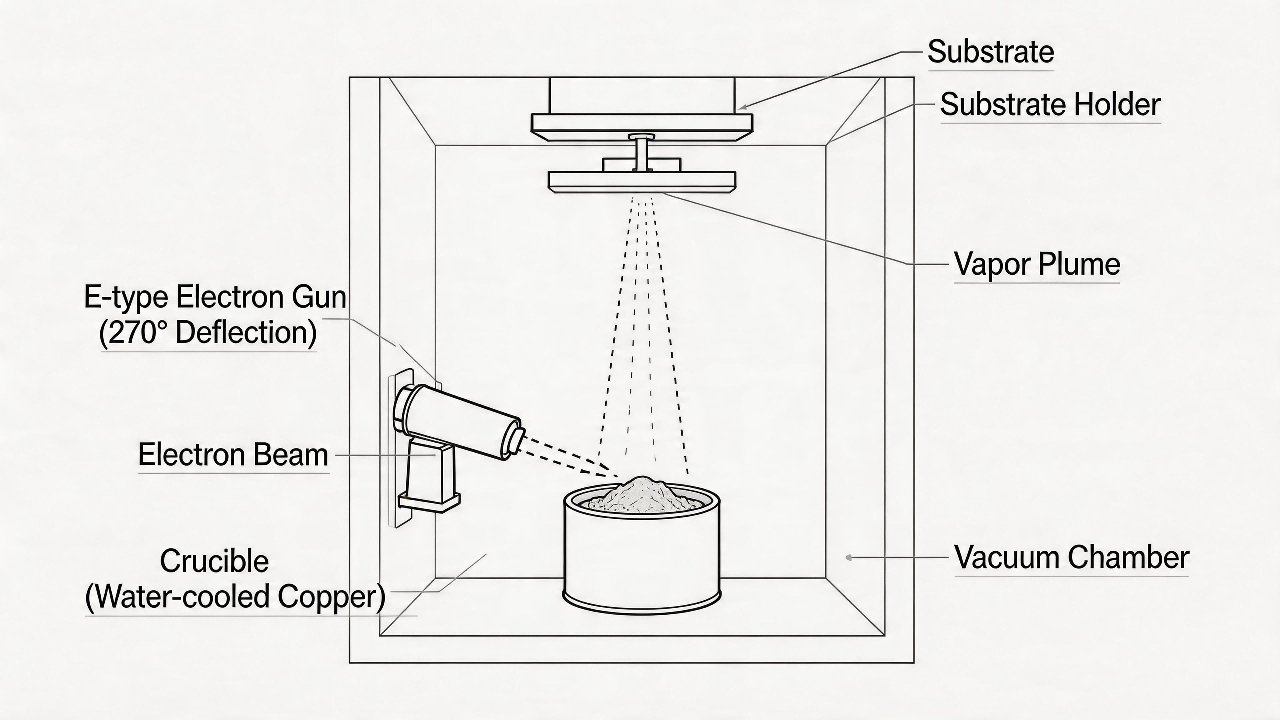
The E-type electron gun, which deflects the electron beam by 270°, overcomes many of the straight gun’s drawbacks and is now widely used. It generates high power density, enabling the melting of metals with high melting points and producing evaporated particles with substantial energy, which ensures strong adhesion between the film and the substrate. However, this gun requires high vacuum conditions and negative high voltage, necessitating pressure monitoring plates inside the chamber. These requirements increase the equipment’s complexity, cost, and maintenance difficulties while reducing safety.
High-frequency induction evaporation source deposition method
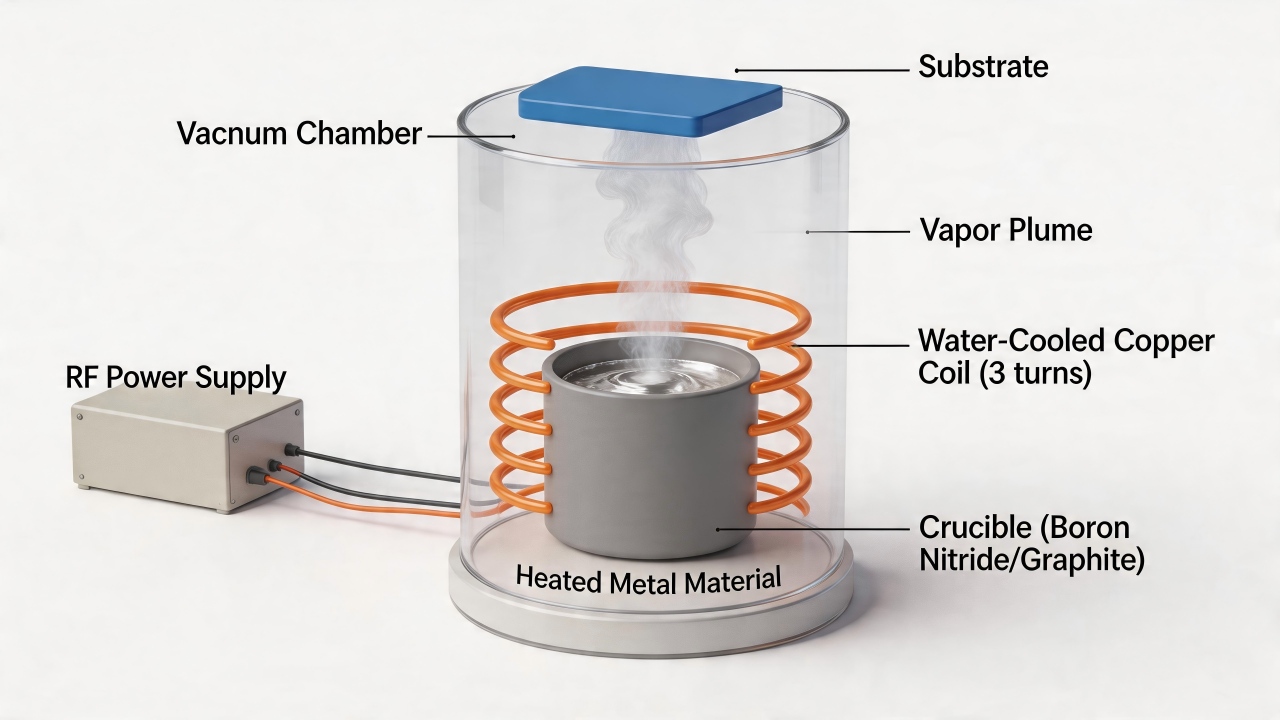
Its disadvantages are: ① Boron nitride crucibles with good thermal shock resistance and stable high-temperature chemical properties must be used; ② The evaporation device must be shielded and requires a more complex and expensive high-frequency generator; ③ The pressure near the coil has a fixed value. If it exceeds this fixed value, the high-frequency field will ionize the residual gas and increase the power consumption.
Laser beam evaporation source evaporation method
Vacuum evaporation process
After the glass substrate is transported to the workshop, it is visually inspected. If the appearance quality meets the requirements, it will be placed on the washing and drying machine; if the glass specifications do not meet the specifications required by the vacuum glass coating machine, it must be cut according to the specifications needed for the coating machine before being placed on the washing and drying machine. In the washing and drying machine, the glass is rinsed with washing water with detergent, brushed with a nylon brush, and then rinsed with tap and deionized water. The water on the glass surface is scraped off with a soft scraper, and then the water on the glass surface is blown dry with filtered dry air using a wind knife. The glass piece is removed and placed on the transfer rack for use.
Film formation process
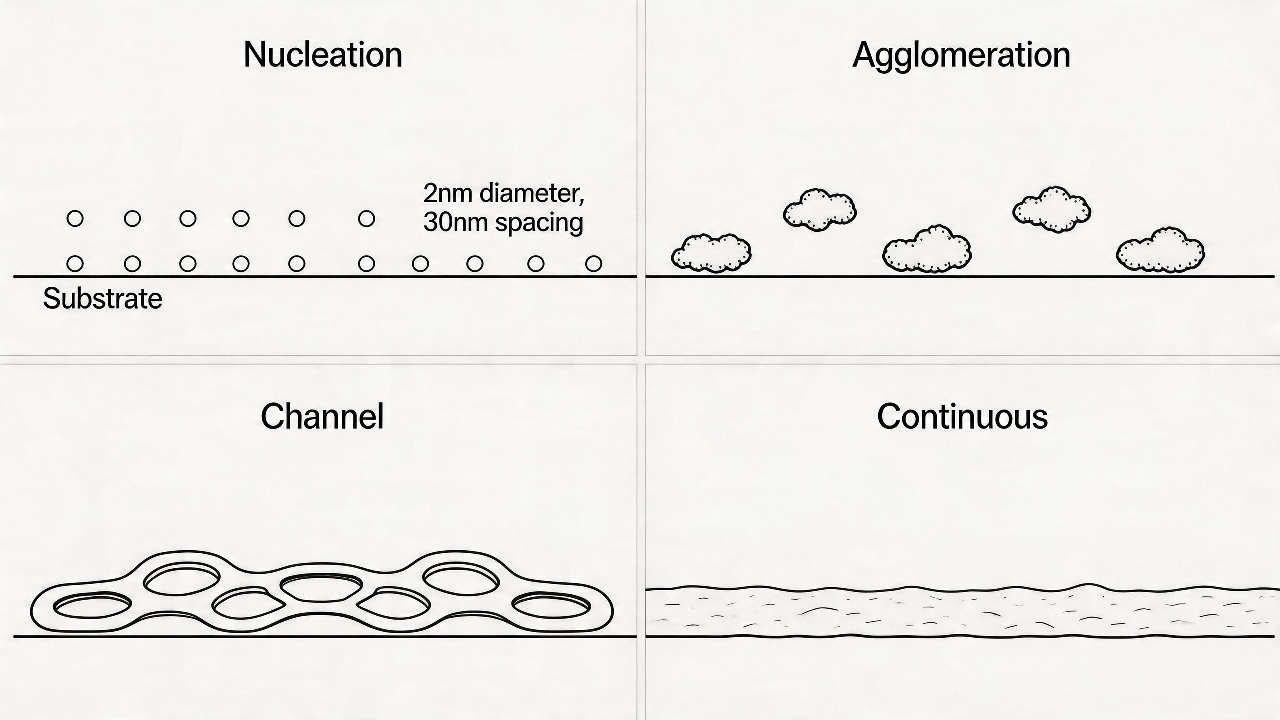
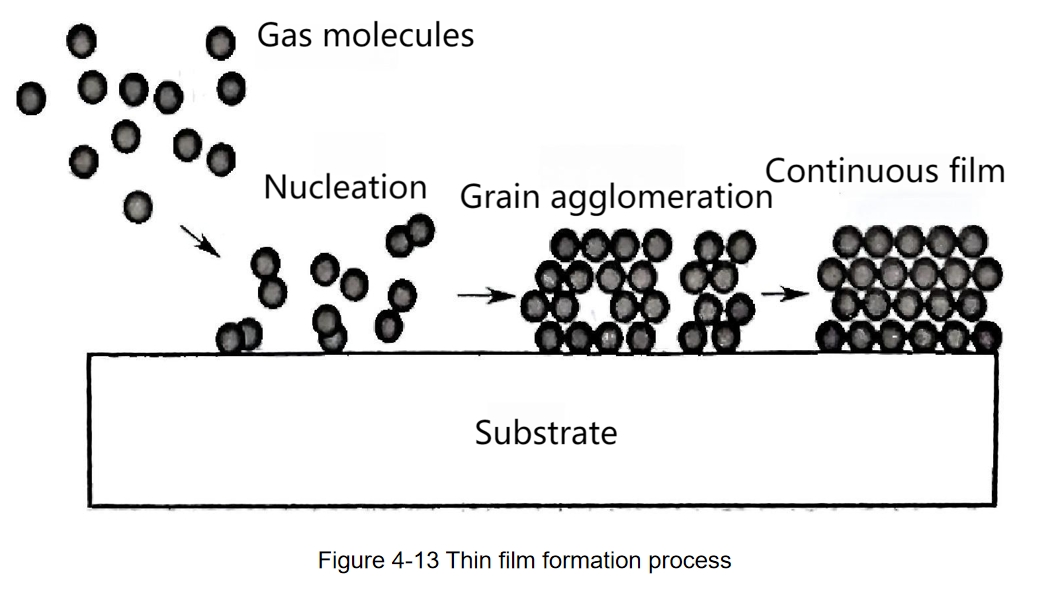
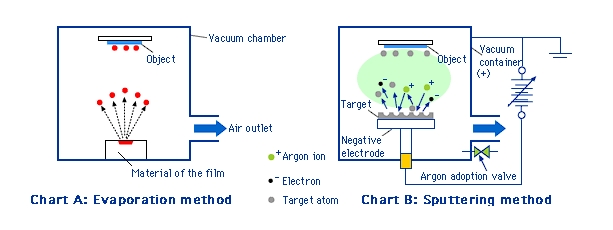
In a vacuum environment, the evaporation material moves linearly in any direction in the state of atoms or molecules under the action of the evaporation source. When it encounters a surface with a lower temperature, it is adsorbed. As the particles continue to increase, a film layer is gradually formed. From the beginning of evaporation to the film formation on the substrate surface, it can be divided into four stages. The schematic diagram of the formation process is shown in Figure 4-12.
When the substrate adsorbs the incident evaporation material particles, many crystal nuclei appear, forming a film layer on the substrate. The diameter of the nucleus is about 2nm, and the distance between the nuclei is about 30nm. More and more atoms are adsorbed, forming islands of different shapes. The process of atoms combining instantly is as follows: two atoms that exist independently → more and more atoms are adsorbed → the contact area gradually becomes larger → the atoms are connected into islands.
Due to the continuous generation of vapor of evaporating material, the original small islands expand and connect to form large islands. The atoms adsorbed on the surface of the substrate have condensed into small islands, and the vapor atoms that arrive later continuously fill the gaps between the islands and aggregate into large islands.
(3) The edges of the large islands are irregularly connected to form a mesh film, channel, passage, and hole stage
The vapor of evaporating material gradually increases, forming a honeycomb structure between the large islands. The gaps begin to connect, but the connection is not dense enough.
(4) Film formation stage
Based on the channel stage, as the vapor atoms of evaporating material are continuously adsorbed, they fill around the channel and gradually form a film layer. The thickness of this film is not uniform at the microscopic level but is uneven.
The film formation process is shown in Figure 4-13.
Fihure 4-12
Principle of Vacuum Evaporation
The principle of glass vacuum evaporation coating
Effect of coating conditions on film
Effect of vacuum chamber pressure on film layer
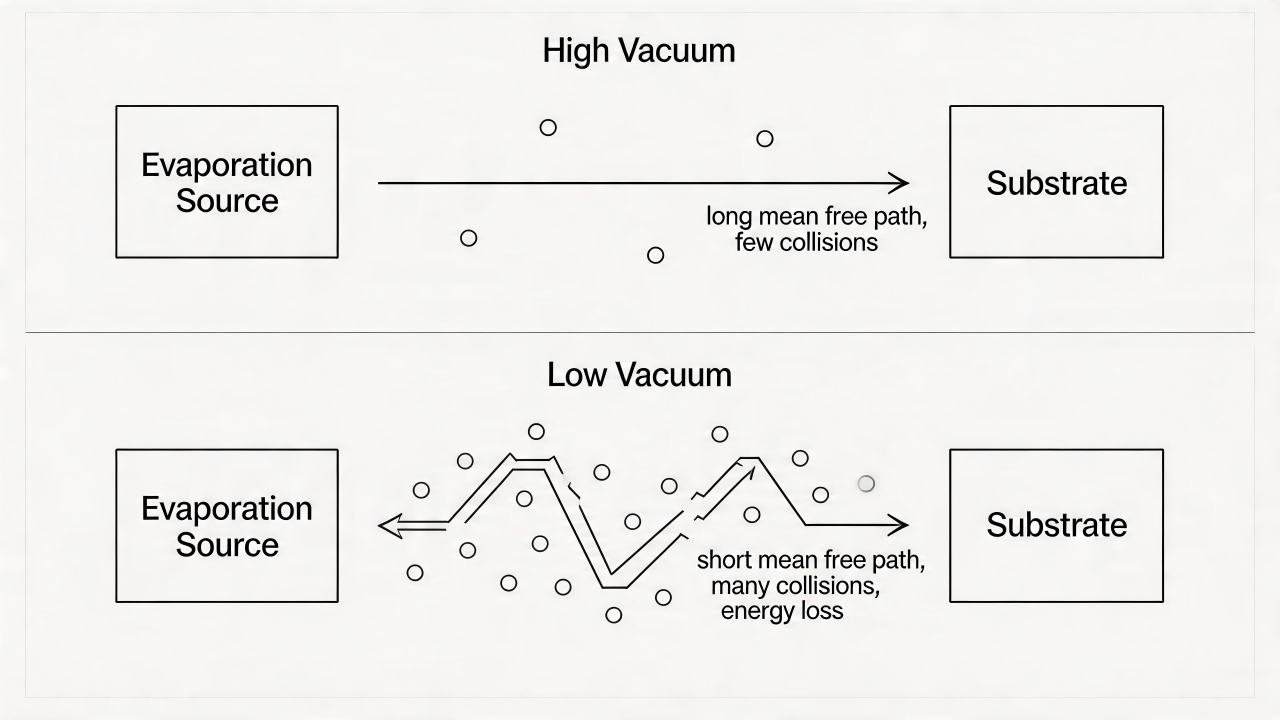
In vacuum evaporation coating, achieving optimal film deposition requires the mean free path of vapor molecules to exceed the distance between the evaporation source and the substrate. This condition is only possible by creating a high vacuum in the chamber, which reduces the number of residual gas molecules and minimizes collisions between vapor and gas molecules, ensuring better deposition efficiency.
As vacuum levels increase, the probability of vapor molecules colliding with residual gas molecules decreases, enhancing film quality. For example, maintaining a vacuum pressure above 6 × 10⁻² Pa during aluminum coating ensures a smooth and durable film layer. However, if vacuum levels drop, two issues may arise: (1) Residual gas molecules adsorbed on the substrate surface react with vapor molecules, forming compounds that degrade the film’s quality. (2) Collisions between vapor molecules and residual gases during deposition reduce the vapor’s kinetic energy, leading to poor adsorption on the substrate, resulting in weak or powdery films that can easily detach.
In practice, aluminum films produced below10-1 Pa often appear gray with reduced adhesion, and the film turns black at even lower vacuum levels and becomes fragile. Maintaining a higher vacuum prevents these issues, ensuring the film adheres properly to the substrate and meets quality standards.
When using vacuum evaporation without baking the chamber and substrate, a vacuum level between 10-2 and 10-5 Pacan still achieve satisfactory film quality. However, vacuum levels exceeding 10-6 Papre-baking is essential to remove gases thoroughly. Contaminants may be introduced if the substrate is not adequately protected during baking, increasing the risk of reduced film quality despite the high vacuum conditions.
Choice of layer deposition rate
Surface conditions of evaporation source and evaporation material
If there is dirt in the evaporation source, a large number of impurity gas molecules will be generated when it is powered on and heated, affecting the quality of the film layer and reducing the deposition rate; if there is dirt in the evaporation material, a large number of impurity gas molecules will be generated when it is heated; if the dirt is an oxide layer, it will also affect evaporation because it is not easy to gasify. Both reasons will lead to a reduction in the deposition rate of the belly layer.
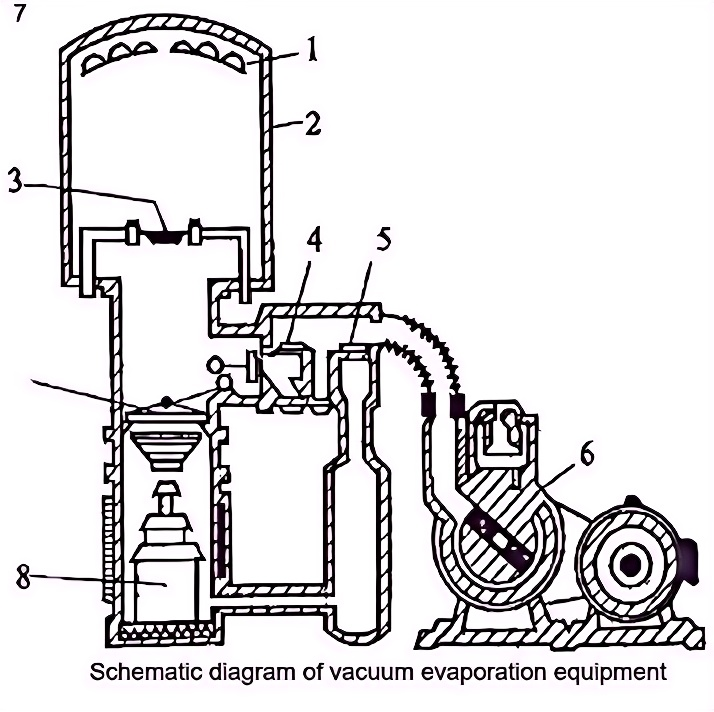
Leading equipment for vacuum evaporation
Contact Us
Your feedback fuels our growth, and your questions drive our solutions.
We value your feedback, inquiries, and suggestions. Please feel free to get in touch with us
General inquiries
Please contact us via sales@bo-glass.com, and we will reply to you as soon as possible.
Interested to work with us
Drop your resume at info@bo-glass.com
and we will get back to you shortly.
We uses the contact information you provide to us to contact you about our relevent content, products, and services.