
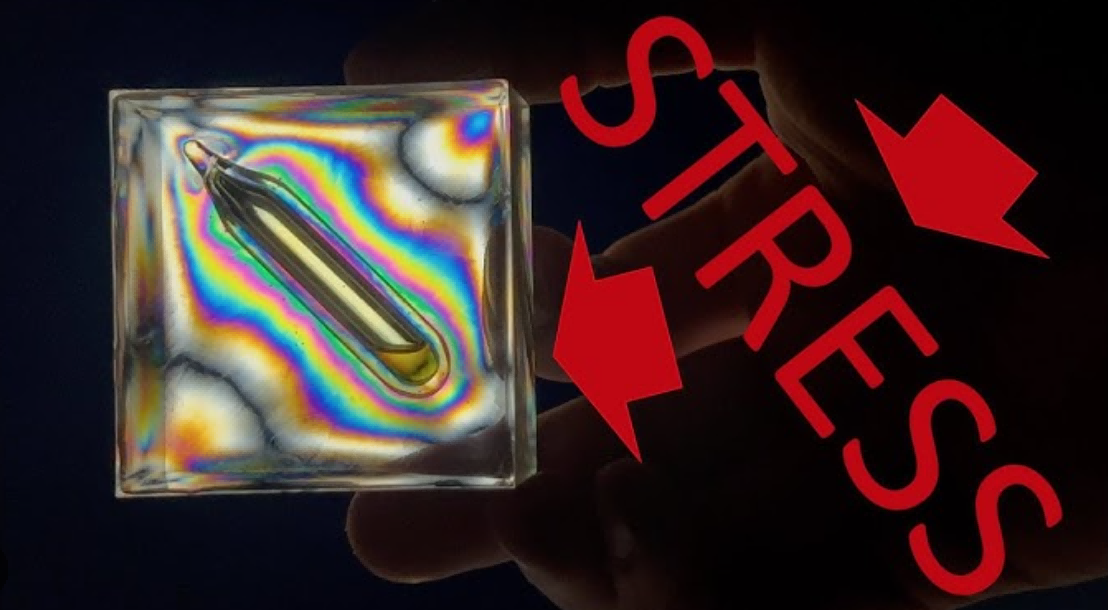
What are the types of internal stress in glass and why they form?
The internal stress of glass includes surface compressive stress and internal tensile stress, which is formed by rapid cooling, enhancing strength and safety.
What are the types of internal stress in glass and why they form
Temporary stress
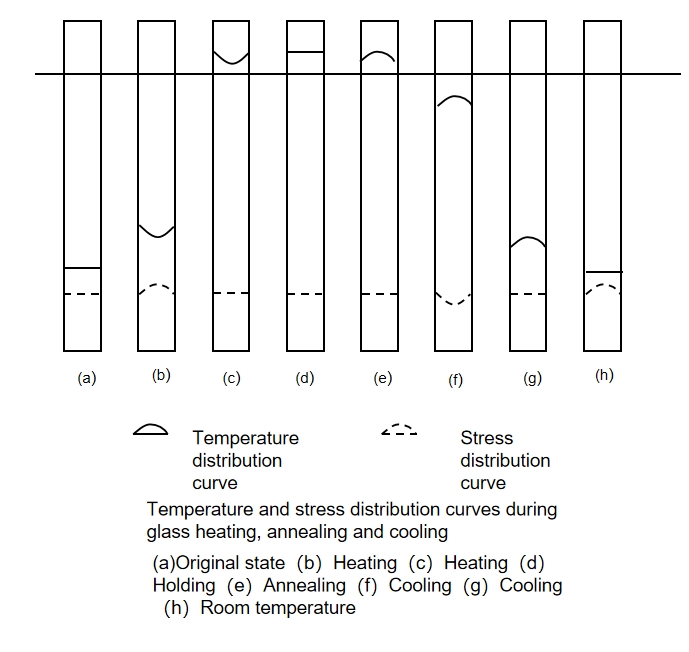
If the outer layer is heated to a certain temperature and the entire glass is heated, the outer layer of the glass no longer expands, but the inner layer continues to expand. In this way, the outer layer is subject to tensile stress, while the inner layer is subject to compressive stress. Their magnitude is equal to the stress generated during the heating process but in the opposite direction. Therefore, when the internal and external temperatures are balanced, the stress in the glass disappears [Figure (d)]. Similarly, the stress distribution generated by a piece of stress-free hot glass at the beginning of the cooling process is exactly opposite to that of the heating process, that is, the outer layer is tensile stress and the inner layer is compressive stress [Figure (e) to Figure (h)]. Therefore, the temporary stress in the glass disappears after the temperature is balanced. However, when the temporary stress exceeds the ultimate strength of the glass, the glass will also crack, especially during the cooling process, the cooling rate should be lower than the heating rate during the heating process.
Permanent stress
The direct cause of permanent stress in glass is the result of stress relaxation in the annealing temperature zone. The degree of stress relaxation depends on the cooling rate, temperature gradient, viscosity, and product thickness in this zone.
In addition to the permanent stress caused by thermal stress, permanent stress can also be generated in glass due to chemical inhomogeneity. For example, during the glass manufacturing process, due to insufficient melting homogenization, defects such as streaks and stones are generated in the glass. The chemical composition of these defects is different from that of the glass body, and their expansion coefficients are also different. For example, the expansion coefficient of silica bricks or material stones is 60×10-7/℃, while that of general glass is about 90×10-7/℃. Therefore, the stress generated between them cannot be eliminated.
| Glass Type | Permissible Permanent Stress (MPa) |
|---|---|
| Class I-II Optical Glass | 2-6 |
| Class III-IIV Optical Glass | 10-20 |
| Flat Glass | 20-95 |
| Rolled Glass | 20-60 |
| Bottles and Containers Glass | 50-400 |
| Hollow Glass | 60 |
| Glass Tubing | 120 |
| Tempered Glass | 1350-2400 |
| Aviation Glass | 25 |
The existence of permanent stress brings the following disadvantages to the production and use process: excessive permanent stress will cause the glass to explode during processing or use; due to the existence of permanent stress, optical precision instruments will produce double refraction and affect the working accuracy of the instrument; using the instrument at high temperature for a long time will cause the optical parts to deform and affect the imaging quality. Various industrial glass products have their own allowable permanent stress values, see the following table.
△=Bd(oy-ox)
△——optical path difference, nm/cm;
B——stress optical constant;
d——glass thickness, mm.
The optical constants of some industrial glasses are listed in the following table.
| Glass Type | B Value |
|---|---|
| Quartz Glass | 3.4 |
| Light Barium Crown Glass | 2.8 |
| 96% High Silica Glass | 3.6 |
| Heavy Barium Crown Glass | 2.14 |
| Low Expansion Silicate Glass | 3.8 |
| Barium Crown Glass | 3.10 |
| Low Tano Borosilicate Glass | 4.7 |
| Light Crown Glass | 3.50 |
| Lead Glass | 2.6 |
| Medium Crown Glass | 3.12 |
| Flat Glass | 2.8 |
| Heavy Crown Glass | 2.67 |
| Calcium Silicate Glass | 2.4 – 2.6 |
| Extra Heavy Crown Glass | 1.19 |
Contact Us
Your feedback fuels our growth, and your questions drive our solutions.
We value your feedback, inquiries, and suggestions. Please feel free to get in touch with us
General inquiries
Please contact us via sales@bo-glass.com, and we will reply to you as soon as possible.
Interested to work with us
Drop your resume at info@bo-glass.com
and we will get back to you shortly.
Request a Custom Glass Quote
Tell us about your project or upload a drawing.
Your drawings remain confidential.
We uses the contact information you provide to us to contact you about our relevent content, products, and services.