
The principle of physical toughening
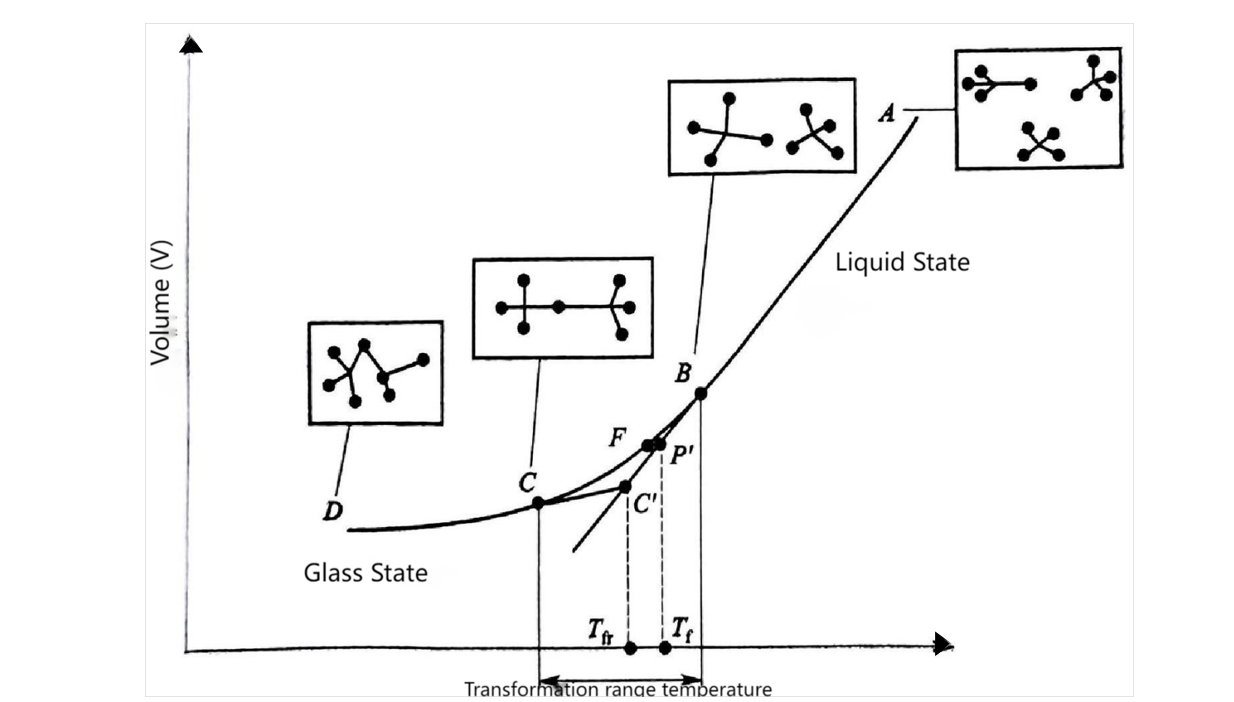
When the glass is transported to an electric heating furnace or a gas heating furnace for heating, the thermal expansion of the glass is shown in the following figure. As the temperature rises, the structure of the glass changes, the viscosity decreases, and the internal connection bonds of the network are elongated, changing from state D to state C in the following figure. When the heating temperature is close to the softening point, the glass changes from a solid state to a liquid state, the viscosity of the glass drops sharply, and many bonds are broken, such as state B or state A in the following figure. At this time, the glass is very easy to deform. If the glass does not deform afterward and is slowly cooled down, the broken bonds can be reconnected, the viscosity of the glass gradually increases, and the network is re-arranged in an orderly manner. When the glass is close to room temperature, the elongated bonds return to their original bond length as the temperature decreases. The above process can only eliminate the internal stress of the glass, but cannot improve the strength of the glass.
Glass Thermal Expansion Table
| Glass Type | Thermal Expansion Coefficient (10-6/°C) |
|---|---|
| Quartz Glass | 0.5 |
| Borosilicate Glass | 3.3 |
| 96% Silica Glass | 0.75 |
| Soda-Lime Glass | 9.0 |
| Lead Glass | 7.0 |
| Calcium Silicate Glass | 8.5 |
| Aluminosilicate Glass | 5.5 |
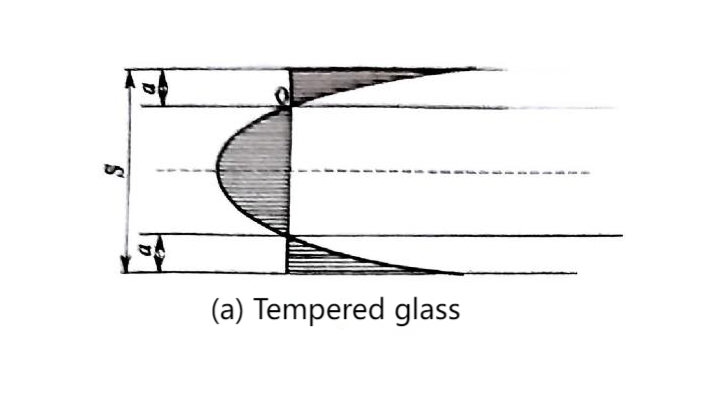
Glass tempering intentionally creates compressive stress on the glass surface and tensile stress inside (see the following picture). The process of tempering glass is to heat the glass to near the softening point (its viscosity value is higher than 106.65 Pa·s), and then use a cooling medium to quickly take away the heat from the glass surface so that the glass surface quickly changes from a liquefied state to a solidified state. In this process, a part of the broken bonds of the glass has no time to reconnect and has already become a solidified state. The volume of this part of the glass after cooling is larger than the volume before heating. The interior of the glass is cooled by heat conduction from the molecular motion of the outer glass. The deeper the glass is, the slower the cooling speed. Therefore, when the glass is cooled, the broken bonds can be reconnected due to the slow cooling of the interior, and the longer bonds can restore their original bond length. When the glass is completely cooled, the volume of the interior of the glass is the same as the original volume. In this way, the volume of the glass surface is larger than the volume of the interior, the glass surface tends to stretch outward relative to the interior, and tensile stress is generated on the inside per unit area. On the contrary, the interior of the glass tends to compress inward relative to the surface, and compressive stress is generated on the inside per unit area. This is the principle of glass tempering.
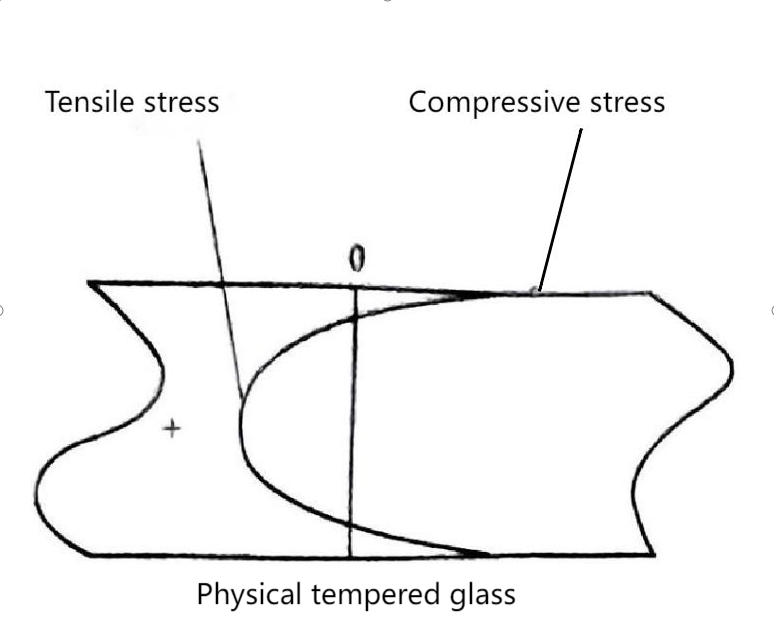
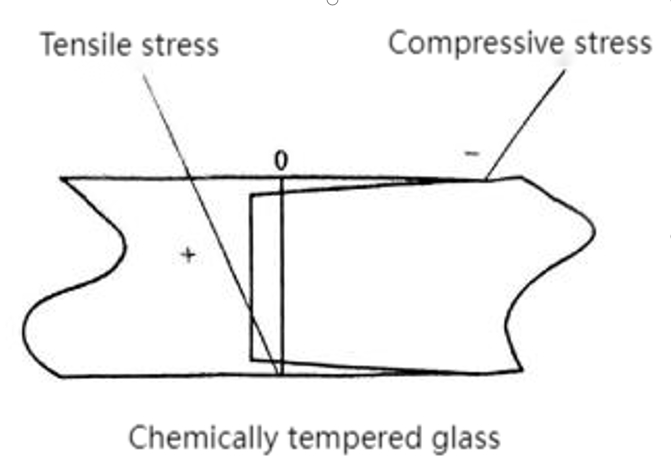
As mentioned above, the generation of permanent stress is the result of stress relaxation and temperature deformation being frozen. The higher the heating temperature of the glass, the faster the rate of stress relaxation, and the greater the stress generated after tempering; the cooling rates of different parts of the glass are different, so the structure of the glass surface has a smaller density, while the inner layer has a larger density. This structural factor causes different expansion coefficients for each part and also causes the generation of internal stress.
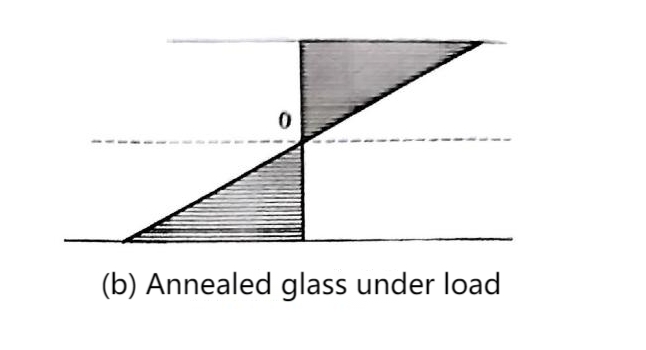
Through such heat treatment, the glass has uniformly distributed internal stress inside, which improves the strength and thermal stability of the glass. When the annealed glass plate is bent under load, the upper surface layer of the glass is subjected to tensile stress, and the lower surface layer is subjected to compressive stress, as shown in Figure (b).
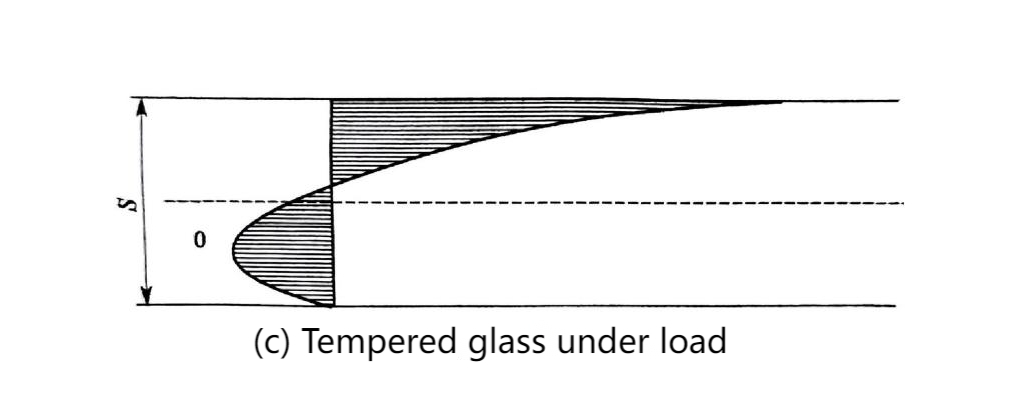
The tensile strength of glass is low, and the glass will break if it exceeds the tensile strength, so the strength of annealed glass is not high. If the load is applied to the tempered glass, its stress distribution is shown in Figure (c). The compressive stress on the surface (upper layer) of the tempered glass is greater than that of the annealed glass, while the tensile stress it receives is smaller than that of the annealed glass. At the same time, the maximum tensile stress in the tempered glass does not exist on the surface like the annealed glass but moves to the center of the plate. Since the compressive strength of glass is almost 10 times greater than its tensile strength, tempered glass does not break under the same load.
In addition, during the tempering process, the microcracks on the glass surface are strongly compressed, which also improves the mechanical strength of tempered glass. Similarly, when tempered glass is suddenly cooled, the tensile stress generated in its outer layer is resisted by the compressive stress in the original direction of the outer layer of the glass, greatly improving its thermal stability. Usually, the strength of tempered glass is 4 to 6 times higher than that of annealed glass, reaching about 350 MPa, and the thermal stability can be increased to about 280 to 320.
The tensile stress of tempered glass exists inside the glass. When the glass breaks, under the protection of the outer layer (although the protection is not strong), the glass can be kept together or a collection of cracks. Moreover, there is uniform internal stress inside the tempered glass. According to the measurement, when the internal tensile stress is 30-32MPa, a fracture surface of 6cm² can be produced, which is equivalent to crushing the glass into particles of about 10mm. This also reveals the reason why tempered glass splits into small particles when it explodes.
Contact Us
Your feedback fuels our growth, and your questions drive our solutions.
We value your feedback, inquiries, and suggestions. Please feel free to get in touch with us
General inquiries
Please contact us via sales@bo-glass.com, and we will reply to you as soon as possible.
Interested to work with us
Drop your resume at info@bo-glass.com
and we will get back to you shortly.
We uses the contact information you provide to us to contact you about our relevent content, products, and services.