
What is tempered glass?
Tempered glass refers to glass that has a compressive stress layer formed on the surface after a processing process. Tempered glass is prestressed glass. To improve the strength of the glass, chemical or physical methods are usually used to form a compressive stress layer on the surface of the glass. When the glass is subjected to external force, the surface stress is first offset, thereby improving the bearing capacity, enhancing the mechanical strength and thermal shock resistance of the glass itself, and having a special fragmentation state.
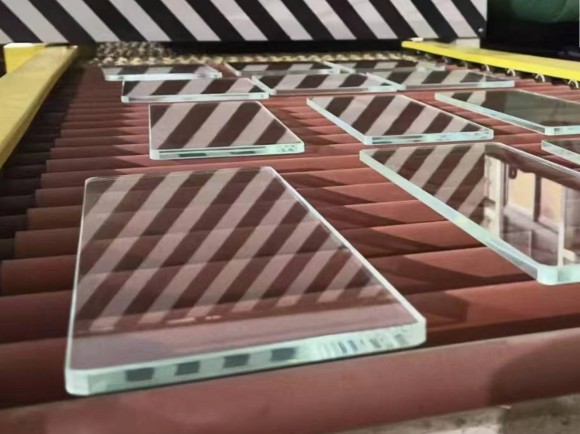
Tempered glass classification
There are many methods for tempering glass, which are usually divided into two categories: physical tempering and chemical tempering. See the following table
| Physical Tempering Methods | Classified by Cooling Medium | Description |
|---|---|---|
| Physical Tempering Methods | Air Tempering | Uses high-pressure air as the cooling medium to strengthen glass |
| Liquid Tempering | Uses oil or water mist as the cooling medium to strengthen glass | |
| Molten Salt Tempering | Uses fusible salts as the cooling medium to strengthen glass | |
| Solid Tempering | Uses high thermal conductivity solid particles as the cooling medium to strengthen glass |
| Category | Classification | Types |
|---|---|---|
| Physical Tempering Method | By Degree of Tempering | Fully Tempered Glass, Semi-Tempered Glass, Regionally Tempered Glass |
| By Method of Tempering | Vertical Tempered Glass, Horizontal Tempered Glass | |
| By Shape of Tempered Glass | Flat Tempered Glass, Bent Tempered Glass | |
| Other Classifications | Standard Tempered Glass, Homogeneous Tempered Glass, Colored Film Tempered Glass, Glazed Tempered Glass, Conductive Tempered Glass |
| Category | Type | Description |
|---|---|---|
| Chemical Tempering Method | Low Temperature Type | Method involving the exchange of smaller-radius alkali metal ions with larger-radius ones at lower temperatures to form a compressive stress layer on the glass surface. |
| High Temperature Type | Method involving the exchange of larger-radius alkali metal ions with smaller-radius ones at higher temperatures to form a material on the glass surface with a lower expansion coefficient, creating a compressive stress layer. | |
| Electrochemical Method | Uses an additional electric field to accelerate ion diffusion rates through ion exchange in the electric field. |
Development of tempered glass in the world
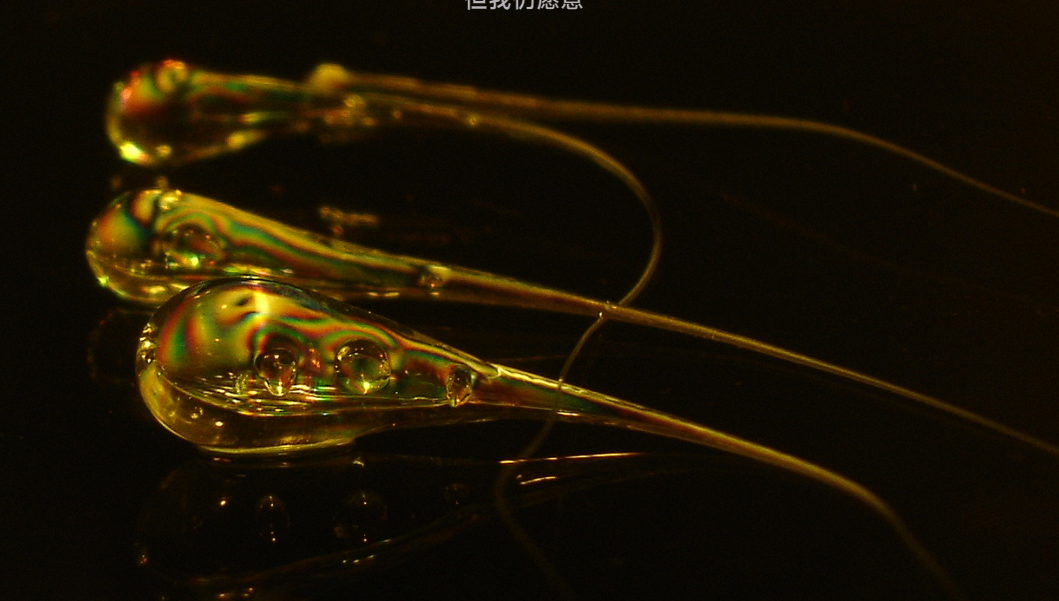
(1) The prototype of tempered glass Tempered glass was discovered hundreds of years ago, but its principle was not known at that time. In the 17th century, Prince Rupert of England dripped molten glass into water to create glass beads. This teardrop-shaped glass is very hard and will not break even if hit with a hammer. However, if the tail of the glass drop is broken, it will suddenly explode into powder. This “toy” was even brought to the court to tease people and was called “Rupert’s drop”.
(2) Research and development of tempered glass The early attempts at tempered glass technology were made in 1870. Francis De La of Bastille, France, obtained the first patent in 1874. The tempering method was to heat the glass to a temperature close to the softening temperature and then immediately put it into a liquid tank with a relatively low temperature to increase the surface stress. This method is an early liquid tempering method. Rudolf Frederick Siemens of Germany obtained a patent in 1875, advocating the use of pressure to temper the glass-contact tempering. Siemens obtained the third patent in 1881, which was for the tempering of flat plates or irregular products. George E. Rogers of Massachusetts, USA, applied the tempering method to glass wine glasses and lamp posts in 1876. In the same year, Hugh O. Heill of New Jersey obtained a patent describing the tempering process in an “observation hole”. The glass product to be tempered is heated in a fire basket and then immersed in two different cooling tanks, the second cooling tank being at a lower temperature than the first. Littleton, Lillie, and Shater issued patents for a similar process in 1942. These patents described the theory of the tempering process and attempted to control the degree of strain induced in the glass during the tempering process.


(3) Industrialization of tempered glass: Dr. Jea Glass Schott first used the tempering process in industry. In the mid-1930s, Europe used flat-tempered safety glass. France was the first to market this product under the trade name Scurit. In the 1940s after World War II, the design of American cars was greatly influenced by aircraft design. Designers wanted cars to be spherical and have a roof made of curved tempered glass. The horizontal self-weight bending tempering method developed at that time could produce large round glass. For spherical bending tempering, this technology also has its limitations.
Soon, the above two methods were replaced by a newly developed rapid self-weight bending tempering method, which can provide millimeter-tempered glass for light and low-energy cars. In 1946, the United States first used the rapid self-weight bending tempering forming method to manufacture the Futuramic Old Mobile and other car manufacturers soon followed suit.
In the early 1950s, the United States first used curved tempered glass as the front windshield of cars. The whole piece of curved tempered glass has a wide field of view and a beautiful appearance. However, there is a lot of stress inside the tempered glass, and many factors will cause it to burst in an instant. In the use of the front windshield of the car, once the glass is broken, the driver’s field of vision cannot be guaranteed, so braking measures cannot be taken in time, resulting in secondary accidents, and small particles of fragments will cause serious damage to the eyes. In 1961, the regional tempering technology of glass came out, and Japan, the United States, Federal Germany, and other countries began to produce regional tempered glass. The regional tempering technology can form different degrees of tempering in the driver’s main view area and the surrounding area of the windshield. The degree of tempering in the main view area is lower, and the fragments are larger after breaking, so the line of sight can be guaranteed and the occurrence of secondary accidents can be avoided. However, the fragments are larger and may have sharp corners, which reduces the safety factor of tempered glass. By the mid-1960s, the United Kingdom and other countries developed regional tempered glass with a honeycomb distribution of fragments, that is, non-uniform distribution. The fragments of this tempered glass are distributed alternately in different sizes, and the distribution of the fragments is independent of the position of the impact point. The devitrification phenomenon after the glass is broken is improved, and the fragments have no sharp corners.
What are the performance characteristics of tempered glass
Compared with ordinary glass, tempered glass has greatly improved bending strength, impact strength and thermal stability.
Bending strength
The bending strength of tempered glass is 4 to 5 times greater than that of ordinary glass. For example, a 6mm×600mm×400mm tempered glass plate can support the mass of 3 people (about 200kg) without damage. The bending strength of tempered glass with a thickness of 5 to 6mm is 1.67×10²MPa.
The stress distribution of tempered glass is parabolic in the thickness direction. The surface layer is compressive stress and the inner layer is tensile stress. When it is subjected to a bending load, due to the result of the synthesis of force, the maximum stress value is not on the glass surface, but moves to the inner layer of the glass, so that it can withstand greater bending loads.
The deflection of tempered glass is 3 to 4 times greater than that of ordinary glass. For example, the maximum deflection of 6mm×1200mm×350mm tempered glass can reach 100mm.
Impact strength
The impact strength of tempered glass is 3 to 10 times higher than that of ordinary transparent glass that has been well annealed. For example, the impact strength of 6 mm thick tempered glass is 8.13 kg·m, while the impact strength of ordinary flat glass is 2.35 kg·m.
Tensile Strength
The tensile strength of thermally stable tempered glass increases, while the elastic modulus decreases. In addition, the density is lower than that of annealed glass. From the calculation formula of thermal stability coefficient K, it can be seen that tempered glass can withstand temperature changes ranging from 250 to 320°C, while ordinary glass of the same thickness can only withstand 70 to 100°C. For example, a tempered glass of 6mm×510mm×310mm is laid on the snow and poured with 1kg of 327.5°C lead water without breaking.
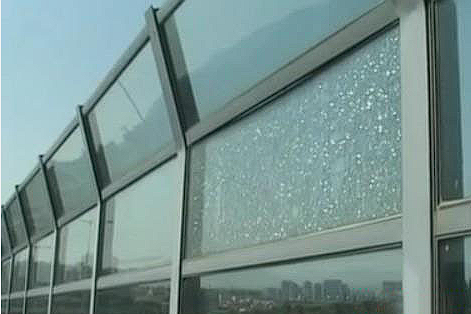
When tempered glass breaks, it first breaks in the inner layer. The cracks caused by tensile stress propagate very fast. At the same time, the compressive stress of the outer layer has the effect of keeping the broken inner layer from peeling off. Therefore, when tempered glass breaks, only small fragments without sharp corners are produced.
There is a large amount of mutually balanced stress distribution in tempered glass, so it is generally not possible to cut it. During the tempered glass processing, the cracks on the glass surface are reduced and the surface condition is improved, which is also the reason why tempered glass has higher strength and better thermal stability.
Contact Us
Your feedback fuels our growth, and your questions drive our solutions.
We value your feedback, inquiries, and suggestions. Please feel free to get in touch with us
General inquiries
Please contact us via sales@bo-glass.com, and we will reply to you as soon as possible.
Interested to work with us
Drop your resume at info@bo-glass.com
and we will get back to you shortly.
We uses the contact information you provide to us to contact you about our relevent content, products, and services.