
What is the sol-gel method?
In 1975, B.E. Yoldas and M. Yamane successfully created thin thin films of porous, transparent aluminum oxide (Al₂O₃). Since the 1980s, the sol-gel method has been used to fabricate composite oxide thin films on glass substrates, broadening its applications in advanced material science and coating technologies.
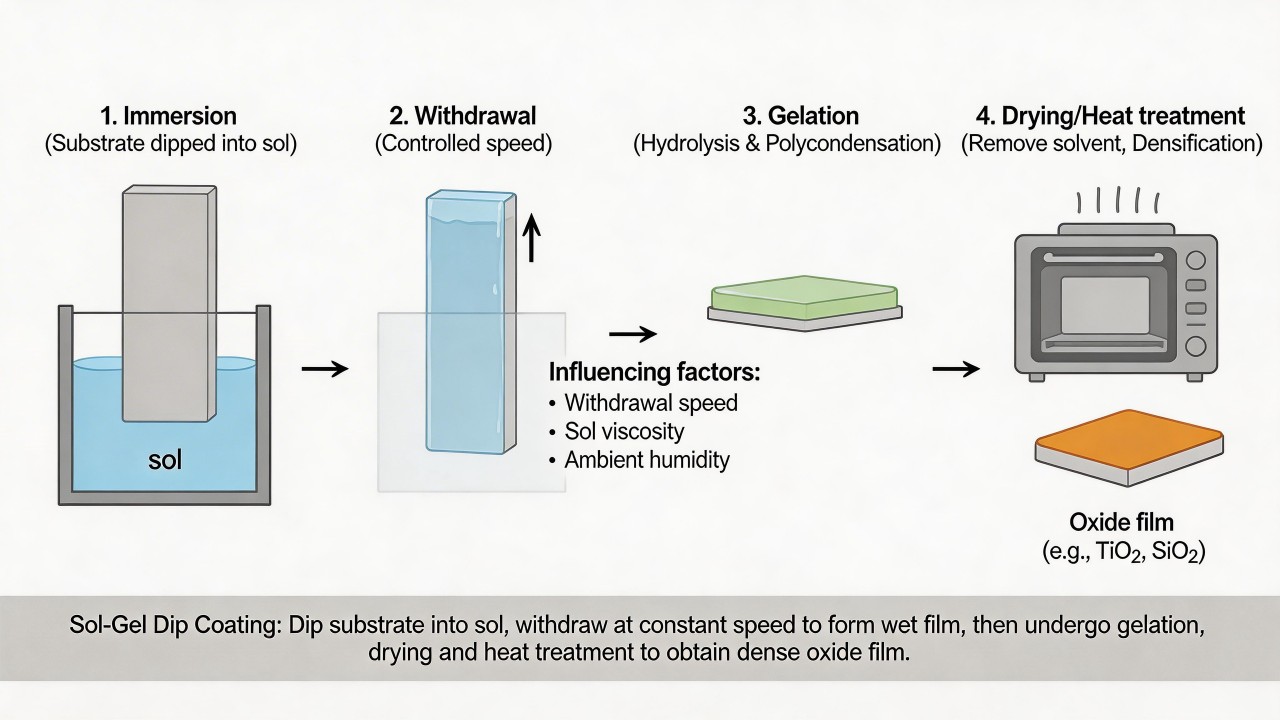
Principle of Film Formation Using the Sol-Gel Method
Al(OR)₃ + H₂O → Al(OR)₂OH + ROH
Al(OR)₂OH + H₂O → Al(OR)(OH)₂ + ROH
Al(OR)(OH)₂ + H₂O → Al(OH)₃ + ROH
Upon heating, 2Al(OH)₃ → Al₂O₃ + 3H₂O.
This process involves stepwise hydrolysis of aluminum alkoxide, diffusion of ROH from the film, and condensation during heating, resulting in Al₂O₃.
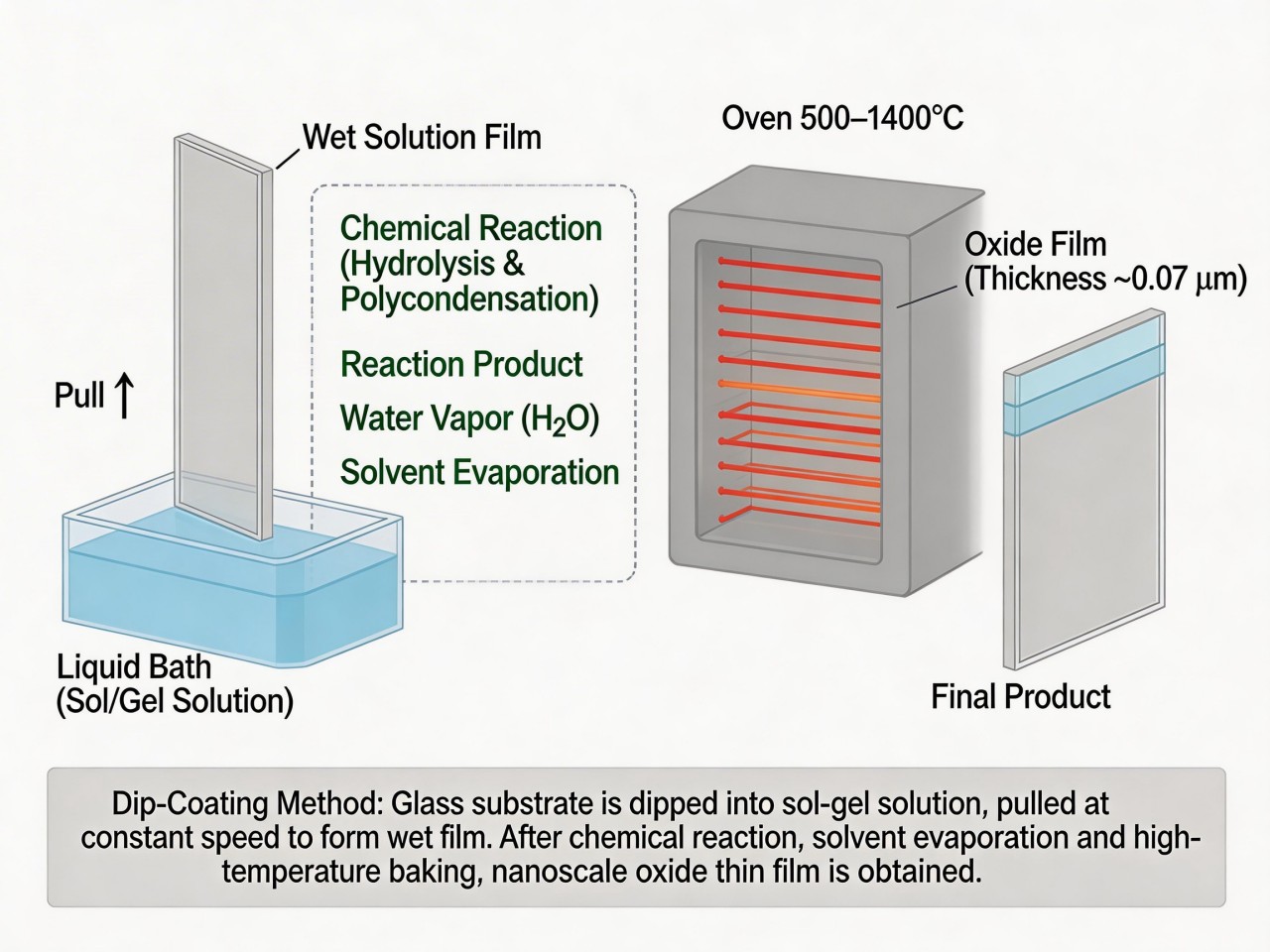
Figure 4-6 Gel dip coating process
Advantages and Applications of the Sol-Gel Method
In addition to oxides, this method can produce other types of films. During the dip-coating process, two types of forces act within the film: cohesive forces parallel to the substrate surface and adhesive forces perpendicular to it. As the film thickness increases, cohesive forces can exceed adhesive forces, introducing tensile stress that affects film quality. Therefore, controlling hydrolysis conditions is essential to enhance adhesion and ensure film integrity.
Chemical bonds between the film and the glass substrate further strengthen adhesion. For instance, hydrolysis of alkoxide compounds can form silicates or titanates that bond covalently with the substrate, ensuring durable and stable films. This characteristic makes the sol-gel method a versatile and efficient technique for producing advanced coatings with diverse applications.
Table 4-2 Properties of non-absorbing and absorbing metal oxide films prepared by gel immersion plating
| Raw Material | Film Material | Color in Transmission | Structure | Remarks |
| Al-sec-butoxide | Al₂O₃ | Colorless | Amorphous | Forms mixture with other oxides |
| Al(NO₃)₃·9H₂O | Al₂O₃ | Colorless | Crystalline | Forms mixture with other oxides |
| Y(NO₃) | Y₂O₃ | Colorless | - | - |
| La(NO₃) | La₂O₃ | Colorless | - | - |
| Ce(NO₃)₃·6H₂O | CeO₂ | Colorless | Crystalline | Forms mixture with other oxides |
| Nd(NO₃)₃ | Nd₂O₃ | Colorless | - | Absorption band at 500–600 nm reduces transmittance |
| In(NO₃) | In₂O₃ | Colorless | Crystalline | Semiconductor |
| Ti(OR) | TiO₂ | Colorless | Crystalline | Forms mixture with other oxides |
| Si(OR)₄ | SiO₂ | Colorless | Amorphous | Forms mixture with other oxides |
| TiCl₄ | TiO₂ | Colorless | Crystalline | Forms mixture with other oxides |
| ZrOCl₂ | ZrO₂ | Colorless | Crystalline | - |
| HfOCl₂·8H₂O | HfO₂ | Colorless | Crystalline | Contains trace Cl in layers |
| ThCl | ThO₂ | Colorless | Crystalline | - |
| Th(NO₃) | ThO₂ | Colorless | - | - |
| SnCl | SnO₂ | Colorless | Crystalline | Semiconductor |
| Pb(OOCCH₃)₂ | PbO | Colorless | Amorphous | Diffuses into glass at 500°C |
| Ta₂O₅ | Ta₂O₅ | Colorless | - | - |
| Sb₂O₃ | Sb₂O₃ | Colorless | - | - |
| Cu(NO₃)₂·3H₂O | CuO | Brown | - | - |
| VOC | VO | Pale green to yellow | - | Optical properties depend on preparation conditions |
| CrO(NO₃)₉H₂O | CrO | Yellow | - | - |
| CrOCl | - | Orange | Crystalline | - |
| Fe(NO₃)₃·9H₂O | Fe₂O₃ | Yellow to red | - | - |
| Co(NO₃)₂·6H₂O | CoO | Brown | - | - |
| Ni(NO₃)₂·6H₂O | NiO | Gray | - | - |
| RuCl₃·H₂O | RuO | Gray | - | Semiconductor |
| RhCl₃ | RhO | Gray to brown | - | - |
| UO₂(OOCCH₃)₂ | UO₂ | Yellow | - | - |
Dip-Coating Solution Preparation for Sol-Gel Process
Solubility and Stability of Precursors
Wettability
Durability of the Solution
Drying and Heating
Viscosity
Examples of Dip-Coating Solution Preparation
SiO₂ Film
Si(OC₂H₅)₄ + 4H₂O → H₄SiO₄ + 4C₂H₅OH
H₄SiO₄ → SiO₂ + 2H₂O
With TEOS having a molar mass of 208 g/mol and water 72 g/mol, the water-to-TEOS ratio required for normal hydrolysis is calculated as 0.346 (g water per g TEOS). The water amount should be adjusted based on ambient humidity: if relative humidity exceeds 65%, reduce water by 0.5%; if below 50%, increase by 0.5%. Excess water can cause film irregularities, while insufficient water slows film formation and weakens adhesion.
Three-Layer Anti-Reflective Film
TiO₂ Films
- For 3–9% Ti(OC₂H₅)₄, add 0.15–0.2 mL HCl per 100 mL.
- For 10–14% Ti(OC₂H₅)₄, add 0.3–0.4 mL HCl per 100 mL.
If the solution turns milky white, HCl is added dropwise until it becomes clear.
Concentration-Based HCl Addition
The amount of HCl added varies with the concentration of TEOS:
- For 3–5% TEOS, add 0.05 mL HCl per 100 mL.
- For 6–8% TEOS, add 0.1 mL HCl per 100 mL.
- For 9–19% TEOS, add 0.15 mL HCl per 100 mL.
- For 20–30% TEOS, add 0.2 mL HCl per 100 mL.
Multicomponent Oxide Films
A dip-coating solution for 4SiO₂·Al₂O₃·6K₂O·0.4Na₂O film is prepared as follows:
- Dissolve 2.06 g of boric acid in 30 mL of ethanol.
- Dissolve silicon ethoxide in 60 mL of ethanol.
- Add 2.169 g of potassium and sodium methoxide (3.6 mL of a 30% methanol solution) to the latter. Stir until any precipitate dissolves.
- Add 12.32 g of aluminum sec-butoxide and the boric acid solution. Continue stirring for 1 hour until the solution becomes clear.
Film Preparation Methods in the Sol-Gel Dip-Coating Process
Vertical Dip-Coating Method
- Lifting Process: The substrate (glass) is dipped into the solution and then gradually lifted out to achieve coating.
- Lowering Process: The substrate remains stationary while the liquid level of the dip-coating solution is reduced.
Due to its operational ease, the lifting process is widely used, especially for large glass panels. A schematic of the lifting process is shown in Figure 4-7. The production steps for oxide films using the vertical dip-coating method are as follows:
- The glass substrate is mounted on a dip-coating frame.
- The prepared dip-coating solution is placed in a tank, and the frame is lowered into the solution.
- The substrate is immersed in the solution, ensuring a uniform coating.
- The frame is lifted at an optimal speed of 10–20 cm/min.
- The coated substrate is dried in air, undergoing hydrolysis and dehydration to form a thin film.
- The substrate is transferred to a heating furnace, where it is heated at 400–500°C for 30 minutes at a ramp rate of 7–10°C/min.
- During heating, the adhered solution undergoes condensation, forming a solid oxide layer.
- The substrate is cooled to room temperature, unloaded, inspected, and packaged.
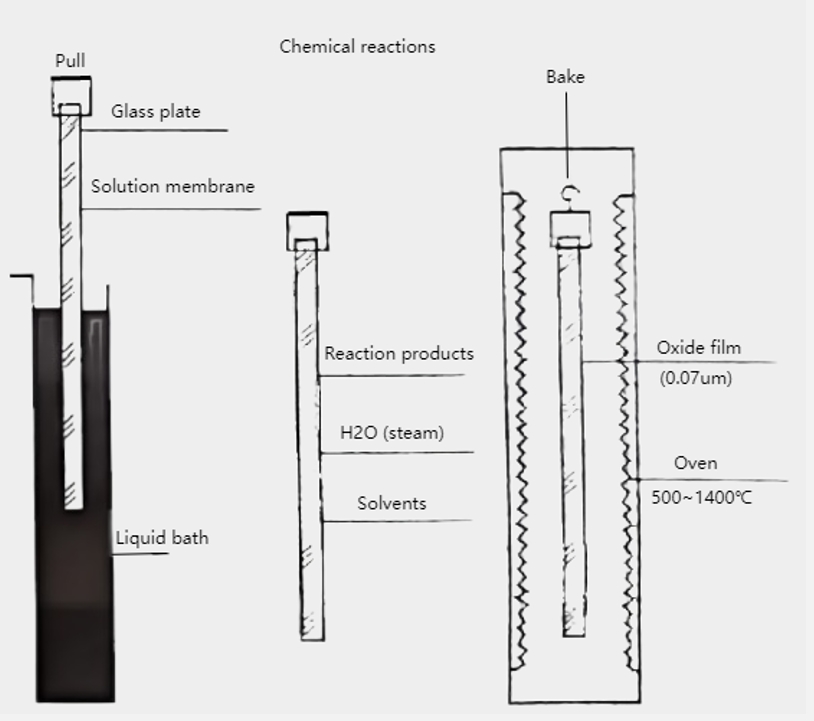
Figure 4-7 Schematic diagram of gel immersion plating lifting process membrane preparation
The film thickness is influenced by parameters such as withdrawal speed, sol viscosity, and surface tension. The relationship is given by Equation 4-8:
The film thickness is influenced by parameters such as withdrawal speed, sol viscosity, and surface tension. The relationship is given by the equation: δ = η · v / γ, where δ is the film thickness, η is the viscosity, v is the withdrawal speed, γ is the surface tension, and g is the gravitational acceleration.
Limitations: Vertical dip-coating is less effective for large flat glass surfaces due to difficulties in maintaining solution stability and for coating only one side of the substrate.
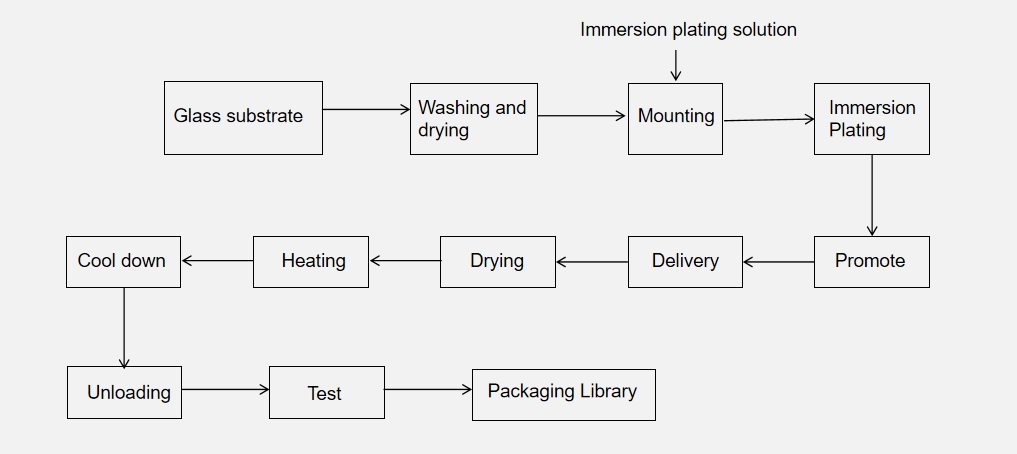
Figure 4-8 Process of preparing oxide film by gel immersion plating lifting process
Spin-Coating Method
The spin-coating method, also known as the centrifugal method, is performed using a spin coater.
- The glass substrate is secured on the coater.
- A dropper dispenses the sol-gel solution onto the rotating substrate.
- Centrifugal force distributes the solution uniformly over the surface.
This method is ideal for small substrates, with typical spin speeds around 1200 rpm. After coating, the substrate is dried and aged at 60°C for 15 minutes to form a gel film. Additional layers can be applied as needed by repeating the process. A schematic of the spin-coating process is shown in Figure 4-9.
Advantages: Spin-coating is highly effective for large-area coatings and can achieve uniform films even on slightly uneven surfaces.
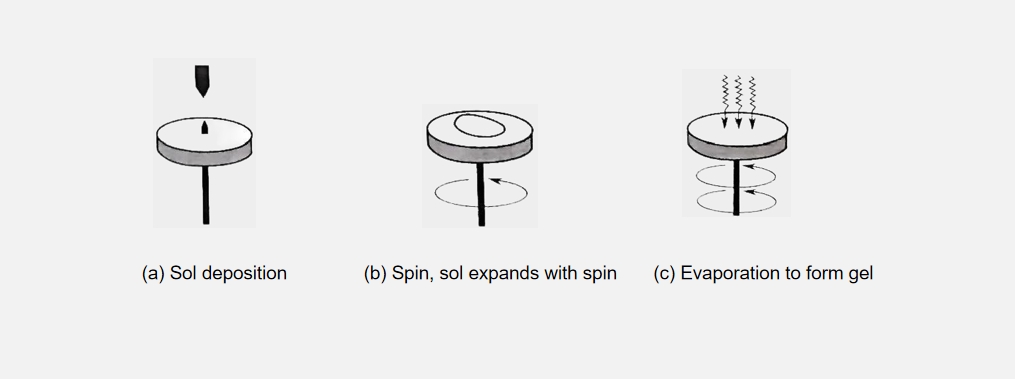
Figure 4-9 Schematic diagram of gel immersion spin process membrane preparation
Advantages of the Sol-Gel Dip-Coating Method
- Simple and inexpensive coating equipment without the need for costly vacuum systems.
- Simultaneous coating of both sides of the glass substrate for enhanced durability or reduced layer count.
- The chemically bonded thin film ensures strong adhesion to the glass surface.
- Easy application of multilayer films to meet specific requirements.
- Effective for coating the inner surfaces of glass products, such as tubes, where vacuum-based methods are challenging.
- Low baking temperatures (380–500°C) prevent deformation of the glass.
Limitations of the Sol-Gel Dip-Coating Method
- Maintaining long-term solution stability during production is challenging.
- Product performance is consistent within a relatively wide range, making precision difficult.
- Not suitable for small or intricate substrates with many edges or corners.
The sol-gel dip-coating method is a versatile and cost-effective process, though its applicability may be limited for specific product geometries or precision requirements.
Contact Us
Your feedback fuels our growth, and your questions drive our solutions.
We value your feedback, inquiries, and suggestions. Please feel free to get in touch with us
General inquiries
Please contact us via sales@bo-glass.com, and we will reply to you as soon as possible.
Interested to work with us
Drop your resume at info@bo-glass.com
and we will get back to you shortly.
We uses the contact information you provide to us to contact you about our relevent content, products, and services.