Self-explosion defects and solutions

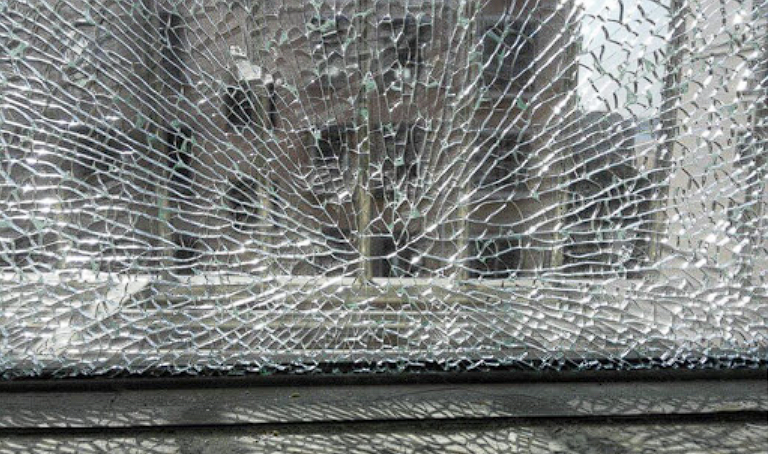
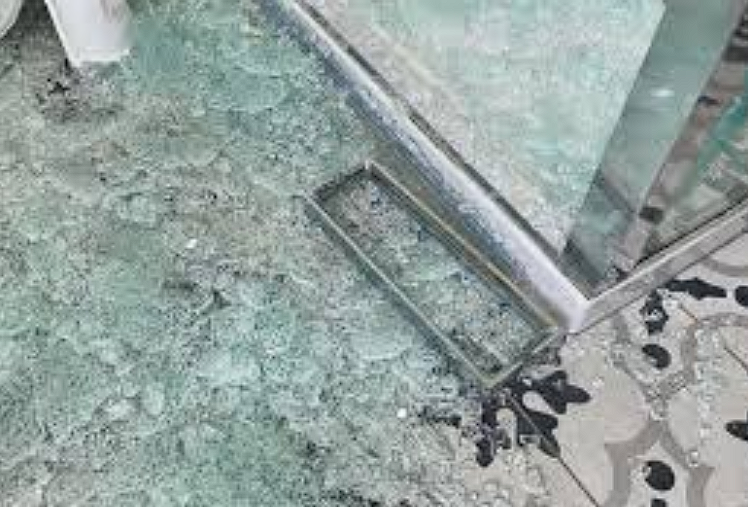
Tempered glass self-explosion refers to the automatic bursting without external force. This hurts the use of tempered glass and may even cause major accidents. According to Australia’s 12-year observation and testing of 17,760 pieces of tempered glass on glass curtain walls, there were 306 cases of self-explosion, with a self-explosion rate of 1.72%. Self-explosion is one of the inherent characteristics of tempered glass and can occur during processing, storage, transportation, installation, and use.
There are many reasons for tempered glass to explode. In summary, they are mainly due to three aspects: excessive internal stress, uneven stress, and defects in the glass.
(1) Glass quality defects The quality defects of the original glass have a decisive influence on the self-explosion of tempered glass, but the degree and mechanism of influence of different defects are different. The specific situations are as follows.
① There are stones and impurities in the glass. Impurities in the glass are the weak points of tempered glass and the stress concentration points. In particular, if the stones are in the tensile stress zone of tempered glass, they are an important factor leading to explosion. Stones exist in the glass and have different expansion coefficients from the glass body. After the glass is tempered, the stress concentration in the crack area around the stones increases exponentially. When the expansion coefficient of the stones is smaller than that of the glass, the tangential stress around the stones is in a tensile state. Crack extension with stones is very easy to occur.

② The glass surface has scratches, cracks, deep crack edges, and other defects due to improper processing or operation, which can easily cause stress concentration or lead to self-explosion of tempered glass.
③ The glass contains nickel sulfide crystals. After the glass is tempered, compressive stress is formed on the surface layer. The inner core layer is tensile stress, and the compressive stress and tensile stress together form a balanced body. When the nickel sulfide crystals in the tempered glass undergo a phase change, their volume expands. The expansion of nickel sulfide in the tensile stress layer of the glass core causes greater tensile stress inside the tempered glass. When the tensile stress exceeds the limit that the glass itself can withstand, it will cause the tempered glass to explode.
Among the above three reasons, the expansion of nickel sulfide inside the tempered glass is the main cause of the tempered glass explosion. The main material of the glass, quartz sand or sandstone, brings in nickel, and the fuel and auxiliary materials bring in sulfur. Nickel sulfide is formed by burning and melting in a high-temperature furnace at 1400-1500℃. When the temperature exceeds 1000℃, nickel sulfide is randomly distributed in the molten glass in the form of droplets. When the temperature drops to 797℃, these small droplets crystallize and solidify, and the nickel sulfide is in the high-temperature a-NiS crystal phase (hexagonal crystal). When the temperature continues to drop to 379℃, the crystal phase changes to low-temperature β-NiS (trigonal system), accompanied by a 2.38% volume expansion. The speed of this transformation process depends not only on the percentage content of different components in the nickel sulfide particles (including Ni₇S₆ and NiS) but also on the temperature of the surrounding area. If the nickel sulfide phase change is not completely converted, even under natural storage and normal use temperature conditions, this process will continue, but the speed is very low.
When the glass is tempered and heated, the temperature of the inner core of the glass is about 620℃, and all the nickel sulfide is in the high-temperature α-NiS phase. Subsequently, the glass enters the wind grid for rapid cooling, and the nickel sulfide in the glass undergoes a phase change at 379℃. Unlike the float annealing furnace, the tempering rapid cooling time is very short, and it does not have time to transform into low-temperature β-NiS and is “frozen” in the glass as a high-temperature nickel sulfide α phase. Rapid rapid cooling allows the glass to be tempered, forming a unified stress balance body with external pressure and internal tension. In the tempered glass, the nickel sulfide phase change is continuously carried out at a low speed, and the volume is constantly expanding, and the force on the surrounding glass increases accordingly. The tempered glass core itself is a tensile stress layer. When the nickel sulfide in the tensile stress layer undergoes a phase change, the volume expansion also forms tensile stress. These two tensile stresses are added together to cause the tempered glass to break, that is, self-explosion.
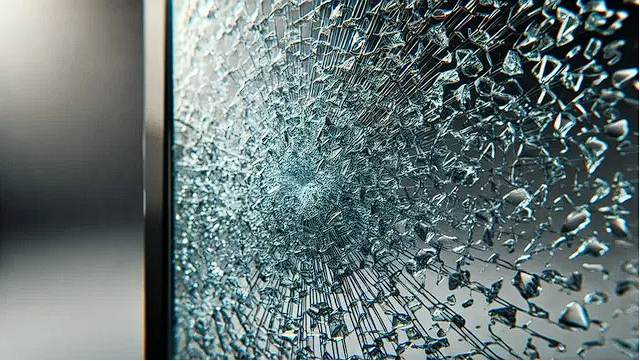
Typical NiS-induced self-explosion fragments are shown in Figure 3-25. As can be seen from Figure 3-25, the self-explosion fragments are radially distributed, and there are two glass blocks shaped like butterfly wings in the center of the radiation, commonly known as “butterfly spots”. NiS stones are located on the interface of the two “butterfly spots”.
(2) Uneven and offset stress distribution When heating or cooling the glass, the temperature gradient along the thickness direction of the glass is uneven and asymmetric. This makes the tempered glass tend to explode by itself, and some will produce a “wind explosion” when it is cooled. If the tensile stress area deviates to one side of the product or the surface, the tempered glass will explode by itself.

(3) Tempering degree The tempering degree can be essentially attributed to the magnitude of the stress inside the glass. Jacob gave the corresponding relationship between the compressive stress value on the glass surface and the number of fragments within a range of 50 mm × 50 mm.
The relationship between the surface stress of glass and the number of fragments is that the tensile stress of the core is numerically equal to half of the surface compressive stress. The American ASTM C1048 standard stipulates that the surface stress range of tempered glass is greater than 69MPa, and that of heat-strengthened glass is 24-52MPa. The curtain wall glass standard in my country stipulates that the stress range is: tempered glass is above 95MPa, and semi-tempered glass is 24-69MPa.
If the degree of tempering of the glass is too strong, stress will be generated in the glass. When the internal strength is lower than the surface strength, the fracture starts from the inside, and the damage will occur when the load is lower than the allowable load of the tempered glass. Especially when there are defects in the tensile stress layer, it is more likely to cause stress concentration and self-explosion.

Prevention and reduction methods

To prevent and reduce the spontaneous explosion of tempered glass, we should consider and pay attention to the original glass, tempering production environment, production process system, and other aspects. Common measures to prevent and reduce the spontaneous explosion of tempered glass mainly include: using high-quality original glass, reducing stress value, uniform stress distribution, and homogenization treatment.
(1) Reduce stress value The distribution of stress in tempered glass is that the two surfaces of tempered glass are compressive stress, the core layer is in tensile stress, and the stress distribution in the thickness of the glass is similar to a parabola. The center of the glass thickness is the vertex of the parabola, that is, the maximum tensile stress; the two sides close to the two surfaces of the glass are compressive stress; the zero stress surface is about 1/3 of the thickness. By analyzing the physical process of tempering rapid cooling, it can be seen that the surface tension of tempered glass and the maximum tensile stress inside have a rough proportional relationship in value, that is, the tensile stress is 1/3 to 1/2 of the compressive stress. Domestic manufacturers generally set the surface tension of tempered glass at around 100MPa, and the actual situation may be higher. The tensile stress of tempered glass itself is about 32-46MPa, and the tensile strength of glass is 59-62MPa. As long as the tension generated by the expansion of nickel sulfide is 30MPa, it is enough to cause self-explosion. If its surface stress is reduced, the tensile stress of tempered glass itself will be reduced accordingly, which will help reduce the occurrence of self-explosion.

The American standard ASTM C1048 stipulates that the surface stress range of tempered glass is greater than 69MPa; semi-tempered (heat-strengthened) glass is 24-52MPa. The curtain wall glass standard GB 17841 stipulates that the semi-tempered stress range is 24MPa<δ≤69MPa. My country’s GB 15763.2-2005 “Safety Glass for Buildings Part 2: Tempered Glass” requires that its surface stress should not be less than 90MPa. This is 5MPa lower than the 95MPa specified in the previous standard, which is conducive to reducing self-explosion.

(2) Maintain uniform stress. Uneven stress in tempered glass will significantly increase the spontaneous explosion rate, which has reached a level that cannot be ignored. The spontaneous explosion caused by uneven stress sometimes manifests itself very concentratedly, especially in a specific batch of bent tempered glass, the spontaneous explosion rate will reach a shocking level and may occur continuously. The main reasons are the uneven local stress and the displacement of the tension layer in the thickness direction. The quality of the original glass itself also has a certain influence. Uneven stress will greatly reduce the strength of the glass, which is equivalent to increasing the internal tensile stress to a certain extent, thereby increasing the spontaneous explosion rate. If the stress of tempered glass can be evenly distributed, the spontaneous explosion rate can be effectively reduced.
(3) Use high-quality float glass. Nickel sulfide inclusions in glass are the essential cause of tempered glass spontaneous explosion. People naturally think whether it is possible to reduce or eliminate this impurity in the production process of float glass. From a technical point of view, the most advanced automatic glass defect detector in the world can only detect point defects larger than 0.2mm. It is almost impossible to pick out all defective glass on the float production line.
Experiments show that adding zinc sulfate or zinc nitrate to float raw materials can effectively reduce the number of nickel sulfide stones. Zinc sulfate or zinc nitrate is a strong oxidant that can oxidize the sulfide in the glass into sulfate, which can be absorbed by the glass liquid, thereby reducing or eliminating nickel sulfide stones.

Contact Us

Your feedback fuels our growth, and your questions drive our solutions.

We value your feedback, inquiries, and suggestions. Please feel free to get in touch with us

General inquiries

Please contact us via sales@bo-glass.com, and we will reply to you as soon as possible.

Interested to work with us

Drop your resume at info@bo-glass.com
and we will get back to you shortly.

    We uses the contact information you provide to us to contact you about our relevent content, products, and services.