
Physical tempering technology for special glass
The physical tempering technology of special glass enhances the strength and durability of glass through heating and rapid cooling.
Physical tempering technology for special glass
With the continuous improvement of flat glass technology, new types of flat glass have been introduced, such as ultra-thin glass, ultra-thick glass, Low-E glass, embossed glass, heat-absorbing glass, etc. Due to their characteristics, the tempering process of these new types of glass is different from that of ordinary flat glass.
Ultra-thin glass tempering technology
The so-called thin glass mainly refers to flat glass or other shaped glass with a thickness of less than 3mm. The application market of tempered thin glass is broad. In the past, due to the difficulty in processing and high cost, it was mainly used for platemaking glass in the electronic industry. At present, with the advancement of technology, the cost has been gradually reduced, and it has been more and more widely used in the fields of construction, automobiles, electrical lighting, etc. The heat exchange intensity between the cooling medium and the glass surface has a decisive influence on the tempering process of glass.
The tempering methods of thin glass mainly include chemical tempering and physical tempering. The advantages of chemical tempering are high strength and good thermal stability. The product is not limited by thickness and geometric shape, and the deformation is very small. There is no self-explosion phenomenon, and it can be cut and processed again after tempering: the disadvantage is that the production cycle is long. The cost is high, the fragments are similar to ordinary glass, and the safety is poor. The liquid medium tempering method, the particle tempering method, and the gas medium tempering method, that is, air-cooled tempering, can temper thin glass.
The liquid medium copper method generally heats the thin glass to about 650℃ and then puts it into a cold tank filled with liquid for tempering. The cooling medium can be potassium nitrate, potassium nitrite, mixed salt water of sodium nitrate, sodium nitrite, etc., mineral oil, or additives such as toluene or carbon tetrachloride added to mineral oil. Some special quenching oils and polysiloxane oils can also be used. Two issues that should be paid attention to during liquid cooling tempering are the excessively high compressive stress layer produced and the avoidance of glass cracking. In addition to using the immersion cooling liquid, the liquid spray method can also be used, but the immersion method is generally used. Triplex Company in the UK was the first to use the liquid medium method to temper glass with a thickness of 0.75-1.5mm, ending the history of physical tempering being unable to temper thin glass.
For thin glass below 3mm, only a few of the imported air-cooled tempering equipment can produce tempered glass with a thickness of less than 3mm. The minimum thickness of glass tempered by domestic equipment is generally around 4mm. Internationally, there have been reports that Russia has tested 1.8mm air-cooled tempered glass. To temper thin glass, a very high heat transfer coefficient is required. In addition, since thin glass has a high requirement for heating uniformity, thin glass is very easy to crack during air-cooling quenching.
(1) Cooling equipment design The heat exchange rate between the cooling medium and the glass surface plays a decisive role in the glass tempering process. In automotive glass and architectural glass applications, the heat transfer coefficient, air flow velocity, and nozzle spacing must be considered when designing wind-cooled tempering for 3-4 mm thick or thinner glass. This is because the heat transfer coefficient is closely related to the tempering stress. The wind grille design is shown in the following figure.
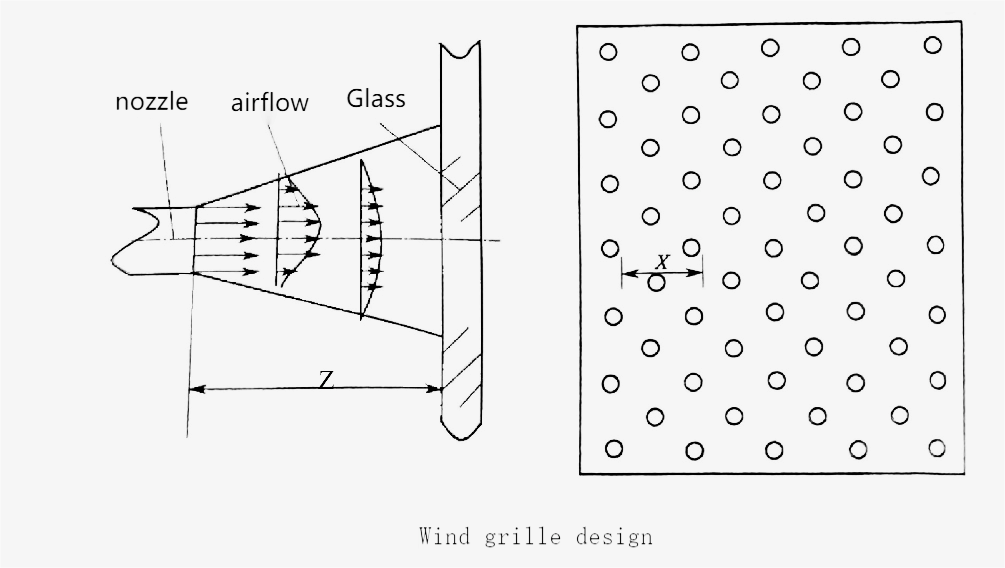
To temper thin glass, a very high heat transfer coefficient is required. The nozzle blows appropriate air to the surface of the glass to obtain a very high heat transfer coefficient. This method has been widely used.
Tempering of flat glass with holes and notches
Tempered flat glass with sharp angles
Tempered Low-E glass
(1) Differences in properties between Low-E glass and ordinary glass
② Heat absorption state The heat absorption performance of both sides of ordinary glass is the same, and both have good infrared absorption performance. The infrared radiation reflectivity of one side of the online low-emissivity glass coating is as high as 85%, and the other side is the same as ordinary glass. The heat absorption effect of the two sides is very different.
③ High-temperature effect of glass heating When ordinary transparent float glass is tempered, the minimum temperature of the glass is required to reach 40-50℃ above Tg. The high temperature only causes greater deformation of the tempered glass, and has no significant effect on the performance of the glass itself; given the film surface characteristics of online low-emissivity glass, the heating cannot exceed 630℃, otherwise, the film layer will be damaged, affecting the basic properties of the glass.
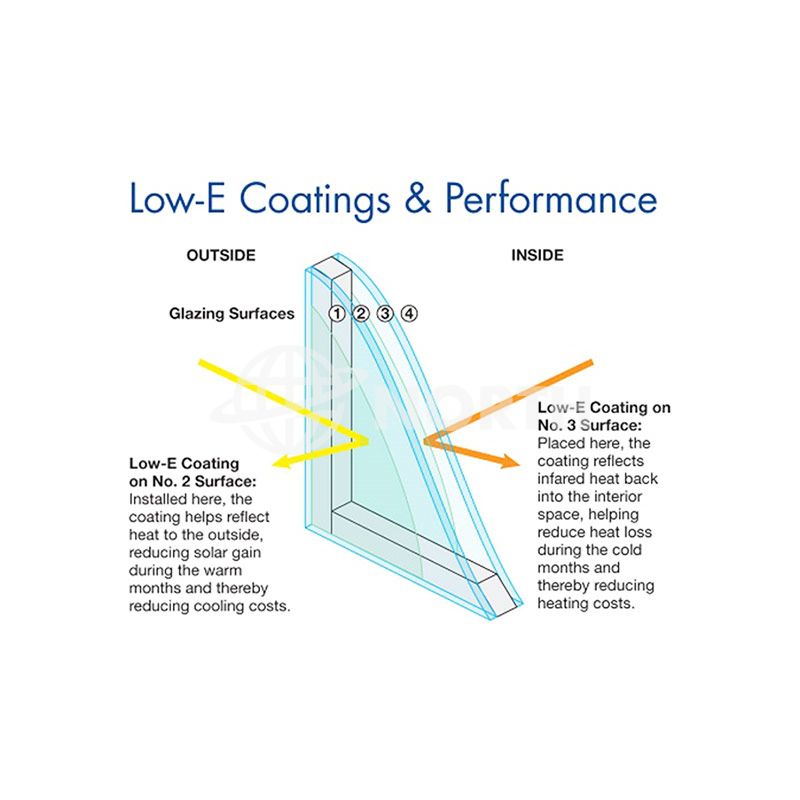
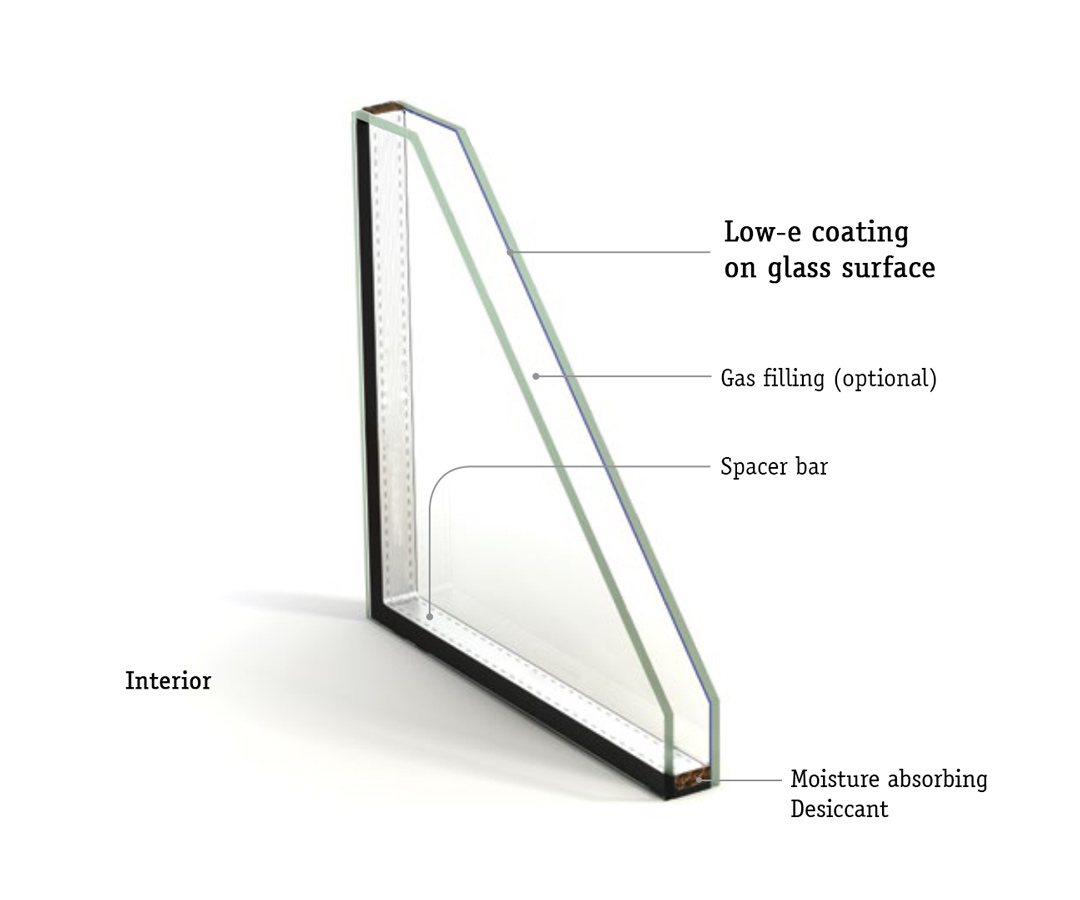
(2) Analysis of problems in tempering low-e glass
The upper and lower surfaces are heated unevenly, the temperature difference is too large, and the expansion of the upper and lower layers is different. The glass will bend toward the upper surface at a lower temperature. In this way, when the glass runs on the ceramic roller, the glass will move in a pot shape, causing the glass to be heated more unevenly.
At the same time, roller marks will also appear on the lower surface of the glass. In severe cases, when the thermal stress caused by the temperature difference exceeds the tensile strength of the glass itself, the glass will burst in the tempering furnace; but if the coated surface is placed on the roller in the furnace in reverse, the glass plate will reduce bending deformation under the action of its gravity, but during the tempering process, the ceramic roller in the heating furnace and the asbestos rope roller in the wind grid are contaminated by glass chips, dust, and other debris, and are not easy to clean due to objective conditions. During the tempering process, these rollers continuously rotate in forward and reverse directions, with deceleration and acceleration, and there is relative displacement friction between the glass and the rollers. Although these pollutants and friction are not enough to seriously scratch the glass surface, they may damage the film layer at high temperatures, causing film peeling, scratches, and crushing, which in turn affects the performance of Low-E glass. In summary, when tempering low-e glass, the film surface should be placed upward to avoid direct contact between the film layer and the rollers and damage.
② During the heating process, the high reflectivity of the low-e glass film layer to infrared radiation reduces the heat absorption rate of the film glass surface. In order to ensure that the internal temperature of the glass plate reaches the tempering temperature, the heating time needs to be extended.
(3) Online tempering of Low-E glass
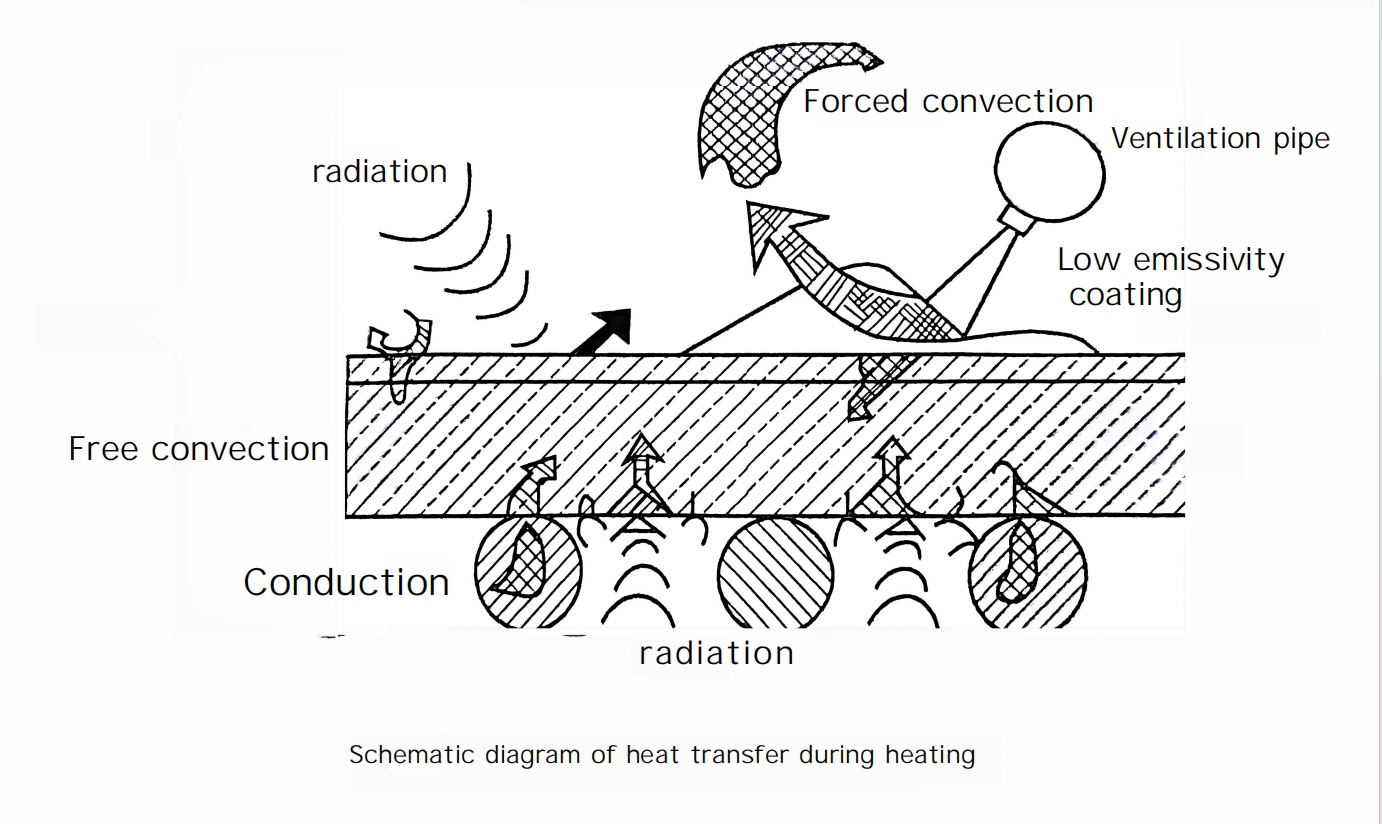
③ Reduce the heat transfer rate of the lower area When lowering the set temperature of the lower area, at the same time, properly adjust the control response system of the upper and lower area heater to slow down the temperature increase of the lower area and reduce the heat transfer rate of the lower surface to achieve a balance between the heat absorption of the upper and lower surfaces.
④ Extend the heating time Since the heat transfer rate of the lower part is reduced and the upper part is not heated well, the heating time is appropriately extended to ensure that the glass plate can reach the required temperature for tempering. See the table for detailed process parameters
Tempering Process Parameters for Low-Emission Glass
| Process Name | Parameter | Process Name | Parameter |
|---|---|---|---|
| Heating Time | 51 s | Nozzle Height | 35 mm |
| Top Furnace Temperature | 680 ℃ | Conveyor Speed | 45 cm/s |
| Bottom Furnace Temperature | 690 ℃ | Unloading Temperature | 45 ℃ |
| Cooling Air Pressure | 1.9 kPa |
Note: The above data is for 6 mm thick, 4610 mm × 1460 mm sized online low-emission glass tempering process parameters.
Tempering of patterned glass
② During production, try to place the glass with the patterned surface facing up to avoid damage to the patterned surface. However, if the production situation does not allow the patterned surface to be placed facing up, special attention should be paid to the condition of the patterned surface and the cleaning and maintenance frequency of the patterned surface should be increased in a timely manner.
③ The heating time must be determined based on the thickest point of the embossed glass.
④ When the embossed glass material is not of the same type, the heating time must be increased by 2.5% to 5%.
⑤ The strengthening wind pressure is determined based on the thickest point of the glass. Since the thickness of the embossed glass is not consistent, it is usually impossible to obtain a uniform distribution of broken particles. If you need to increase the broken particles, you need to increase the size of the strengthening wind pressure.
⑥ Because the surface flatness of embossed glass is poor (uneven), it is easy to produce white spots or irregular white lines on the glass after production.
Tempering of engraved and sandblasted glass
② The thickness of engraved and sandblasted glass is different, so the heating time must be increased by 2.5% to 7% compared with the same general glass.
③ When strengthening thick glass, special attention must be paid to the adjustment of engraving into sandblasting and increasing the heating time.
④ The strengthening wind pressure is determined according to the thickest point of the glass. If the broken particles need to be increased, the strengthening wind pressure needs to be increased. However, when the thickness of engraved and sandblasted glass differs too much, the strengthening wind pressure must be appropriately reduced to increase the success rate of strengthening.
⑤ When producing engraved and sandblasted glass, try to place the uneven surface of the glass upward to avoid damage to the processed surface.
Tempering of heat-absorbing glass
Tempered color glass
Tempering of coated glass
② The temperature setting can be reduced by 3-7℃, and the heating time is the same as that of ordinary glass of the same thickness or increased by
3%-5%.
③ Adjust the temperature setting and heating time. The upper electric heating temperature setting can be increased by 5-20℃ as needed. Do not make the temperature of the glass too high to avoid damage to the coated surface.
In addition, the parameter adjustment of coated glass mainly depends on the thermal reflectivity of the coated surface. The higher the thermal reflectivity, the more difficult it is to heat the glass, and the higher the relative production difficulty. Therefore, it is also very helpful to use a higher upper electric heating temperature setting to produce glass with higher thermal reflectivity.
Stained glass (printed glass)
② The tempering process can only be carried out after the glaze is dried, and the glaze surface must be facing up and cannot be reversed during processing.
③ If the glaze is dried naturally, it will take at least one day (24h); if it is dried in a color-drying furnace (90-120℃), it depends on the thickness of the ink and the drying situation. If the ink on the painted surface (printed surface) is not dry and the strengthening process is carried out, it is easy to cause bubbles and particles in the ink or cause the color to be gray and dull.
④ The upper electric heating temperature setting can be increased by 5-20℃ as needed (depending on the glaze thickness and glaze sintering temperature). When strengthening thick glass, the upper electric heating temperature should not be increased too much, and the auxiliary heating pressure in the furnace must be reduced by 50% or turned off.
⑤ If the glass bends upward after strengthening, the exhaust distance of the strengthening area can be adjusted to improve it.
⑥ The sintering temperature of the glaze is the biggest factor that determines the heating time and furnace temperature setting. Therefore, the characteristics of the glaze must be confirmed before tempering processing as a reference for parameter setting.
Contact Us
Your feedback fuels our growth, and your questions drive our solutions.
We value your feedback, inquiries, and suggestions. Please feel free to get in touch with us
General inquiries
Please contact us via sales@bo-glass.com, and we will reply to you as soon as possible.
Interested to work with us
Drop your resume at info@bo-glass.com
and we will get back to you shortly.
We uses the contact information you provide to us to contact you about our relevent content, products, and services.