
Physical tempering process classification
Physical tempering technology can be divided into gas tempering, liquid cooling tempering, particle tempering and spray tempering according to the quenching medium. According to the different production equipment used, physical tempered glass production methods can be roughly divided into vertical hanging tempering, horizontal tempering and air cushion tempering.
(1) Gas medium tempering method, also known as an air-cooled tempering method. It includes horizontal air cushion tempering, horizontal roller tempering, vertical tempering, and other methods. The so-called air-cooled tempering method is a production method in which the glass is heated to a temperature close to the softening temperature of the glass (650-700°C), and then air is blown on both sides of it to quickly cool it down, to increase the mechanical strength and thermal stability of the glass. The quenching of heated glass is an important step in the production of tempered glass by physical tempering. The basic requirement for quenching glass is to cool it quickly and evenly, to obtain evenly distributed stress. To obtain evenly cooled glass, the cooling device must effectively vent hot air, facilitate the removal of accidentally generated broken glass, and minimize its noise.
① Advantages and Disadvantages The advantages of air-cooled tempering are low cost, large output, high mechanical strength, heat shock resistance (maximum safe working temperature can reach 287.78℃), and high heat gradient resistance (can withstand 204.44℃). In addition to enhancing mechanical strength, air-cooled tempered glass can form small fragments when broken, which can reduce harm to the human body. However, there are certain requirements for the thickness and shape of the glass (the minimum thickness of glass tempered by domestic equipment is generally around 3mm), the cooling speed is slow and the energy consumption is high. For thin glass, there is still the problem of glass deformation during the tempering process, and it cannot be used in fields with high optical quality requirements.
② Scope of application At present, air-tempering technology is widely used, and air-tempered glass is mostly used in automobiles, ships, and buildings.
During liquid tempering, since the edge of the glass plate enters the quenching tank first, cracks caused by uneven stress will occur. To solve this problem, it can be pre-cooled by air cooling or liquid spraying and then placed in an organic liquid for rapid cooling. Water and organic solution can also be placed in the quenching tank, and the organic solution floats on the water. When the heated glass is placed in the tank, the organic solution plays a pre-cooling role, absorbs part of the heat, and then enters the water for rapid cooling. In addition to immersing in cooling liquid, liquid spraying can also be used, but immersion is generally used. Triplex, a British company, first used the liquid medium method to temper glass with a thickness of 0.75-1.5 mm in the 1980s, ending the history of physical tempering being unable to temper thin glass.
The difficulty of liquid tempering is to establish a reasonable liquid cooling process system. Two issues should be noted during liquid cooling tempering: one is the excessively high compressive stress layer, and the other is to avoid glass cracking.
① Advantages and disadvantages The liquid medium tempering method uses a large specific heat capacity of water and a high heat of vaporization, so the amount used is greatly reduced, thereby reducing energy consumption and costs, and the cooling speed is fast, the safety performance is high, and the deformation is small. Since the glass is heated and then inserted into the liquid medium during cooling, it is easy for large-area glass plates to be heated unevenly, affecting the quality and yield rate.
② Scope of application It is mainly suitable for tempering various small-area thin glasses, such as glasses glass, LCD glass, and glass for optical instruments.
(3) Particle tempering method The particle tempering method is a process method in which the glass is heated to a temperature close to the softening temperature and then quenched in a fluidized bed with solid particles (generally alumina particles with a particle size of less than 200μm) to strengthen the glass. Theoretically, using solid as a cooling medium can produce thinner, lighter, and stronger tempered glass. Therefore, from the mid-1970s to the early 1980s, the United Kingdom, Japan, Belgium, Germany, and other countries successively applied this technology to production.
① Advantages and Disadvantages The particle tempering method can temper ultra-thin glass with high strength and good quality. It is an advanced technology for manufacturing high-performance tempered glass. Compared with the traditional wind tempering process, the new particle tempering process has a large cooling medium and is suitable for tempering ultra-thin glass. The energy-saving effect is significant (energy saving of about 40%). However, the cooling medium cost of the particle tempering process is relatively high.
② Scope of application High-strength, high-precision thin glass and ultra-thin glass.
① Advantages and Disadvantages The cooling medium is easy to obtain, low cost, and does not pollute the environment. It can also temper thin glass that cannot be tempered by general gas, liquid, and particle tempering, but the cooling uniformity is difficult to control.
②Scope of application Because its cooling system is difficult to control, it is currently less used.
Vertical hanging tempering process
(1)Process Introduction The vertical hanging tempering method is to heat the glass in a heating furnace to the specified temperature, and then transport it to a wind cooling device for cooling through a chain conveyor, a crank conveyor, an adjustable speed conveyor, or other conveying devices. The glass must be located on the vertical plane of the center line of the wind grid and remain stationary. The airflow ejected is evenly cooled by the movement of the wind grids on both sides. The movement of the wind grids can be divided into three types: rotary, horizontal reciprocating, and up-and-down reciprocating. The cooling air is blown toward the glass by gas nozzles evenly arranged on the wind grid (either in a rectangular or plum blossom shape). The inner diameter of the nozzle hole is generally 3 to 6 mm when using low-pressure air (ordinary fan air supply); when using high-pressure air (compressed air), it is generally 0.6 to 1 mm. The nozzle mouth is generally 45 to 50 mm away from the glass surface. The pressure of the cooling air is generally 3700 to 9800 Pa. For example, the cooling air pressure of 6 mm glass is 3700 to 4500 Pa, the theoretical quenching time is 15 seconds, and the actual blowing time is 30 seconds.
The disadvantages of the vertical tempering method are low productivity, inevitable pinch mark defects in the product, elongation, bending, or warping when the glass is heated, and it is not easy to realize production automation. Its advantages are low investment, low cost, and simple operation. Therefore, some domestic manufacturers still use this method to produce tempered glass.
(2) Process flow The vertical tempering process is a physical tempering method. Its production process is roughly glass After the original glass is prepared, cut, edged, washed, dried, and inspected for semi-finished products, it is clamped along the upper edge with heat-resistant steel clamps and sent to the electric heating furnace for heating. When the glass is heated to the required temperature, it is quickly moved to the wind grid for quenching. In the tempered wind grid, compressed air is evenly and quickly blown on both surfaces of the glass to cool the glass rapidly. During the cooling process of the glass, a large temperature gradient is generated between the inner layer and the surface layer of the glass, thus generating compressive stress on the surface layer of the glass and tensile stress on the inner layer, thereby improving the mechanical strength and thermal stability of the glass. After quenching, the glass is removed from the wind grid and the clamps are removed. After inspection, it can be packaged and stored.
The process flow of the vertical hanging tempering method is shown in Figure .
Horizontal tempering method
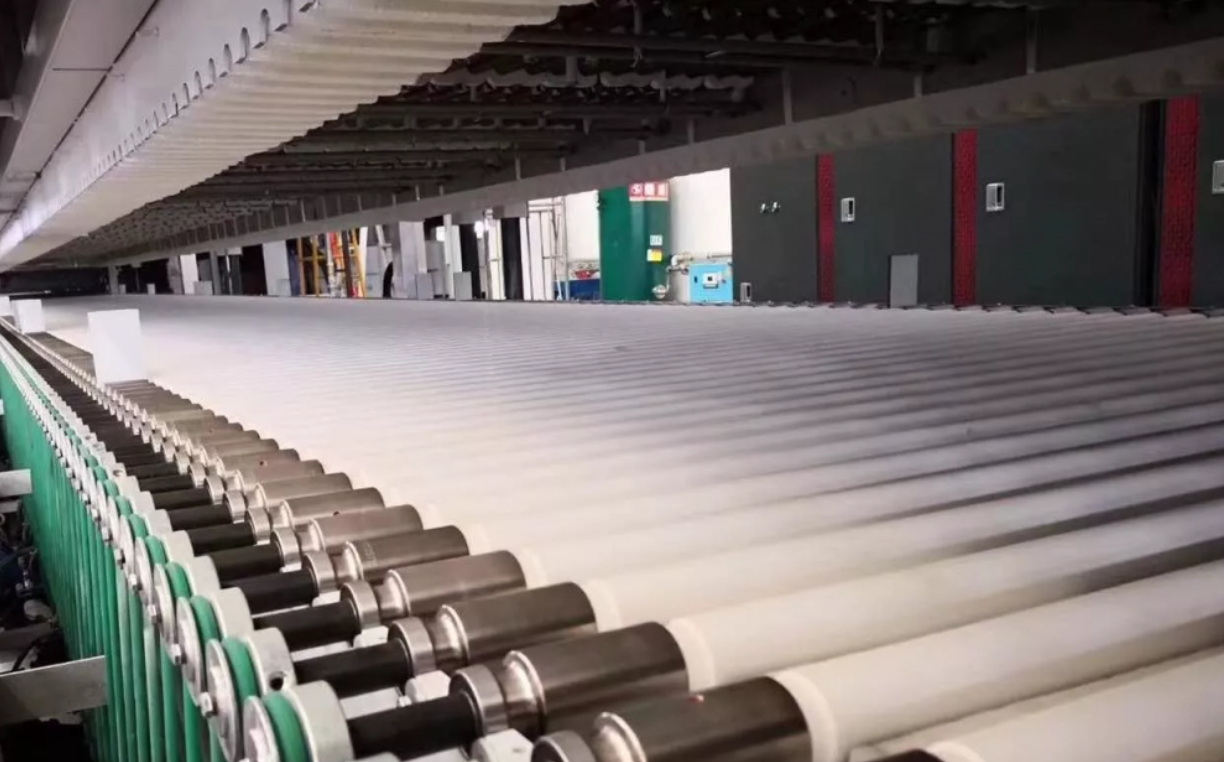
Each process of the horizontal tempering method is carried out on a horizontal roller, in which the heating furnace and the cooling device can reciprocate. The cooling device of the horizontal tempering method is also a wind grille, and its jetting methods include nozzle type, spray hole type, and slit type. The upper wind grille is composed of a steel frame, a wind grille lifting device, a wind grille, a compressed air pipe, and other components; the structure and number of the lower wind grille are the same as the upper wind grille, but the nozzle of the wind grille is installed at the upper end of the wind grille, and no guide plate is installed between each wind grille, leaving a certain gap so that the glass that is occasionally broken during the production process can fall into the broken glass conveyor below through this gap.
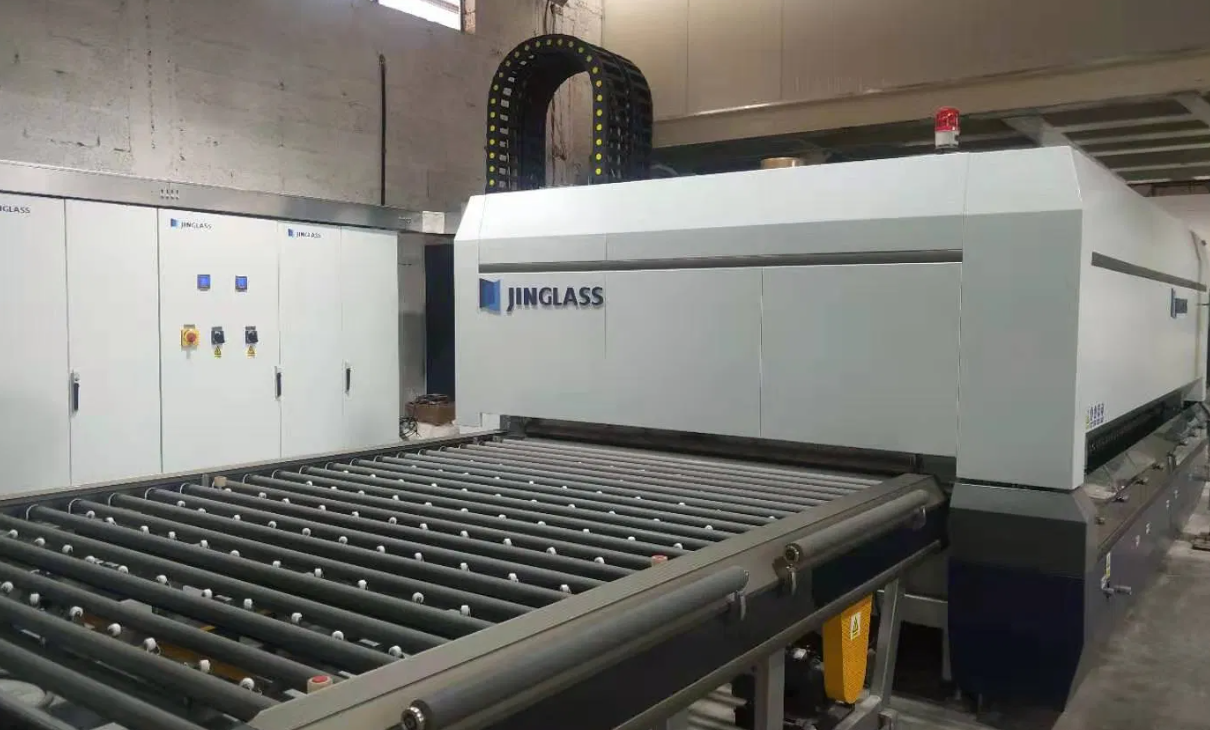
(2) Process Flow The horizontal tempering method is the most commonly used glass tempering method in the world. It uses a horizontal roller to transport the glass to the heating furnace and cooling device for heating and blowing tempering.
The microcomputer sets the input process parameters such as heating time, top temperature, bottom temperature, unloading temperature, and pressurization time according to the type and thickness of the required tempered glass.
The glass is loaded reasonably according to the loading specifications, and the tempering mark is affixed and printed according to the product requirements.
The heated glass enters the heating chamber from the loading table and is heated on the reciprocating ceramic roller until it reaches the appropriate tempering temperature.
After being heated, the quenched glass enters the wind grid and undergoes a blowing quenching process on the reciprocating fiber roller.
After the unloaded glass is tempered, it is cooled to the set unloading temperature (generally around 40°C) and can be unloaded from the unloading table.
(3) Operation requirements When processing glass using the horizontal tempering method, the following basic operation requirements must be followed.
The glass must be quickly heated to the required tempering temperature, and ensure that there is no temperature difference between the upper and lower surfaces and the middle of each area of the glass during the heating process (or it is extremely small, enough to meet the tempering requirements).
The glass must be cooled as evenly as possible at the best cooling speed, and the speed depends on the thickness of the glass and some other mechanical properties of the glass, ensure that the upper and lower surfaces of the glass are cooled at the same time.
During the tempering process, the glass must be transported without deformation and some other marks.
The glass must be cooled as quickly as possible after heating.
(4) Process characteristics
High production efficiency, good product quality, and high economic benefits.
Wide processing range, can temper various glasses of different thicknesses and sizes, including white glass, brown glass, embossed glass, tinted glass, and Low-E glass.
Easy to operate and easy to load and unload. Heating, quenching, and mechanical transmission are all automated, and only one person and one central control machine are needed to control the entire system.
The flatness of the glass has been greatly improved compared to the flatness of tempered glass produced by the traditional vertical hanging method. First, the deformation of the clamping part disappears, and second, when the glass moves on the quartz roller, it is like being placed on a mold, which limits the deformation of the softened glass.
Contact Us
Your feedback fuels our growth, and your questions drive our solutions.
We value your feedback, inquiries, and suggestions. Please feel free to get in touch with us
General inquiries
Please contact us via sales@bo-glass.com, and we will reply to you as soon as possible.
Interested to work with us
Drop your resume at info@bo-glass.com
and we will get back to you shortly.
We uses the contact information you provide to us to contact you about our relevent content, products, and services.