
How to operate thermal detour?
Single-chamber heat bending furnace operation
When bending glass using a single-chamber heat bending furnace, the following procedures should be followed.
②. After checking that the mold is qualified, put it in. If it is a hollow mold, apply plaster or chalk powder to the surrounding frame. If it is a solid or semi-solid mold, clean the surface after placing it and, if necessary, add a layer of asbestos paper.
③ Put the glass on the mold. Before placing the glass, check whether the glass is qualified; when placing the glass, pay attention to the equal distance between the periphery of the glass and the outer shape of the mold frame. For a glass of different sizes, the large piece should be at the bottom and the small piece should be at the top, and the steps around the large and small pieces of glass should be equal; for a glass of different thicknesses, the thick one should be at the bottom and the thin one should be at the top.
④ Turn off the furnace and heat it at a low temperature according to the process requirements. When it reaches the specified temperature, stop heating and keep warm according to the regulations. The heating process must be uniform, and the speed cannot be too fast.
⑤ After the insulation is completed, start heating. When the glass reaches the softening temperature, observe it in the hot bending window. After the glass is bent in place, turn off the heater in time or make the glass leave.
⑦ After the glass cools to the specified temperature, take out the bent glass.
Put in the next piece of glass for hot bending according to the above process (the hot bending furnace with annealing and cooling chamber can load the glass during annealing). You can also use another mold to bend another hot-bent glass according to the above process.
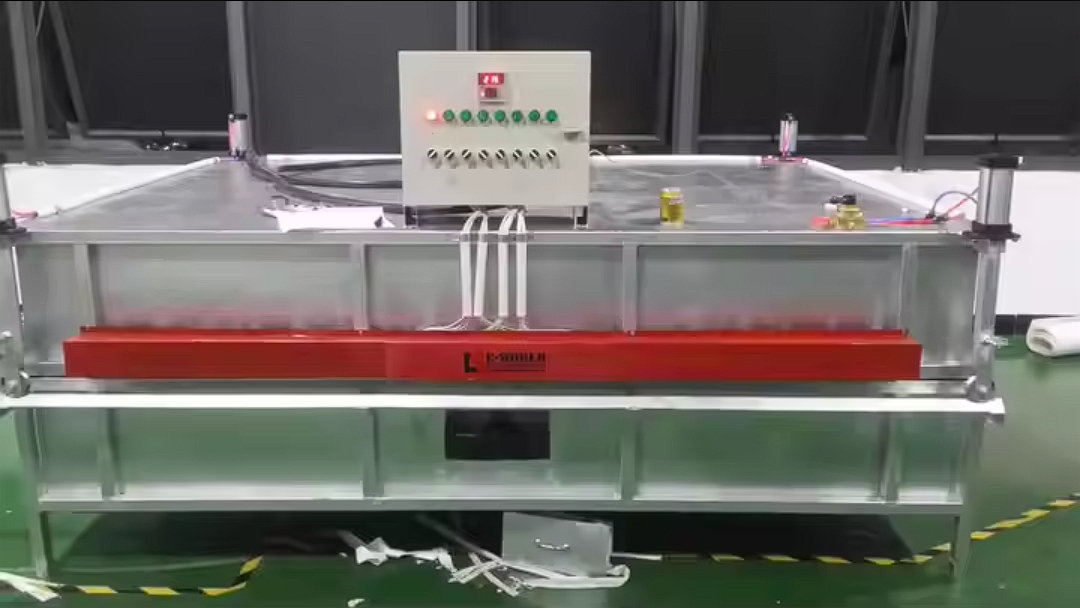
Single-chamber heat bending furnace operation
Continuous hot bending furnace
When using a continuous hot bending furnace to bend multiple types of glass in the same furnace, the order of loading should be determined based on factors such as size, area, bending depth, shape, and thickness. The fundamental principle is to arrange the glass in a sequence where the bending time of adjacent pieces is as close as possible. This ensures a stable heating process and minimizes temperature fluctuations.
This arrangement is necessary because the continuous hot bending furnace operates with multiple preheating chambers, and glass pieces are processed sequentially. The bending time of the glass at the front directly determines the preheating duration of the glass behind it. If the sequence is not properly arranged, larger glass pieces may overheat while waiting for smaller ones to finish bending, or smaller pieces may receive insufficient preheating due to larger pieces ahead requiring longer processing.
By following the optimized loading sequence, heating time variations between adjacent glass pieces remain minimal, ensuring a smooth transition in temperature throughout the bending process. This method effectively prevents interference between different glass types, maintaining consistent bending quality, improving production efficiency, and reducing the likelihood of defects.
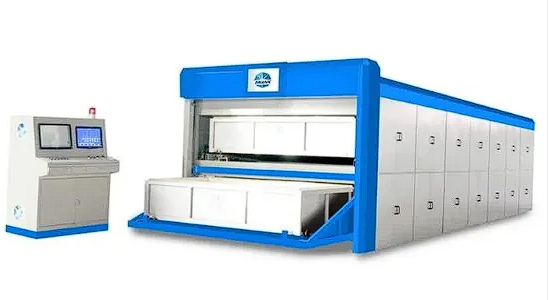
Continuous hot bending furnace
Continuous hot bending furnace operation
When bending glass using a continuous heat bending furnace, the following procedures should be followed.
① First check whether the equipment is normal and there are no flammable materials in and around the furnace.
② Check whether the air pressure is qualified (if there is a pyrometer hot bending furnace, first pass cooling water to the pyrometer and check whether the drainage is normal).
③ Raise the temperature according to the process requirements and keep it for the specified time; then raise the temperature according to the process requirements. The heating process should be kept uniform; when raising the temperature, the speed should not be too fast.
④ Put in the hot bending mold (it can also be put in one by one after starting the equipment). The hollow mold should be coated with gypsum powder or chalk powder on the surrounding frame. If it is a solid mold, clean the surface and add a layer of asbestos paper on the surface if necessary.
⑤ Start the hot bending furnace (if there is a fan, start the fan at the same time). Generally, the empty car should be used first to preheat the car and mold.
⑥ At the loading end, check that the glass is qualified and then place it on the mold. When placing the glass, pay attention to the equal distance between the periphery of the glass and the outer shape of the mold frame. For a glass of different sizes, the large piece should be at the bottom and the small piece should be at the top, and the steps around the large and small pieces of glass should be equal; for a glass of different thicknesses, the thicker one should be at the bottom and the thinner one should be at the top.
⑦ After each piece is loaded, the glass is preheated in the preheating room one by one as required.
⑧ After the glass is preheated to the specified temperature, it enters the hot bending room. At this time, hot bending should be performed by observation. When the glass is bent in place, the heater should be turned off in time or the glass should be removed.
⑨ The glass enters the annealing room and cools down evenly step by step.
⑩ After the glass cools to the specified temperature, it enters the unloading table and takes out the bent glass.
⑪ Then load the glass, hot bend, and anneal according to the above process to carry out continuous production.
Contact Us
Your feedback fuels our growth, and your questions drive our solutions.
We value your feedback, inquiries, and suggestions. Please feel free to get in touch with us
General inquiries
Please contact us via sales@bo-glass.com, and we will reply to you as soon as possible.
Interested to work with us
Drop your resume at info@bo-glass.com
and we will get back to you shortly.
We uses the contact information you provide to us to contact you about our relevent content, products, and services.