
Energy-saving measures in the physical tempering production process
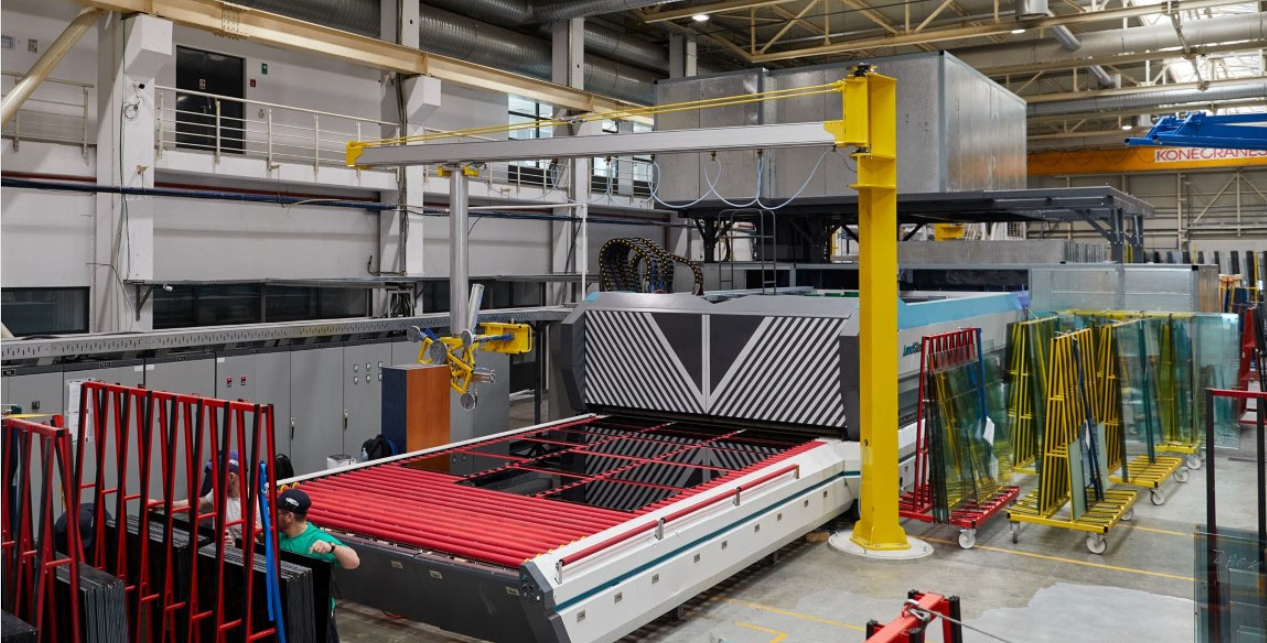
Energy-saving measures in the physical tempering production process can be divided into energy-saving measures in the heating process and energy-saving measures in the rapid cooling process.
Energy-saving measures in the heating process
To produce tempered glass using physical methods, the flat glass must be heated to above 600℃ and then rapidly cooled. These two processes consume a lot of heat and electricity.
The existing glass tempering process mostly uses electric heating wires for heating, and the heat transfer method is mainly convection. If infrared thermal technology is applied to tempered glass production, the heat transfer method becomes mostly radiation. According to theoretical calculations, in the medium temperature range of 650-700℃, radiation heat transfer is 7-9 times that of convection heat transfer. Therefore, using infrared heaters in the heating process can achieve energy savings.
Infrared radiation heaters are based on the characteristics of many materials that easily absorb infrared rays. They convert general heat energy into infrared radiation energy, which is directly radiated to the heated object to cause the resonance of the object’s molecules, thereby heating the object to the required temperature with lower energy and faster speed. Infrared rays that can penetrate the atmosphere are generally divided into three bands: near-infrared 1-2.5μm, mid-infrared band 3-5μm, and far infrared band 8-13μm. The energy-saving effect of ordinary infrared heaters is still not significant because the wavelength range of radiation is too wide. To improve thermal efficiency, the radiation wavelength of the infrared radiation heater must be consistent with the absorption wavelength range of the heated material.
(1) Effective absorption wavelength Each material has its special absorption characteristics for wavelength, that is, it absorbs heat energy of a certain wavelength higher than other wavelengths. According to some data reports, in general processing technology, the effective absorption wavelength range of glass is 2.4~6μm, and in the heating process of tempered glass, the effective absorption wavelength range of glass is 2.7~3μm. This belongs to the mid-infrared band and is slightly close to the near-infrared region. The temperature of this band is equivalent to 704 ~ 843 ℃. If this temperature is not reached, the glass cannot be tempered well. If it exceeds this temperature, heat energy will be wasted.
(3) Shape of heater Another feature of infrared radiation heating is that radiation heat transfer does not require a medium and can be transmitted in a vacuum. In atmospheric transmission, the main components of air are oxygen and nitrogen, so the energy lost in the medium and the flow of the medium is less. According to thermal engineering calculations, the utilization rate of radiation heat transfer at 700-1000℃ is 5.7-7.4 times that of convection heat transfer. In addition, infrared radiation heating also has the characteristic of uniform heating. To better play this characteristic, the shape of the heater is very important. For tempered flat glass, from a macroscopic point of view, the heating uniformity of the tubular heater is not as good as that of the plate heater. The practice has proved that the flat heater is more suitable. It is conducive to improving the quality of tempered glass, improving the product yield, and being used for tempering more difficult colored glaze glass. Therefore, the flat heater is the best for tempered flat glass. In addition, infrared rays are reflective. Installing reflective and focusing components in the heater to allow infrared energy to radiate in a direction and provide concentrated heating is also a common method of infrared energy saving.
Saving measures in rapid cooling process
According to experience, the power of the blower should be greatly increased for tempering glass thinner than 4mm. For example, the optimal power for 6mm thick glass is 3.5kW/m², 5mm thick glass is 10~20kW/m², 4mm thick glass is 40~80kW/m², 3.8mm thick glass is 50~100kW/m², 3.2mm thick glass is 140~280kW/m², and 3mm thick glass is 200~400kW/m².
It can be seen that the blower power required for glass below 3.8mm thick is not economical, so for glass thinner than 4mm, the method of blower plus air compressor is often used to reduce the total load of the equipment. The air compressor works continuously, and after each rapid cooling, the air is filled into the air tank. For example, a tempering furnace of a foreign company uses a 40-50kW/m² blower and a 15kW/m² air compressor when tempering 3mm thick glass, which reduces the total power of the equipment by 100-300kW/m².
Contact Us
Your feedback fuels our growth, and your questions drive our solutions.
We value your feedback, inquiries, and suggestions. Please feel free to get in touch with us
General inquiries
Please contact us via sales@bo-glass.com, and we will reply to you as soon as possible.
Interested to work with us
Drop your resume at info@bo-glass.com
and we will get back to you shortly.
We uses the contact information you provide to us to contact you about our relevent content, products, and services.