What is Fused Quartz Glass?

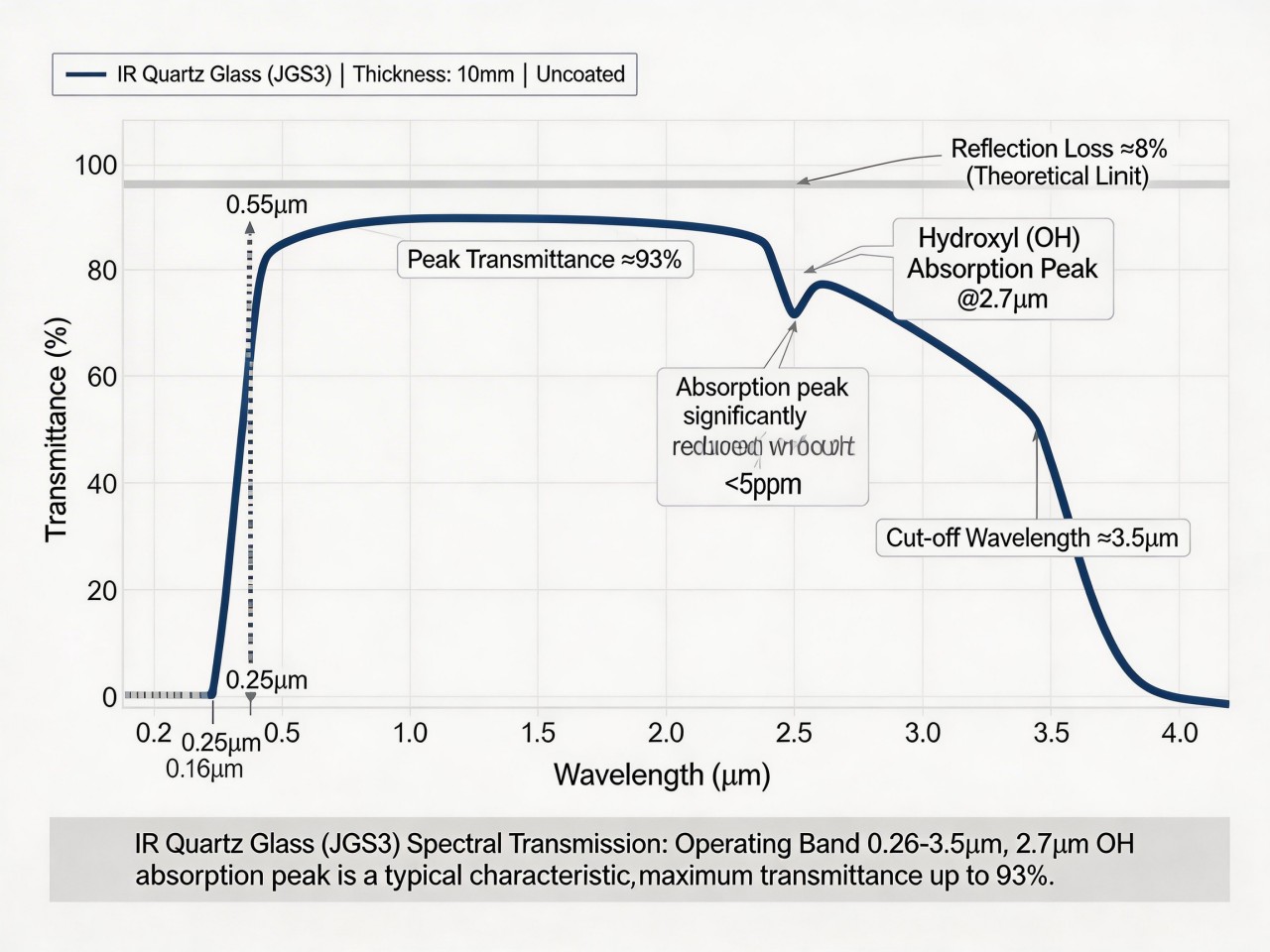
Infrared quartz glass spectrum transmission curve

Electric-melted quartz glass is a type of quartz glass produced by using electric power to melt crystal powder at high temperatures through methods such as resistance heating, arc, medium-frequency induction, or high-frequency plasma. This type of glass is characterized by a low hydroxyl content (106 to 105) and low infrared absorption at 2.73μm, which is commonly referred to as infrared quartz glass. However, due to metal impurities introduced during the raw material preparation and melting process, the transmittance in the far ultraviolet region (<300nm) is relatively low.[/et_pb_text][et_pb_text _builder_version="4.27.2" _module_preset="default" global_colors_info="{}"]

The production and forming techniques for electric-melted quartz glass include vacuum electric melting, two-step melting, and continuous melting processes.

Vacuum Electric Melting Process
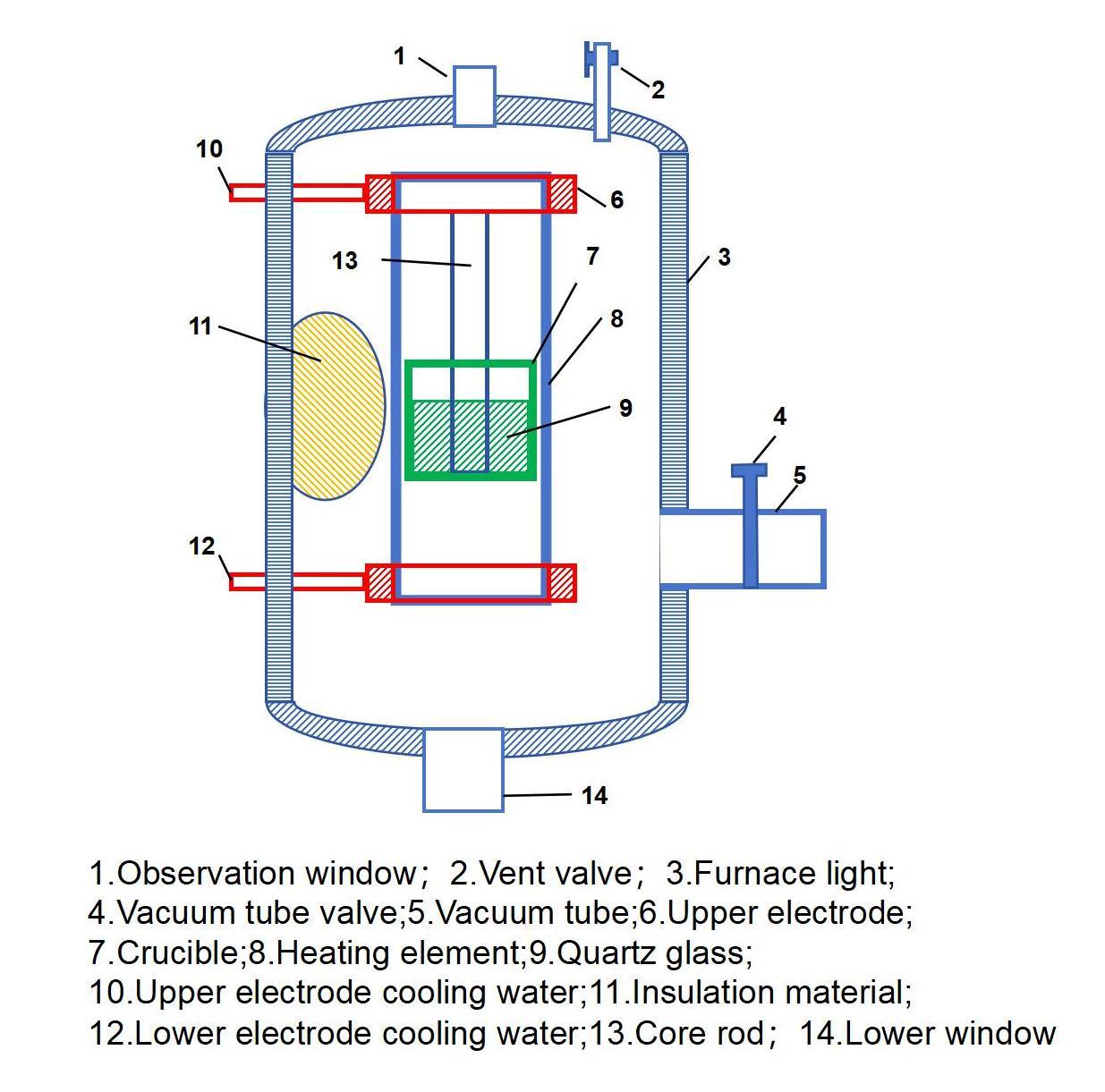
In this process, crystal powder is placed in a graphite crucible and heated in a vacuum electric furnace to temperatures of 1800°C to 2000°C under a vacuum of 0.1 to 10 Pa. This method is the primary technique for producing infrared quartz glass for optical applications. Companies such as GE and Heraeus use this method to produce low-hydroxyl quartz glass with diameters up to 1.8 meters and thicknesses of up to 650 mm.
The furnace diagram (Fig. 3-2) shows the main components including the observation window, exhaust valve, vacuum valve, crucible, heating body, quartz glass, and cooling systems.
Quartz glass is a network-forming glass with a high viscosity at high temperatures (e.g., 10⁵ dPa·s at 1800°C). Due to this high viscosity, it is difficult for bubbles to rise and clear during the melting process. The melting of quartz powder follows a sintering mechanism, where particles first sinter, and the “necking” phenomenon occurs, causing particles to liquefy at the points of contact, expelling gas from between the particles.
At 1400°C, quartz undergoes a phase transition from α-quartz to β-quartz, which involves a volume change. Therefore, sufficient time must be allowed during the heating process to ensure complete phase transition, preventing issues with expansion that could affect sintering. This phase transition helps expel gas trapped inside the quartz.
During the heating process, the temperature distribution within the furnace is not uniform, which can lead to incomplete phase transformation of the quartz powder and the formation of bubbles within the glass melt. To reduce bubble formation, a well-controlled heating process, with an appropriate particle size distribution (usually 40 to 80 mesh for electric melting quartz powder), is important.

Impurity Content and Defects of Fused Quartz Glass

The metallic impurity content in electric-melted quartz glass mainly depends on the purity of the quartz raw material and the melting process, including the purity of the graphite crucible and the processing environment. The table below shows the metallic impurity content in vacuum electric-melted quartz glass (JGS₃) and the impurity content in GE124 quartz glass (analyzed by manufacturers using direct spectrophotometric analysis).
Due to the inhomogeneous accumulation of quartz material or the presence of impurities during the melting process, local gas pockets and crystalline defects can occur in the glass. These defects typically result in the formation of bubbles and crystalline spots, which may impact the quality of the final product. For optical-grade infrared quartz glass, only defect-free parts of the molten glass are selected for processing.
Electric-melted quartz glass ingots can also be further processed into rods, tubes, and other quartz glass products using the two-step process. These types of quartz glass can have hydroxyl contents of less than 5×10⁶, making them suitable for specialized applications.
Element Impurities in Quartz Glass
Element JGS₃ (×10⁻⁶) GE124 (×10⁻⁶)
A 0.4 0.4
B 0.0 0.5
C 0.2 0.2
Cu 0.6 0.6
Fe <50 <50
K 0.1 0.1
Li 0.05 0.05
Mg 0.7 0.7
Mn 0.1 0.1
Na 1.1 1.1
Ni 0.8 0.8
Ti 0.8 0.8
Zr 0.9 0.9

Two-Step Molding Process

The two-step molding process involves second-time heat treatment of quartz glass ingots (or thick-walled tubes) to produce rods, tubes, and large plates.

The two-step molding process is often used in quartz glass thermal processing due to its simplicity, flexibility, and control over product quality. However, it is energy-intensive and costly. It is typically used for producing rods, optical fiber tubes, large-diameter tubes, and large plates.

The two-step melting process can be divided into the contact method and the non-contact method.

Contact Method

The contact method involves using a molding die to shape the molten quartz glass under the influence of tensile force. Its key features include simple operation, easy size control, and suitability for large-size products. However, it can cause surface scratches, requiring further precision processing. This method is typically used for producing rods, optical fiber tubes, large pipes, and large plates.

Medium frequency rod drawing process

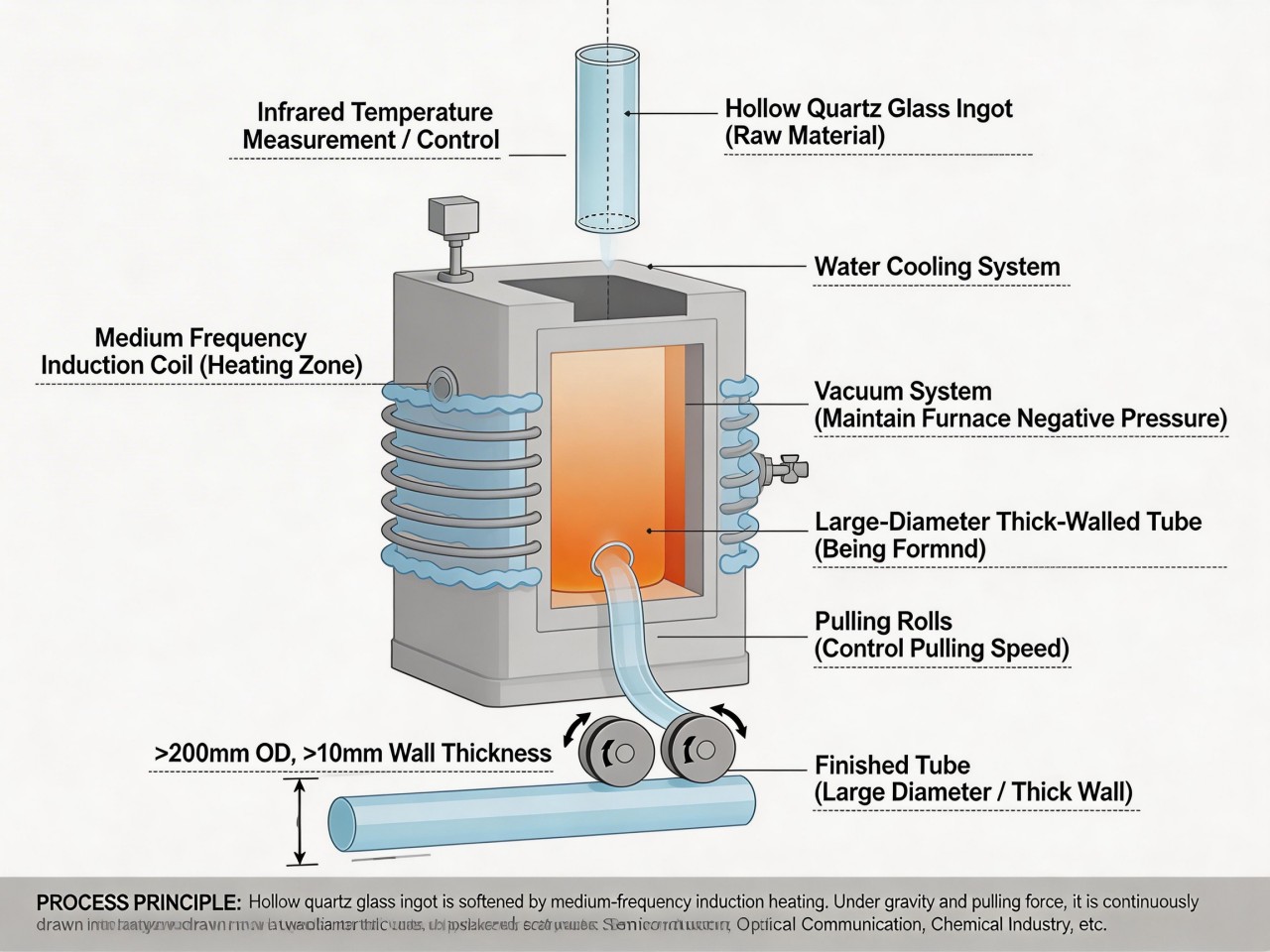
A medium-frequency induction furnace heats quartz glass ingots to a molten state. The molten glass is then shaped into rods by pulling through a die and cooled to the desired dimensions. This process is suitable for producing large-diameter quartz glass rods.

Main process parameters include:

  1. Furnace Power: 30-150 kW, depending on the number of coil turns.
  2. Medium Frequency Power: Provided by a frequency generator or a thyristor-controlled cabinet, with an output frequency of 500–2000 Hz.
  3. Drawing Speed: Determines the final product shape. The drawing speed affects the diameter and uniformity of the product.

Medium Frequency Tube Drawing Process
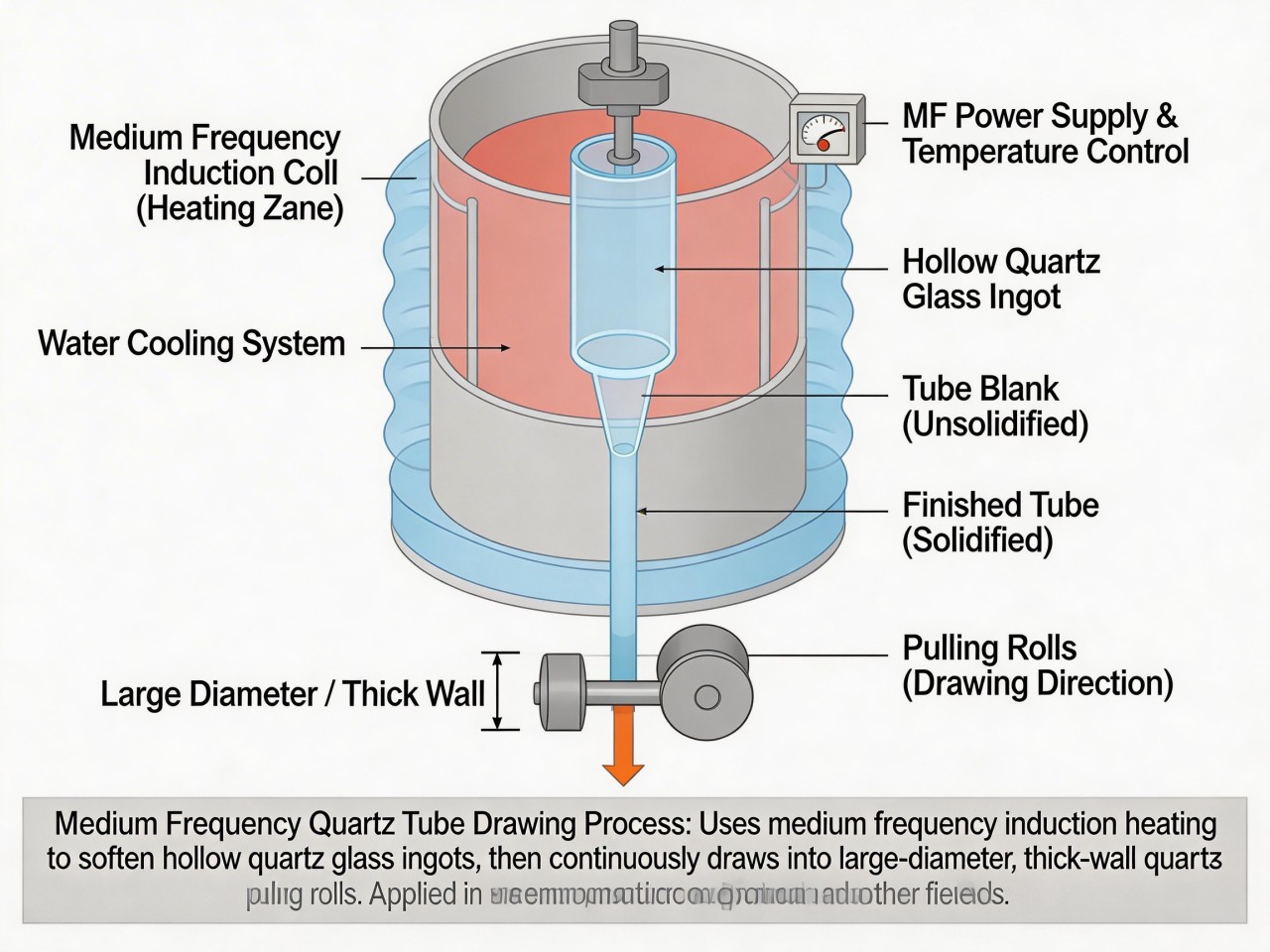
Similar to the rod drawing process, but it is adapted for producing larger diameter or thick-walled tubes by using hollow quartz glass ingots.

Non-Contact Method

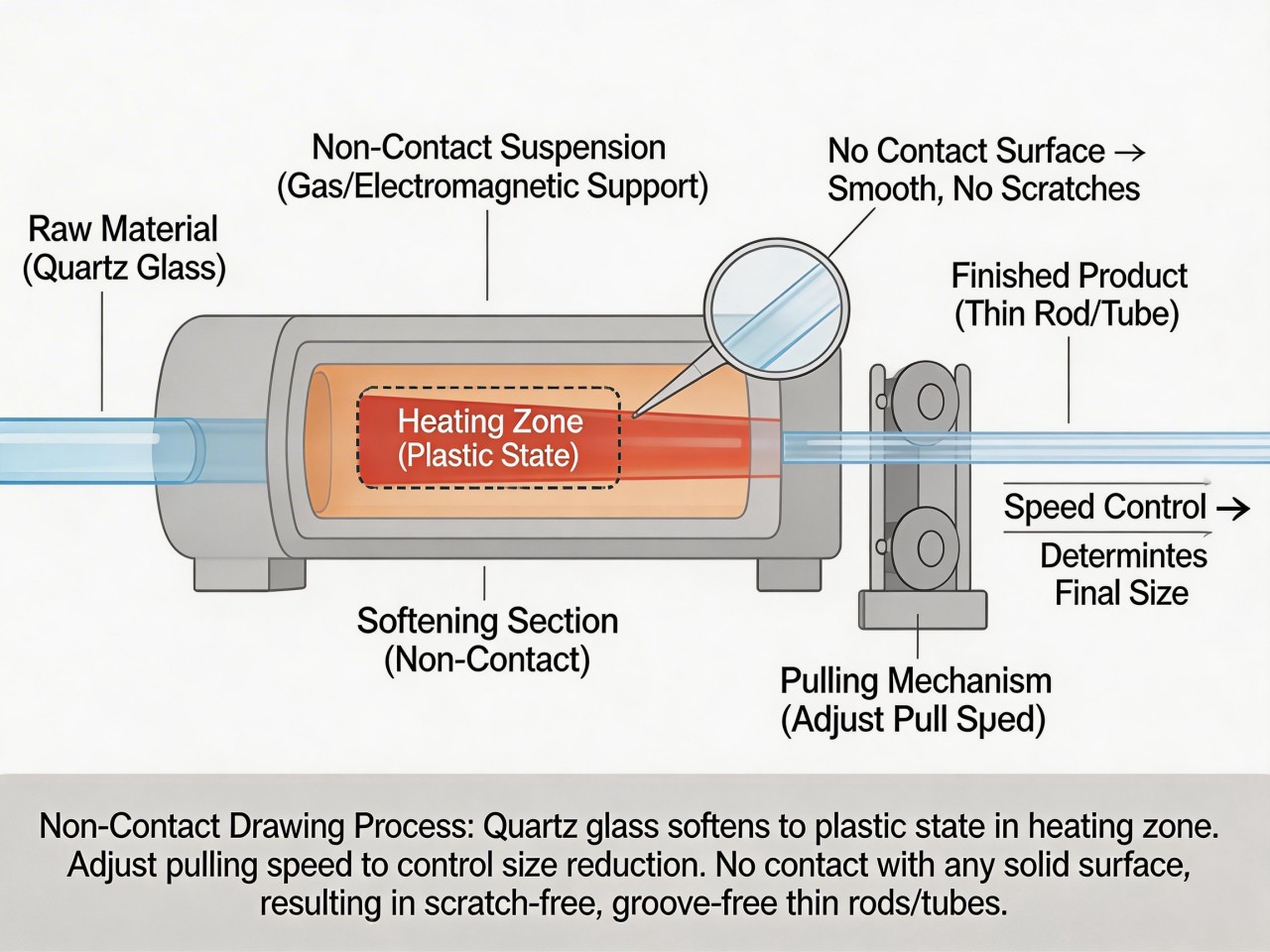
The principle of the non-contact method is to pull the quartz glass into a plastic state in the furnace’s heating area, then reduce the size of the quartz cylinder by adjusting the pulling speed, ensuring the quartz glass rod (or tube) reaches the required dimensions. In this method, the molten quartz glass surface does not contact any solid, resulting in a smooth surface without scratches or grooves. It is generally used for producing fine rods or tubes.
Main process parameters include:

  1. High-Temperature Zone Parameters: The temperature in the high-temperature zone is typically controlled at around 1700°C. If the temperature is too high or too low, it can affect the molding quality.
  2. Glass Ingot Surface Roughness: The glass ingot surface should be finely polished with a roughness of 0.1μm or higher. If the roughness is too large, the product surface may be uneven.
  3. Feed Speed and Drawing Speed: These jointly determine the diameter of the glass rod. By adjusting the drawing speed, rods of different diameters can be produced.
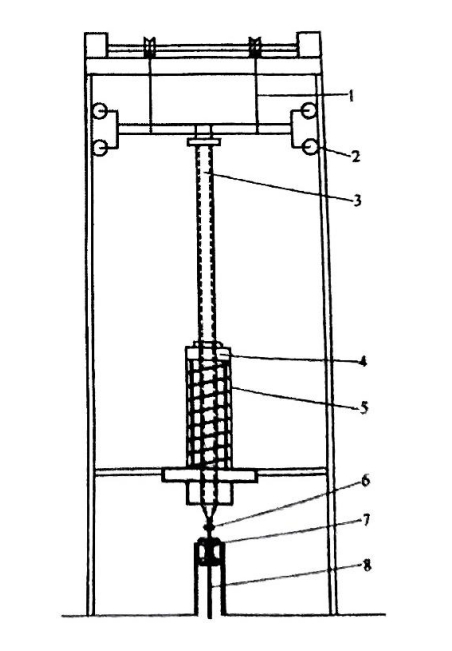
The quartz glass ingot is made into a hollow ingot when producing quartz glass tubes. Both the inner and outer surfaces need to be finely polished, and the inner gas pressure is adjusted to control the tube’s inner diameter and wall thickness. The non-contact method requires high-quality equipment, where the feed system should be free of crawling or vibration, and the tube drawing system should operate smoothly to prevent fluctuations in product quality.
Figure 3-7 Non-contact tube (rod) drawing
1-feeding system; 2-feeding guide rail: 3-quartz glass: 4-furnace basket: 5-furnace body: 6-guide wheel: 7-tube drawing machine: 8-quartz glass tube

Continuous Melting Process

The continuous melting process of quartz glass refers to the use of automated mechanical feeding, where crystal materials are continuously melted in the furnace, and quartz glass is pulled out continuously from the discharge port. By controlling a series of process parameters, quartz glass products with fixed specifications can be continuously produced. The continuous melting process has a long history. As early as 1940, resistance furnaces equipped with molybdenum crucibles were used to continuously produce quartz glass tubes for 14 days, although many gas lines appeared in the tubes. This was the prototype of the first continuous melting furnace. Over time, the process has evolved to produce quartz glass tubes with diameters ranging from 2 to 180 mm, including double-hole tubes and quartz glass rods.
Compared to batch processing, the continuous melting process is highly automated and has long production cycles. Compared to batch processing, it offers low production costs and good product dimensional consistency. It is suitable for mass production in industries such as electric light sources and electric heating.
Raw Materials
Continuous melting typically uses crystal raw materials that undergo screening, crushing, acid washing, water washing, and drying before being packaged and stored. The particle size of the raw material is typically between 80 and 200 mesh. Preheating the raw material at 800-1000°C is sometimes done to compensate for the temperature of the crucible surface. As the size of the crucible increases, its thermal capacity increases and preheating may not be required, allowing the raw material to be melted directly.

Protective Gases
Domestic continuous melting furnaces commonly use two methods for protective gases: one is a nitrogen and hydrogen mixture, and the other is pure hydrogen gas. Some foreign companies also use argon gas, but its effect is not as good as pure hydrogen. While pure hydrogen leads to a higher hydroxyl content in the product, its strong penetration ability reduces gas lines and bubbles. The protective gases prevent oxidation of the heating elements and molybdenum crucibles in the high-temperature areas and help expel volatile materials from the furnace.

Crucible and Core Rods
Molybdenum crucibles are used for their durability and high heat resistance. The domestic largest crucible size is 4760mm × 1600mm, and the melting efficiency can reach 10-20 kg/h. The core rod, used to form the inner shape of the quartz glass, can produce different wall thicknesses of quartz glass tubes. Some methods use dual-core rods to produce double-hole quartz glass tubes.
Contact Us

Your feedback fuels our growth, and your questions drive our solutions.

We value your feedback, inquiries, and suggestions. Please feel free to get in touch with us

General inquiries

Please contact us via sales@bo-glass.com, and we will reply to you as soon as possible.

Interested to work with us

Drop your resume at info@bo-glass.com
and we will get back to you shortly.

    We uses the contact information you provide to us to contact you about our relevent content, products, and services.