
Chemical tempering process
High temperature ion exchange process
In the temperature range between the softening point and the transition point of glass, a thin layer with a smaller expansion coefficient than the glass matrix is formed on the glass surface through ion exchange between glass and molten salt. When cooled, a compressive stress layer is formed on the glass surface due to the inconsistent contraction of the surface layer and the matrix. The magnitude of the stress can be calculated by formula (4-6).
σs=E(1-v)-¹(a1—a2)△T (4-6)
Where o₈——surface stress, MPa;
E——glass elastic modulus, GPa; v——Poisson’s ratio;
a₁,a₂——expansion coefficients of inner and outer layers of glass, 1/℃; △T——temperature difference, ℃.
For example, a glass containing 57% to 66% (mass fraction, the same below) SiO₂, 13.5% to 23% Al₂O₃,
38% to 11% Na₂O, and 10% to 1% Li₂O is immersed in a molten salt of Li+, Na+ Ag+ at 600 to 750°C. The Na+ in the glass is replaced by Ag+ or Li+, producing a double exchange layer, that is, the outer side is β-eucryptite and the inner side is a lithium metasilicate crystallized glass layer, which can greatly increase the strength.
Except for special products, general products are not produced by high-temperature methods because the processing temperature is high and the energy consumption is large. In addition, the required materials are the most expensive among alkali metals, which increases the production cost.
Low temperature ion exchange process
σs=(1−ν)⋅VE⋅ΔV
(4-7)
where os——surface stress, MPa;
E——glass elastic modulus, GPa; v——Poisson’s ratio;
V——the volume of glass before ion exchange, m³; △V——the volume difference caused by ion exchange, m³.
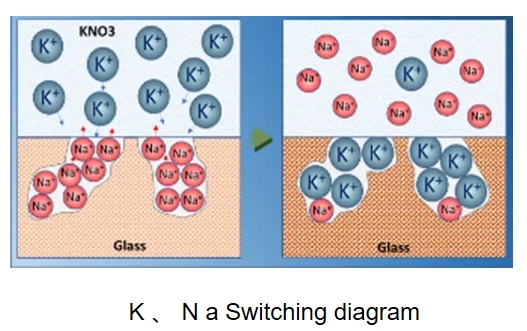
According to theoretical calculations, industrial Na₂O-CaO-SiO₂ glass generally contains about 15% (molar fraction) of Na₂O and a density of about 2.5g/cm³. It is calculated that 1cm³ of glass contains about 7×10²¹ Na+. If all these Na+ are replaced by K+, a volume change of about 4.5% will be generated, so the compressive stress on the glass surface caused by ion exchange is calculated to be about 900MPa, but this calculated value is difficult to achieve in actual production. Burggreaf has proved that the density of glass obtained by ion exchange is much higher than that of glass of the same composition obtained by conventional melting steps, while the volume change is less than the expected value, so the observed stress is also lower than the calculated value. In addition, there is also stress relaxation during the ion exchange process. In addition, the thickness of the ion exchange infiltration layer with commercial value is generally between 20 and 30 μm. If there are microcracks that penetrate the infiltration layer deeply, the compressive stress generated by ion exchange and the tensile stress balanced with it will act on the microcracks at the same time. Moreover, the tip of the microcrack is just in the tensile stress zone, which also affects the improvement of strength.
(2) Production process formula and parameters
① Molten salt material
Main material: KNO₃ (chemically pure grade) 85%~98% (mass ratio).
Auxiliary additives: Al₂O₃ powder, potassium silicate, diatomaceous earth, others 2%~15% (mass ratio).
② Molten salt temperature of salt bath The general temperature is 380~500℃.
③ Exchange time Determined according to product enhancement needs and processing temperature, the exchange time will generally not be extended due to the glass thickness increase.
④ Design furnace temperature
Low-temperature preheating furnace: 200~300℃. High-temperature preheating furnace: 350~400℃. In molten salt tank: 410~500℃. High-temperature cooling furnace: 350~450℃. Medium-temperature cooling furnace: 200~300℃. Low-temperature cooling furnace: 150~200℃.
⑤ Selection of salt bath material The composition of molten salt determines its strong corrosiveness. To maintain the long-term activity of molten salt and the safety of production, the high-temperature corrosion resistance of salt bath materials should be good. Generally, most molten salts can be contained in stainless steel or high-silicon glass salt baths. Molten salts containing chloride ions are corrosive to stainless steel, so it is best to be contained in high-silicon glass salt baths. In actual production, to prevent accidents, the above-mentioned salt bath must be placed in a larger heat-resistant metal pool filled with fine sand (the temperature can be controlled at ±1℃).
Contact Us
Your feedback fuels our growth, and your questions drive our solutions.
We value your feedback, inquiries, and suggestions. Please feel free to get in touch with us
General inquiries
Please contact us via sales@bo-glass.com, and we will reply to you as soon as possible.
Interested to work with us
Drop your resume at info@bo-glass.com
and we will get back to you shortly.
We uses the contact information you provide to us to contact you about our relevent content, products, and services.